Communicating in a Crisis

    CATHERINE WORBOYS,
        CURTIN&CO

          www.curtinandco.com
For discussion today
• What makes a crisis?
• Why effective communication is crucial in a crisis
• Key stakeholders and pre-crisis communication
• Assembling a crisis team
• Effectively preparing for a crisis
  – Both internally and externally


                       www.curtinandco.com
What makes a crisis?
• Rather like earthquake prediction
    – Many indicators, but unreliable
    – So you need to be prepared for a range of situations
• In crises:
•   Those with good reputations
    – will be less scarred; recover more quickly

• Therefore you must handle issues well; tone of voice,
  honesty, generosity, etc. to avoid a crisis

    A crisis is an issue badly managed
                            www.curtinandco.com
Perceptions are Powerful
• In today’s media landscape:

  • If you think you have a problem then you
                probably have one

 • If someone else thinks you have a problem
          then you definitely have one

                     • EG: TGV France “crash” – simulation
                       which was reported as real

                         www.curtinandco.com
Why managing a crisis matters
• Reputation management
     • Impacts on sales, credibility, credit rating, etc.
     • Could make recruitment more difficult - hits internal
       morale
     • Uncomfortable for management
• Expensively built brand image is tarnished
• In the best case you can gain
     • Tylenol – blackmailer threatened to poison products
• In the worst case you lose the company
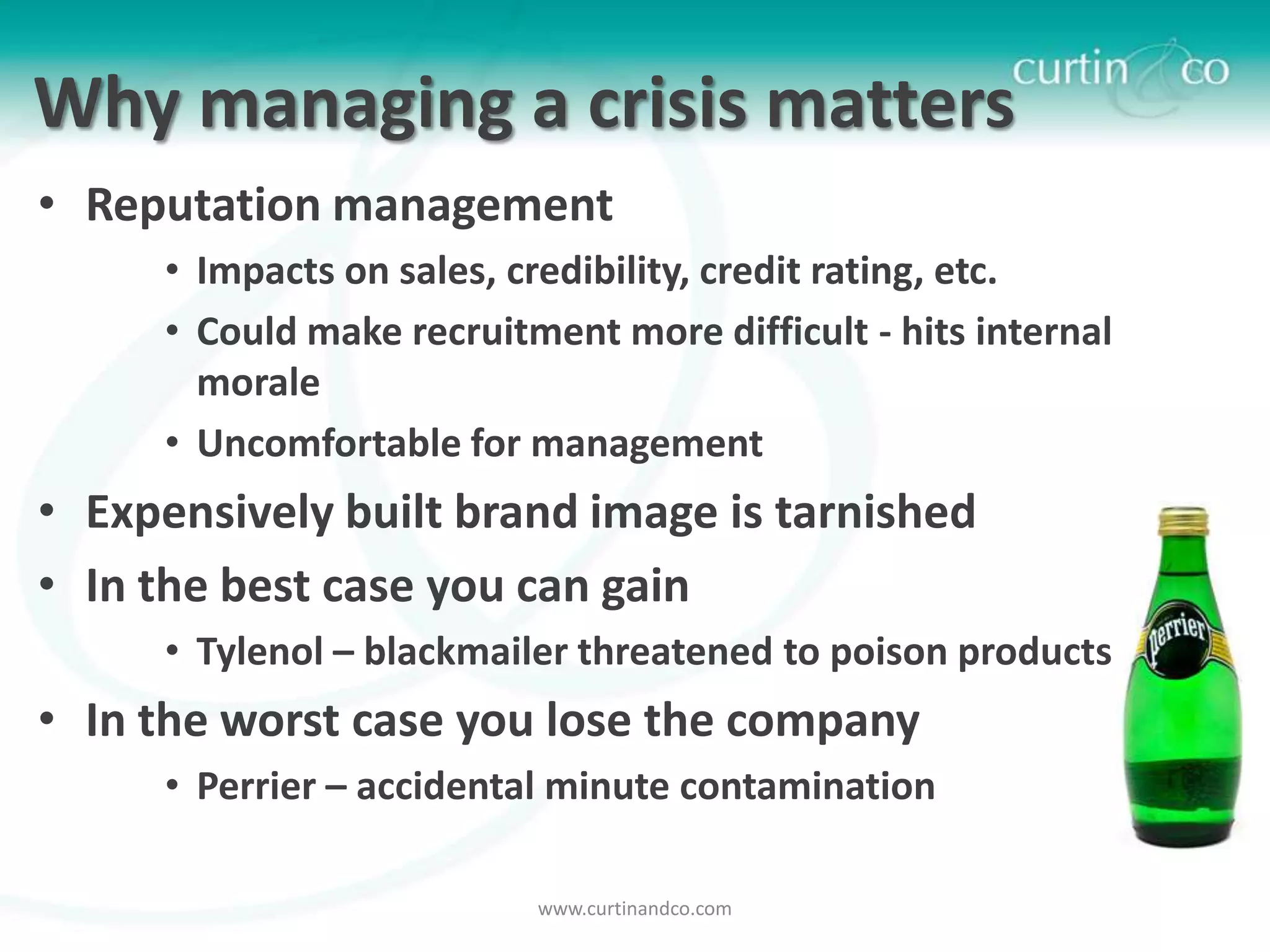
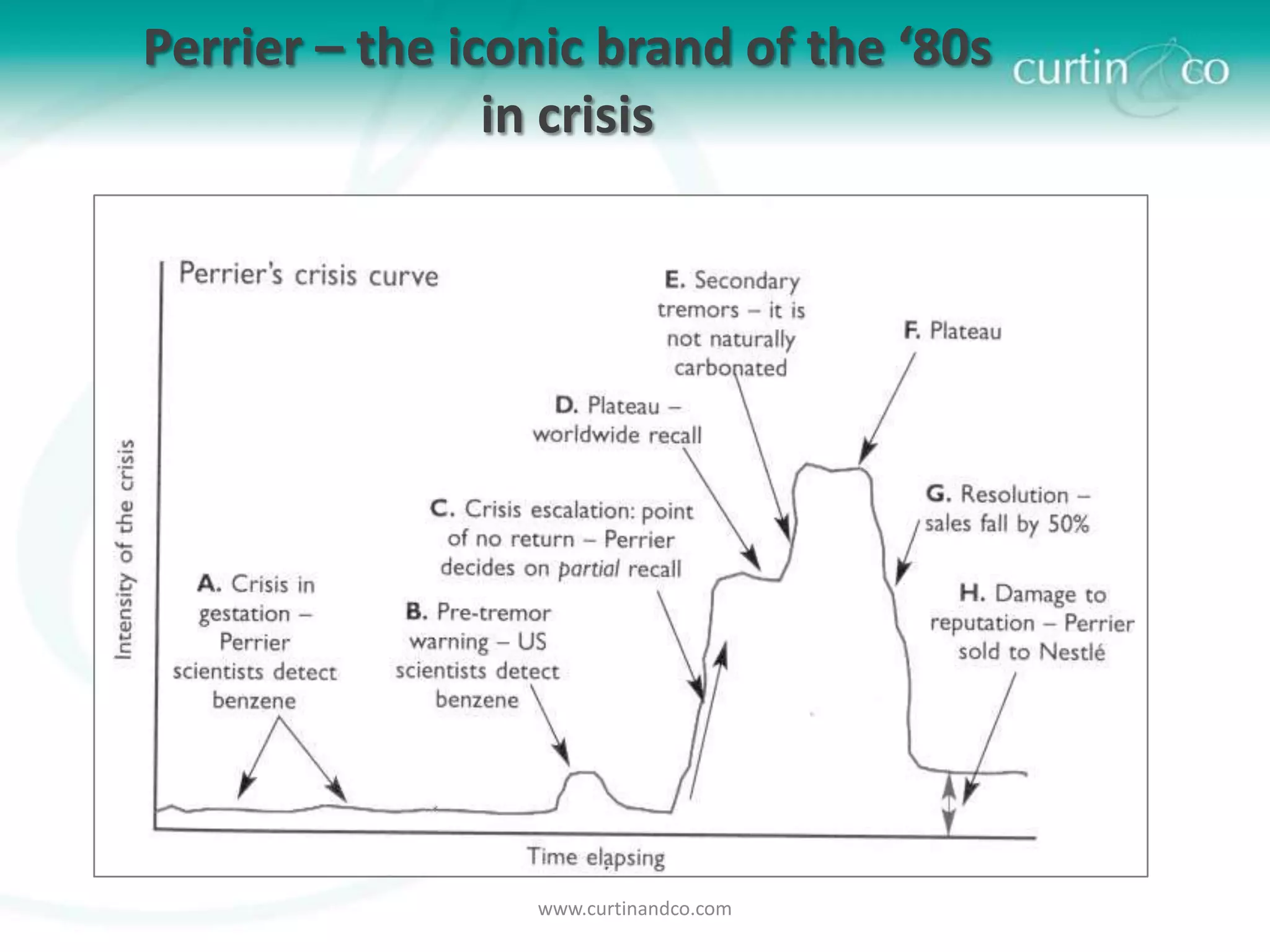
     • Perrier – accidental minute contamination

                          www.curtinandco.com
Perrier – the iconic brand of the ‘80s
                in crisis


                 www.curtinandco.com
Lessons to be learnt
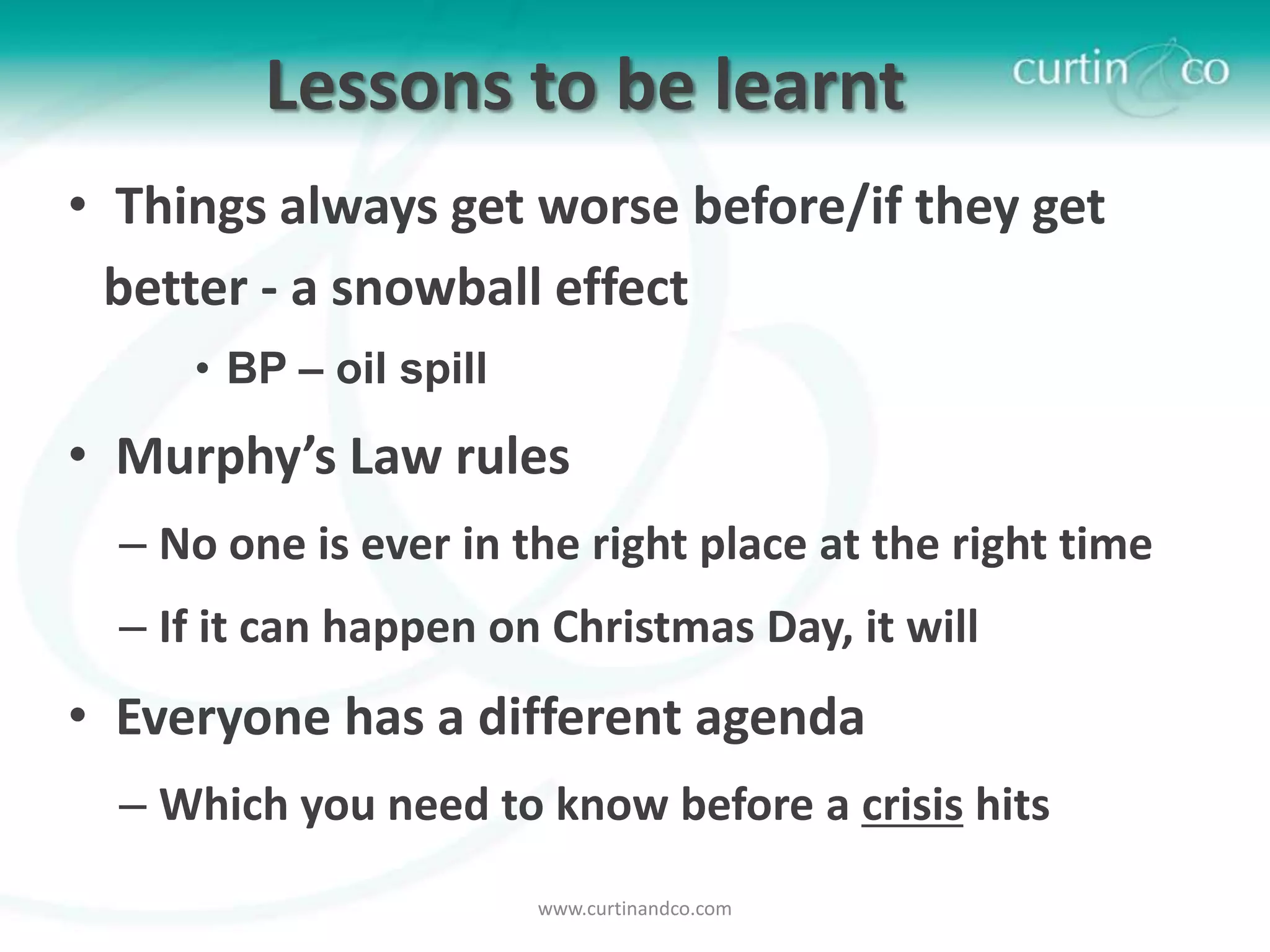
• Things always get worse before/if they get
  better - a snowball effect
     • BP – oil spill

• Murphy’s Law rules
  – No one is ever in the right place at the right time
  – If it can happen on Christmas Day, it will
• Everyone has a different agenda
  – Which you need to know before a crisis hits
                        www.curtinandco.com
The dangers of the ‘cover-up’
• Cover-up – a media definition: Deliberately (a)
  hiding information (b) not releasing it promptly
• Hiding information always leads to either
  – economies with the truth
  – misinformation or
  – plain lying
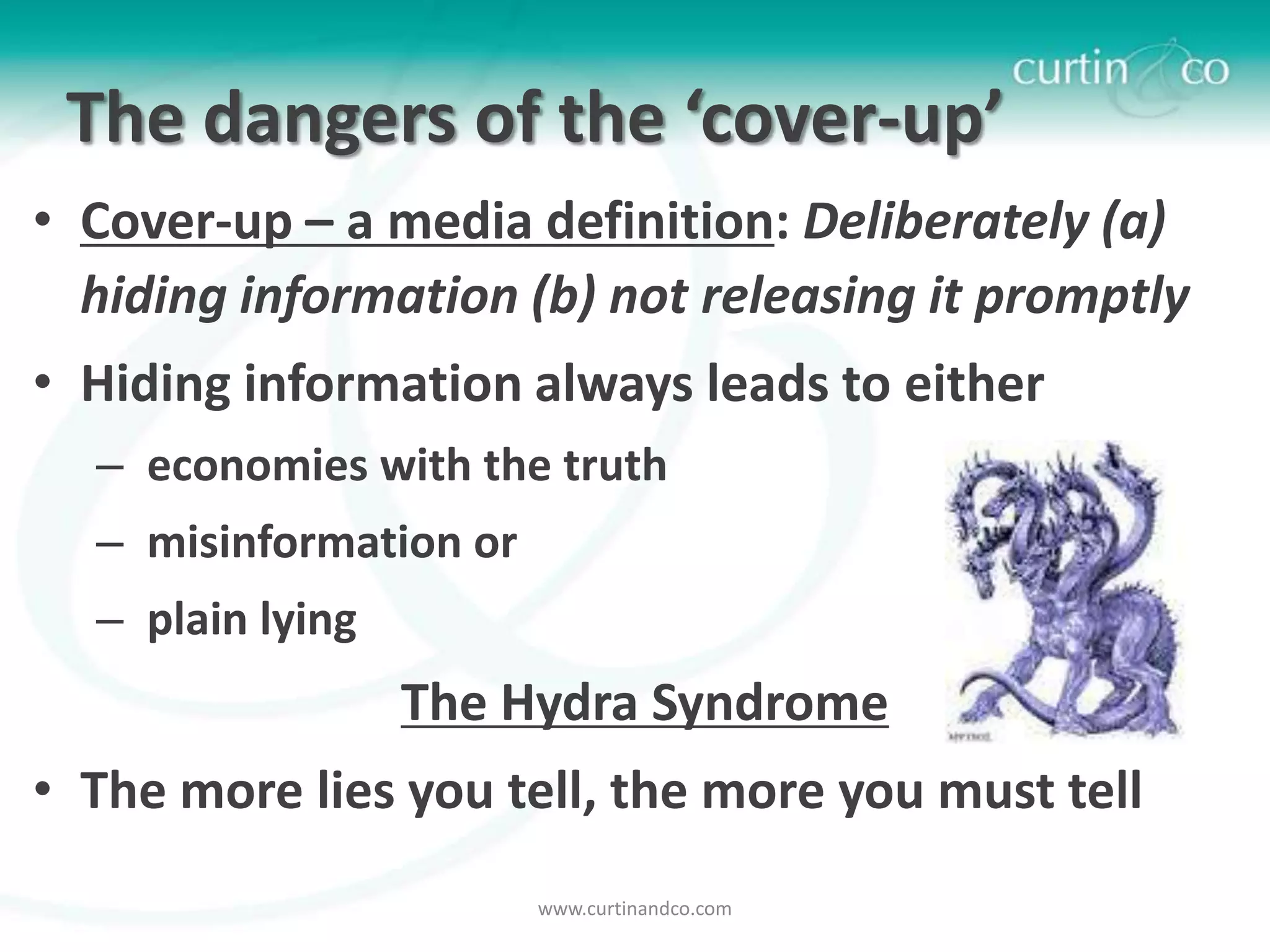
                  The Hydra Syndrome
• The more lies you tell, the more you must tell
                        www.curtinandco.com
Cadbury and salmonella
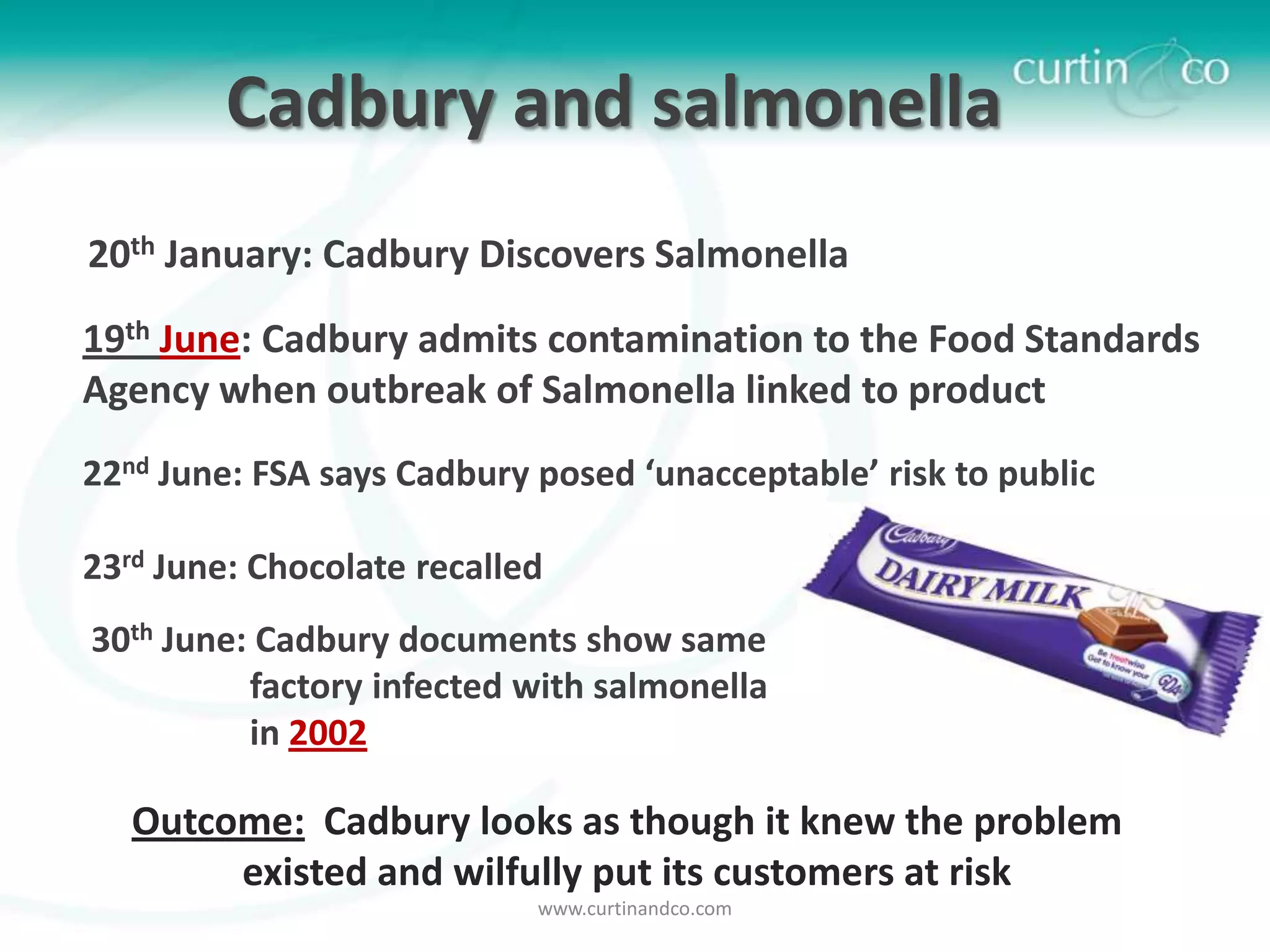
20th January: Cadbury Discovers Salmonella

19th June: Cadbury admits contamination to the Food Standards
Agency when outbreak of Salmonella linked to product
22nd June: FSA says Cadbury posed ‘unacceptable’ risk to public

23rd June: Chocolate recalled
30th June: Cadbury documents show same
          factory infected with salmonella
          in 2002

   Outcome: Cadbury looks as though it knew the problem
        existed and wilfully put its customers at risk
                            www.curtinandco.com
Key rules of communicating in a crisis
• Speed is of the essence
   – If you have information, release it
   – If not, have “no comment” prepared
   – Five minutes is a long time in Cyberspace

• Know your stakeholders before you are in a crisis
   – Who will help you when you need them?

• Prepare your key messages
   – And all the scenarios you can think of – they may seem extreme but
     crises are

• Most of all – prepare your people
   – Who is your crisis team?
   – How regularly do they train?
   – Everyone else should be trained to give “no comment”
                              www.curtinandco.com
Crisis Management
Some of the key players you
       must know


           www.curtinandco.com
The Media – old and new
• Speed is of the essence
• The media watches the media
       • TFL suffered from Twitter campaign against employee in 2010
• Website comment - posted fast
       • Can deflect hundreds of queries quickly
       • Can be easily prepared in advance as a “hidden” page to trigger
• Agenda-setting rather than opinion influencers
   – Media tells people what to think about
• They are under fierce competitive pressure
• Journalism is ‘the first rough cut of history’
• Truth is an early casualty
   – But having friends can help
                                www.curtinandco.com
The Politicians
• Politicians have strong drivers
       • Ego and altruism
• Make sure they have a special ‘hot line’ number for crises
• Get to them before they get to you
   – Have telephone numbers (office, home, mobile, addresses, e-mails, etc.)

• One/two Directors to contact top politicians
• Senior Managers handle local councillors, MPs etc.
• A crisis is an easy campaign “band wagon” for politicians
  – If they know you and support you in the media it can reduce impact

 This is third party advocacy - they can say what you can’t
                                www.curtinandco.com
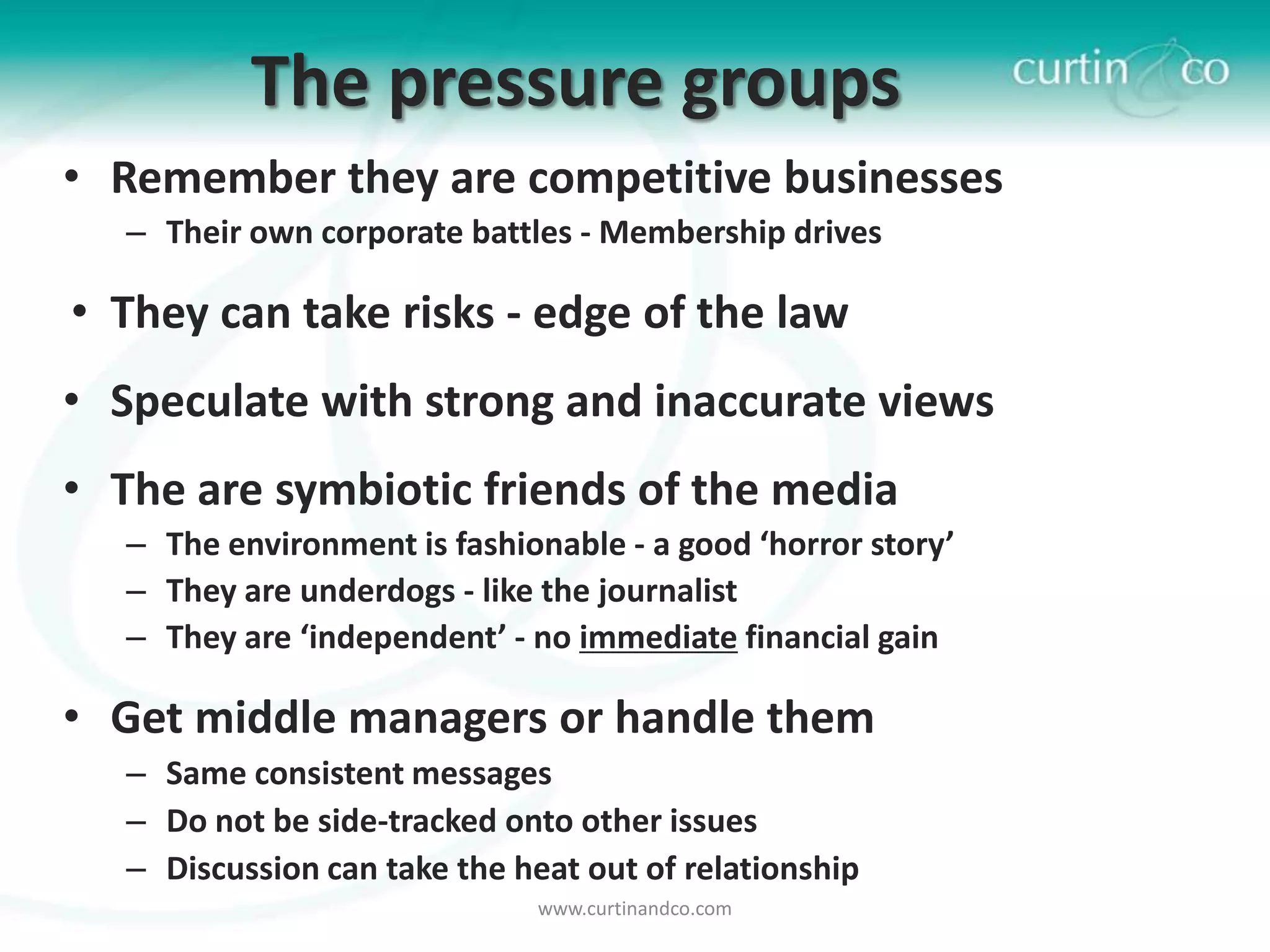
The pressure groups
• Remember they are competitive businesses
   – Their own corporate battles - Membership drives

• They can take risks - edge of the law
• Speculate with strong and inaccurate views
• The are symbiotic friends of the media
   – The environment is fashionable - a good ‘horror story’
   – They are underdogs - like the journalist
   – They are ‘independent’ - no immediate financial gain

• Get middle managers or handle them
   – Same consistent messages
   – Do not be side-tracked onto other issues
   – Discussion can take the heat out of relationship
                               www.curtinandco.com
Handling a Crisis
  The Boy Scout Rule:
     Be prepared,
internally and externally


       www.curtinandco.com
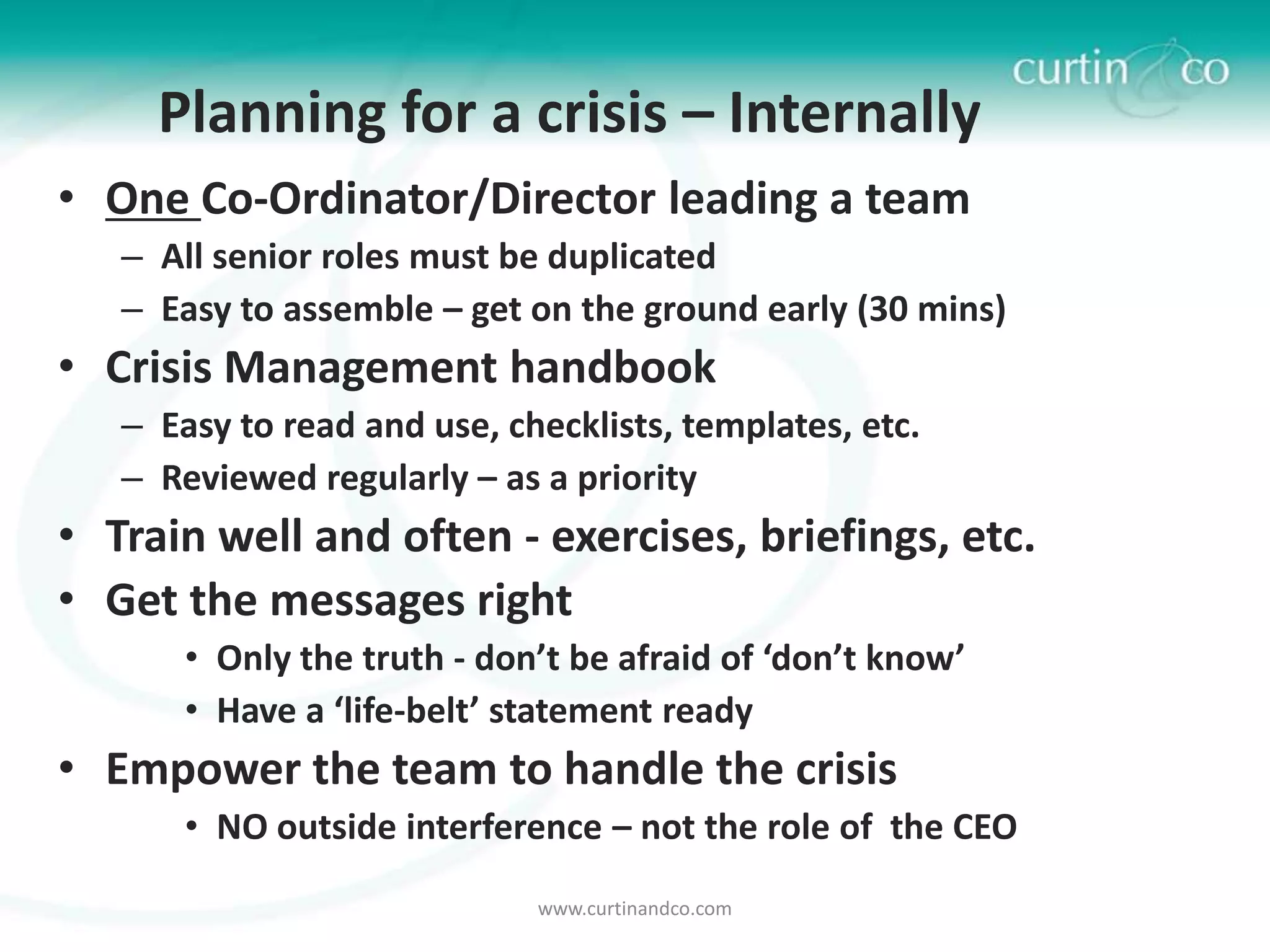
Planning for a crisis – Internally
• One Co-Ordinator/Director leading a team
   – All senior roles must be duplicated
   – Easy to assemble – get on the ground early (30 mins)
• Crisis Management handbook
   – Easy to read and use, checklists, templates, etc.
   – Reviewed regularly – as a priority
• Train well and often - exercises, briefings, etc.
• Get the messages right
       • Only the truth - don’t be afraid of ‘don’t know’
       • Have a ‘life-belt’ statement ready
• Empower the team to handle the crisis
       • NO outside interference – not the role of the CEO
                             www.curtinandco.com
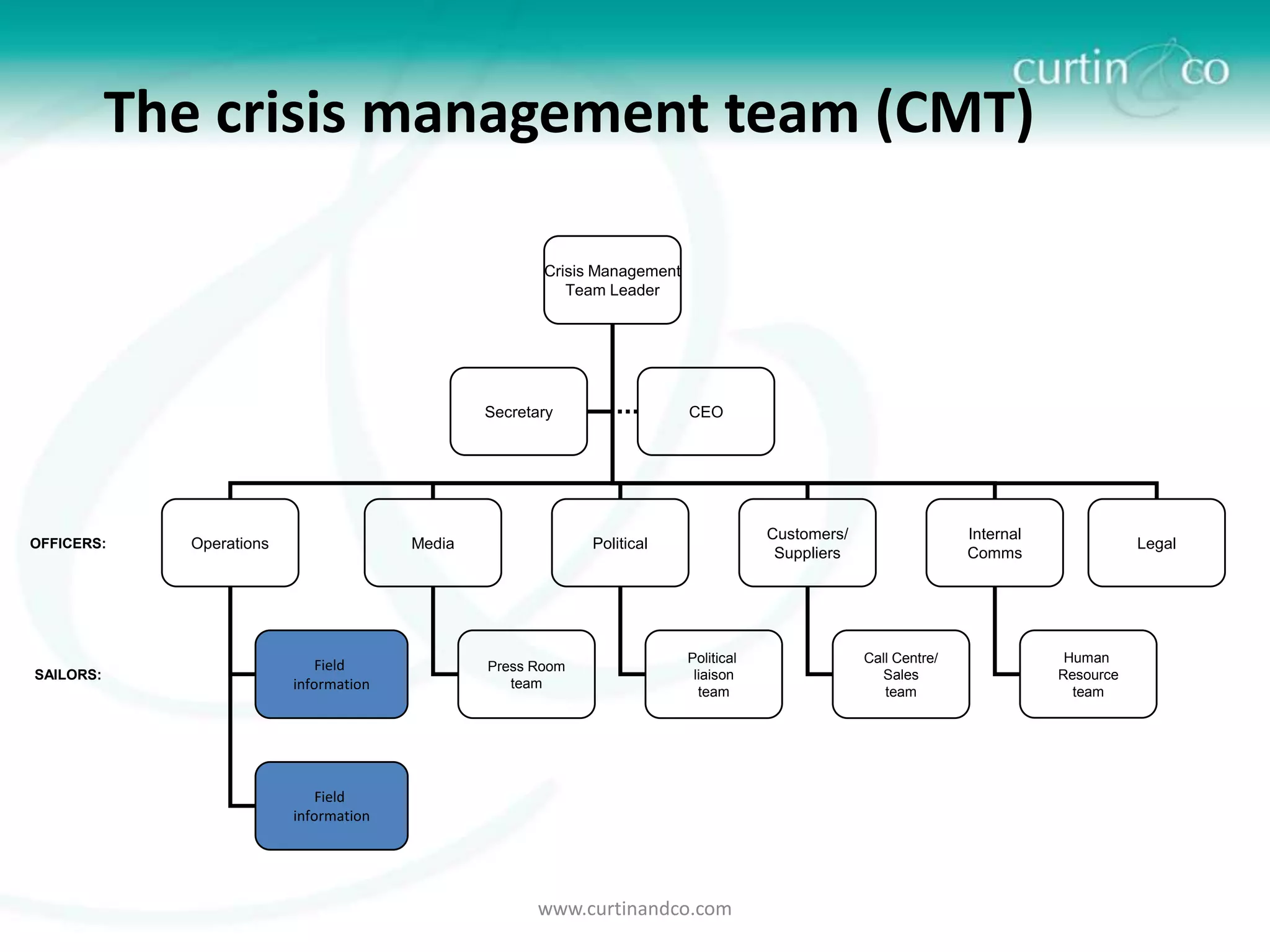
The crisis management team (CMT)

                                                        Crisis Management
                                                           Team Leader


                                                 Secretary                  CEO


                                                                                        Customers/                  Internal
OFFICERS:     Operations                 Media                Political                                                                   Legal
                                                                                         Suppliers                  Comms


                                                                            Political                Call Centre/               Human
                               Field             Press Room
SAILORS:                                                                     liaison                   Sales                   Resource
                           information              team
                                                                              team                      team                     team


                               Field
                           information


                                                        www.curtinandco.com
Planning for a crisis – Externally
• Set up a stakeholder management programme
   • So you know the key players before you need them
   • Invest in a CRM programme to monitor progress
   • Make it a key KPI for all senior executives
      • EG: To meet one journalist a week; one politician a month
• Regularly brainstorm potential scenarios
   • And create key messages for them
• Review hidden website pages regularly
   • And consider social media options
• Ask your advocates to input into your key messages
   • And make them the first target for supportive quotes
• Above all…train everyone regularly
   • Even if it is just to say “no comment”
                             www.curtinandco.com
Conclusions
• Crisis Management is a sequential stage of Issues
  Management
• A company which manages issues well will either avoid
  crises or lower their impact
• To manage a crisis well, you must be prepared
• Crisis management and comms is an on-going process
   – It cannot start when the crisis occurs
• And this is all hard work…
• ...but then, a crisis is always much more fun than work

                          www.curtinandco.com

Catherine communicating in a crisis presentation

  • 1.
    Communicating in aCrisis CATHERINE WORBOYS, CURTIN&CO www.curtinandco.com
  • 2.
    For discussion today •What makes a crisis? • Why effective communication is crucial in a crisis • Key stakeholders and pre-crisis communication • Assembling a crisis team • Effectively preparing for a crisis – Both internally and externally www.curtinandco.com
  • 3.
    What makes acrisis? • Rather like earthquake prediction – Many indicators, but unreliable – So you need to be prepared for a range of situations • In crises: • Those with good reputations – will be less scarred; recover more quickly • Therefore you must handle issues well; tone of voice, honesty, generosity, etc. to avoid a crisis A crisis is an issue badly managed www.curtinandco.com
  • 4.
    Perceptions are Powerful •In today’s media landscape: • If you think you have a problem then you probably have one • If someone else thinks you have a problem then you definitely have one • EG: TGV France “crash” – simulation which was reported as real www.curtinandco.com
  • 5.
    Why managing acrisis matters • Reputation management • Impacts on sales, credibility, credit rating, etc. • Could make recruitment more difficult - hits internal morale • Uncomfortable for management • Expensively built brand image is tarnished • In the best case you can gain • Tylenol – blackmailer threatened to poison products • In the worst case you lose the company • Perrier – accidental minute contamination www.curtinandco.com
  • 6.
    Perrier – theiconic brand of the ‘80s in crisis www.curtinandco.com
  • 7.
    Lessons to belearnt • Things always get worse before/if they get better - a snowball effect • BP – oil spill • Murphy’s Law rules – No one is ever in the right place at the right time – If it can happen on Christmas Day, it will • Everyone has a different agenda – Which you need to know before a crisis hits www.curtinandco.com
  • 8.
    The dangers ofthe ‘cover-up’ • Cover-up – a media definition: Deliberately (a) hiding information (b) not releasing it promptly • Hiding information always leads to either – economies with the truth – misinformation or – plain lying The Hydra Syndrome • The more lies you tell, the more you must tell www.curtinandco.com
  • 9.
    Cadbury and salmonella 20thJanuary: Cadbury Discovers Salmonella 19th June: Cadbury admits contamination to the Food Standards Agency when outbreak of Salmonella linked to product 22nd June: FSA says Cadbury posed ‘unacceptable’ risk to public 23rd June: Chocolate recalled 30th June: Cadbury documents show same factory infected with salmonella in 2002 Outcome: Cadbury looks as though it knew the problem existed and wilfully put its customers at risk www.curtinandco.com
  • 10.
    Key rules ofcommunicating in a crisis • Speed is of the essence – If you have information, release it – If not, have “no comment” prepared – Five minutes is a long time in Cyberspace • Know your stakeholders before you are in a crisis – Who will help you when you need them? • Prepare your key messages – And all the scenarios you can think of – they may seem extreme but crises are • Most of all – prepare your people – Who is your crisis team? – How regularly do they train? – Everyone else should be trained to give “no comment” www.curtinandco.com
  • 11.
    Crisis Management Some ofthe key players you must know www.curtinandco.com
  • 12.
    The Media –old and new • Speed is of the essence • The media watches the media • TFL suffered from Twitter campaign against employee in 2010 • Website comment - posted fast • Can deflect hundreds of queries quickly • Can be easily prepared in advance as a “hidden” page to trigger • Agenda-setting rather than opinion influencers – Media tells people what to think about • They are under fierce competitive pressure • Journalism is ‘the first rough cut of history’ • Truth is an early casualty – But having friends can help www.curtinandco.com
  • 13.
    The Politicians • Politicianshave strong drivers • Ego and altruism • Make sure they have a special ‘hot line’ number for crises • Get to them before they get to you – Have telephone numbers (office, home, mobile, addresses, e-mails, etc.) • One/two Directors to contact top politicians • Senior Managers handle local councillors, MPs etc. • A crisis is an easy campaign “band wagon” for politicians – If they know you and support you in the media it can reduce impact This is third party advocacy - they can say what you can’t www.curtinandco.com
  • 14.
    The pressure groups •Remember they are competitive businesses – Their own corporate battles - Membership drives • They can take risks - edge of the law • Speculate with strong and inaccurate views • The are symbiotic friends of the media – The environment is fashionable - a good ‘horror story’ – They are underdogs - like the journalist – They are ‘independent’ - no immediate financial gain • Get middle managers or handle them – Same consistent messages – Do not be side-tracked onto other issues – Discussion can take the heat out of relationship www.curtinandco.com
  • 15.
    Handling a Crisis The Boy Scout Rule: Be prepared, internally and externally www.curtinandco.com
  • 16.
    Planning for acrisis – Internally • One Co-Ordinator/Director leading a team – All senior roles must be duplicated – Easy to assemble – get on the ground early (30 mins) • Crisis Management handbook – Easy to read and use, checklists, templates, etc. – Reviewed regularly – as a priority • Train well and often - exercises, briefings, etc. • Get the messages right • Only the truth - don’t be afraid of ‘don’t know’ • Have a ‘life-belt’ statement ready • Empower the team to handle the crisis • NO outside interference – not the role of the CEO www.curtinandco.com
  • 17.
    The crisis managementteam (CMT) Crisis Management Team Leader Secretary CEO Customers/ Internal OFFICERS: Operations Media Political Legal Suppliers Comms Political Call Centre/ Human Field Press Room SAILORS: liaison Sales Resource information team team team team Field information www.curtinandco.com
  • 18.
    Planning for acrisis – Externally • Set up a stakeholder management programme • So you know the key players before you need them • Invest in a CRM programme to monitor progress • Make it a key KPI for all senior executives • EG: To meet one journalist a week; one politician a month • Regularly brainstorm potential scenarios • And create key messages for them • Review hidden website pages regularly • And consider social media options • Ask your advocates to input into your key messages • And make them the first target for supportive quotes • Above all…train everyone regularly • Even if it is just to say “no comment” www.curtinandco.com
  • 19.
    Conclusions • Crisis Managementis a sequential stage of Issues Management • A company which manages issues well will either avoid crises or lower their impact • To manage a crisis well, you must be prepared • Crisis management and comms is an on-going process – It cannot start when the crisis occurs • And this is all hard work… • ...but then, a crisis is always much more fun than work www.curtinandco.com