Sentence correction
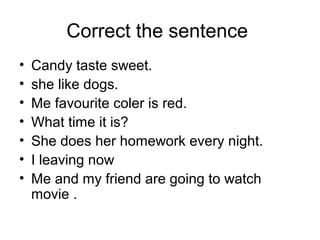
Correct the sentence
• Candy taste sweet.
• she like dogs.
• Me favourite coler is red.
• What time it is?
• She does her homework every night.
• I leaving now
• Me and my friend are going to watch
movie .
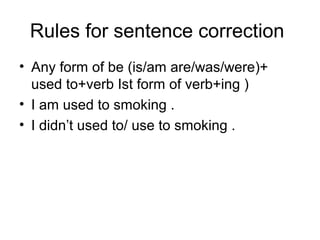
Rules for sentence correction
• Any form of be (is/am are/was/were)+
used to+verb Ist form of verb+ing )
• I am used to smoking .
• I didn’t used to/ use to smoking .
•
Read the complete sentence. Do not simply read the
underlined part of the sentence, because context may be
important in determining the correct answer. As
mentioned above, choice A will always be a copy of the
original underlined part of the sentence. If you cannot
find any errors, grammatical or otherwise, in the original
sentence, choose A, and move on. Don't worry about
spelling, capitalization, or punctuation; they are not
covered in Sentence Correction questions. If you do find
an error in the underlined portion, or if you're not sure,
proceed to step two
•
After you've read the sentence, look for clues
indicating what grammar rule the question is
testing. These grammar rules, and the clues to look for,
will be covered in more detail in the next section. Keep
an eye out for:
Agreement Issues: Look for pronouns, verbs, and
nouns: do they agree?
Modifiers: Look for introductory phrases set off by a
comma: is the modifier used correctly?
Parallels: Look for commas separating words in a list, as
well as expressions such as not only...but
also, both..and, either...or,neither...nor: is everything
parallel?
•
After you've dissected the question,
compare answer choices and note how
they differ. Look for the answer choice
that preserves the meaning of the
original sentence without creating new
errors. Eliminate answer choices with
grammar errors. Use the process of
elimination scrap paper charts to narrow
your choices
• Learning the French isn’t easy.
• In each of the following pairs of sentences, one sentence
is correct, and the other is wrong. Choose the correct
sentence.
• 1. a) He asked had we taken our food. / b) He asked if
we had taken our food.
• 2. a) He asked where I was going. / b) He asked that
where I was going.
• 3. a) He asked to her why she was angry. / b) He asked
her why she was angry.
• 4. a) No one cared for him after his wife died. / b) No one
took care of him after his wife had died.
• 5. a) When I went there I found that the bag had
disappeared. / b) When I went there I found that the bag
was disappeared.
• 6. a) I did not stop because he had gone
out before I arrived. / b) I did not stop
because he went out before I arrived.
• 7. a) When I go to Bombay I will see him. /
b) When I will go to Bombay I will see him
•
Error of subject verb agreement
• Each of the candidates was/were awarded a certificate for
participation.
• Either of those dresses is/are suitable for the party.
• 3. Either the student or his parents has/have to be pres ent in the
function.
• 4. Everybody or anybody is/are able to answer these questions.
• 5. Neither of them is/are an ex pert of the suject.
• 6. The ones who is/are found guilty must be punished.
• 7. You or she has/have to be blamed for the accident.
• 8. They and I was/were present there last night.
• 9. Jessica is absent, but some of her class is/are present.
• 10. No one know/knows what hap pens after death.
• Answers 1. was–means each one 2. is–
one of the dresses 3. have–the last noun
parents 4. is 5. is–not one of them 6. are–
ones is plural 7. has–the last sub ject she
8. were–and makes the sub ject plu ral 9.
are–class means class mates here 10.
knows–no one is singular.
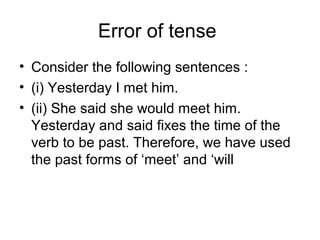
Error of tense
• Consider the following sentences :
• (i) Yesterday I met him.
• (ii) She said she would meet him.
Yesterday and said fixes the time of the
verb to be past. Therefore, we have used
the past forms of ‘meet’ and ‘will
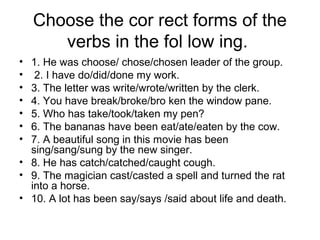
Choose the cor rect forms of the
verbs in the fol low ing.
• 1. He was choose/ chose/chosen leader of the group.
• 2. I have do/did/done my work.
• 3. The letter was write/wrote/written by the clerk.
• 4. You have break/broke/bro ken the window pane.
• 5. Who has take/took/taken my pen?
• 6. The bananas have been eat/ate/eaten by the cow.
• 7. A beautiful song in this movie has been
sing/sang/sung by the new singer.
• 8. He has catch/catched/caught cough.
• 9. The magician cast/casted a spell and turned the rat
into a horse.
• 10. A lot has been say/says /said about life and death.
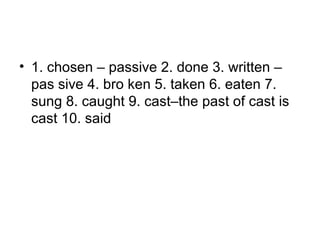
• 1. chosen – passive 2. done 3. written –
pas sive 4. bro ken 5. taken 6. eaten 7.
sung 8. caught 9. cast–the past of cast is
cast 10. said
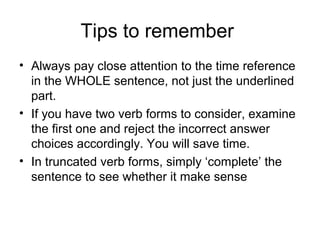
Tips to remember
• Always pay close attention to the time reference
in the WHOLE sentence, not just the underlined
part.
• If you have two verb forms to consider, examine
the first one and reject the incorrect answer
choices accordingly. You will save time.
• In truncated verb forms, simply ‘complete’ the
sentence to see whether it make sense
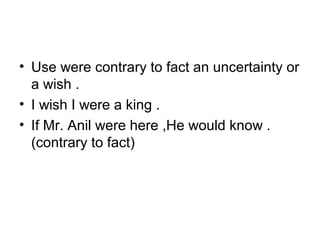
• Use were contrary to fact an uncertainty or
a wish .
• I wish I were a king .
• If Mr. Anil were here ,He would know .
(contrary to fact)
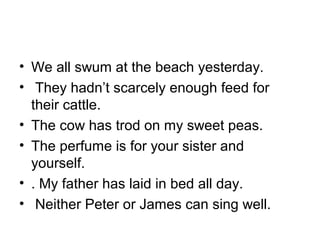
• We all swum at the beach yesterday.
• They hadn’t scarcely enough feed for
their cattle.
• The cow has trod on my sweet peas.
• The perfume is for your sister and
yourself.
• . My father has laid in bed all day.
• Neither Peter or James can sing well.
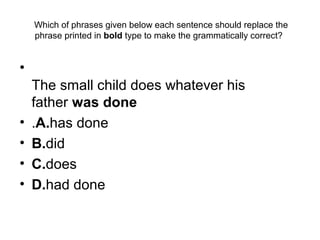
 Which of phrases given below each sentence should replace the 
phrase printed in bold type to make the grammatically correct? 
•  
The small child does whatever his 
father was done
• .A.has done
• B.did
• C.does
• D.had done
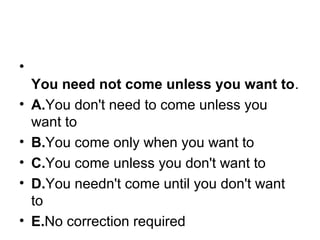
•
You need not come unless you want to.
• A.You don't need to come unless you 
want to
• B.You come only when you want to
• C.You come unless you don't want to
• D.You needn't come until you don't want 
to
• E.No correction required
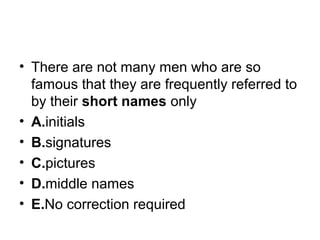
• There are not many men who are so 
famous that they are frequently referred to 
by their short names only
• A.initials
• B.signatures
• C.pictures
• D.middle names
• E.No correction required
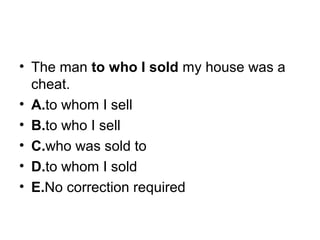
• The man to who I sold my house was a 
cheat.
• A.to whom I sell
• B.to who I sell
• C.who was sold to
• D.to whom I sold
• E.No correction required
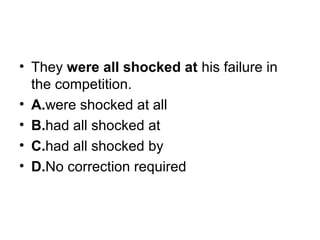
• They were all shocked at his failure in 
the competition.
• A.were shocked at all
• B.had all shocked at
• C.had all shocked by
• D.No correction required
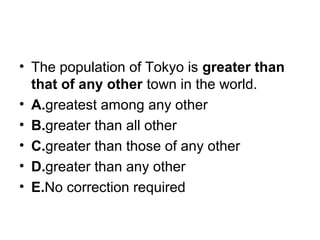
• The population of Tokyo is greater than
that of any other town in the world.
• A.greatest among any other
• B.greater than all other
• C.greater than those of any other
• D.greater than any other
• E.No correction required
•  Why did you not threw the bag away?
• A.did you not throw
• B.had you not threw
• C.did you not thrown
• D.you did not thrown
• E.No correction required
• Shapes of gods and goddess are 
worshipped by people.
• A.Images
• B.Reflections
• C.Clay shapes
• D.Clay toys
• E.No correction required
•
She cooks, washes dishes, does her 
homework and then relaxing.
• A.relaxing then
• B.then is relaxing
• C.relaxing is then
• D.then relaxes
• E.No correction required
• Anyone interested in the use of computers 
can learn much if you have access to a 
personal computer.
• A.they have access
• B.access can be available
• C.he or she has access
• D.one of them have access
• E.No correction required
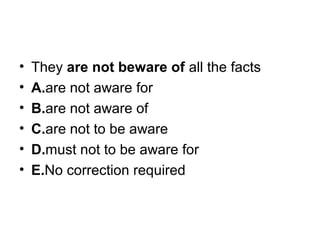
• They are not beware of all the facts
• A.are not aware for
• B.are not aware of
• C.are not to be aware
• D.must not to be aware for
• E.No correction required
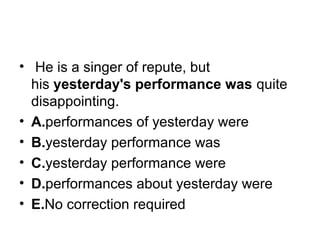
•  He is a singer of repute, but 
his yesterday's performance was quite 
disappointing.
• A.performances of yesterday were
• B.yesterday performance was
• C.yesterday performance were
• D.performances about yesterday were
• E.No correction required
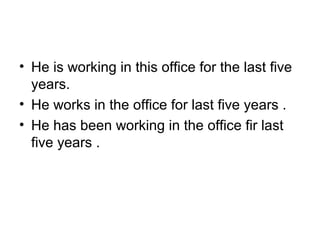
• He is working in this office for the last five 
years.  
• He works in the office for last five years .
• He has been working in the office fir last 
five years .
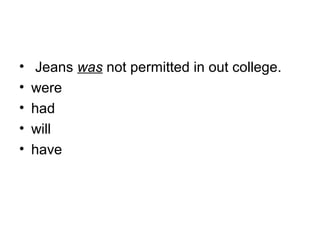
•  Jeans was not permitted in out college.
• were
• had
• will
• have
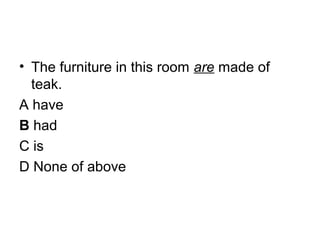
• The furniture in this room are made of 
teak.
A have
B had
C is
D None of above
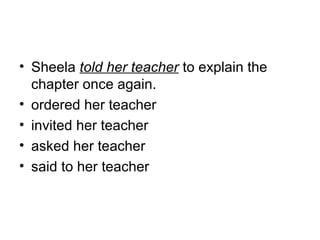
• Sheela told her teacher to explain the 
chapter once again.
• ordered her teacher
• invited her teacher
• asked her teacher
• said to her teacher
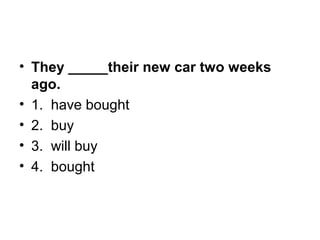
• They _____their new car two weeks
ago.
• 1.  have bought
• 2.  buy
• 3.  will buy
• 4.  bought
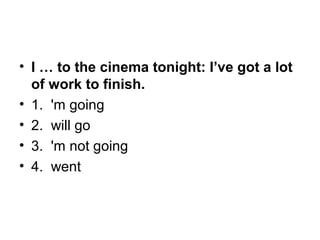
• I … to the cinema tonight: I’ve got a lot
of work to finish.
• 1.  'm going
• 2.  will go
• 3.  'm not going
• 4.  went
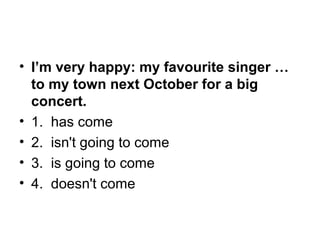
• I’m very happy: my favourite singer …
to my town next October for a big
concert.
• 1.  has come
• 2.  isn't going to come
• 3.  is going to come
• 4.  doesn't come
• My brother … football in the same club
as me.
• 1.  is playing
• 2.  plays
• 3.  played
• 4.  play
• She’s shocked because she … a
terrible accident.
• 1.  saw
• 2.  is going to see
• 3.  has seen
• 4.  sees
• I … English tea. Is it good?
• 1.  drink
• 2.  've never drunk
• 3.  am drinking
• 4.  have drunk
• My mother … 42 years old next
Saturday.
• 1.  was
• 2.  will have
• 3.  will be
• 4.  is
• Sam … the marathon for the first time
in 2009.
• 1.  ran
• 2.  runs
• 3.  is running
• 4.  has run
• For dinner last night we … fish and
chips.
• 1.  will have
• 2.  had
• 3.  are having
• 4.  have had
• If it’s sunny tomorrow, maybe we … go
to the beach.
• 1.  will go
• 2.  went
• 3.  go
• 4.  don't go
• If it’s sunny tomorrow, maybe we … go
to the beach.
• 1. will go
• 2.  went
• 3.  go
• 4.  don't go
• We … Mrs Stewart when we were in
California.
• 1.  are meeting
• 2.  have met
• 3.  will meet
• 4.  met
• I … in a first-class hotel: it’s too
expensive for me.
• 1.  'm going to sleep
• 2.  sleep
• 3.  am sleeping
• 4.  've never slept
• A cactus will flower in spite of the fact that 
they receive little water in the desert .
• The number of accidents caused by 
cellular phone usage is many times what 
they were last summer. 
•  A cactus will flower in spite of the fact that it
receives little water in the desert. 
• The number of accidents caused by cellular 
phone usage is many times what it was last 
summer. 
• [Note: The number is always singular (“The 
number of cars he owned was impressive.”) A
number is always plural. (“A number of fans 
lined up outside the concert hall.”)  
• Even though variable rate mortgages are an attractive option due to
low introductory interest rates, it can be potentially dangerous for
people with tight budgets, whose monthly expenditures should
remain fairly constant to avoid ending up in debt.
• (A) it can be potentially dangerous for people with tight budgets, 
whose
• (B) they can be potentially dangerous for people with tight budgets, 
because their
• (C) they are potentially dangerous for people with tight budgets, 
whose
• (D) for people with tight budgets it can be dangerous, because their
• (E) for people with tight budgets, they can be potentially dangerous 
in that their
• There are a couple errors present here: The first pronoun in the 
main clause should be “they” in order to agree with its referent, 
“mortgages.”  “Whose” correctly refers to “people,” but “can be 
potentially” is redundant.
• (A) — the statement as written — is incorrect. “It” does not agree 
with the plural subject “mortgages,” and “can be potentially” is 
redundant.
• (B)  is unclear whether “their” refers to “mortgages” or “people,” and 
“can be potentially” is still redundant.
• (C) is the correct answer: “They” agrees with “mortgages;” “whose” 
agrees with “people;” and the redundancy has been omitted.
• (D)’s construction doesn’t work — “their” is ambiguous and “it” 
should be plural.
• and (E) “In that their” is even more ambiguous and wordy.
• Neither Jason nor Sam wants to share 
their office during the remodeling project. 
• Neither Jason nor Sam wants to share his 
office during the remodeling project. 
• A)          B)          AorB
• She cooks, washes dishes, does her
homework and then relaxing.
• 1.  then relaxes
• 2.  relaxing then
• 3.  then is relaxing
• 4.  relaxing is then
• Ago is always used with Past Indefinite 
Tense. So, if ago is used in a sentence, 
that sentence must be in the Past 
Indefinite Tense.
• For example,
• Incorrect- He has come a month ago.
• He came a month ago.
• At present means at this moment and it is used 
with •Present Tense, whereas presently and 
shortly are used for future; action and generally
• used with Future Indefinite Tense.
• For example,
• Incorrect- Presently he is in the room.
• Correct- At present he is in the room.
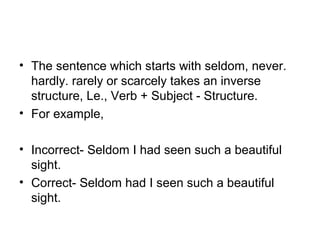
• The sentence which starts with seldom, never. 
hardly. rarely or scarcely takes an inverse 
structure, Le., Verb + Subject - Structure. 
• For example,
• Incorrect- Seldom I had seen such a beautiful 
sight.
• Correct- Seldom had I seen such a beautiful 
sight.
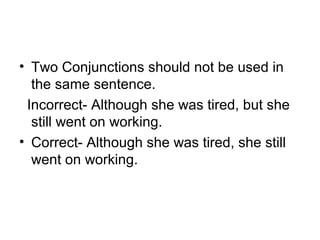
• Two Conjunctions should not be used in 
the same sentence.
  Incorrect- Although she was tired, but she 
still went on working.
• Correct- Although she was tired, she still 
went on working.
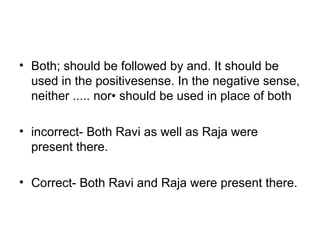
• Both; should be followed by and. It should be 
used in the positivesense. In the negative sense, 
neither ..... nor• should be used in place of both
• incorrect- Both Ravi as well as Raja were 
present there.
• Correct- Both Ravi and Raja were present there.
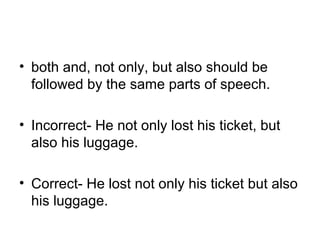
• both and, not only, but also should be 
followed by the same parts of speech.
• Incorrect- He not only lost his ticket, but 
also his luggage.
• Correct- He lost not only his ticket but also 
his luggage.
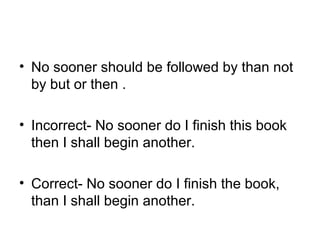
• No sooner should be followed by than not 
by but or then .
• Incorrect- No sooner do I finish this book 
then I shall begin another.
• Correct- No sooner do I finish the book, 
than I shall begin another.
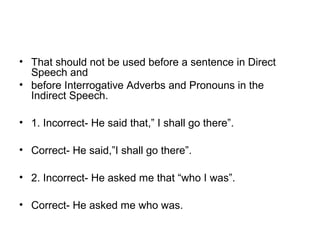
• That should not be used before a sentence in Direct 
Speech and
• before Interrogative Adverbs and Pronouns in the 
Indirect Speech.
• 1. Incorrect- He said that,” I shall go there”.
• Correct- He said,”I shall go there”.
• 2. Incorrect- He asked me that “who I was”.
• Correct- He asked me who was.
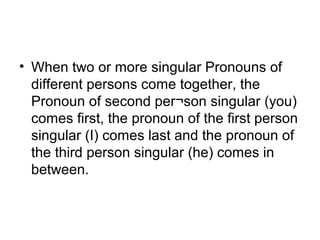
• When two or more singular Pronouns of 
different persons come together, the 
Pronoun of second per¬son singular (you) 
comes first, the pronoun of the first person 
singular (I) comes last and the pronoun of 
the third person singular (he) comes in 
between.
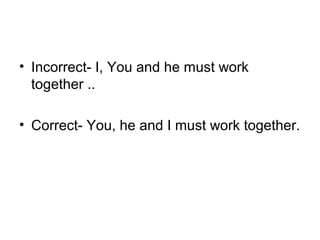
• Incorrect- I, You and he must work 
together ..
• Correct- You, he and I must work together.
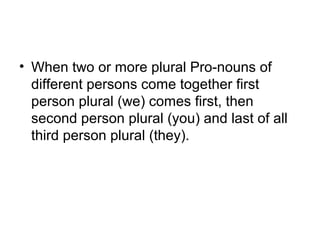
• When two or more plural Pro-nouns of 
different persons come together first 
person plural (we) comes first, then 
second person plural (you) and last of all 
third person plural (they).
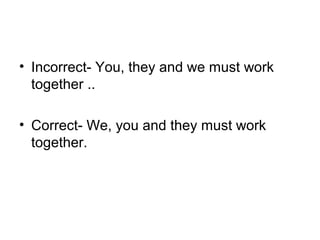
• Incorrect- You, they and we must work 
together ..
• Correct- We, you and they must work 
together.
•
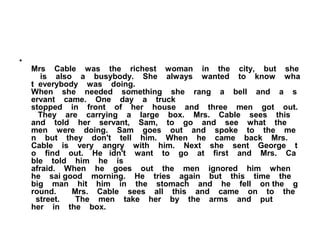
Mrs Cable was the richest woman in the city, but she
is also a busybody. She always wanted to know wha
t everybody was doing.
When she needed something she rang a bell and a s
ervant came. One day a truck
stopped in front of her house and three men got out.
They are carrying a large box. Mrs. Cable sees this
and told her servant, Sam, to go and see what the
men were doing. Sam goes out and spoke to the me
n but they don't tell him. When he came back Mrs.
Cable is very angry with him. Next she sent George t
o find out. He idn't want to go at first and Mrs. Ca
ble told him he is
afraid. When he goes out the men ignored him when
he sai good morning. He tries again but this time the
big man hit him in the stomach and he fell on the g
round. Mrs. Cable sees all this and came on to the
street. The men take her by the arms and put
her in the box.

19465 lecture19 22-19541_sentence correction (1)