


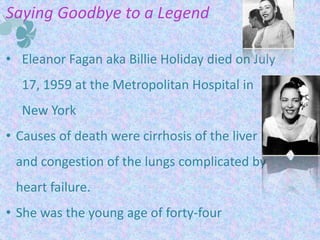
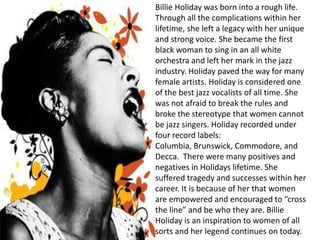
Billie HolidayThe Rise and Fall of One of the Greatest Jazz SingersKyra BedellProfessor Sean AbelMusic 3422 July 2011
"No one can figure out your worth but you." - Pearl BaileyIt is a known fact that women have come a long way in the music industry.
It is also a known that African Americans have come a very far way in the United States.
It is known that women and African Americans were discriminated and judged all to often in early America, especially when it comes to music.
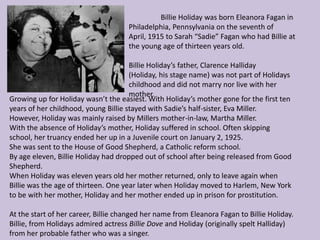
It is also know that good can come from bad. If a persons determination is strong enough they can accomplish anything.	Billie Holiday was born Eleanora Fagan in Philadelphia, Pennsylvania on the seventh of April, 1915 to Sarah “Sadie” Fagan who had Billie at the young age of thirteen years old.Billie Holiday’s father, Clarence Halliday (Holiday, his stage name) was not part of Holidays childhood and did not marry nor live with her mother.Growing up for Holiday wasn’t the easiest. With Holiday’s mother gone for the first ten years of her childhood, young Billie stayed with Sadie’s half-sister, Eva Miller. However, Holiday was mainly raised by Millers mother-in-law, Martha Miller.With the absence of Holiday’s mother, Holiday suffered in school. Often skipping school, her truancy ended her up in a Juvenile court on January 2, 1925.She was sent to the House of Good Shepherd, a Catholic reform school. By age eleven, Billie Holiday had dropped out of school after being released from Good Shepherd.When Holiday was eleven years old her mother returned, only to leave again when Billie was the age of thirteen. One year later when Holiday moved to Harlem, New York to be with her mother, Holiday and her mother ended up in prison for prostitution. At the start of her career, Billie changed her name from Eleanora Fagan to Billie Holiday. Billie, from Holidays admired actress Billie Dove and Holiday (originally spelt Halliday) from her probable father who was a singer.
“Those who wish to sing, always 						find a song.”
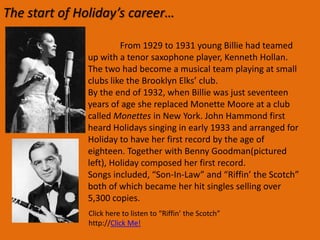
The start of Holiday’s career…	From 1929 to 1931 young Billie had teamed up with a tenor saxophone player, Kenneth Hollan. The two had become a musical team playing at small clubs like the Brooklyn Elks’ club. By the end of 1932, when Billie was just seventeen years of age she replaced Monette Moore at a club called Monettes in New York. John Hammond first heard Holidays singing in early 1933 and arranged for Holiday to have her first record by the age of eighteen. Together with Benny Goodman(pictured left), Holiday composed her first record.Songs included, “Son-In-Law” and “Riffin’ the Scotch” both of which became her hit singles selling over 5,300 copies. Click here to listen to “Riffin’ the Scotch”http://Click Me!
After Holidays first record, the record label that Holiday was recording under were not appealed to her sound.
Her producers heavily tried to persuade Holiday to sound more like Cleo Brown, a popular woman jazz singer of the 1930s and 40s who was considered “established.”
After Billie Holidays recording of “What a Little Moonlight Can Do” had done well, producers recognized Holiday as an individual.
One year after “What a Little Moonlight Can Do” was released, Holiday started to record under her own name.Please click to listen to “What a Little Moonlight Can Do.” Click Me!
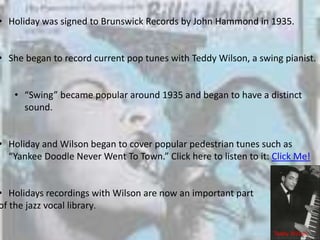
Holiday was signed to Brunswick Records by John Hammond in 1935.
She began to record current pop tunes with Teddy Wilson, a swing pianist.
“Swing” became popular around 1935 and began to have a distinct sound.
Holiday and Wilson began to cover popular pedestrian tunes such as “Yankee Doodle Never Went To Town.” Click here to listen to it: Click Me!
Holidays recordings with Wilson are now an important part of the jazz vocal library.Teddy Wilson
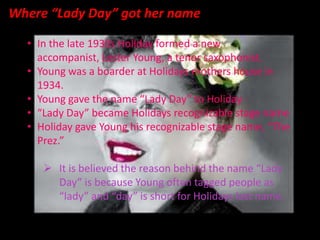
Where “Lady Day” got her nameIn the late 1930s Holiday formed a new accompanist, Lester Young, a tenor saxophonist.
Young was a boarder at Holidays mothers house in 1934.
Young gave the name “Lady Day” to Holiday
“Lady Day” became Holidays recognizable stage name
Holiday gave Young his recognizable stage name, “The Prez.”
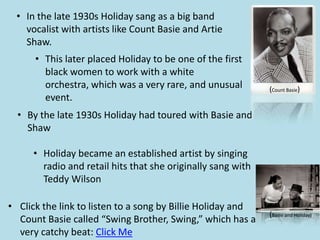
It is believed the reason behind the name “Lady Day” is because Young often tagged people as “lady” and “day” is short for Holidays last name.In the late 1930s Holiday sang as a big band vocalist with artists like Count Basie and Artie Shaw.
This later placed Holiday to be one of the first black women to work with a white orchestra, which was a very rare, and unusual event.(Count Basie)By the late 1930s Holiday had toured with Basie and Shaw
Holiday became an established artist by singing radio and retail hits that she originally sang with Teddy Wilson
Click the link to listen to a song by Billie Holiday and Count Basie called “Swing Brother, Swing,” which has a very catchy beat: Click Me(Basie and Holiday)
Finally Getting Somewhere…By 1938 Holidays songs were becoming more popular throughout America.

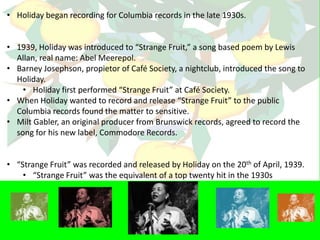
Billie Holiday

  • 1.
    Billie HolidayThe Riseand Fall of One of the Greatest Jazz SingersKyra BedellProfessor Sean AbelMusic 3422 July 2011
  • 2.
    "No one canfigure out your worth but you." - Pearl BaileyIt is a known fact that women have come a long way in the music industry.
  • 3.
    It is alsoa known that African Americans have come a very far way in the United States.
  • 4.
    It is knownthat women and African Americans were discriminated and judged all to often in early America, especially when it comes to music.
  • 5.
    It is alsoknow that good can come from bad. If a persons determination is strong enough they can accomplish anything. Billie Holiday was born Eleanora Fagan in Philadelphia, Pennsylvania on the seventh of April, 1915 to Sarah “Sadie” Fagan who had Billie at the young age of thirteen years old.Billie Holiday’s father, Clarence Halliday (Holiday, his stage name) was not part of Holidays childhood and did not marry nor live with her mother.Growing up for Holiday wasn’t the easiest. With Holiday’s mother gone for the first ten years of her childhood, young Billie stayed with Sadie’s half-sister, Eva Miller. However, Holiday was mainly raised by Millers mother-in-law, Martha Miller.With the absence of Holiday’s mother, Holiday suffered in school. Often skipping school, her truancy ended her up in a Juvenile court on January 2, 1925.She was sent to the House of Good Shepherd, a Catholic reform school. By age eleven, Billie Holiday had dropped out of school after being released from Good Shepherd.When Holiday was eleven years old her mother returned, only to leave again when Billie was the age of thirteen. One year later when Holiday moved to Harlem, New York to be with her mother, Holiday and her mother ended up in prison for prostitution. At the start of her career, Billie changed her name from Eleanora Fagan to Billie Holiday. Billie, from Holidays admired actress Billie Dove and Holiday (originally spelt Halliday) from her probable father who was a singer.
  • 6.
    “Those who wishto sing, always find a song.”
  • 7.
    The start ofHoliday’s career… From 1929 to 1931 young Billie had teamed up with a tenor saxophone player, Kenneth Hollan. The two had become a musical team playing at small clubs like the Brooklyn Elks’ club. By the end of 1932, when Billie was just seventeen years of age she replaced Monette Moore at a club called Monettes in New York. John Hammond first heard Holidays singing in early 1933 and arranged for Holiday to have her first record by the age of eighteen. Together with Benny Goodman(pictured left), Holiday composed her first record.Songs included, “Son-In-Law” and “Riffin’ the Scotch” both of which became her hit singles selling over 5,300 copies. Click here to listen to “Riffin’ the Scotch”http://Click Me!
  • 8.
    After Holidays firstrecord, the record label that Holiday was recording under were not appealed to her sound.
  • 9.
    Her producers heavilytried to persuade Holiday to sound more like Cleo Brown, a popular woman jazz singer of the 1930s and 40s who was considered “established.”
  • 10.
    After Billie Holidaysrecording of “What a Little Moonlight Can Do” had done well, producers recognized Holiday as an individual.
  • 11.
    One year after“What a Little Moonlight Can Do” was released, Holiday started to record under her own name.Please click to listen to “What a Little Moonlight Can Do.” Click Me!
  • 12.
    Holiday was signedto Brunswick Records by John Hammond in 1935.
  • 13.
    She began torecord current pop tunes with Teddy Wilson, a swing pianist.
  • 14.
    “Swing” became populararound 1935 and began to have a distinct sound.
  • 15.
    Holiday and Wilsonbegan to cover popular pedestrian tunes such as “Yankee Doodle Never Went To Town.” Click here to listen to it: Click Me!
  • 16.
    Holidays recordings withWilson are now an important part of the jazz vocal library.Teddy Wilson
  • 17.
    Where “Lady Day”got her nameIn the late 1930s Holiday formed a new accompanist, Lester Young, a tenor saxophonist.
  • 18.
    Young was aboarder at Holidays mothers house in 1934.
  • 19.
    Young gave thename “Lady Day” to Holiday
  • 20.
    “Lady Day” becameHolidays recognizable stage name
  • 21.
    Holiday gave Younghis recognizable stage name, “The Prez.”
  • 22.
    It is believedthe reason behind the name “Lady Day” is because Young often tagged people as “lady” and “day” is short for Holidays last name.In the late 1930s Holiday sang as a big band vocalist with artists like Count Basie and Artie Shaw.
  • 23.
    This later placedHoliday to be one of the first black women to work with a white orchestra, which was a very rare, and unusual event.(Count Basie)By the late 1930s Holiday had toured with Basie and Shaw
  • 24.
    Holiday became anestablished artist by singing radio and retail hits that she originally sang with Teddy Wilson
  • 25.
    Click the linkto listen to a song by Billie Holiday and Count Basie called “Swing Brother, Swing,” which has a very catchy beat: Click Me(Basie and Holiday)
  • 26.
    Finally Getting Somewhere…By1938 Holidays songs were becoming more popular throughout America.