Desert Landforms
YOU MUST… Describe the characteristics
of the fluvial and aeolian landforms listed
YOU SHOULD… Explain the physical
processes that created these landforms
YOU COULD… Support your knowledge of
the above with specific facts and figures
What you need to know
Landforms resulting from wind
action:
• Yardangs
• Zeugen
• Sand dunes
Landforms resulting from water
action:
Pediments
Inselbergs
Mesas and buttes
Salt lakes
Alluvial fans
Wadis
Badlands
NB: Desert pavements, ventifacts, deflation hollows and
rock pedestals are NOT mentioned by name in the spec,
these can be used as supporting examples in essays but you
cannot be asked a direct question on them.
What you need to know
• Yardangs
• Zeugen
• Sand dunes
• Pediments
• Inselbergs
• Mesas and buttes
• Salt lakes
• Alluvial fans
• Wadis
• Badlands
Just like with River landforms you
must be able to:
- Draw a sketch of each one
- Describe what is looks like, giving
specific facts and figures if you can
- Explain how it formed
Wind Action (aeolian landforms)
• Yardangs
• Zeugen
• Sand dunes
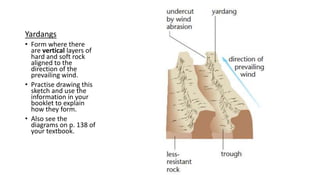
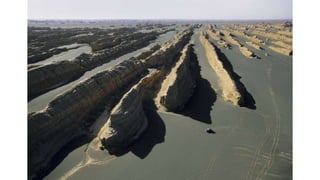
Yardangs
• Form where there
are vertical layers of
hard and soft rock
aligned to the
direction of the
prevailing wind.
• Practise drawing this
sketch and use the
information in your
booklet to explain
how they form.
• Also see the
diagrams on p. 138 of
your textbook.
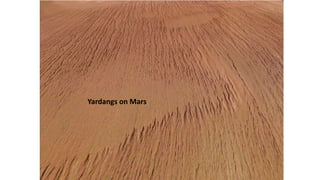
Yardangs on Mars
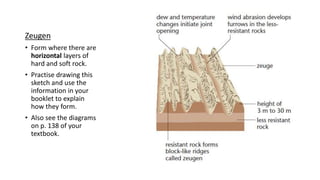
Zeugen
• Form where there are
horizontal layers of
hard and soft rock.
• Practise drawing this
sketch and use the
information in your
booklet to explain
how they form.
• Also see the diagrams
on p. 138 of your
textbook.
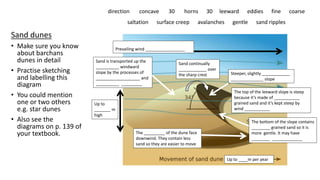
Up to ____m per year
Steeper, slightly ____________
______________ slope
The bottom of the slope contains
________ grained sand so it is
more gentle. It may have
________ _____________
Sand is transported up the
__________ windward
slope by the processes of
___________________ and
__________ _________
Prevailing wind _________________
Up to
_______ m
high
The _________ of the dune face
downwind. They contain less
sand so they are easier to move
Sand continually
____________ over
the sharp crest
The top of the leeward slope is steep
because it’s made of ___________
grained sand and it’s kept steep by
wind ___________
direction concave 30 horns 30 leeward eddies fine coarse
saltation surface creep avalanches gentle sand ripples
Sand dunes
• Make sure you know
about barchans
dunes in detail
• Practise sketching
and labelling this
diagram
• You could mention
one or two others
e.g. star dunes
• Also see the
diagrams on p. 139 of
your textbook.
Water Action (fluvial landforms)
• Pediments
• Inselbergs
• Mesas and buttes
• Salt lakes
• Alluvial fans
• Wadis
• Badlands
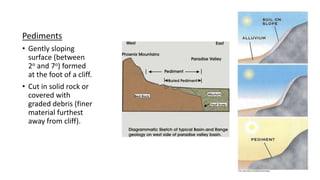
Pediments
• Gently sloping
surface (between
2o and 7o) formed
at the foot of a cliff.
• Cut in solid rock or
covered with
graded debris (finer
material furthest
away from cliff).
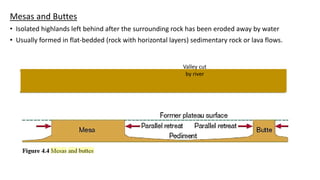
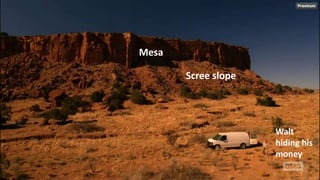
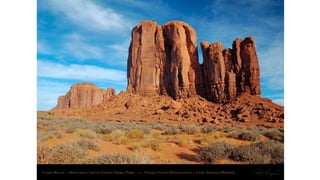
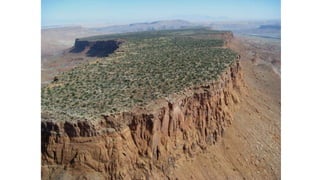
Mesas and Buttes
• Isolated highlands left behind after the surrounding rock has been eroded away by water
• Usually formed in flat-bedded (rock with horizontal layers) sedimentary rock or lava flows.
Valley cut
by river
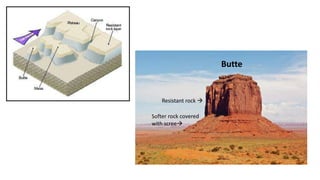
Butte
Resistant rock 
Softer rock covered
with scree
Mesa
Walt
hiding his
money
Scree slope
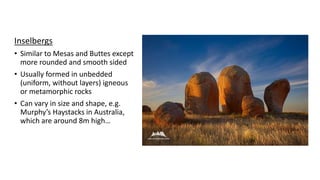
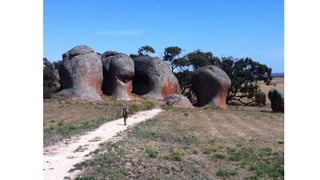
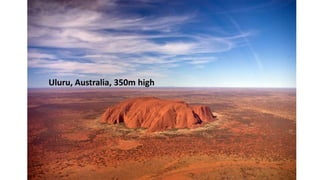
Inselbergs
• Similar to Mesas and Buttes except
more rounded and smooth sided
• Usually formed in unbedded
(uniform, without layers) igneous
or metamorphic rocks
• Can vary in size and shape, e.g.
Murphy’s Haystacks in Australia,
which are around 8m high…
Uluru, Australia, 350m high
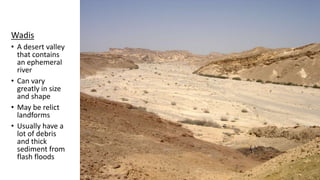
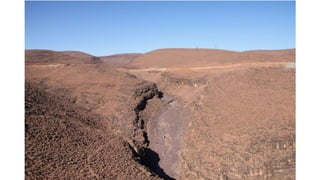
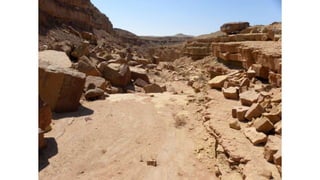
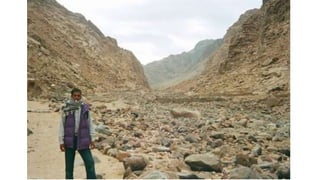
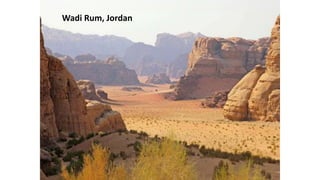
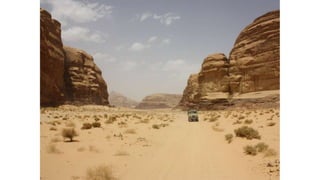
Wadis
• A desert valley
that contains
an ephemeral
river
• Can vary
greatly in size
and shape
• May be relict
landforms
• Usually have a
lot of debris
and thick
sediment from
flash floods
Wadi Rum, Jordan
Alien planet in movie Prometheus
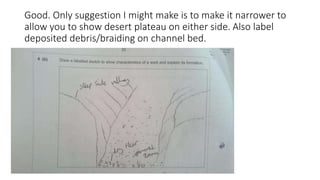
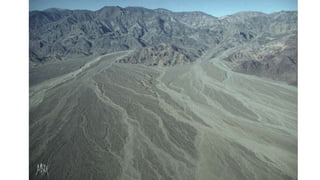
Good. Only suggestion I might make is to make it narrower to
allow you to show desert plateau on either side. Also label
deposited debris/braiding on channel bed.
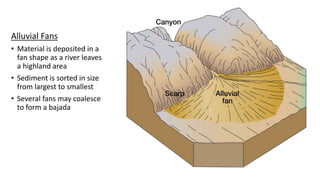
Alluvial Fans
• Material is deposited in a
fan shape as a river leaves
a highland area
• Sediment is sorted in size
from largest to smallest
• Several fans may coalesce
to form a bajada
Badlands
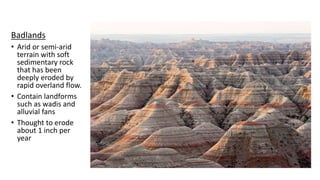
• Arid or semi-arid
terrain with soft
sedimentary rock
that has been
deeply eroded by
rapid overland flow.
• Contain landforms
such as wadis and
alluvial fans
• Thought to erode
about 1 inch per
year
Desert Landforms Challenge!
• Get into pairs
• Around the room are places to draw each landform
• You will have 1 minute on each landform
• The first person must draw it, everyone else can add
labels/annotations or extra parts to the sketch

Desert landforms revision

  • 1.
    Desert Landforms YOU MUST…Describe the characteristics of the fluvial and aeolian landforms listed YOU SHOULD… Explain the physical processes that created these landforms YOU COULD… Support your knowledge of the above with specific facts and figures
  • 2.
    What you needto know Landforms resulting from wind action: • Yardangs • Zeugen • Sand dunes Landforms resulting from water action: Pediments Inselbergs Mesas and buttes Salt lakes Alluvial fans Wadis Badlands NB: Desert pavements, ventifacts, deflation hollows and rock pedestals are NOT mentioned by name in the spec, these can be used as supporting examples in essays but you cannot be asked a direct question on them.
  • 3.
    What you needto know • Yardangs • Zeugen • Sand dunes • Pediments • Inselbergs • Mesas and buttes • Salt lakes • Alluvial fans • Wadis • Badlands Just like with River landforms you must be able to: - Draw a sketch of each one - Describe what is looks like, giving specific facts and figures if you can - Explain how it formed
  • 4.
    Wind Action (aeolianlandforms) • Yardangs • Zeugen • Sand dunes
  • 5.
    Yardangs • Form wherethere are vertical layers of hard and soft rock aligned to the direction of the prevailing wind. • Practise drawing this sketch and use the information in your booklet to explain how they form. • Also see the diagrams on p. 138 of your textbook.
  • 7.
  • 8.
    Zeugen • Form wherethere are horizontal layers of hard and soft rock. • Practise drawing this sketch and use the information in your booklet to explain how they form. • Also see the diagrams on p. 138 of your textbook.
  • 11.
    Up to ____mper year Steeper, slightly ____________ ______________ slope The bottom of the slope contains ________ grained sand so it is more gentle. It may have ________ _____________ Sand is transported up the __________ windward slope by the processes of ___________________ and __________ _________ Prevailing wind _________________ Up to _______ m high The _________ of the dune face downwind. They contain less sand so they are easier to move Sand continually ____________ over the sharp crest The top of the leeward slope is steep because it’s made of ___________ grained sand and it’s kept steep by wind ___________ direction concave 30 horns 30 leeward eddies fine coarse saltation surface creep avalanches gentle sand ripples Sand dunes • Make sure you know about barchans dunes in detail • Practise sketching and labelling this diagram • You could mention one or two others e.g. star dunes • Also see the diagrams on p. 139 of your textbook.
  • 14.
    Water Action (fluviallandforms) • Pediments • Inselbergs • Mesas and buttes • Salt lakes • Alluvial fans • Wadis • Badlands
  • 15.
    Pediments • Gently sloping surface(between 2o and 7o) formed at the foot of a cliff. • Cut in solid rock or covered with graded debris (finer material furthest away from cliff).
  • 16.
    Mesas and Buttes •Isolated highlands left behind after the surrounding rock has been eroded away by water • Usually formed in flat-bedded (rock with horizontal layers) sedimentary rock or lava flows. Valley cut by river
  • 17.
    Butte Resistant rock  Softerrock covered with scree
  • 18.
  • 21.
    Inselbergs • Similar toMesas and Buttes except more rounded and smooth sided • Usually formed in unbedded (uniform, without layers) igneous or metamorphic rocks • Can vary in size and shape, e.g. Murphy’s Haystacks in Australia, which are around 8m high…
  • 23.
  • 24.
    Wadis • A desertvalley that contains an ephemeral river • Can vary greatly in size and shape • May be relict landforms • Usually have a lot of debris and thick sediment from flash floods
  • 30.
  • 32.
    Alien planet inmovie Prometheus
  • 33.
    Good. Only suggestionI might make is to make it narrower to allow you to show desert plateau on either side. Also label deposited debris/braiding on channel bed.
  • 34.
    Alluvial Fans • Materialis deposited in a fan shape as a river leaves a highland area • Sediment is sorted in size from largest to smallest • Several fans may coalesce to form a bajada
  • 38.
    Badlands • Arid orsemi-arid terrain with soft sedimentary rock that has been deeply eroded by rapid overland flow. • Contain landforms such as wadis and alluvial fans • Thought to erode about 1 inch per year
  • 41.
    Desert Landforms Challenge! •Get into pairs • Around the room are places to draw each landform • You will have 1 minute on each landform • The first person must draw it, everyone else can add labels/annotations or extra parts to the sketch

Editor's Notes

  • #6 Gap fill starter to have on desks as they come in – this should help with homework!
  • #7 Yardangs in the gobi desert
  • #8 Yardangs on mars (https://solarsystem.nasa.gov/multimedia/display.cfm?IM_ID=2763)
  • #9 Gap fill starter to have on desks as they come in – this should help with homework!
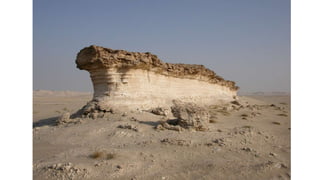
  • #11 Zeuge in Bahrain
  • #12 Gap fill starter to have on desks as they come in – this should help with homework!
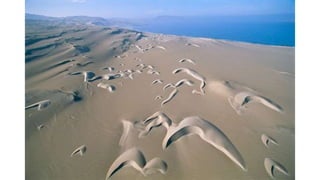
  • #13 Barchan dunes in Peru
  • #16 Gap fill starter to have on desks as they come in – this should help with homework!
  • #17 (Raw, M. 2012: My Revision Notes; AQA AS Geography)
  • #22 Gap fill starter to have on desks as they come in – this should help with homework!
  • #24 Gap fill starter to have on desks as they come in – this should help with homework!
  • #25 Gap fill starter to have on desks as they come in – this should help with homework!
  • #35 Gap fill starter to have on desks as they come in – this should help with homework!
  • #39 Gap fill starter to have on desks as they come in – this should help with homework!