07/04/2025
Chapter-3
Project Identification
• The first stage in the project life cycle is to find potential projects.
• Some of the sources of projects are:
i. Resource based
ii. Market based
iii. Need-based
iv. Well – informed technical specialists and local leaders are also
common sources of projects
 Ideas for new projects also may come from proposals to extend existing
programs.
 In general, most projects start as an elementary idea.
 Identification is the first step in the project cycle
 Opportunity sensing is essential for new as well as existing entrepreneurs; once
existing entrepreneurs reach the comfort stage in their project, new business
opportunities need to be identified for enterprise sustenance, growth and
development.
07/04/2025
Con’t
 In the present era of liberalization and globalization, competition is
increasingly intensifying. Growth opportunities abound for expansion,
diversification or modernization, and for this entrepreneur needs to scan
the emerging environment before finalizing the most optimal opportunity
that maximizes gains from limited investment and resources
 Project identification is the idea stage and it involves activities concerned
with surveying, reviewing and inventorizing existing data and information.
These include:
 natural resource data
 human resource data
 socio-economic data
 resource availability
 market gap
 need gap
07/04/2025
Con’t
 Having achieved a good database, the process of identification of gaps would
have been laid. Thus, such gaps, which lead to project ideas, could be
generated
 Once a project is identified, the next step is to carry out a project
preparation document, which is also called feasibility study
 There are three main steps that should take place.
 Identification of needs and problem recognition.
 The formulation of objectives that projects should aim at
 Identification of suitable projects
This is a stage where one project-idea out of several alternatives is chosen and
defined.
 It involves identifying environmental problems to be addressed and the
needs and interests of possible beneficiaries and stakeholders.
07/04/2025
Con’t
 Generally, project ideas are born:
 Micro level sources:- Project ideas originated at individual or
household level
 Macro Sources: Project ideas originated by institutions at
regional or federal level.
 Sources of project ideas: Identification is often the outcome
of a triggering process rather than an analytical exercise.
 Problem analysis
 Stakeholder analysis
 Objective analysis
 Alternative analysis
 SWOT analysis
07/04/2025
Con’t
I. PROBLEM ANALYSIS
 On the basis of available information, the existing situation is analysed
 The major problems are identified and the main causal relationships between these are
visualized.
 The aim at this early stage is to establish an overview of the situation.
 In formulating problems, existing problems should be identified and will serve as source
of project idea.
A. Analyze the performance of existing industries:
 A study of existing industries in terms of their profitability and capacity utilizations
 An examination of capacity utilization of various industries provides information Such a
study becomes more useful if it is done region wise, particularly for products which have
high transportation costs.
B. Examine the inputs and outputs of various industries:
 Materials, purchased parts or supplies are presently being procured from distant sources
with attendant time lag and transportation cost and
 Several firms produce internally some components/parts which can be supplied at a lower
cost by a single manufacturer who can enjoy economies of scale.
 Similarly, a study of the output of the existing industries may reveal opportunities for
adding value through further processing of the main outputs.
07/04/2025
Con’t
C. Review import and exports:
 Helpful in understanding the trend of imports of various goods
and the potential for import substitution.
 it improves the balance of payments situation,
 it generates employment, and
 It provides a market for the supporting industries and services.
D. Analyze Economic and Social Trends:
 Helpful in projecting demand for various goods and services.
E. Draw Clues from Consumption Abroad:
 Identify projects for the manufacture of products or supply of
services which are new to the country but extensively used
abroad.
07/04/2025
Con’t
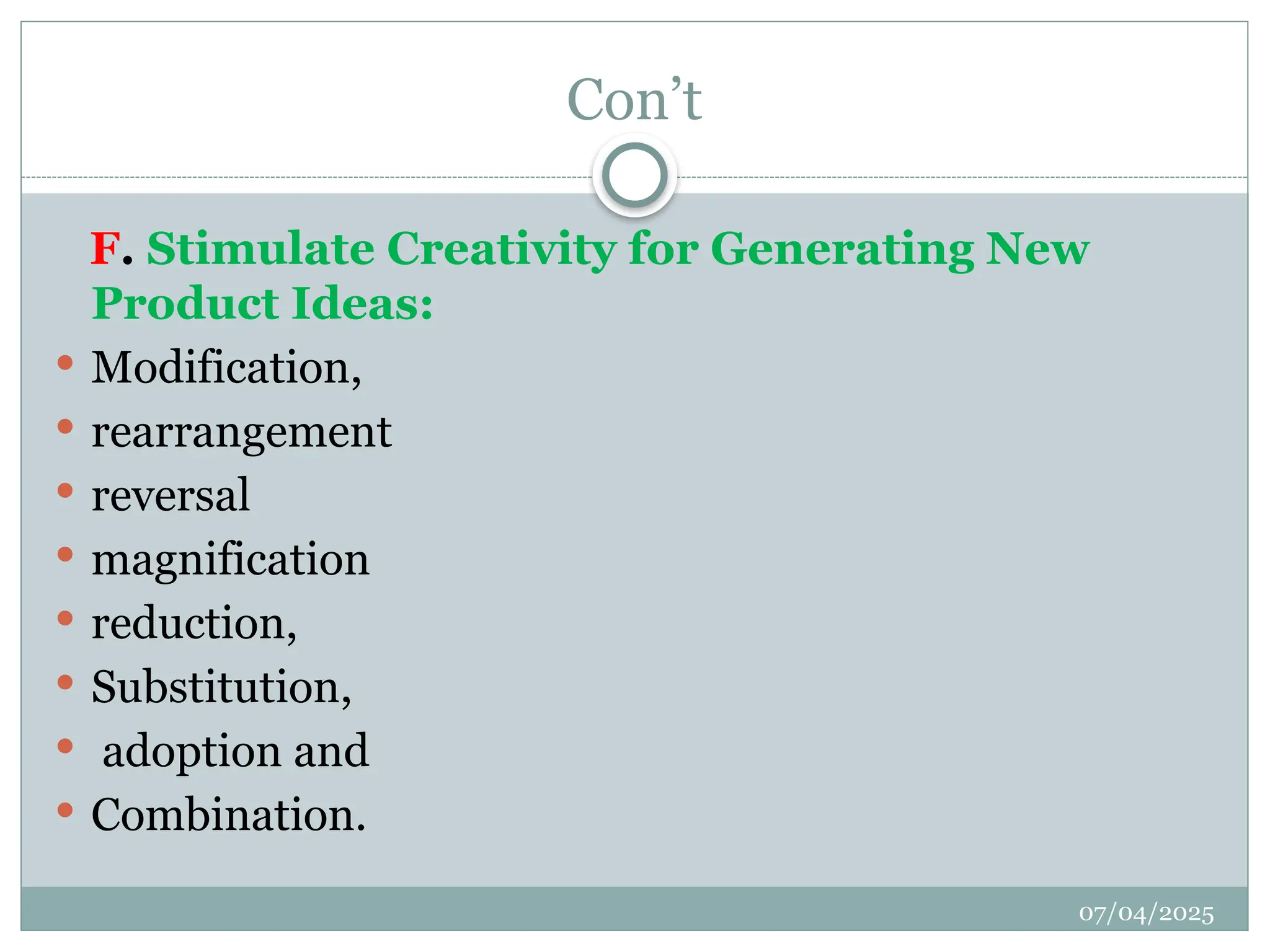
F. Stimulate Creativity for Generating New
Product Ideas:
 Modification,
 rearrangement
 reversal
 magnification
 reduction,
 Substitution,
 adoption and
 Combination.
07/04/2025
Con’t
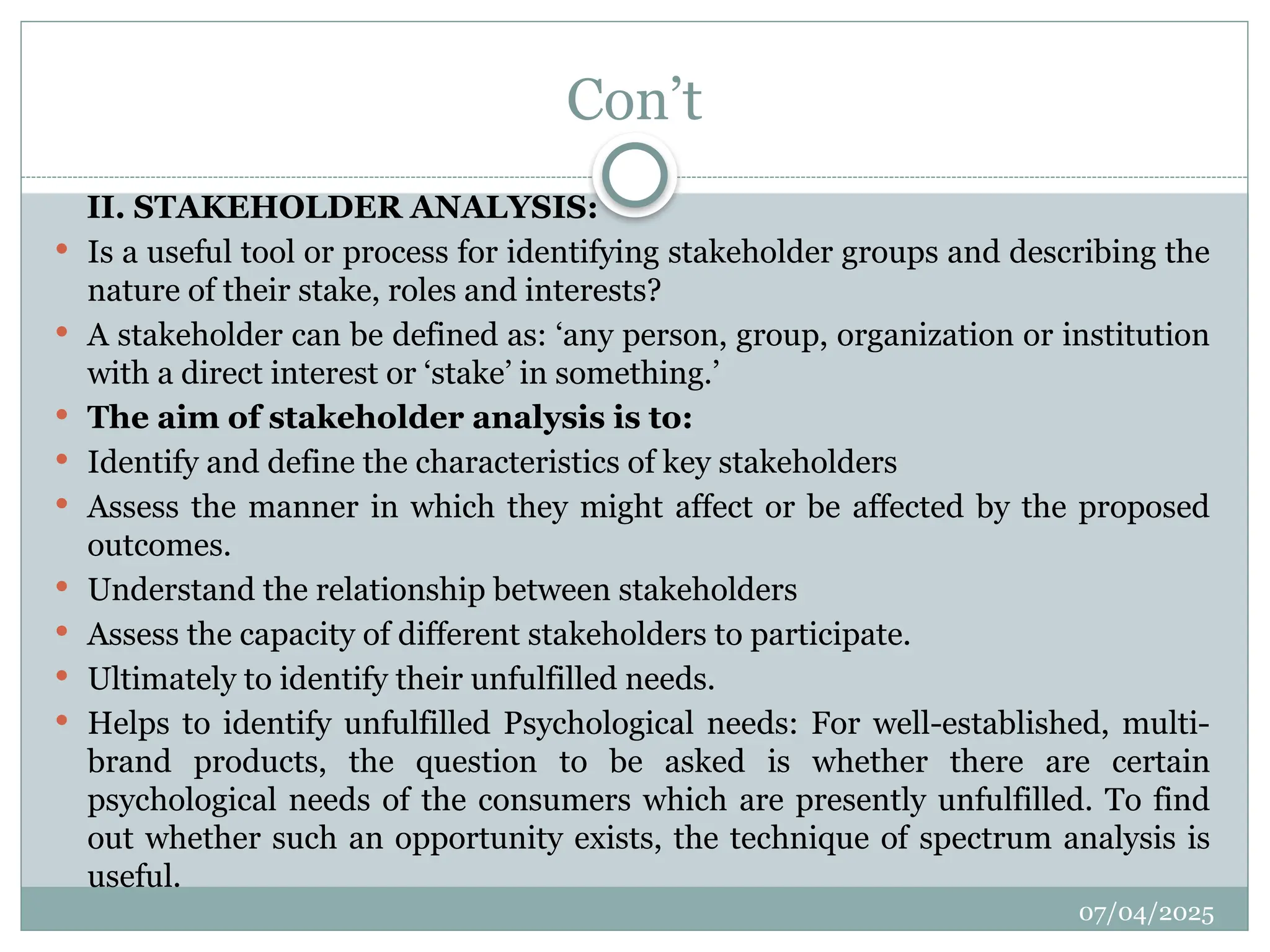
II. STAKEHOLDER ANALYSIS:
 Is a useful tool or process for identifying stakeholder groups and describing the
nature of their stake, roles and interests?
 A stakeholder can be defined as: ‘any person, group, organization or institution
with a direct interest or ‘stake’ in something.’
 The aim of stakeholder analysis is to:
 Identify and define the characteristics of key stakeholders
 Assess the manner in which they might affect or be affected by the proposed
outcomes.
 Understand the relationship between stakeholders
 Assess the capacity of different stakeholders to participate.
 Ultimately to identify their unfulfilled needs.
 Helps to identify unfulfilled Psychological needs: For well-established, multi-
brand products, the question to be asked is whether there are certain
psychological needs of the consumers which are presently unfulfilled. To find
out whether such an opportunity exists, the technique of spectrum analysis is
useful.
07/04/2025
Con’t
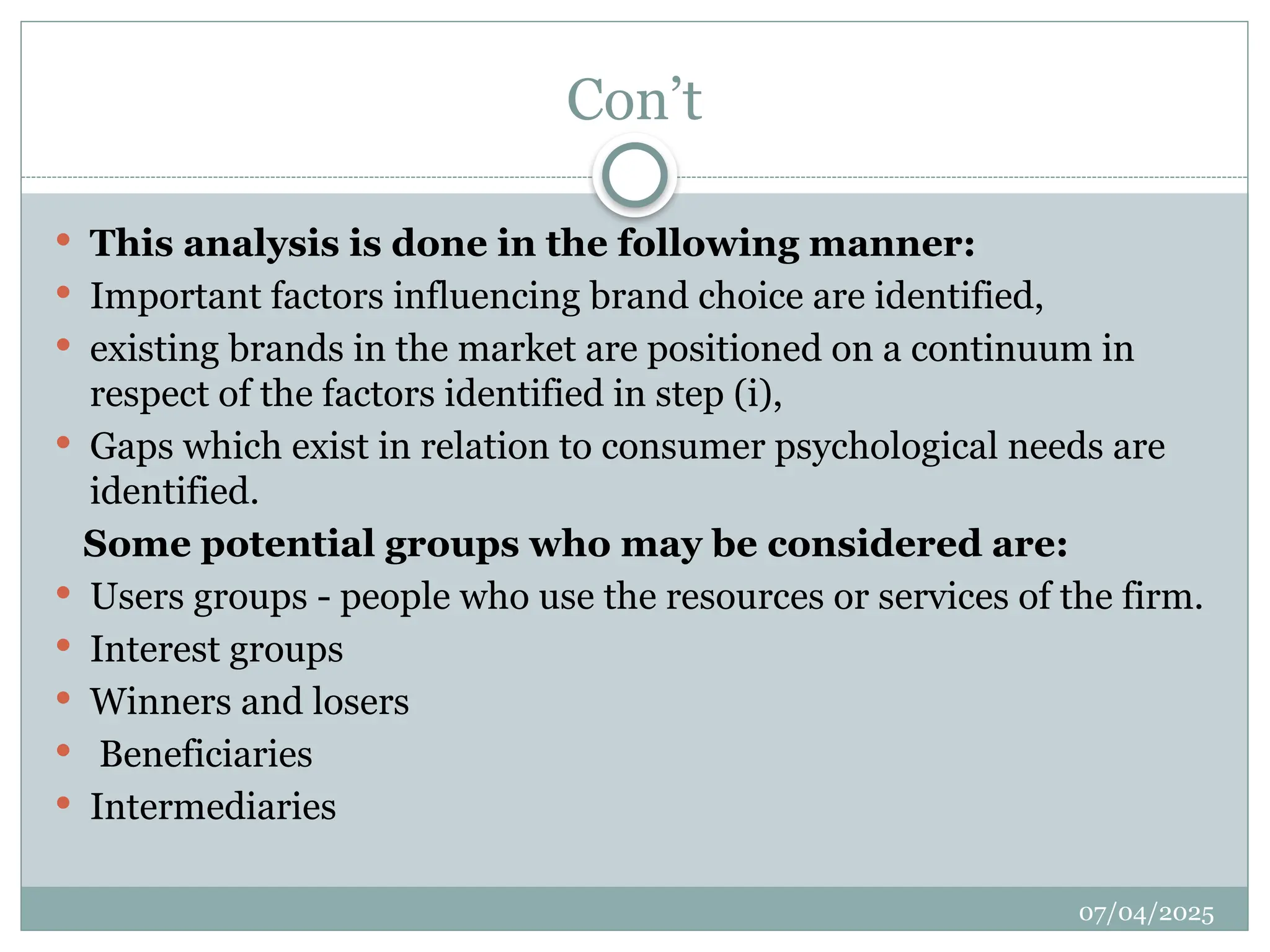
 This analysis is done in the following manner:
 Important factors influencing brand choice are identified,
 existing brands in the market are positioned on a continuum in
respect of the factors identified in step (i),
 Gaps which exist in relation to consumer psychological needs are
identified.
Some potential groups who may be considered are:
 Users groups - people who use the resources or services of the firm.
 Interest groups
 Winners and losers
 Beneficiaries
 Intermediaries
07/04/2025
Con’t
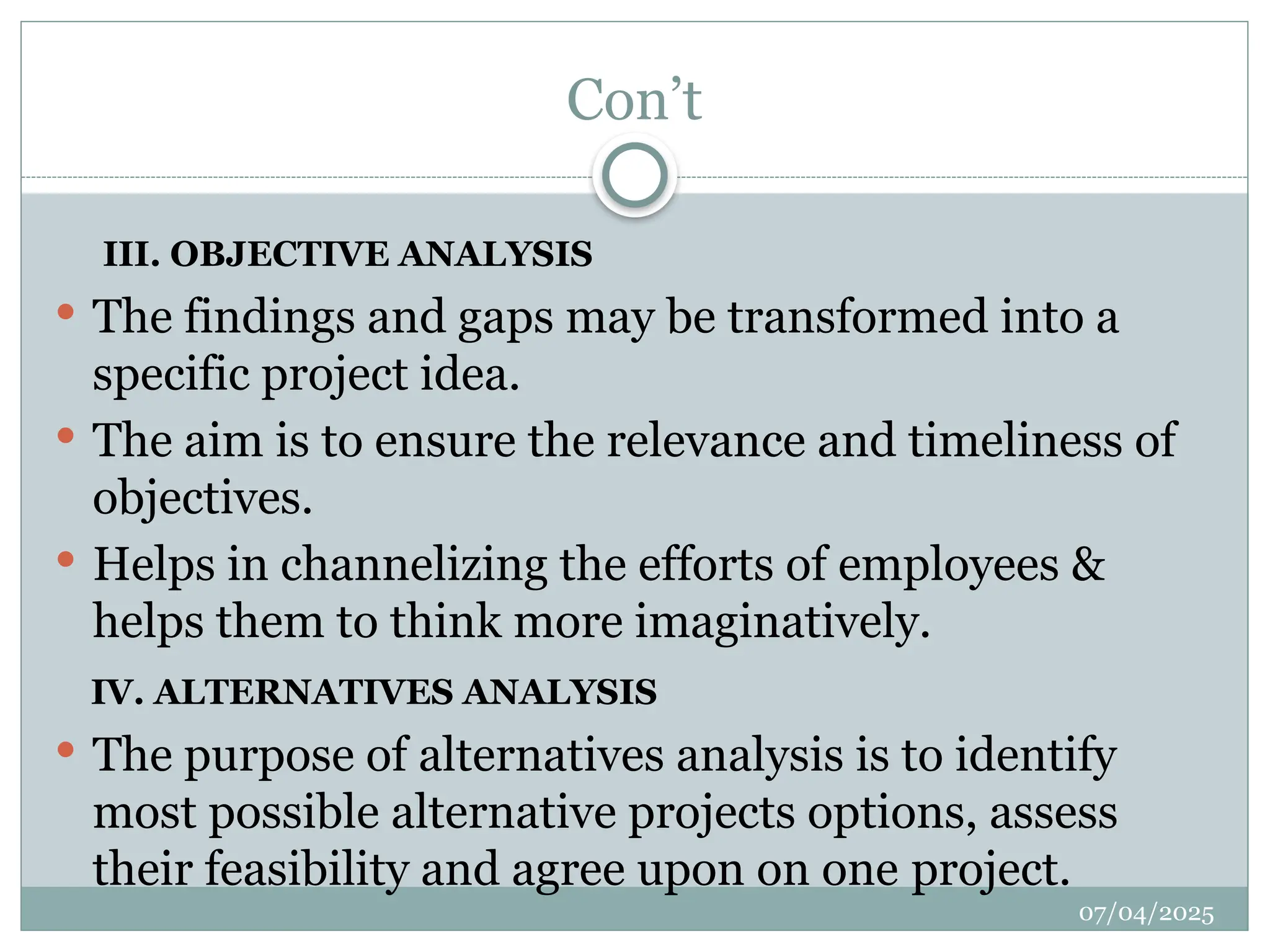
III. OBJECTIVE ANALYSIS
 The findings and gaps may be transformed into a
specific project idea.
 The aim is to ensure the relevance and timeliness of
objectives.
 Helps in channelizing the efforts of employees &
helps them to think more imaginatively.
IV. ALTERNATIVES ANALYSIS
 The purpose of alternatives analysis is to identify
most possible alternative projects options, assess
their feasibility and agree upon on one project.
07/04/2025
IV. SWOT ANALYSIS
 A conscious deliberate and systematic effort by an organization to identify opportunities
that can be profitably exploited by it.
 Used to analyse the internal strengths and weaknesses of an organization and the
external opportunities and threats that it faces.
 SWOT analysis is a tool used to evaluate the Strengths, Weaknesses, Opportunities, and
Threats involved in a project idea.
 It involves specifying the objective of the business venture or project and identifying the
internal and external factors that are favorable and unfavorable to achieve the objective.
 Must first start with defining a desired end state or objective.
 Internal factors: - The strengths and weaknesses internal to the organization.
 External factors:-The opportunities and threats presented by the external
environment to the organization.
 A project idea may also originate from multiple sources. For instance:
 New experiments emerging from previous project failures,
 Expansion and replication of successful projects tested locally or proven feasible in other
developing countries,
 From the discovery of critical economic and social bottlenecks of shortages, excess or
idle resources,
 Forward & backward linkages with existing projects,
07/04/2025
SW OT ANALYSIS
Dr. Gardachew Worku, Project Analysis and Mgt
Strengths
 Strengths are what you excel at more so than your competitors. Strengths are integral to
your organization, so it can be a pool of talented people, a solid business process, a
proprietary technology, or an excellent work culture. Any aspect of your company that
brings an advantage is a strength.
Weaknesses
 Weaknesses are the things that create disadvantages to your team or organization. These
are inherent features that can be present in personnel, procedures, systems, or culture. If
there is a policy or practice that you want to remove or replace by something better, it
would probably be a weakness.
Opportunities
 Opportunities are favorable external factors that can help you gain an advantage. They are
available openings or chances that your team can pursue with additional effort or
investment. It can be a proper timing, special offer, an easing of restriction, or a recently
released application.
Threats
 Threats can be any external factor that affects the project, team, or business negatively.
They are obstacles to your workflow, schedule, budget, or end product or service. A new
technology, a recent regulation, or the success of a competitor can all be threats.
07/04/2025
Con’t
 A proposal may be deemed to have passed the identification
test and be ready for detailed preparation when:
 Major options and alternatives have been identified and some
initial choices made;
 The principal institutional and policy issues affecting project
outcome have been identified and deemed amenable to solution;
 The project options selected are expected to be justified, given
rough estimates of the expected costs and benefits;
 There is justifiable expectation that the project will have
adequate support from the relevant political authorities, other
stakeholders and the intended beneficiaries.
07/04/2025
Dr. Gardachew Worku, Project Analysis and Mgt
THANK YOU!

Project Management ch3.ppt for masters of management

  • 1.
    07/04/2025 Chapter-3 Project Identification • Thefirst stage in the project life cycle is to find potential projects. • Some of the sources of projects are: i. Resource based ii. Market based iii. Need-based iv. Well – informed technical specialists and local leaders are also common sources of projects  Ideas for new projects also may come from proposals to extend existing programs.  In general, most projects start as an elementary idea.  Identification is the first step in the project cycle  Opportunity sensing is essential for new as well as existing entrepreneurs; once existing entrepreneurs reach the comfort stage in their project, new business opportunities need to be identified for enterprise sustenance, growth and development.
  • 2.
    07/04/2025 Con’t  In thepresent era of liberalization and globalization, competition is increasingly intensifying. Growth opportunities abound for expansion, diversification or modernization, and for this entrepreneur needs to scan the emerging environment before finalizing the most optimal opportunity that maximizes gains from limited investment and resources  Project identification is the idea stage and it involves activities concerned with surveying, reviewing and inventorizing existing data and information. These include:  natural resource data  human resource data  socio-economic data  resource availability  market gap  need gap
  • 3.
    07/04/2025 Con’t  Having achieveda good database, the process of identification of gaps would have been laid. Thus, such gaps, which lead to project ideas, could be generated  Once a project is identified, the next step is to carry out a project preparation document, which is also called feasibility study  There are three main steps that should take place.  Identification of needs and problem recognition.  The formulation of objectives that projects should aim at  Identification of suitable projects This is a stage where one project-idea out of several alternatives is chosen and defined.  It involves identifying environmental problems to be addressed and the needs and interests of possible beneficiaries and stakeholders.
  • 4.
    07/04/2025 Con’t  Generally, projectideas are born:  Micro level sources:- Project ideas originated at individual or household level  Macro Sources: Project ideas originated by institutions at regional or federal level.  Sources of project ideas: Identification is often the outcome of a triggering process rather than an analytical exercise.  Problem analysis  Stakeholder analysis  Objective analysis  Alternative analysis  SWOT analysis
  • 5.
    07/04/2025 Con’t I. PROBLEM ANALYSIS On the basis of available information, the existing situation is analysed  The major problems are identified and the main causal relationships between these are visualized.  The aim at this early stage is to establish an overview of the situation.  In formulating problems, existing problems should be identified and will serve as source of project idea. A. Analyze the performance of existing industries:  A study of existing industries in terms of their profitability and capacity utilizations  An examination of capacity utilization of various industries provides information Such a study becomes more useful if it is done region wise, particularly for products which have high transportation costs. B. Examine the inputs and outputs of various industries:  Materials, purchased parts or supplies are presently being procured from distant sources with attendant time lag and transportation cost and  Several firms produce internally some components/parts which can be supplied at a lower cost by a single manufacturer who can enjoy economies of scale.  Similarly, a study of the output of the existing industries may reveal opportunities for adding value through further processing of the main outputs.
  • 6.
    07/04/2025 Con’t C. Review importand exports:  Helpful in understanding the trend of imports of various goods and the potential for import substitution.  it improves the balance of payments situation,  it generates employment, and  It provides a market for the supporting industries and services. D. Analyze Economic and Social Trends:  Helpful in projecting demand for various goods and services. E. Draw Clues from Consumption Abroad:  Identify projects for the manufacture of products or supply of services which are new to the country but extensively used abroad.
  • 7.
    07/04/2025 Con’t F. Stimulate Creativityfor Generating New Product Ideas:  Modification,  rearrangement  reversal  magnification  reduction,  Substitution,  adoption and  Combination.
  • 8.
    07/04/2025 Con’t II. STAKEHOLDER ANALYSIS: Is a useful tool or process for identifying stakeholder groups and describing the nature of their stake, roles and interests?  A stakeholder can be defined as: ‘any person, group, organization or institution with a direct interest or ‘stake’ in something.’  The aim of stakeholder analysis is to:  Identify and define the characteristics of key stakeholders  Assess the manner in which they might affect or be affected by the proposed outcomes.  Understand the relationship between stakeholders  Assess the capacity of different stakeholders to participate.  Ultimately to identify their unfulfilled needs.  Helps to identify unfulfilled Psychological needs: For well-established, multi- brand products, the question to be asked is whether there are certain psychological needs of the consumers which are presently unfulfilled. To find out whether such an opportunity exists, the technique of spectrum analysis is useful.
  • 9.
    07/04/2025 Con’t  This analysisis done in the following manner:  Important factors influencing brand choice are identified,  existing brands in the market are positioned on a continuum in respect of the factors identified in step (i),  Gaps which exist in relation to consumer psychological needs are identified. Some potential groups who may be considered are:  Users groups - people who use the resources or services of the firm.  Interest groups  Winners and losers  Beneficiaries  Intermediaries
  • 10.
    07/04/2025 Con’t III. OBJECTIVE ANALYSIS The findings and gaps may be transformed into a specific project idea.  The aim is to ensure the relevance and timeliness of objectives.  Helps in channelizing the efforts of employees & helps them to think more imaginatively. IV. ALTERNATIVES ANALYSIS  The purpose of alternatives analysis is to identify most possible alternative projects options, assess their feasibility and agree upon on one project.
  • 11.
    07/04/2025 IV. SWOT ANALYSIS A conscious deliberate and systematic effort by an organization to identify opportunities that can be profitably exploited by it.  Used to analyse the internal strengths and weaknesses of an organization and the external opportunities and threats that it faces.  SWOT analysis is a tool used to evaluate the Strengths, Weaknesses, Opportunities, and Threats involved in a project idea.  It involves specifying the objective of the business venture or project and identifying the internal and external factors that are favorable and unfavorable to achieve the objective.  Must first start with defining a desired end state or objective.  Internal factors: - The strengths and weaknesses internal to the organization.  External factors:-The opportunities and threats presented by the external environment to the organization.  A project idea may also originate from multiple sources. For instance:  New experiments emerging from previous project failures,  Expansion and replication of successful projects tested locally or proven feasible in other developing countries,  From the discovery of critical economic and social bottlenecks of shortages, excess or idle resources,  Forward & backward linkages with existing projects,
  • 12.
    07/04/2025 SW OT ANALYSIS Dr.Gardachew Worku, Project Analysis and Mgt Strengths  Strengths are what you excel at more so than your competitors. Strengths are integral to your organization, so it can be a pool of talented people, a solid business process, a proprietary technology, or an excellent work culture. Any aspect of your company that brings an advantage is a strength. Weaknesses  Weaknesses are the things that create disadvantages to your team or organization. These are inherent features that can be present in personnel, procedures, systems, or culture. If there is a policy or practice that you want to remove or replace by something better, it would probably be a weakness. Opportunities  Opportunities are favorable external factors that can help you gain an advantage. They are available openings or chances that your team can pursue with additional effort or investment. It can be a proper timing, special offer, an easing of restriction, or a recently released application. Threats  Threats can be any external factor that affects the project, team, or business negatively. They are obstacles to your workflow, schedule, budget, or end product or service. A new technology, a recent regulation, or the success of a competitor can all be threats.
  • 13.
    07/04/2025 Con’t  A proposalmay be deemed to have passed the identification test and be ready for detailed preparation when:  Major options and alternatives have been identified and some initial choices made;  The principal institutional and policy issues affecting project outcome have been identified and deemed amenable to solution;  The project options selected are expected to be justified, given rough estimates of the expected costs and benefits;  There is justifiable expectation that the project will have adequate support from the relevant political authorities, other stakeholders and the intended beneficiaries.
  • 14.
    07/04/2025 Dr. Gardachew Worku,Project Analysis and Mgt THANK YOU!