Presentation on
ISO/IEC 17025:2017
Presented by: Md. Tarikul Islam
Sub-assistant Manager
Microbiology Department
PRAN Quality Control Laboratory-PIP
What is ISO 17025:2017 ?
 General requirements for the competence, impartiality & consistent operation of
testing and calibration laboratories.
 This is an International Standard which is the basis for accreditation from an
accrediting body.
Key Changes in ISO 17025:2017 version
over ISO 17025:2005 version
 Change from Procedure-based to Performance-based.
 Focus on Impartiality, Competence & Consistent operations.
 Addition of Sampling to Laboratory activities.
 Recognition of Electronic-based systems & records.
 Great alignment with ISO 9001 (Clause- 8).
 Risk-based approach.
 Decision Rule (Measurement of Uncertainty)
 Introduce greater flexibility & focus on results.
Purpose of ISO/IEC 17025:2017
 It enables laboratories to demonstrate that they operate laboratory activities
competently and generate valid results.
 Thereby promoting confidence in their work both nationally and around the world.
Benefits from ISO 17025:2017
 International Reputation.
 Cost Reduction.
 Systemic Approach.
 Improved Laboratory testing Environment.
 Enhanced Customer’s Satisfaction Level.
 Documentation.
 Employee Moral & Training.
Accreditation
 The action or process of officially recognizing someone as having a particular
status or being qualified to perform a particular activity.
 The independent, third-party evaluation of a conformity assessment body against
recognized standards, conveying formal demonstration of its impartiality and
competence to carry out specific conformity assessment tasks (such as certification,
inspection and testing).
Scope (1)
 This document specifies the general requirements for the competence, impartiality
and consistent operation of laboratories.
 This document is applicable to all organizations performing laboratory activities,
regardless of the number of personnel.
 Laboratory customers, regulatory authorities, organizations and schemes using
peer-assessment, accreditation bodies, and others use this document in confirming
or recognizing the competence of laboratories.
Meaning of Some Terms
 “Shall” indicates a requirement
 “Should” indicates a recommendation
 “May” indicates a permission
 “Can” indicates a possibility or a capability.
WHAT IS RISK-BASED THINKING?
 The concept of risk has always been implicit in ISO 9001 – the 2015 revision makes it more explicit
and builds it into the whole management system
 Risk-based thinking is already part of the process approach.
 Risk-based thinking makes preventive action part of the routine.
 Risk is often thought of only in the negative sense .
 Risk-based thinking can also help to identify opportunities. This can be considered to be the positive
side of risk.
Normative Reference (2)
 ISO/IEC Guide 99, International vocabulary of metrology- Basic and general concepts and
associated terms.
 ISO/IEC 17000, Conformity assessment- Vocabulary and general principles.
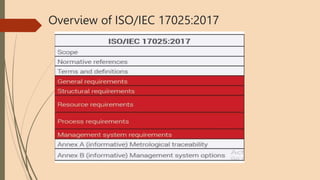
Overview of ISO/IEC 17025:2017
Overall Requirements of ISO 17025:2017
 Management of Personnel Competency.
 Document Control of Procedures.
 Effective Technical Records.
 Suitable Facilities & Conditions.
 Suitable Calibrated Equipment.
 Certified Reference Materials.
 Suitable Reactions.
 Suitable test materials.
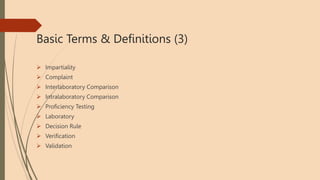
Basic Terms & Definitions (3)
 Impartiality
 Complaint
 Interlaboratory Comparison
 Intralaboratory Comparison
 Proficiency Testing
 Laboratory
 Decision Rule
 Verification
 Validation
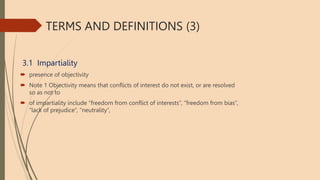
TERMS AND DEFINITIONS (3)
3.1 Impartiality
 presence of objectivity
 Note 1 Objectivity means that conflicts of interest do not exist, or are resolved
so as not to
 of impartiality include “freedom from conflict of interests”, “freedom from bias”,
“lack of prejudice”, “neutrality”,
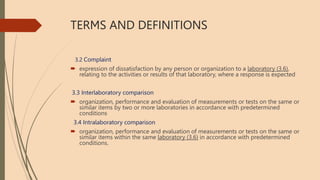
TERMS AND DEFINITIONS
3.2 Complaint
 expression of dissatisfaction by any person or organization to a laboratory (3.6),
relating to the activities or results of that laboratory, where a response is expected
3.3 Interlaboratory comparison
 organization, performance and evaluation of measurements or tests on the same or
similar items by two or more laboratories in accordance with predetermined
conditions
3.4 Intralaboratory comparison
 organization, performance and evaluation of measurements or tests on the same or
similar items within the same laboratory (3.6) in accordance with predetermined
conditions.
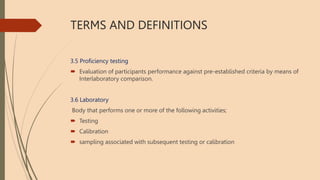
TERMS AND DEFINITIONS
3.5 Proficiency testing
 Evaluation of participants performance against pre-established criteria by means of
Interlaboratory comparison.
3.6 Laboratory
Body that performs one or more of the following activities;
 Testing
 Calibration
 sampling associated with subsequent testing or calibration
TERMS AND DEFINITIONS
3.7 Decision rule-rule that describes how measurement uncertainty is accounted for
when stating conformity with a specified requirement.
3.8 Verification -provision of objective evidence that a given item fulfils specified
requirements.
3.9 Validation -verification, where the specified requirements are adequate for an
intended use.
RISK MANAGEMENT
 Requires the laboratory to plan and implement actions to address & recover
risks and opportunities.
 Establishes a basis for increasing the effectiveness of the quality management
system, achieving improved results and preventing negative effects.
 The laboratory is responsible for deciding which risks and opportunities need to
be addressed.
WHAT SHOULD WE DO ?
 Identify what the risks and opportunities are in your organization
 Plan actions to address the risks
 how can I avoid or eliminate the risk?
 how can I mitigate the risk ?
 Implement the plan – take action
 Check the effectiveness of the actions – does it work?
General Requirements (4)
 Impartiality (4.1).
 Confidentiality (4.2).
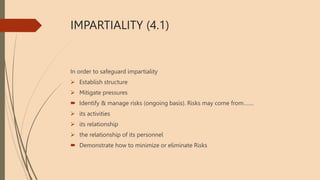
IMPARTIALITY (4.1)
In order to safeguard impartiality
 Establish structure
 Mitigate pressures
 Identify & manage risks (ongoing basis). Risks may come from…….
 its activities
 its relationship
 the relationship of its personnel
 Demonstrate how to minimize or eliminate Risks
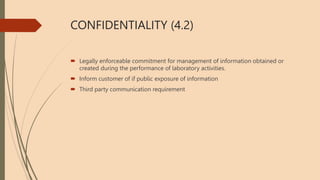
CONFIDENTIALITY (4.2)
 Legally enforceable commitment for management of information obtained or
created during the performance of laboratory activities.
 Inform customer of if public exposure of information
 Third party communication requirement
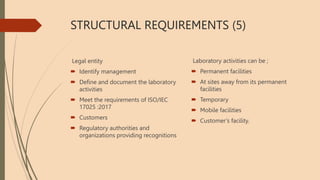
STRUCTURAL REQUIREMENTS (5)
Legal entity
 Identify management
 Define and document the laboratory
activities
 Meet the requirements of ISO/IEC
17025 :2017
 Customers
 Regulatory authorities and
organizations providing recognitions
Laboratory activities can be ;
 Permanent facilities
 At sites away from its permanent
facilities
 Temporary
 Mobile facilities
 Customer’s facility.
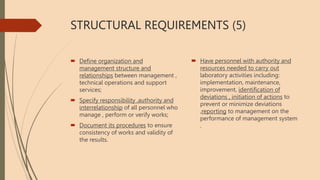
STRUCTURAL REQUIREMENTS (5)
 Define organization and
management structure and
relationships between management ,
technical operations and support
services;
 Specify responsibility ,authority and
interrelationship of all personnel who
manage , perform or verify works;
 Document its procedures to ensure
consistency of works and validity of
the results.
 Have personnel with authority and
resources needed to carry out
laboratory activities including:
implementation, maintenance,
improvement, identification of
deviations , initiation of actions to
prevent or minimize deviations
,reporting to management on the
performance of management system
.
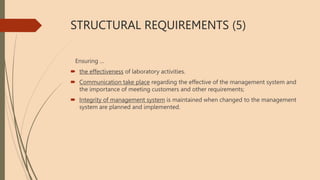
STRUCTURAL REQUIREMENTS (5)
Ensuring …
 the effectiveness of laboratory activities.
 Communication take place regarding the effective of the management system and
the importance of meeting customers and other requirements;
 Integrity of management system is maintained when changed to the management
system are planned and implemented.
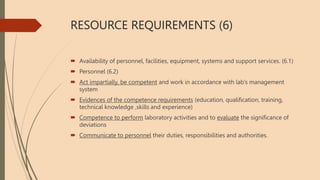
RESOURCE REQUIREMENTS (6)
 Availability of personnel, facilities, equipment, systems and support services. (6.1)
 Personnel (6.2)
 Act impartially, be competent and work in accordance with lab’s management
system
 Evidences of the competence requirements (education, qualification, training,
technical knowledge ,skills and experience)
 Competence to perform laboratory activities and to evaluate the significance of
deviations
 Communicate to personnel their duties, responsibilities and authorities.
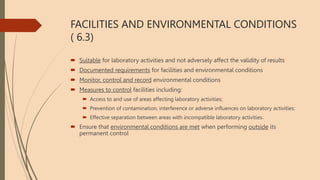
FACILITIES AND ENVIRONMENTAL CONDITIONS
( 6.3)
 Suitable for laboratory activities and not adversely affect the validity of results
 Documented requirements for facilities and environmental conditions
 Monitor, control and record environmental conditions
 Measures to control facilities including:
 Access to and use of areas affecting laboratory activities;
 Prevention of contamination, interference or adverse influences on laboratory activities;
 Effective separation between areas with incompatible laboratory activities.
 Ensure that environmental conditions are met when performing outside its
permanent control
EQUIPMENT (6.4)
 Available and function properly
 Conform with specification before
place into service
 Capable to achieve required accuracy
 Calibration of measuring equipment
 Establish calibration program
 Calibration status
 Action for out of service
 Intermediate checks
 Update/implement correction factors
or reference values
 Measures to prevent unintended
adjustments
 Equipment records
METROLOGICAL TRACEABILITY (6.5)
 Establish and maintain metrological traceability of its measurement results
 Ensure that measurement results are traceable to the SI units:
 Competent laboratory;
 Competent producer;
 Comparison, directly or indirectly with national or international standards.
 Demonstrate metrological traceability to an appropriate reference when not
technical possible to the SI units:
 Competent producer;
 Suitable comparison.
EXTERNALLY PROVIDED PRODUCTS AND
SERVICES (6.6)
 Ensure that suitable externally provided products and services are used when
products and services:
 Are intended for incorporation into the laboratory’s own activities;
 Are provided ,in part or in full, directly to the customer by the laboratory as
received from the external provider;
 Are used to support the operation of the laboratory.
PROCESS REQUIREMENTS (7)
 REVIEW OF REQUESTS,TENDERS AND CONTRACTS (7.1)
 SELECTION, VERIFICATION AND VALIDATION OF METHODS (7.2)
 SAMPLING (7.3)
 Sampling plan
 Sampling method
 Retain records
 HANDLING OF TEST OR CALIBRATION ITEMS (7.4)
HANDLING OF TEST OR CALIBRATION
ITEMS (7.4)
 Have a procedure
 Have a system for unambiguous identification
 Records of the item
 Facilities to maintain items
TECHNICAL RECORDS (7.5)
 Sufficient information
 Amendment can be tracked to previous versions or original observations
Measurement of Uncertainty (7.6)
 Sources of Deviations.
 All deviations shall be sum. Up through valid equation.
 Convert all Data into same unit.
 Lowest valued unit shall be used.
 Shall measure at least once in a year based on changes in
parameters/conditions/Environment/facilities.
 The laboratory shall perform Repeatability & Reproducibility to determine the
Measurement of Uncertainty.
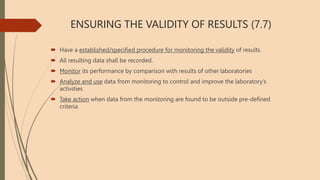
ENSURING THE VALIDITY OF RESULTS (7.7)
 Have a established/specified procedure for monitoring the validity of results.
 All resulting data shall be recorded.
 Monitor its performance by comparison with results of other laboratories
 Analyze and use data from monitoring to control and improve the laboratory’s
activities
 Take action when data from the monitoring are found to be outside pre-defined
criteria
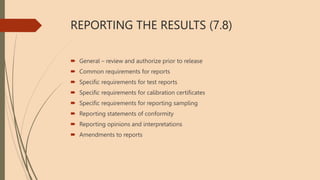
REPORTING THE RESULTS (7.8)
 General – review and authorize prior to release
 Common requirements for reports
 Specific requirements for test reports
 Specific requirements for calibration certificates
 Specific requirements for reporting sampling
 Reporting statements of conformity
 Reporting opinions and interpretations
 Amendments to reports
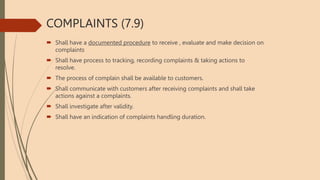
COMPLAINTS (7.9)
 Shall have a documented procedure to receive , evaluate and make decision on
complaints
 Shall have process to tracking, recording complaints & taking actions to
resolve.
 The process of complain shall be available to customers.
 Shall communicate with customers after receiving complaints and shall take
actions against a complaints.
 Shall investigate after validity.
 Shall have an indication of complaints handling duration.
NONCONFORMING WORK (7.10)
 Have a defined/specified procedure to
find out & handle Non-conforming
Work.
 Shall identify the sources.
 Shall take Corrective Actions based
upon the risk levels established by the
laboratory
 An evaluation is made of the
significance of
 A decision is taken on the acceptability
of NC work
 The responsibility for authorizing the
resumption of work is defined.
 Retain records of NC work and actions
taken
 Implement corrective action where the
evaluation indicates the NC work could
recur or is doubt about the conformity
of laboratory’s operation
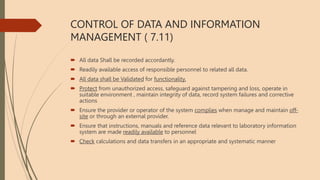
CONTROL OF DATA AND INFORMATION
MANAGEMENT ( 7.11)
 All data Shall be recorded accordantly.
 Readily available access of responsible personnel to related all data.
 All data shall be Validated for functionality.
 Protect from unauthorized access, safeguard against tampering and loss, operate in
suitable environment , maintain integrity of data, record system failures and corrective
actions
 Ensure the provider or operator of the system complies when manage and maintain off-
site or through an external provider.
 Ensure that instructions, manuals and reference data relevant to laboratory information
system are made readily available to personnel
 Check calculations and data transfers in an appropriate and systematic manner
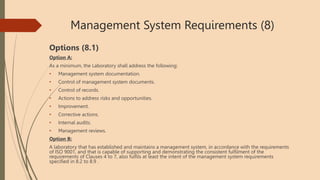
Management System Requirements (8)
Options (8.1)
Option A:
As a minimum, the Laboratory shall address the following:
• Management system documentation.
• Control of management system documents.
• Control of records.
• Actions to address risks and opportunities.
• Improvement.
• Corrective actions.
• Internal audits.
• Management reviews.
Option B:
A laboratory that has established and maintains a management system, in accordance with the requirements
of ISO 9001, and that is capable of supporting and demonstrating the consistent fulfilment of the
requirements of Clauses 4 to 7, also fulfils at least the intent of the management system requirements
specified in 8.2 to 8.9 .
MANAGEMENT SYSTEM DOCUMENTATION (8.2)
 MS Documentation - Policies & Objectives for the fulfilment of the purpose of
ISO/IEC 17025:2017
 Establish ,document and maintain
 Acknowledge and implement at all levels of the laboratory organization
 Address the competence, impartiality and consistent of the operation
 Make reference or link to other documents
 Easy to access by relevant personnel
 EVIDENCES of commitment to the development and implementation of the MS and
to continually improving its effectiveness.
CONTROL OF MANAGEMENT SYSTEM
DOCUMENTATION (8.3)
Ensure……….
 Approve prior to issue
 Review / update
 Identification of current revision / changes
 Available at point of use
 Uniquely identify
 Unintended use of obsolete documents
CONTROLS OF RECORDS (8.4)
 Establish and retain legible records
 Implement the controls
 Retain for a period consistent with its contractual obligations
 Readily available
Actions to address risks & opportunities (8.5)
 The Laboratory shall consider the risks & opportunities associated with the laboratory
activities in order to-
 Give assurance that the management system achieves its intended results.
 Enhance opportunities to achieve the purpose and objectives of the laboratory.
 Prevent or reduce undesired impacts and potential failures in the laboratory activities.
 Achieve improvement.
 The Laboratory shall plan actions to address these risks & opportunities.
 Actions taken to address risks & opportunities shall be proportional to the potential impact
on the validity of laboratory results.
IMPROVEMENT (8.6)
 Identify and select opportunities for improvement
 Implementation
 Seek feed back & use and analyze feed back to improve the MS
CORRECTIVE ACTIONS (8.7)
 React to NC
 Evaluate the need for action & implement
 Review the effectiveness
 Update risk & opportunities
 Make changes to the MS
 Retain records
INTERNAL AUDITS (8.8)
 Conduct as planned intervals
 Plan , establish and maintain audit program
 Define the audit criteria and scope for each audit
 Report the results to relevant management
 Implement correction and corrective actions without undue delay
 Retain records
MANAGEMENT REVIEWS(8.9)
 Review at planned intervals
 Record all inputs to the management review
 Record all decisions and actions of output
Thanks…

Presentation on ISO-IEC 17025-2017.pptx

  • 1.
    Presentation on ISO/IEC 17025:2017 Presentedby: Md. Tarikul Islam Sub-assistant Manager Microbiology Department PRAN Quality Control Laboratory-PIP
  • 2.
    What is ISO17025:2017 ?  General requirements for the competence, impartiality & consistent operation of testing and calibration laboratories.  This is an International Standard which is the basis for accreditation from an accrediting body.
  • 3.
    Key Changes inISO 17025:2017 version over ISO 17025:2005 version  Change from Procedure-based to Performance-based.  Focus on Impartiality, Competence & Consistent operations.  Addition of Sampling to Laboratory activities.  Recognition of Electronic-based systems & records.  Great alignment with ISO 9001 (Clause- 8).  Risk-based approach.  Decision Rule (Measurement of Uncertainty)  Introduce greater flexibility & focus on results.
  • 4.
    Purpose of ISO/IEC17025:2017  It enables laboratories to demonstrate that they operate laboratory activities competently and generate valid results.  Thereby promoting confidence in their work both nationally and around the world.
  • 5.
    Benefits from ISO17025:2017  International Reputation.  Cost Reduction.  Systemic Approach.  Improved Laboratory testing Environment.  Enhanced Customer’s Satisfaction Level.  Documentation.  Employee Moral & Training.
  • 6.
    Accreditation  The actionor process of officially recognizing someone as having a particular status or being qualified to perform a particular activity.  The independent, third-party evaluation of a conformity assessment body against recognized standards, conveying formal demonstration of its impartiality and competence to carry out specific conformity assessment tasks (such as certification, inspection and testing).
  • 7.
    Scope (1)  Thisdocument specifies the general requirements for the competence, impartiality and consistent operation of laboratories.  This document is applicable to all organizations performing laboratory activities, regardless of the number of personnel.  Laboratory customers, regulatory authorities, organizations and schemes using peer-assessment, accreditation bodies, and others use this document in confirming or recognizing the competence of laboratories.
  • 8.
    Meaning of SomeTerms  “Shall” indicates a requirement  “Should” indicates a recommendation  “May” indicates a permission  “Can” indicates a possibility or a capability.
  • 9.
    WHAT IS RISK-BASEDTHINKING?  The concept of risk has always been implicit in ISO 9001 – the 2015 revision makes it more explicit and builds it into the whole management system  Risk-based thinking is already part of the process approach.  Risk-based thinking makes preventive action part of the routine.  Risk is often thought of only in the negative sense .  Risk-based thinking can also help to identify opportunities. This can be considered to be the positive side of risk.
  • 10.
    Normative Reference (2) ISO/IEC Guide 99, International vocabulary of metrology- Basic and general concepts and associated terms.  ISO/IEC 17000, Conformity assessment- Vocabulary and general principles.
  • 11.
  • 12.
    Overall Requirements ofISO 17025:2017  Management of Personnel Competency.  Document Control of Procedures.  Effective Technical Records.  Suitable Facilities & Conditions.  Suitable Calibrated Equipment.  Certified Reference Materials.  Suitable Reactions.  Suitable test materials.
  • 13.
    Basic Terms &Definitions (3)  Impartiality  Complaint  Interlaboratory Comparison  Intralaboratory Comparison  Proficiency Testing  Laboratory  Decision Rule  Verification  Validation
  • 14.
    TERMS AND DEFINITIONS(3) 3.1 Impartiality  presence of objectivity  Note 1 Objectivity means that conflicts of interest do not exist, or are resolved so as not to  of impartiality include “freedom from conflict of interests”, “freedom from bias”, “lack of prejudice”, “neutrality”,
  • 15.
    TERMS AND DEFINITIONS 3.2Complaint  expression of dissatisfaction by any person or organization to a laboratory (3.6), relating to the activities or results of that laboratory, where a response is expected 3.3 Interlaboratory comparison  organization, performance and evaluation of measurements or tests on the same or similar items by two or more laboratories in accordance with predetermined conditions 3.4 Intralaboratory comparison  organization, performance and evaluation of measurements or tests on the same or similar items within the same laboratory (3.6) in accordance with predetermined conditions.
  • 16.
    TERMS AND DEFINITIONS 3.5Proficiency testing  Evaluation of participants performance against pre-established criteria by means of Interlaboratory comparison. 3.6 Laboratory Body that performs one or more of the following activities;  Testing  Calibration  sampling associated with subsequent testing or calibration
  • 17.
    TERMS AND DEFINITIONS 3.7Decision rule-rule that describes how measurement uncertainty is accounted for when stating conformity with a specified requirement. 3.8 Verification -provision of objective evidence that a given item fulfils specified requirements. 3.9 Validation -verification, where the specified requirements are adequate for an intended use.
  • 18.
    RISK MANAGEMENT  Requiresthe laboratory to plan and implement actions to address & recover risks and opportunities.  Establishes a basis for increasing the effectiveness of the quality management system, achieving improved results and preventing negative effects.  The laboratory is responsible for deciding which risks and opportunities need to be addressed.
  • 19.
    WHAT SHOULD WEDO ?  Identify what the risks and opportunities are in your organization  Plan actions to address the risks  how can I avoid or eliminate the risk?  how can I mitigate the risk ?  Implement the plan – take action  Check the effectiveness of the actions – does it work?
  • 20.
    General Requirements (4) Impartiality (4.1).  Confidentiality (4.2).
  • 21.
    IMPARTIALITY (4.1) In orderto safeguard impartiality  Establish structure  Mitigate pressures  Identify & manage risks (ongoing basis). Risks may come from…….  its activities  its relationship  the relationship of its personnel  Demonstrate how to minimize or eliminate Risks
  • 22.
    CONFIDENTIALITY (4.2)  Legallyenforceable commitment for management of information obtained or created during the performance of laboratory activities.  Inform customer of if public exposure of information  Third party communication requirement
  • 23.
    STRUCTURAL REQUIREMENTS (5) Legalentity  Identify management  Define and document the laboratory activities  Meet the requirements of ISO/IEC 17025 :2017  Customers  Regulatory authorities and organizations providing recognitions Laboratory activities can be ;  Permanent facilities  At sites away from its permanent facilities  Temporary  Mobile facilities  Customer’s facility.
  • 24.
    STRUCTURAL REQUIREMENTS (5) Define organization and management structure and relationships between management , technical operations and support services;  Specify responsibility ,authority and interrelationship of all personnel who manage , perform or verify works;  Document its procedures to ensure consistency of works and validity of the results.  Have personnel with authority and resources needed to carry out laboratory activities including: implementation, maintenance, improvement, identification of deviations , initiation of actions to prevent or minimize deviations ,reporting to management on the performance of management system .
  • 25.
    STRUCTURAL REQUIREMENTS (5) Ensuring…  the effectiveness of laboratory activities.  Communication take place regarding the effective of the management system and the importance of meeting customers and other requirements;  Integrity of management system is maintained when changed to the management system are planned and implemented.
  • 26.
    RESOURCE REQUIREMENTS (6) Availability of personnel, facilities, equipment, systems and support services. (6.1)  Personnel (6.2)  Act impartially, be competent and work in accordance with lab’s management system  Evidences of the competence requirements (education, qualification, training, technical knowledge ,skills and experience)  Competence to perform laboratory activities and to evaluate the significance of deviations  Communicate to personnel their duties, responsibilities and authorities.
  • 27.
    FACILITIES AND ENVIRONMENTALCONDITIONS ( 6.3)  Suitable for laboratory activities and not adversely affect the validity of results  Documented requirements for facilities and environmental conditions  Monitor, control and record environmental conditions  Measures to control facilities including:  Access to and use of areas affecting laboratory activities;  Prevention of contamination, interference or adverse influences on laboratory activities;  Effective separation between areas with incompatible laboratory activities.  Ensure that environmental conditions are met when performing outside its permanent control
  • 28.
    EQUIPMENT (6.4)  Availableand function properly  Conform with specification before place into service  Capable to achieve required accuracy  Calibration of measuring equipment  Establish calibration program  Calibration status  Action for out of service  Intermediate checks  Update/implement correction factors or reference values  Measures to prevent unintended adjustments  Equipment records
  • 29.
    METROLOGICAL TRACEABILITY (6.5) Establish and maintain metrological traceability of its measurement results  Ensure that measurement results are traceable to the SI units:  Competent laboratory;  Competent producer;  Comparison, directly or indirectly with national or international standards.  Demonstrate metrological traceability to an appropriate reference when not technical possible to the SI units:  Competent producer;  Suitable comparison.
  • 30.
    EXTERNALLY PROVIDED PRODUCTSAND SERVICES (6.6)  Ensure that suitable externally provided products and services are used when products and services:  Are intended for incorporation into the laboratory’s own activities;  Are provided ,in part or in full, directly to the customer by the laboratory as received from the external provider;  Are used to support the operation of the laboratory.
  • 31.
    PROCESS REQUIREMENTS (7) REVIEW OF REQUESTS,TENDERS AND CONTRACTS (7.1)  SELECTION, VERIFICATION AND VALIDATION OF METHODS (7.2)  SAMPLING (7.3)  Sampling plan  Sampling method  Retain records  HANDLING OF TEST OR CALIBRATION ITEMS (7.4)
  • 32.
    HANDLING OF TESTOR CALIBRATION ITEMS (7.4)  Have a procedure  Have a system for unambiguous identification  Records of the item  Facilities to maintain items
  • 33.
    TECHNICAL RECORDS (7.5) Sufficient information  Amendment can be tracked to previous versions or original observations
  • 34.
    Measurement of Uncertainty(7.6)  Sources of Deviations.  All deviations shall be sum. Up through valid equation.  Convert all Data into same unit.  Lowest valued unit shall be used.  Shall measure at least once in a year based on changes in parameters/conditions/Environment/facilities.  The laboratory shall perform Repeatability & Reproducibility to determine the Measurement of Uncertainty.
  • 35.
    ENSURING THE VALIDITYOF RESULTS (7.7)  Have a established/specified procedure for monitoring the validity of results.  All resulting data shall be recorded.  Monitor its performance by comparison with results of other laboratories  Analyze and use data from monitoring to control and improve the laboratory’s activities  Take action when data from the monitoring are found to be outside pre-defined criteria
  • 36.
    REPORTING THE RESULTS(7.8)  General – review and authorize prior to release  Common requirements for reports  Specific requirements for test reports  Specific requirements for calibration certificates  Specific requirements for reporting sampling  Reporting statements of conformity  Reporting opinions and interpretations  Amendments to reports
  • 37.
    COMPLAINTS (7.9)  Shallhave a documented procedure to receive , evaluate and make decision on complaints  Shall have process to tracking, recording complaints & taking actions to resolve.  The process of complain shall be available to customers.  Shall communicate with customers after receiving complaints and shall take actions against a complaints.  Shall investigate after validity.  Shall have an indication of complaints handling duration.
  • 38.
    NONCONFORMING WORK (7.10) Have a defined/specified procedure to find out & handle Non-conforming Work.  Shall identify the sources.  Shall take Corrective Actions based upon the risk levels established by the laboratory  An evaluation is made of the significance of  A decision is taken on the acceptability of NC work  The responsibility for authorizing the resumption of work is defined.  Retain records of NC work and actions taken  Implement corrective action where the evaluation indicates the NC work could recur or is doubt about the conformity of laboratory’s operation
  • 39.
    CONTROL OF DATAAND INFORMATION MANAGEMENT ( 7.11)  All data Shall be recorded accordantly.  Readily available access of responsible personnel to related all data.  All data shall be Validated for functionality.  Protect from unauthorized access, safeguard against tampering and loss, operate in suitable environment , maintain integrity of data, record system failures and corrective actions  Ensure the provider or operator of the system complies when manage and maintain off- site or through an external provider.  Ensure that instructions, manuals and reference data relevant to laboratory information system are made readily available to personnel  Check calculations and data transfers in an appropriate and systematic manner
  • 40.
    Management System Requirements(8) Options (8.1) Option A: As a minimum, the Laboratory shall address the following: • Management system documentation. • Control of management system documents. • Control of records. • Actions to address risks and opportunities. • Improvement. • Corrective actions. • Internal audits. • Management reviews. Option B: A laboratory that has established and maintains a management system, in accordance with the requirements of ISO 9001, and that is capable of supporting and demonstrating the consistent fulfilment of the requirements of Clauses 4 to 7, also fulfils at least the intent of the management system requirements specified in 8.2 to 8.9 .
  • 41.
    MANAGEMENT SYSTEM DOCUMENTATION(8.2)  MS Documentation - Policies & Objectives for the fulfilment of the purpose of ISO/IEC 17025:2017  Establish ,document and maintain  Acknowledge and implement at all levels of the laboratory organization  Address the competence, impartiality and consistent of the operation  Make reference or link to other documents  Easy to access by relevant personnel  EVIDENCES of commitment to the development and implementation of the MS and to continually improving its effectiveness.
  • 42.
    CONTROL OF MANAGEMENTSYSTEM DOCUMENTATION (8.3) Ensure……….  Approve prior to issue  Review / update  Identification of current revision / changes  Available at point of use  Uniquely identify  Unintended use of obsolete documents
  • 43.
    CONTROLS OF RECORDS(8.4)  Establish and retain legible records  Implement the controls  Retain for a period consistent with its contractual obligations  Readily available
  • 44.
    Actions to addressrisks & opportunities (8.5)  The Laboratory shall consider the risks & opportunities associated with the laboratory activities in order to-  Give assurance that the management system achieves its intended results.  Enhance opportunities to achieve the purpose and objectives of the laboratory.  Prevent or reduce undesired impacts and potential failures in the laboratory activities.  Achieve improvement.  The Laboratory shall plan actions to address these risks & opportunities.  Actions taken to address risks & opportunities shall be proportional to the potential impact on the validity of laboratory results.
  • 45.
    IMPROVEMENT (8.6)  Identifyand select opportunities for improvement  Implementation  Seek feed back & use and analyze feed back to improve the MS
  • 46.
    CORRECTIVE ACTIONS (8.7) React to NC  Evaluate the need for action & implement  Review the effectiveness  Update risk & opportunities  Make changes to the MS  Retain records
  • 47.
    INTERNAL AUDITS (8.8) Conduct as planned intervals  Plan , establish and maintain audit program  Define the audit criteria and scope for each audit  Report the results to relevant management  Implement correction and corrective actions without undue delay  Retain records
  • 48.
    MANAGEMENT REVIEWS(8.9)  Reviewat planned intervals  Record all inputs to the management review  Record all decisions and actions of output
  • 49.