1
Analysis and Optimization of Random Sensing
Order in Cognitive Radio Systems
Hossein Shokri-Ghadikolaei and Carlo Fischione
Abstract—Developing an efficient spectrum access policy en-
ables cognitive radios to dramatically increase spectrum utiliza-
tion while assuring predetermined quality of service levels for the
primary users. In this letter, modeling, performance analysis, and
optimization of a distributed secondary network with random
sensing order policy are studied. Specifically, the secondary
users create a random order of the available channels to sense
and find a transmission opportunity in a distributed manner.
For this network, the average throughputs of the secondary
users and average interference level between the secondary and
primary users are evaluated by a new Markov model. Then, a
maximization of the secondary network performance in terms of
throughput while keeping under control the average interference
is proposed. Then, a simple and practical adaptive algorithm
is developed to optimize the network in a distributed manner.
Interestingly, the proposed algorithm follows the variations of the
wireless channels in non-stationary conditions and besides having
substantially lower computational cost, it outperforms static
brute force optimization. Finally, numerical results are provided
to demonstrate the efficiencies of the proposed schemes. It is
shown that fully distributed algorithms can achieve substantial
performance improvements in cognitive radio networks without
the need of centralized management or message passing among
the users.
Keywords—Cognitive radio, sequential channel sensing, Markov
model, average throughput, average interference.
I. INTRODUCTION
TTH limited spectrum resources and intense growth of high
data rate communications have motivated opportunistic
spectrum access using the promising concept of cognitive radio
networks. Cognitive radio networks can promote spectrum
utilization by allowing low-priority secondary users (SUs) to
opportunistically exploit the unused licensed channels of high-
priority primary users (PUs). Meanwhile, due to preemptive
priority of the PUs to access the channels, the SUs must vacate
the channel whenever the corresponding PUs appear. In this
case, a set of procedures called spectrum handoff (SHO) is
initiated to help the SU to effectively find a new transmission
opportunity and resume its unfinished transmission [1]. To this
end, temporarily-available transmission opportunities must be
explored first.
Generally speaking, there exists more than one channel to be
sensed by an SU. Here, we assume that the SUs can sense and
possibly transmit on one channel at a time due to processing
and hardware constraints. Therefore, an SU sorts the channels
in an order, senses the first channel of the order, and transmits
on the channel provided that it is sensed free. If the channel
is sensed busy, the SU initiates the SHO procedure and then
senses the second channel of the sensing order. This kind of
sensing-access is called sequential channel sensing [1].
The authors are with KTH Royal Institute of Technology, Stockholm,
Sweden (e-mail: hshokri, carlofi@kth.se).
This work was supported by the FP7 EU project Hydrobionets.
The SUs sense the channels at the beginning of each time
slot and initiate the SHO procedure whenever the current
channel is sensed busy. Optimal and suboptimal sensing orders
of a CRN containing only one SU are developed in [2], [3],
which maximize the average achievable throughput of the SU
in a time slot. These results have been further extended for
a CRN with two [4] and multiple SUs [5], [6]. Most of the
literatures, however, focus on single SU or centralized CRNs
[2]–[6]. In [7], an autonomous sensing order setting strategy
is proposed for distributed CRNs with the aim of minimizing
the likelihood of collisions with other SUs. But, the miss
detection probability is assumed zero, meaning that the SUs
do not make interference for the PUs as well as other SUs.
Therefore, quality of service (QoS) provisioning for the PUs
is not addressed in that study. In [8], the authors exploit a
modified p-persistent MAC protocol to set the sensing orders
of the SUs in a distributed manner.
In this letter, we investigate the performance of random
sensing orders policy (RSOP) for the SUs. That is, once an
SHO is triggered, all the SU create a set of random channels
to be sensed. Then, the sequential channel sensing process
is initiated. We provide required guidlines for modeling the
behaviors of the SUs using a finite state Markov chain. By
this model, the performance of the random sensing order
policy is derived, and an effective algorithm is developed to
optimize the performance of the CRN in a distributed fashion.
Compared to the literature mentioned above, this is the first
paper to 1) consider the problem of SHO for sequential channel
sensing in a distributed set-up with multiple SUs with more
realistic assumptions including miss detection and false alarm
probabilities, 2) investigate the impact of the SUs’ transmis-
sions on the channel occupation probabilities, 3) derive the
accumulated interference caused by other SUs’ transmissions,
4) pose an optimization problem and develop a practical
adaptive algorithm to maximize the average throughput while
provisioning QoS for the PUs.
II. RANDOM SENSING ORDER
In the sequential channel sensing methodology, once a hand-
off is requested, each SU’s time slot divides into sensing and
transmission modes. In the sensing mode, the SUs sequentially
sense the channels based on their sensing orders [2]–[6]. The
procedure continues until one of the following events happens
[8]: (a) transmission opportunities are found for all the SUs,
(b) no time remains for sensing new channels in the time slot,
or (c) no non-sensed channels are remained.
The order of the channel heavily affects QoS parameters
of the SUs and PUs and can be optimally determined in a
centralized CRN [2], [5], wherein the SUs are placed in a list
so that the average achievable throughput is maximized. How-
ever, those proposals cannot be directly applied to a distributed
CRNs. For the networks, a simple sensing order is proposed
in [8], wherein the channels are arranged by their indices.
2
While this sensing order facilitates the network modeling and
performance evaluation, a high level of contention to access the
spectrum resources is imposed to the SUs, which significantly
degrades the average throughput of the CRN.
In order to mitigate the aforementioned problem, the RSOP
can be used. In this scheme, an SU randomly (with uniform
distribution) chooses a target channel in each sensing interval.
Therefore, the requests of the SUs are distributed among all
available channels, and thereby the reduction of the contention
level among the SUs increases the CRN throughput. In order
to further decrease the contention and provide multiple access
among the SUs, a modified version of the conventional p-
persistent multiple access protocol is proposed in the letter.
That is, each SU senses each channel with the probability p
and skips the sensing process with the probability (1 − p).
From the above discussions, the channel sensing-access pol-
icy of the RSOP follows a Markov process, and the following
statements enable us to find the transition probabilities:
• An SU can successfully transmit on each channel, if it
is free, and the false alarm does not occur. Once this
event happens, the SU’s state changes to the transmitter
nodes, and it transmits on the channel for the rest of the
time slot.
• The interference happens whenever the channel is busy,
and the SU mistakenly senses it free.
• If either the SU skips sensing process in a step, with
probability of p, or sense a channel busy, it tries to
randomly choose a new channel and then sense it, in
the next step.
By a Markov chain analysis, we can can show that the average
throughput of each SU and the average interference time
due to the SUs’ transmissions depend on sensing time τ
and channel access probability p. We denote by r (τ, p) and
tI (τ, p) the average throughput and the average interference
time, respectively. Hence, the performance of the CRN can be
optimized by choosing the values of p and τ that maximize
the average throughput r (τ, p), as a QoS metric for the SU,
and bounding the interference time tI (τ, p), as a QoS metric
for the PUs as well as the SUs. That is,
[τ∗
, p∗
] = argmax
τ,p
r (τ, p) (1)
s.t. tI (τ, p) ≤ tmax
I
0 ≤ τ ≤ T
0 ≤ p ≤ 1 ,
where T is a time slot duration, and tmax
I represents the
maximum tolerable value of the interference time.
By estimating the average throughput and interference level
[9], and comparing with previous estimations, we implement a
fully distributed algorithm to adjust the channel sensing time
and probability of each SU in each sensing step. In this algo-
rithm, an SU decreases p, and tries to contribute in reduction of
contention level in the CRN, if several SUs contend to access
the same channels. Also, the algorithm let the SUs to increase
their transmission time and consequently average throughput
if the interference level constraint is not violated. Let Ns
and Np be the number of SUs and PUs, respectively. Table I
demonstrates the performance enhancement due to optimal p
and τ derived in (1), and compares the average throughput and
interference for two scenarios: (i) optimal values, which are
obtained by a brute force numerical optimization search and
TABLE I. AVERAGE THROUGHPUT AND THE CORRESPONDING
NORMALIZED INTERFERENCE (tmax
I = 0.05T ).
Static Optimal Design Adaptive Algorithm
Throughput Interference Throughput Interference
Ns = 3, Np = 7 1.4410 0.0478 1.4472 0.0399
Ns = 5, Np = 7 1.9205 0.0500 1.9791 0.0497
(ii) adaptive values as achieved by the proposed algorithm. As
expected, adopting the optimal and adaptive values for p and τ
increases the average throughput while the interference meets
the constraint. Specifically, for the case Ns = 3, Np = 7,
the average throughput of the SUs achieved by the optimal
design respectively is about 24% more than the one achieved
in p = 0.8, τ = 0.1T. Also, from the table, the proposed
algorithm outperforms even static optimal design; because in
the optimal design all the SUs adopt the same sensing time
and access probability, whereas the proposed algorithm let the
SUs to follow the variation of the wireless environment, and
adaptively adjust the above values.
III. CONCLUSION
Modeling and performance evaluation of random sensing
order policy (RSOP) in a distributed cognitive radio network
(CRN) were investigated in this letter. The required guide-
lines for modeling the behaviors of the secondary users were
discussed, and the performance of the RSOP in terms of
the average throughput of the CRN and average interference
levels between the SUs and the primary users was evaluated.
Then, two approaches for optimizing the performance of the
CRN were studied and compared. The proposed algorithm
enhances the performance of the CRN without high computa-
tional burden, as demonstrated through numerical performance
evaluation.
REFERENCES
[1] I. Christian, S. Moh, I. Chung, and J. Lee, “Spectrum mobility in
cognitive radio networks,” IEEE Commun. Mag., vol. 50, no. 6, pp. 114–
121, June 2012.
[2] H. Jiang, R. F. L. Lai, and H. V. Poor, “Optimal selection of channel
sensing order in cognitive radio,” IEEE Trans. Wireless Commun., vol. 8,
no. 1, pp. 297–307, Jan. 2009.
[3] Z. Zhang and H. Jiang, “Cognitive radio with imperfect spectrum sensing:
The optimal set of channels to sense,” IEEE Wireless Commun. Letters,
vol. 1, no. 2, pp. 133–136, Apr. 2012.
[4] R. Fan and H. Jiang, “Channel sensing-order setting in cognitive radio
networks: A two-user case,” IEEE Trans. Veh. Technol., vol. 58, no. 9,
pp. 4997–5008, Nov. 2009.
[5] H. Shokri-Ghadikolaei and M. Nasiri-Kenari, “Sensing matrix setting
schemes for cognitive networks and their performance analysis,” IET
Commun., vol. 6, no. 17, pp. 3026–3035, Nov. 2012.
[6] H. Shokri-Ghadikolaei and R. Fallahi, “Intelligent sensing matrix setting
in cognitive radio networks,” IEEE Commun. Letters, vol. 16, no. 11, pp.
1824–1827, Nov. 2012.
[7] Z. Khan, J. Lehtomaki, L. DaSilva, and M. Latva-aho, “Autonomous
sensing order selection strategies exploiting channel access information,”
IEEE Trans. on Mobile Comput., vol. 12, no. 2, pp. 274–288, Feb. 2013.
[8] H. Shokri-Ghadikolaei, F. Sheikholeslami, and M. Nasiri-Kenari, “Dis-
tributed multiuser sequential channel sensing schemes in multichannel
cognitive radio networks,” IEEE Trans. Wireless Commun., vol. 12, no. 5,
pp. 2055–2067, May 2013.
[9] S. H. Park, H. Yoon, and J. W. Kim, “A cross-layered network adaptive
HD video steaming in digital A/V home network: Channel monitoring
and video rate adaptation,” IEEE Trans. on Consum. Electron., vol. 52,
no. 4, pp. 1245–1252, Nov. 2006.
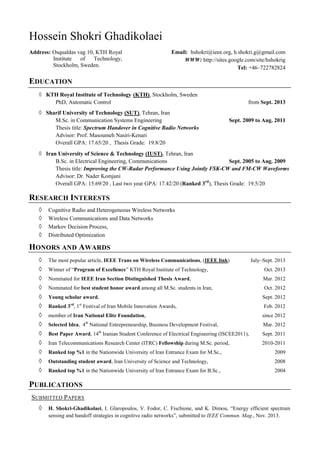
Hossein Shokri Ghadikolaei
Address: Osqualdas vag 10, KTH Royal
Institute of Technology,
Stockholm, Sweden.
Email: hshokri@ieee.org, h.shokri.g@gmail.com
WWW: http://sites.google.com/site/hshokrig
Tel: +46–722782824
EDUCATION
◊ KTH Royal Institute of Technology (KTH), Stockholm, Sweden
PhD, Automatic Control from Sept. 2013
◊ Sharif University of Technology (SUT), Tehran, Iran
M.Sc. in Communication Systems Engineering Sept. 2009 to Aug. 2011
Thesis title: Spectrum Handover in Cognitive Radio Networks
Advisor: Prof. Masoumeh Nasiri-Kenari
Overall GPA: 17.65/20 , Thesis Grade: 19.8/20
◊ Iran University of Science & Technology (IUST), Tehran, Iran
B.Sc. in Electrical Engineering, Communications Sept. 2005 to Aug. 2009
Thesis title: Improving the CW-Radar Performance Using Jointly FSK-CW and FM-CW Waveforms
Advisor: Dr. Nader Komjani
Overall GPA: 15.69/20 , Last two year GPA: 17.42/20 (Ranked 3rd
), Thesis Grade: 19.5/20
RESEARCH INTERESTS
◊ Cognitive Radio and Heterogeneous Wireless Networks
◊ Wireless Communications and Data Networks
◊ Markov Decision Process,
◊ Distributed Optimization
HONORS AND AWARDS
◊ The most popular article, IEEE Trans on Wireless Communications, (IEEE link) July~Sept. 2013
◊ Winner of “Program of Excellence” KTH Royal Institute of Technology, Oct. 2013
◊ Nominated for IEEE Iran Section Distinguished Thesis Award, Mar. 2012
◊ Nominated for best student honor award among all M.Sc. students in Iran, Oct. 2012
◊ Young scholar award, Sept. 2012
◊ Ranked 3rd
, 1st
Festival of Iran Mobile Innovation Awards, Feb. 2012
◊ member of Iran National Elite Foundation, since 2012
◊ Selected Idea, 4th
National Entrepreneurship, Business Development Festival, Mar. 2012
◊ Best Paper Award, 14th
Iranian Student Conference of Electrical Engineering (ISCEE2011), Sept. 2011
◊ Iran Telecommunications Research Center (ITRC) Fellowship during M.Sc. period, 2010-2011
◊ Ranked top %1 in the Nationwide University of Iran Entrance Exam for M.Sc., 2009
◊ Outstanding student award, Iran University of Science and Technology, 2008
◊ Ranked top %1 in the Nationwide University of Iran Entrance Exam for B.Sc., 2004
PUBLICATIONS
SUBMITTED PAPERS
◊ H. Shokri-Ghadikolaei, I. Glaropoulos, V. Fodor, C. Fischione, and K. Dimou, “Energy efficient spectrum
sensing and handoff strategies in cognitive radio networks”, submitted to IEEE Commun. Mag., Nov. 2013.
◊ H. Shokri-Ghadikolaei and C. Fischione, “Analyses and optimization of distributed random sensing order in
cognitive radio systems”, will be submitted to IEEE J. Select. Areas Commun., Dec. 2013.
◊ H. Shokri-Ghadikolaei and C. Fischione, “Distributed random sensing order analysis and optimization in
cognitive radio systems”, submitted to IEEE ICC 2014.
◊ H. Shokri-Ghadikolaei and F. Yaghoubi, “Performance Analysis of Sequential Spectrum Sensing in
Centralized Cognitive Radio Networks”, submitted to IEEE WCNC 2014.
◊ H. Shokri-Ghadikolaei and F. Yaghoubi, “Performance evaluation of sequential spectrum sensing in
centralized cognitive radio networks," revision has been submitted to IEEE Trans. Veh. Technol., July 2013.
JOURNAL PAPERS
◊ H. Shokri-Ghadikolaei, F. Sheikholeslami, and M. Nasiri-Kenari, “Distributed multiuser sequential channel
sensing schemes in multichannel cognitive radio networks,” IEEE Trans. on Wireless Commun., vol. 12, no. 5,
pp. 2055-2067, May 2013.  download
◊ H. Shokri-Ghadikolaei, Y. Abdi, and M. Nasiri-Kenari, “Analytical and learning-based spectrum sensing time
optimization in cognitive radio systems,” IET Commun., vol. 7, no. 5, pp. 480-489, Mar. 2013.  download
◊ H. Shokri-Ghadikolaei and M. Nasiri-Kenari, “Sensing matrix setting schemes for cognitive networks and
their performance analysis”, IET Commun., vol. 6, no. 17, pp. 3026-3035, Nov. 2012.  download
◊ H. Shokri-Ghadikolaei and R. Fallahi, “Intelligent sensing matrix setting scheme in cognitive radio networks”,
IEEE Commun. Letters, vol. 16, no. 11, pp. 1824-1827, Nov. 2012.  download
CONFERENCE PAPERS
◊ H. Shokri-Ghadikolaei and M. Nasiri-Kenari, “Optimal and suboptimal sensing sequences in multiuser
cognitive radio networks”, in Proc IEEE IST2012, pp. 243-248, Nov. 2012.  download
◊ H. Shokri-Ghadikolaei, Y. Abdi, and M. Nasiri-Kenari, “Learning-based spectrum sensing time optimization
in cognitive radio systems,” in Proc. IEEE IST2012, pp. 249-254, Nov. 2012.  download
◊ H. Shokri-Ghadikolaei and A. Gavili-Gilan, “Possible applications and challenges in cognitive radio systems,”
14th
ISCEE, Sept. 2011.
◊ H. Shokri-Ghadikolaei and A. Gavili-Gilan, “A survey on spectrum sensing schemes in cognitive radio
networks,” 14th
ISCEE, Sept. 2011.
◊ A. Gavili-Gilan and H. Shokri-Ghadikolaei, “Interference reduction and throughput maximization by
beamforming,” 14th
ISCEE, Sept. 2011. (received best paper award)
◊ A. Gavili-Gilan and H. Shokri-Ghadikolaei, “An approach to image separation using non-subsample wavelet
and improved non-subsample contourlet,” 14th
ISCEE, Sept. 2011.
◊ B. Mamandipoor and H. Shokri, “An improved discrete probabilistic localization method (I-DPLM) in wireless
sensor networks,” Seventh INSS, June, 2010.  download
WORKSHOPS
◊ H. Shokri-Ghadikolaei and M. Nasiri-Kenari, “Cognitive radio networks and their challenges,” (invited),
ICEE2013, May 2013
◊ H. Shokri-Ghadikolaei, “Evolution of cellular networks, from 1G to 4G”, Bahaaran Co. Oct. 2012. (invited)
◊ H. Shokri-Ghadikolaei, “An introduction to LTE-A”, ITRC, Sept. 2012.
◊ H. Shokri-Ghadikolaei, “Cognitive radio, challenges, solutions, and open issues”, 14th ISCEE, Sept. 2011.
SERVICES
◊ TPC of IEEE BIS’14, PRIP-2014, SCAIE’14, and IJCDS 2014.
◊ Member of IEEE.
◊ Reviewer of several accredit journal and conferences (for detailed information, see my webpage)
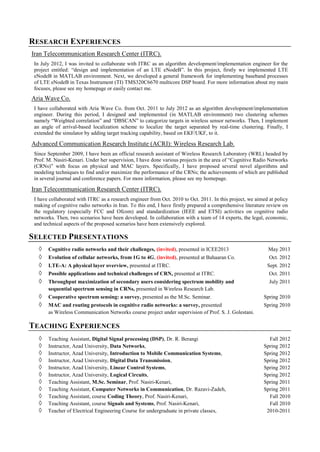
RESEARCH EXPERIENCES
Iran Telecommunication Research Center (ITRC).
In July 2012, I was invited to collaborate with ITRC as an algorithm development/implementation engineer for the
project entitled: “design and implementation of an LTE eNodeB”. In this project, firstly we implemented LTE
eNodeB in MATLAB environment. Next, we developed a general framework for implementing baseband processes
of LTE eNodeB in Texas Instrument (TI) TMS320C6670 multicore DSP board. For more information about my main
focuses, please see my homepage or easily contact me.
Aria Wave Co.
I have collaborated with Aria Wave Co. from Oct. 2011 to July 2012 as an algorithm development/implementation
engineer. During this period, I designed and implemented (in MATLAB environment) two clustering schemes
namely “Weighted correlation” and ‘DBSCAN” to categorize targets in wireless sensor networks. Then, I implement
an angle of arrival-based localization scheme to localize the target separated by real-time clustering. Finally, I
extended the simulator by adding target tracking capability, based on EKF/UKF, to it.
Advanced Communication Research Institute (ACRI): Wireless Research Lab.
Since September 2009, I have been an official research assistant of Wireless Research Laboratory (WRL) headed by
Prof. M. Nasiri-Kenari. Under her supervision, I have done various projects in the area of “Cognitive Radio Networks
(CRNs)” with focus on physical and MAC layers. Specifically, I have proposed several novel algorithms and
‎modeling techniques to find and/or maximize the performance of the CRNs; the achievements of which are published
in several journal and conference papers. For more information, please see my homepage.
Iran Telecommunication Research Center (ITRC).
I have collaborated with ITRC as a research engineer from Oct. 2010 to Oct. 2011. In this project, we aimed at policy
making of cognitive radio networks in Iran. To this end, I have firstly prepared a comprehensive literature review on
the regulatory (especially FCC and Ofcom) and standardization (IEEE and ETSI) activities on cognitive radio
networks. Then, two scenarios have been developed. In collaboration with a team of 14 experts, the legal, economic,
and technical aspects of the proposed scenarios have been extensively explored.
SELECTED PRESENTATIONS
◊ Cognitive radio networks and their challenges, (invited), presented in ICEE2013 May 2013
◊ Evolution of cellular networks, from 1G to 4G, (invited), presented at Bahaaran Co. Oct. 2012
◊ LTE-A: A physical layer overview, presented at ITRC. Sept. 2012
◊ Possible applications and technical challenges of CRN, presented at ITRC. Oct. 2011
◊ Throughput maximization of secondary users considering spectrum mobility and July 2011
sequential spectrum sensing in CRNs, presented in Wireless Research Lab.
◊ Cooperative spectrum sensing: a survey, presented as the M.Sc. Seminar. Spring 2010
◊ MAC and routing protocols in cognitive radio networks: a survey, presented Spring 2010
as Wireless Communication Networks course project under supervision of Prof. S. J. Golestani.
TEACHING EXPERIENCES
◊ Teaching Assistant, Digital Signal processing (DSP), Dr. R. Berangi Fall 2012
◊ Instructor, Azad University, Data Networks, Spring 2012
◊ Instructor, Azad University, Introduction to Mobile Communication Systems, Spring 2012
◊ Instructor, Azad University, Digital Data Transmission, Spring 2012
◊ Instructor, Azad University, Linear Control Systems, Spring 2012
◊ Instructor, Azad University, Logical Circuits, Spring 2012
◊ Teaching Assistant, M.Sc. Seminar, Prof. Nasiri-Kenari, Spring 2011
◊ Teaching Assistant, Computer Networks in Communication, Dr. Razavi-Zadeh, Spring 2011
◊ Teaching Assistant, course Coding Theory, Prof. Nasiri-Kenari, Fall 2010
◊ Teaching Assistant, course Signals and Systems, Prof. Nasiri-Kenari, Fall 2010
◊ Teacher of Electrical Engineering Course for undergraduate in private classes, 2010-2011
◊ Teaching Assistant, course Electromagnetic, Dr. N. Komjani, Fall 2008
◊ Teacher of Physics and Mathematics for high school students, 2005-2007
SELECTED ACADEMIC PROJECTS
GRADUATE COURSE PROJECTS ( < 2011)
◊ Literature survey of physical, MAC, and routing protocols of cognitive radio networks, Spring 2010
◊ Literature survey and extensive simulation of cooperative spectrum sensing in cognitive Spring 2010
radio networks, M.Sc. Seminar
◊ Simulation of data link protocols (stop and wait, sliding window…) with NS-2 Fall 2009
and NS-NAM (for graphical representation),
◊ IEEE 802.11 fairness with NS-2 and NS-NAM, and with NS-3 and Wireshark, Fall 2009
◊ Simulation of LAN (Ethernet, Switch Local Area Networks), and TCP/IP with OPNET, Fall 2009
◊ Simulation of unicast and multicast routing with NS-2 and NS-NAM, Fall 2009
◊ Simulation of reactive MANET routing protocols (DSR, DSDV and AODV) with NS-2 Fall 2009
◊ Simulation of LMS and RLS adaptive algorithms for noise reduction, Fall 2009
UNDERGRADUATE COURSE PROJECTS ( > 2009)
◊ Literature survey and simulation of electrical impedance tomography (EIT) schemes, Spring 2009
◊ Design and implementation of a digital image processing simulator Spring 2009
◊ Technical report of a novel discrete probabilistic localization method for WSNs, Spring 2009
HOBBIES
◊ Hiking, swimming, reading mythical and mysterious novels, watching documentaries -especially about nature
as well as ancient worlds, and looking at the stars.
COMPUTER SKILLS AND STANDARDS
◊ Programming Languages: C/C++, Matlab (expert), Simulink, TMS320C6xxx linear and ordinary Assembly,
TCL, familiar with Mathematica.
◊ Network Programming: NS2, NS3, familiar with OPNET.
◊ Applications: OrCAD PSpice, Proteus, Code Composer Studio (DSP boards’ application).
◊ Document Preparation Programming: MS Office, LaTeX.
◊ Standards: familiar with IEEE 802.11 (a, b, g), 802.16, 802.22, and 3GPP LTE Rel-8, 9, 10, and 11.
LANGUAGES
◊ Persian (Native), English (Fluent), Arabic (Familiar)
REFERENCES
◊ Available upon request.

17 hossein-abstract-cv-shokri

  • 1.
    1 Analysis and Optimizationof Random Sensing Order in Cognitive Radio Systems Hossein Shokri-Ghadikolaei and Carlo Fischione Abstract—Developing an efficient spectrum access policy en- ables cognitive radios to dramatically increase spectrum utiliza- tion while assuring predetermined quality of service levels for the primary users. In this letter, modeling, performance analysis, and optimization of a distributed secondary network with random sensing order policy are studied. Specifically, the secondary users create a random order of the available channels to sense and find a transmission opportunity in a distributed manner. For this network, the average throughputs of the secondary users and average interference level between the secondary and primary users are evaluated by a new Markov model. Then, a maximization of the secondary network performance in terms of throughput while keeping under control the average interference is proposed. Then, a simple and practical adaptive algorithm is developed to optimize the network in a distributed manner. Interestingly, the proposed algorithm follows the variations of the wireless channels in non-stationary conditions and besides having substantially lower computational cost, it outperforms static brute force optimization. Finally, numerical results are provided to demonstrate the efficiencies of the proposed schemes. It is shown that fully distributed algorithms can achieve substantial performance improvements in cognitive radio networks without the need of centralized management or message passing among the users. Keywords—Cognitive radio, sequential channel sensing, Markov model, average throughput, average interference. I. INTRODUCTION TTH limited spectrum resources and intense growth of high data rate communications have motivated opportunistic spectrum access using the promising concept of cognitive radio networks. Cognitive radio networks can promote spectrum utilization by allowing low-priority secondary users (SUs) to opportunistically exploit the unused licensed channels of high- priority primary users (PUs). Meanwhile, due to preemptive priority of the PUs to access the channels, the SUs must vacate the channel whenever the corresponding PUs appear. In this case, a set of procedures called spectrum handoff (SHO) is initiated to help the SU to effectively find a new transmission opportunity and resume its unfinished transmission [1]. To this end, temporarily-available transmission opportunities must be explored first. Generally speaking, there exists more than one channel to be sensed by an SU. Here, we assume that the SUs can sense and possibly transmit on one channel at a time due to processing and hardware constraints. Therefore, an SU sorts the channels in an order, senses the first channel of the order, and transmits on the channel provided that it is sensed free. If the channel is sensed busy, the SU initiates the SHO procedure and then senses the second channel of the sensing order. This kind of sensing-access is called sequential channel sensing [1]. The authors are with KTH Royal Institute of Technology, Stockholm, Sweden (e-mail: hshokri, carlofi@kth.se). This work was supported by the FP7 EU project Hydrobionets. The SUs sense the channels at the beginning of each time slot and initiate the SHO procedure whenever the current channel is sensed busy. Optimal and suboptimal sensing orders of a CRN containing only one SU are developed in [2], [3], which maximize the average achievable throughput of the SU in a time slot. These results have been further extended for a CRN with two [4] and multiple SUs [5], [6]. Most of the literatures, however, focus on single SU or centralized CRNs [2]–[6]. In [7], an autonomous sensing order setting strategy is proposed for distributed CRNs with the aim of minimizing the likelihood of collisions with other SUs. But, the miss detection probability is assumed zero, meaning that the SUs do not make interference for the PUs as well as other SUs. Therefore, quality of service (QoS) provisioning for the PUs is not addressed in that study. In [8], the authors exploit a modified p-persistent MAC protocol to set the sensing orders of the SUs in a distributed manner. In this letter, we investigate the performance of random sensing orders policy (RSOP) for the SUs. That is, once an SHO is triggered, all the SU create a set of random channels to be sensed. Then, the sequential channel sensing process is initiated. We provide required guidlines for modeling the behaviors of the SUs using a finite state Markov chain. By this model, the performance of the random sensing order policy is derived, and an effective algorithm is developed to optimize the performance of the CRN in a distributed fashion. Compared to the literature mentioned above, this is the first paper to 1) consider the problem of SHO for sequential channel sensing in a distributed set-up with multiple SUs with more realistic assumptions including miss detection and false alarm probabilities, 2) investigate the impact of the SUs’ transmis- sions on the channel occupation probabilities, 3) derive the accumulated interference caused by other SUs’ transmissions, 4) pose an optimization problem and develop a practical adaptive algorithm to maximize the average throughput while provisioning QoS for the PUs. II. RANDOM SENSING ORDER In the sequential channel sensing methodology, once a hand- off is requested, each SU’s time slot divides into sensing and transmission modes. In the sensing mode, the SUs sequentially sense the channels based on their sensing orders [2]–[6]. The procedure continues until one of the following events happens [8]: (a) transmission opportunities are found for all the SUs, (b) no time remains for sensing new channels in the time slot, or (c) no non-sensed channels are remained. The order of the channel heavily affects QoS parameters of the SUs and PUs and can be optimally determined in a centralized CRN [2], [5], wherein the SUs are placed in a list so that the average achievable throughput is maximized. How- ever, those proposals cannot be directly applied to a distributed CRNs. For the networks, a simple sensing order is proposed in [8], wherein the channels are arranged by their indices.
  • 2.
    2 While this sensingorder facilitates the network modeling and performance evaluation, a high level of contention to access the spectrum resources is imposed to the SUs, which significantly degrades the average throughput of the CRN. In order to mitigate the aforementioned problem, the RSOP can be used. In this scheme, an SU randomly (with uniform distribution) chooses a target channel in each sensing interval. Therefore, the requests of the SUs are distributed among all available channels, and thereby the reduction of the contention level among the SUs increases the CRN throughput. In order to further decrease the contention and provide multiple access among the SUs, a modified version of the conventional p- persistent multiple access protocol is proposed in the letter. That is, each SU senses each channel with the probability p and skips the sensing process with the probability (1 − p). From the above discussions, the channel sensing-access pol- icy of the RSOP follows a Markov process, and the following statements enable us to find the transition probabilities: • An SU can successfully transmit on each channel, if it is free, and the false alarm does not occur. Once this event happens, the SU’s state changes to the transmitter nodes, and it transmits on the channel for the rest of the time slot. • The interference happens whenever the channel is busy, and the SU mistakenly senses it free. • If either the SU skips sensing process in a step, with probability of p, or sense a channel busy, it tries to randomly choose a new channel and then sense it, in the next step. By a Markov chain analysis, we can can show that the average throughput of each SU and the average interference time due to the SUs’ transmissions depend on sensing time τ and channel access probability p. We denote by r (τ, p) and tI (τ, p) the average throughput and the average interference time, respectively. Hence, the performance of the CRN can be optimized by choosing the values of p and τ that maximize the average throughput r (τ, p), as a QoS metric for the SU, and bounding the interference time tI (τ, p), as a QoS metric for the PUs as well as the SUs. That is, [τ∗ , p∗ ] = argmax τ,p r (τ, p) (1) s.t. tI (τ, p) ≤ tmax I 0 ≤ τ ≤ T 0 ≤ p ≤ 1 , where T is a time slot duration, and tmax I represents the maximum tolerable value of the interference time. By estimating the average throughput and interference level [9], and comparing with previous estimations, we implement a fully distributed algorithm to adjust the channel sensing time and probability of each SU in each sensing step. In this algo- rithm, an SU decreases p, and tries to contribute in reduction of contention level in the CRN, if several SUs contend to access the same channels. Also, the algorithm let the SUs to increase their transmission time and consequently average throughput if the interference level constraint is not violated. Let Ns and Np be the number of SUs and PUs, respectively. Table I demonstrates the performance enhancement due to optimal p and τ derived in (1), and compares the average throughput and interference for two scenarios: (i) optimal values, which are obtained by a brute force numerical optimization search and TABLE I. AVERAGE THROUGHPUT AND THE CORRESPONDING NORMALIZED INTERFERENCE (tmax I = 0.05T ). Static Optimal Design Adaptive Algorithm Throughput Interference Throughput Interference Ns = 3, Np = 7 1.4410 0.0478 1.4472 0.0399 Ns = 5, Np = 7 1.9205 0.0500 1.9791 0.0497 (ii) adaptive values as achieved by the proposed algorithm. As expected, adopting the optimal and adaptive values for p and τ increases the average throughput while the interference meets the constraint. Specifically, for the case Ns = 3, Np = 7, the average throughput of the SUs achieved by the optimal design respectively is about 24% more than the one achieved in p = 0.8, τ = 0.1T. Also, from the table, the proposed algorithm outperforms even static optimal design; because in the optimal design all the SUs adopt the same sensing time and access probability, whereas the proposed algorithm let the SUs to follow the variation of the wireless environment, and adaptively adjust the above values. III. CONCLUSION Modeling and performance evaluation of random sensing order policy (RSOP) in a distributed cognitive radio network (CRN) were investigated in this letter. The required guide- lines for modeling the behaviors of the secondary users were discussed, and the performance of the RSOP in terms of the average throughput of the CRN and average interference levels between the SUs and the primary users was evaluated. Then, two approaches for optimizing the performance of the CRN were studied and compared. The proposed algorithm enhances the performance of the CRN without high computa- tional burden, as demonstrated through numerical performance evaluation. REFERENCES [1] I. Christian, S. Moh, I. Chung, and J. Lee, “Spectrum mobility in cognitive radio networks,” IEEE Commun. Mag., vol. 50, no. 6, pp. 114– 121, June 2012. [2] H. Jiang, R. F. L. Lai, and H. V. Poor, “Optimal selection of channel sensing order in cognitive radio,” IEEE Trans. Wireless Commun., vol. 8, no. 1, pp. 297–307, Jan. 2009. [3] Z. Zhang and H. Jiang, “Cognitive radio with imperfect spectrum sensing: The optimal set of channels to sense,” IEEE Wireless Commun. Letters, vol. 1, no. 2, pp. 133–136, Apr. 2012. [4] R. Fan and H. Jiang, “Channel sensing-order setting in cognitive radio networks: A two-user case,” IEEE Trans. Veh. Technol., vol. 58, no. 9, pp. 4997–5008, Nov. 2009. [5] H. Shokri-Ghadikolaei and M. Nasiri-Kenari, “Sensing matrix setting schemes for cognitive networks and their performance analysis,” IET Commun., vol. 6, no. 17, pp. 3026–3035, Nov. 2012. [6] H. Shokri-Ghadikolaei and R. Fallahi, “Intelligent sensing matrix setting in cognitive radio networks,” IEEE Commun. Letters, vol. 16, no. 11, pp. 1824–1827, Nov. 2012. [7] Z. Khan, J. Lehtomaki, L. DaSilva, and M. Latva-aho, “Autonomous sensing order selection strategies exploiting channel access information,” IEEE Trans. on Mobile Comput., vol. 12, no. 2, pp. 274–288, Feb. 2013. [8] H. Shokri-Ghadikolaei, F. Sheikholeslami, and M. Nasiri-Kenari, “Dis- tributed multiuser sequential channel sensing schemes in multichannel cognitive radio networks,” IEEE Trans. Wireless Commun., vol. 12, no. 5, pp. 2055–2067, May 2013. [9] S. H. Park, H. Yoon, and J. W. Kim, “A cross-layered network adaptive HD video steaming in digital A/V home network: Channel monitoring and video rate adaptation,” IEEE Trans. on Consum. Electron., vol. 52, no. 4, pp. 1245–1252, Nov. 2006.
  • 3.
    Hossein Shokri Ghadikolaei Address:Osqualdas vag 10, KTH Royal Institute of Technology, Stockholm, Sweden. Email: hshokri@ieee.org, h.shokri.g@gmail.com WWW: http://sites.google.com/site/hshokrig Tel: +46–722782824 EDUCATION ◊ KTH Royal Institute of Technology (KTH), Stockholm, Sweden PhD, Automatic Control from Sept. 2013 ◊ Sharif University of Technology (SUT), Tehran, Iran M.Sc. in Communication Systems Engineering Sept. 2009 to Aug. 2011 Thesis title: Spectrum Handover in Cognitive Radio Networks Advisor: Prof. Masoumeh Nasiri-Kenari Overall GPA: 17.65/20 , Thesis Grade: 19.8/20 ◊ Iran University of Science & Technology (IUST), Tehran, Iran B.Sc. in Electrical Engineering, Communications Sept. 2005 to Aug. 2009 Thesis title: Improving the CW-Radar Performance Using Jointly FSK-CW and FM-CW Waveforms Advisor: Dr. Nader Komjani Overall GPA: 15.69/20 , Last two year GPA: 17.42/20 (Ranked 3rd ), Thesis Grade: 19.5/20 RESEARCH INTERESTS ◊ Cognitive Radio and Heterogeneous Wireless Networks ◊ Wireless Communications and Data Networks ◊ Markov Decision Process, ◊ Distributed Optimization HONORS AND AWARDS ◊ The most popular article, IEEE Trans on Wireless Communications, (IEEE link) July~Sept. 2013 ◊ Winner of “Program of Excellence” KTH Royal Institute of Technology, Oct. 2013 ◊ Nominated for IEEE Iran Section Distinguished Thesis Award, Mar. 2012 ◊ Nominated for best student honor award among all M.Sc. students in Iran, Oct. 2012 ◊ Young scholar award, Sept. 2012 ◊ Ranked 3rd , 1st Festival of Iran Mobile Innovation Awards, Feb. 2012 ◊ member of Iran National Elite Foundation, since 2012 ◊ Selected Idea, 4th National Entrepreneurship, Business Development Festival, Mar. 2012 ◊ Best Paper Award, 14th Iranian Student Conference of Electrical Engineering (ISCEE2011), Sept. 2011 ◊ Iran Telecommunications Research Center (ITRC) Fellowship during M.Sc. period, 2010-2011 ◊ Ranked top %1 in the Nationwide University of Iran Entrance Exam for M.Sc., 2009 ◊ Outstanding student award, Iran University of Science and Technology, 2008 ◊ Ranked top %1 in the Nationwide University of Iran Entrance Exam for B.Sc., 2004 PUBLICATIONS SUBMITTED PAPERS ◊ H. Shokri-Ghadikolaei, I. Glaropoulos, V. Fodor, C. Fischione, and K. Dimou, “Energy efficient spectrum sensing and handoff strategies in cognitive radio networks”, submitted to IEEE Commun. Mag., Nov. 2013.
  • 4.
    ◊ H. Shokri-Ghadikolaeiand C. Fischione, “Analyses and optimization of distributed random sensing order in cognitive radio systems”, will be submitted to IEEE J. Select. Areas Commun., Dec. 2013. ◊ H. Shokri-Ghadikolaei and C. Fischione, “Distributed random sensing order analysis and optimization in cognitive radio systems”, submitted to IEEE ICC 2014. ◊ H. Shokri-Ghadikolaei and F. Yaghoubi, “Performance Analysis of Sequential Spectrum Sensing in Centralized Cognitive Radio Networks”, submitted to IEEE WCNC 2014. ◊ H. Shokri-Ghadikolaei and F. Yaghoubi, “Performance evaluation of sequential spectrum sensing in centralized cognitive radio networks," revision has been submitted to IEEE Trans. Veh. Technol., July 2013. JOURNAL PAPERS ◊ H. Shokri-Ghadikolaei, F. Sheikholeslami, and M. Nasiri-Kenari, “Distributed multiuser sequential channel sensing schemes in multichannel cognitive radio networks,” IEEE Trans. on Wireless Commun., vol. 12, no. 5, pp. 2055-2067, May 2013.  download ◊ H. Shokri-Ghadikolaei, Y. Abdi, and M. Nasiri-Kenari, “Analytical and learning-based spectrum sensing time optimization in cognitive radio systems,” IET Commun., vol. 7, no. 5, pp. 480-489, Mar. 2013.  download ◊ H. Shokri-Ghadikolaei and M. Nasiri-Kenari, “Sensing matrix setting schemes for cognitive networks and their performance analysis”, IET Commun., vol. 6, no. 17, pp. 3026-3035, Nov. 2012.  download ◊ H. Shokri-Ghadikolaei and R. Fallahi, “Intelligent sensing matrix setting scheme in cognitive radio networks”, IEEE Commun. Letters, vol. 16, no. 11, pp. 1824-1827, Nov. 2012.  download CONFERENCE PAPERS ◊ H. Shokri-Ghadikolaei and M. Nasiri-Kenari, “Optimal and suboptimal sensing sequences in multiuser cognitive radio networks”, in Proc IEEE IST2012, pp. 243-248, Nov. 2012.  download ◊ H. Shokri-Ghadikolaei, Y. Abdi, and M. Nasiri-Kenari, “Learning-based spectrum sensing time optimization in cognitive radio systems,” in Proc. IEEE IST2012, pp. 249-254, Nov. 2012.  download ◊ H. Shokri-Ghadikolaei and A. Gavili-Gilan, “Possible applications and challenges in cognitive radio systems,” 14th ISCEE, Sept. 2011. ◊ H. Shokri-Ghadikolaei and A. Gavili-Gilan, “A survey on spectrum sensing schemes in cognitive radio networks,” 14th ISCEE, Sept. 2011. ◊ A. Gavili-Gilan and H. Shokri-Ghadikolaei, “Interference reduction and throughput maximization by beamforming,” 14th ISCEE, Sept. 2011. (received best paper award) ◊ A. Gavili-Gilan and H. Shokri-Ghadikolaei, “An approach to image separation using non-subsample wavelet and improved non-subsample contourlet,” 14th ISCEE, Sept. 2011. ◊ B. Mamandipoor and H. Shokri, “An improved discrete probabilistic localization method (I-DPLM) in wireless sensor networks,” Seventh INSS, June, 2010.  download WORKSHOPS ◊ H. Shokri-Ghadikolaei and M. Nasiri-Kenari, “Cognitive radio networks and their challenges,” (invited), ICEE2013, May 2013 ◊ H. Shokri-Ghadikolaei, “Evolution of cellular networks, from 1G to 4G”, Bahaaran Co. Oct. 2012. (invited) ◊ H. Shokri-Ghadikolaei, “An introduction to LTE-A”, ITRC, Sept. 2012. ◊ H. Shokri-Ghadikolaei, “Cognitive radio, challenges, solutions, and open issues”, 14th ISCEE, Sept. 2011. SERVICES ◊ TPC of IEEE BIS’14, PRIP-2014, SCAIE’14, and IJCDS 2014. ◊ Member of IEEE. ◊ Reviewer of several accredit journal and conferences (for detailed information, see my webpage)
  • 5.
    RESEARCH EXPERIENCES Iran TelecommunicationResearch Center (ITRC). In July 2012, I was invited to collaborate with ITRC as an algorithm development/implementation engineer for the project entitled: “design and implementation of an LTE eNodeB”. In this project, firstly we implemented LTE eNodeB in MATLAB environment. Next, we developed a general framework for implementing baseband processes of LTE eNodeB in Texas Instrument (TI) TMS320C6670 multicore DSP board. For more information about my main focuses, please see my homepage or easily contact me. Aria Wave Co. I have collaborated with Aria Wave Co. from Oct. 2011 to July 2012 as an algorithm development/implementation engineer. During this period, I designed and implemented (in MATLAB environment) two clustering schemes namely “Weighted correlation” and ‘DBSCAN” to categorize targets in wireless sensor networks. Then, I implement an angle of arrival-based localization scheme to localize the target separated by real-time clustering. Finally, I extended the simulator by adding target tracking capability, based on EKF/UKF, to it. Advanced Communication Research Institute (ACRI): Wireless Research Lab. Since September 2009, I have been an official research assistant of Wireless Research Laboratory (WRL) headed by Prof. M. Nasiri-Kenari. Under her supervision, I have done various projects in the area of “Cognitive Radio Networks (CRNs)” with focus on physical and MAC layers. Specifically, I have proposed several novel algorithms and ‎modeling techniques to find and/or maximize the performance of the CRNs; the achievements of which are published in several journal and conference papers. For more information, please see my homepage. Iran Telecommunication Research Center (ITRC). I have collaborated with ITRC as a research engineer from Oct. 2010 to Oct. 2011. In this project, we aimed at policy making of cognitive radio networks in Iran. To this end, I have firstly prepared a comprehensive literature review on the regulatory (especially FCC and Ofcom) and standardization (IEEE and ETSI) activities on cognitive radio networks. Then, two scenarios have been developed. In collaboration with a team of 14 experts, the legal, economic, and technical aspects of the proposed scenarios have been extensively explored. SELECTED PRESENTATIONS ◊ Cognitive radio networks and their challenges, (invited), presented in ICEE2013 May 2013 ◊ Evolution of cellular networks, from 1G to 4G, (invited), presented at Bahaaran Co. Oct. 2012 ◊ LTE-A: A physical layer overview, presented at ITRC. Sept. 2012 ◊ Possible applications and technical challenges of CRN, presented at ITRC. Oct. 2011 ◊ Throughput maximization of secondary users considering spectrum mobility and July 2011 sequential spectrum sensing in CRNs, presented in Wireless Research Lab. ◊ Cooperative spectrum sensing: a survey, presented as the M.Sc. Seminar. Spring 2010 ◊ MAC and routing protocols in cognitive radio networks: a survey, presented Spring 2010 as Wireless Communication Networks course project under supervision of Prof. S. J. Golestani. TEACHING EXPERIENCES ◊ Teaching Assistant, Digital Signal processing (DSP), Dr. R. Berangi Fall 2012 ◊ Instructor, Azad University, Data Networks, Spring 2012 ◊ Instructor, Azad University, Introduction to Mobile Communication Systems, Spring 2012 ◊ Instructor, Azad University, Digital Data Transmission, Spring 2012 ◊ Instructor, Azad University, Linear Control Systems, Spring 2012 ◊ Instructor, Azad University, Logical Circuits, Spring 2012 ◊ Teaching Assistant, M.Sc. Seminar, Prof. Nasiri-Kenari, Spring 2011 ◊ Teaching Assistant, Computer Networks in Communication, Dr. Razavi-Zadeh, Spring 2011 ◊ Teaching Assistant, course Coding Theory, Prof. Nasiri-Kenari, Fall 2010 ◊ Teaching Assistant, course Signals and Systems, Prof. Nasiri-Kenari, Fall 2010 ◊ Teacher of Electrical Engineering Course for undergraduate in private classes, 2010-2011
  • 6.
    ◊ Teaching Assistant,course Electromagnetic, Dr. N. Komjani, Fall 2008 ◊ Teacher of Physics and Mathematics for high school students, 2005-2007 SELECTED ACADEMIC PROJECTS GRADUATE COURSE PROJECTS ( < 2011) ◊ Literature survey of physical, MAC, and routing protocols of cognitive radio networks, Spring 2010 ◊ Literature survey and extensive simulation of cooperative spectrum sensing in cognitive Spring 2010 radio networks, M.Sc. Seminar ◊ Simulation of data link protocols (stop and wait, sliding window…) with NS-2 Fall 2009 and NS-NAM (for graphical representation), ◊ IEEE 802.11 fairness with NS-2 and NS-NAM, and with NS-3 and Wireshark, Fall 2009 ◊ Simulation of LAN (Ethernet, Switch Local Area Networks), and TCP/IP with OPNET, Fall 2009 ◊ Simulation of unicast and multicast routing with NS-2 and NS-NAM, Fall 2009 ◊ Simulation of reactive MANET routing protocols (DSR, DSDV and AODV) with NS-2 Fall 2009 ◊ Simulation of LMS and RLS adaptive algorithms for noise reduction, Fall 2009 UNDERGRADUATE COURSE PROJECTS ( > 2009) ◊ Literature survey and simulation of electrical impedance tomography (EIT) schemes, Spring 2009 ◊ Design and implementation of a digital image processing simulator Spring 2009 ◊ Technical report of a novel discrete probabilistic localization method for WSNs, Spring 2009 HOBBIES ◊ Hiking, swimming, reading mythical and mysterious novels, watching documentaries -especially about nature as well as ancient worlds, and looking at the stars. COMPUTER SKILLS AND STANDARDS ◊ Programming Languages: C/C++, Matlab (expert), Simulink, TMS320C6xxx linear and ordinary Assembly, TCL, familiar with Mathematica. ◊ Network Programming: NS2, NS3, familiar with OPNET. ◊ Applications: OrCAD PSpice, Proteus, Code Composer Studio (DSP boards’ application). ◊ Document Preparation Programming: MS Office, LaTeX. ◊ Standards: familiar with IEEE 802.11 (a, b, g), 802.16, 802.22, and 3GPP LTE Rel-8, 9, 10, and 11. LANGUAGES ◊ Persian (Native), English (Fluent), Arabic (Familiar) REFERENCES ◊ Available upon request.