
L. Kreinin, N. Bordin, N. Eisenberg
bSolar, 21 Havaad Haleumi Street, Jerusalem 91160, Israel
P. Grabitz, S. Hasenauer, D. Obhof, G. Wahl, G. Wein, D. Zimmerling
bSolar GmbH,Theresienstraße 2, 74072 Heilbronn, Germany
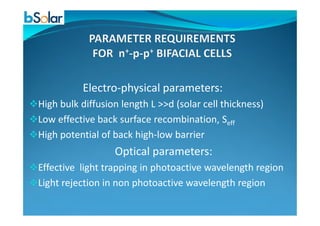
1. INTRODUCTION.
Parameter requirements and their implementation
2. EXPERIMENTAL
SR as a tool of recombination parametersSR as a tool of recombination parameters
evaluation
Accuracy of SR determination
3. RESULTS AND DISCUSSION
Main results of industrial fabrication of bifacial cells
Limiting factors and improvements possibilities
4. CONCLUSIONS
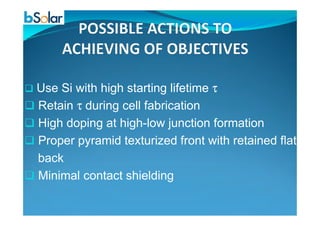
Electro-physical parameters:
High bulk diffusion length L >>d (solar cell thickness)
Low effective back surface recombination, SLow effective back surface recombination, Seff
High potential of back high-low barrier
Optical parameters:
Effective light trapping in photoactive wavelength region
Light rejection in non photoactive wavelength region
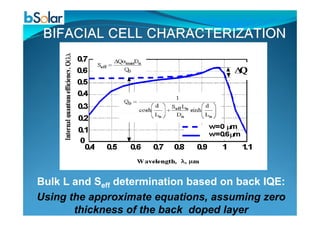
Use Si with high starting lifetime τ
Retain τ during cell fabrication
High doping at high-low junction formation
Proper pyramid texturized front with retained flat
back
Minimal contact shielding
Bulk L and Seff determination based on back IQE:
Using the approximate equations, assuming zero
thickness of the back doped layer
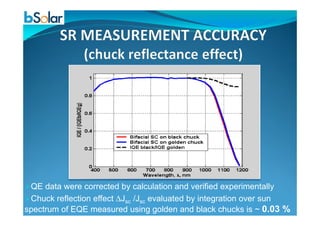
QE data were corrected by calculation and verified experimentally
Chuck reflection effect ∆Jsc /Jsc evaluated by integration over sun
spectrum of EQE measured using golden and black chucks is ~ 0.03 %
Bifacial over mono facial cell IQE improvement is due to :
- better light trapping
- lower back surface recombination
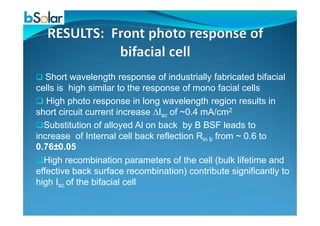
Short wavelength response of industrially fabricated bifacial
cells is high similar to the response of mono facial cells
High photo response in long wavelength region results in
short circuit current increase ∆Isc of ~0.4 mA/cm2short circuit current increase ∆Isc of ~0.4 mA/cm2
Substitution of alloyed Al on back by B BSF leads to
increase of Internal cell back reflection Rin b from ~ 0.6 to
0.76±0.05
High recombination parameters of the cell (bulk lifetime and
effective back surface recombination) contribute significantly to
high Isc of the bifacial cell
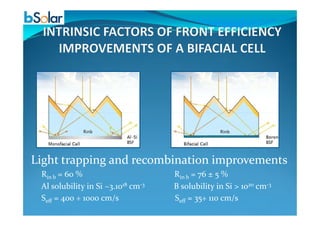
Light trapping and recombination improvements
Rin b = 60 % Rin b = 76 ± 5 %
Al solubility in Si ~3.1018 cm-3 B solubility in Si > 1020 cm-3
Seff = 400 ÷ 1000 cm/s Seff = 35÷ 110 cm/s
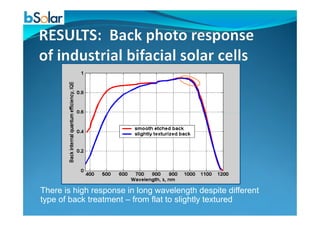
There is high response in long wavelength despite different
type of back treatment – from flat to slightly textured
Fabrication processing retains bulk lifetime τb in the
range 0.2 – 1 ms
BSF provides effective surface recombination Seff in the
range 35 – 110 cm/s
Back recombination limits solar cell open circuit voltage
to 640 – 660 mV
Back to front short circuit current ratio (Isc b/Isc f) =
74 ÷ 79 %
Back antireflective coating optimization should result in
(Isc b/Isc f) = 84 %
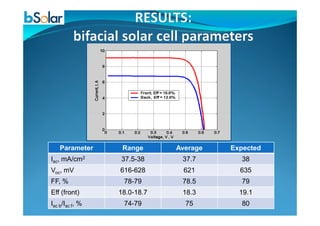
ExpectedAverageRangeParameter
3837.737.5-38Isc, mA/cm2
635621616-628Voc, mV
7978.578-79FF, %
19.118.318.0-18.7Eff (front)
807574-79Isc b/Isc f, %
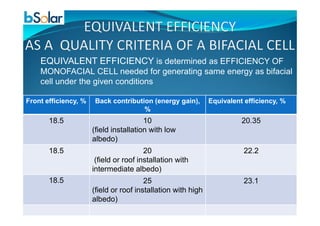
EQUIVALENT EFFICIENCY is determined as EFFICIENCY OF
MONOFACIAL CELL needed for generating same energy as bifacial
cell under the given conditions
Equivalent efficiency, %Back contribution (energy gain),
%
Front efficiency, %
20.3510
(field installation with low
albedo)
18.5
22.220
(field or roof installation with
intermediate albedo)
18.5
23.125
(field or roof installation with high
albedo)
18.5
n+-p-p+ is promising structure for industrially produced terrestrial
bifacial cells
Pilot batches demonstrate retained bulk lifetime τb and provide
effective back surface recombination in the range 35 – 110 cm/s
Low Seff in combination with effective light trapping contribute to
increased long wavelength response, full photo generated currentincreased long wavelength response, full photo generated current
(by ~ 0.4 mA/cm2) and efficiency (by ~0.5 % abs).
Back to front short circuit current ratio is in the range 74 – 79 %
Equivalent efficiency as a quality criteria of bifacial cell achieved
22 - 23 % in the most typical applications.
Improvement cell efficiency above ~19 % is expected after
tuning existing industrial fabrication processes

03 kreinin b solar

  • 1.
    L. Kreinin, N.Bordin, N. Eisenberg bSolar, 21 Havaad Haleumi Street, Jerusalem 91160, Israel P. Grabitz, S. Hasenauer, D. Obhof, G. Wahl, G. Wein, D. Zimmerling bSolar GmbH,Theresienstraße 2, 74072 Heilbronn, Germany
  • 2.
    1. INTRODUCTION. Parameter requirementsand their implementation 2. EXPERIMENTAL SR as a tool of recombination parametersSR as a tool of recombination parameters evaluation Accuracy of SR determination 3. RESULTS AND DISCUSSION Main results of industrial fabrication of bifacial cells Limiting factors and improvements possibilities 4. CONCLUSIONS
  • 3.
    Electro-physical parameters: High bulkdiffusion length L >>d (solar cell thickness) Low effective back surface recombination, SLow effective back surface recombination, Seff High potential of back high-low barrier Optical parameters: Effective light trapping in photoactive wavelength region Light rejection in non photoactive wavelength region
  • 4.
    Use Si withhigh starting lifetime τ Retain τ during cell fabrication High doping at high-low junction formation Proper pyramid texturized front with retained flat back Minimal contact shielding
  • 5.
    Bulk L andSeff determination based on back IQE: Using the approximate equations, assuming zero thickness of the back doped layer
  • 6.
    QE data werecorrected by calculation and verified experimentally Chuck reflection effect ∆Jsc /Jsc evaluated by integration over sun spectrum of EQE measured using golden and black chucks is ~ 0.03 %
  • 7.
    Bifacial over monofacial cell IQE improvement is due to : - better light trapping - lower back surface recombination
  • 8.
    Short wavelength responseof industrially fabricated bifacial cells is high similar to the response of mono facial cells High photo response in long wavelength region results in short circuit current increase ∆Isc of ~0.4 mA/cm2short circuit current increase ∆Isc of ~0.4 mA/cm2 Substitution of alloyed Al on back by B BSF leads to increase of Internal cell back reflection Rin b from ~ 0.6 to 0.76±0.05 High recombination parameters of the cell (bulk lifetime and effective back surface recombination) contribute significantly to high Isc of the bifacial cell
  • 9.
    Light trapping andrecombination improvements Rin b = 60 % Rin b = 76 ± 5 % Al solubility in Si ~3.1018 cm-3 B solubility in Si > 1020 cm-3 Seff = 400 ÷ 1000 cm/s Seff = 35÷ 110 cm/s
  • 10.
    There is highresponse in long wavelength despite different type of back treatment – from flat to slightly textured
  • 11.
    Fabrication processing retainsbulk lifetime τb in the range 0.2 – 1 ms BSF provides effective surface recombination Seff in the range 35 – 110 cm/s Back recombination limits solar cell open circuit voltage to 640 – 660 mV Back to front short circuit current ratio (Isc b/Isc f) = 74 ÷ 79 % Back antireflective coating optimization should result in (Isc b/Isc f) = 84 %
  • 12.
  • 13.
    EQUIVALENT EFFICIENCY isdetermined as EFFICIENCY OF MONOFACIAL CELL needed for generating same energy as bifacial cell under the given conditions Equivalent efficiency, %Back contribution (energy gain), % Front efficiency, % 20.3510 (field installation with low albedo) 18.5 22.220 (field or roof installation with intermediate albedo) 18.5 23.125 (field or roof installation with high albedo) 18.5
  • 14.
    n+-p-p+ is promisingstructure for industrially produced terrestrial bifacial cells Pilot batches demonstrate retained bulk lifetime τb and provide effective back surface recombination in the range 35 – 110 cm/s Low Seff in combination with effective light trapping contribute to increased long wavelength response, full photo generated currentincreased long wavelength response, full photo generated current (by ~ 0.4 mA/cm2) and efficiency (by ~0.5 % abs). Back to front short circuit current ratio is in the range 74 – 79 % Equivalent efficiency as a quality criteria of bifacial cell achieved 22 - 23 % in the most typical applications. Improvement cell efficiency above ~19 % is expected after tuning existing industrial fabrication processes