© 2014, Confidential
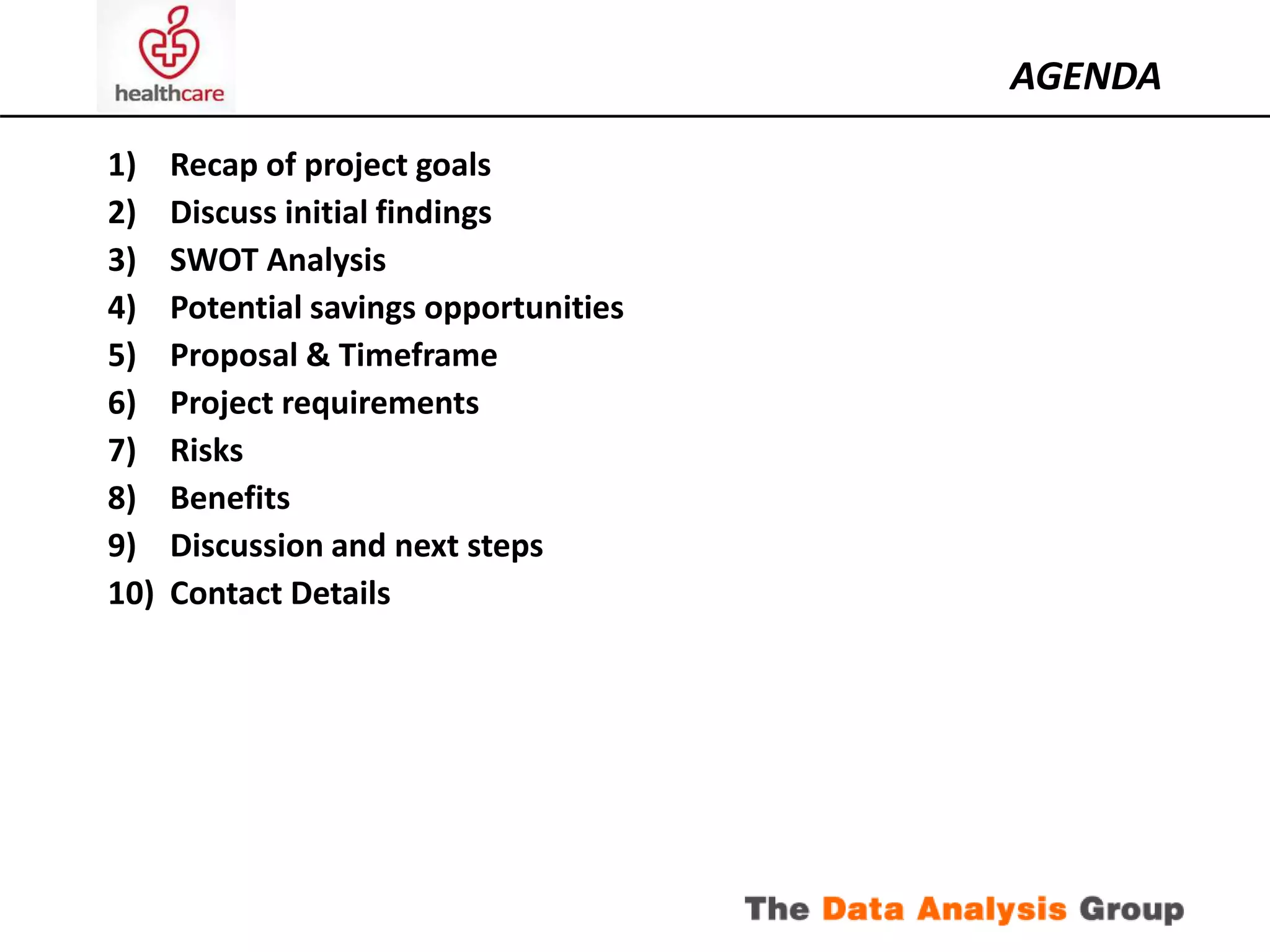
AGENDA 
1) Recap of project goals 
2) Discuss initial findings 
3) SWOT Analysis 
4) Potential savings opportunities 
5) Proposal & Timeframe 
6) Project requirements 
7) Risks 
8) Benefits 
9) Discussion and next steps 
10) Contact Details
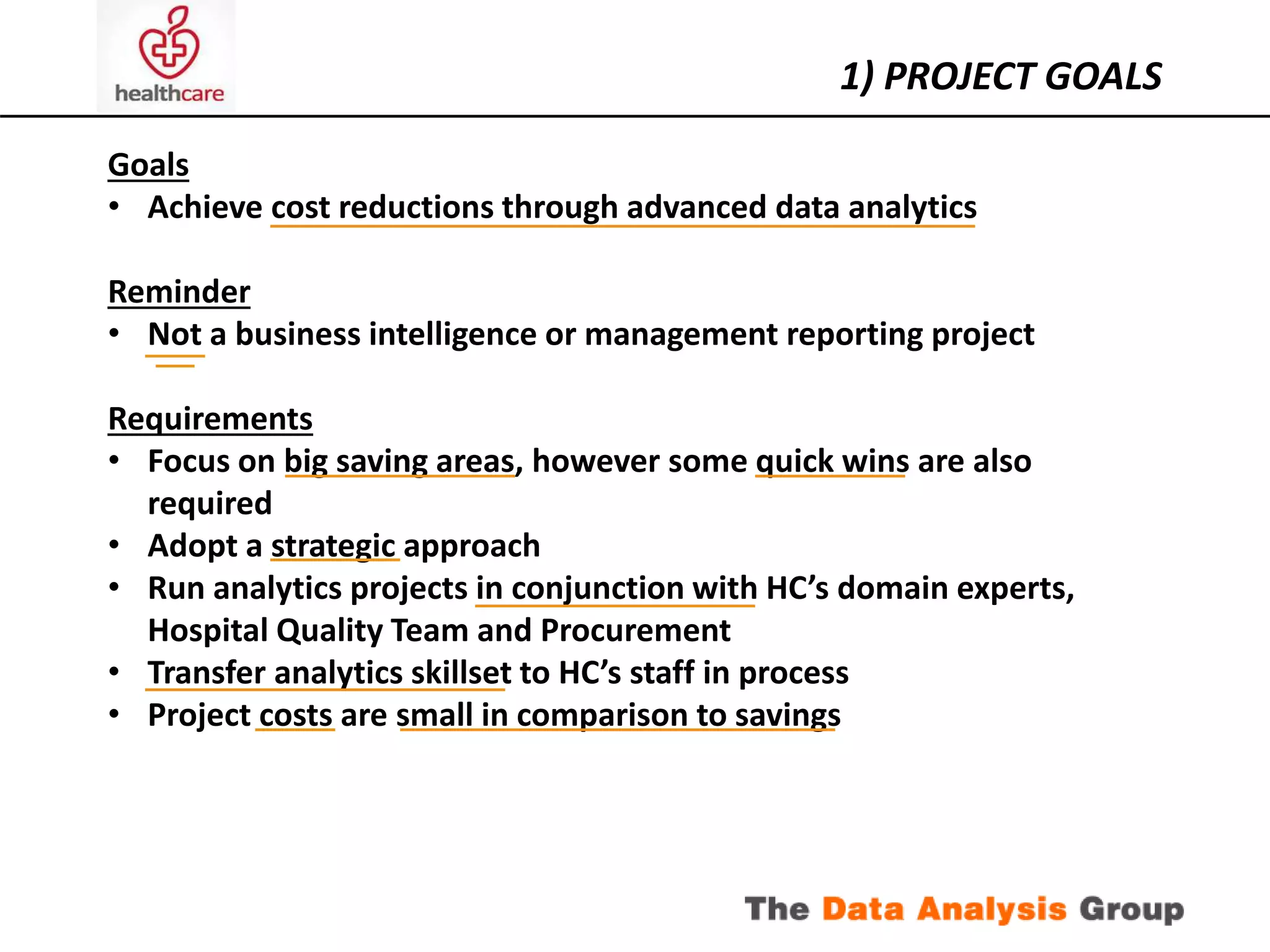
1) PROJECT GOALS 
Goals 
• Achieve cost reductions through advanced data analytics 
Reminder 
• Not a business intelligence or management reporting project 
Requirements 
• Focus on big saving areas, however some quick wins are also 
required 
• Adopt a strategic approach 
• Run analytics projects in conjunction with HC’s domain experts, 
Hospital Quality Team and Procurement 
• Transfer analytics skillset to HC’s staff in process 
• Project costs are small in comparison to savings
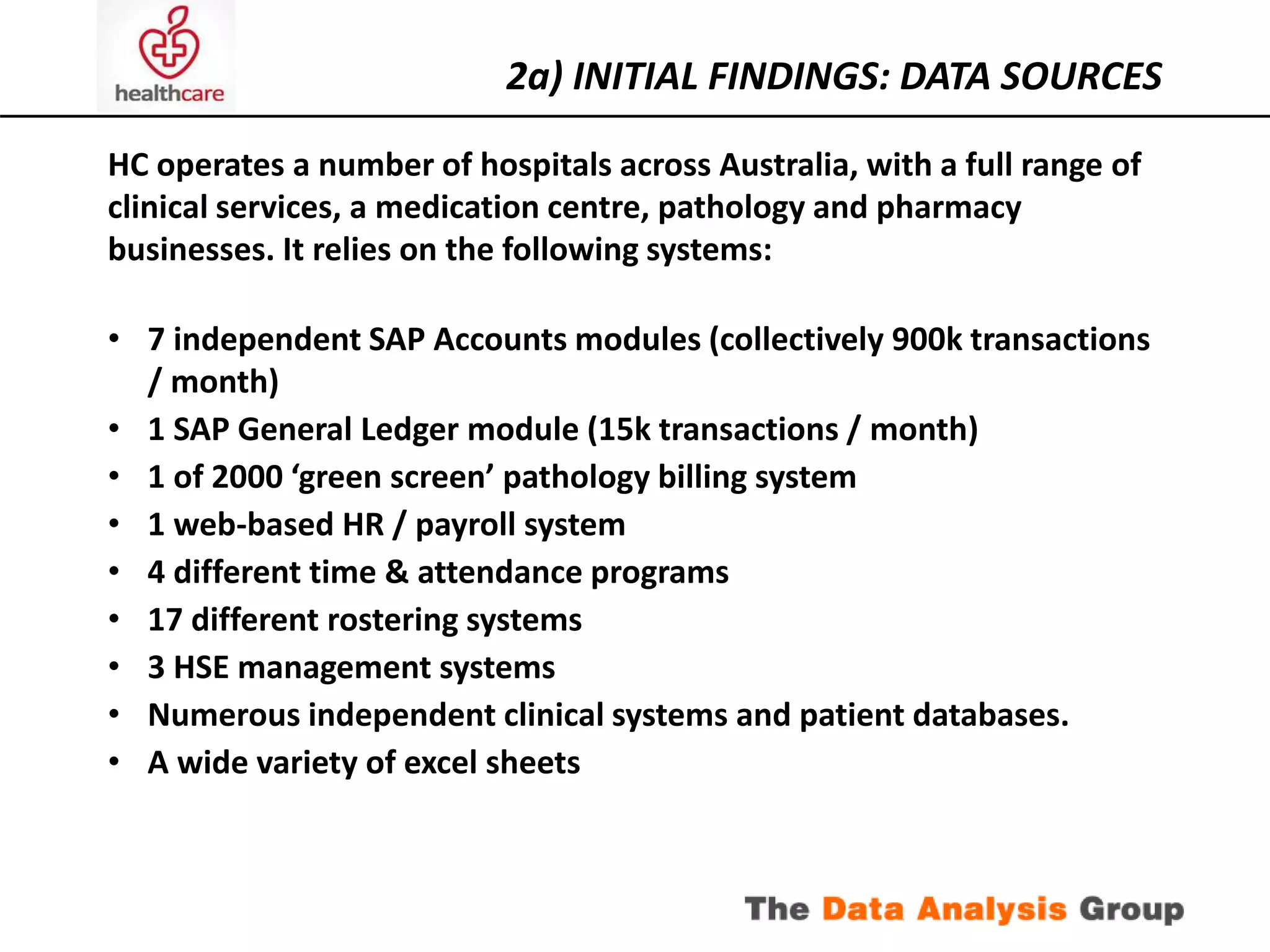
2a) INITIAL FINDINGS: DATA SOURCES 
HC operates a number of hospitals across Australia, with a full range of 
clinical services, a medication centre, pathology and pharmacy 
businesses. It relies on the following systems: 
• 7 independent SAP Accounts modules (collectively 900k transactions 
/ month) 
• 1 SAP General Ledger module (15k transactions / month) 
• 1 of 2000 ‘green screen’ pathology billing system 
• 1 web-based HR / payroll system 
• 4 different time & attendance programs 
• 17 different rostering systems 
• 3 HSE management systems 
• Numerous independent clinical systems and patient databases. 
• A wide variety of excel sheets
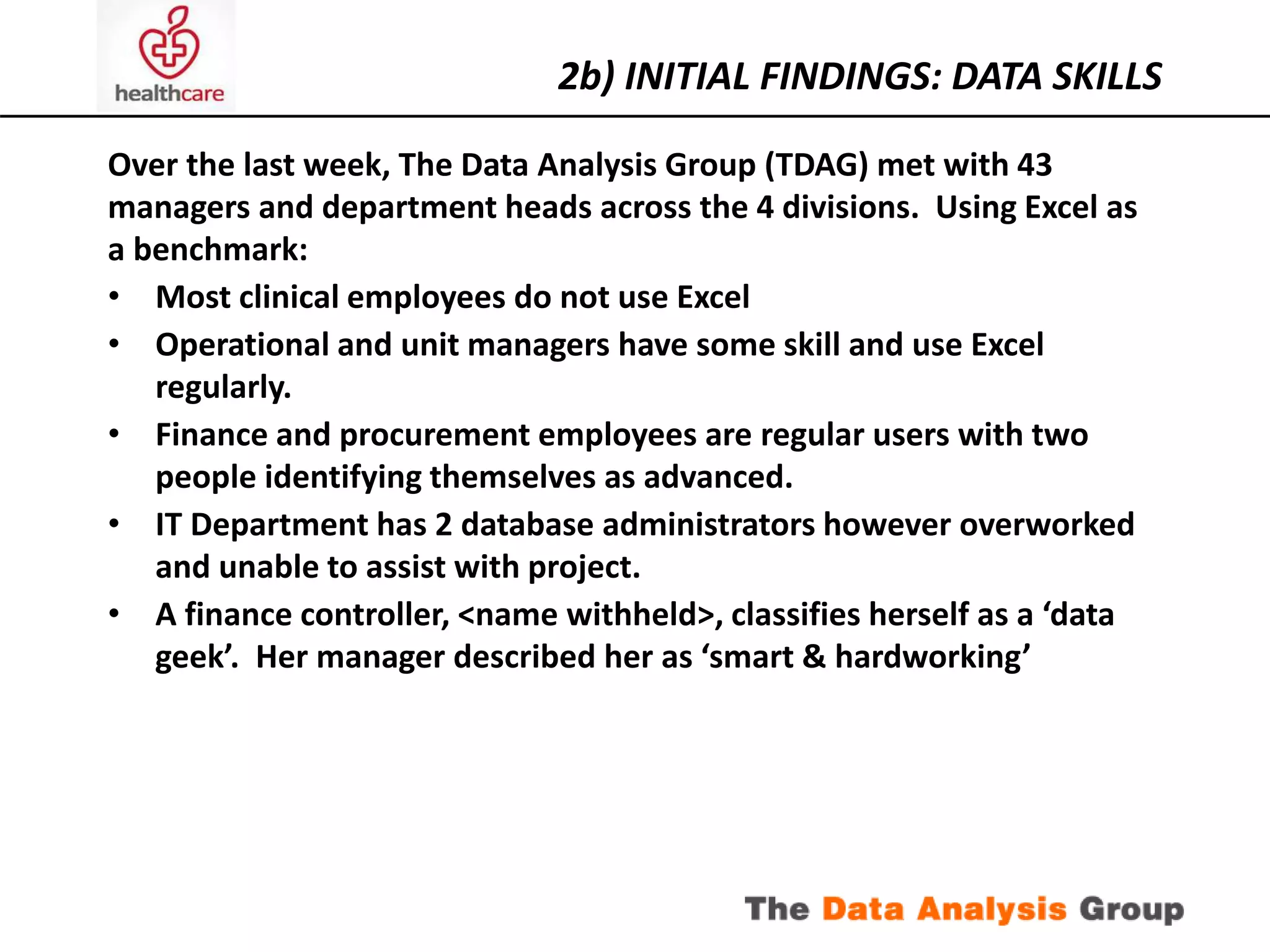
2b) INITIAL FINDINGS: DATA SKILLS 
Over the last week, The Data Analysis Group (TDAG) met with 43 
managers and department heads across the 4 divisions. Using Excel as 
a benchmark: 
• Most clinical employees do not use Excel 
• Operational and unit managers have some skill and use Excel 
regularly. 
• Finance and procurement employees are regular users with two 
people identifying themselves as advanced. 
• IT Department has 2 database administrators however overworked 
and unable to assist with project. 
• A finance controller, <name withheld>, classifies herself as a ‘data 
geek’. Her manager described her as ‘smart & hardworking’
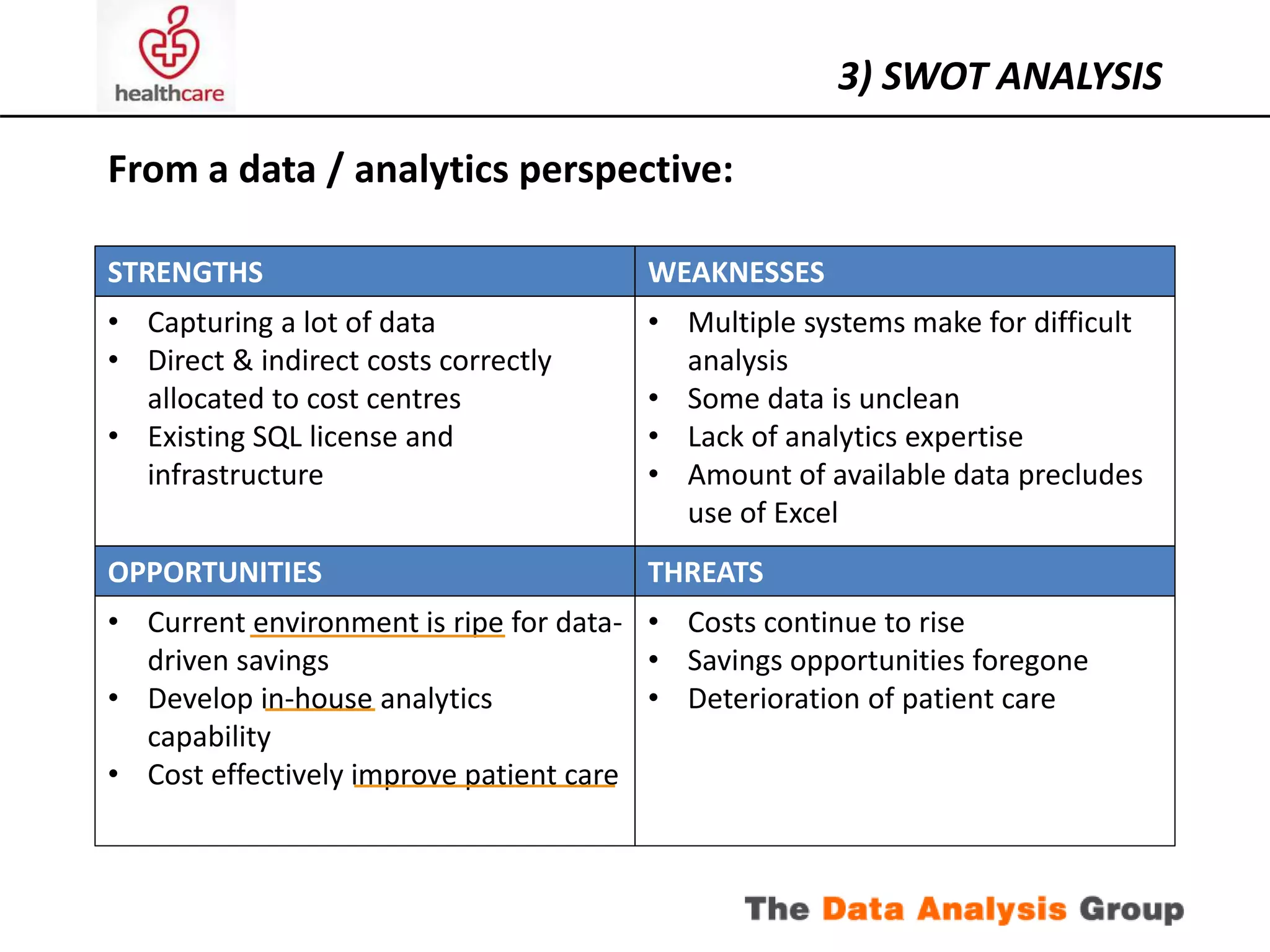
From a data / analytics perspective: 
3) SWOT ANALYSIS 
STRENGTHS WEAKNESSES 
• Capturing a lot of data 
• Direct & indirect costs correctly 
allocated to cost centres 
• Existing SQL license and 
infrastructure 
OPPORTUNITIES THREATS 
• Current environment is ripe for data-driven 
savings 
• Develop in-house analytics 
capability 
• Cost effectively improve patient care 
• Multiple systems make for difficult 
analysis 
• Some data is unclean 
• Lack of analytics expertise 
• Amount of available data precludes 
use of Excel 
• Costs continue to rise 
• Savings opportunities foregone 
• Deterioration of patient care
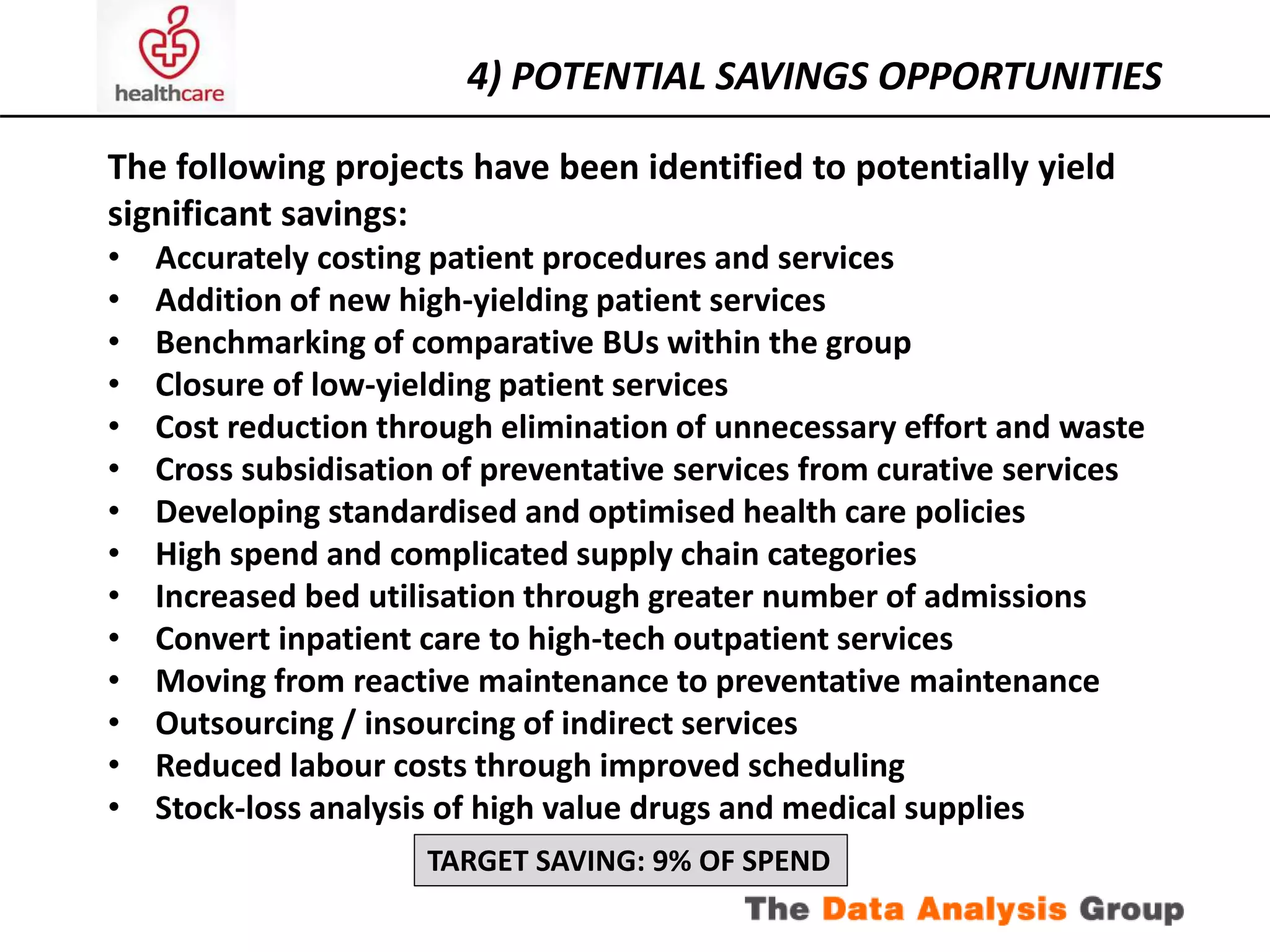
4) POTENTIAL SAVINGS OPPORTUNITIES 
The following projects have been identified to potentially yield 
significant savings: 
• Accurately costing patient procedures and services 
• Addition of new high-yielding patient services 
• Benchmarking of comparative BUs within the group 
• Closure of low-yielding patient services 
• Cost reduction through elimination of unnecessary effort and waste 
• Cross subsidisation of preventative services from curative services 
• Developing standardised and optimised health care policies 
• High spend and complicated supply chain categories 
• Increased bed utilisation through greater number of admissions 
• Convert inpatient care to high-tech outpatient services 
• Moving from reactive maintenance to preventative maintenance 
• Outsourcing / insourcing of indirect services 
• Reduced labour costs through improved scheduling 
• Stock-loss analysis of high value drugs and medical supplies 
TARGET SAVING: 9% OF SPEND
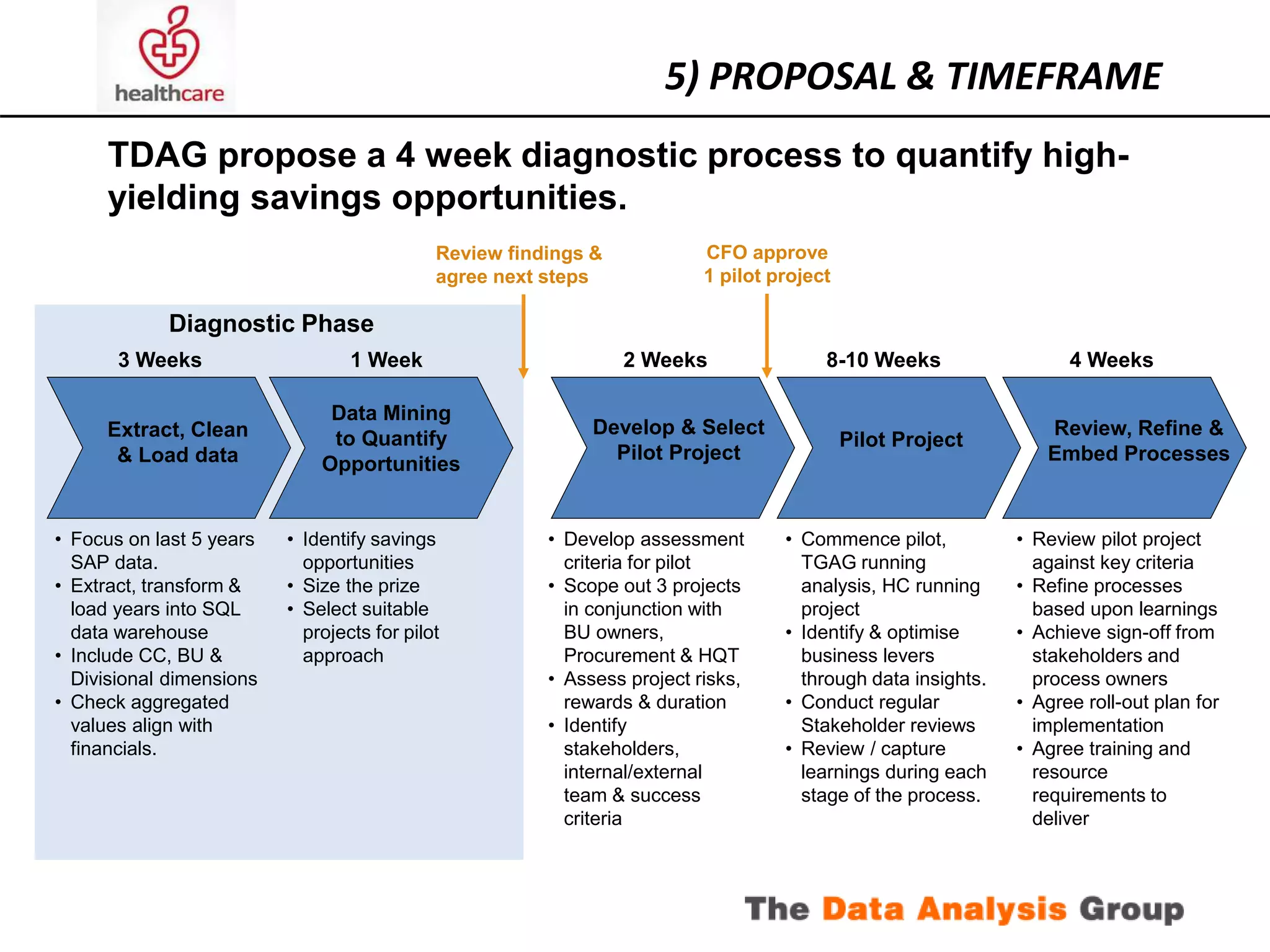
TDAG propose a 4 week diagnostic process to quantify high-yielding 
savings opportunities. 
3 Weeks 1 Week 2 Weeks 8-10 Weeks 4 Weeks 
Extract, Clean 
& Load data 
• Focus on last 5 years 
SAP data. 
• Extract, transform & 
load years into SQL 
data warehouse 
• Include CC, BU & 
Divisional dimensions 
• Check aggregated 
values align with 
financials. 
Data Mining 
to Quantify 
Opportunities 
Develop & Select 
Pilot Project 
Pilot Project 
Review, Refine & 
Embed Processes 
• Identify savings 
opportunities 
• Size the prize 
• Select suitable 
projects for pilot 
approach 
• Develop assessment 
criteria for pilot 
• Scope out 3 projects 
in conjunction with 
BU owners, 
Procurement & HQT 
• Assess project risks, 
rewards & duration 
• Identify 
stakeholders, 
internal/external 
team & success 
criteria 
• Commence pilot, 
TGAG running 
analysis, HC running 
project 
• Identify & optimise 
business levers 
through data insights. 
• Conduct regular 
Stakeholder reviews 
• Review / capture 
learnings during each 
stage of the process. 
• Review pilot project 
against key criteria 
• Refine processes 
based upon learnings 
• Achieve sign-off from 
stakeholders and 
process owners 
• Agree roll-out plan for 
implementation 
• Agree training and 
resource 
requirements to 
deliver 
Diagnostic Phase 
Review findings & 
agree next steps 
5) PROPOSAL & TIMEFRAME 
CFO approve 
1 pilot project
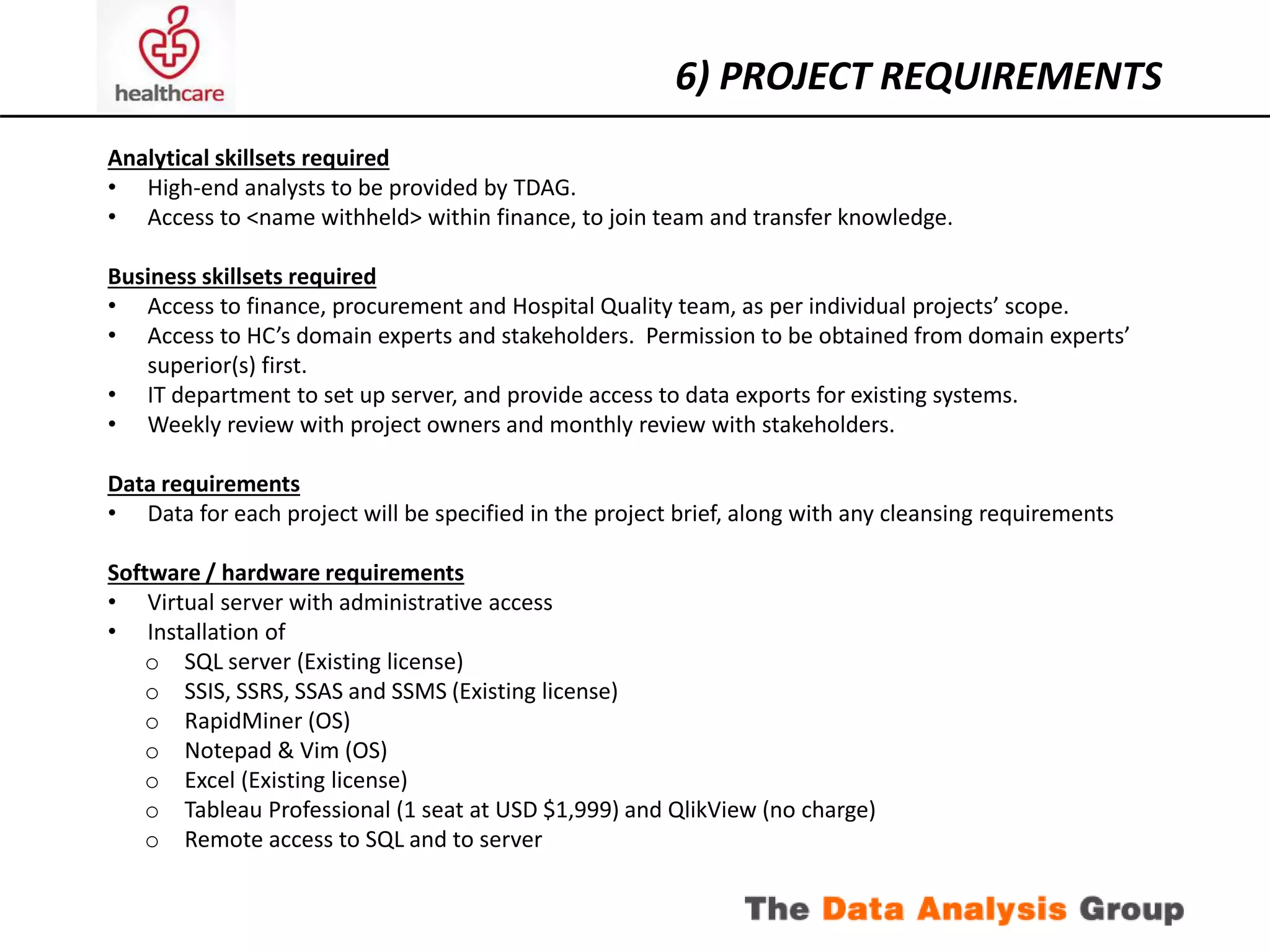
6) PROJECT REQUIREMENTS 
Analytical skillsets required 
• High-end analysts to be provided by TDAG. 
• Access to <name withheld> within finance, to join team and transfer knowledge. 
Business skillsets required 
• Access to finance, procurement and Hospital Quality team, as per individual projects’ scope. 
• Access to HC’s domain experts and stakeholders. Permission to be obtained from domain experts’ 
superior(s) first. 
• IT department to set up server, and provide access to data exports for existing systems. 
• Weekly review with project owners and monthly review with stakeholders. 
Data requirements 
• Data for each project will be specified in the project brief, along with any cleansing requirements 
Software / hardware requirements 
• Virtual server with administrative access 
• Installation of 
o SQL server (Existing license) 
o SSIS, SSRS, SSAS and SSMS (Existing license) 
o RapidMiner (OS) 
o Notepad & Vim (OS) 
o Excel (Existing license) 
o Tableau Professional (1 seat at USD $1,999) and QlikView (no charge) 
o Remote access to SQL and to server
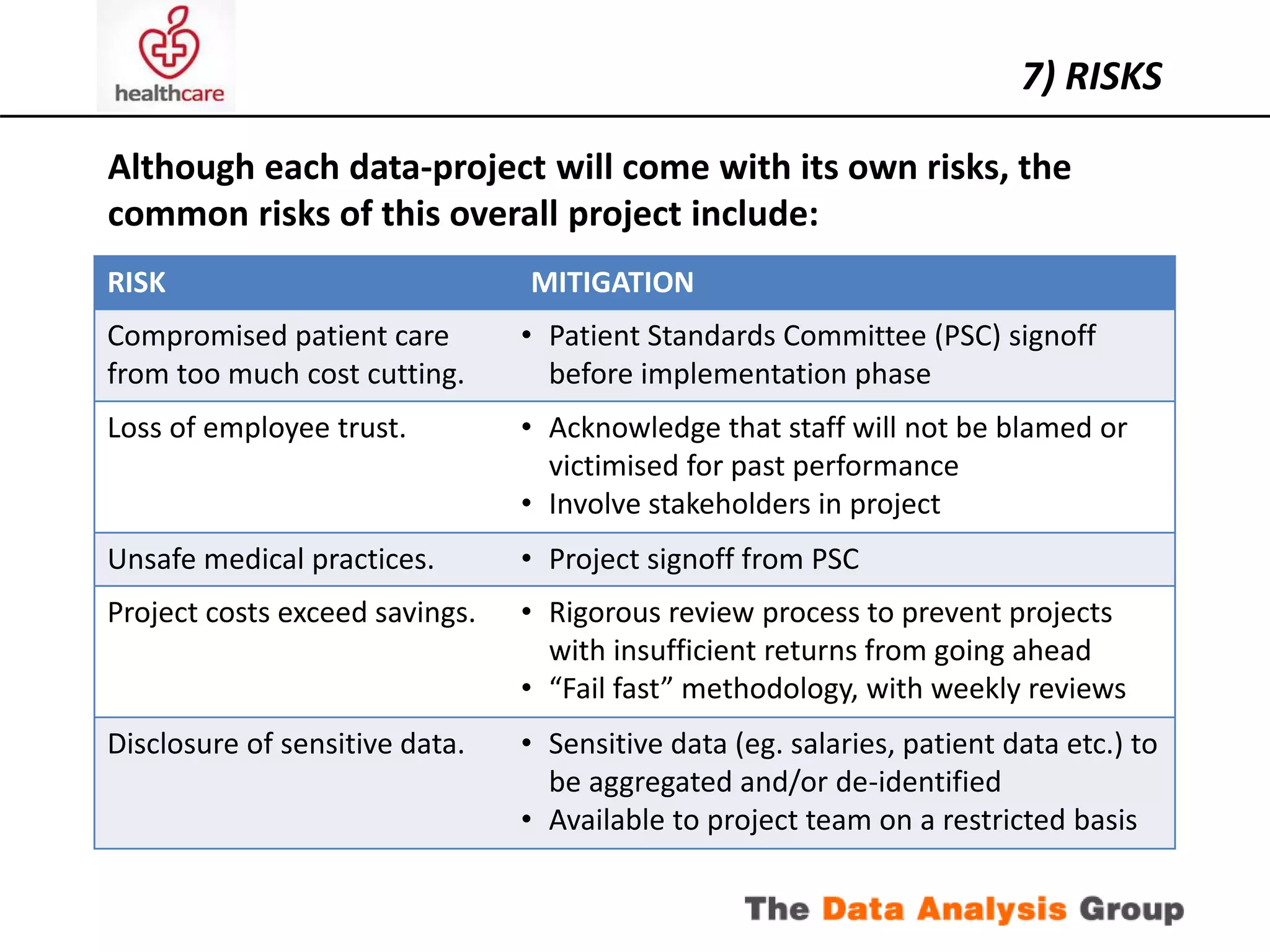
7) RISKS 
Although each data-project will come with its own risks, the 
common risks of this overall project include: 
RISK MITIGATION 
Compromised patient care 
from too much cost cutting. 
• Patient Standards Committee (PSC) signoff 
before implementation phase 
Loss of employee trust. • Acknowledge that staff will not be blamed or 
victimised for past performance 
• Involve stakeholders in project 
Unsafe medical practices. • Project signoff from PSC 
Project costs exceed savings. • Rigorous review process to prevent projects 
with insufficient returns from going ahead 
• “Fail fast” methodology, with weekly reviews 
Disclosure of sensitive data. • Sensitive data (eg. salaries, patient data etc.) to 
be aggregated and/or de-identified 
• Available to project team on a restricted basis
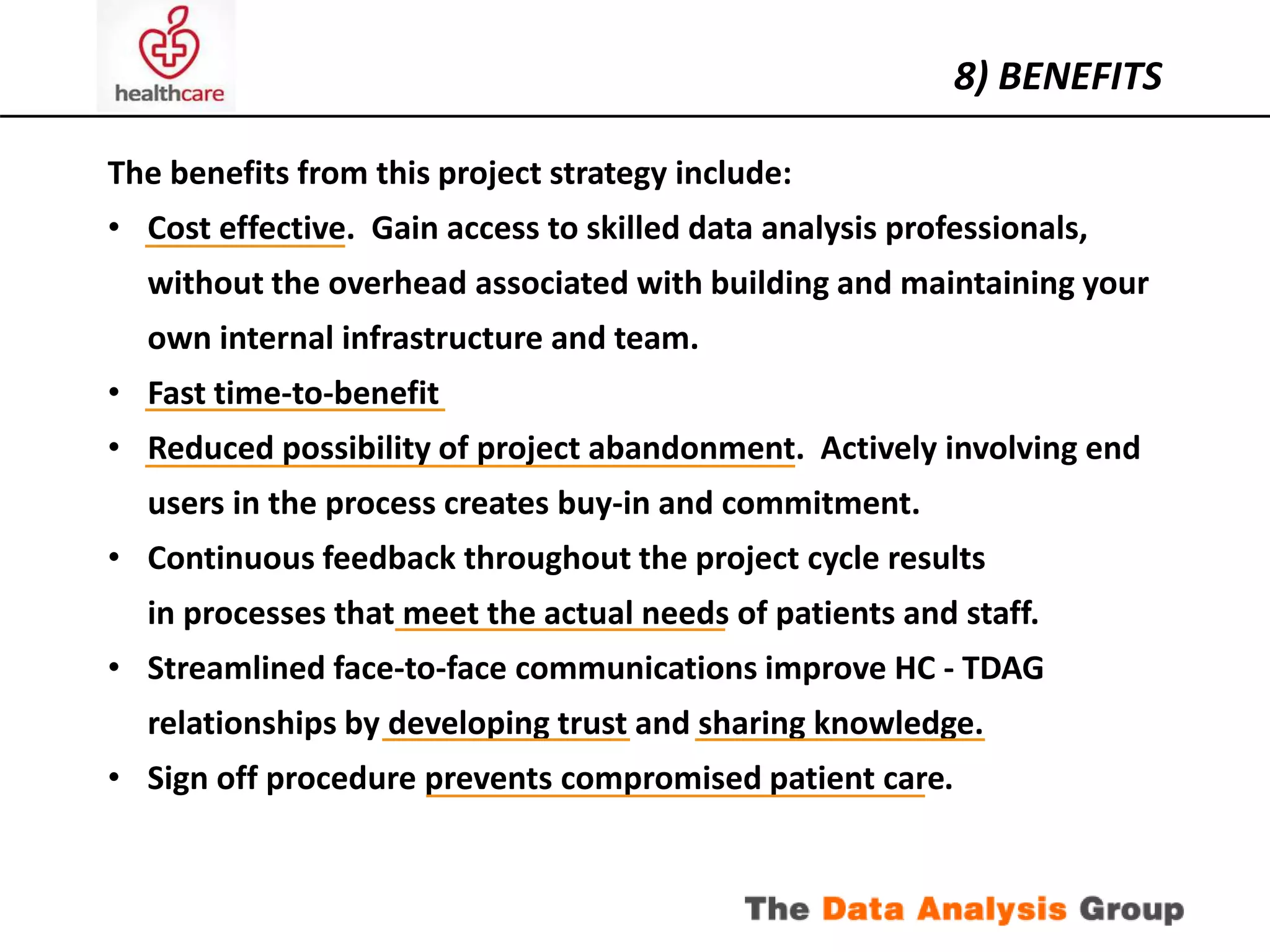
The benefits from this project strategy include: 
• Cost effective. Gain access to skilled data analysis professionals, 
without the overhead associated with building and maintaining your 
own internal infrastructure and team. 
• Fast time-to-benefit 
• Reduced possibility of project abandonment. Actively involving end 
users in the process creates buy-in and commitment. 
• Continuous feedback throughout the project cycle results 
in processes that meet the actual needs of patients and staff. 
• Streamlined face-to-face communications improve HC - TDAG 
relationships by developing trust and sharing knowledge. 
• Sign off procedure prevents compromised patient care. 
8) BENEFITS
9) DISCUSSION AND NEXT STEPS 
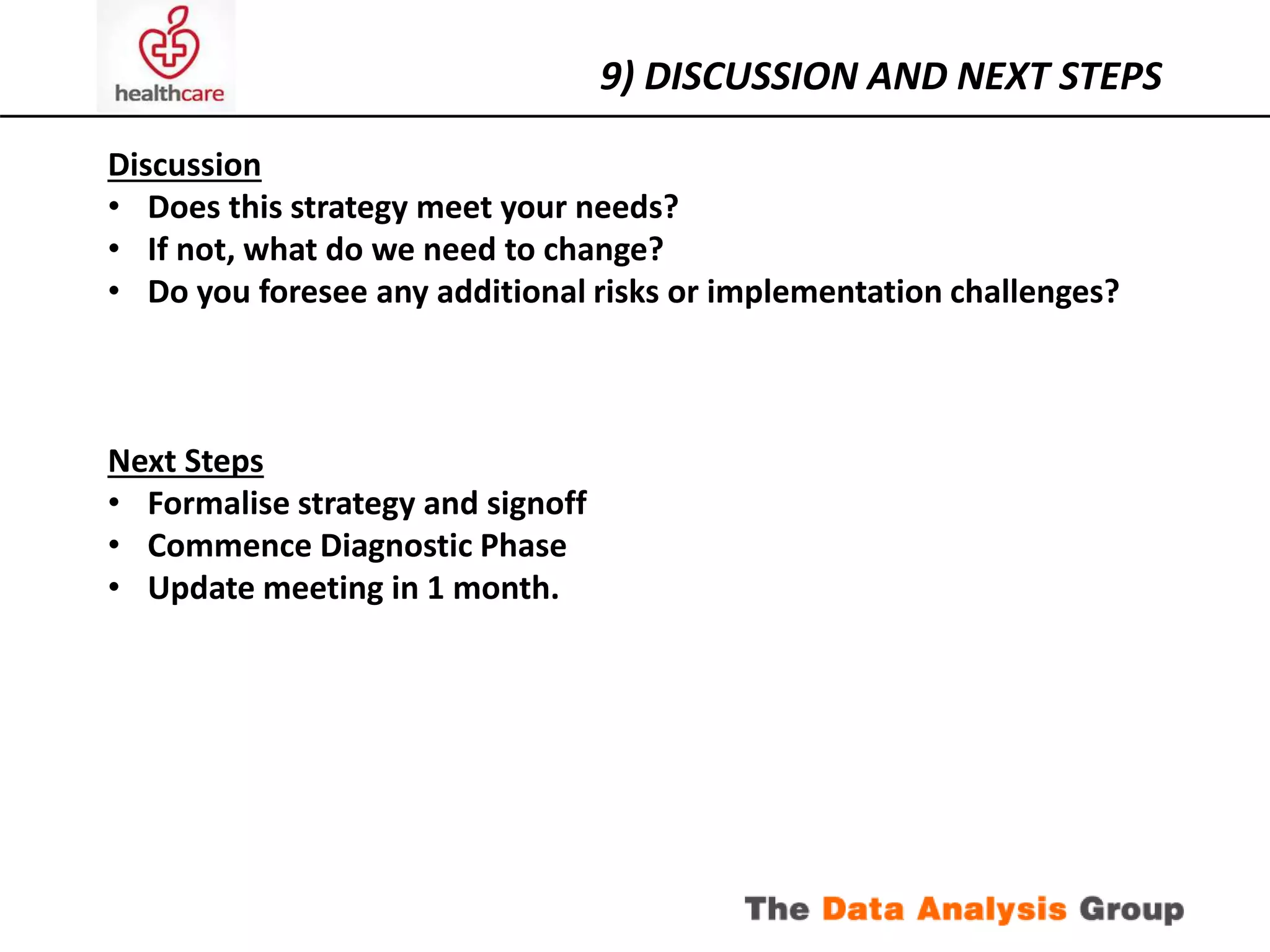
Discussion 
• Does this strategy meet your needs? 
• If not, what do we need to change? 
• Do you foresee any additional risks or implementation challenges? 
Next Steps 
• Formalise strategy and signoff 
• Commence Diagnostic Phase 
• Update meeting in 1 month.
10) CONTACT DETAILS 
For further information, please contact 
The Data Analysis Group on: 
James Karis 
CEO & Chief Geek 
p) 1300 788 662 
e) info@data-analysis.com.au 
w) www.data-analysis.com.au

Health Care: Cost Reductions through Data Insights - The Data Analysis Group

  • 1.
  • 2.
    AGENDA 1) Recapof project goals 2) Discuss initial findings 3) SWOT Analysis 4) Potential savings opportunities 5) Proposal & Timeframe 6) Project requirements 7) Risks 8) Benefits 9) Discussion and next steps 10) Contact Details
  • 3.
    1) PROJECT GOALS Goals • Achieve cost reductions through advanced data analytics Reminder • Not a business intelligence or management reporting project Requirements • Focus on big saving areas, however some quick wins are also required • Adopt a strategic approach • Run analytics projects in conjunction with HC’s domain experts, Hospital Quality Team and Procurement • Transfer analytics skillset to HC’s staff in process • Project costs are small in comparison to savings
  • 4.
    2a) INITIAL FINDINGS:DATA SOURCES HC operates a number of hospitals across Australia, with a full range of clinical services, a medication centre, pathology and pharmacy businesses. It relies on the following systems: • 7 independent SAP Accounts modules (collectively 900k transactions / month) • 1 SAP General Ledger module (15k transactions / month) • 1 of 2000 ‘green screen’ pathology billing system • 1 web-based HR / payroll system • 4 different time & attendance programs • 17 different rostering systems • 3 HSE management systems • Numerous independent clinical systems and patient databases. • A wide variety of excel sheets
  • 5.
    2b) INITIAL FINDINGS:DATA SKILLS Over the last week, The Data Analysis Group (TDAG) met with 43 managers and department heads across the 4 divisions. Using Excel as a benchmark: • Most clinical employees do not use Excel • Operational and unit managers have some skill and use Excel regularly. • Finance and procurement employees are regular users with two people identifying themselves as advanced. • IT Department has 2 database administrators however overworked and unable to assist with project. • A finance controller, <name withheld>, classifies herself as a ‘data geek’. Her manager described her as ‘smart & hardworking’
  • 6.
    From a data/ analytics perspective: 3) SWOT ANALYSIS STRENGTHS WEAKNESSES • Capturing a lot of data • Direct & indirect costs correctly allocated to cost centres • Existing SQL license and infrastructure OPPORTUNITIES THREATS • Current environment is ripe for data-driven savings • Develop in-house analytics capability • Cost effectively improve patient care • Multiple systems make for difficult analysis • Some data is unclean • Lack of analytics expertise • Amount of available data precludes use of Excel • Costs continue to rise • Savings opportunities foregone • Deterioration of patient care
  • 7.
    4) POTENTIAL SAVINGSOPPORTUNITIES The following projects have been identified to potentially yield significant savings: • Accurately costing patient procedures and services • Addition of new high-yielding patient services • Benchmarking of comparative BUs within the group • Closure of low-yielding patient services • Cost reduction through elimination of unnecessary effort and waste • Cross subsidisation of preventative services from curative services • Developing standardised and optimised health care policies • High spend and complicated supply chain categories • Increased bed utilisation through greater number of admissions • Convert inpatient care to high-tech outpatient services • Moving from reactive maintenance to preventative maintenance • Outsourcing / insourcing of indirect services • Reduced labour costs through improved scheduling • Stock-loss analysis of high value drugs and medical supplies TARGET SAVING: 9% OF SPEND
  • 8.
    TDAG propose a4 week diagnostic process to quantify high-yielding savings opportunities. 3 Weeks 1 Week 2 Weeks 8-10 Weeks 4 Weeks Extract, Clean & Load data • Focus on last 5 years SAP data. • Extract, transform & load years into SQL data warehouse • Include CC, BU & Divisional dimensions • Check aggregated values align with financials. Data Mining to Quantify Opportunities Develop & Select Pilot Project Pilot Project Review, Refine & Embed Processes • Identify savings opportunities • Size the prize • Select suitable projects for pilot approach • Develop assessment criteria for pilot • Scope out 3 projects in conjunction with BU owners, Procurement & HQT • Assess project risks, rewards & duration • Identify stakeholders, internal/external team & success criteria • Commence pilot, TGAG running analysis, HC running project • Identify & optimise business levers through data insights. • Conduct regular Stakeholder reviews • Review / capture learnings during each stage of the process. • Review pilot project against key criteria • Refine processes based upon learnings • Achieve sign-off from stakeholders and process owners • Agree roll-out plan for implementation • Agree training and resource requirements to deliver Diagnostic Phase Review findings & agree next steps 5) PROPOSAL & TIMEFRAME CFO approve 1 pilot project
  • 9.
    6) PROJECT REQUIREMENTS Analytical skillsets required • High-end analysts to be provided by TDAG. • Access to <name withheld> within finance, to join team and transfer knowledge. Business skillsets required • Access to finance, procurement and Hospital Quality team, as per individual projects’ scope. • Access to HC’s domain experts and stakeholders. Permission to be obtained from domain experts’ superior(s) first. • IT department to set up server, and provide access to data exports for existing systems. • Weekly review with project owners and monthly review with stakeholders. Data requirements • Data for each project will be specified in the project brief, along with any cleansing requirements Software / hardware requirements • Virtual server with administrative access • Installation of o SQL server (Existing license) o SSIS, SSRS, SSAS and SSMS (Existing license) o RapidMiner (OS) o Notepad & Vim (OS) o Excel (Existing license) o Tableau Professional (1 seat at USD $1,999) and QlikView (no charge) o Remote access to SQL and to server
  • 10.
    7) RISKS Althougheach data-project will come with its own risks, the common risks of this overall project include: RISK MITIGATION Compromised patient care from too much cost cutting. • Patient Standards Committee (PSC) signoff before implementation phase Loss of employee trust. • Acknowledge that staff will not be blamed or victimised for past performance • Involve stakeholders in project Unsafe medical practices. • Project signoff from PSC Project costs exceed savings. • Rigorous review process to prevent projects with insufficient returns from going ahead • “Fail fast” methodology, with weekly reviews Disclosure of sensitive data. • Sensitive data (eg. salaries, patient data etc.) to be aggregated and/or de-identified • Available to project team on a restricted basis
  • 11.
    The benefits fromthis project strategy include: • Cost effective. Gain access to skilled data analysis professionals, without the overhead associated with building and maintaining your own internal infrastructure and team. • Fast time-to-benefit • Reduced possibility of project abandonment. Actively involving end users in the process creates buy-in and commitment. • Continuous feedback throughout the project cycle results in processes that meet the actual needs of patients and staff. • Streamlined face-to-face communications improve HC - TDAG relationships by developing trust and sharing knowledge. • Sign off procedure prevents compromised patient care. 8) BENEFITS
  • 12.
    9) DISCUSSION ANDNEXT STEPS Discussion • Does this strategy meet your needs? • If not, what do we need to change? • Do you foresee any additional risks or implementation challenges? Next Steps • Formalise strategy and signoff • Commence Diagnostic Phase • Update meeting in 1 month.
  • 13.
    10) CONTACT DETAILS For further information, please contact The Data Analysis Group on: James Karis CEO & Chief Geek p) 1300 788 662 e) info@data-analysis.com.au w) www.data-analysis.com.au