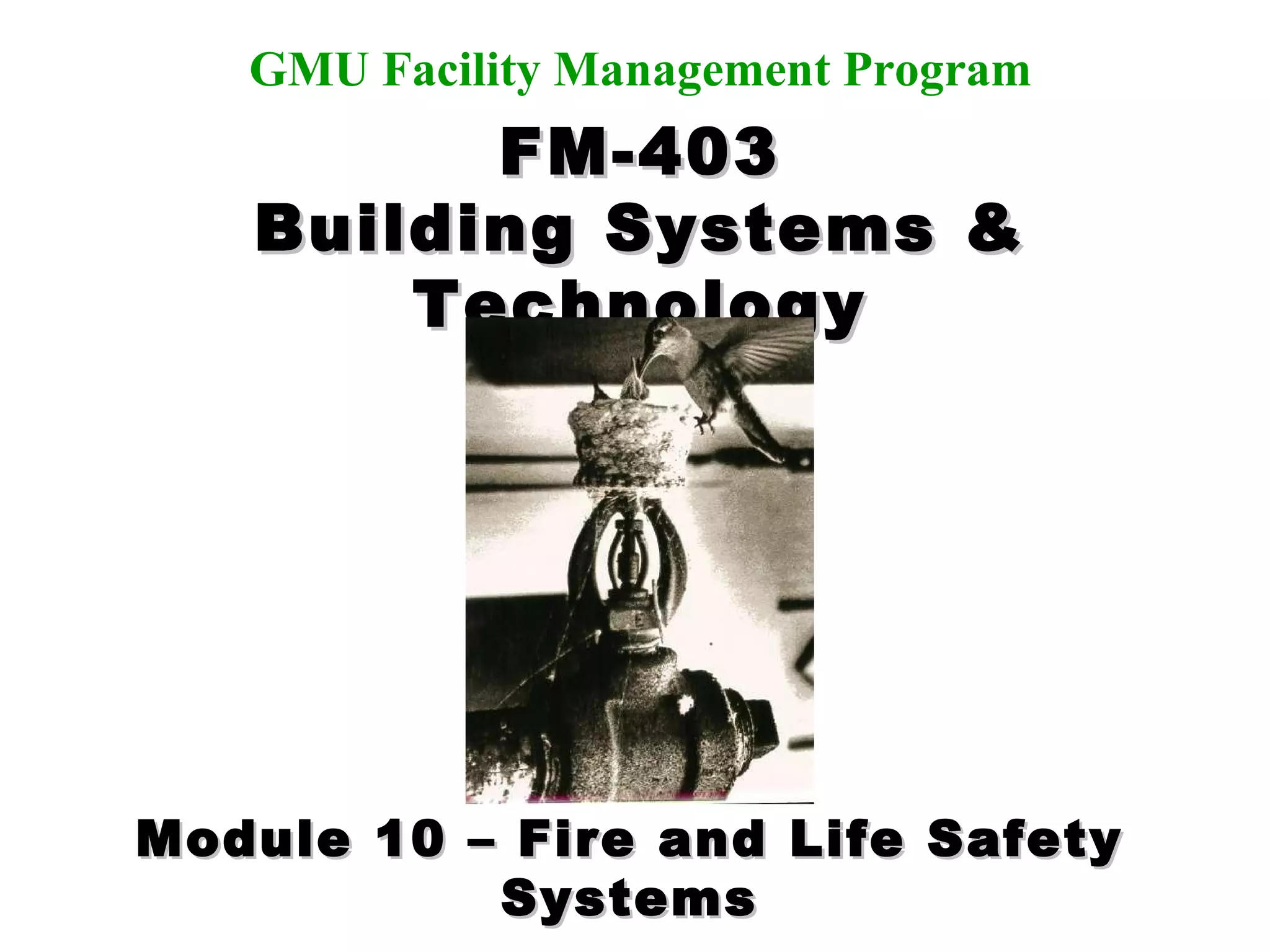
FM-403 Building Systems & Technology Dave Leathers, CFM Jim Whittaker, P.E. Chris Hodges, P.E., RRC Instructors: GMU Facility Management Program Module 10 – Fire and Life Safety Systems
Purpose Protect occupants Protect the asset Fire suppression Fire detection Notification Evacuation Extinguish Fire alarm systems Detect React Notify Control Evacuate Fire and Life Safety Systems
Fire Protection Program Main components of fire protection: Early detection and alarm system Means of egress Compartmentalization Smoke Control Fire Suppression Systems Emergency Power Fire and Life Safety Systems
Basic Fire Protection Principles All the elements for basic fire protection can be broken down into these categories:  passive fire protection systems active fire protection systems Fire and Life Safety Systems
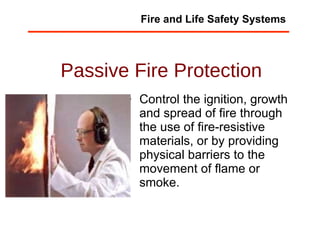
Passive Fire Protection Control the ignition, growth and spread of fire through the use of fire-resistive materials, or by providing physical barriers to the movement of flame or smoke.  Fire and Life Safety Systems
Passive Fire Protection Intended to maintain the following:  Provide structural integrity of floor, wall and ceiling assemblies during a fire for a specified time period  Compartmentalize the room or space to control the fire spread Provide exiting systems for occupants to safely evacuate the building  Fire and Life Safety Systems
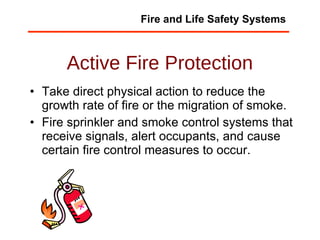
Active Fire Protection Take direct physical action to reduce the growth rate of fire or the migration of smoke. Fire sprinkler and smoke control systems that receive signals, alert occupants, and cause certain fire control measures to occur.  Fire and Life Safety Systems
Fire Protection Codes &   Design Standards National Fire Protection Agency (NFPA) standards include: NFPA 10 - Fire Extinguishers NFPA 70 - Electrical Systems NFPA 72 - Fire Alarm Systems NFPA 96 - Kitchen Hoods NFPA 90A and 90B - Mechanical Systems NFPA 101 - Life Safety NFPA 99 - Healthcare Systems and several other standards for special hazard systems Fire and Life Safety Systems
Fire codes are often written so that the authority to enforce the code can be a municipality, or other government agency. These authorities are called AHJ’s, or Authorities Having Jurisdiction. Fire Protection Codes & Design Standards Fire and Life Safety Systems
Performance based fire protection approach   Evaluating the hazard presented and the development of the most appropriate method to protect this given hazard Risk Assessment  Evaluate Hazards  Manage Fire Impact  Determine Appropriate Fire Protection Tools   Fire and Life Safety Systems
Passive Fire Protection Systems The purpose of compartmentalizing is to protect building occupants and property by: Confining the fire, heat smoke and toxic gases to the area of origin until the fire is extinguished or completely burns itself out Providing areas of refuge for the occupants and protecting firefighters Fire and Life Safety Systems
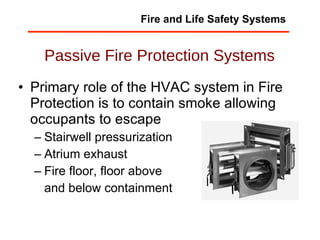
Passive Fire Protection Systems Primary role of the HVAC system in Fire Protection is to contain smoke allowing occupants to escape Stairwell pressurization Atrium exhaust Fire floor, floor above and below containment Fire and Life Safety Systems
Passive Fire Protection Systems Smoke rather than actual flames accounts for about 90% of all fire casualties One solution is to minimize the use of furnishings and construction materials that produce large quantities of smoke Fire and Life Safety Systems
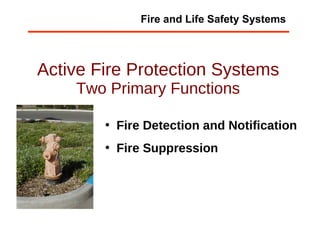
Active Fire Protection Systems Two Primary Functions Fire Detection and Notification Fire Suppression Fire and Life Safety Systems
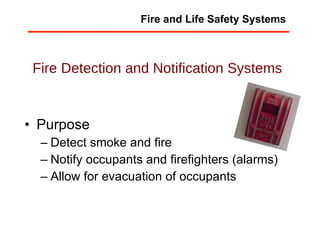
Fire Detection and Notification Systems Purpose Detect smoke and fire Notify occupants and firefighters (alarms) Allow for evacuation of occupants Fire and Life Safety Systems
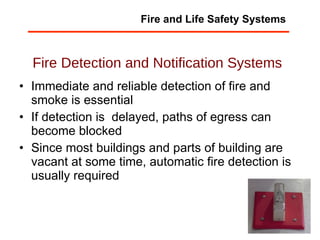
Fire Detection and Notification Systems Immediate and reliable detection of fire and smoke is essential If detection is  delayed, paths of egress can become blocked Since most buildings and parts of building are vacant at some time, automatic fire detection is usually required Fire and Life Safety Systems
Fire Detection System Components Detectors: Smoke detectors Duct detectors Heat detectors Pull stations Flow switches Notifiers: Speakers Horns/bells Lights Controllers: Local control panels Annunciator panels Main control panels Tamper switches Central station notification device Other Wire HVAC system connections Computer, printer, etc. Trouble alarms Fire and Life Safety Systems
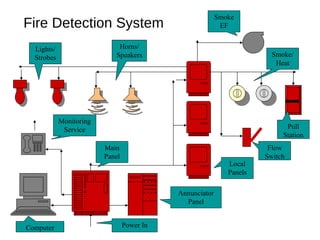
Fire Detection System Main Panel Annunciator Panel Monitoring Service Computer Power In Local Panels Flow Switch Pull Station Smoke/Heat Smoke EF Horns/ Speakers Lights/ Strobes
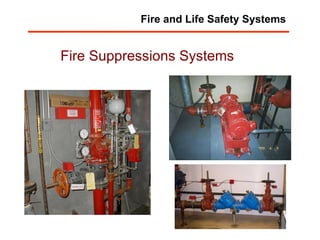
Fire Suppressions Systems Fire and Life Safety Systems
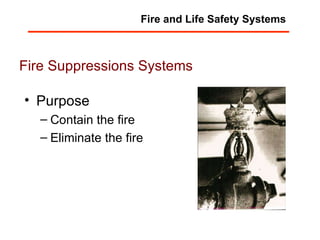
Fire Suppressions Systems Purpose Contain the fire Eliminate the fire Fire and Life Safety Systems
Fire Suppression System Components Piping Control valves Fire pumps Jockey pumps Air compressors Fire extinguishers Chemical systems Alarm valves Sprinkler heads Automatic valves Back flow preventers Strainers Control valve locks Indicators Fire and Life Safety Systems
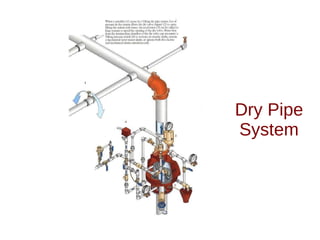
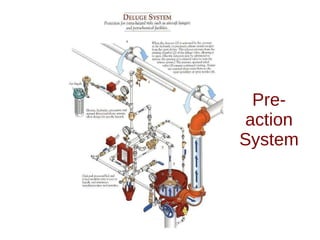
Fire Suppression System Types Wet type system Dry type system Pre-action system Chemical system Hose Fire extinguisher Fire and Life Safety Systems
Fire Suppression System Components Automatic Sprinkler Control Design Objectives “ In general terms of property protection, sprinkler systems are typically designed to achieve  fire control...” “ Fire control can be described as limiting the fire size by decreasing the rate of heat release and pre-wetting adjacent combustibles, while  NFPA Fire Protection Handbook, 19th Edition, p. 10-193. Fire and Life Safety Systems
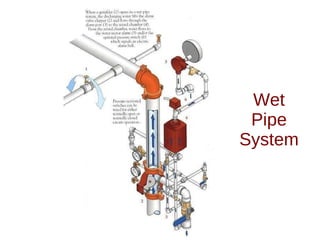
Wet Pipe System
Dry Pipe System
Pre-action System
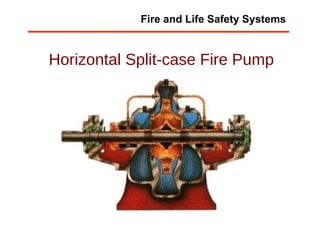
Fire Pumps Typically, three types of fire pumps are used:  horizontal split-case,  vertical in-line  and vertical shaft turbine.  Fire and Life Safety Systems
Horizontal Split-case Fire Pump Fire and Life Safety Systems
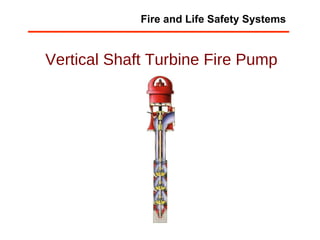
Vertical Shaft Turbine Fire Pump Fire and Life Safety Systems
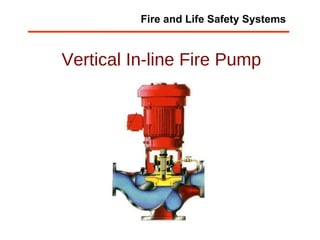
Vertical In-line Fire Pump Fire and Life Safety Systems
Maintenan ce Only as good as the design, installation and maintenance of the systems. Passive systems do not have the same testing and inspection requirements or standards as active fire protection systems. Once the passive system is installed, inspected and accepted by the building official and the certificate of occupancy is issued, the system is generally not re-inspected unless changes to the structure affecting the passive system occur.  Fire and Life Safety Systems
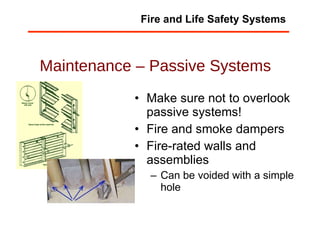
Maintenance – Passive Systems Make sure not to overlook passive systems! Fire and smoke dampers Fire-rated walls and assemblies Can be voided with a simple hole Fire and Life Safety Systems
Maintenance – Testing & Maintenance Program Has the occupancy classification changed?  Have any walls been relocated?  Are the exits free of obstructions?  Are the emergency lights operational?  Have any fire extinguishers been removed or relocated?  Are fire and smoke walls still intact?  Fire and Life Safety Systems
Fire Alarms Maintenance A systematic approach to fire alarm system maintenance should include the following three components:  Inspection and Testing  Maintenance Management  Operational Considerations   Fire and Life Safety Systems
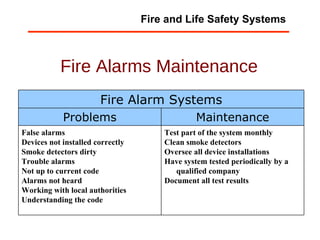
Fire Alarms Maintenance Fire Alarm Systems Problems Maintenance False alarms Devices not installed correctly Smoke detectors dirty Trouble alarms Not up to current code Alarms not heard Working with local authorities Understanding the code Test part of the system monthly Clean smoke detectors Oversee all device installations Have system tested periodically by a qualified company Document all test results Fire and Life Safety Systems
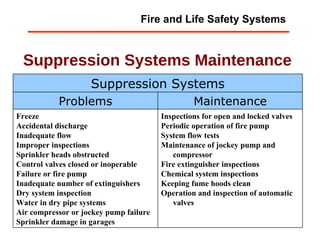
Suppression Systems Maintenance Suppression Systems Problems Maintenance Freeze Accidental discharge Inadequate flow Improper inspections Sprinkler heads obstructed Control valves closed or inoperable Failure or fire pump Inadequate number of extinguishers Dry system inspection Water in dry pipe systems Air compressor or jockey pump failure Sprinkler damage in garages Inspections for open and locked valves Periodic operation of fire pump System flow tests Maintenance of jockey pump and compressor Fire extinguisher inspections Chemical system inspections Keeping fume hoods clean Operation and inspection of automatic valves Fire and Life Safety Systems
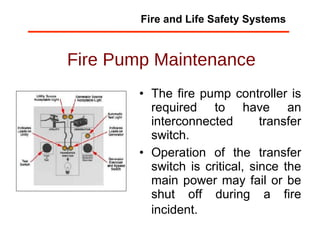
Fire Pump Maintenance Two procedures should be followed for testing automatic transfer switches.  The first procedure consists of simulating normal power failure while the pump is delivering peak power output to cause connection of the pump motor to the alternate power source. This is to verify that higher than normal currents do not occur during testing of the transfer switch.  Second, engine generator sets providing emergency or standby power to fire pump assemblies and automatic transfer switches shall be tested routinely and exercised in accordance with NFPA 110, Standard for Emergency and Standby Power Systems. This test is to verify the proper operation of the transfer switch. Fire and Life Safety Systems
Fire Pump Maintenance The fire pump controller is required to have an interconnected transfer switch. Operation of the transfer switch is critical, since the main power may fail or be shut off during a fire incident.   Fire and Life Safety Systems
Fire Protection Deficiencies Means of Egress Fire Detection and Alarm Fire Suppression Fire Rated Separations Emergency Lighting / Exit Signs Fire and Life Safety Systems
WHAT TO LOOK FOR . . . Identification of Defects Fire and Life Safety Systems
What To Look For . . . Have Alterations Been Made That Could Affect Life/Safety Recommendations Periodically Test Detection and Alarm Systems Routinely Check Egress Routes & Doors Remove Stored Combustible Materials Be Careful With Tenant Improvements & Fitouts Are Alarms Adequate, Y2K & ADA Compliant Is Emergency Egress & Lighting Adequate? Code Violations – Storage, Signage, Fire Stopping, Doors Is Compartmentation & Sprinkler Coverage Adequate? Recalled Sprinklers – Central Omega & Star Sprinklers Fire and Life Safety Systems
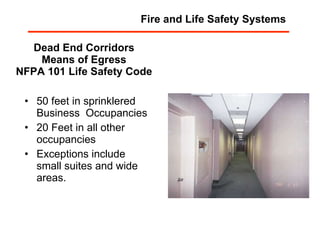
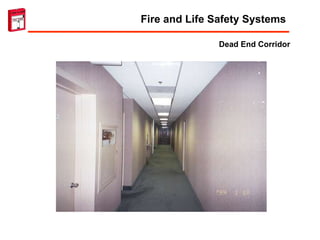
Dead End Corridors Means of Egress NFPA 101 Life Safety Code 50 feet in sprinklered Business  Occupancies 20 Feet in all other occupancies Exceptions include small suites and wide areas. Fire and Life Safety Systems
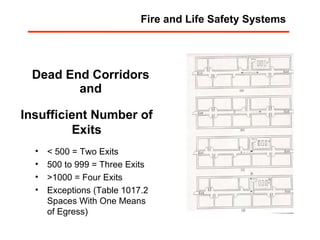
Dead End Corridors and Fire and Life Safety Systems Insufficient Number of Exits < 500 = Two Exits 500 to 999 = Three Exits >1000 = Four Exits Exceptions (Table 1017.2 Spaces With One Means of Egress)
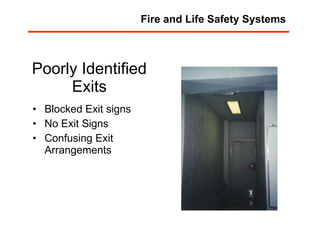
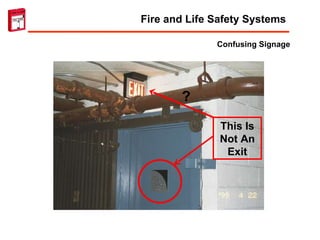
Poorly Identified Exits Blocked Exit signs No Exit Signs Confusing Exit Arrangements Fire and Life Safety Systems
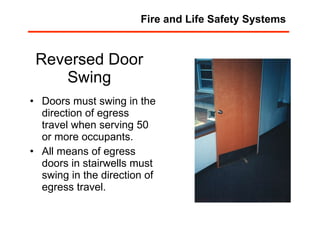
Reversed Door Swing Doors must swing in the direction of egress travel when serving 50 or more occupants. All means of egress doors in stairwells must swing in the direction of egress travel. Fire and Life Safety Systems
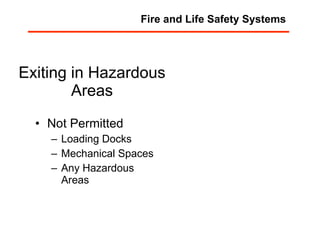
Exiting in Hazardous Areas Not Permitted Loading Docks Mechanical Spaces Any Hazardous Areas Fire and Life Safety Systems
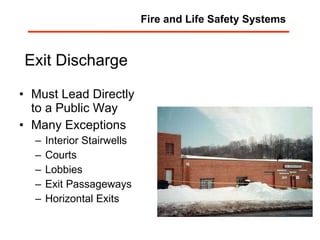
Exit Discharge Must Lead Directly to a Public Way Many Exceptions Interior Stairwells Courts Lobbies Exit Passageways Horizontal Exits Fire and Life Safety Systems
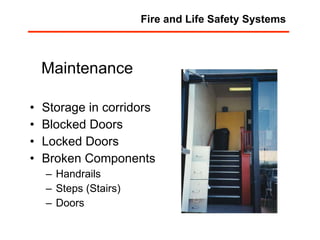
Maintenance Storage in corridors Blocked Doors Locked Doors Broken Components Handrails Steps (Stairs) Doors Fire and Life Safety Systems
Maintenance and Testing Reports Review Recent Reports Determine Testing Cycle in NFPA 13 Verify Existence and Extent of Maintenance and Testing Programs Fire and Life Safety Systems
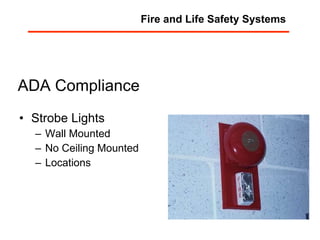
ADA Compliance Strobe Lights Wall Mounted No Ceiling Mounted Locations Fire and Life Safety Systems
Monitoring of All Necessary Systems HVAC Sprinkler System Initiating Devices Notification Appliances Fire Pump Magnetic Door Holders Fire and Life Safety Systems
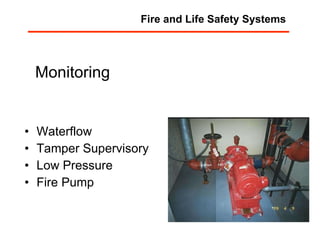
Monitoring Waterflow Tamper Supervisory Low Pressure Fire Pump Fire and Life Safety Systems
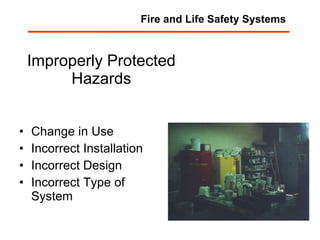
Improperly Protected Hazards Change in Use  Incorrect Installation Incorrect Design Incorrect Type of System Fire and Life Safety Systems
Recalled Sprinklers Central Omega Star Sprinklers Fire and Life Safety Systems
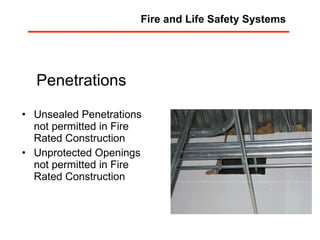
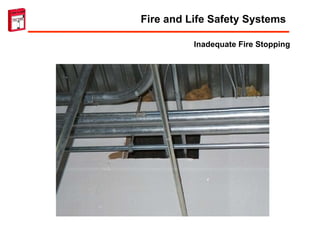
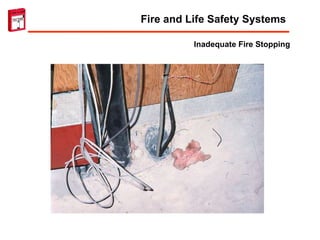
Penetrations Unsealed Penetrations not permitted in Fire Rated Construction Unprotected Openings not permitted in Fire Rated Construction Fire and Life Safety Systems
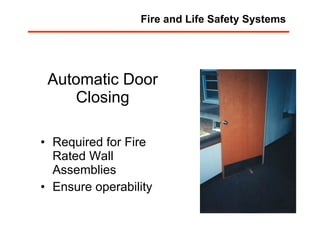
Automatic Door Closing Required for Fire Rated Wall Assemblies Ensure operability Fire and Life Safety Systems
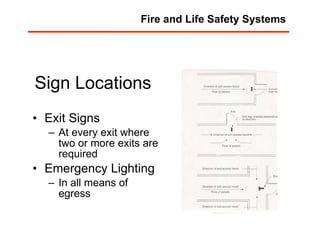
Sign Locations Exit Signs At every exit where two or more exits are required Emergency Lighting In all means of egress Fire and Life Safety Systems
Renovations, alterations and additions require the new construction to meet current codes.  Existing systems to remain generally can remain as is and are “grandfathered” under the new codes…with the exception of  possibly ...  Fire alarm and suppression systems Fire and Life Safety Systems
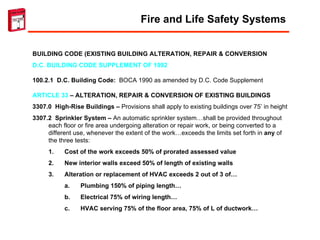
BUILDING CODE (EXISTING BUILDING ALTERATION, REPAIR & CONVERSION D.C. BUILDING CODE SUPPLEMENT OF 1992 100.2.1  D.C. Building Code:  BOCA 1990 as amended by D.C. Code Supplement ARTICLE 33  – ALTERATION, REPAIR & CONVERSION OF EXISTING BUILDINGS 3307.0  High-Rise Buildings –  Provisions shall apply to existing buildings over 75’ in height 3307.2  Sprinkler System –  An automatic sprinkler system…shall be provided throughout each floor or fire area undergoing alteration or repair work, or being converted to a different use, whenever the extent of the work…exceeds the limits set forth in  any  of the three tests: Cost of the work exceeds 50% of prorated assessed value New interior walls exceed 50% of length of existing walls Alteration or replacement of HVAC exceeds 2 out of 3 of… Plumbing 150% of piping length… Electrical 75% of wiring length… HVAC serving 75% of the floor area, 75% of L of ductwork… Fire and Life Safety Systems
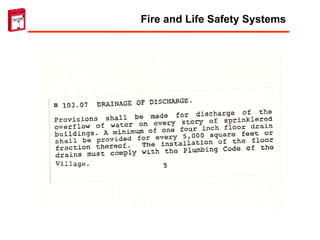
Fire & Life Safety Fire and Life Safety Systems
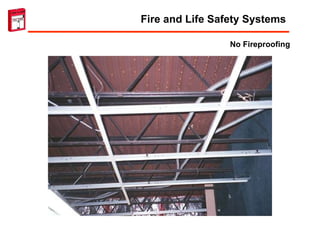
Fire & Life Safety No Fireproofing Fire and Life Safety Systems
Dead End Corridor Fire and Life Safety Systems
Fire & Life Safety This Is Not An Exit ? Confusing Signage Fire and Life Safety Systems
Fire & Life Safety Inadequate Fire Stopping Fire and Life Safety Systems
Inadequate Fire Stopping Fire and Life Safety Systems
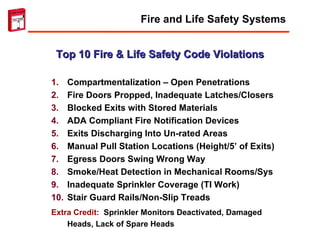
Compartmentalization – Open Penetrations Fire Doors Propped, Inadequate Latches/Closers Blocked Exits with Stored Materials ADA Compliant Fire Notification Devices Exits Discharging Into Un-rated Areas Manual Pull Station Locations (Height/5’ of Exits) Egress Doors Swing Wrong Way Smoke/Heat Detection in Mechanical Rooms/Sys Inadequate Sprinkler Coverage (TI Work) Stair Guard Rails/Non-Slip Treads Extra Credit:   Sprinkler Monitors Deactivated, Damaged Heads, Lack of Spare Heads Top 10 Fire & Life Safety Code Violations Fire and Life Safety Systems

Fm 403 Mod 10 Fire & Life Safety Systems

  • 1.
    FM-403 Building Systems& Technology Dave Leathers, CFM Jim Whittaker, P.E. Chris Hodges, P.E., RRC Instructors: GMU Facility Management Program Module 10 – Fire and Life Safety Systems
  • 2.
    Purpose Protect occupantsProtect the asset Fire suppression Fire detection Notification Evacuation Extinguish Fire alarm systems Detect React Notify Control Evacuate Fire and Life Safety Systems
  • 3.
    Fire Protection ProgramMain components of fire protection: Early detection and alarm system Means of egress Compartmentalization Smoke Control Fire Suppression Systems Emergency Power Fire and Life Safety Systems
  • 4.
    Basic Fire ProtectionPrinciples All the elements for basic fire protection can be broken down into these categories: passive fire protection systems active fire protection systems Fire and Life Safety Systems
  • 5.
    Passive Fire ProtectionControl the ignition, growth and spread of fire through the use of fire-resistive materials, or by providing physical barriers to the movement of flame or smoke. Fire and Life Safety Systems
  • 6.
    Passive Fire ProtectionIntended to maintain the following: Provide structural integrity of floor, wall and ceiling assemblies during a fire for a specified time period Compartmentalize the room or space to control the fire spread Provide exiting systems for occupants to safely evacuate the building Fire and Life Safety Systems
  • 7.
    Active Fire ProtectionTake direct physical action to reduce the growth rate of fire or the migration of smoke. Fire sprinkler and smoke control systems that receive signals, alert occupants, and cause certain fire control measures to occur. Fire and Life Safety Systems
  • 8.
    Fire Protection Codes& Design Standards National Fire Protection Agency (NFPA) standards include: NFPA 10 - Fire Extinguishers NFPA 70 - Electrical Systems NFPA 72 - Fire Alarm Systems NFPA 96 - Kitchen Hoods NFPA 90A and 90B - Mechanical Systems NFPA 101 - Life Safety NFPA 99 - Healthcare Systems and several other standards for special hazard systems Fire and Life Safety Systems
  • 9.
    Fire codes areoften written so that the authority to enforce the code can be a municipality, or other government agency. These authorities are called AHJ’s, or Authorities Having Jurisdiction. Fire Protection Codes & Design Standards Fire and Life Safety Systems
  • 10.
    Performance based fireprotection approach Evaluating the hazard presented and the development of the most appropriate method to protect this given hazard Risk Assessment Evaluate Hazards Manage Fire Impact Determine Appropriate Fire Protection Tools Fire and Life Safety Systems
  • 11.
    Passive Fire ProtectionSystems The purpose of compartmentalizing is to protect building occupants and property by: Confining the fire, heat smoke and toxic gases to the area of origin until the fire is extinguished or completely burns itself out Providing areas of refuge for the occupants and protecting firefighters Fire and Life Safety Systems
  • 12.
    Passive Fire ProtectionSystems Primary role of the HVAC system in Fire Protection is to contain smoke allowing occupants to escape Stairwell pressurization Atrium exhaust Fire floor, floor above and below containment Fire and Life Safety Systems
  • 13.
    Passive Fire ProtectionSystems Smoke rather than actual flames accounts for about 90% of all fire casualties One solution is to minimize the use of furnishings and construction materials that produce large quantities of smoke Fire and Life Safety Systems
  • 14.
    Active Fire ProtectionSystems Two Primary Functions Fire Detection and Notification Fire Suppression Fire and Life Safety Systems
  • 15.
    Fire Detection andNotification Systems Purpose Detect smoke and fire Notify occupants and firefighters (alarms) Allow for evacuation of occupants Fire and Life Safety Systems
  • 16.
    Fire Detection andNotification Systems Immediate and reliable detection of fire and smoke is essential If detection is delayed, paths of egress can become blocked Since most buildings and parts of building are vacant at some time, automatic fire detection is usually required Fire and Life Safety Systems
  • 17.
    Fire Detection SystemComponents Detectors: Smoke detectors Duct detectors Heat detectors Pull stations Flow switches Notifiers: Speakers Horns/bells Lights Controllers: Local control panels Annunciator panels Main control panels Tamper switches Central station notification device Other Wire HVAC system connections Computer, printer, etc. Trouble alarms Fire and Life Safety Systems
  • 18.
    Fire Detection SystemMain Panel Annunciator Panel Monitoring Service Computer Power In Local Panels Flow Switch Pull Station Smoke/Heat Smoke EF Horns/ Speakers Lights/ Strobes
  • 19.
    Fire Suppressions SystemsFire and Life Safety Systems
  • 20.
    Fire Suppressions SystemsPurpose Contain the fire Eliminate the fire Fire and Life Safety Systems
  • 21.
    Fire Suppression SystemComponents Piping Control valves Fire pumps Jockey pumps Air compressors Fire extinguishers Chemical systems Alarm valves Sprinkler heads Automatic valves Back flow preventers Strainers Control valve locks Indicators Fire and Life Safety Systems
  • 22.
    Fire Suppression SystemTypes Wet type system Dry type system Pre-action system Chemical system Hose Fire extinguisher Fire and Life Safety Systems
  • 23.
    Fire Suppression SystemComponents Automatic Sprinkler Control Design Objectives “ In general terms of property protection, sprinkler systems are typically designed to achieve fire control...” “ Fire control can be described as limiting the fire size by decreasing the rate of heat release and pre-wetting adjacent combustibles, while NFPA Fire Protection Handbook, 19th Edition, p. 10-193. Fire and Life Safety Systems
  • 24.
  • 25.
  • 26.
  • 27.
    Fire Pumps Typically,three types of fire pumps are used: horizontal split-case, vertical in-line and vertical shaft turbine. Fire and Life Safety Systems
  • 28.
    Horizontal Split-case FirePump Fire and Life Safety Systems
  • 29.
    Vertical Shaft TurbineFire Pump Fire and Life Safety Systems
  • 30.
    Vertical In-line FirePump Fire and Life Safety Systems
  • 31.
    Maintenan ce Onlyas good as the design, installation and maintenance of the systems. Passive systems do not have the same testing and inspection requirements or standards as active fire protection systems. Once the passive system is installed, inspected and accepted by the building official and the certificate of occupancy is issued, the system is generally not re-inspected unless changes to the structure affecting the passive system occur. Fire and Life Safety Systems
  • 32.
    Maintenance – PassiveSystems Make sure not to overlook passive systems! Fire and smoke dampers Fire-rated walls and assemblies Can be voided with a simple hole Fire and Life Safety Systems
  • 33.
    Maintenance – Testing& Maintenance Program Has the occupancy classification changed? Have any walls been relocated? Are the exits free of obstructions? Are the emergency lights operational? Have any fire extinguishers been removed or relocated? Are fire and smoke walls still intact? Fire and Life Safety Systems
  • 34.
    Fire Alarms MaintenanceA systematic approach to fire alarm system maintenance should include the following three components: Inspection and Testing Maintenance Management Operational Considerations Fire and Life Safety Systems
  • 35.
    Fire Alarms MaintenanceFire Alarm Systems Problems Maintenance False alarms Devices not installed correctly Smoke detectors dirty Trouble alarms Not up to current code Alarms not heard Working with local authorities Understanding the code Test part of the system monthly Clean smoke detectors Oversee all device installations Have system tested periodically by a qualified company Document all test results Fire and Life Safety Systems
  • 36.
    Suppression Systems MaintenanceSuppression Systems Problems Maintenance Freeze Accidental discharge Inadequate flow Improper inspections Sprinkler heads obstructed Control valves closed or inoperable Failure or fire pump Inadequate number of extinguishers Dry system inspection Water in dry pipe systems Air compressor or jockey pump failure Sprinkler damage in garages Inspections for open and locked valves Periodic operation of fire pump System flow tests Maintenance of jockey pump and compressor Fire extinguisher inspections Chemical system inspections Keeping fume hoods clean Operation and inspection of automatic valves Fire and Life Safety Systems
  • 37.
    Fire Pump MaintenanceTwo procedures should be followed for testing automatic transfer switches. The first procedure consists of simulating normal power failure while the pump is delivering peak power output to cause connection of the pump motor to the alternate power source. This is to verify that higher than normal currents do not occur during testing of the transfer switch. Second, engine generator sets providing emergency or standby power to fire pump assemblies and automatic transfer switches shall be tested routinely and exercised in accordance with NFPA 110, Standard for Emergency and Standby Power Systems. This test is to verify the proper operation of the transfer switch. Fire and Life Safety Systems
  • 38.
    Fire Pump MaintenanceThe fire pump controller is required to have an interconnected transfer switch. Operation of the transfer switch is critical, since the main power may fail or be shut off during a fire incident. Fire and Life Safety Systems
  • 39.
    Fire Protection DeficienciesMeans of Egress Fire Detection and Alarm Fire Suppression Fire Rated Separations Emergency Lighting / Exit Signs Fire and Life Safety Systems
  • 40.
    WHAT TO LOOKFOR . . . Identification of Defects Fire and Life Safety Systems
  • 41.
    What To LookFor . . . Have Alterations Been Made That Could Affect Life/Safety Recommendations Periodically Test Detection and Alarm Systems Routinely Check Egress Routes & Doors Remove Stored Combustible Materials Be Careful With Tenant Improvements & Fitouts Are Alarms Adequate, Y2K & ADA Compliant Is Emergency Egress & Lighting Adequate? Code Violations – Storage, Signage, Fire Stopping, Doors Is Compartmentation & Sprinkler Coverage Adequate? Recalled Sprinklers – Central Omega & Star Sprinklers Fire and Life Safety Systems
  • 42.
    Dead End CorridorsMeans of Egress NFPA 101 Life Safety Code 50 feet in sprinklered Business Occupancies 20 Feet in all other occupancies Exceptions include small suites and wide areas. Fire and Life Safety Systems
  • 43.
    Dead End Corridorsand Fire and Life Safety Systems Insufficient Number of Exits < 500 = Two Exits 500 to 999 = Three Exits >1000 = Four Exits Exceptions (Table 1017.2 Spaces With One Means of Egress)
  • 44.
    Poorly Identified ExitsBlocked Exit signs No Exit Signs Confusing Exit Arrangements Fire and Life Safety Systems
  • 45.
    Reversed Door SwingDoors must swing in the direction of egress travel when serving 50 or more occupants. All means of egress doors in stairwells must swing in the direction of egress travel. Fire and Life Safety Systems
  • 46.
    Exiting in HazardousAreas Not Permitted Loading Docks Mechanical Spaces Any Hazardous Areas Fire and Life Safety Systems
  • 47.
    Exit Discharge MustLead Directly to a Public Way Many Exceptions Interior Stairwells Courts Lobbies Exit Passageways Horizontal Exits Fire and Life Safety Systems
  • 48.
    Maintenance Storage incorridors Blocked Doors Locked Doors Broken Components Handrails Steps (Stairs) Doors Fire and Life Safety Systems
  • 49.
    Maintenance and TestingReports Review Recent Reports Determine Testing Cycle in NFPA 13 Verify Existence and Extent of Maintenance and Testing Programs Fire and Life Safety Systems
  • 50.
    ADA Compliance StrobeLights Wall Mounted No Ceiling Mounted Locations Fire and Life Safety Systems
  • 51.
    Monitoring of AllNecessary Systems HVAC Sprinkler System Initiating Devices Notification Appliances Fire Pump Magnetic Door Holders Fire and Life Safety Systems
  • 52.
    Monitoring Waterflow TamperSupervisory Low Pressure Fire Pump Fire and Life Safety Systems
  • 53.
    Improperly Protected HazardsChange in Use Incorrect Installation Incorrect Design Incorrect Type of System Fire and Life Safety Systems
  • 54.
    Recalled Sprinklers CentralOmega Star Sprinklers Fire and Life Safety Systems
  • 55.
    Penetrations Unsealed Penetrationsnot permitted in Fire Rated Construction Unprotected Openings not permitted in Fire Rated Construction Fire and Life Safety Systems
  • 56.
    Automatic Door ClosingRequired for Fire Rated Wall Assemblies Ensure operability Fire and Life Safety Systems
  • 57.
    Sign Locations ExitSigns At every exit where two or more exits are required Emergency Lighting In all means of egress Fire and Life Safety Systems
  • 58.
    Renovations, alterations andadditions require the new construction to meet current codes. Existing systems to remain generally can remain as is and are “grandfathered” under the new codes…with the exception of possibly ... Fire alarm and suppression systems Fire and Life Safety Systems
  • 59.
    BUILDING CODE (EXISTINGBUILDING ALTERATION, REPAIR & CONVERSION D.C. BUILDING CODE SUPPLEMENT OF 1992 100.2.1 D.C. Building Code: BOCA 1990 as amended by D.C. Code Supplement ARTICLE 33 – ALTERATION, REPAIR & CONVERSION OF EXISTING BUILDINGS 3307.0 High-Rise Buildings – Provisions shall apply to existing buildings over 75’ in height 3307.2 Sprinkler System – An automatic sprinkler system…shall be provided throughout each floor or fire area undergoing alteration or repair work, or being converted to a different use, whenever the extent of the work…exceeds the limits set forth in any of the three tests: Cost of the work exceeds 50% of prorated assessed value New interior walls exceed 50% of length of existing walls Alteration or replacement of HVAC exceeds 2 out of 3 of… Plumbing 150% of piping length… Electrical 75% of wiring length… HVAC serving 75% of the floor area, 75% of L of ductwork… Fire and Life Safety Systems
  • 60.
    Fire & LifeSafety Fire and Life Safety Systems
  • 61.
    Fire & LifeSafety No Fireproofing Fire and Life Safety Systems
  • 62.
    Dead End CorridorFire and Life Safety Systems
  • 63.
    Fire & LifeSafety This Is Not An Exit ? Confusing Signage Fire and Life Safety Systems
  • 64.
    Fire & LifeSafety Inadequate Fire Stopping Fire and Life Safety Systems
  • 65.
    Inadequate Fire StoppingFire and Life Safety Systems
  • 66.
    Compartmentalization – OpenPenetrations Fire Doors Propped, Inadequate Latches/Closers Blocked Exits with Stored Materials ADA Compliant Fire Notification Devices Exits Discharging Into Un-rated Areas Manual Pull Station Locations (Height/5’ of Exits) Egress Doors Swing Wrong Way Smoke/Heat Detection in Mechanical Rooms/Sys Inadequate Sprinkler Coverage (TI Work) Stair Guard Rails/Non-Slip Treads Extra Credit: Sprinkler Monitors Deactivated, Damaged Heads, Lack of Spare Heads Top 10 Fire & Life Safety Code Violations Fire and Life Safety Systems

Editor's Notes

  • #2 Goals of Workshop: Start w/ what is not the goal – To make y’all experts in Codes &amp; Regulations by the time you leave. (UNLESS ALREADY) Understand where they came from, why we have them, how and when they apply &amp; are enforced &amp; how to get information. Also understand where they are headed. Take away something that will help you in your job (even if one little fact) &amp; have some fun!!! THOUGHT ABOUT HOW TO MAKE A WORKSHOP ON CODES AND REGULATIONS FUN . . . HERE’S WHAT I CAME UP WITH. SYNERGY - MAKE OUR OWN FUN, ASK QUESTIONS, SHARE EXPERIENCES, INTERACT – LEARN FROM PEERS.
  • #60 BUILDING CODE (EXISTING BUILDING ALTERATION, REPAIR &amp; CONVERSION D.C. BUILDING CODE SUPPLEMENT OF 1992 100.2.1 D.C. Building Code: BOCA 1990 as amended by D.C. Code Supplement ARTICLE 33 – ALTERATION, REPAIR &amp; CONVERSION OF EXISTING BUILDINGS 3307.0 High-Rise Buildings – Provisions shall apply to existing buildings over 75’ in height 3307.2 Sprinkler System – An automatic sprinkler system…shall be provided throughout each floor or fire area undergoing alteration or repair work, or being converted to a different use, whenever the extent of the work…exceeds the limits set forth in any of the three tests: Cost of the work exceeds 50% of prorated assessed value New interior walls exceed 50% of length of existing walls Alteration or replacement of HVAC exceeds 2 out of 3 of… Plumbing 150% of piping length… Electrical 75% of wiring length… HVAC serving 75% of the floor area, 75% of L of ductwork…
  • #67 SELECT WHAT YOUR GROUP THINKS AS THE MOST COMMON VIOLATION. BY THE AUTHORITY VESTED IN ME BY ABSOLUTELY NO-ONE – I HAVE FINAL ANSWER. NO ONE QUESTIONS ME!!!