




Computer Based Assessment
   of Clinical Reasoning
 A cooperative project between 3 Dutch
           medical schools

                Mathijs Doets, MSc
         Erasmus University Medical Center
           (Rotterdam, The Netherlands)
Presentation outline

•   Project overview and goals
•   Clinical reasoning in medical education
•   Project activities and results
•   Pilots
•   Future directions
Project participants
         AMC Amsterdam
         2.300 medical students
         250 doctors graduate yearly


                                                  UMC Utrecht
                                                  2.100 medical students
                                                  275 doctors graduate yearly


Erasmus MC Rotterdam
2.400 medical students
280 doctors graduate yearly
                                       Organisation for ICT in higher education
Project overview

• March 2011 – March 2013
• Different phases:
  – Literature study
  – Determine formats for assessment
  – Training of teachers
  – Development of questions
  – Technical infrastructure
  – Pilots
  – Implementation in curriculum
What is clinical reasoning?

Clinical reasoning is a core competence of a doctor and a
key element of medical education

Definition
The process through which the physician defines a patient's
most probable diagnosis and determines further policy

To answer a clinical reasoning question, students should
have underlying knowledge and should be able to apply this
knowledge to solve a patient's problem
Assessment of clinical reasoning

Assessment of clinical reasoning is very often paper based
or oral

Disadvantages
•Very labour intensive
•Oral exams often subjective
if not very well structured
Aim of the project

Reduce workload for teachers (and staff) in high quality
assessments of clinical reasoning,
by developing a more objective and more efficient form
of assessment of clinical reasoning

Solution
Joint development of questions
•collaborating per discipline
•analysis and validation of test items

Making the assessments computer based
•creating a shared question database
•developing good digital formats
Literature study

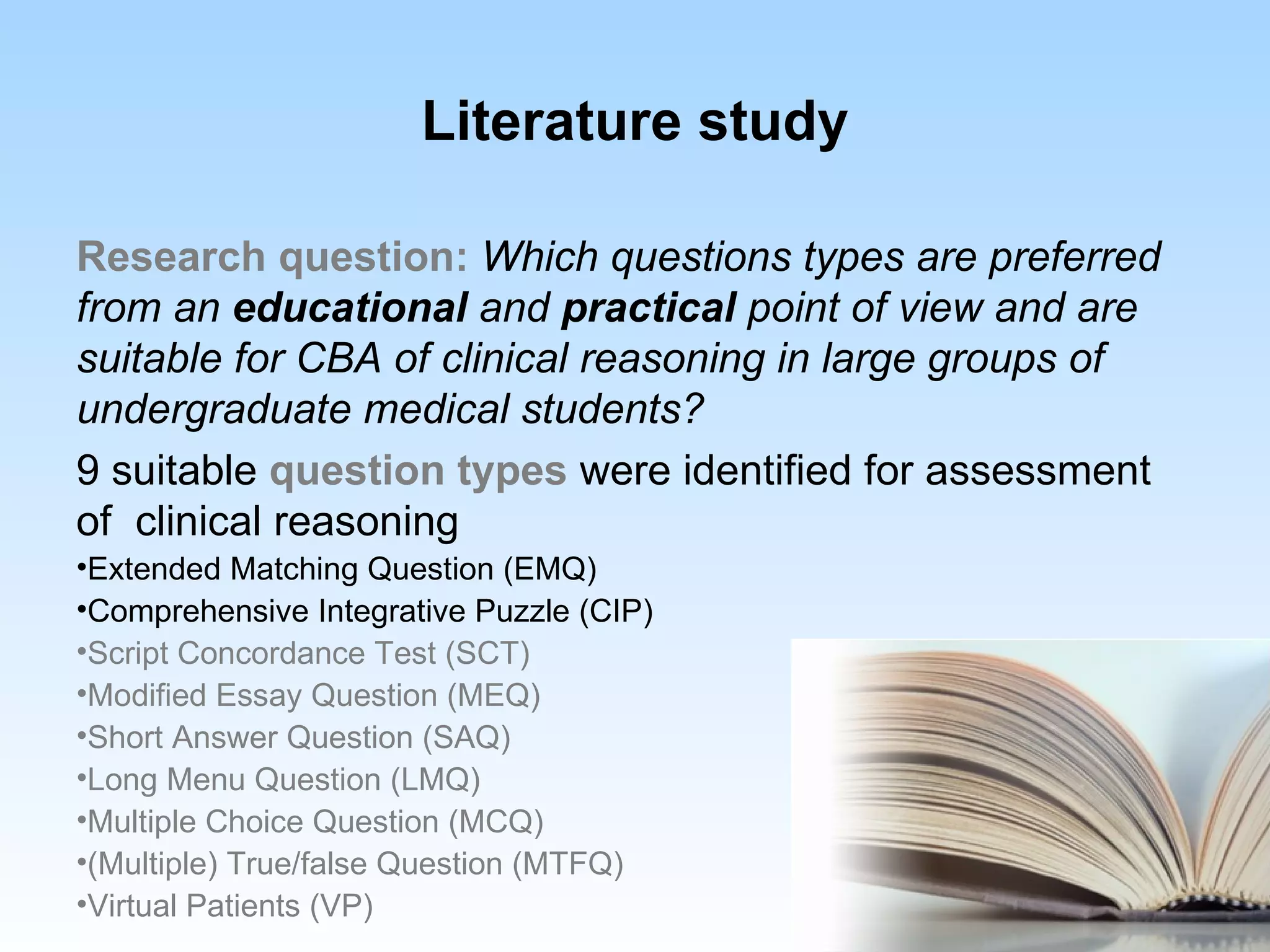
Research question: Which questions types are preferred
from an educational and practical point of view and are
suitable for CBA of clinical reasoning in large groups of
undergraduate medical students?
9 suitable question types were identified for assessment
of clinical reasoning
•Extended Matching Question (EMQ)
•Comprehensive Integrative Puzzle (CIP)
•Script Concordance Test (SCT)
•Modified Essay Question (MEQ)
•Short Answer Question (SAQ)
•Long Menu Question (LMQ)
•Multiple Choice Question (MCQ)
•(Multiple) True/false Question (MTFQ)
•Virtual Patients (VP)
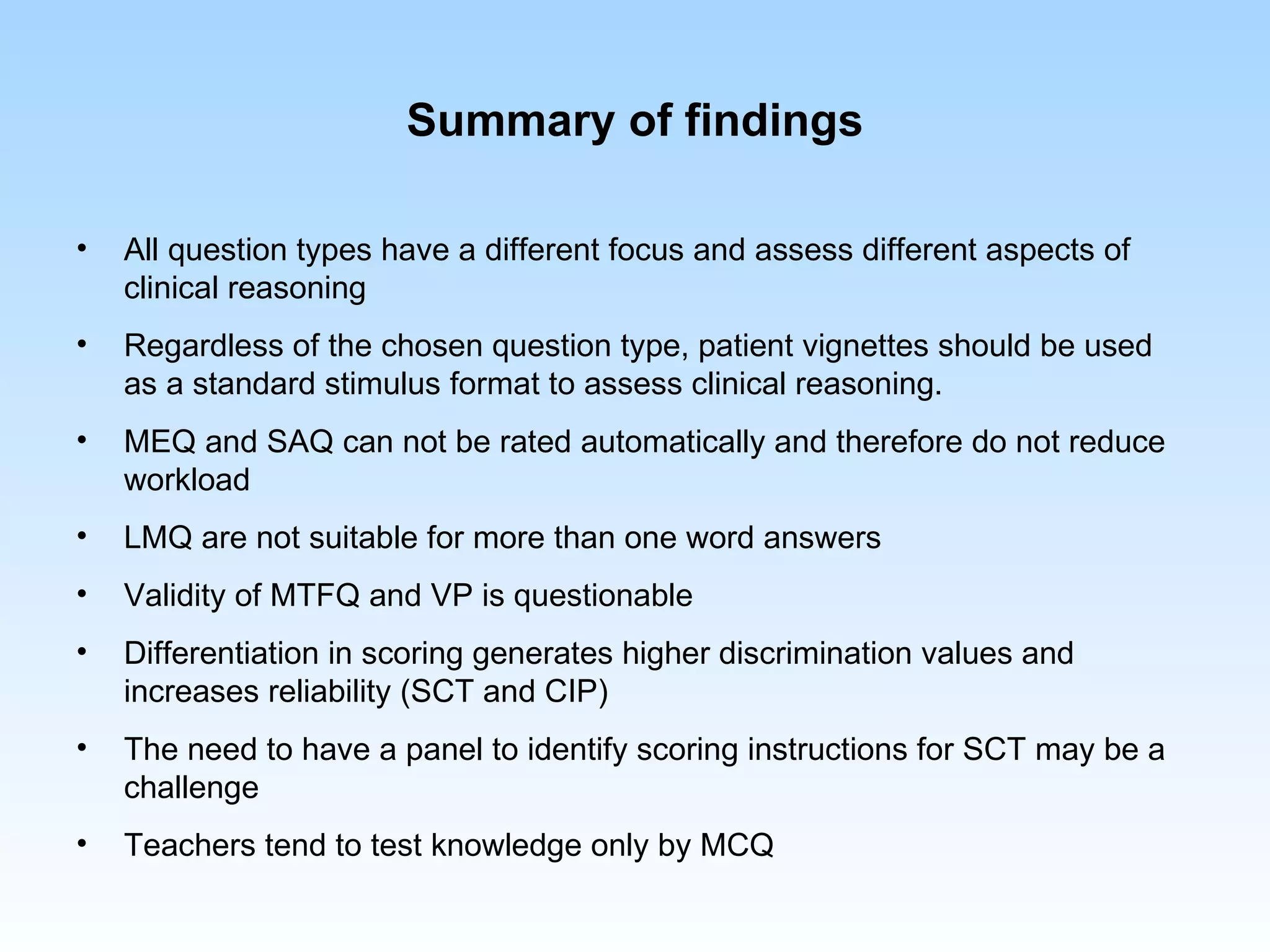
Summary of findings

•   All question types have a different focus and assess different aspects of
    clinical reasoning
•   Regardless of the chosen question type, patient vignettes should be used
    as a standard stimulus format to assess clinical reasoning.
•   MEQ and SAQ can not be rated automatically and therefore do not reduce
    workload
•   LMQ are not suitable for more than one word answers
•   Validity of MTFQ and VP is questionable
•   Differentiation in scoring generates higher discrimination values ​and
    increases reliability (SCT and CIP)
•   The need to have a panel to identify scoring instructions for SCT may be a
    challenge
•   Teachers tend to test knowledge only by MCQ
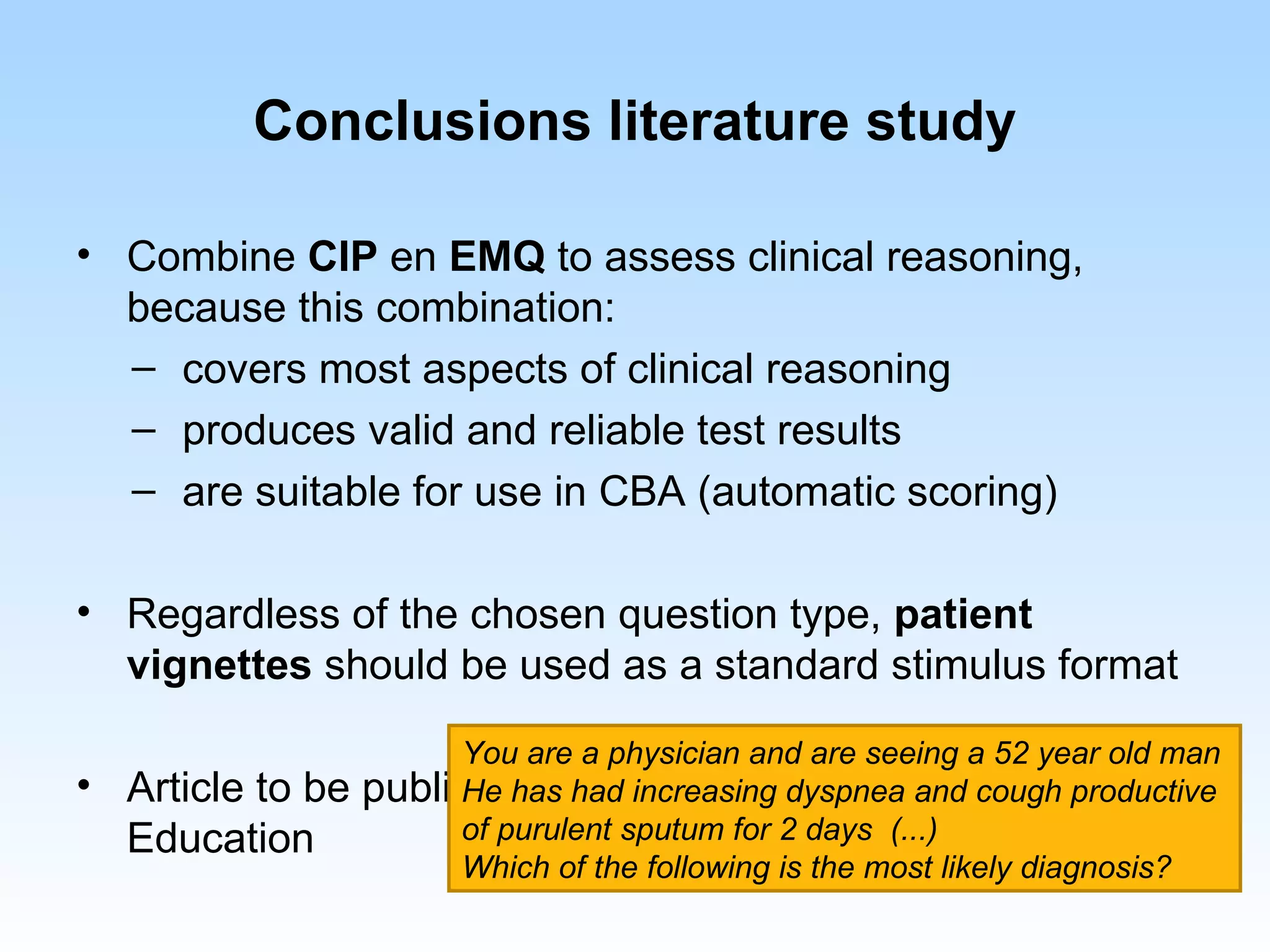
Conclusions literature study

• Combine CIP en EMQ to assess clinical reasoning,
  because this combination:
  – covers most aspects of clinical reasoning
  – produces valid and reliable test results
  – are suitable for use in CBA (automatic scoring)

• Regardless of the chosen question type, patient
  vignettes should be used as a standard stimulus format

                       You are a physician and are seeing a 52 year old man
• Article to be   published in Dutch Journal forand cough productive
                       He has had increasing dyspnea Medical
  Education            of purulent sputum for 2 days (...)
                       Which of the following is the most likely diagnosis?
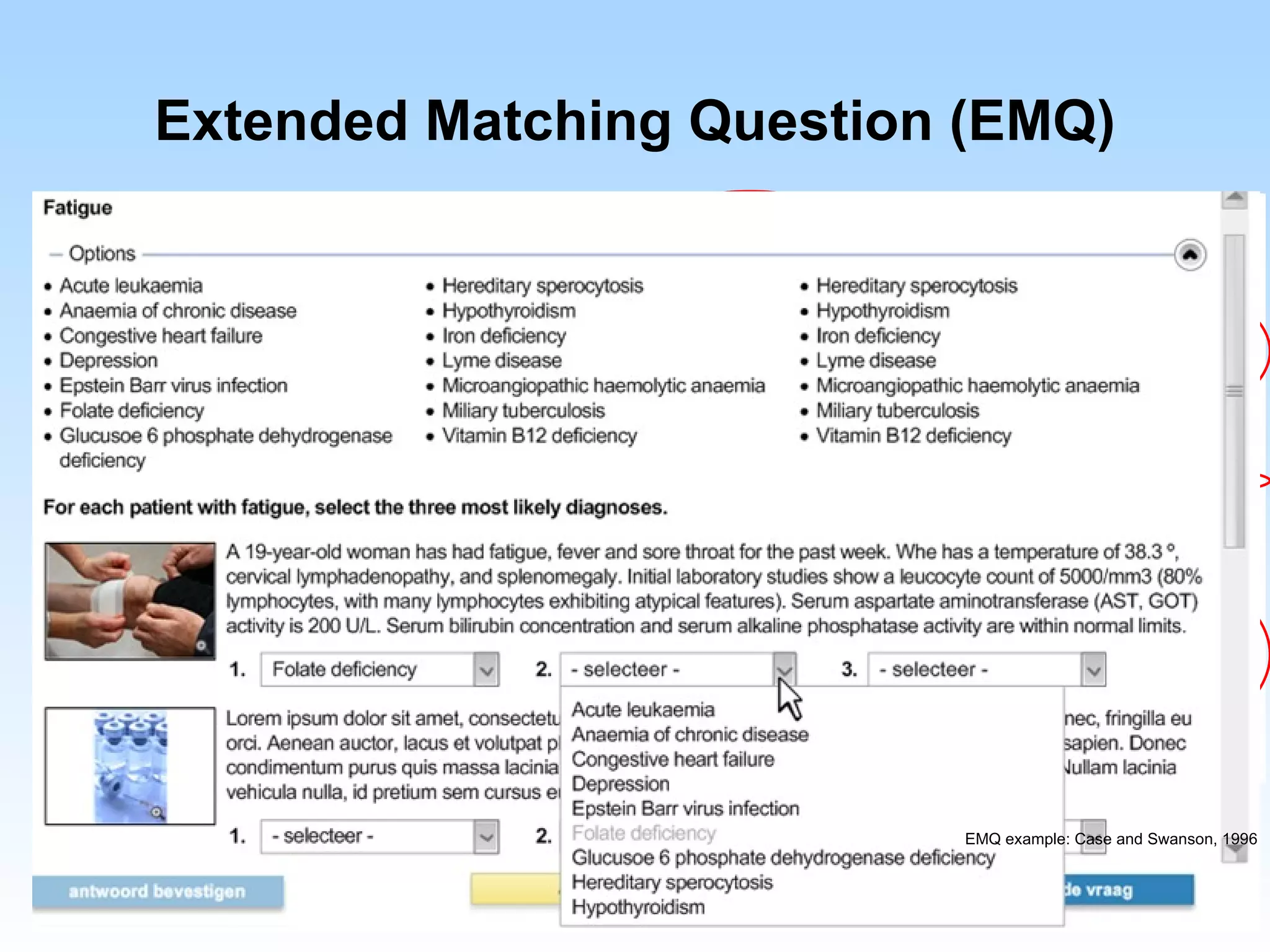
Extended Matching Question (EMQ)

• Starting with a theme
  or clinical problem

• A list with 8-15 options

• Question

• 2 or 3 patient vignettes

• Scoring: points for each
  correct answer; multiple
  answers may be correct
                              EMQ example: Case and Swanson, 1996
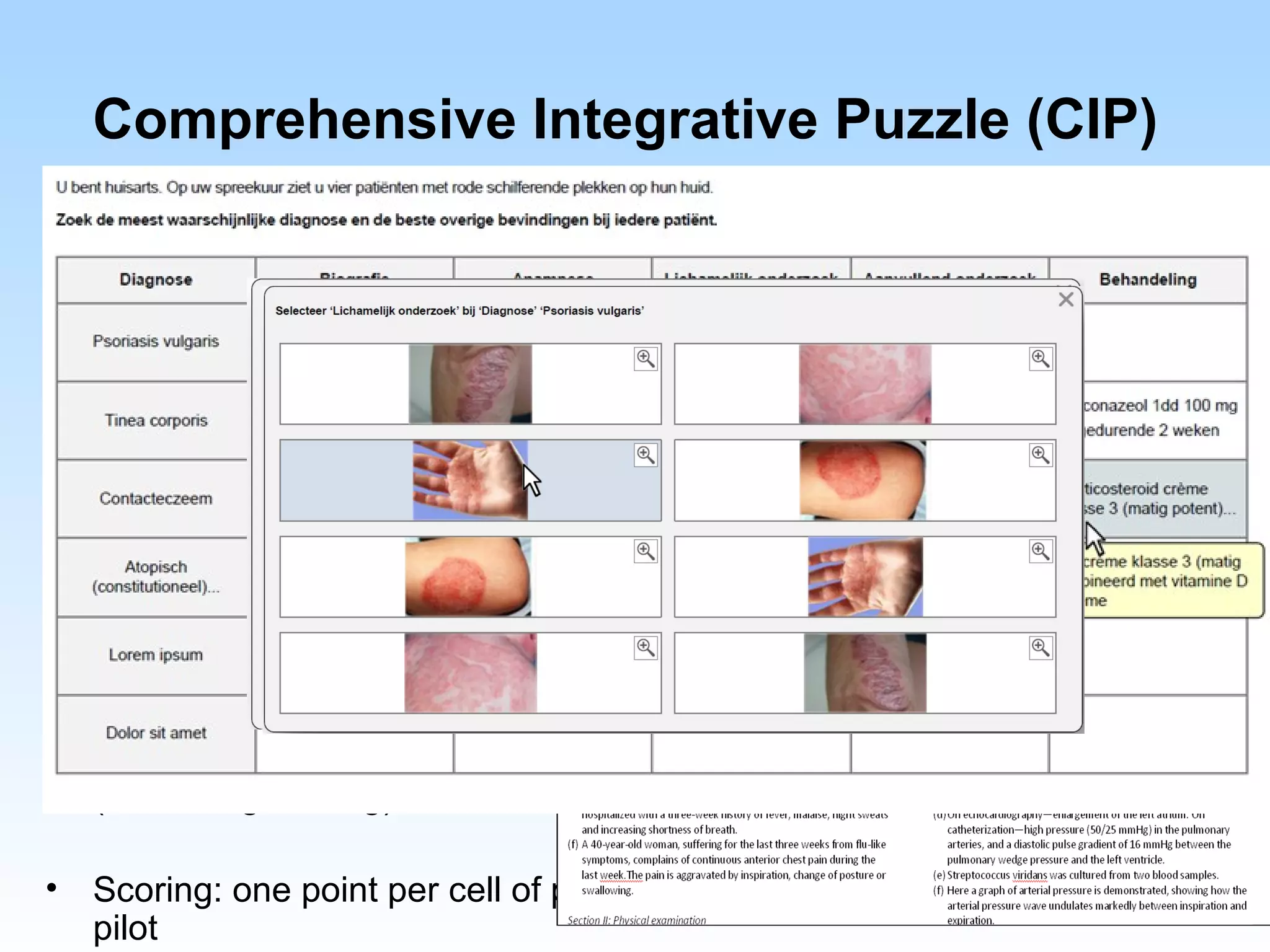
Comprehensive Integrative Puzzle (CIP)
•   Combines data from: medical history, physical examination, diagnostic
    tests into a logical, coherent patient case, given a diagnosis (1st column).

                                                                   Treatment


•   Matrix
    from 4x4 to 7x7 rows/columns

•   Alternatives are presented for each column

•   Answer options may be used once, more than once, or not at all
    (reduces guessing)

•   Scoring: one point per cell of points for complete row: to be determined in
    pilot
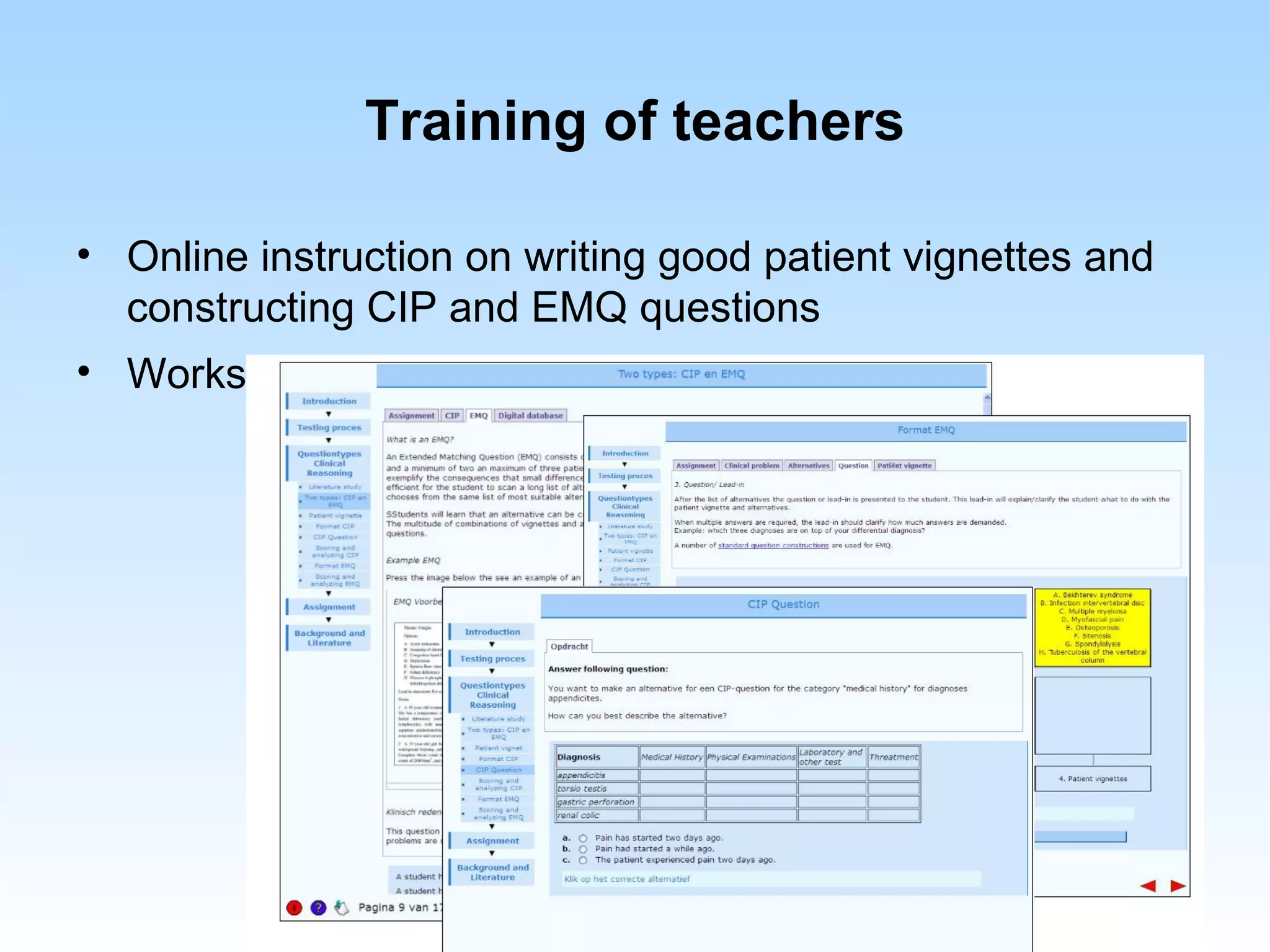
Training of teachers

• Online instruction on writing good patient vignettes and
  constructing CIP and EMQ questions
• Workshop for teachers
Technical infrastructure:
          Store and share questions
• Search for a system which:
   – Stores CIP and EMQ
   – Allows searching by discipline and topic
   – Supports reviewing questions between medical schools


• Cooperation with IMS from april 2012
• Implementation of CIP summer 2012
• Pilot with users september-december 2012


• Export to assesment systems: QMP, Testvision, Blackboard
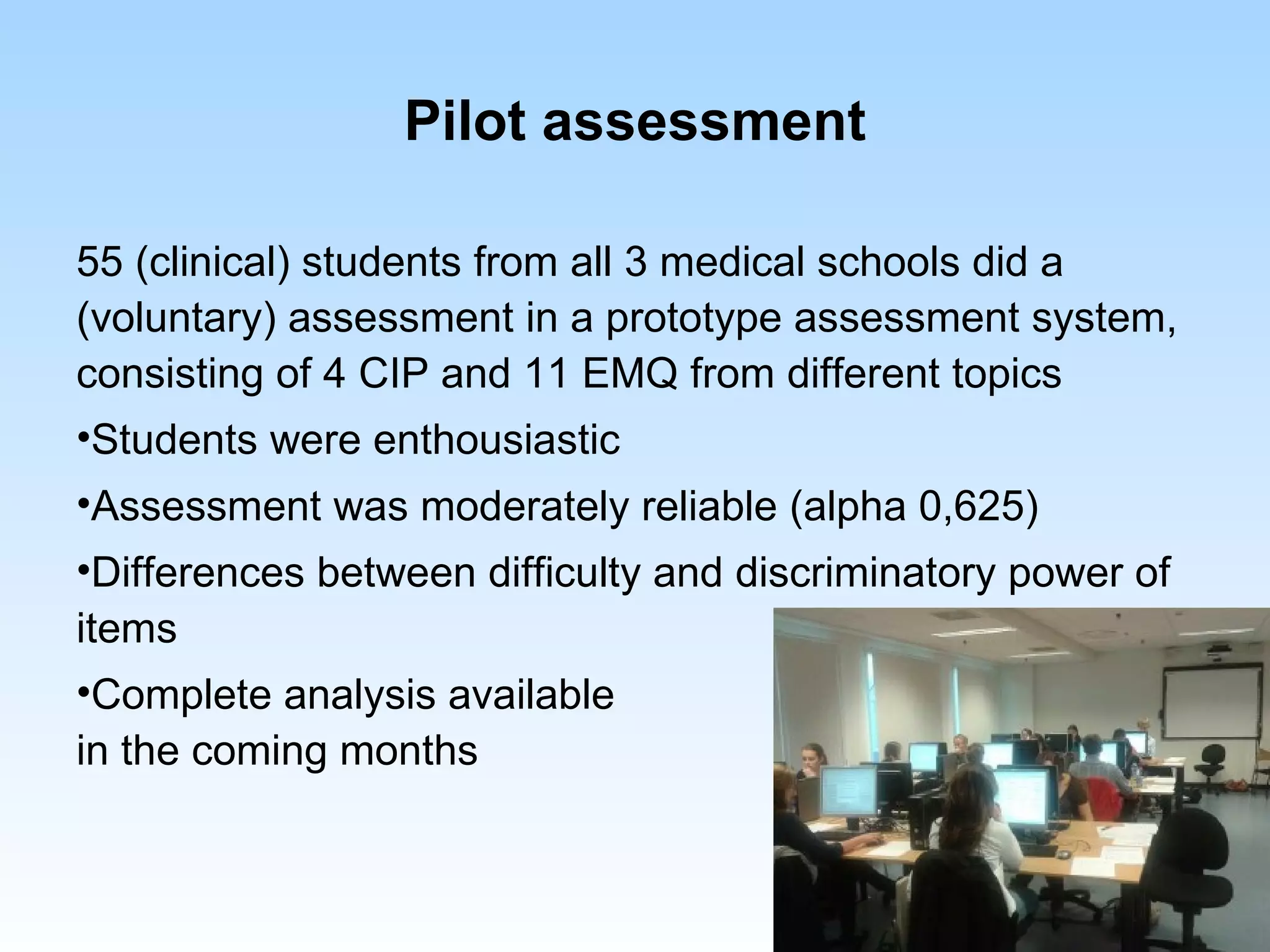
Pilot assessment

55 (clinical) students from all 3 medical schools did a
(voluntary) assessment in a prototype assessment system,
consisting of 4 CIP and 11 EMQ from different topics
•Students were enthousiastic
•Assessment was moderately reliable (alpha 0,625)
•Differences between difficulty and discriminatory power of
items
•Complete analysis available
in the coming months
Project future activities

• Development of more questions
• Entering and classifying questions in IMS
• Reviewing questions through IMS
• Implementation of assessments in curriculum
   – Clinical part (internships)
   – Different choices for each medical school (by
     discipline or integrated assessments)
• Lasting cooperation beyond the project
Questions?
References


• Ber, R. (2003). The CIP (Comprehensive Integrative Puzzle) assessment method. Medical Teacher, 25,
  171-176.
• Beullens, J., Struyf, E., & Van Damme, B. (2005) Do extended matching multiple-choice questions measure
  clinical reasoning? Medical Education, 39, 410-417.
• Beullens, J., van Damme, B., Jaspaert, H., Janssen, P.J. (2002) Are extended-matching multiple-choice
  items appropriate for a final test in medical education? Medical Teacher, 24 (4) 390-395.
• Bhakta, B., Tennant, A., Horton, M., Lawton, G., Andrich, D. (2005) Using item response theory to explore
  the psychometric properties of extended matching questions examination in undergraduate medical
  education. BMC Medical Education, 5: 1-9.
• Case, S.M., Swanson, D.B., Ripkey, D.R. (1994) Multiple-Choice Question Strategies. Comparison of Items
  in Five-option and Extended-matching Formats for Assessment of Diagnostic Skills. Academic Medicine, 69
  (10), 1-3.
• Coderre, S.P., Harasym, P., Mandin, H., Fick, G. (2004) The impact of two multiple-choice question formats
  on the problem-solving strategies used by novices and experts. BMC Medical Education, 4 (23), 1-9.
• Groothoff, J.W., Frenkel, J., Tytgat, G.A., Vreede, W.B., Bosman, D.K., ten Cate, O.Th. J. (2008) Growth of
  analytical thinking skills over time as measured with the MATCH test. Medical Education, 42 (10),
  1037-1043.
• Samuels A (2006) Extended Matching Questions and the Royal Australian and New Zealand College of
  Psychiatrists written examination: an overview. Australasian Psychiatry, 14, (1), 63-66.
• Schuwirth, L.W.T., van der Vleuten, C.P.M. (2003) ABC of learning and teaching in medicine. Written
  assessment, BMJ (326), 643-645.
• Schuwirth, L.W.T., van der Vleuten, C.P.M. (2004) Different written assessment methods: what can be said
  about their strengths and weaknesses? Medical Education (38), 974-979.

Computer based assessment of clinical reasoning (Heidelberg 2012)

  • 1.
    Computer Based Assessment of Clinical Reasoning A cooperative project between 3 Dutch medical schools Mathijs Doets, MSc Erasmus University Medical Center (Rotterdam, The Netherlands)
  • 2.
    Presentation outline • Project overview and goals • Clinical reasoning in medical education • Project activities and results • Pilots • Future directions
  • 3.
    Project participants AMC Amsterdam 2.300 medical students 250 doctors graduate yearly UMC Utrecht 2.100 medical students 275 doctors graduate yearly Erasmus MC Rotterdam 2.400 medical students 280 doctors graduate yearly Organisation for ICT in higher education
  • 4.
    Project overview • March2011 – March 2013 • Different phases: – Literature study – Determine formats for assessment – Training of teachers – Development of questions – Technical infrastructure – Pilots – Implementation in curriculum
  • 5.
    What is clinicalreasoning? Clinical reasoning is a core competence of a doctor and a key element of medical education Definition The process through which the physician defines a patient's most probable diagnosis and determines further policy To answer a clinical reasoning question, students should have underlying knowledge and should be able to apply this knowledge to solve a patient's problem
  • 6.
    Assessment of clinicalreasoning Assessment of clinical reasoning is very often paper based or oral Disadvantages •Very labour intensive •Oral exams often subjective if not very well structured
  • 7.
    Aim of theproject Reduce workload for teachers (and staff) in high quality assessments of clinical reasoning, by developing a more objective and more efficient form of assessment of clinical reasoning Solution Joint development of questions •collaborating per discipline •analysis and validation of test items Making the assessments computer based •creating a shared question database •developing good digital formats
  • 8.
    Literature study Research question:Which questions types are preferred from an educational and practical point of view and are suitable for CBA of clinical reasoning in large groups of undergraduate medical students? 9 suitable question types were identified for assessment of clinical reasoning •Extended Matching Question (EMQ) •Comprehensive Integrative Puzzle (CIP) •Script Concordance Test (SCT) •Modified Essay Question (MEQ) •Short Answer Question (SAQ) •Long Menu Question (LMQ) •Multiple Choice Question (MCQ) •(Multiple) True/false Question (MTFQ) •Virtual Patients (VP)
  • 9.
    Summary of findings • All question types have a different focus and assess different aspects of clinical reasoning • Regardless of the chosen question type, patient vignettes should be used as a standard stimulus format to assess clinical reasoning. • MEQ and SAQ can not be rated automatically and therefore do not reduce workload • LMQ are not suitable for more than one word answers • Validity of MTFQ and VP is questionable • Differentiation in scoring generates higher discrimination values ​and increases reliability (SCT and CIP) • The need to have a panel to identify scoring instructions for SCT may be a challenge • Teachers tend to test knowledge only by MCQ
  • 10.
    Conclusions literature study •Combine CIP en EMQ to assess clinical reasoning, because this combination: – covers most aspects of clinical reasoning – produces valid and reliable test results – are suitable for use in CBA (automatic scoring) • Regardless of the chosen question type, patient vignettes should be used as a standard stimulus format You are a physician and are seeing a 52 year old man • Article to be published in Dutch Journal forand cough productive He has had increasing dyspnea Medical Education of purulent sputum for 2 days (...) Which of the following is the most likely diagnosis?
  • 11.
    Extended Matching Question(EMQ) • Starting with a theme or clinical problem • A list with 8-15 options • Question • 2 or 3 patient vignettes • Scoring: points for each correct answer; multiple answers may be correct EMQ example: Case and Swanson, 1996
  • 12.
    Comprehensive Integrative Puzzle(CIP) • Combines data from: medical history, physical examination, diagnostic tests into a logical, coherent patient case, given a diagnosis (1st column). Treatment • Matrix from 4x4 to 7x7 rows/columns • Alternatives are presented for each column • Answer options may be used once, more than once, or not at all (reduces guessing) • Scoring: one point per cell of points for complete row: to be determined in pilot
  • 13.
    Training of teachers •Online instruction on writing good patient vignettes and constructing CIP and EMQ questions • Workshop for teachers
  • 14.
    Technical infrastructure: Store and share questions • Search for a system which: – Stores CIP and EMQ – Allows searching by discipline and topic – Supports reviewing questions between medical schools • Cooperation with IMS from april 2012 • Implementation of CIP summer 2012 • Pilot with users september-december 2012 • Export to assesment systems: QMP, Testvision, Blackboard
  • 15.
    Pilot assessment 55 (clinical)students from all 3 medical schools did a (voluntary) assessment in a prototype assessment system, consisting of 4 CIP and 11 EMQ from different topics •Students were enthousiastic •Assessment was moderately reliable (alpha 0,625) •Differences between difficulty and discriminatory power of items •Complete analysis available in the coming months
  • 16.
    Project future activities •Development of more questions • Entering and classifying questions in IMS • Reviewing questions through IMS • Implementation of assessments in curriculum – Clinical part (internships) – Different choices for each medical school (by discipline or integrated assessments) • Lasting cooperation beyond the project
  • 17.
  • 18.
    References • Ber, R.(2003). The CIP (Comprehensive Integrative Puzzle) assessment method. Medical Teacher, 25, 171-176. • Beullens, J., Struyf, E., & Van Damme, B. (2005) Do extended matching multiple-choice questions measure clinical reasoning? Medical Education, 39, 410-417. • Beullens, J., van Damme, B., Jaspaert, H., Janssen, P.J. (2002) Are extended-matching multiple-choice items appropriate for a final test in medical education? Medical Teacher, 24 (4) 390-395. • Bhakta, B., Tennant, A., Horton, M., Lawton, G., Andrich, D. (2005) Using item response theory to explore the psychometric properties of extended matching questions examination in undergraduate medical education. BMC Medical Education, 5: 1-9. • Case, S.M., Swanson, D.B., Ripkey, D.R. (1994) Multiple-Choice Question Strategies. Comparison of Items in Five-option and Extended-matching Formats for Assessment of Diagnostic Skills. Academic Medicine, 69 (10), 1-3. • Coderre, S.P., Harasym, P., Mandin, H., Fick, G. (2004) The impact of two multiple-choice question formats on the problem-solving strategies used by novices and experts. BMC Medical Education, 4 (23), 1-9. • Groothoff, J.W., Frenkel, J., Tytgat, G.A., Vreede, W.B., Bosman, D.K., ten Cate, O.Th. J. (2008) Growth of analytical thinking skills over time as measured with the MATCH test. Medical Education, 42 (10), 1037-1043. • Samuels A (2006) Extended Matching Questions and the Royal Australian and New Zealand College of Psychiatrists written examination: an overview. Australasian Psychiatry, 14, (1), 63-66. • Schuwirth, L.W.T., van der Vleuten, C.P.M. (2003) ABC of learning and teaching in medicine. Written assessment, BMJ (326), 643-645. • Schuwirth, L.W.T., van der Vleuten, C.P.M. (2004) Different written assessment methods: what can be said about their strengths and weaknesses? Medical Education (38), 974-979.