RESEARCH ARTICLE Open Access
Video feedback and e-Learning enhances
laboratory skills and engagement in
medical laboratory science students
Rebecca Donkin*
, Elizabeth Askew and Hollie Stevenson
Abstract
Background: Traditionally, the training of medical laboratory science students has taken place in the laboratory and
has been led by academic and pathology experts in a face-to-face context. In recent years, budgetary pressures,
increasing student enrolments and limited access to laboratory equipment have resulted in reduced staff-student
contact hours in medical laboratory science education. While this restructure in resources has been challenging, it
has encouraged innovation in online blended learning.
Methods: Blended learning histology lessons were implemented in a face-to-face and e-Learning format in a
medical laboratory science program to teach tissue morphology and technical procedures outside of the
traditional laboratory classroom. Participating students were randomly allocated to either the ‘video’ group
(n = 14) or the ‘control’ group (n = 14). After all students attempted the e-Learning lessons and viewed expert-led
video recordings online, students demonstrated their hands-on practical skills in the laboratory. Technical skills,
demonstration of safety awareness, and use of histology equipment was captured by video through first person ‘point
of view’ recordings for the ‘video’ group only. The ‘control’ group performed the same activities but were not recorded.
Prior to summative assessment, the ‘video’ group students had a digital resource portfolio that enabled them to review
their skills, receive captured feedback and retain a visual copy of their recorded procedure.
Results: Results showed that students who participated in the online video format had statistically better practical
examination scores and final grades compared to the control group.
Conclusion: Findings from this study suggest that students are engaged and motivated when being taught in a
blended learning format and respond positively to the use of video recordings with expert feedback for the initial
learning of hands-on techniques. For the academic, developing a blended learning medical laboratory science
program, which includes annotated virtual microscopy, video demonstrations, and online interactive e-Learning
activities, provides an effective and economic approach to learning and teaching.
Keywords: Medical laboratory science, Blended learning, Interactive learning environments, Media in education,
Simulations
© The Author(s). 2019 Open Access This article is distributed under the terms of the Creative Commons Attribution 4.0
International License (http://creativecommons.org/licenses/by/4.0/), which permits unrestricted use, distribution, and
reproduction in any medium, provided you give appropriate credit to the original author(s) and the source, provide a link to
the Creative Commons license, and indicate if changes were made. The Creative Commons Public Domain Dedication waiver
(http://creativecommons.org/publicdomain/zero/1.0/) applies to the data made available in this article, unless otherwise stated.
* Correspondence: rdonkin@usc.edu.au
School of Health and Sport Sciences, University of the Sunshine Coast, 90
Sippy Downs Drive, Sippy Downs, 4556 Queensland, Australia
Donkin et al. BMC Medical Education (2019) 19:310
https://doi.org/10.1186/s12909-019-1745-1
Background
Introduction
Medical laboratory science (MLS) programs that de-
velop curricula with evidence-based practice, critical
thinking, research and scholarship, report that stu-
dent enthusiasm and motivation are key elements to
positive learning outcomes [1, 2]. Previously, this en-
thusiasm has been engendered through laboratory-
based study, rather than in the lecture theatre using
books and passive learning. Blended learning, using a
combination of face-to-face and online activities, has
proven to be comparable with or even improve the
grades achieved by the traditional teaching of MLS
[3, 4].
Blended learning facilitates learning in a variety of
physical places and at different times. In addition, the
student controls the pace and mode of the teaching and
learning experience which may consist of: recorded lec-
tures; interactive online modules; web based learning;
virtual or simulated learning, mobile device learning
(tablet or phone), learning management systems, e-
Learning; and learning platforms facilitated through
asynchronous internet tools [5, 6].
Previously, providing resources for students to learn
outside of the laboratory involved (often poor quality)
video recordings, postings of self-made clips on web-
sites (which may be in unrelatable settings or pro-
duced for non-related disciplines), or online activities
which fail to simulate the technique for a learner [5].
However, successful course design and the associated
materials must have a student-centred approach to in-
crease student engagement and to improve learning
outcomes [7].
One such method of blended learning is the use of
video assisted feedback to capture a ‘point of view’ re-
cording of the student’s attempt to perform a labora-
tory procedure. Video recording is not a new
technology, it requires minimal operative knowledge
and the end product does not require high cognitive
load or skills in information literacy to extract and
assess the learning objective. The recording allows the
student to receive feedback and improve skills while
also providing a comparison between how the learner
perceives their performance to that given by the ex-
pert [8].
Although video assisted feedback of practical skills is
not new, there is limited evidence [9] that video record-
ing of the student skills and technical ability when in the
pathology laboratory increases engagement with learning
and improves grade scores. The aim of our study was to
determine if students enrolled in a MLS program dis-
played greater engagement with the subject and achieved
higher grade results when using video feedback and on-
line resources.
Educational context
Students enrolled in a MLS program in 2017, were in-
vited to participate in the study. The participants were
studying a first-year undergraduate course in histology
that ran for 13 weeks which explored general pathology:
structure and function of cells, tissue and organs of the
human body, and the technical aspects used in pathology
services, including preparation of tissue samples for light
microscopy. At the end of the course students were re-
quired to complete a practical examination to demon-
strate their skills in laboratory techniques and
morphological identification. For successful completion
of the course students were required to attend a mini-
mum of 80% of the laboratory practicals and achieve an
overall 50% grade or higher in the practical examination.
The practical examination was assessed by two experts
in histology. Students independently performed histology
techniques which included: embedding- orienting and
mounting samples into paraffin wax; and microtomy- sec-
tioning tissue samples on a microtome. Throughout these
exercises the students were viewed by the assessor who
marked the technique on the basis of: safety- hazard
avoidance; knowledge of techniques and use of equip-
ment; confidence in performing the procedures without
reliance on notes; knowledge as to why and how the tech-
nique was performed; and the quality of the final product.
To supplement their learning, students were provided
with several online resources that formed a digital learn-
ing portfolio that did not require laboratory access. The
portfolio included: online web based resources and
student activities (quizzes, short answer questions, anno-
tated morphology pictures); 24-h access to virtual slides
(e.g. annotated moveable online tissue sections); online
tutorial feedback provided by an expert in histology;
interactive online learning modules (e-Learning); and
expert-led video demonstrations in the histology
laboratory.
Methods
Course delivery
The histology course had run successfully (as measured
by final grade and the university’s graduate attributes)
for the previous 4 years (2013–2016) however, due to in-
creased student enrolment, reduced staffing, a decreased
equipment budget, and a strategic priority to implement
a blended learning curriculum, the course was reviewed
and restructured. The learning content remained the
same however the delivery was different. Due to the
reduction in face-to-face contact hours, major online ini-
tiatives were implemented that included online only
delivery of lecture material and an online student portfo-
lio that contained: online video recordings of histology
techniques (recordings of experts and students); and an
online e-Learning module (Introduction to Histology).
Donkin et al. BMC Medical Education (2019) 19:310 Page 2 of 12
All students had access to the expert histology technique
video demonstrations and online modules from week 6
of the semester to reinforce their learning. Table 1 illus-
trates the changes from the former (pre-2017) conven-
tional curriculum to the current (2017) curriculum
which integrates blended learning tools for course
delivery.
The online e-Learning module was developed in The
SmartSparrow Adaptive e-Learning Platform [10] and
consisted of interactive and engaging activities to learn
histology techniques that could be completed in 20–30
min. The module incorporated embedded videos re-
corded on a GoPro© or an iPhone 6 s© to capture: first
person ‘point of view’ technical skills of an expert per-
forming the histology technique; adaptive feedback;
‘drop and drag’ morphology; multiple choice questions;
‘roll over’ and annotated answers; extended feedback
from a virtual ‘Biomedical Scientist’; and student-led
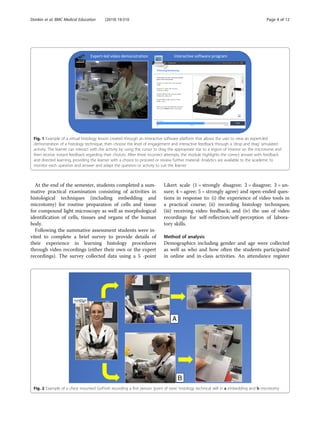
learning (choice of activities). Figure 1 illustrates an ex-
ample of an online module that included an expert led
video demonstration and an interactive ‘drop and drag’
activity for a histology technique (microtomy) with feed-
back and capacity to complete multiple attempts.
Study design
The study involved a mixed methods approach of quan-
titative and qualitative methods. Students were assigned
with a non-identifiable code number in week 4 of the se-
mester and randomly allocated to one of two groups,
‘video’ or ‘control’ to assess student skills, knowledge
and experience in histology techniques delivered in an
online ‘video’ and face-to-face ‘control’ format.
All students had three formative attempts at the hist-
ology techniques from weeks 6–9 before a summative
assessment in week 11. In the first and second attempts
all students were supervised by two histology Instructors
and received individual oral and written (rubric) forma-
tive feedback on technical skills, safety and advice for
improvement. On the third formative attempt students
in the ‘video’ group used a chest mounted GoPro© and
tri-pod recording through an iPhone 6 s© to capture first
person ‘point of view’ technical skills (Fig. 2). The re-
cording was made by the student and supervised by a
student peer, not by an Instructor. Students did not re-
ceive oral feedback by the student peer or Instructor at
the time of the recording. The video did not contain any
identifiable features of the student such as face, hands,
or skin. The file was saved with the non-identifiable code
number and made available through the student’s online
portfolio using the university learning management sys-
tem, Blackboard™. The video recording could be viewed
multiple times by the student through a password pro-
tected login.
In weeks 7–10 of the semester, after the student
had viewed the recordings by themselves, the In-
structor completed a blind written assessment (rubric)
of the recordings. When all video assessments were
completed, the code numbers were released to iden-
tify the students and they were invited to participate
in a 5 min, one-on-one review of the video with the
assessor. Feedback was provided by the assessor in re-
gard to the student’s technical skills, suggestions for
improvement, and an opportunity to raise questions
about their performance and self-reflect on their tech-
nical ability.
Students in the ‘control’ group received the same con-
tent delivery in-class and online but were not video
recorded performing their final attempt at the histology
techniques. The control group received oral feedback
from a student peer at the time of the technique (ap-
proximately for 5 min for each attempt) and peer written
(rubric) feedback.
Table 1 Curriculum renewal summary pre-and post-online interventions of blended learning tools
Teaching Component Former Course Delivery Current Course Delivery
Lecture Face-to-face and online
2 h/week for 13 weeks
Online only
2 h/week for 13 weeks
Tutorial Large class, didactic, independent learning (+/−
computer access)
1 h/week for 13 weeks
Team-based learning (4–6/group), with computer access
3 h/fortnight for 13 weeks
Practical 2 h/week for 13 weeks 2 h/week for 13 weeks
Virtual slides Available Available
Video feedbacka
Not available Available online for embedding and microtomy techniques
Online e-Learning
modules
Not available Available for histology techniques
Online student
portfolio
Not available Available for morphology and histology techniques (embedding
and microtomy)
Face-to-face contact
hours
65 h/ semester 44 h/ semester
a
Available to video study participants in 2017 only
Donkin et al. BMC Medical Education (2019) 19:310 Page 3 of 12
At the end of the semester, students completed a sum-
mative practical examination consisting of activities in
histological techniques (including embedding and
microtomy) for routine preparation of cells and tissue
for compound light microscopy as well as morphological
identification of cells, tissues and organs of the human
body.
Following the summative assessment students were in-
vited to complete a brief survey to provide details of
their experience in learning histology procedures
through video recordings (either their own or the expert
recordings). The survey collected data using a 5 -point
Likert scale (1 = strongly disagree; 2 = disagree; 3 = un-
sure; 4 = agree; 5 = strongly agree) and open-ended ques-
tions in response to: (i) the experience of video tools in
a practical course; (ii) recording histology techniques;
(iii) receiving video feedback; and (iv) the use of video
recordings for self-reflection/self-perception of labora-
tory skills.
Method of analysis
Demographics including gender and age were collected
as well as who and how often the students participated
in online and in-class activities. An attendance register
Fig. 1 Example of a virtual histology lesson created through an interactive software platform that allows the user to view an expert-led
demonstration of a histology technique, then choose the level of engagement and interactive feedback through a ‘drop and drag’ simulated
activity. The learner can interact with the activity by using the cursor to drag the appropriate star to a region of interest on the microtome and
then receive instant feedback regarding their choices. After three incorrect attempts, the module highlights the correct answer with feedback
and directed learning, providing the learner with a choice to proceed or review further material. Analytics are available to the academic to
monitor each question and answer and adapt the question or activity to suit the learner
B
A
Fig. 2 Example of a chest mounted GoPro© recording a first person ‘point of view’ histology technical skill in a embedding and b microtomy
Donkin et al. BMC Medical Education (2019) 19:310 Page 4 of 12
was kept for all laboratory and tutorial classes and at the
end of the laboratory practical an Instructor would con-
firm if the tasks for the lesson had or had not been satis-
factorily completed.
The online resources: an introduction to the histology
laboratory; expert histology techniques videos (embed-
ding and microtomy demonstrations); and online mod-
ule analytics were captured through the learning
management system, Blackboard™ and SmartSparrow
[10]. To exclude any bias due to changes in academic
ability or skill level the 2017 pre-test, summative prac-
tical assessment and final grade results were compared
with the 2016 cohort. The pre-test quiz consisted of
multiple choice and short answer questions relating to
histology techniques in the laboratory.
Statistical analysis
Quantitative data from the practical assessment tasks
and pre-test quiz were analysed using the Statistical
Package for Social Sciences (SPSS) version 22 (SPSS Inc.,
Chicago, IL). Data were analysed using independent
sample t-tests with criteria of a 95% confidence interval
and a null hypothesis that there is no significant change
in student’s grade following participation in video feed-
back. A P value < 0.05 was a significant level to suggest
strong evidence against the null hypothesis. This project
was approved by the University of the Sunshine Coast
Human Research Ethics Committee A17982.
Power and sample size
To adequately detect a 15% difference in grade outcomes
between student learning in the ‘video’ group versus the
‘control’ group with statistical power 80%, alpha = 0.05
and assuming a standard deviation on 12 points, a sam-
ple size of at least 11 students per group was required.
Results
Descriptive results
There were 31 students enrolled in MLS121 Histology
in 2017 of which 28 agreed to participate in the study.
Students were randomly allocated to either the ‘video’
group (n = 14; 11 females, 3 males) or the ‘control’ group
(n = 14; 10 females, 4 males) by week 4. There were 75%
females and 25% males, 65% were more than 20 years
old and all students were enrolled in a MLS program.
These descriptive statistics were an accurate representa-
tion of the demographics of students enrolled in the pro-
gram for the past 4 years.
The pre-requisite first-year course ‘Cell Biology’ was
required prior to enrolment in the histology course, stu-
dents were also required to enrol in ‘Human Physiology’
in the same semester. To some extent students had hist-
ology knowledge prior to starting the course because of
the pre-requisite and co-requisite courses. Therefore, to
exclude any bias resulting from previous or current
knowledge a pre-test quiz was conducted at the begin-
ning of the course in both 2016 (n = 26) and 2017 (n =
28). The average mark for the pre-test result in 2016
was 77% (SD ± 13) and in 2017 was 74% (SD ± 22) and
were not statistically different (P value 0.58). The pre-
test result was also analysed for bias between the 2017
‘video’ and ‘control’ group and was also not statistically
significant (P value 0.15).
Analysis of in-class and online use of learning material
All students were given access to the same in-class la-
boratory and online learning content throughout the
course. All activities were voluntary except for a require-
ment to attend at least 80% of laboratory practicals.
Frequency analytics of the 2017 student cohort in-class
attendance (laboratory and tutorial), online material
usage (interactive histology module) and viewed record-
ings of expert demonstrations of histology equipment
(introduction to the histology laboratory; embedding
demonstration; and microtomy demonstration) are re-
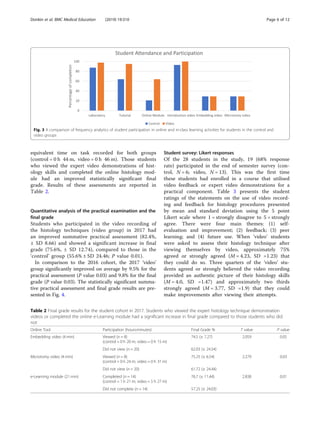
ported by percentage for each group: ‘video’ compared
to ‘control’ in Fig. 3.
As there was a minimum 80% requirement for labora-
tory attendance, participation in the practical component
of the course was high for both groups (control = 87.5%,
video = 97.7%), as was viewing the six-minute ‘Introduc-
tion to Histology’ video (control = 93%, video = 100%),
which was available in the laboratory practical, through
the student’s online portfolio and in the online e-
Learning module. In total, the ‘Introduction to Hist-
ology’ video was viewed 94 times. Total time spent on
task was 3 h and 47 min (control = 1 h 17 m, video = 2 h
40 m) throughout the 13-week semester.
Differences in participation between the two groups
related to the voluntary attendance at tutorials and
the completion of the online e-Learning histology
module. The tutorials were well attended by the video
group (95.1%) in comparison to the control group
(64.0%). From the 2017 cohort a half of the students
completed the voluntary online e-Learning module
and most of these students (77%, N = 10) were in the
video group. In total, the module was completed 29
times, total time spent on task was 6 h and 48 min
(control = 1 h 21 m, video =5 h 27 m) and was re-
peated more than once by seven students in the video
group. The average score was 86% (range 43–100%)
and the average time spent on the lesson was 21 min
(range 4–47 min). The eight-minute ‘Histology Tech-
nique’ videos made by the Instructor that depicted
the ‘expert’ completing the embedding (4 min) and
microtomy (4 min) techniques was viewed 25 times,
by only eight students (control = 4; video = 4). Total
time spent on task was 1 h and 30 min, with
Donkin et al. BMC Medical Education (2019) 19:310 Page 5 of 12
equivalent time on task recorded for both groups
(control = 0 h 44 m, video = 0 h 46 m). Those students
who viewed the expert video demonstrations of hist-
ology skills and completed the online histology mod-
ule had an improved statistically significant final
grade. Results of these assessments are reported in
Table 2.
Quantitative analysis of the practical examination and the
final grade
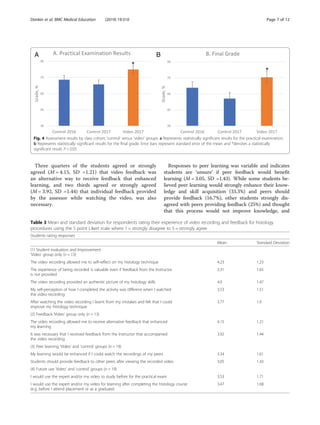
Students who participated in the video recording of
the histology techniques (video group) in 2017 had
an improved summative practical assessment (82.4%,
± SD 8.66) and showed a significant increase in final
grade (75.6%, ± SD 12.74), compared to those in the
‘control’ group (55.6% ± SD 24.46; P value 0.01).
In comparison to the 2016 cohort, the 2017 ‘video’
group significantly improved on average by 9.5% for the
practical assessment (P value 0.03) and 9.8% for the final
grade (P value 0.03). The statistically significant summa-
tive practical assessment and final grade results are pre-
sented in Fig. 4.
Student survey: Likert responses
Of the 28 students in the study, 19 (68% response
rate) participated in the end of semester survey (con-
trol, N = 6; video, N = 13). This was the first time
these students had enrolled in a course that utilised
video feedback or expert video demonstrations for a
practical component. Table 3 presents the student
ratings of the statements on the use of video record-
ing and feedback for histology procedures presented
by mean and standard deviation using the 5 point
Likert scale where 1 = strongly disagree to 5 = strongly
agree. There were four main themes: (1) self-
evaluation and improvement; (2) feedback; (3) peer
learning; and (4) future use. When ‘video’ students
were asked to assess their histology technique after
viewing themselves by video, approximately 75%
agreed or strongly agreed (M = 4.23, SD =1.23) that
they could do so. Three quarters of the ‘video’ stu-
dents agreed or strongly believed the video recording
provided an authentic picture of their histology skills
(M = 4.0, SD =1.47) and approximately two thirds
strongly agreed (M = 3.77, SD =1.9) that they could
make improvements after viewing their attempts.
Fig. 3 A comparison of frequency analytics of student participation in online and in-class learning activities for students in the control and
video groups
Table 2 Final grade results for the student cohort in 2017. Students who viewed the expert histology technique demonstration
videos or completed the online e-Learning module had a significant increase in final grade compared to those students who did
not
Online Tool Participation (hours:minutes) Final Grade % T value P value
Embedding video (4 min) Viewed (n = 8)
(control = 0 h 20 m; video = 0 h 15 m)
74.5 (± 7.27) 2.059 0.05
Did not view (n = 20) 62.03 (± 24.54)
Microtomy video (4 min) Viewed (n = 8)
(control = 0 h 24 m; video = 0 h 31 m)
75.25 (± 6.54) 2.279 0.03
Did not view (n = 20) 61.72 (± 24.44)
e-Learning module (21 min) Completed (n = 14)
(control = 1 h 21 m; video = 5 h 27 m)
76.7 (± 11.44) 2.838 0.01
Did not complete (n = 14) 57.25 (± 24.03)
Donkin et al. BMC Medical Education (2019) 19:310 Page 6 of 12
Three quarters of the students agreed or strongly
agreed (M = 4.15, SD =1.21) that video feedback was
an alternative way to receive feedback that enhanced
learning, and two thirds agreed or strongly agreed
(M = 3.92, SD =1.44) that individual feedback provided
by the assessor while watching the video, was also
necessary.
Responses to peer learning was variable and indicates
students are ‘unsure’ if peer feedback would benefit
learning (M = 3.05, SD =1.43). While some students be-
lieved peer learning would strongly enhance their know-
ledge and skill acquisition (33.3%) and peers should
provide feedback (16.7%), other students strongly dis-
agreed with peers providing feedback (25%) and thought
that this process would not improve knowledge, and
A B
Fig. 4 Assessment results by class cohort, ‘control’ versus ‘video’ groups. a Represents statistically significant results for the practical examination.
b Represents statistically significant results for the final grade. Error bars represent standard error of the mean and *denotes a statistically
significant result, P < 0.05
Table 3 Mean and standard deviation for respondents rating their experience of video recording and feedback for histology
procedures using the 5 point Likert scale where 1 = strongly disagree to 5 = strongly agree
Students rating responses
Mean Standard Deviation
(1) Student evaluation and Improvement
‘Video’ group only (n = 13)
The video recording allowed me to self-reflect on my histology technique 4.23 1.23
The experience of being recorded is valuable even if feedback from the Instructor
is not provided
3.31 1.65
The video recording provided an authentic picture of my histology skills 4.0 1.47
My self-perception of how I completed the activity was different when I watched
the video recording
3.53 1.51
After watching the video recording I learnt from my mistakes and felt that I could
improve my histology technique
3.77 1.9
(2) Feedback ‘Video’ group only (n = 13)
The video recording allowed me to receive alternative feedback that enhanced
my learning
4.15 1.21
It was necessary that I received feedback from the Instructor that accompanied
the video recording
3.92 1.44
(3) Peer learning ‘Video’ and ‘control’ groups (n = 19)
My learning would be enhanced if I could watch the recordings of my peers 3.34 1.61
Students should provide feedback to other peers after viewing the recorded video 3.05 1.43
(4) Future use ‘Video’ and ‘control’ groups (n = 19)
I would use the expert and/or my video to study before for the practical exam 3.53 1.71
I would use the expert and/or my video for learning after completing the histology course
(e.g. before I attend placement or as a graduate)
3.47 1.68
Donkin et al. BMC Medical Education (2019) 19:310 Page 7 of 12
learning would not be enhanced. Approximately two
thirds of the respondents agreed or strongly agreed
(M = 3.53, SD =1.71) that they would use a video record-
ing (either their own or from the expert) for study
purposes and agreed they would use the video recording
again after completion of the course or as a revision tool
during placement in the profession (M = 3.47, SD =1.68).
Qualitative survey: open-ended responses
The open-ended question data from the survey identified
whether respondents had a positive, negative or indiffer-
ent experience concerning the video recordings. Re-
spondent answers were analysed to identify a theme or
keyword that was used in a coding scheme [11] by two
academic experts. The three themes included comments
that were: (1) positive - improvement in technique, en-
gagement, confidence, learning/importance and em-
powerment; (2) negative - anxiety, avoidance, poor
outcome, insecurity; and (3) indifferent - no preference,
unsure, combination of positive and negative comments.
A summary of the participants responses is presented in
Fig. 5.
Two academics coded 115 open-ended responses from
the 19 participants with an intraclass correlation coeffi-
cient of 0.924 and Cronbach’s Alpha 0.918, suggesting
excellent agreement between raters. The majority (66%)
expressed positive comments which highlighted engage-
ment, improvement in technique and learning import-
ance. A typical response was: “I was grateful for the
opportunity to have a video made of my attempt at em-
bedding tissue ready for microtomy. By viewing and
receiving timely feedback of my video, I was able to im-
prove my embedding technique and confidence level”.
Most students did not find the recording device intrusive
or uncomfortable and some “forgot about being re-
corded” once they began the histology technique and the
experience was positive “as it helped with exam nerves
knowing I have been watched closely before [through
video]”. The negative comments (28%) involved anxiety
of being recorded “I felt nervous being recorded” and
avoidance, not wanting to participate or complete the
activity while being recorded in front of other peers “I
would not recommend being recorded, I only want verbal
or written feedback at the time of my attempt”. A small
proportion of responses (6%) were indifferent such as:
“I’m not sure if the videos are helpful, or if I learnt from
them”.
Discussion
The goals of this study were to investigate whether video
feedback and online resources in a MLS program pro-
vided value and engagement in terms of student
performance and perceptions; and how video and online
assisted feedback could be designed to promote inter-
active and engaging experiences.
In regard to student performance this study found two
things. Firstly, improved exam scores and secondly im-
proved engagement for the ‘video’ group. For example,
there were significant differences in learning outcomes
between the control and video group experiences. Aver-
age final grade for the 2016 ‘control’ group was 65.83%,
(±SD 18.86) compared to the ‘video’ group 75.6%, (±SD
Fig. 5 Percentages of positive, negative and indifferent comments from respondents to the open-ended survey data of student’s perspective of
video recordings
Donkin et al. BMC Medical Education (2019) 19:310 Page 8 of 12
12.74). Secondly, there was an increase in voluntary en-
gagement for the ‘video’ group compared to the 2017
‘control’ group through tutorial attendance (control =
64%; video = 95%), ‘Introduction to Histology’ video
views (control = 1 h 17 m; video = 2 h 40 m) and time on
task for the e-Learning module (control = 1 h 21 m; video
=5 h 27 m).
These findings are consistent with other studies that
have found comparable or improved gains using video
feedback [8, 12, 13]. The literature in video feedback re-
ports themes in ‘nervousness’ of being video-recorded
with subsequent ‘reflective dialogue that increases self-
knowledge’ [8] and a high level of satisfaction with indi-
vidual feedback provided by the Instructor [13, 14].
Videos demonstrated by the expert have ‘helped recreate
the in-person laboratory session’ experience [12] and
watching one’s own performance through video im-
proved confidence, clinical knowledge and learning [13],
which was similarly reported in the ‘video’ group.
E-Learning and interactive virtual learning benefits for
the student are mixed. Literature reports improved gains
through increased exam scores [15, 16], flexibility to
learn anywhere and anytime [17] and positive attitudes
towards virtual experiences [18]. However, comparable
attitudes and performance to the traditional face-to-face
instruction [19], or poorer results [4] have also been re-
ported in the health sciences education literature.
Motivation to learn
It was important to not only assess improved grade out-
comes but also to analyse the students’ perspectives and
self-perceptions of their engagement and learning expe-
riences. After implementing any curriculum change
using online learning it is important to ask, “do students
use the feedback to improve and what makes students
pay attention to feedback?”. These questions underpin
achievement goal theory, the motivation behind the
learners’ decisions and behaviours to achieve a learning
goal [20, 21] or in essence the motivation to learn.
We analysed how often and when the students used
the online material for knowledge acquisition, revision
or feedback. Moreover, the qualitative analysis provided
an in-depth response to motivation and engagement.
Whilst it was shown that video-assisted feedback and
online learning improved grade outcomes, not all stu-
dents liked being video recorded, stated anxiety, or were
not motivated to learn using online resources. It has
been reported that feeling challenged whilst learning
may enhance learning, and some have argued that this
emotional response could heighten attention to the ac-
tivity and improve learning outcomes [22]. Challenging
students within their comfort zone may improve learn-
ing but over challenging may have the opposite effect by
causing anxiety or avoidance. Anxiety in learning is a
pathway to situational interest, “situational interest is
triggered by the complex interplay between the student’s
interest and goals and the teaching environment” [23].
Moderate levels of anxiety are motivating, triggering stu-
dents to work harder and this may explain why those
students allocated to the ‘video’ group had increased
time on task and engaged more than the control group
in both online and face-to-face learning activities. The
perceived ‘anxiety’ of being video recorded while com-
pleting a task and having an ‘expert’ analyse the tech-
nique may promote learning attributes such as
participation and engagement in voluntary learning ac-
tivities. For the control group the anxiety is less, and the
task is seen as unimportant which may lead to reduced
interest and engagement.
Feedback
The effect of a known interaction which ‘makes you
focus because you will be scrutinised’ is part of the social
system of learning that can readily engage students in an
online environment [24]. Understanding how students
prepare and their motivation to use learning resources
and seek feedback is important when designing learning
activities that are online or simulated [25]. However,
previous research has shown that perceived versus actual
online engagement is full of contradictions and merely
offering online resources with feedback is not necessarily
sufficient to promote learning [26, 27]. Both the video
and control group were offered the same online re-
sources however, the video group engaged up to four
times more than the control group as evidenced by time
on task (e-Learning module control = 1 h 21 min; video =
5 h 22 min).
While motivation and emotion have been recognized
as factors that influence how students interpret and use
feedback [25, 28] the learning style and the nature of the
task are also influencing factors [29]. Performance-
oriented goals, whereby students want positive affirm-
ation of their proficiency when performing a learning
activity which thereby focusses their motivation to
achieve [20] was notable in the video group. The nature
of the task, being assessed by an Instructor, influenced
this group to be motivated to achieve, this group had a
much richer experience by choosing to increase their ex-
posure to the content. The learning style ‘to master the
technique’ before being assessed by an Instructor is likely
a strong influencing factor to perform well, compared to
being assessed by a peer. The control group who re-
ceived feedback by their peers performing the formative
histology techniques did not have the same motivation
to engage in the online resources, and therefore had less
exposure to content. As evidenced by the reduced time
on task and tutorial participation (tutorial attendance
Donkin et al. BMC Medical Education (2019) 19:310 Page 9 of 12
control = 64%; video = 95%) the control group did not
have the same performance-oriented goals.
Moreover, achievement goals have been shown to in-
fluence feedback-seeking behaviours. In a meta-analysis
of the goal orientation literature, Payne et al. [30] found
that feedback-seeking was positively related to mastery-
approach goals such as ‘hands-on’ skills. The ‘educa-
tional alliance’ and the importance of instructor pres-
ence (whether online or face-to-face) to foster a
feedback relationship and the learners’ perceptions of
the supervisory relationship is also important [31]. The
‘anxiety’ response and the need to be ‘prepared’ for In-
structor feedback may explain why the video group
spent more time on task. Video assisted feedback pro-
vides objective evidence of an individual’s performance
because it provides accurate real-time data and can be
viewed multiple times [13], there is no place to ‘hide’ or
recollect a different perception of the activity.
Most students reported that their “self-perception of
completing the histology activity was different compared
to the video recording” (M = 3.53, SD = 1.51) however,
after watching the video and receiving feedback from the
‘expert’ they agreed that “it provided an authentic pic-
ture of their histology skills” (M = 4.0, SD = 1.47). Agree-
able student responses such as: “the video recording
allowed me to receive alternative feedback that enhanced
my learning” (M = 4.15, SD = 1.21) and “it was necessary
that I received verbal/written feedback from the In-
structor that accompanied the video recording” (M =
3.92, SD = 1.44) highlights the importance of prompt
and accurate feedback to provide an authentic picture of
the performance however, these statements do not re-
flect the associated time and effort taken by the assessor
to provide the feedback.
Although the ‘video’ group consisted of only 14 stu-
dents and the total time for providing feedback was ap-
proximately three and a half hours (5 min per student to
provide oral feedback and approximately 10 min for
video review and written feedback) this level of feedback
could not be replicated in a larger cohort. It could be
suggested that students peer review themselves to
reduce the marking and feedback time associated with
formative review. Albeit, this will likely change the en-
gagement and motivation associated with the achieve-
ment goal and feedback-seeking behaviours as was
experienced in the 2017 ‘control’ group in this study.
Interestingly, no students in this study reported anx-
iety or avoidance when watching the ‘expert’ video tech-
nique or when receiving feedback from a peer. In fact, a
quarter of students believed peer feedback did not
enhance learning and over a half (58%) would not rec-
ommend peer-feedback for learning a histology tech-
nique. The usefulness of student feedback reported in
the literature is mixed. Some studies strongly believe
peer review benefits learning and critical thinking [30,
32]while improving the capacity to provide feedback in
large courses [33], while others do not find it useful or
report avoidance behaviours to not participate in peer
feedback [34]. Additionally, self-evaluations have been
reported to be more specific and useful than peer-
feedback [35] but it could be argued that this would
mitigate the importance of Instructor presence and the
perceived social benefit of being reviewed by the ‘expert’.
Alternatively, in review of the time commitment for the
assessor to provide feedback for a larger cohort, it may
be plausible for all students to video record their per-
formance and the Instructor randomly selects some stu-
dents to be assessed. This may maintain engagement
and motivation for performance-oriented goals and en-
courage the use of learning resources and feedback seek-
ing behaviours.
The motivation behind the learners’ decisions and be-
haviours to achieve a learning goal is multi-faceted and
is likely influenced by many explicit and implicit vari-
ables. This study reinforces the importance of motiv-
ation, emotion and the social nature of learning. In
particular, carefully designed and evaluated blended
learning tools can have both direct and indirect effects
on final grades by improving knowledge and increasing
engagement in the course [36]. Studies indicate that
noncognitive skills, such as motivation and conscien-
tiousness, are crucial factors in the efficient development
of cognitive skills in science learning [37]. It has been re-
ported from the same authors that online simulations
can increase both learning outcomes and motivation
levels. However, the final stage in learning requires real
equipment that must be acquired with hands-on experi-
ence and expertise in learning [38].
Conclusions
It is not anticipated that online learning will completely
replace the physical presence and hands-on learning in
the laboratory. Nonetheless, our study shows that a
blended learning approach that combines traditional
hands-on learning with educational technology enhances
learning in the laboratory and has benefits for both the
student and the academic. Virtual or online learning ex-
periences may be effective alternatives when the hands-
on approach is too complex for early learners, expensive,
or inaccessible due to laboratory constraints, or the ac-
tivity is too time consuming to complete in the labora-
tory. Developing online resources that simulate and
prepare the student for laboratory procedures promotes
an enriched and sustainable learning experience. The
student is more likely to be engaged and motivated to
learn because they have attempted the simulated proced-
ure and had multiple opportunities to learn the proced-
ure prior to the laboratory session. Specifically, video
Donkin et al. BMC Medical Education (2019) 19:310 Page 10 of 12
and online assisted feedback provided by the expert im-
proves grade outcomes and improves engagement
through motivation which is linked to achievement goal
theory.
Limitations to adopting this combination of learning
methods include the educational technology expertise to
develop the online tools, the time allocated to feedback
and developing such technologies, and the necessary
motivation and engagement of the student to accept and
adopt the blending learning approach to their studies. It
is plausible that the conscientious student who readily
engages with blended learning or has previous experi-
ence in online learning or video feedback will perform
better regardless of the learning intervention. Without
strong financial and institutional support, it is difficult to
achieve positive outcomes when introducing blended
learning to curriculum renewal in medical science
programs.
Acknowledgements
The authors thank Ms. Katie Gould, USC Laboratory Instructor for academic
support during the histology laboratories, Mr. Tim Jensen, USC Resource
Developer for assistance with video editing and production, Dr. Mary Kynn
for statistical advice and the USC students who participated in the study.
Authors’ contributions
All authors have contributed to the study design, contributed to manuscript
preparation, read and accept responsibility for the manuscript’s contents. All
authors read and approved the final manuscript.
Funding
This research did not receive any funding.
Availability of data and materials
The datasets used and/or analysed during the current study are available
from the corresponding author on reasonable request.
Ethics approval and consent to participate
This study received human ethics approval from the University of the
Sunshine Coast’s Human Research Ethics Committee (A17982) and all
participants provided written consent to participate.
Consent for publication
Not applicable. Figure 1 contains an image of the author RD and Fig. 2
contains images of author HS. Both authors have provided written consent
for their image to be published in the manuscript.
Competing interests
The authors declare that they have no competing interests. RD is an
Associate Editor for BMC Medical Education.
Received: 22 April 2018 Accepted: 5 August 2019
References
1. Heuertz RM. Research in the Medical Laboratory Science curriculum. Clin
Lab Sc. 2011;24(Suppl 4):54–60.
2. Leibach EK. Grounded theory in medical laboratory science expert practice
development. Clin Lab Sc. 2011;24(4 Suppl):4 -37-44.
3. Castillo D. The effectiveness of digital microscopy as a teaching tool in
medical laboratory science curriculum. Clin Lab Sc. 2012;25(Suppl 4):4–11.
4. Conway-Klaassen JM, Wiesner SM, Desens C, Trcka P, Swinehart C. Using
online instruction and virtual laboratories to teach hemostasis in a medical
laboratory science program. Clin Lab Sc. 2012;25(Suppl 4):224–9.
5. Garrison DR, Kanuka H. Blended learning: uncovering its transformative
potential in higher education. Internet High Educ. 2004;7:95–105.
6. Hartfield P. Blended learning as an effective pedagogical paradigm for
biomedical science. High Learn Res Comm. 2013;3:3–4.
7. Davis CR, Bates A, Ellis H, Roberts A. Human anatomy: let the students tell
us how to teach. Anat Sci Ed. 2014;7:262–72.
8. Nyström A, Pålsson Y, Hofsten A, Häggström E. Nursing students'
experiences of being video-recorded during examination in a fictive
emergency care situation. Int J Nurs Prac. 2014;20:540–8.
9. Hawkins SC, Osborne A, Schofield SJ, Pournaras DJ, Chester JF.
Improving the accuracy of self-assessment of practical clinical skills
using video feedback the importance of including benchmarks. Med
Teach. 2012;4:279–84.
10. SmartSparrow. Adaptive eLearning Platform. 2017 [cited 2017 28
November]; Available from: https://www.smartsparrow.com.
11. Graneheim UH, Lundman B. Qualitative content analysis in nursing research:
concepts, procedures and measures to achieve trustworthiness. Nur Educ
Tod. 2004;24:105–12.
12. Thompson AR, Lowrie DJ. An evaluation of outcomes following the
replacement of traditional histology laboratories with self-study modules.
Anat Sc Educ. 2017;10:276–85. https://doi.org/10.1002/ase.1659.
13. Oseni Z, Than HH, Kolakowska E, Chalmers L, Hanboonkunupakarn B,
McGready R. Video-based feedback as a method for training rural
healthcare workers to manage medical emergencies: a pilot study. BMC
Med Ed. 2017;17:149.
14. Parish S, Weber C, Steiner-Grossman P, Milan F, Burton W, Marantz P.
Teaching clinical skills through videotape review: a randomized trial of
group versus individual reviews. Teach Learn Med. 2006;18:92–8. https://doi.
org/10.1207/s15328015tlm1802_1.
15. Donkin R, & Askew E. An evaluation of formative “in-class” versus “E-
learning” activities to benefit student learning outcomes in biomedical
sciences. J Biomed Educ 2017; 9127978. https://doi.org/10.1155/2017/
9127978.
16. Brinson JR. Learning outcome achievement in non-traditional (virtual and
remote) versus traditional (hands-on) laboratories: a review of the empirical
research. Comp Educ. 2015;87:218.
17. Heradio R, de La Torre L, Galan D, Cabrerizo F, Herrera-Viedma E, Dormido S.
Virtual and remote labs in education: a bibliometric analysis. Comp Educ.
2016;98:14–38. https://doi.org/10.1016/j.compedu.2016.03.010.
18. Pyatt K, Sims R. Virtual and physical experimentation in inquiry-based
science labs: attitudes, performance and access. J Sci Ed Tech. 2012;21:
133–47.
19. Poulová P, Simonová I, & Cerná M. Students Attitudes, Opinions and
Perception of eLearning’ in European Conference on e-Learning. Academic
Conferences International Limited, Kidmore End, 2012 p. 425–XV. Retrieved
from http://search.proquest.com/docview/1328342519/.
20. Dweck CS. Motivational processes affecting learning. Amer Psych. 1986;41:
1040–8.
21. Elliot AJ. A conceptual history of the achievement goal construct. In: Elliot
AJ, Dweck CS, editors. Handbook of competence and motivation. New York:
Guilford Press; 2005. p. 52–72.
22. Fraser K, Ma I, Teteris E, Baxter H, Wright B, McLaughlin K. Emotion,
cognitive load and learning outcomes during simulation training. Med Ed.
2012;46:055–62.
23. Ella K, Karen N, Catherine P. Student interest as a key driver of engagement
for first year students. Student Success. 2017;8:55–66. https://doi.org/10.52
04/ssj.v8i2.379.
24. Shih P, Velan GM, Shulruf B. Shared values and socio-cultural norms: E-
learning technologies from a social practice perspective. Iss Ed Res. 2017;27:
550–66.
25. Naismith LM, Lajoie SP. Motivation and emotion predict medical students'
attention to computer-based feedback. Adv Health Sci Educ Theory Pract.
2017;23:1–21.
26. Cook DA, Erwin PJ, Triola MM. Computerized virtual patients in health
professions education: a systematic review and meta-analysis. Acad Med.
2010;85:1589–602. https://doi.org/10.1097/ACM.0b013e3181edfe13.
27. Harrison CJ, Könings KD, Molyneux A, Schuwirth LWT, Wass V, Van Der
Vleuten CPM. Web-based feedback after summative assessment: how do
students engage? Med Ed. 2013;47:734–44. https://doi.org/10.1111/
medu.12209.
28. Poulos A, Mahony MJ. Effectiveness of feedback: the students’ perspective.
Assess Eval High Educ. 2008;33:143–54.
29. Shute VJ. Focus on formative feedback. Educ Res Rev. 2008;78:153–89.
Donkin et al. BMC Medical Education (2019) 19:310 Page 11 of 12
30. Payne SC, Youngcourt SS, Beaubien JM. A meta-analytic examination of the
goal orientation nomological net. J App Psych. 2007;92:128–50.
31. Telio S, Ajjawi R, Regehr G. The “educational alliance” as a framework
for reconceptualising feedback in medical education. Acad Med. 2015;
90:609–14.
32. Hanrahan SJ, Isaacs G. Assessing Self- and Peer-Assessment: The
Students’ Views. High Ed Res Dev. 2001;20:53–70. https://doi.org/10.1
080/07294360123776.
33. Topping KJ. Peer Assessment. Theor Pract. 2009;48:20–7. https://doi.org/10.1
080/00405840802577569.
34. Meek Sarah EM, Blakemore L, Marks L. Is Peer Review an Appropriate Form
of Assessment in a MOOC? Student Participation and Performance in
Formative Peer Review. Ass Eval High Ed. 2017;42:1000–13. https://doi.org/1
0.1080/02602938.2016.1221052.
35. Hulsman RL, van Der Vloodt J. Self-evaluation and peer-feedback of medical
students' communication skills using a web-based video annotation system.
Exploring content and specificity. Pat Ed Couns. 2015;98:356–63. https://doi.
org/10.1016/j.pec.2014.11.007.
36. López-Pérez MV, Pérez-López MC, Rodríguez-Ariza L. Blended learning in
higher education: students’ perceptions and their relation to outcomes.
Comp Educ. 2011;56:818–26.
37. Bonde MT, Makransky G, Wandall J, Larsen M, Morsing M, Jarmer H, et al.
Improving biotech education through gamified laboratory simulations. Nat
Biotech. 2014;32:694–7.
38. Potkonjak V, Gardner M, Callaghan V, Mattila P, Guetl C, Petrović VM,
Jovanović K. Virtual laboratories for education in science, technology, and
engineering: a review. Comp Educ. 2016;95:309–27. https://doi.org/10.1016/j.
compedu.2016.02.002.
Publisher’s Note
Springer Nature remains neutral with regard to jurisdictional claims in
published maps and institutional affiliations.
Donkin et al. BMC Medical Education (2019) 19:310 Page 12 of 12

La retroalimentacion en video

  • 1.
    RESEARCH ARTICLE OpenAccess Video feedback and e-Learning enhances laboratory skills and engagement in medical laboratory science students Rebecca Donkin* , Elizabeth Askew and Hollie Stevenson Abstract Background: Traditionally, the training of medical laboratory science students has taken place in the laboratory and has been led by academic and pathology experts in a face-to-face context. In recent years, budgetary pressures, increasing student enrolments and limited access to laboratory equipment have resulted in reduced staff-student contact hours in medical laboratory science education. While this restructure in resources has been challenging, it has encouraged innovation in online blended learning. Methods: Blended learning histology lessons were implemented in a face-to-face and e-Learning format in a medical laboratory science program to teach tissue morphology and technical procedures outside of the traditional laboratory classroom. Participating students were randomly allocated to either the ‘video’ group (n = 14) or the ‘control’ group (n = 14). After all students attempted the e-Learning lessons and viewed expert-led video recordings online, students demonstrated their hands-on practical skills in the laboratory. Technical skills, demonstration of safety awareness, and use of histology equipment was captured by video through first person ‘point of view’ recordings for the ‘video’ group only. The ‘control’ group performed the same activities but were not recorded. Prior to summative assessment, the ‘video’ group students had a digital resource portfolio that enabled them to review their skills, receive captured feedback and retain a visual copy of their recorded procedure. Results: Results showed that students who participated in the online video format had statistically better practical examination scores and final grades compared to the control group. Conclusion: Findings from this study suggest that students are engaged and motivated when being taught in a blended learning format and respond positively to the use of video recordings with expert feedback for the initial learning of hands-on techniques. For the academic, developing a blended learning medical laboratory science program, which includes annotated virtual microscopy, video demonstrations, and online interactive e-Learning activities, provides an effective and economic approach to learning and teaching. Keywords: Medical laboratory science, Blended learning, Interactive learning environments, Media in education, Simulations © The Author(s). 2019 Open Access This article is distributed under the terms of the Creative Commons Attribution 4.0 International License (http://creativecommons.org/licenses/by/4.0/), which permits unrestricted use, distribution, and reproduction in any medium, provided you give appropriate credit to the original author(s) and the source, provide a link to the Creative Commons license, and indicate if changes were made. The Creative Commons Public Domain Dedication waiver (http://creativecommons.org/publicdomain/zero/1.0/) applies to the data made available in this article, unless otherwise stated. * Correspondence: rdonkin@usc.edu.au School of Health and Sport Sciences, University of the Sunshine Coast, 90 Sippy Downs Drive, Sippy Downs, 4556 Queensland, Australia Donkin et al. BMC Medical Education (2019) 19:310 https://doi.org/10.1186/s12909-019-1745-1
  • 2.
    Background Introduction Medical laboratory science(MLS) programs that de- velop curricula with evidence-based practice, critical thinking, research and scholarship, report that stu- dent enthusiasm and motivation are key elements to positive learning outcomes [1, 2]. Previously, this en- thusiasm has been engendered through laboratory- based study, rather than in the lecture theatre using books and passive learning. Blended learning, using a combination of face-to-face and online activities, has proven to be comparable with or even improve the grades achieved by the traditional teaching of MLS [3, 4]. Blended learning facilitates learning in a variety of physical places and at different times. In addition, the student controls the pace and mode of the teaching and learning experience which may consist of: recorded lec- tures; interactive online modules; web based learning; virtual or simulated learning, mobile device learning (tablet or phone), learning management systems, e- Learning; and learning platforms facilitated through asynchronous internet tools [5, 6]. Previously, providing resources for students to learn outside of the laboratory involved (often poor quality) video recordings, postings of self-made clips on web- sites (which may be in unrelatable settings or pro- duced for non-related disciplines), or online activities which fail to simulate the technique for a learner [5]. However, successful course design and the associated materials must have a student-centred approach to in- crease student engagement and to improve learning outcomes [7]. One such method of blended learning is the use of video assisted feedback to capture a ‘point of view’ re- cording of the student’s attempt to perform a labora- tory procedure. Video recording is not a new technology, it requires minimal operative knowledge and the end product does not require high cognitive load or skills in information literacy to extract and assess the learning objective. The recording allows the student to receive feedback and improve skills while also providing a comparison between how the learner perceives their performance to that given by the ex- pert [8]. Although video assisted feedback of practical skills is not new, there is limited evidence [9] that video record- ing of the student skills and technical ability when in the pathology laboratory increases engagement with learning and improves grade scores. The aim of our study was to determine if students enrolled in a MLS program dis- played greater engagement with the subject and achieved higher grade results when using video feedback and on- line resources. Educational context Students enrolled in a MLS program in 2017, were in- vited to participate in the study. The participants were studying a first-year undergraduate course in histology that ran for 13 weeks which explored general pathology: structure and function of cells, tissue and organs of the human body, and the technical aspects used in pathology services, including preparation of tissue samples for light microscopy. At the end of the course students were re- quired to complete a practical examination to demon- strate their skills in laboratory techniques and morphological identification. For successful completion of the course students were required to attend a mini- mum of 80% of the laboratory practicals and achieve an overall 50% grade or higher in the practical examination. The practical examination was assessed by two experts in histology. Students independently performed histology techniques which included: embedding- orienting and mounting samples into paraffin wax; and microtomy- sec- tioning tissue samples on a microtome. Throughout these exercises the students were viewed by the assessor who marked the technique on the basis of: safety- hazard avoidance; knowledge of techniques and use of equip- ment; confidence in performing the procedures without reliance on notes; knowledge as to why and how the tech- nique was performed; and the quality of the final product. To supplement their learning, students were provided with several online resources that formed a digital learn- ing portfolio that did not require laboratory access. The portfolio included: online web based resources and student activities (quizzes, short answer questions, anno- tated morphology pictures); 24-h access to virtual slides (e.g. annotated moveable online tissue sections); online tutorial feedback provided by an expert in histology; interactive online learning modules (e-Learning); and expert-led video demonstrations in the histology laboratory. Methods Course delivery The histology course had run successfully (as measured by final grade and the university’s graduate attributes) for the previous 4 years (2013–2016) however, due to in- creased student enrolment, reduced staffing, a decreased equipment budget, and a strategic priority to implement a blended learning curriculum, the course was reviewed and restructured. The learning content remained the same however the delivery was different. Due to the reduction in face-to-face contact hours, major online ini- tiatives were implemented that included online only delivery of lecture material and an online student portfo- lio that contained: online video recordings of histology techniques (recordings of experts and students); and an online e-Learning module (Introduction to Histology). Donkin et al. BMC Medical Education (2019) 19:310 Page 2 of 12
  • 3.
    All students hadaccess to the expert histology technique video demonstrations and online modules from week 6 of the semester to reinforce their learning. Table 1 illus- trates the changes from the former (pre-2017) conven- tional curriculum to the current (2017) curriculum which integrates blended learning tools for course delivery. The online e-Learning module was developed in The SmartSparrow Adaptive e-Learning Platform [10] and consisted of interactive and engaging activities to learn histology techniques that could be completed in 20–30 min. The module incorporated embedded videos re- corded on a GoPro© or an iPhone 6 s© to capture: first person ‘point of view’ technical skills of an expert per- forming the histology technique; adaptive feedback; ‘drop and drag’ morphology; multiple choice questions; ‘roll over’ and annotated answers; extended feedback from a virtual ‘Biomedical Scientist’; and student-led learning (choice of activities). Figure 1 illustrates an ex- ample of an online module that included an expert led video demonstration and an interactive ‘drop and drag’ activity for a histology technique (microtomy) with feed- back and capacity to complete multiple attempts. Study design The study involved a mixed methods approach of quan- titative and qualitative methods. Students were assigned with a non-identifiable code number in week 4 of the se- mester and randomly allocated to one of two groups, ‘video’ or ‘control’ to assess student skills, knowledge and experience in histology techniques delivered in an online ‘video’ and face-to-face ‘control’ format. All students had three formative attempts at the hist- ology techniques from weeks 6–9 before a summative assessment in week 11. In the first and second attempts all students were supervised by two histology Instructors and received individual oral and written (rubric) forma- tive feedback on technical skills, safety and advice for improvement. On the third formative attempt students in the ‘video’ group used a chest mounted GoPro© and tri-pod recording through an iPhone 6 s© to capture first person ‘point of view’ technical skills (Fig. 2). The re- cording was made by the student and supervised by a student peer, not by an Instructor. Students did not re- ceive oral feedback by the student peer or Instructor at the time of the recording. The video did not contain any identifiable features of the student such as face, hands, or skin. The file was saved with the non-identifiable code number and made available through the student’s online portfolio using the university learning management sys- tem, Blackboard™. The video recording could be viewed multiple times by the student through a password pro- tected login. In weeks 7–10 of the semester, after the student had viewed the recordings by themselves, the In- structor completed a blind written assessment (rubric) of the recordings. When all video assessments were completed, the code numbers were released to iden- tify the students and they were invited to participate in a 5 min, one-on-one review of the video with the assessor. Feedback was provided by the assessor in re- gard to the student’s technical skills, suggestions for improvement, and an opportunity to raise questions about their performance and self-reflect on their tech- nical ability. Students in the ‘control’ group received the same con- tent delivery in-class and online but were not video recorded performing their final attempt at the histology techniques. The control group received oral feedback from a student peer at the time of the technique (ap- proximately for 5 min for each attempt) and peer written (rubric) feedback. Table 1 Curriculum renewal summary pre-and post-online interventions of blended learning tools Teaching Component Former Course Delivery Current Course Delivery Lecture Face-to-face and online 2 h/week for 13 weeks Online only 2 h/week for 13 weeks Tutorial Large class, didactic, independent learning (+/− computer access) 1 h/week for 13 weeks Team-based learning (4–6/group), with computer access 3 h/fortnight for 13 weeks Practical 2 h/week for 13 weeks 2 h/week for 13 weeks Virtual slides Available Available Video feedbacka Not available Available online for embedding and microtomy techniques Online e-Learning modules Not available Available for histology techniques Online student portfolio Not available Available for morphology and histology techniques (embedding and microtomy) Face-to-face contact hours 65 h/ semester 44 h/ semester a Available to video study participants in 2017 only Donkin et al. BMC Medical Education (2019) 19:310 Page 3 of 12
  • 4.
    At the endof the semester, students completed a sum- mative practical examination consisting of activities in histological techniques (including embedding and microtomy) for routine preparation of cells and tissue for compound light microscopy as well as morphological identification of cells, tissues and organs of the human body. Following the summative assessment students were in- vited to complete a brief survey to provide details of their experience in learning histology procedures through video recordings (either their own or the expert recordings). The survey collected data using a 5 -point Likert scale (1 = strongly disagree; 2 = disagree; 3 = un- sure; 4 = agree; 5 = strongly agree) and open-ended ques- tions in response to: (i) the experience of video tools in a practical course; (ii) recording histology techniques; (iii) receiving video feedback; and (iv) the use of video recordings for self-reflection/self-perception of labora- tory skills. Method of analysis Demographics including gender and age were collected as well as who and how often the students participated in online and in-class activities. An attendance register Fig. 1 Example of a virtual histology lesson created through an interactive software platform that allows the user to view an expert-led demonstration of a histology technique, then choose the level of engagement and interactive feedback through a ‘drop and drag’ simulated activity. The learner can interact with the activity by using the cursor to drag the appropriate star to a region of interest on the microtome and then receive instant feedback regarding their choices. After three incorrect attempts, the module highlights the correct answer with feedback and directed learning, providing the learner with a choice to proceed or review further material. Analytics are available to the academic to monitor each question and answer and adapt the question or activity to suit the learner B A Fig. 2 Example of a chest mounted GoPro© recording a first person ‘point of view’ histology technical skill in a embedding and b microtomy Donkin et al. BMC Medical Education (2019) 19:310 Page 4 of 12
  • 5.
    was kept forall laboratory and tutorial classes and at the end of the laboratory practical an Instructor would con- firm if the tasks for the lesson had or had not been satis- factorily completed. The online resources: an introduction to the histology laboratory; expert histology techniques videos (embed- ding and microtomy demonstrations); and online mod- ule analytics were captured through the learning management system, Blackboard™ and SmartSparrow [10]. To exclude any bias due to changes in academic ability or skill level the 2017 pre-test, summative prac- tical assessment and final grade results were compared with the 2016 cohort. The pre-test quiz consisted of multiple choice and short answer questions relating to histology techniques in the laboratory. Statistical analysis Quantitative data from the practical assessment tasks and pre-test quiz were analysed using the Statistical Package for Social Sciences (SPSS) version 22 (SPSS Inc., Chicago, IL). Data were analysed using independent sample t-tests with criteria of a 95% confidence interval and a null hypothesis that there is no significant change in student’s grade following participation in video feed- back. A P value < 0.05 was a significant level to suggest strong evidence against the null hypothesis. This project was approved by the University of the Sunshine Coast Human Research Ethics Committee A17982. Power and sample size To adequately detect a 15% difference in grade outcomes between student learning in the ‘video’ group versus the ‘control’ group with statistical power 80%, alpha = 0.05 and assuming a standard deviation on 12 points, a sam- ple size of at least 11 students per group was required. Results Descriptive results There were 31 students enrolled in MLS121 Histology in 2017 of which 28 agreed to participate in the study. Students were randomly allocated to either the ‘video’ group (n = 14; 11 females, 3 males) or the ‘control’ group (n = 14; 10 females, 4 males) by week 4. There were 75% females and 25% males, 65% were more than 20 years old and all students were enrolled in a MLS program. These descriptive statistics were an accurate representa- tion of the demographics of students enrolled in the pro- gram for the past 4 years. The pre-requisite first-year course ‘Cell Biology’ was required prior to enrolment in the histology course, stu- dents were also required to enrol in ‘Human Physiology’ in the same semester. To some extent students had hist- ology knowledge prior to starting the course because of the pre-requisite and co-requisite courses. Therefore, to exclude any bias resulting from previous or current knowledge a pre-test quiz was conducted at the begin- ning of the course in both 2016 (n = 26) and 2017 (n = 28). The average mark for the pre-test result in 2016 was 77% (SD ± 13) and in 2017 was 74% (SD ± 22) and were not statistically different (P value 0.58). The pre- test result was also analysed for bias between the 2017 ‘video’ and ‘control’ group and was also not statistically significant (P value 0.15). Analysis of in-class and online use of learning material All students were given access to the same in-class la- boratory and online learning content throughout the course. All activities were voluntary except for a require- ment to attend at least 80% of laboratory practicals. Frequency analytics of the 2017 student cohort in-class attendance (laboratory and tutorial), online material usage (interactive histology module) and viewed record- ings of expert demonstrations of histology equipment (introduction to the histology laboratory; embedding demonstration; and microtomy demonstration) are re- ported by percentage for each group: ‘video’ compared to ‘control’ in Fig. 3. As there was a minimum 80% requirement for labora- tory attendance, participation in the practical component of the course was high for both groups (control = 87.5%, video = 97.7%), as was viewing the six-minute ‘Introduc- tion to Histology’ video (control = 93%, video = 100%), which was available in the laboratory practical, through the student’s online portfolio and in the online e- Learning module. In total, the ‘Introduction to Hist- ology’ video was viewed 94 times. Total time spent on task was 3 h and 47 min (control = 1 h 17 m, video = 2 h 40 m) throughout the 13-week semester. Differences in participation between the two groups related to the voluntary attendance at tutorials and the completion of the online e-Learning histology module. The tutorials were well attended by the video group (95.1%) in comparison to the control group (64.0%). From the 2017 cohort a half of the students completed the voluntary online e-Learning module and most of these students (77%, N = 10) were in the video group. In total, the module was completed 29 times, total time spent on task was 6 h and 48 min (control = 1 h 21 m, video =5 h 27 m) and was re- peated more than once by seven students in the video group. The average score was 86% (range 43–100%) and the average time spent on the lesson was 21 min (range 4–47 min). The eight-minute ‘Histology Tech- nique’ videos made by the Instructor that depicted the ‘expert’ completing the embedding (4 min) and microtomy (4 min) techniques was viewed 25 times, by only eight students (control = 4; video = 4). Total time spent on task was 1 h and 30 min, with Donkin et al. BMC Medical Education (2019) 19:310 Page 5 of 12
  • 6.
    equivalent time ontask recorded for both groups (control = 0 h 44 m, video = 0 h 46 m). Those students who viewed the expert video demonstrations of hist- ology skills and completed the online histology mod- ule had an improved statistically significant final grade. Results of these assessments are reported in Table 2. Quantitative analysis of the practical examination and the final grade Students who participated in the video recording of the histology techniques (video group) in 2017 had an improved summative practical assessment (82.4%, ± SD 8.66) and showed a significant increase in final grade (75.6%, ± SD 12.74), compared to those in the ‘control’ group (55.6% ± SD 24.46; P value 0.01). In comparison to the 2016 cohort, the 2017 ‘video’ group significantly improved on average by 9.5% for the practical assessment (P value 0.03) and 9.8% for the final grade (P value 0.03). The statistically significant summa- tive practical assessment and final grade results are pre- sented in Fig. 4. Student survey: Likert responses Of the 28 students in the study, 19 (68% response rate) participated in the end of semester survey (con- trol, N = 6; video, N = 13). This was the first time these students had enrolled in a course that utilised video feedback or expert video demonstrations for a practical component. Table 3 presents the student ratings of the statements on the use of video record- ing and feedback for histology procedures presented by mean and standard deviation using the 5 point Likert scale where 1 = strongly disagree to 5 = strongly agree. There were four main themes: (1) self- evaluation and improvement; (2) feedback; (3) peer learning; and (4) future use. When ‘video’ students were asked to assess their histology technique after viewing themselves by video, approximately 75% agreed or strongly agreed (M = 4.23, SD =1.23) that they could do so. Three quarters of the ‘video’ stu- dents agreed or strongly believed the video recording provided an authentic picture of their histology skills (M = 4.0, SD =1.47) and approximately two thirds strongly agreed (M = 3.77, SD =1.9) that they could make improvements after viewing their attempts. Fig. 3 A comparison of frequency analytics of student participation in online and in-class learning activities for students in the control and video groups Table 2 Final grade results for the student cohort in 2017. Students who viewed the expert histology technique demonstration videos or completed the online e-Learning module had a significant increase in final grade compared to those students who did not Online Tool Participation (hours:minutes) Final Grade % T value P value Embedding video (4 min) Viewed (n = 8) (control = 0 h 20 m; video = 0 h 15 m) 74.5 (± 7.27) 2.059 0.05 Did not view (n = 20) 62.03 (± 24.54) Microtomy video (4 min) Viewed (n = 8) (control = 0 h 24 m; video = 0 h 31 m) 75.25 (± 6.54) 2.279 0.03 Did not view (n = 20) 61.72 (± 24.44) e-Learning module (21 min) Completed (n = 14) (control = 1 h 21 m; video = 5 h 27 m) 76.7 (± 11.44) 2.838 0.01 Did not complete (n = 14) 57.25 (± 24.03) Donkin et al. BMC Medical Education (2019) 19:310 Page 6 of 12
  • 7.
    Three quarters ofthe students agreed or strongly agreed (M = 4.15, SD =1.21) that video feedback was an alternative way to receive feedback that enhanced learning, and two thirds agreed or strongly agreed (M = 3.92, SD =1.44) that individual feedback provided by the assessor while watching the video, was also necessary. Responses to peer learning was variable and indicates students are ‘unsure’ if peer feedback would benefit learning (M = 3.05, SD =1.43). While some students be- lieved peer learning would strongly enhance their know- ledge and skill acquisition (33.3%) and peers should provide feedback (16.7%), other students strongly dis- agreed with peers providing feedback (25%) and thought that this process would not improve knowledge, and A B Fig. 4 Assessment results by class cohort, ‘control’ versus ‘video’ groups. a Represents statistically significant results for the practical examination. b Represents statistically significant results for the final grade. Error bars represent standard error of the mean and *denotes a statistically significant result, P < 0.05 Table 3 Mean and standard deviation for respondents rating their experience of video recording and feedback for histology procedures using the 5 point Likert scale where 1 = strongly disagree to 5 = strongly agree Students rating responses Mean Standard Deviation (1) Student evaluation and Improvement ‘Video’ group only (n = 13) The video recording allowed me to self-reflect on my histology technique 4.23 1.23 The experience of being recorded is valuable even if feedback from the Instructor is not provided 3.31 1.65 The video recording provided an authentic picture of my histology skills 4.0 1.47 My self-perception of how I completed the activity was different when I watched the video recording 3.53 1.51 After watching the video recording I learnt from my mistakes and felt that I could improve my histology technique 3.77 1.9 (2) Feedback ‘Video’ group only (n = 13) The video recording allowed me to receive alternative feedback that enhanced my learning 4.15 1.21 It was necessary that I received feedback from the Instructor that accompanied the video recording 3.92 1.44 (3) Peer learning ‘Video’ and ‘control’ groups (n = 19) My learning would be enhanced if I could watch the recordings of my peers 3.34 1.61 Students should provide feedback to other peers after viewing the recorded video 3.05 1.43 (4) Future use ‘Video’ and ‘control’ groups (n = 19) I would use the expert and/or my video to study before for the practical exam 3.53 1.71 I would use the expert and/or my video for learning after completing the histology course (e.g. before I attend placement or as a graduate) 3.47 1.68 Donkin et al. BMC Medical Education (2019) 19:310 Page 7 of 12
  • 8.
    learning would notbe enhanced. Approximately two thirds of the respondents agreed or strongly agreed (M = 3.53, SD =1.71) that they would use a video record- ing (either their own or from the expert) for study purposes and agreed they would use the video recording again after completion of the course or as a revision tool during placement in the profession (M = 3.47, SD =1.68). Qualitative survey: open-ended responses The open-ended question data from the survey identified whether respondents had a positive, negative or indiffer- ent experience concerning the video recordings. Re- spondent answers were analysed to identify a theme or keyword that was used in a coding scheme [11] by two academic experts. The three themes included comments that were: (1) positive - improvement in technique, en- gagement, confidence, learning/importance and em- powerment; (2) negative - anxiety, avoidance, poor outcome, insecurity; and (3) indifferent - no preference, unsure, combination of positive and negative comments. A summary of the participants responses is presented in Fig. 5. Two academics coded 115 open-ended responses from the 19 participants with an intraclass correlation coeffi- cient of 0.924 and Cronbach’s Alpha 0.918, suggesting excellent agreement between raters. The majority (66%) expressed positive comments which highlighted engage- ment, improvement in technique and learning import- ance. A typical response was: “I was grateful for the opportunity to have a video made of my attempt at em- bedding tissue ready for microtomy. By viewing and receiving timely feedback of my video, I was able to im- prove my embedding technique and confidence level”. Most students did not find the recording device intrusive or uncomfortable and some “forgot about being re- corded” once they began the histology technique and the experience was positive “as it helped with exam nerves knowing I have been watched closely before [through video]”. The negative comments (28%) involved anxiety of being recorded “I felt nervous being recorded” and avoidance, not wanting to participate or complete the activity while being recorded in front of other peers “I would not recommend being recorded, I only want verbal or written feedback at the time of my attempt”. A small proportion of responses (6%) were indifferent such as: “I’m not sure if the videos are helpful, or if I learnt from them”. Discussion The goals of this study were to investigate whether video feedback and online resources in a MLS program pro- vided value and engagement in terms of student performance and perceptions; and how video and online assisted feedback could be designed to promote inter- active and engaging experiences. In regard to student performance this study found two things. Firstly, improved exam scores and secondly im- proved engagement for the ‘video’ group. For example, there were significant differences in learning outcomes between the control and video group experiences. Aver- age final grade for the 2016 ‘control’ group was 65.83%, (±SD 18.86) compared to the ‘video’ group 75.6%, (±SD Fig. 5 Percentages of positive, negative and indifferent comments from respondents to the open-ended survey data of student’s perspective of video recordings Donkin et al. BMC Medical Education (2019) 19:310 Page 8 of 12
  • 9.
    12.74). Secondly, therewas an increase in voluntary en- gagement for the ‘video’ group compared to the 2017 ‘control’ group through tutorial attendance (control = 64%; video = 95%), ‘Introduction to Histology’ video views (control = 1 h 17 m; video = 2 h 40 m) and time on task for the e-Learning module (control = 1 h 21 m; video =5 h 27 m). These findings are consistent with other studies that have found comparable or improved gains using video feedback [8, 12, 13]. The literature in video feedback re- ports themes in ‘nervousness’ of being video-recorded with subsequent ‘reflective dialogue that increases self- knowledge’ [8] and a high level of satisfaction with indi- vidual feedback provided by the Instructor [13, 14]. Videos demonstrated by the expert have ‘helped recreate the in-person laboratory session’ experience [12] and watching one’s own performance through video im- proved confidence, clinical knowledge and learning [13], which was similarly reported in the ‘video’ group. E-Learning and interactive virtual learning benefits for the student are mixed. Literature reports improved gains through increased exam scores [15, 16], flexibility to learn anywhere and anytime [17] and positive attitudes towards virtual experiences [18]. However, comparable attitudes and performance to the traditional face-to-face instruction [19], or poorer results [4] have also been re- ported in the health sciences education literature. Motivation to learn It was important to not only assess improved grade out- comes but also to analyse the students’ perspectives and self-perceptions of their engagement and learning expe- riences. After implementing any curriculum change using online learning it is important to ask, “do students use the feedback to improve and what makes students pay attention to feedback?”. These questions underpin achievement goal theory, the motivation behind the learners’ decisions and behaviours to achieve a learning goal [20, 21] or in essence the motivation to learn. We analysed how often and when the students used the online material for knowledge acquisition, revision or feedback. Moreover, the qualitative analysis provided an in-depth response to motivation and engagement. Whilst it was shown that video-assisted feedback and online learning improved grade outcomes, not all stu- dents liked being video recorded, stated anxiety, or were not motivated to learn using online resources. It has been reported that feeling challenged whilst learning may enhance learning, and some have argued that this emotional response could heighten attention to the ac- tivity and improve learning outcomes [22]. Challenging students within their comfort zone may improve learn- ing but over challenging may have the opposite effect by causing anxiety or avoidance. Anxiety in learning is a pathway to situational interest, “situational interest is triggered by the complex interplay between the student’s interest and goals and the teaching environment” [23]. Moderate levels of anxiety are motivating, triggering stu- dents to work harder and this may explain why those students allocated to the ‘video’ group had increased time on task and engaged more than the control group in both online and face-to-face learning activities. The perceived ‘anxiety’ of being video recorded while com- pleting a task and having an ‘expert’ analyse the tech- nique may promote learning attributes such as participation and engagement in voluntary learning ac- tivities. For the control group the anxiety is less, and the task is seen as unimportant which may lead to reduced interest and engagement. Feedback The effect of a known interaction which ‘makes you focus because you will be scrutinised’ is part of the social system of learning that can readily engage students in an online environment [24]. Understanding how students prepare and their motivation to use learning resources and seek feedback is important when designing learning activities that are online or simulated [25]. However, previous research has shown that perceived versus actual online engagement is full of contradictions and merely offering online resources with feedback is not necessarily sufficient to promote learning [26, 27]. Both the video and control group were offered the same online re- sources however, the video group engaged up to four times more than the control group as evidenced by time on task (e-Learning module control = 1 h 21 min; video = 5 h 22 min). While motivation and emotion have been recognized as factors that influence how students interpret and use feedback [25, 28] the learning style and the nature of the task are also influencing factors [29]. Performance- oriented goals, whereby students want positive affirm- ation of their proficiency when performing a learning activity which thereby focusses their motivation to achieve [20] was notable in the video group. The nature of the task, being assessed by an Instructor, influenced this group to be motivated to achieve, this group had a much richer experience by choosing to increase their ex- posure to the content. The learning style ‘to master the technique’ before being assessed by an Instructor is likely a strong influencing factor to perform well, compared to being assessed by a peer. The control group who re- ceived feedback by their peers performing the formative histology techniques did not have the same motivation to engage in the online resources, and therefore had less exposure to content. As evidenced by the reduced time on task and tutorial participation (tutorial attendance Donkin et al. BMC Medical Education (2019) 19:310 Page 9 of 12
  • 10.
    control = 64%;video = 95%) the control group did not have the same performance-oriented goals. Moreover, achievement goals have been shown to in- fluence feedback-seeking behaviours. In a meta-analysis of the goal orientation literature, Payne et al. [30] found that feedback-seeking was positively related to mastery- approach goals such as ‘hands-on’ skills. The ‘educa- tional alliance’ and the importance of instructor pres- ence (whether online or face-to-face) to foster a feedback relationship and the learners’ perceptions of the supervisory relationship is also important [31]. The ‘anxiety’ response and the need to be ‘prepared’ for In- structor feedback may explain why the video group spent more time on task. Video assisted feedback pro- vides objective evidence of an individual’s performance because it provides accurate real-time data and can be viewed multiple times [13], there is no place to ‘hide’ or recollect a different perception of the activity. Most students reported that their “self-perception of completing the histology activity was different compared to the video recording” (M = 3.53, SD = 1.51) however, after watching the video and receiving feedback from the ‘expert’ they agreed that “it provided an authentic pic- ture of their histology skills” (M = 4.0, SD = 1.47). Agree- able student responses such as: “the video recording allowed me to receive alternative feedback that enhanced my learning” (M = 4.15, SD = 1.21) and “it was necessary that I received verbal/written feedback from the In- structor that accompanied the video recording” (M = 3.92, SD = 1.44) highlights the importance of prompt and accurate feedback to provide an authentic picture of the performance however, these statements do not re- flect the associated time and effort taken by the assessor to provide the feedback. Although the ‘video’ group consisted of only 14 stu- dents and the total time for providing feedback was ap- proximately three and a half hours (5 min per student to provide oral feedback and approximately 10 min for video review and written feedback) this level of feedback could not be replicated in a larger cohort. It could be suggested that students peer review themselves to reduce the marking and feedback time associated with formative review. Albeit, this will likely change the en- gagement and motivation associated with the achieve- ment goal and feedback-seeking behaviours as was experienced in the 2017 ‘control’ group in this study. Interestingly, no students in this study reported anx- iety or avoidance when watching the ‘expert’ video tech- nique or when receiving feedback from a peer. In fact, a quarter of students believed peer feedback did not enhance learning and over a half (58%) would not rec- ommend peer-feedback for learning a histology tech- nique. The usefulness of student feedback reported in the literature is mixed. Some studies strongly believe peer review benefits learning and critical thinking [30, 32]while improving the capacity to provide feedback in large courses [33], while others do not find it useful or report avoidance behaviours to not participate in peer feedback [34]. Additionally, self-evaluations have been reported to be more specific and useful than peer- feedback [35] but it could be argued that this would mitigate the importance of Instructor presence and the perceived social benefit of being reviewed by the ‘expert’. Alternatively, in review of the time commitment for the assessor to provide feedback for a larger cohort, it may be plausible for all students to video record their per- formance and the Instructor randomly selects some stu- dents to be assessed. This may maintain engagement and motivation for performance-oriented goals and en- courage the use of learning resources and feedback seek- ing behaviours. The motivation behind the learners’ decisions and be- haviours to achieve a learning goal is multi-faceted and is likely influenced by many explicit and implicit vari- ables. This study reinforces the importance of motiv- ation, emotion and the social nature of learning. In particular, carefully designed and evaluated blended learning tools can have both direct and indirect effects on final grades by improving knowledge and increasing engagement in the course [36]. Studies indicate that noncognitive skills, such as motivation and conscien- tiousness, are crucial factors in the efficient development of cognitive skills in science learning [37]. It has been re- ported from the same authors that online simulations can increase both learning outcomes and motivation levels. However, the final stage in learning requires real equipment that must be acquired with hands-on experi- ence and expertise in learning [38]. Conclusions It is not anticipated that online learning will completely replace the physical presence and hands-on learning in the laboratory. Nonetheless, our study shows that a blended learning approach that combines traditional hands-on learning with educational technology enhances learning in the laboratory and has benefits for both the student and the academic. Virtual or online learning ex- periences may be effective alternatives when the hands- on approach is too complex for early learners, expensive, or inaccessible due to laboratory constraints, or the ac- tivity is too time consuming to complete in the labora- tory. Developing online resources that simulate and prepare the student for laboratory procedures promotes an enriched and sustainable learning experience. The student is more likely to be engaged and motivated to learn because they have attempted the simulated proced- ure and had multiple opportunities to learn the proced- ure prior to the laboratory session. Specifically, video Donkin et al. BMC Medical Education (2019) 19:310 Page 10 of 12
  • 11.
    and online assistedfeedback provided by the expert im- proves grade outcomes and improves engagement through motivation which is linked to achievement goal theory. Limitations to adopting this combination of learning methods include the educational technology expertise to develop the online tools, the time allocated to feedback and developing such technologies, and the necessary motivation and engagement of the student to accept and adopt the blending learning approach to their studies. It is plausible that the conscientious student who readily engages with blended learning or has previous experi- ence in online learning or video feedback will perform better regardless of the learning intervention. Without strong financial and institutional support, it is difficult to achieve positive outcomes when introducing blended learning to curriculum renewal in medical science programs. Acknowledgements The authors thank Ms. Katie Gould, USC Laboratory Instructor for academic support during the histology laboratories, Mr. Tim Jensen, USC Resource Developer for assistance with video editing and production, Dr. Mary Kynn for statistical advice and the USC students who participated in the study. Authors’ contributions All authors have contributed to the study design, contributed to manuscript preparation, read and accept responsibility for the manuscript’s contents. All authors read and approved the final manuscript. Funding This research did not receive any funding. Availability of data and materials The datasets used and/or analysed during the current study are available from the corresponding author on reasonable request. Ethics approval and consent to participate This study received human ethics approval from the University of the Sunshine Coast’s Human Research Ethics Committee (A17982) and all participants provided written consent to participate. Consent for publication Not applicable. Figure 1 contains an image of the author RD and Fig. 2 contains images of author HS. Both authors have provided written consent for their image to be published in the manuscript. Competing interests The authors declare that they have no competing interests. RD is an Associate Editor for BMC Medical Education. Received: 22 April 2018 Accepted: 5 August 2019 References 1. Heuertz RM. Research in the Medical Laboratory Science curriculum. Clin Lab Sc. 2011;24(Suppl 4):54–60. 2. Leibach EK. Grounded theory in medical laboratory science expert practice development. Clin Lab Sc. 2011;24(4 Suppl):4 -37-44. 3. Castillo D. The effectiveness of digital microscopy as a teaching tool in medical laboratory science curriculum. Clin Lab Sc. 2012;25(Suppl 4):4–11. 4. Conway-Klaassen JM, Wiesner SM, Desens C, Trcka P, Swinehart C. Using online instruction and virtual laboratories to teach hemostasis in a medical laboratory science program. Clin Lab Sc. 2012;25(Suppl 4):224–9. 5. Garrison DR, Kanuka H. Blended learning: uncovering its transformative potential in higher education. Internet High Educ. 2004;7:95–105. 6. Hartfield P. Blended learning as an effective pedagogical paradigm for biomedical science. High Learn Res Comm. 2013;3:3–4. 7. Davis CR, Bates A, Ellis H, Roberts A. Human anatomy: let the students tell us how to teach. Anat Sci Ed. 2014;7:262–72. 8. Nyström A, Pålsson Y, Hofsten A, Häggström E. Nursing students' experiences of being video-recorded during examination in a fictive emergency care situation. Int J Nurs Prac. 2014;20:540–8. 9. Hawkins SC, Osborne A, Schofield SJ, Pournaras DJ, Chester JF. Improving the accuracy of self-assessment of practical clinical skills using video feedback the importance of including benchmarks. Med Teach. 2012;4:279–84. 10. SmartSparrow. Adaptive eLearning Platform. 2017 [cited 2017 28 November]; Available from: https://www.smartsparrow.com. 11. Graneheim UH, Lundman B. Qualitative content analysis in nursing research: concepts, procedures and measures to achieve trustworthiness. Nur Educ Tod. 2004;24:105–12. 12. Thompson AR, Lowrie DJ. An evaluation of outcomes following the replacement of traditional histology laboratories with self-study modules. Anat Sc Educ. 2017;10:276–85. https://doi.org/10.1002/ase.1659. 13. Oseni Z, Than HH, Kolakowska E, Chalmers L, Hanboonkunupakarn B, McGready R. Video-based feedback as a method for training rural healthcare workers to manage medical emergencies: a pilot study. BMC Med Ed. 2017;17:149. 14. Parish S, Weber C, Steiner-Grossman P, Milan F, Burton W, Marantz P. Teaching clinical skills through videotape review: a randomized trial of group versus individual reviews. Teach Learn Med. 2006;18:92–8. https://doi. org/10.1207/s15328015tlm1802_1. 15. Donkin R, & Askew E. An evaluation of formative “in-class” versus “E- learning” activities to benefit student learning outcomes in biomedical sciences. J Biomed Educ 2017; 9127978. https://doi.org/10.1155/2017/ 9127978. 16. Brinson JR. Learning outcome achievement in non-traditional (virtual and remote) versus traditional (hands-on) laboratories: a review of the empirical research. Comp Educ. 2015;87:218. 17. Heradio R, de La Torre L, Galan D, Cabrerizo F, Herrera-Viedma E, Dormido S. Virtual and remote labs in education: a bibliometric analysis. Comp Educ. 2016;98:14–38. https://doi.org/10.1016/j.compedu.2016.03.010. 18. Pyatt K, Sims R. Virtual and physical experimentation in inquiry-based science labs: attitudes, performance and access. J Sci Ed Tech. 2012;21: 133–47. 19. Poulová P, Simonová I, & Cerná M. Students Attitudes, Opinions and Perception of eLearning’ in European Conference on e-Learning. Academic Conferences International Limited, Kidmore End, 2012 p. 425–XV. Retrieved from http://search.proquest.com/docview/1328342519/. 20. Dweck CS. Motivational processes affecting learning. Amer Psych. 1986;41: 1040–8. 21. Elliot AJ. A conceptual history of the achievement goal construct. In: Elliot AJ, Dweck CS, editors. Handbook of competence and motivation. New York: Guilford Press; 2005. p. 52–72. 22. Fraser K, Ma I, Teteris E, Baxter H, Wright B, McLaughlin K. Emotion, cognitive load and learning outcomes during simulation training. Med Ed. 2012;46:055–62. 23. Ella K, Karen N, Catherine P. Student interest as a key driver of engagement for first year students. Student Success. 2017;8:55–66. https://doi.org/10.52 04/ssj.v8i2.379. 24. Shih P, Velan GM, Shulruf B. Shared values and socio-cultural norms: E- learning technologies from a social practice perspective. Iss Ed Res. 2017;27: 550–66. 25. Naismith LM, Lajoie SP. Motivation and emotion predict medical students' attention to computer-based feedback. Adv Health Sci Educ Theory Pract. 2017;23:1–21. 26. Cook DA, Erwin PJ, Triola MM. Computerized virtual patients in health professions education: a systematic review and meta-analysis. Acad Med. 2010;85:1589–602. https://doi.org/10.1097/ACM.0b013e3181edfe13. 27. Harrison CJ, Könings KD, Molyneux A, Schuwirth LWT, Wass V, Van Der Vleuten CPM. Web-based feedback after summative assessment: how do students engage? Med Ed. 2013;47:734–44. https://doi.org/10.1111/ medu.12209. 28. Poulos A, Mahony MJ. Effectiveness of feedback: the students’ perspective. Assess Eval High Educ. 2008;33:143–54. 29. Shute VJ. Focus on formative feedback. Educ Res Rev. 2008;78:153–89. Donkin et al. BMC Medical Education (2019) 19:310 Page 11 of 12
  • 12.
    30. Payne SC,Youngcourt SS, Beaubien JM. A meta-analytic examination of the goal orientation nomological net. J App Psych. 2007;92:128–50. 31. Telio S, Ajjawi R, Regehr G. The “educational alliance” as a framework for reconceptualising feedback in medical education. Acad Med. 2015; 90:609–14. 32. Hanrahan SJ, Isaacs G. Assessing Self- and Peer-Assessment: The Students’ Views. High Ed Res Dev. 2001;20:53–70. https://doi.org/10.1 080/07294360123776. 33. Topping KJ. Peer Assessment. Theor Pract. 2009;48:20–7. https://doi.org/10.1 080/00405840802577569. 34. Meek Sarah EM, Blakemore L, Marks L. Is Peer Review an Appropriate Form of Assessment in a MOOC? Student Participation and Performance in Formative Peer Review. Ass Eval High Ed. 2017;42:1000–13. https://doi.org/1 0.1080/02602938.2016.1221052. 35. Hulsman RL, van Der Vloodt J. Self-evaluation and peer-feedback of medical students' communication skills using a web-based video annotation system. Exploring content and specificity. Pat Ed Couns. 2015;98:356–63. https://doi. org/10.1016/j.pec.2014.11.007. 36. López-Pérez MV, Pérez-López MC, Rodríguez-Ariza L. Blended learning in higher education: students’ perceptions and their relation to outcomes. Comp Educ. 2011;56:818–26. 37. Bonde MT, Makransky G, Wandall J, Larsen M, Morsing M, Jarmer H, et al. Improving biotech education through gamified laboratory simulations. Nat Biotech. 2014;32:694–7. 38. Potkonjak V, Gardner M, Callaghan V, Mattila P, Guetl C, Petrović VM, Jovanović K. Virtual laboratories for education in science, technology, and engineering: a review. Comp Educ. 2016;95:309–27. https://doi.org/10.1016/j. compedu.2016.02.002. Publisher’s Note Springer Nature remains neutral with regard to jurisdictional claims in published maps and institutional affiliations. Donkin et al. BMC Medical Education (2019) 19:310 Page 12 of 12