Types of Assessments 
Elizabeth E. Walsh, Saint Leo University
Assessment Classifications 
(Vogt, 2011). 
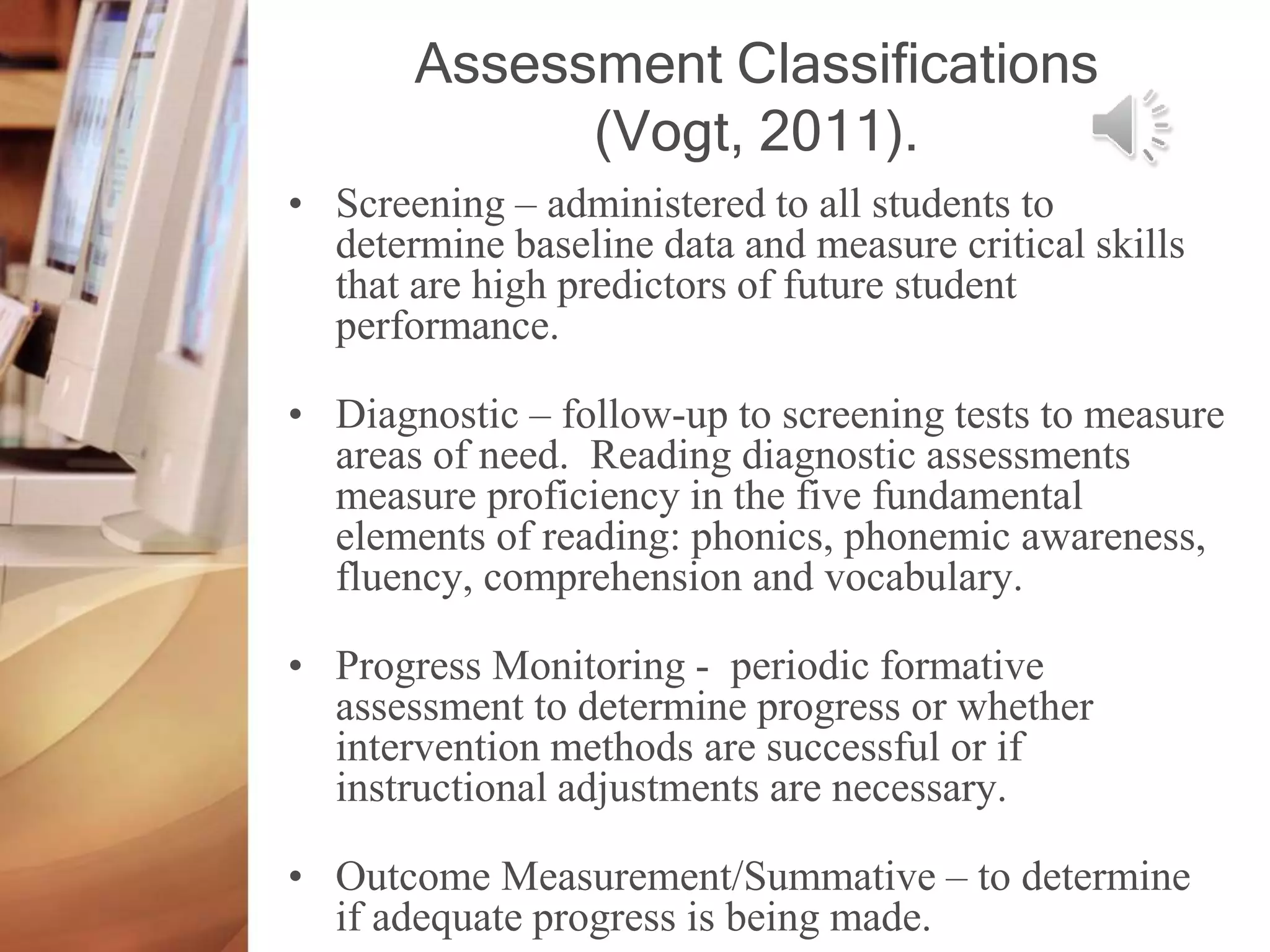
• Screening – administered to all students to 
determine baseline data and measure critical skills 
that are high predictors of future student 
performance. 
• Diagnostic – follow-up to screening tests to measure 
areas of need. Reading diagnostic assessments 
measure proficiency in the five fundamental 
elements of reading: phonics, phonemic awareness, 
fluency, comprehension and vocabulary. 
• Progress Monitoring - periodic formative 
assessment to determine progress or whether 
intervention methods are successful or if 
instructional adjustments are necessary. 
• Outcome Measurement/Summative – to determine 
if adequate progress is being made.
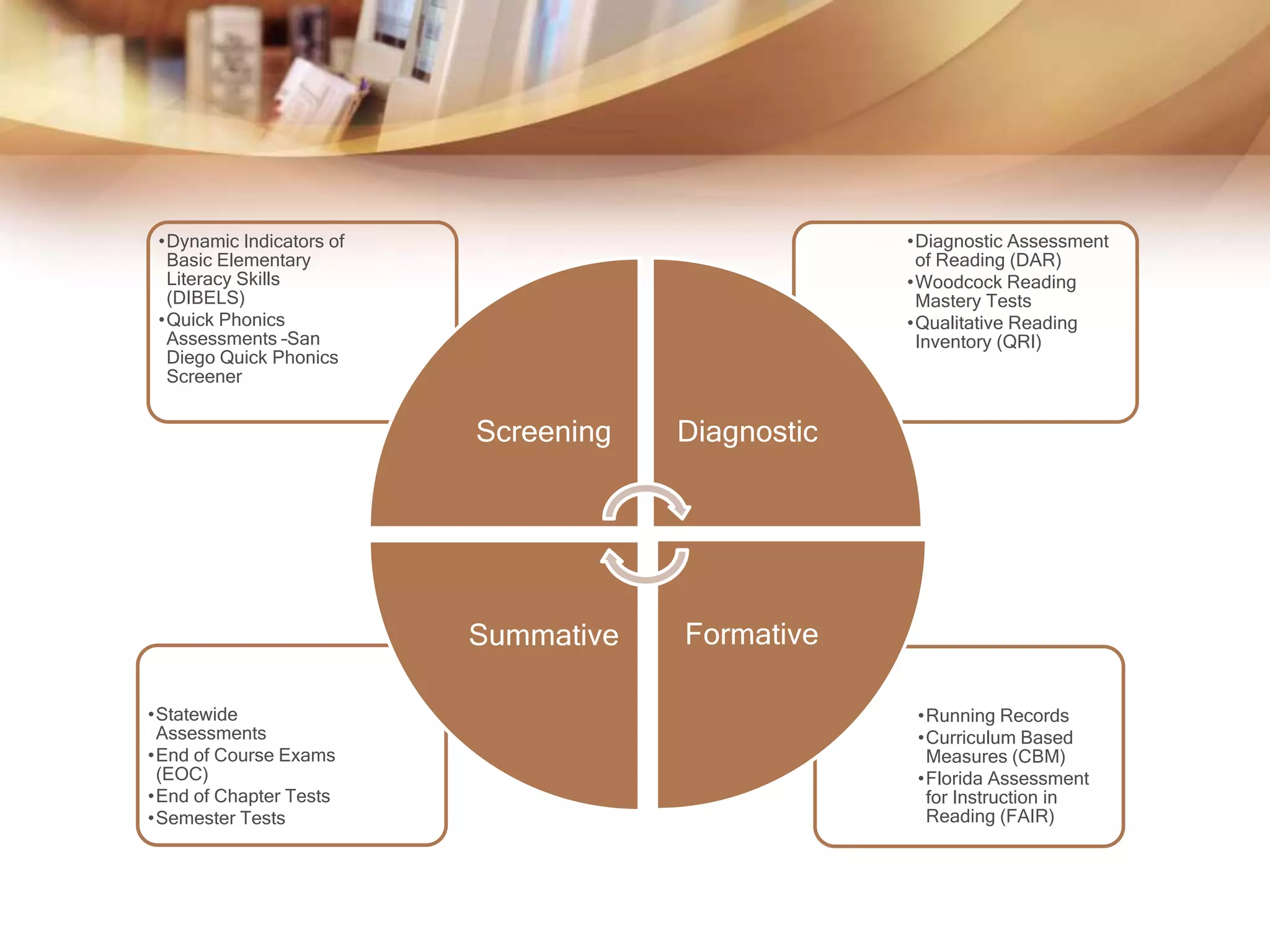
•Running Records 
•Curriculum Based 
Measures (CBM) 
•Florida Assessment 
for Instruction in 
Reading (FAIR) 
•Statewide 
Assessments 
•End of Course Exams 
(EOC) 
•End of Chapter Tests 
•Semester Tests 
•Diagnostic Assessment 
of Reading (DAR) 
•Woodcock Reading 
Mastery Tests 
•Qualitative Reading 
Inventory (QRI) 
•Dynamic Indicators of 
Basic Elementary 
Literacy Skills 
(DIBELS) 
•Quick Phonics 
Assessments –San 
Diego Quick Phonics 
Screener 
Screening Diagnostic 
Summative Formative
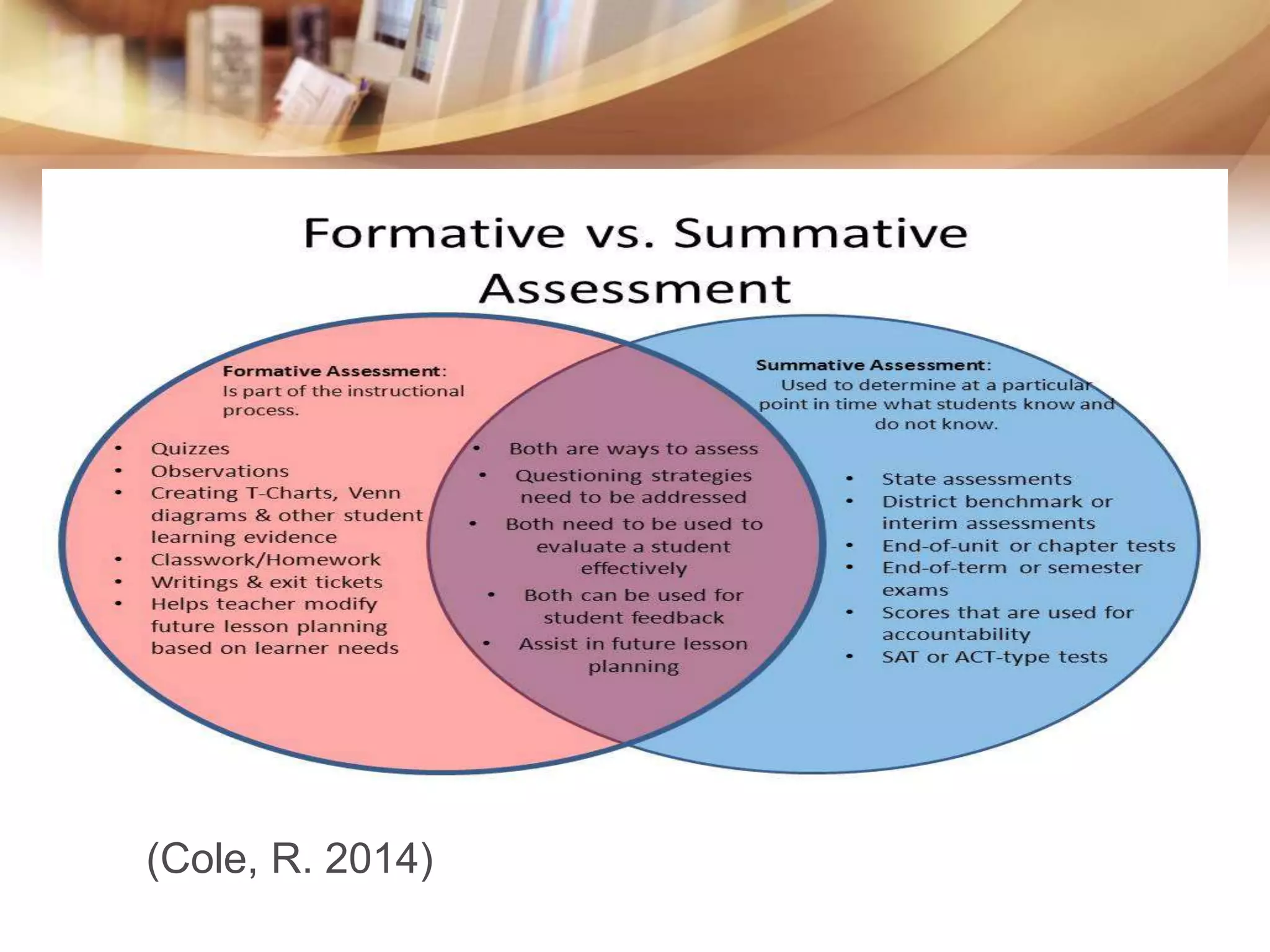
(Cole, R. 2014)
Print master 
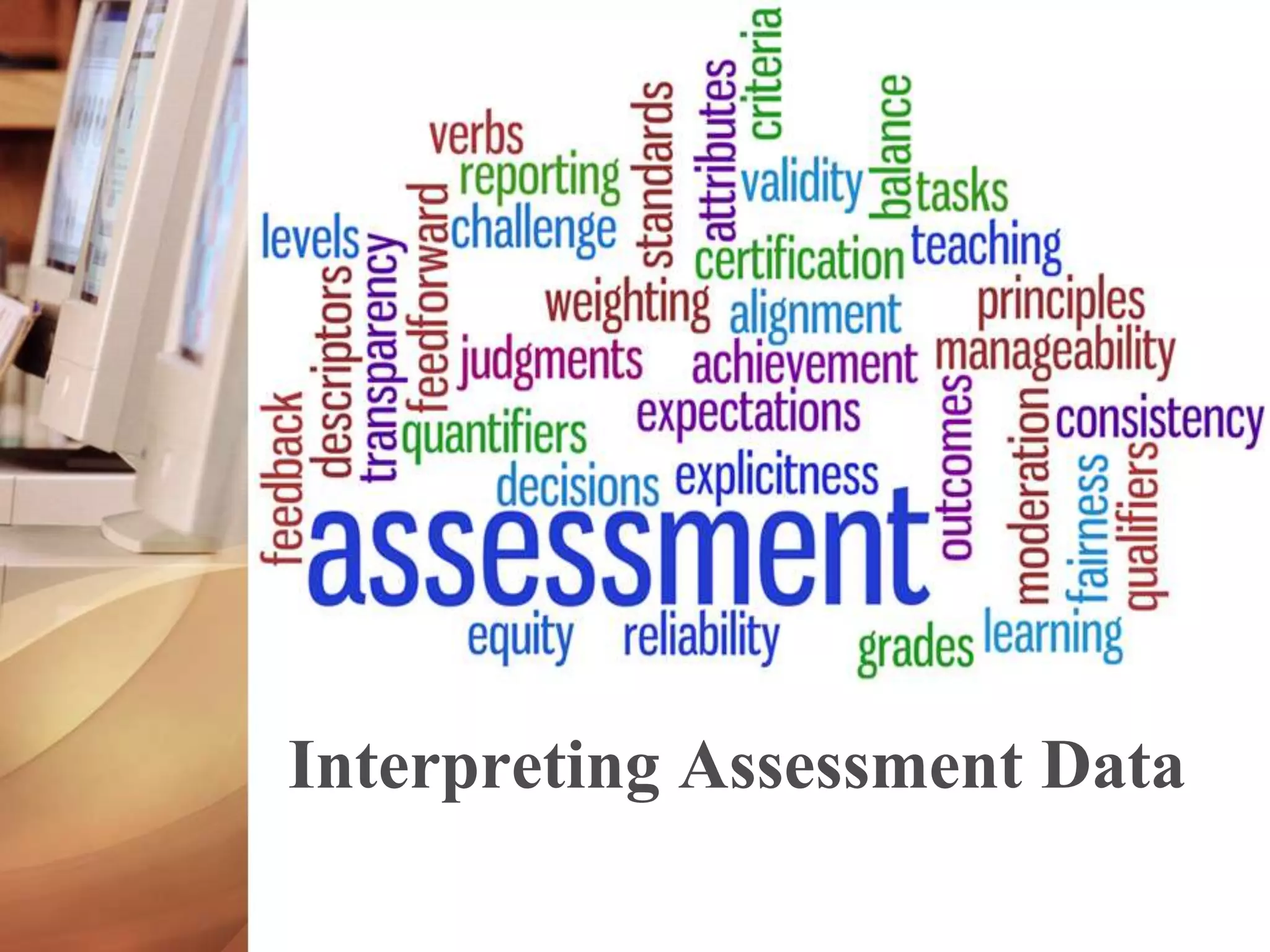
Interpreting Assessment Data
Criterion-Referenced Tests 
Criterion-Referenced Tests (CRT) measure 
students’ performance against standards or 
key benchmarks that students are 
expected to perform (Gunning, 2014, p. 
68). These tests are used to measure 
ability to perform overtime, and are used to 
drive instruction. A teacher will use 
assessment data to determine present 
levels of performance and prior knowledge; 
plan instruction and measure gains; 
compare student’s individual performance 
with the class, school, and district, or larger 
population; and determine proficiency in 
meeting the required standards. Scores 
are shown as raw score, percentile, or 
achievement level.
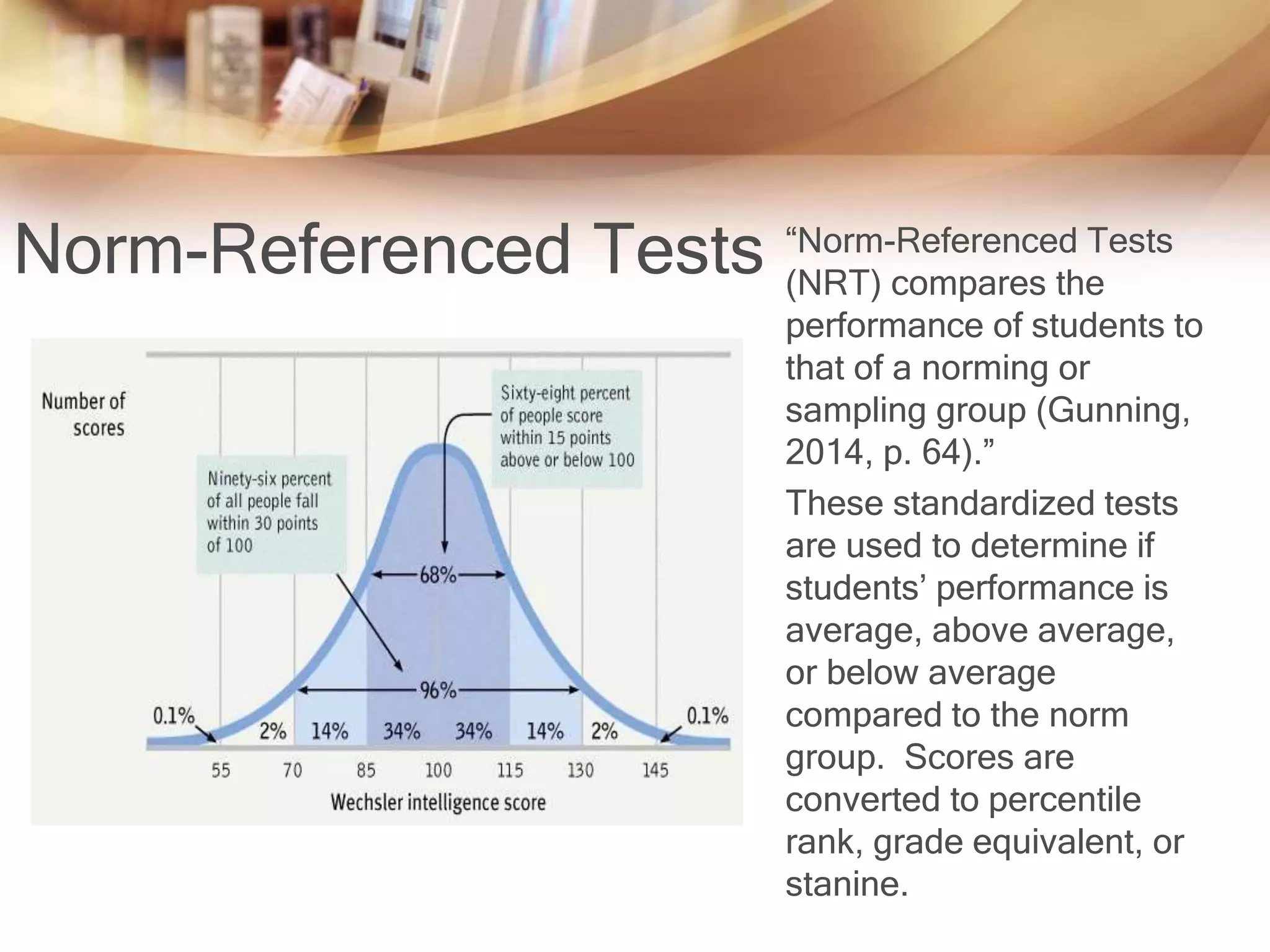
Norm-Referenced Tests “Norm-Referenced Tests 
(NRT) compares the 
performance of students to 
that of a norming or 
sampling group (Gunning, 
2014, p. 64).” 
These standardized tests 
are used to determine if 
students’ performance is 
average, above average, 
or below average 
compared to the norm 
group. Scores are 
converted to percentile 
rank, grade equivalent, or 
stanine.
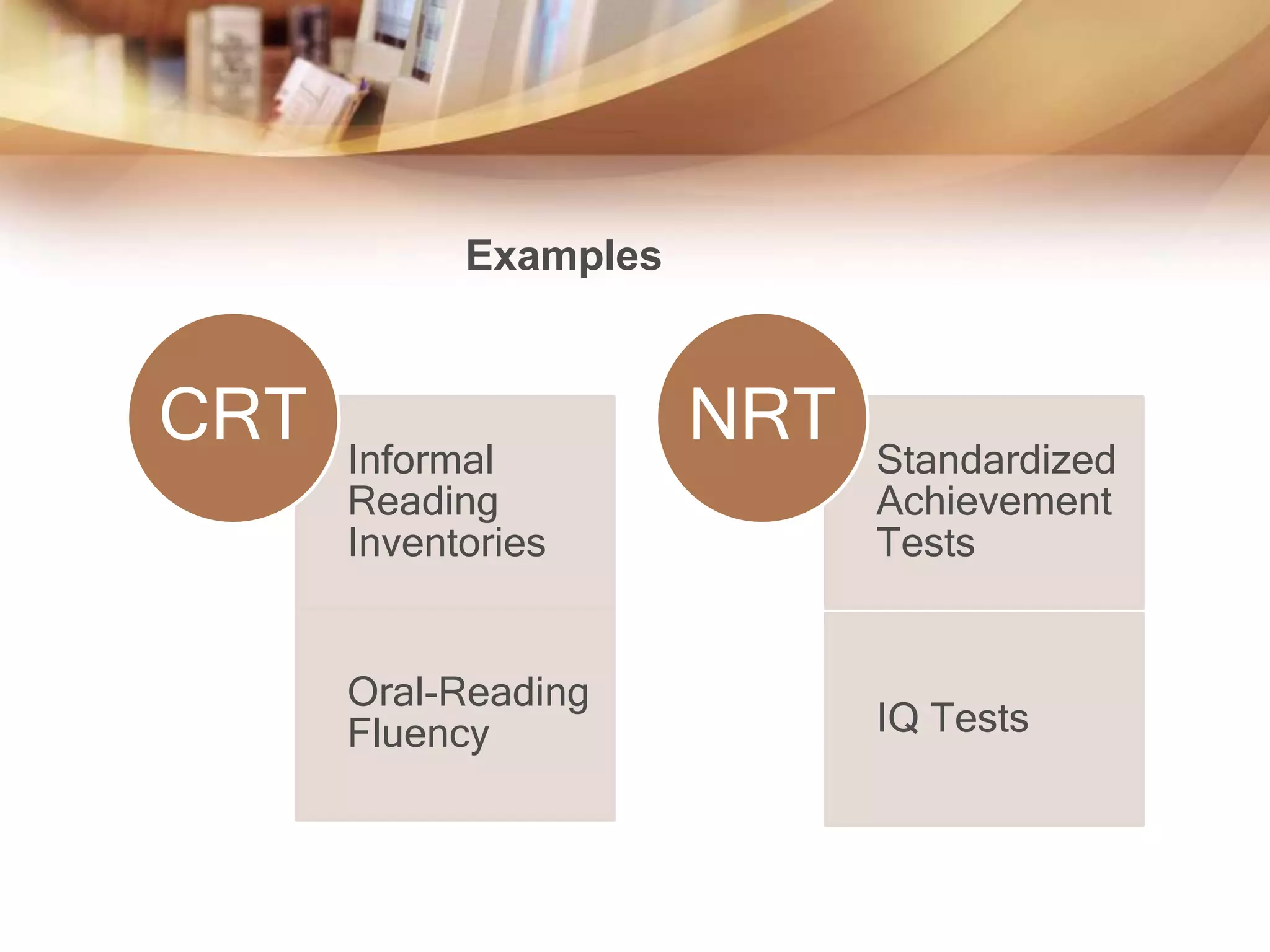
Informal 
Reading 
Inventories 
Oral-Reading 
Fluency 
CRT 
Standardized 
Achievement 
Tests 
IQ Tests 
NRT 
Examples
Reliability and Validity 
• Reliability and validity are important to maintain 
integrity in data that is used to make educational 
decisions like grades, placement, extra support 
services needed, and to drive instructional needs. 
• Having reliable and valid data makes it more 
comparable from person to person and from year 
to year. 
• If a test is valid it is” almost always reliable, the 
validity inferred from the assessments is essential 
-- even more crucial than the reliability” (USF, 
n.d., para 5).
• Reliability refers to the consistency in which an assessment 
delivers similar results assuming it was given to the same 
person or group again (Gunning, 2014). This means if two 
observers were using the same rubric or guidelines to 
observe or review the same student they would come to 
similar results. The values for reliability coefficients range 
from 0 to 1.0. “Generally, if the reliability of a standardized 
test is above .80, it is said to have very good reliability; if it is 
below .50, it would not be considered a very reliable test” 
(USF, n.d., para. 4). 
• Validity is the degree in which the assessment measures 
what it intends to measure and the degree to which the 
results can be used to make educational decisions 
(Gunning, 2014). This means that the assessment tests the 
material or strategy that was taught in a similar context.
References 
Assessment Bubble Clip Art (2014). Education assessment and evaluation, Latin 
American Educational Services. Retrieved from: 
http://www.latinamericaneducationalservices.com/images/educational_assessment_header.jpg 
Assessment Wordle. Retrieved from: http://www.teaching-learning.utas.edu.au/assessment/how-to-implement- 
cra 
Cole, R, (2014). EDTC 614 Integrating Technology: Formative vs. summative assessments.Retrieved 
from: http://kingcolemedia.com/wp-content/ 
uploads/2014/04/ColeR_LT6_VennDiagramFormativeSummativeAssessmentsJPEG.jpg 
Gunning, T.G. (2014), Assessing and correcting reading and writing difficulties, 4th ed., Pearson 
Education, Inc., Boston, MA. 
School Teaching PowerPoint Template. Retrieved from: 
http://www.freeppt.net/download-template/school-teaching-study-373.html 
USF (n.d.). Classroom Assessment: Basic Concepts. Pinellas County School District and Florida Center 
for Instructional Technology at University of South Florida. 
Retrieved from: http://fcit.usf.edu/assessment/basic/basicc.html 
Vogt, M. & Shearer, B. (2011). Reading specialists and literacy coaches in the real world. Boston, 
MA: Pearson. 
Wechsler Intelligence Score Bell Curve Image. Retrieved from: http://www.bing.com/images/

Types of assessments

  • 1.
    Types of Assessments Elizabeth E. Walsh, Saint Leo University
  • 2.
    Assessment Classifications (Vogt,2011). • Screening – administered to all students to determine baseline data and measure critical skills that are high predictors of future student performance. • Diagnostic – follow-up to screening tests to measure areas of need. Reading diagnostic assessments measure proficiency in the five fundamental elements of reading: phonics, phonemic awareness, fluency, comprehension and vocabulary. • Progress Monitoring - periodic formative assessment to determine progress or whether intervention methods are successful or if instructional adjustments are necessary. • Outcome Measurement/Summative – to determine if adequate progress is being made.
  • 3.
    •Running Records •CurriculumBased Measures (CBM) •Florida Assessment for Instruction in Reading (FAIR) •Statewide Assessments •End of Course Exams (EOC) •End of Chapter Tests •Semester Tests •Diagnostic Assessment of Reading (DAR) •Woodcock Reading Mastery Tests •Qualitative Reading Inventory (QRI) •Dynamic Indicators of Basic Elementary Literacy Skills (DIBELS) •Quick Phonics Assessments –San Diego Quick Phonics Screener Screening Diagnostic Summative Formative
  • 4.
  • 5.
  • 6.
    Criterion-Referenced Tests Criterion-ReferencedTests (CRT) measure students’ performance against standards or key benchmarks that students are expected to perform (Gunning, 2014, p. 68). These tests are used to measure ability to perform overtime, and are used to drive instruction. A teacher will use assessment data to determine present levels of performance and prior knowledge; plan instruction and measure gains; compare student’s individual performance with the class, school, and district, or larger population; and determine proficiency in meeting the required standards. Scores are shown as raw score, percentile, or achievement level.
  • 7.
    Norm-Referenced Tests “Norm-ReferencedTests (NRT) compares the performance of students to that of a norming or sampling group (Gunning, 2014, p. 64).” These standardized tests are used to determine if students’ performance is average, above average, or below average compared to the norm group. Scores are converted to percentile rank, grade equivalent, or stanine.
  • 8.
    Informal Reading Inventories Oral-Reading Fluency CRT Standardized Achievement Tests IQ Tests NRT Examples
  • 9.
    Reliability and Validity • Reliability and validity are important to maintain integrity in data that is used to make educational decisions like grades, placement, extra support services needed, and to drive instructional needs. • Having reliable and valid data makes it more comparable from person to person and from year to year. • If a test is valid it is” almost always reliable, the validity inferred from the assessments is essential -- even more crucial than the reliability” (USF, n.d., para 5).
  • 10.
    • Reliability refersto the consistency in which an assessment delivers similar results assuming it was given to the same person or group again (Gunning, 2014). This means if two observers were using the same rubric or guidelines to observe or review the same student they would come to similar results. The values for reliability coefficients range from 0 to 1.0. “Generally, if the reliability of a standardized test is above .80, it is said to have very good reliability; if it is below .50, it would not be considered a very reliable test” (USF, n.d., para. 4). • Validity is the degree in which the assessment measures what it intends to measure and the degree to which the results can be used to make educational decisions (Gunning, 2014). This means that the assessment tests the material or strategy that was taught in a similar context.
  • 11.
    References Assessment BubbleClip Art (2014). Education assessment and evaluation, Latin American Educational Services. Retrieved from: http://www.latinamericaneducationalservices.com/images/educational_assessment_header.jpg Assessment Wordle. Retrieved from: http://www.teaching-learning.utas.edu.au/assessment/how-to-implement- cra Cole, R, (2014). EDTC 614 Integrating Technology: Formative vs. summative assessments.Retrieved from: http://kingcolemedia.com/wp-content/ uploads/2014/04/ColeR_LT6_VennDiagramFormativeSummativeAssessmentsJPEG.jpg Gunning, T.G. (2014), Assessing and correcting reading and writing difficulties, 4th ed., Pearson Education, Inc., Boston, MA. School Teaching PowerPoint Template. Retrieved from: http://www.freeppt.net/download-template/school-teaching-study-373.html USF (n.d.). Classroom Assessment: Basic Concepts. Pinellas County School District and Florida Center for Instructional Technology at University of South Florida. Retrieved from: http://fcit.usf.edu/assessment/basic/basicc.html Vogt, M. & Shearer, B. (2011). Reading specialists and literacy coaches in the real world. Boston, MA: Pearson. Wechsler Intelligence Score Bell Curve Image. Retrieved from: http://www.bing.com/images/