Measures – measuring diseases
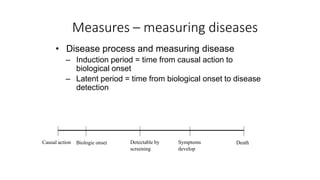
• Disease process and measuring disease
– Induction period = time from causal action to
biological onset
– Latent period = time from biological onset to disease
detection
Biologic onset Detectable by
screening
Symptoms
develop
DeathCausal action
Measures – measuring diseases
• Disease process and measuring disease
– Timing of disease process may differ between
individuals
– Timing of detection may differ between individuals
Biologic onset Detectable by
screening
Symptoms
develop
DeathCausal action
Measures – measuring diseases
Biologic onset Detectable by
screening
Symptoms
develop
DeathCausal action
Biologic onset
• Disease process and measuring disease
– Timing of disease process may differ between
individuals
Detectable by
screening
Symptoms
develop
Death
Causal action
A
B
JC: mention length bias
Measures – measuring diseases
• Disease process and measuring disease
– Timing of detection may differ between individuals
Biologic onset Detectable by
screening
Symptoms
develop
DeathCausal action
Biologic onset Detectable by
screening
Symptoms
develop
DeathCausal action
A
B
JC: mention lead time bias
Measures – measuring diseases
• Defining disease outcome for a study
– Have to consider underlying disease process and
potential variations in that process
– Have to consider how disease is being detected
• This will influence what your measure of
disease is capturing
Measures – measuring diseases
• Example: prevalence of cancer (proportion with
disease at a particular time) will miss cases of
aggressive cancers
Epidemiologic measures
• Prevalence vs. incidence
– Prevalence = proportion of the population with a
disease
– Incidence = frequency of development of new cases
of disease in a population
• New case is usually the first occurrence of a
disease for a non-diseased person
Epidemiologic measures
• Risk vs. rate
• Risk = the probability of developing disease over a
specified time period
– Population measure that is often interpreted at the individual
level
– Must specify the time period for the risk to be meaningfully
interpreted (X-year risk)
– Example: 10 year risk of mortality among men diagnosed with
prostate cancer is 0.1 or 1/10 men diagnosed with prostate
cancer die within 10 years
Epidemiologic measures
• Risk vs. rate
• Rate (average) = average change in disease status per
unit of time over a time period relative to the size of the
candidate population (incidence density)
• Example: There are 78 new cases of lyme disease per
100,000 population per year in CT (estimated in 2008)
• Interpreted at population level
• A rate, so time is in the denominator
Epidemiologic measures
• Risk vs. rate
• Rate (instantaneous) = the instantaneous potential for
change in disease status per unit of time at time t
relative to the size of the candidate (i.e., disease-free)
population at time t (hazard)
• The instantaneous rate (hazard) of lyme disease on
August 31, 2008 in CT is ?
– Instantaneous rates cannot be directly calculated from
epidemiologic data because they are defined for an infinitely
small time interval
– We can estimate average rates for smaller time intervals when
we have sufficient data

1.5.2 measures measuring disease

  • 1.
    Measures – measuringdiseases • Disease process and measuring disease – Induction period = time from causal action to biological onset – Latent period = time from biological onset to disease detection Biologic onset Detectable by screening Symptoms develop DeathCausal action
  • 2.
    Measures – measuringdiseases • Disease process and measuring disease – Timing of disease process may differ between individuals – Timing of detection may differ between individuals Biologic onset Detectable by screening Symptoms develop DeathCausal action
  • 3.
    Measures – measuringdiseases Biologic onset Detectable by screening Symptoms develop DeathCausal action Biologic onset • Disease process and measuring disease – Timing of disease process may differ between individuals Detectable by screening Symptoms develop Death Causal action A B JC: mention length bias
  • 4.
    Measures – measuringdiseases • Disease process and measuring disease – Timing of detection may differ between individuals Biologic onset Detectable by screening Symptoms develop DeathCausal action Biologic onset Detectable by screening Symptoms develop DeathCausal action A B JC: mention lead time bias
  • 5.
    Measures – measuringdiseases • Defining disease outcome for a study – Have to consider underlying disease process and potential variations in that process – Have to consider how disease is being detected • This will influence what your measure of disease is capturing
  • 6.
    Measures – measuringdiseases • Example: prevalence of cancer (proportion with disease at a particular time) will miss cases of aggressive cancers
  • 7.
    Epidemiologic measures • Prevalencevs. incidence – Prevalence = proportion of the population with a disease – Incidence = frequency of development of new cases of disease in a population • New case is usually the first occurrence of a disease for a non-diseased person
  • 8.
    Epidemiologic measures • Riskvs. rate • Risk = the probability of developing disease over a specified time period – Population measure that is often interpreted at the individual level – Must specify the time period for the risk to be meaningfully interpreted (X-year risk) – Example: 10 year risk of mortality among men diagnosed with prostate cancer is 0.1 or 1/10 men diagnosed with prostate cancer die within 10 years
  • 9.
    Epidemiologic measures • Riskvs. rate • Rate (average) = average change in disease status per unit of time over a time period relative to the size of the candidate population (incidence density) • Example: There are 78 new cases of lyme disease per 100,000 population per year in CT (estimated in 2008) • Interpreted at population level • A rate, so time is in the denominator
  • 10.
    Epidemiologic measures • Riskvs. rate • Rate (instantaneous) = the instantaneous potential for change in disease status per unit of time at time t relative to the size of the candidate (i.e., disease-free) population at time t (hazard) • The instantaneous rate (hazard) of lyme disease on August 31, 2008 in CT is ? – Instantaneous rates cannot be directly calculated from epidemiologic data because they are defined for an infinitely small time interval – We can estimate average rates for smaller time intervals when we have sufficient data