STATISTICS
for
ANALYTICS
B Y -
DEEPIKA GUPTA
What is ANALYTICS?
•A Process of
•finding Information from
•Data to make a
•Decision and
•subsequently Act on it
EXAMPLE
(Simple)
Decision Required:
Suppose you are a captain of Indian Cricket Team and you have to decide whether to
includeYuvraaj Singh or Shikhar Dhawan in the team for the next match…
Data:
You have the runs scored by both in last 10 matches
Information:
Calculate average score of both the players
Action:
Choose the player who has better average
EXAMPLE
(Difficult)
Problem:
Finding out the chances of a customer clicking on specific advertisement
online, based on the data of his browsing history in past one year.
In this,
Your data is big data and your analysis tools will change, you might require
machine learning algorithms like Naive-Bayes to find answer of this problem.
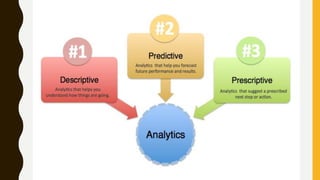
ANALYTICS includes
•Descriptive Models
•Predictive Models &
•Prescriptive Models
DESCRIPTIVE Analytics
•Use data aggregation and data mining to
provide insight into the past and answer:
“What has happened?”
PREDICTIVE Analytics
•Use statistical models and forecasts
techniques to understand the future and
answer:
“What could happen?”
PRESCRIPTIVE Analytics
•Use optimization and simulation
algorithms to advice on possible
outcomes and answer:
“What should we do?”
Difference between DATA ANALYSIS, DATA
ANALYTICS, DATA MINING, MACHINE LEARNING, BIG
DATA & DATA SCIENCE
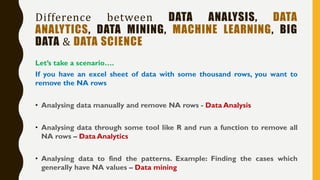
Let’s take a scenario….
If you have an excel sheet of data with some thousand rows, you want to
remove the NA rows
• Analysing data manually and remove NA rows - Data Analysis
• Analysing data through some tool like R and run a function to remove all
NA rows – Data Analytics
• Analysing data to find the patterns. Example: Finding the cases which
generally have NA values – Data mining
• Using an algorithm to analyse data. Example: Run a K-means clustering
algorithm to cluster the NA records together – Machine Learning
• If you have the excel sheet containing millions of records which your tools
like excel, R etc can not handle – Big Data
• Mother of all, where small to huge data can be analysed by using multiple
platforms like R, Hadoop, Machine Learning etc – Data Science
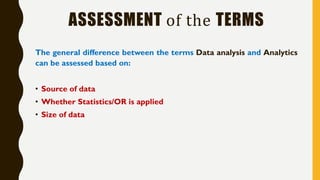
ASSESSMENT of the TERMS
The general difference between the terms Data analysis and Analytics
can be assessed based on:
• Source of data
• Whether Statistics/OR is applied
• Size of data
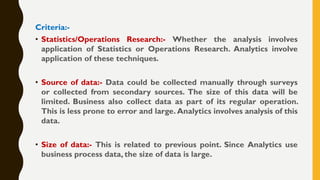
Criteria:-
• Statistics/Operations Research:- Whether the analysis involves
application of Statistics or Operations Research. Analytics involve
application of these techniques.
• Source of data:- Data could be collected manually through surveys
or collected from secondary sources. The size of this data will be
limited. Business also collect data as part of its regular operation.
This is less prone to error and large. Analytics involves analysis of this
data.
• Size of data:- This is related to previous point. Since Analytics use
business process data, the size of data is large.
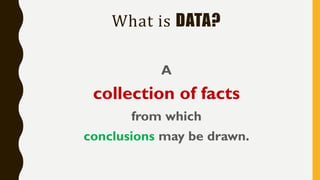
What is DATA?
A
collection of facts
from which
conclusions may be drawn.
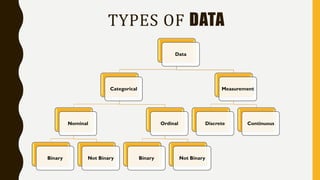
TYPES OF DATA
Data
Categorical
Nominal
Binary Not Binary
Ordinal
Binary Not Binary
Measurement
Discrete Continuous
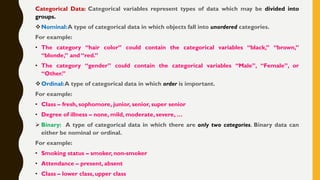
Categorical Data: Categorical variables represent types of data which may be divided into
groups.
❖Nominal:A type of categorical data in which objects fall into unordered categories.
For example:
• The category “hair color” could contain the categorical variables “black,” “brown,”
“blonde,” and “red.”
• The category “gender” could contain the categorical variables “Male”, “Female”, or
“Other.”
❖Ordinal:A type of categorical data in which order is important.
For example:
• Class – fresh, sophomore, junior, senior, super senior
• Degree of illness – none, mild, moderate, severe, …
➢ Binary: A type of categorical data in which there are only two categories. Binary data can
either be nominal or ordinal.
For example:
• Smoking status – smoker, non-smoker
• Attendance – present, absent
• Class – lower class, upper class
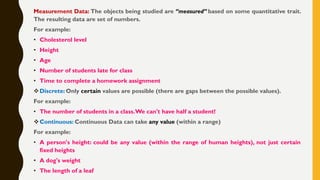
Measurement Data: The objects being studied are “measured” based on some quantitative trait.
The resulting data are set of numbers.
For example:
• Cholesterol level
• Height
• Age
• Number of students late for class
• Time to complete a homework assignment
❖Discrete: Only certain values are possible (there are gaps between the possible values).
For example:
• The number of students in a class.We can't have half a student!
❖Continuous: Continuous Data can take any value (within a range)
For example:
• A person's height: could be any value (within the range of human heights), not just certain
fixed heights
• A dog's weight
• The length of a leaf
WHO CARES?The type(s) of data
collected
in a study
determine the type of
statistical analysis
used.
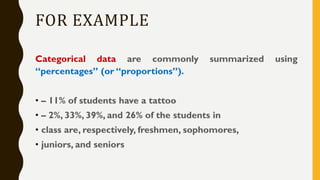
FOR EXAMPLE
Categorical data are commonly summarized using
“percentages” (or “proportions”).
• – 11% of students have a tattoo
• – 2%, 33%, 39%, and 26% of the students in
• class are, respectively, freshmen, sophomores,
• juniors, and seniors
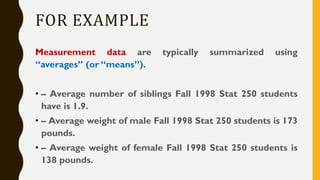
FOR EXAMPLE
Measurement data are typically summarized using
“averages” (or “means”).
• – Average number of siblings Fall 1998 Stat 250 students
have is 1.9.
• – Average weight of male Fall 1998 Stat 250 students is 173
pounds.
• – Average weight of female Fall 1998 Stat 250 students is
138 pounds.
STATISTICS
Statistics is a collection of
mathematical techniques that help
to analyze and present data.
NORMAL
DISTRIBUTION
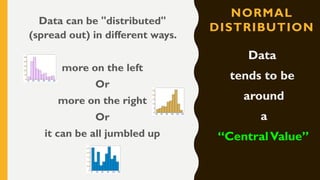
Data can be "distributed"
(spread out) in different ways.
more on the left
Or
more on the right
Or
it can be all jumbled up
Data
tends to be
around
a
“CentralValue”
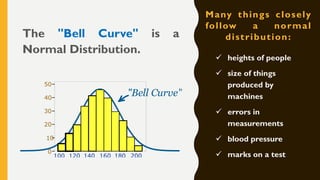
Many things closely
follow a normal
distribution:The "Bell Curve" is a
Normal Distribution.
✓ heights of people
✓ size of things
produced by
machines
✓ errors in
measurements
✓ blood pressure
✓ marks on a test
We say the data is
"NORMALLY DISTRIBUTED":
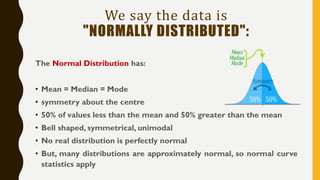
The Normal Distribution has:
• Mean = Median = Mode
• symmetry about the centre
• 50% of values less than the mean and 50% greater than the mean
• Bell shaped, symmetrical, unimodal
• No real distribution is perfectly normal
• But, many distributions are approximately normal, so normal curve
statistics apply
THE STANDARD NORMAL DISTRIBUTION
❖A normal distribution with the added properties
that mean = 0 and the SD = 1
❖Converting a distribution into a standard normal
means converting raw scores into Z-scores
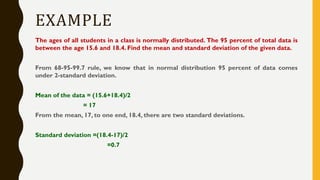
EXAMPLE
The ages of all students in a class is normally distributed. The 95 percent of total data is
between the age 15.6 and 18.4. Find the mean and standard deviation of the given data.
From 68-95-99.7 rule, we know that in normal distribution 95 percent of data comes
under 2-standard deviation.
Mean of the data = (15.6+18.4)/2
= 17
From the mean, 17, to one end, 18.4, there are two standard deviations.
Standard deviation =(18.4-17)/2
=0.7
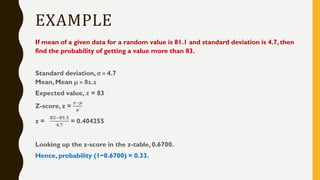
EXAMPLE
If mean of a given data for a random value is 81.1 and standard deviation is 4.7, then
find the probability of getting a value more than 83.
Standard deviation, σ = 4.7
Mean, Mean μ = 81.1
Expected value, 𝒙 = 83
Z-score, z =
𝒙−𝝁
𝝈
z =
𝟖𝟑−𝟖𝟏.𝟏
𝟒.𝟕
= 0.404255
Looking up the z-score in the z-table, 0.6700.
Hence, probability (1−0.6700) = 0.33.
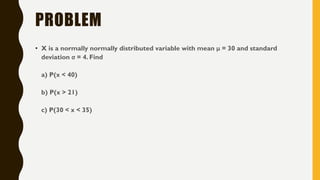
PROBLEM
• X is a normally normally distributed variable with mean μ = 30 and standard
deviation σ = 4. Find
a) P(x < 40)
b) P(x > 21)
c) P(30 < x < 35)
SOLUTION
• Note:What is meant here by area is the area under the standard normal curve.
a) For x = 40, the z-value z = (40 - 30) / 4 = 2.5
Hence P(x < 40) = P(z < 2.5) = [area to the left of 2.5] = 0.9938
b) For x = 21, z = (21 - 30) / 4 = -2.25
Hence P(x > 21) = P(z > -2.25) = [total area] - [area to the left of -2.25]
= 1 - 0.0122 = 0.9878
c) For x = 30 , z = (30 - 30) / 4 = 0 and for x = 35, z = (35 - 30) / 4 = 1.25
Hence P(30 < x < 35) = P(0 < z < 1.25) = [area to the left of z = 1.25] - [area to the left
of 0]
= 0.8944 - 0.5 = 0.3944
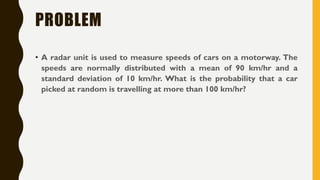
PROBLEM
• A radar unit is used to measure speeds of cars on a motorway. The
speeds are normally distributed with a mean of 90 km/hr and a
standard deviation of 10 km/hr. What is the probability that a car
picked at random is travelling at more than 100 km/hr?
SOLUTION
• Let x be the random variable that represents the speed of cars. x has μ = 90 and σ
= 10.We have to find the probability that x is higher than 100 or P(x > 100)
For x = 100 , z = (100 - 90) / 10 = 1
P(x > 90) = P(z >, 1) = [total area] - [area to the left of z = 1]
= 1 - 0.8413 = 0.1587
The probability that a car selected at a random has a speed greater than 100
km/hr is equal to 0.1587
PROBLEM
• For a certain type of computers, the length of time bewteen charges
of the battery is normally distributed with a mean of 50 hours and a
standard deviation of 15 hours. John owns one of these computers
and wants to know the probability that the length of time will be
between 50 and 70 hours.
SOLUTION
• Let x be the random variable that represents the length of time. It has a mean of 50
and a standard deviation of 15.We have to find the probability that x is between 50 and
70 or P( 50< x < 70)
For x = 50 , z = (50 - 50) / 15 = 0
For x = 70 , z = (70 - 50) / 15 = 1.33 (rounded to 2 decimal places)
P( 50< x < 70) = P( 0< z < 1.33) = [area to the left of z = 1.33] - [area to the left of z =
0]
= 0.9082 - 0.5 = 0.4082
The probability that John's computer has a length of time between 50 and 70 hours is
equal to 0.4082.
BINOMIAL
DISTRIBUTION
About things
with
Two
results
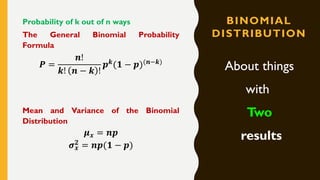
Probability of k out of n ways
The General Binomial Probability
Formula
𝑷 =
𝒏!
𝒌! 𝒏 − 𝒌 !
𝒑 𝒌(𝟏 − 𝒑)(𝒏−𝒌)
Mean and Variance of the Binomial
Distribution
𝝁 𝒙 = 𝒏𝒑
𝝈 𝒙
𝟐
= 𝒏𝒑(𝟏 − 𝒑)
EXAMPLE
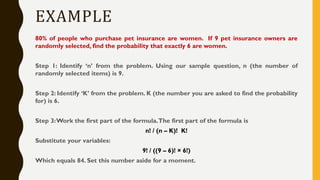
80% of people who purchase pet insurance are women. If 9 pet insurance owners are
randomly selected, find the probability that exactly 6 are women.
Step 1: Identify ‘n’ from the problem. Using our sample question, n (the number of
randomly selected items) is 9.
Step 2: Identify ‘K’ from the problem. K (the number you are asked to find the probability
for) is 6.
Step 3:Work the first part of the formula.The first part of the formula is
n! / (n – K)! K!
Substitute your variables:
9! / ((9 – 6)! × 6!)
Which equals 84. Set this number aside for a moment.
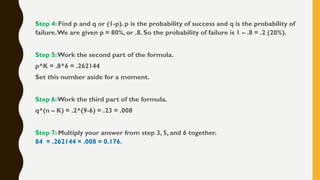
Step 4: Find p and q or (1-p). p is the probability of success and q is the probability of
failure.We are given p = 80%, or .8. So the probability of failure is 1 – .8 = .2 (20%).
Step 5:Work the second part of the formula.
p^K = .8^6 = .262144
Set this number aside for a moment.
Step 6:Work the third part of the formula.
q^(n – K) = .2^(9-6) = .23 = .008
Step 7: Multiply your answer from step 3, 5, and 6 together.
84 × .262144 × .008 = 0.176.
POISSON
DISTRIBUTIONCalculating the Poisson Distribution
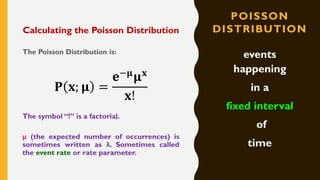
The Poisson Distribution is:
𝐏 𝐱; 𝛍 =
𝐞−𝛍
𝛍 𝐱
𝐱!
The symbol “!” is a factorial.
μ (the expected number of occurrences) is
sometimes written as λ. Sometimes called
the event rate or rate parameter.
events
happening
in a
fixed interval
of
time
POISSON CHARACTERISTICS
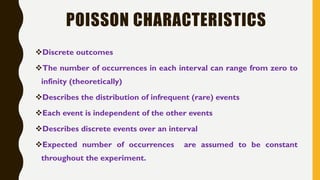
❖Discrete outcomes
❖The number of occurrences in each interval can range from zero to
infinity (theoretically)
❖Describes the distribution of infrequent (rare) events
❖Each event is independent of the other events
❖Describes discrete events over an interval
❖Expected number of occurrences are assumed to be constant
throughout the experiment.
EXAMPLE
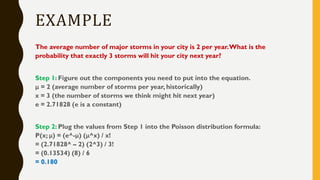
The average number of major storms in your city is 2 per year.What is the
probability that exactly 3 storms will hit your city next year?
Step 1: Figure out the components you need to put into the equation.
μ = 2 (average number of storms per year, historically)
x = 3 (the number of storms we think might hit next year)
e = 2.71828 (e is a constant)
Step 2: Plug the values from Step 1 into the Poisson distribution formula:
P(x; μ) = (e^-μ) (μ^x) / x!
= (2.71828^ – 2) (2^3) / 3!
= (0.13534) (8) / 6
= 0.180
MEANMathematically,
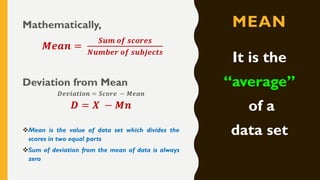
𝑴𝒆𝒂𝒏 =
𝑺𝒖𝒎 𝒐𝒇 𝒔𝒄𝒐𝒓𝒆𝒔
𝑵𝒖𝒎𝒃𝒆𝒓 𝒐𝒇 𝒔𝒖𝒃𝒋𝒆𝒄𝒕𝒔
Deviation from Mean
𝑫𝒆𝒗𝒊𝒂𝒕𝒊𝒐𝒏 = 𝑺𝒄𝒐𝒓𝒆 − 𝑴𝒆𝒂𝒏
𝑫 = 𝑿 − 𝑴𝒏
❖Mean is the value of data set which divides the
scores in two equal parts
❖Sum of deviation from the mean of data is always
zero
It is the
“average”
of a
data set
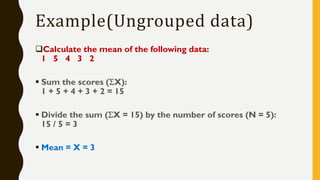
Example(Ungrouped data)
Calculate the mean of the following data:
1 5 4 3 2
▪ Sum the scores (X):
1 + 5 + 4 + 3 + 2 = 15
▪ Divide the sum (X = 15) by the number of scores (N = 5):
15 / 5 = 3
▪ Mean = X = 3
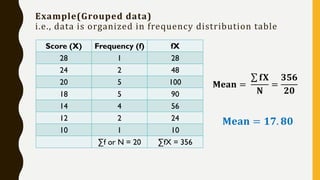
Example(Grouped data)
i.e., data is organized in frequency distribution table
Score (X) Frequency (f) fX
28 1 28
24 2 48
20 5 100
18 5 90
14 4 56
12 2 24
10 1 10
∑f or N = 20 ∑fX = 356
𝐌𝐞𝐚𝐧 =
σ 𝐟𝐗
𝐍
=
𝟑𝟓𝟔
𝟐𝟎
𝐌𝐞𝐚𝐧 = 𝟏𝟕. 𝟖𝟎
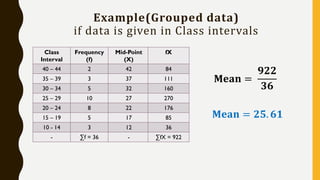
Example(Grouped data)
if data is given in Class intervals
Class
Interval
Frequency
(f)
40 – 44 2
35 – 39 3
30 – 34 5
25 – 29 10
20 – 24 8
15 – 19 5
10 - 14 3
- ∑f = 36
Mid-Point
(X)
42
37
32
27
22
17
12
-
fX
84
111
160
270
176
85
36
∑fX = 922
𝐌𝐞𝐚𝐧 =
𝟗𝟐𝟐
𝟑𝟔
𝐌𝐞𝐚𝐧 = 𝟐𝟓. 𝟔𝟏
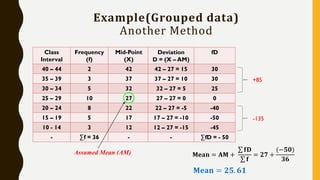
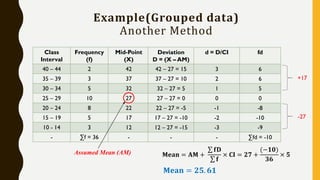
Example(Grouped data)
Another Method
Class
Interval
Frequency
(f)
40 – 44 2
35 – 39 3
30 – 34 5
25 – 29 10
20 – 24 8
15 – 19 5
10 - 14 3
- ∑f = 36
Mid-Point
(X)
42
37
32
27
22
17
12
-
Deviation
D = (X – AM)
42 – 27 = 15
37 – 27 = 10
32 – 27 = 5
27 – 27 = 0
22 – 27 = -5
17 – 27 = -10
12 – 27 = -15
-
fD
30
30
25
0
-40
-50
-45
∑fD = - 50
Assumed Mean (AM)
+85
-135
𝐌𝐞𝐚𝐧 = 𝐀𝐌 +
σ 𝐟𝐃
σ 𝐟
= 𝟐𝟕 +
(−𝟓𝟎)
𝟑𝟔
𝐌𝐞𝐚𝐧 = 𝟐𝟓. 𝟔𝟏
Example(Grouped data)
Another Method
Class
Interval
Frequency
(f)
40 – 44 2
35 – 39 3
30 – 34 5
25 – 29 10
20 – 24 8
15 – 19 5
10 - 14 3
- ∑f = 36
Mid-Point
(X)
42
37
32
27
22
17
12
-
Deviation
D = (X – AM)
42 – 27 = 15
37 – 27 = 10
32 – 27 = 5
27 – 27 = 0
22 – 27 = -5
17 – 27 = -10
12 – 27 = -15
-
d = D/CI
3
2
1
0
-1
-2
-3
-
fd
6
6
5
0
-8
-10
-9
∑fd = -10
Assumed Mean (AM)
+17
-27
𝐌𝐞𝐚𝐧 = 𝐀𝐌 +
σ 𝐟𝐃
σ 𝐟
× 𝐂𝐈 = 𝟐𝟕 +
(−𝟏𝟎)
𝟑𝟔
× 𝟓
𝐌𝐞𝐚𝐧 = 𝟐𝟓. 𝟔𝟏
MEDIAN❖‘Median’ is point on a scale such
that half the scores falls above it
and half the scores falls below it.
❖To find the Median, place the
numbers in value order and find
the middle.
❖The median is not as sensitive to
extreme values as the mean.
“Middle”
of a
sorted list
of
numbers.
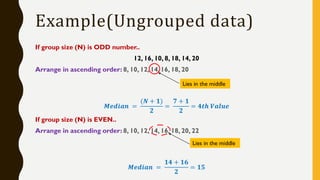
If group size (N) is ODD number..
12, 16, 10, 8, 18, 14, 20
Arrange in ascending order: 8, 10, 12, 14, 16, 18, 20
𝑴𝒆𝒅𝒊𝒂𝒏 =
(𝑵 + 𝟏)
𝟐
=
𝟕 + 𝟏
𝟐
= 𝟒𝒕𝒉 𝑽𝒂𝒍𝒖𝒆
If group size (N) is EVEN..
Arrange in ascending order: 8, 10, 12, 14, 16, 18, 20, 22
𝑴𝒆𝒅𝒊𝒂𝒏 =
𝟏𝟒 + 𝟏𝟔
𝟐
= 𝟏𝟓
Example(Ungrouped data)
Lies in the middle
Lies in the middle
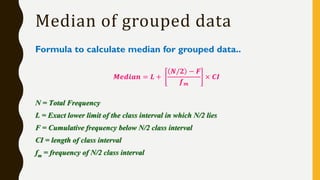
Formula to calculate median for grouped data..
𝑴𝒆𝒅𝒊𝒂𝒏 = 𝑳 +
𝑵/𝟐 − 𝑭
𝒇 𝒎
× 𝑪𝑰
N = Total Frequency
L = Exact lower limit of the class interval in which N/2 lies
F = Cumulative frequency below N/2 class interval
CI = length of class interval
fm = frequency of N/2 class interval
Median of grouped data
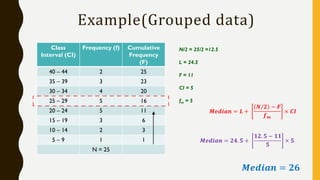
Example(Grouped data)
Class
Interval (CI)
Frequency (f) Cumulative
Frequency
(F)
40 – 44 2 25
35 – 39 3 23
30 – 34 4 20
25 – 29 5 16
20 – 24 5 11
15 – 19 3 6
10 – 14 2 3
5 – 9 1 1
N = 25
N/2 = 25/2 =12.5
L = 24.5
F = 11
CI = 5
fm = 5
𝑴𝒆𝒅𝒊𝒂𝒏 = 𝑳 +
𝑵/𝟐 − 𝑭
𝒇 𝒎
× 𝑪𝑰
𝑴𝒆𝒅𝒊𝒂𝒏 = 𝟐𝟒. 𝟓 +
𝟏𝟐. 𝟓 − 𝟏𝟏
𝟓
× 𝟓
𝑴𝒆𝒅𝒊𝒂𝒏 = 𝟐𝟔
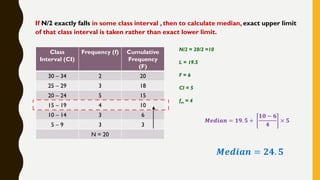
If N/2 exactly falls in some class interval , then to calculate median, exact upper limit
of that class interval is taken rather than exact lower limit.
Class
Interval (CI)
Frequency (f) Cumulative
Frequency
(F)
30 – 34 2 20
25 – 29 3 18
20 – 24 5 15
15 – 19 4 10
10 – 14 3 6
5 – 9 3 3
N = 20
N/2 = 20/2 =10
L = 19.5
F = 6
CI = 5
fm = 4
𝑴𝒆𝒅𝒊𝒂𝒏 = 𝟏𝟗. 𝟓 +
𝟏𝟎 − 𝟔
𝟒
× 𝟓
𝑴𝒆𝒅𝒊𝒂𝒏 = 𝟐𝟒. 𝟓
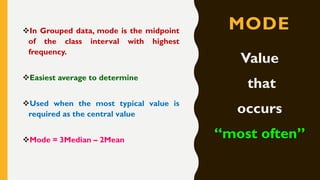
MODE❖In Grouped data, mode is the midpoint
of the class interval with highest
frequency.
❖Easiest average to determine
❖Used when the most typical value is
required as the central value
❖Mode = 3Median – 2Mean
Value
that
occurs
“most often”
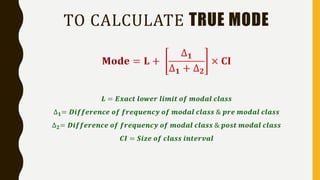
TO CALCULATE TRUE MODE
Example(Grouped data)
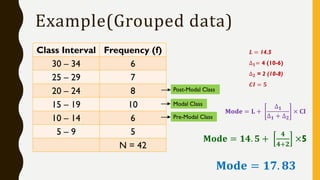
Class Interval Frequency (f)
30 – 34 6
25 – 29 7
20 – 24 8
15 – 19 10
10 – 14 6
5 – 9 5
N = 42
Modal Class
Pre-Modal Class
Post-Modal Class
𝑳 = 14.5
∆ 𝟏= 4 (10-6)
∆ 𝟐 = 2 (10-8)
𝑪𝑰 = 𝟓
𝐌𝐨𝐝𝐞 = 𝐋 +
∆ 𝟏
∆ 𝟏 + ∆ 𝟐
× 𝐂𝐈
𝐌𝐨𝐝𝐞 = 𝟏𝟒. 𝟓 +
𝟒
𝟒+𝟐
×5
𝐌𝐨𝐝𝐞 = 𝟏𝟕. 𝟖𝟑
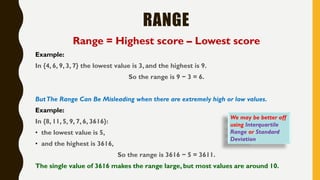
RANGE
Range = Highest score – Lowest score
Example:
In {4, 6, 9, 3, 7} the lowest value is 3, and the highest is 9.
So the range is 9 − 3 = 6.
ButThe Range Can Be Misleading when there are extremely high or low values.
Example:
In {8, 11, 5, 9, 7, 6, 3616}:
• the lowest value is 5,
• and the highest is 3616,
So the range is 3616 − 5 = 3611.
The single value of 3616 makes the range large, but most values are around 10.
We may be better off
using Interquartile
Range or Standard
Deviation
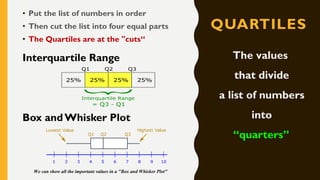
QUARTILES
• Put the list of numbers in order
• Then cut the list into four equal parts
• The Quartiles are at the "cuts“
Interquartile Range
Box andWhisker Plot
The values
that divide
a list of numbers
into
“quarters”
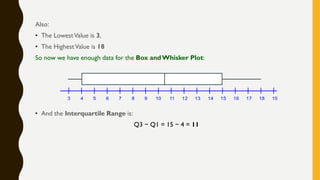
We can show all the important values in a "Box and Whisker Plot"
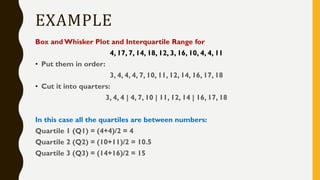
EXAMPLE
Box and Whisker Plot and Interquartile Range for
4, 17, 7, 14, 18, 12, 3, 16, 10, 4, 4, 11
• Put them in order:
3, 4, 4, 4, 7, 10, 11, 12, 14, 16, 17, 18
• Cut it into quarters:
3, 4, 4 | 4, 7, 10 | 11, 12, 14 | 16, 17, 18
In this case all the quartiles are between numbers:
Quartile 1 (Q1) = (4+4)/2 = 4
Quartile 2 (Q2) = (10+11)/2 = 10.5
Quartile 3 (Q3) = (14+16)/2 = 15
Also:
• The LowestValue is 3,
• The HighestValue is 18
So now we have enough data for the Box andWhisker Plot:
• And the Interquartile Range is:
Q3 − Q1 = 15 − 4 = 11
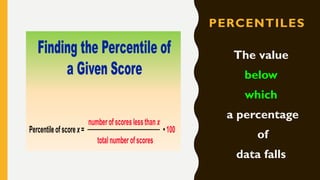
PERCENTILES
The value
below
which
a percentage
of
data falls
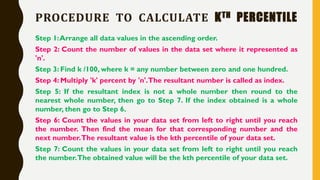
PROCEDURE TO CALCULATE KTH PERCENTILE
Step 1:Arrange all data values in the ascending order.
Step 2: Count the number of values in the data set where it represented as
'n'.
Step 3: Find k /100, where k = any number between zero and one hundred.
Step 4: Multiply 'k' percent by 'n'.The resultant number is called as index.
Step 5: If the resultant index is not a whole number then round to the
nearest whole number, then go to Step 7. If the index obtained is a whole
number, then go to Step 6.
Step 6: Count the values in your data set from left to right until you reach
the number. Then find the mean for that corresponding number and the
next number.The resultant value is the kth percentile of your data set.
Step 7: Count the values in your data set from left to right until you reach
the number.The obtained value will be the kth percentile of your data set.
STANDARD
DEVIATIONS
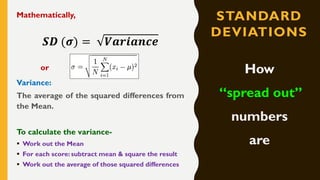
Mathematically,
𝑺𝑫 (𝝈) = 𝑽𝒂𝒓𝒊𝒂𝒏𝒄𝒆
or
Variance:
The average of the squared differences from
the Mean.
To calculate the variance-
▪ Work out the Mean
▪ For each score: subtract mean & square the result
▪ Work out the average of those squared differences
How
“spread out”
numbers
are
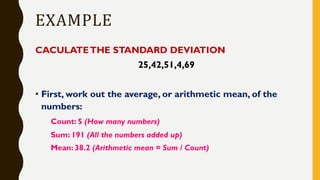
EXAMPLE
CACULATETHE STANDARD DEVIATION
25,42,51,4,69
• First, work out the average, or arithmetic mean, of the
numbers:
Count: 5 (How many numbers)
Sum: 191 (All the numbers added up)
Mean: 38.2 (Arithmetic mean = Sum / Count)
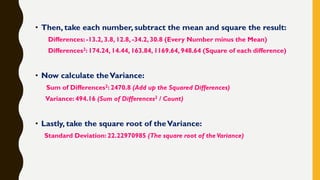
• Then, take each number, subtract the mean and square the result:
Differences: -13.2, 3.8, 12.8, -34.2, 30.8 (Every Number minus the Mean)
Differences2: 174.24, 14.44, 163.84, 1169.64, 948.64 (Square of each difference)
• Now calculate theVariance:
Sum of Differences2: 2470.8 (Add up the Squared Differences)
Variance: 494.16 (Sum of Differences2 / Count)
• Lastly, take the square root of theVariance:
Standard Deviation: 22.22970985 (The square root of the Variance)
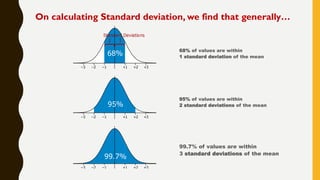
On calculating Standard deviation, we find that generally…
68% of values are within
1 standard deviation of the mean
95% of values are within
2 standard deviations of the mean
99.7% of values are within
3 standard deviations of the mean
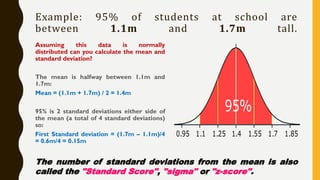
Example: 95% of students at school are
between 1.1m and 1.7m tall.
Assuming this data is normally
distributed can you calculate the mean and
standard deviation?
The mean is halfway between 1.1m and
1.7m:
Mean = (1.1m + 1.7m) / 2 = 1.4m
95% is 2 standard deviations either side of
the mean (a total of 4 standard deviations)
so:
First Standard deviation = (1.7m – 1.1m)/4
= 0.6m/4 = 0.15m
The number of standard deviations from the mean is also
called the "Standard Score", "sigma" or "z-score".
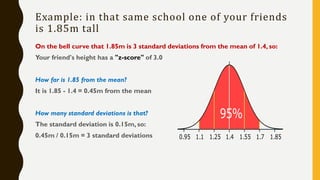
Example: in that same school one of your friends
is 1.85m tall
On the bell curve that 1.85m is 3 standard deviations from the mean of 1.4, so:
Your friend's height has a "z-score" of 3.0
How far is 1.85 from the mean?
It is 1.85 - 1.4 = 0.45m from the mean
How many standard deviations is that?
The standard deviation is 0.15m, so:
0.45m / 0.15m = 3 standard deviations
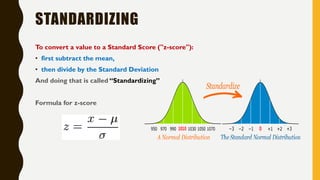
STANDARDIZING
To convert a value to a Standard Score ("z-score"):
• first subtract the mean,
• then divide by the Standard Deviation
And doing that is called “Standardizing”
Formula for z-score
PROPERTIES OF Z-SCORES
❖Z-score indicates how many SD’s a score falls above or below the mean.
❖Positive z-scores are above the mean.
❖Negative z-scores are below the mean.
❖Area under curve  probability
❖Z-scores are standardized scores  allows for easy comparison of
distributions
WHY
STANDARDIZE .. ?
Standardizing
helps us
“to make decisions”
about our
data.
PROBABILITY
How likely
something
is to
happen
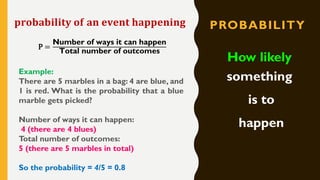
𝐩𝐫𝐨𝐛𝐚𝐛𝐢𝐥𝐢𝐭𝐲 𝐨𝐟 𝐚𝐧 𝐞𝐯𝐞𝐧𝐭 𝐡𝐚𝐩𝐩𝐞𝐧𝐢𝐧𝐠
P =
Number of ways it can happen
Total number of outcomes
Example:
There are 5 marbles in a bag: 4 are blue, and
1 is red. What is the probability that a blue
marble gets picked?
Number of ways it can happen:
4 (there are 4 blues)
Total number of outcomes:
5 (there are 5 marbles in total)
So the probability = 4/5 = 0.8
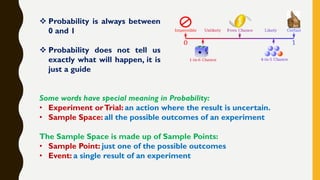
❖ Probability is always between
0 and 1
❖ Probability does not tell us
exactly what will happen, it is
just a guide
Some words have special meaning in Probability:
• Experiment orTrial: an action where the result is uncertain.
• Sample Space: all the possible outcomes of an experiment
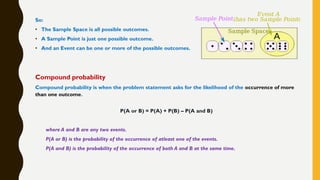
The Sample Space is made up of Sample Points:
• Sample Point: just one of the possible outcomes
• Event: a single result of an experiment
So:
• The Sample Space is all possible outcomes.
• A Sample Point is just one possible outcome.
• And an Event can be one or more of the possible outcomes.
Compound probability
Compound probability is when the problem statement asks for the likelihood of the occurrence of more
than one outcome.
P(A or B) = P(A) + P(B) – P(A and B)
where A and B are any two events.
P(A or B) is the probability of the occurrence of atleast one of the events.
P(A and B) is the probability of the occurrence of both A and B at the same time.
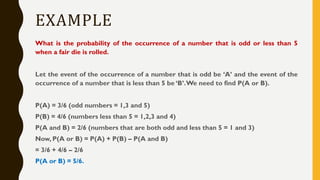
EXAMPLE
What is the probability of the occurrence of a number that is odd or less than 5
when a fair die is rolled.
Let the event of the occurrence of a number that is odd be ‘A’ and the event of the
occurrence of a number that is less than 5 be ‘B’.We need to find P(A or B).
P(A) = 3/6 (odd numbers = 1,3 and 5)
P(B) = 4/6 (numbers less than 5 = 1,2,3 and 4)
P(A and B) = 2/6 (numbers that are both odd and less than 5 = 1 and 3)
Now, P(A or B) = P(A) + P(B) – P(A and B)
= 3/6 + 4/6 – 2/6
P(A or B) = 5/6.
Mutually exclusive events:
When two events cannot occur at the same time, they are considered mutually
exclusive.
For a mutually exclusive event, P(A and B) = 0.
Example 1:What is the probability of getting a 2 or a 5 when a die is rolled?
Solution:
Taking the individual probabilities of each number, getting a 2 is 1/6 and so is getting a 5.
Applying the formula of compound probability,
Probability of getting a 2 or a 5,
P(2 or 5) = P(2) + P(5) – P(2 and 5)
==> 1/6 + 1/6 – 0
==> 2/6 = 1/3.
Independent Event
When multiple events occur, if the outcome of one event DOES NOT affect the
outcome of the other events, they are called independent events.
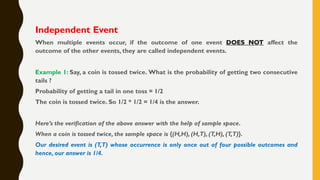
Example 1: Say, a coin is tossed twice. What is the probability of getting two consecutive
tails ?
Probability of getting a tail in one toss = 1/2
The coin is tossed twice. So 1/2 * 1/2 = 1/4 is the answer.
Here’s the verification of the above answer with the help of sample space.
When a coin is tossed twice, the sample space is {(H,H), (H,T), (T,H), (T,T)}.
Our desired event is (T,T) whose occurrence is only once out of four possible outcomes and
hence, our answer is 1/4.
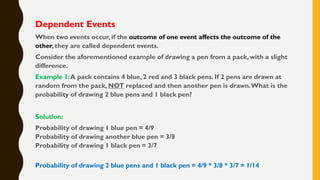
Dependent Events
When two events occur, if the outcome of one event affects the outcome of the
other, they are called dependent events.
Consider the aforementioned example of drawing a pen from a pack, with a slight
difference.
Example 1:A pack contains 4 blue, 2 red and 3 black pens. If 2 pens are drawn at
random from the pack, NOT replaced and then another pen is drawn.What is the
probability of drawing 2 blue pens and 1 black pen?
Solution:
Probability of drawing 1 blue pen = 4/9
Probability of drawing another blue pen = 3/8
Probability of drawing 1 black pen = 3/7
Probability of drawing 2 blue pens and 1 black pen = 4/9 * 3/8 * 3/7 = 1/14
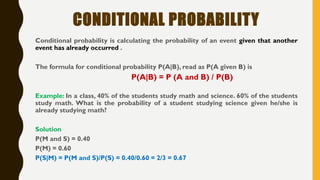
CONDITIONAL PROBABILITY
Conditional probability is calculating the probability of an event given that another
event has already occurred .
The formula for conditional probability P(A|B), read as P(A given B) is
P(A|B) = P (A and B) / P(B)
Example: In a class, 40% of the students study math and science. 60% of the students
study math. What is the probability of a student studying science given he/she is
already studying math?
Solution
P(M and S) = 0.40
P(M) = 0.60
P(S|M) = P(M and S)/P(S) = 0.40/0.60 = 2/3 = 0.67
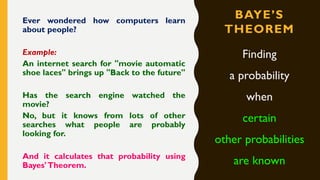
BAYE’S
THEOREM
Ever wondered how computers learn
about people?
Example:
An internet search for "movie automatic
shoe laces" brings up "Back to the future"
Has the search engine watched the
movie?
No, but it knows from lots of other
searches what people are probably
looking for.
And it calculates that probability using
Bayes'Theorem.
Finding
a probability
when
certain
other probabilities
are known
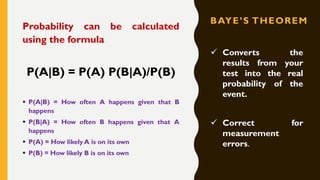
BAYE’S THEOREM
Probability can be calculated
using the formula
P(A|B) = P(A) P(B|A)/P(B)
▪ P(A|B) = How often A happens given that B
happens
▪ P(B|A) = How often B happens given that A
happens
▪ P(A) = How likely A is on its own
▪ P(B) = How likely B is on its own
✓ Converts the
results from your
test into the real
probability of the
event.
✓ Correct for
measurement
errors.
EXAMPLE
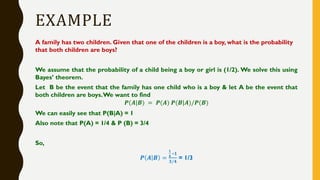
A family has two children. Given that one of the children is a boy, what is the probability
that both children are boys?
We assume that the probability of a child being a boy or girl is (1/2). We solve this using
Bayes’ theorem.
Let B be the event that the family has one child who is a boy & let A be the event that
both children are boys.We want to find
𝑷(𝑨|𝑩) = 𝑷(𝑨) 𝑷(𝑩|𝑨)/𝑷(𝑩)
We can easily see that P(B|A) = 1
Also note that P(A) = 1/4 & P (B) = 3/4
So,
𝑷 𝑨 𝑩 =
𝟏
𝟒
∗𝟏
𝟑/𝟒
= 1/3
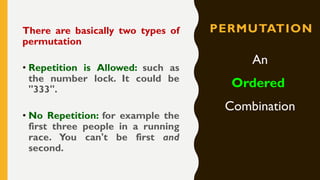
PERMUTATIONThere are basically two types of
permutation
• Repetition is Allowed: such as
the number lock. It could be
"333".
• No Repetition: for example the
first three people in a running
race. You can't be first and
second.
An
Ordered
Combination
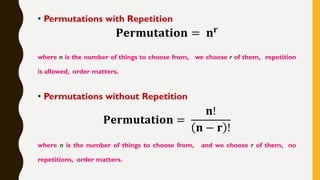
• Permutations with Repetition
𝐏𝐞𝐫𝐦𝐮𝐭𝐚𝐭𝐢𝐨𝐧 = 𝐧 𝐫
where n is the number of things to choose from, we choose r of them, repetition
is allowed, order matters.
• Permutations without Repetition
𝐏𝐞𝐫𝐦𝐮𝐭𝐚𝐭𝐢𝐨𝐧 =
𝐧!
𝐧 − 𝐫 !
where n is the number of things to choose from, and we choose r of them, no
repetitions, order matters.
EXAMPLE
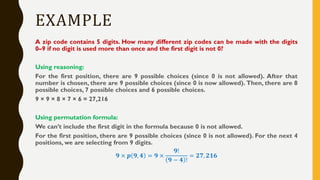
A zip code contains 5 digits. How many different zip codes can be made with the digits
0–9 if no digit is used more than once and the first digit is not 0?
Using reasoning:
For the first position, there are 9 possible choices (since 0 is not allowed). After that
number is chosen, there are 9 possible choices (since 0 is now allowed). Then, there are 8
possible choices, 7 possible choices and 6 possible choices.
9 × 9 × 8 × 7 × 6 = 27,216
Using permutation formula:
We can’t include the first digit in the formula because 0 is not allowed.
For the first position, there are 9 possible choices (since 0 is not allowed). For the next 4
positions, we are selecting from 9 digits.
𝟗 × 𝒑 𝟗, 𝟒 = 𝟗 ×
𝟗!
𝟗 − 𝟒 !
= 𝟐𝟕, 𝟐𝟏𝟔
EXAMPLE
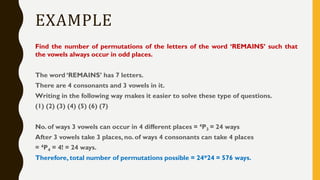
Find the number of permutations of the letters of the word ‘REMAINS’ such that
the vowels always occur in odd places.
The word ‘REMAINS’ has 7 letters.
There are 4 consonants and 3 vowels in it.
Writing in the following way makes it easier to solve these type of questions.
(1) (2) (3) (4) (5) (6) (7)
No. of ways 3 vowels can occur in 4 different places = 4P3 = 24 ways
After 3 vowels take 3 places, no. of ways 4 consonants can take 4 places
= 4P4 = 4! = 24 ways.
Therefore, total number of permutations possible = 24*24 = 576 ways.
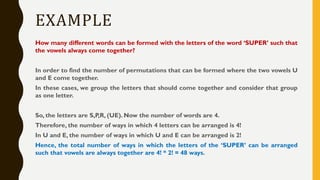
EXAMPLE
How many different words can be formed with the letters of the word ‘SUPER’ such that
the vowels always come together?
In order to find the number of permutations that can be formed where the two vowels U
and E come together.
In these cases, we group the letters that should come together and consider that group
as one letter.
So, the letters are S,P,R, (UE). Now the number of words are 4.
Therefore, the number of ways in which 4 letters can be arranged is 4!
In U and E, the number of ways in which U and E can be arranged is 2!
Hence, the total number of ways in which the letters of the ‘SUPER’ can be arranged
such that vowels are always together are 4! * 2! = 48 ways.
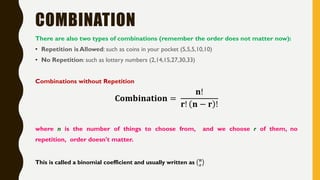
COMBINATION
There are also two types of combinations (remember the order does not matter now):
• Repetition is Allowed: such as coins in your pocket (5,5,5,10,10)
• No Repetition: such as lottery numbers (2,14,15,27,30,33)
Combinations without Repetition
𝐂𝐨𝐦𝐛𝐢𝐧𝐚𝐭𝐢𝐨𝐧 =
𝐧!
𝐫! 𝐧 − 𝐫 !
where n is the number of things to choose from, and we choose r of them, no
repetition, order doesn't matter.
This is called a binomial coefficient and usually written as 𝐧
𝐫
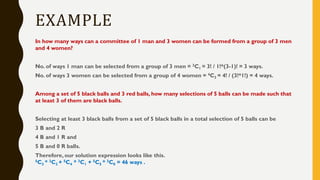
EXAMPLE
In how many ways can a committee of 1 man and 3 women can be formed from a group of 3 men
and 4 women?
No. of ways 1 man can be selected from a group of 3 men = 3C1 = 3! / 1!*(3-1)! = 3 ways.
No. of ways 3 women can be selected from a group of 4 women = 4C3 = 4! / (3!*1!) = 4 ways.
Among a set of 5 black balls and 3 red balls, how many selections of 5 balls can be made such that
at least 3 of them are black balls.
Selecting at least 3 black balls from a set of 5 black balls in a total selection of 5 balls can be
3 B and 2 R
4 B and 1 R and
5 B and 0 R balls.
Therefore, our solution expression looks like this.
5C3 * 3C2 + 5C4 * 3C1 + 5C5 * 3C0 = 46 ways .
EXAMPLE
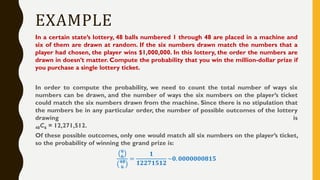
In a certain state’s lottery, 48 balls numbered 1 through 48 are placed in a machine and
six of them are drawn at random. If the six numbers drawn match the numbers that a
player had chosen, the player wins $1,000,000. In this lottery, the order the numbers are
drawn in doesn’t matter. Compute the probability that you win the million-dollar prize if
you purchase a single lottery ticket.
In order to compute the probability, we need to count the total number of ways six
numbers can be drawn, and the number of ways the six numbers on the player’s ticket
could match the six numbers drawn from the machine. Since there is no stipulation that
the numbers be in any particular order, the number of possible outcomes of the lottery
drawing is
48C6 = 12,271,512.
Of these possible outcomes, only one would match all six numbers on the player’s ticket,
so the probability of winning the grand prize is:
𝟔
𝟔
𝟒𝟖
𝟔
=
𝟏
𝟏𝟐𝟐𝟕𝟏𝟓𝟏𝟐
~𝟎. 𝟎𝟎𝟎𝟎𝟎𝟎𝟎𝟖𝟏𝟓
CORRELATION
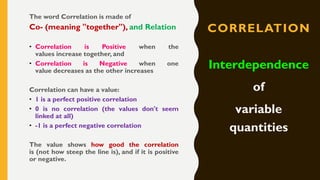
The word Correlation is made of
Co- (meaning "together"), and Relation
• Correlation is Positive when the
values increase together, and
• Correlation is Negative when one
value decreases as the other increases
Correlation can have a value:
• 1 is a perfect positive correlation
• 0 is no correlation (the values don't seem
linked at all)
• -1 is a perfect negative correlation
The value shows how good the correlation
is (not how steep the line is), and if it is positive
or negative.
Interdependence
of
variable
quantities
EXAMPLE
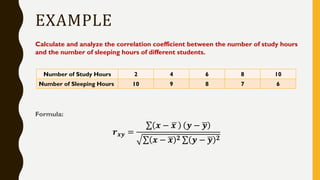
Calculate and analyze the correlation coefficient between the number of study hours
and the number of sleeping hours of different students.
Formula:
𝒓 𝒙𝒚 =
σ 𝒙 − ഥ𝒙 𝒚 − ഥ𝒚
σ 𝒙 − ഥ𝒙 𝟐 σ 𝒚 − ഥ𝒚 𝟐
Number of Study Hours 2 4 6 8 10
Number of Sleeping Hours 10 9 8 7 6
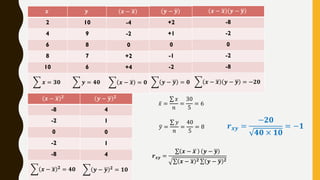
𝒙 𝒚
2 10
4 9
6 8
8 7
10 6
෍ 𝒙 = 𝟑𝟎 ෍ 𝒚 = 𝟒𝟎
𝒙 − ഥ𝒙
-4
-2
0
+2
+4
෍ 𝒙 − ഥ𝒙 = 𝟎
𝒚 − ഥ𝒚
+2
+1
0
-1
-2
෍ 𝒚 − ഥ𝒚 = 𝟎
𝒙 − ഥ𝒙 𝒚 − ഥ𝒚
-8
-2
0
-2
-8
෍ 𝒙 − ഥ𝒙 𝒚 − ഥ𝒚 = −𝟐𝟎
𝒙 − ഥ𝒙 𝟐
-8
-2
0
-2
-8
෍ 𝒙 − ഥ𝒙 𝟐
= 𝟒𝟎
𝒚 − ഥ𝒚 𝟐
4
1
0
1
4
෍ 𝒚 − ഥ𝒚 𝟐 = 𝟏𝟎
𝒓 𝒙𝒚 =
−𝟐𝟎
𝟒𝟎 × 𝟏𝟎
= −𝟏
𝒓 𝒙𝒚 =
σ 𝒙 − ഥ𝒙 𝒚 − ഥ𝒚
σ 𝒙 − ഥ𝒙 𝟐 σ 𝒚 − ഥ𝒚 𝟐
ҧ𝑥 =
σ 𝑥
𝑛
=
30
5
= 6
ത𝑦 =
σ 𝑦
𝑛
=
40
5
= 8
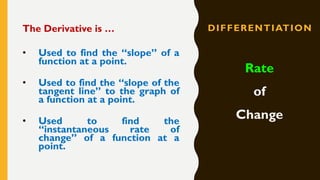
DIFFERENTIATIONThe Derivative is …
• Used to find the “slope” of a
function at a point.
• Used to find the “slope of the
tangent line” to the graph of
a function at a point.
• Used to find the
“instantaneous rate of
change” of a function at a
point.
Rate
of
Change
THE POWER RULE
1
[ ] , is any real numberN Nd
x Nx N
dx


[ ] 1
d
x
dx

THE CONSTANT RULE
[ ] 0, is a constant
d
c c
dx

The derivative of a constant function is zero.
THE CONSTANT MULTIPLE RULE
   [ ( ) ] '( ) , is a constant
d
c f x c f x c
dx

The derivative of a constant times a function is equal to the constant
times the derivative of the function.
THE SUM AND DIFFERENCE RULES
[ ( ) ( )] '( ) '( )
d
f x g x f x g x
dx
  
The derivative of a sum is the sum of the derivatives.
[ ( ) ( )] '( ) '( )
d
f x g x f x g x
dx
  
The derivative of a difference is the difference of the derivatives.
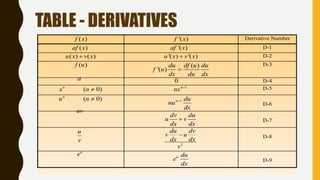
TABLE - DERIVATIVES
( )f x '( )f x Derivative Number
( )af x '( )af x D-1
( ) ( )u x v x '( ) '( )u x v x D-2
( )f u ( )
'( )
du df u du
f u
dx du dx

D-3
a 0 D-4
( 0)n
x n  1n
nx  D-5
( 0)n
u n  1n du
nu
dx

D-6
uv
dv du
u v
dx dx
 D-7
u
v
2
du dv
v u
dx dx
v
 D-8
u
e u du
e
dx
D-9
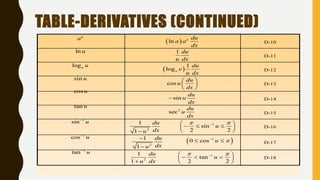
TABLE-DERIVATIVES (CONTINUED)
u
a
 ln u du
a a
dx
D-10
ln u 1 du
u dx
D-11
loga u
 
1
loga
du
e
u dx
D-12
sin u
cos
du
u
dx
 
 
 
D-13
cos u
sin
du
u
dx
 D-14
tan u
2
sec
du
u
dx
D-15
1
sin u
1
2
1
sin
2 21
du
u
dxu
  
   
 
D-16
1
cos u
2
1
1
du
dxu


 1
0 cos u 
  D-17
1
tan u
1
2
1
tan
1 2 2
du
u
u dx
  
   
  
D-18
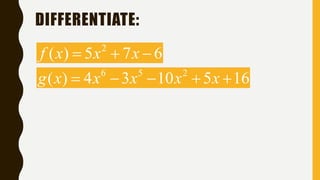
DIFFERENTIATE:
2
( ) 5 7 6f x x x  
6 5 2
( ) 4 3 10 5 16g x x x x x    
APPLICATIONS: MAXIMA AND MINIMA
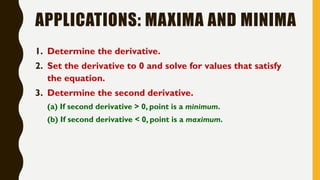
1. Determine the derivative.
2. Set the derivative to 0 and solve for values that satisfy
the equation.
3. Determine the second derivative.
(a) If second derivative > 0, point is a minimum.
(b) If second derivative < 0, point is a maximum.
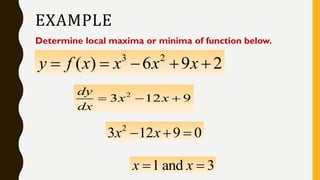
EXAMPLE
Determine local maxima or minima of function below.
3 2
( ) 6 9 2y f x x x x    
2
3 12 9
dy
x x
dx
  
2
3 12 9 0x x  
1 and 3x x 
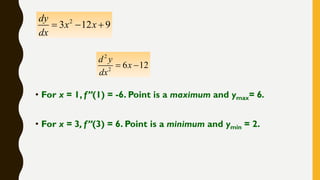
• For x = 1, f”(1) = -6. Point is a maximum and ymax= 6.
• For x = 3, f”(3) = 6. Point is a minimum and ymin = 2.
2
3 12 9
dy
x x
dx
  
2
2
6 12
d y
x
dx
 
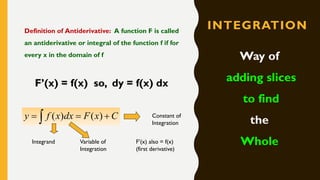
INTEGRATION
Way of
adding slices
to find
the
Whole
  CxFdxxfy )()(
Integrand Variable of
Integration
Constant of
Integration
F’(x) also = f(x)
(first derivative)
Definition of Antiderivative: A function F is called
an antiderivative or integral of the function f if for
every x in the domain of f
F’(x) = f(x) so, dy = f(x) dx
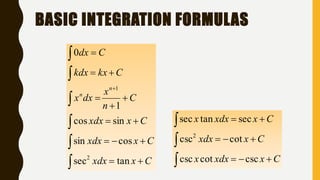
BASIC INTEGRATION FORMULAS
Cxxdx
Cxxdx
Cxxdx
C
n
x
dxx
Ckxkdx
Cdx
n
n















tansec
cossin
sincos
1
0
2
1
Cxxdxx
Cxxdx
Cxxdxx






csccotcsc
cotcsc
sectansec
2
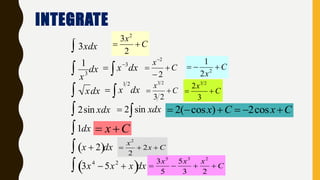
INTEGRATE
3xdx
1
x3 dx
x dx
2sin xdx
1dx
x  2  dx
3x4
 5x2
 x  dx
C
x

2
3 2


 dxx 3
C
x




2
2
C
x
 2
2
1
dxx
21
 C
x

23
23
C
x

3
2 23
 xdxsin2 CxCx  cos2)cos(2
Cx 
Cx
x
 2
2
2
C
xxx

23
5
5
3 235
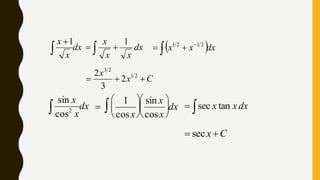
dx
x
x

1
dx
xx
x 1
   dxxx

 2121
Cx
x
 21
23
2
3
2
dx
x
x
 2
cos
sin


1
cosx






sin x
cosx





 dx dxxx tansec
Cx  sec
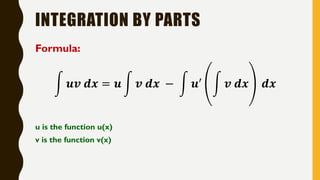
INTEGRATION BY PARTS
Formula:
න 𝒖𝒗 𝒅𝒙 = 𝒖 න 𝒗 𝒅𝒙 − න 𝒖′ න 𝒗 𝒅𝒙 𝒅𝒙
u is the function u(x)
v is the function v(x)
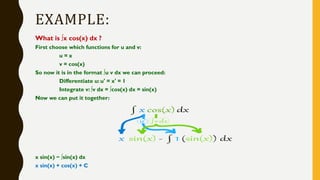
EXAMPLE:
What is ∫x cos(x) dx ?
First choose which functions for u and v:
u = x
v = cos(x)
So now it is in the format ∫u v dx we can proceed:
Differentiate u: u' = x' = 1
Integrate v: ∫v dx = ∫cos(x) dx = sin(x)
Now we can put it together:
x sin(x) − ∫sin(x) dx
x sin(x) + cos(x) + C
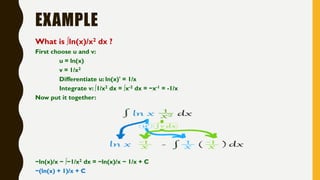
EXAMPLE
What is ∫ln(x)/x2 dx ?
First choose u and v:
u = ln(x)
v = 1/x2
Differentiate u: ln(x)' = 1/x
Integrate v: ∫1/x2 dx = ∫x-2 dx = −x-1 = -1/x
Now put it together:
−ln(x)/x − ∫−1/x2 dx = −ln(x)/x − 1/x + C
−(ln(x) + 1)/x + C
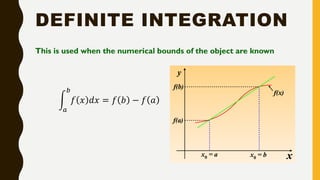
DEFINITE INTEGRATION
This is used when the numerical bounds of the object are known
න
𝑎
𝑏
𝑓 𝑥 𝑑𝑥 = 𝑓 𝑏 − 𝑓 𝑎
y
xx0 = a x0 = b
f(a)
f(b)
f(x)
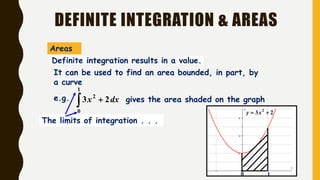
DEFINITE INTEGRATION & AREAS
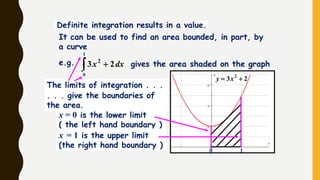
0 1
23 2
 xy
It can be used to find an area bounded, in part, by
a curve
e.g.
 
1
0
2
23 dxx gives the area shaded on the graph
The limits of integration . . .
Definite integration results in a value.
Areas
. . . give the boundaries of
the area.
The limits of integration . . .
0 1
23 2
 xy
It can be used to find an area bounded, in part, by
a curve
Definite integration results in a value.
x = 0 is the lower limit
( the left hand boundary )
x = 1 is the upper limit
(the right hand boundary )
  dxx 23 2
0
1
e.g. gives the area shaded on the graph
0 1
23 2
 xy
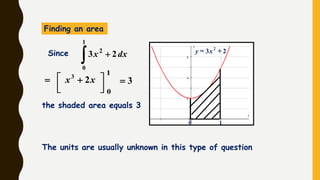
Finding an area
the shaded area equals 3
The units are usually unknown in this type of question
 
1
0
2
23 dxxSince
3
1
0



 xx 23

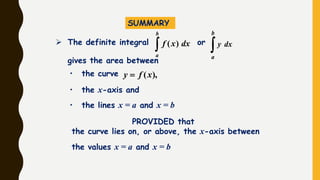
SUMMARY
• the curve ),(xfy 
• the lines x = a and x = b
• the x-axis and
PROVIDED that
the curve lies on, or above, the x-axis between
the values x = a and x = b
➢ The definite integral or
gives the area between

b
a
dxxf )(

b
a
dxy
xxy 22

xxy 22

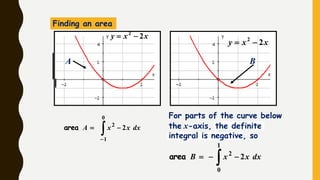
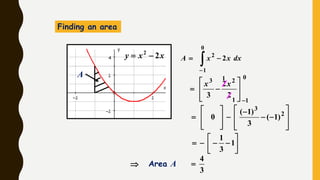
Finding an area


0
1
2
2 dxxxAarea
A B
 
1
0
2
2 dxxxBarea
For parts of the curve below
the x-axis, the definite
integral is negative, so
xxy 22

A
Finding an area


0
1
2
2 dxxxA










2
2
3
23
0
1
xx



















 2
3
)1(
3
)1(
0






 1
3
1
1
1
3
4
Area A
xxy 22

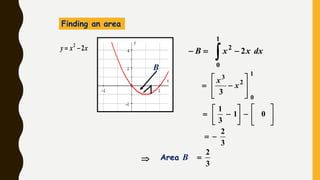
B
Finding an area
 
1
0
2
2 dxxxB








 2
3
1
0
3
x
x












 01
3
1
3
2

3
2
Area B
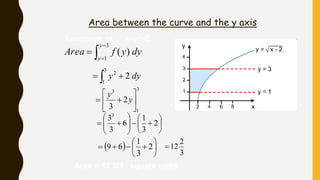
Area between the curve and the y axis
dyy 2
3
1
2
 
Rearrange as x=y2+2
dyyfArea
y
y



3
1
)(
3
1
3
2
3






 y
y












 2
3
1
6
3
33
  





 2
3
1
69
3
2
12
Area = 12 2/3 square units
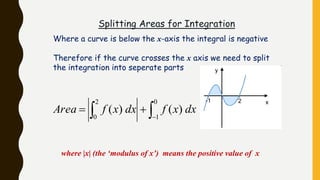
Splitting Areas for Integration
Where a curve is below the x-axis the integral is negative
Therefore if the curve crosses the x axis we need to split
the integration into seperate parts
dxxfdxxfArea  

0
1
2
0
)()(
where |x| (the ‘modulus of x’) means the positive value of x
Example
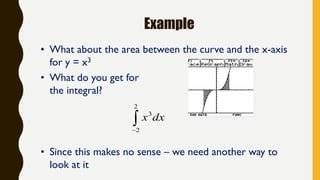
• What about the area between the curve and the x-axis
for y = x3
• What do you get for
the integral?
• Since this makes no sense – we need another way to
look at it
2
3
2
x dx


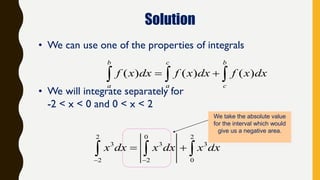
Solution
• We can use one of the properties of integrals
• We will integrate separately for
-2 < x < 0 and 0 < x < 2
( ) ( ) ( )
b c b
a a c
f x dx f x dx f x dx   
2 0 2
3 3 3
2 2 0
x dx x dx x dx
 
   
We take the absolute value
for the interval which would
give us a negative area.
dxxgxfArea
b
a  ))()((
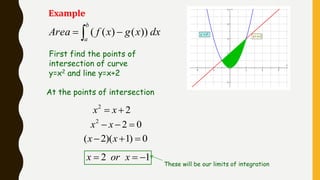
Example
First find the points of
intersection of curve
y=x2 and line y=x+2
At the points of intersection
22
 xx
022
 xx
0)1)(2(  xx
12  xorx
These will be our limits of integration
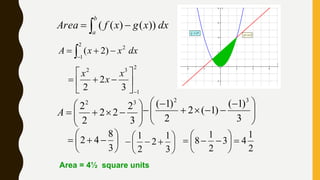
dxxgxfArea
b
a  ))()((
dxxxA 

2
1
2
)2(
2
1
32
3
2
2 







x
x
x







3
2
22
2
2 32
A 




 



3
)1(
)1(2
2
)1( 32







3
8
42 






3
1
2
2
1
2
1
43
2
1
8 






Area = 4½ square units
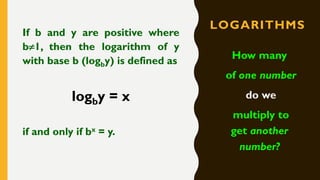
LOGARITHMS
If b and y are positive where
b1, then the logarithm of y
with base b (logby) is defined as
logby = x
if and only if bx = y.
How many
of one number
do we
multiply to
get another
number?
Logarithms are everywhere…….
In our daily life we use phrases like
6 figures
Double digits
Order of magnitude
Interest rates etc…
Here we are describing numbers in terms of their powers of 10.
Interest rate is logarithm of the growth in an investment.
Logarithms find the cause for an effect.
i. e., input for some output
Large numbers break our brains.
To overcome this number blindness we write numbers in terms of
logarithms.
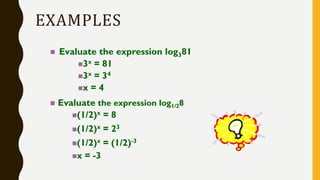
EXAMPLES
 Evaluate the expression log381
3x = 81
 Evaluate the expression log1/28
(1/2)x = 8
3x = 34
x = 4
(1/2)x = 23
(1/2)x = (1/2)-3
x = -3
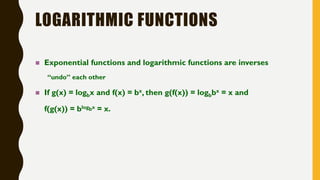
LOGARITHMIC FUNCTIONS
 Exponential functions and logarithmic functions are inverses
“undo” each other
 If g(x) = logbx and f(x) = bx, then g(f(x)) = logbbx = x and
f(g(x)) = blogbx = x.
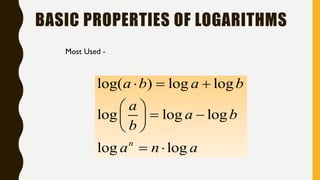
BASIC PROPERTIES OF LOGARITHMS
log( ) log log
log log log
log logn
a b a b
a
a b
b
a n a
  
 
  
 
 
Most Used -
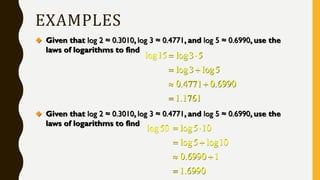
EXAMPLES
 Given that log 2 ≈ 0.3010, log 3 ≈ 0.4771, and log 5 ≈ 0.6990, use the
laws of logarithms to find
log15 log3 5
log3 log5
0.4771 0.6990
1.1761
 
 
 

 Given that log 2 ≈ 0.3010, log 3 ≈ 0.4771, and log 5 ≈ 0.6990, use the
laws of logarithms to find
log50 log5 10
log5 log10
0.6990 1
1.6990
 
 
 

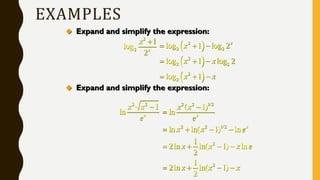
EXAMPLES
 Expand and simplify the expression:
2
2
1
log
2x
x 
 
 
 
2
2 2
2
2 2
2
2
log 1 log 2
log 1 log 2
log 1
x
x
x x
x x
  
  
  
 Expand and simplify the expression:
2 2
1
ln x
x x
e
 2 2 1/2
2 2 1/2
2
2
( 1)
ln
ln ln( 1) ln
1
2ln ln( 1) ln
2
1
2ln ln( 1)
2
x
x
x x
e
x x e
x x x e
x x x


   
   
   
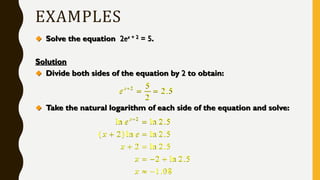
EXAMPLES
 Solve the equation 2ex + 2 = 5.
Solution
 Divide both sides of the equation by 2 to obtain:
 Take the natural logarithm of each side of the equation and solve:
2 5
2.5
2
x
e 
 
2
ln ln 2.5
( 2)ln ln 2.5
2 ln 2.5
2 ln 2.5
1.08
x
e
x e
x
x
x


 
 
  
 
EXAMPLES
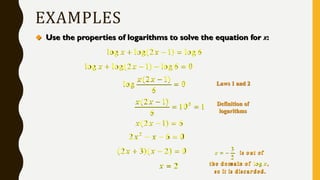
 Use the properties of logarithms to solve the equation for x:
log log(2 1) log6x x  
log log(2 1) log6 0x x   
(2 1)
log 0
6
x x 

0(2 1)
10 1
6
x x 
 
(2 1) 6x x  
2
2 6 0x x  
(2 3)( 2) 0x x  
2x 
Laws 1 and 2
Definition of
logarithms
3
2
log
x
x
  is out of
the domain of ,
so it is discarded.
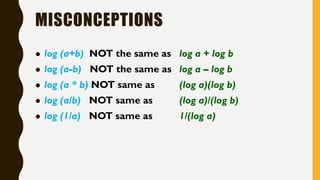
MISCONCEPTIONS
 log (a+b) NOT the same as log a + log b
 log (a-b) NOT the same as log a – log b
 log (a * b) NOT same as (log a)(log b)
 log (a/b) NOT same as (log a)/(log b)
 log (1/a) NOT same as 1/(log a)
USEFULNESS OF LOGARITHMS
 Logarithms useful in measuring quantities which vary
widely
 Acidity (pH) of a solution
 Sound (decibels)
 Earthquakes (Richter scale)
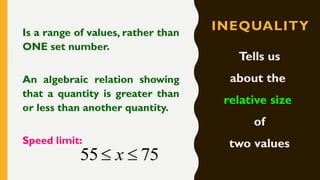
INEQUALITYIs a range of values, rather than
ONE set number.
An algebraic relation showing
that a quantity is greater than
or less than another quantity.
Speed limit:
Tells us
about the
relative size
of
two values
7555  x
Symbols



 Less than
Greater than
Less than OR EQUAL TO
Greater than OR EQUAL TO
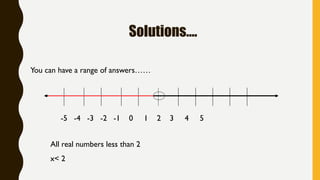
Solutions….
You can have a range of answers……
-5 -4 -3 -2 -1 0 1 2 3 4 5
All real numbers less than 2
x< 2
Solutions continued…
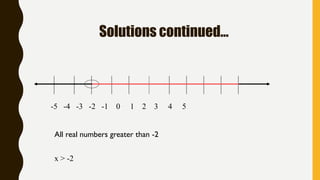
-5 -4 -3 -2 -1 0 1 2 3 4 5
All real numbers greater than -2
x > -2
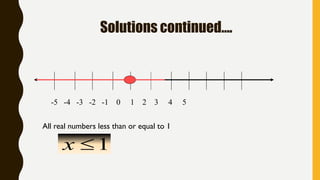
Solutions continued….
-5 -4 -3 -2 -1 0 1 2 3 4 5
All real numbers less than or equal to 1
1x
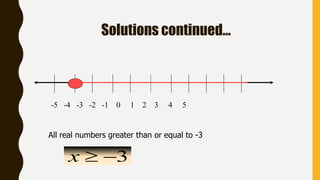
Solutions continued…
-5 -4 -3 -2 -1 0 1 2 3 4 5
All real numbers greater than or equal to -3
3x
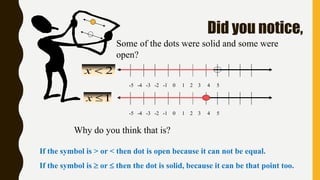
Did you notice,
Some of the dots were solid and some were
open?
-5 -4 -3 -2 -1 0 1 2 3 4 5
2x
-5 -4 -3 -2 -1 0 1 2 3 4 5
1x
Why do you think that is?
If the symbol is > or < then dot is open because it can not be equal.
If the symbol is  or  then the dot is solid, because it can be that point too.
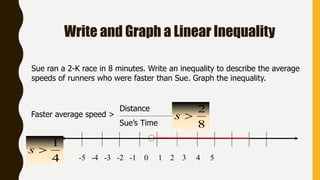
Write and Graph a Linear Inequality
Sue ran a 2-K race in 8 minutes. Write an inequality to describe the average
speeds of runners who were faster than Sue. Graph the inequality.
Faster average speed >
Distance
Sue’s Time 8
2
s
4
1
s
-5 -4 -3 -2 -1 0 1 2 3 4 5
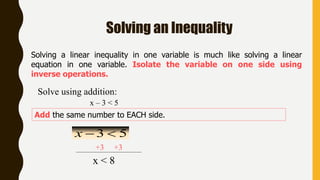
Solving an Inequality
Solving a linear inequality in one variable is much like solving a linear
equation in one variable. Isolate the variable on one side using
inverse operations.
Add the same number to EACH side.
x – 3 < 5
Solve using addition:
53 x
+3 +3
x < 8
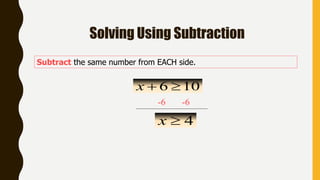
Solving Using Subtraction
Subtract the same number from EACH side.
106 x
4x
-6 -6
THE TRAP…..
When you multiply or divide each side of an inequality
by a negative number, you must reverse the inequality
symbol to maintain a true statement.
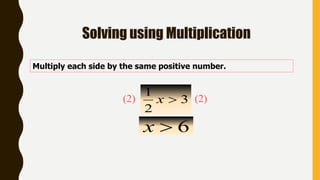
Solving using Multiplication
Multiply each side by the same positive number.
3
2
1
x
6x
(2) (2)
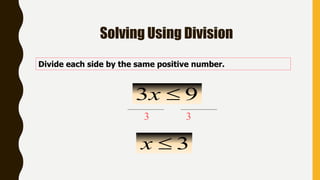
Solving Using Division
Divide each side by the same positive number.
93 x
3x
3 3
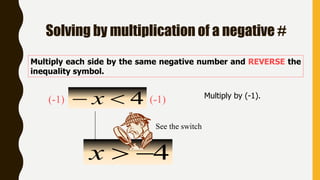
Solving by multiplication of a negative #
Multiply each side by the same negative number and REVERSE the
inequality symbol.
4 x Multiply by (-1).
4x
(-1) (-1)
See the switch
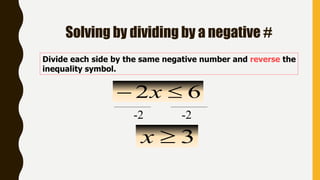
Solving by dividing by a negative #
Divide each side by the same negative number and reverse the
inequality symbol.
62  x
3x
-2 -2
Compound Inequality
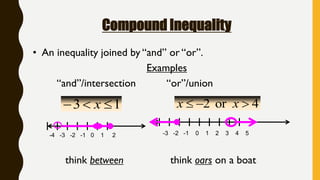
• An inequality joined by “and” or “or”.
Examples
“and”/intersection “or”/union
think between think oars on a boat
13  x
-4 -3 -2 -1 0 1 2
4or2  xx
-3 -2 -1 0 1 2 3 4 5
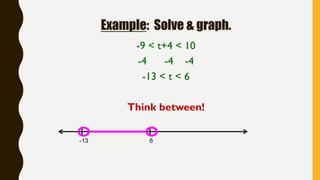
Example: Solve & graph.
-9 < t+4 < 10
-4 -4 -4
-13 < t < 6
Think between!
-13 6
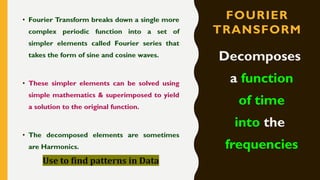
FOURIER
TRANSFORM
Decomposes
a function
of time
into the
frequencies
Thank You

Statistics for analytics

  • 1.
  • 2.
    What is ANALYTICS? •AProcess of •finding Information from •Data to make a •Decision and •subsequently Act on it
  • 3.
    EXAMPLE (Simple) Decision Required: Suppose youare a captain of Indian Cricket Team and you have to decide whether to includeYuvraaj Singh or Shikhar Dhawan in the team for the next match… Data: You have the runs scored by both in last 10 matches Information: Calculate average score of both the players Action: Choose the player who has better average
  • 4.
    EXAMPLE (Difficult) Problem: Finding out thechances of a customer clicking on specific advertisement online, based on the data of his browsing history in past one year. In this, Your data is big data and your analysis tools will change, you might require machine learning algorithms like Naive-Bayes to find answer of this problem.
  • 5.
  • 6.
    DESCRIPTIVE Analytics •Use dataaggregation and data mining to provide insight into the past and answer: “What has happened?”
  • 7.
    PREDICTIVE Analytics •Use statisticalmodels and forecasts techniques to understand the future and answer: “What could happen?”
  • 8.
    PRESCRIPTIVE Analytics •Use optimizationand simulation algorithms to advice on possible outcomes and answer: “What should we do?”
  • 10.
    Difference between DATAANALYSIS, DATA ANALYTICS, DATA MINING, MACHINE LEARNING, BIG DATA & DATA SCIENCE Let’s take a scenario…. If you have an excel sheet of data with some thousand rows, you want to remove the NA rows • Analysing data manually and remove NA rows - Data Analysis • Analysing data through some tool like R and run a function to remove all NA rows – Data Analytics • Analysing data to find the patterns. Example: Finding the cases which generally have NA values – Data mining
  • 11.
    • Using analgorithm to analyse data. Example: Run a K-means clustering algorithm to cluster the NA records together – Machine Learning • If you have the excel sheet containing millions of records which your tools like excel, R etc can not handle – Big Data • Mother of all, where small to huge data can be analysed by using multiple platforms like R, Hadoop, Machine Learning etc – Data Science
  • 12.
    ASSESSMENT of theTERMS The general difference between the terms Data analysis and Analytics can be assessed based on: • Source of data • Whether Statistics/OR is applied • Size of data
  • 13.
    Criteria:- • Statistics/Operations Research:-Whether the analysis involves application of Statistics or Operations Research. Analytics involve application of these techniques. • Source of data:- Data could be collected manually through surveys or collected from secondary sources. The size of this data will be limited. Business also collect data as part of its regular operation. This is less prone to error and large. Analytics involves analysis of this data. • Size of data:- This is related to previous point. Since Analytics use business process data, the size of data is large.
  • 14.
    What is DATA? A collectionof facts from which conclusions may be drawn.
  • 15.
    TYPES OF DATA Data Categorical Nominal BinaryNot Binary Ordinal Binary Not Binary Measurement Discrete Continuous
  • 16.
    Categorical Data: Categoricalvariables represent types of data which may be divided into groups. ❖Nominal:A type of categorical data in which objects fall into unordered categories. For example: • The category “hair color” could contain the categorical variables “black,” “brown,” “blonde,” and “red.” • The category “gender” could contain the categorical variables “Male”, “Female”, or “Other.” ❖Ordinal:A type of categorical data in which order is important. For example: • Class – fresh, sophomore, junior, senior, super senior • Degree of illness – none, mild, moderate, severe, … ➢ Binary: A type of categorical data in which there are only two categories. Binary data can either be nominal or ordinal. For example: • Smoking status – smoker, non-smoker • Attendance – present, absent • Class – lower class, upper class
  • 17.
    Measurement Data: Theobjects being studied are “measured” based on some quantitative trait. The resulting data are set of numbers. For example: • Cholesterol level • Height • Age • Number of students late for class • Time to complete a homework assignment ❖Discrete: Only certain values are possible (there are gaps between the possible values). For example: • The number of students in a class.We can't have half a student! ❖Continuous: Continuous Data can take any value (within a range) For example: • A person's height: could be any value (within the range of human heights), not just certain fixed heights • A dog's weight • The length of a leaf
  • 18.
    WHO CARES?The type(s)of data collected in a study determine the type of statistical analysis used.
  • 19.
    FOR EXAMPLE Categorical dataare commonly summarized using “percentages” (or “proportions”). • – 11% of students have a tattoo • – 2%, 33%, 39%, and 26% of the students in • class are, respectively, freshmen, sophomores, • juniors, and seniors
  • 20.
    FOR EXAMPLE Measurement dataare typically summarized using “averages” (or “means”). • – Average number of siblings Fall 1998 Stat 250 students have is 1.9. • – Average weight of male Fall 1998 Stat 250 students is 173 pounds. • – Average weight of female Fall 1998 Stat 250 students is 138 pounds.
  • 21.
    STATISTICS Statistics is acollection of mathematical techniques that help to analyze and present data.
  • 22.
    NORMAL DISTRIBUTION Data can be"distributed" (spread out) in different ways. more on the left Or more on the right Or it can be all jumbled up Data tends to be around a “CentralValue”
  • 23.
    Many things closely followa normal distribution:The "Bell Curve" is a Normal Distribution. ✓ heights of people ✓ size of things produced by machines ✓ errors in measurements ✓ blood pressure ✓ marks on a test
  • 24.
    We say thedata is "NORMALLY DISTRIBUTED": The Normal Distribution has: • Mean = Median = Mode • symmetry about the centre • 50% of values less than the mean and 50% greater than the mean • Bell shaped, symmetrical, unimodal • No real distribution is perfectly normal • But, many distributions are approximately normal, so normal curve statistics apply
  • 25.
    THE STANDARD NORMALDISTRIBUTION ❖A normal distribution with the added properties that mean = 0 and the SD = 1 ❖Converting a distribution into a standard normal means converting raw scores into Z-scores
  • 26.
    EXAMPLE The ages ofall students in a class is normally distributed. The 95 percent of total data is between the age 15.6 and 18.4. Find the mean and standard deviation of the given data. From 68-95-99.7 rule, we know that in normal distribution 95 percent of data comes under 2-standard deviation. Mean of the data = (15.6+18.4)/2 = 17 From the mean, 17, to one end, 18.4, there are two standard deviations. Standard deviation =(18.4-17)/2 =0.7
  • 27.
    EXAMPLE If mean ofa given data for a random value is 81.1 and standard deviation is 4.7, then find the probability of getting a value more than 83. Standard deviation, σ = 4.7 Mean, Mean μ = 81.1 Expected value, 𝒙 = 83 Z-score, z = 𝒙−𝝁 𝝈 z = 𝟖𝟑−𝟖𝟏.𝟏 𝟒.𝟕 = 0.404255 Looking up the z-score in the z-table, 0.6700. Hence, probability (1−0.6700) = 0.33.
  • 28.
    PROBLEM • X isa normally normally distributed variable with mean μ = 30 and standard deviation σ = 4. Find a) P(x < 40) b) P(x > 21) c) P(30 < x < 35)
  • 29.
    SOLUTION • Note:What ismeant here by area is the area under the standard normal curve. a) For x = 40, the z-value z = (40 - 30) / 4 = 2.5 Hence P(x < 40) = P(z < 2.5) = [area to the left of 2.5] = 0.9938 b) For x = 21, z = (21 - 30) / 4 = -2.25 Hence P(x > 21) = P(z > -2.25) = [total area] - [area to the left of -2.25] = 1 - 0.0122 = 0.9878 c) For x = 30 , z = (30 - 30) / 4 = 0 and for x = 35, z = (35 - 30) / 4 = 1.25 Hence P(30 < x < 35) = P(0 < z < 1.25) = [area to the left of z = 1.25] - [area to the left of 0] = 0.8944 - 0.5 = 0.3944
  • 30.
    PROBLEM • A radarunit is used to measure speeds of cars on a motorway. The speeds are normally distributed with a mean of 90 km/hr and a standard deviation of 10 km/hr. What is the probability that a car picked at random is travelling at more than 100 km/hr?
  • 31.
    SOLUTION • Let xbe the random variable that represents the speed of cars. x has μ = 90 and σ = 10.We have to find the probability that x is higher than 100 or P(x > 100) For x = 100 , z = (100 - 90) / 10 = 1 P(x > 90) = P(z >, 1) = [total area] - [area to the left of z = 1] = 1 - 0.8413 = 0.1587 The probability that a car selected at a random has a speed greater than 100 km/hr is equal to 0.1587
  • 32.
    PROBLEM • For acertain type of computers, the length of time bewteen charges of the battery is normally distributed with a mean of 50 hours and a standard deviation of 15 hours. John owns one of these computers and wants to know the probability that the length of time will be between 50 and 70 hours.
  • 33.
    SOLUTION • Let xbe the random variable that represents the length of time. It has a mean of 50 and a standard deviation of 15.We have to find the probability that x is between 50 and 70 or P( 50< x < 70) For x = 50 , z = (50 - 50) / 15 = 0 For x = 70 , z = (70 - 50) / 15 = 1.33 (rounded to 2 decimal places) P( 50< x < 70) = P( 0< z < 1.33) = [area to the left of z = 1.33] - [area to the left of z = 0] = 0.9082 - 0.5 = 0.4082 The probability that John's computer has a length of time between 50 and 70 hours is equal to 0.4082.
  • 34.
    BINOMIAL DISTRIBUTION About things with Two results Probability ofk out of n ways The General Binomial Probability Formula 𝑷 = 𝒏! 𝒌! 𝒏 − 𝒌 ! 𝒑 𝒌(𝟏 − 𝒑)(𝒏−𝒌) Mean and Variance of the Binomial Distribution 𝝁 𝒙 = 𝒏𝒑 𝝈 𝒙 𝟐 = 𝒏𝒑(𝟏 − 𝒑)
  • 35.
    EXAMPLE 80% of peoplewho purchase pet insurance are women. If 9 pet insurance owners are randomly selected, find the probability that exactly 6 are women. Step 1: Identify ‘n’ from the problem. Using our sample question, n (the number of randomly selected items) is 9. Step 2: Identify ‘K’ from the problem. K (the number you are asked to find the probability for) is 6. Step 3:Work the first part of the formula.The first part of the formula is n! / (n – K)! K! Substitute your variables: 9! / ((9 – 6)! × 6!) Which equals 84. Set this number aside for a moment.
  • 36.
    Step 4: Findp and q or (1-p). p is the probability of success and q is the probability of failure.We are given p = 80%, or .8. So the probability of failure is 1 – .8 = .2 (20%). Step 5:Work the second part of the formula. p^K = .8^6 = .262144 Set this number aside for a moment. Step 6:Work the third part of the formula. q^(n – K) = .2^(9-6) = .23 = .008 Step 7: Multiply your answer from step 3, 5, and 6 together. 84 × .262144 × .008 = 0.176.
  • 37.
    POISSON DISTRIBUTIONCalculating the PoissonDistribution The Poisson Distribution is: 𝐏 𝐱; 𝛍 = 𝐞−𝛍 𝛍 𝐱 𝐱! The symbol “!” is a factorial. μ (the expected number of occurrences) is sometimes written as λ. Sometimes called the event rate or rate parameter. events happening in a fixed interval of time
  • 38.
    POISSON CHARACTERISTICS ❖Discrete outcomes ❖Thenumber of occurrences in each interval can range from zero to infinity (theoretically) ❖Describes the distribution of infrequent (rare) events ❖Each event is independent of the other events ❖Describes discrete events over an interval ❖Expected number of occurrences are assumed to be constant throughout the experiment.
  • 39.
    EXAMPLE The average numberof major storms in your city is 2 per year.What is the probability that exactly 3 storms will hit your city next year? Step 1: Figure out the components you need to put into the equation. μ = 2 (average number of storms per year, historically) x = 3 (the number of storms we think might hit next year) e = 2.71828 (e is a constant) Step 2: Plug the values from Step 1 into the Poisson distribution formula: P(x; μ) = (e^-μ) (μ^x) / x! = (2.71828^ – 2) (2^3) / 3! = (0.13534) (8) / 6 = 0.180
  • 40.
    MEANMathematically, 𝑴𝒆𝒂𝒏 = 𝑺𝒖𝒎 𝒐𝒇𝒔𝒄𝒐𝒓𝒆𝒔 𝑵𝒖𝒎𝒃𝒆𝒓 𝒐𝒇 𝒔𝒖𝒃𝒋𝒆𝒄𝒕𝒔 Deviation from Mean 𝑫𝒆𝒗𝒊𝒂𝒕𝒊𝒐𝒏 = 𝑺𝒄𝒐𝒓𝒆 − 𝑴𝒆𝒂𝒏 𝑫 = 𝑿 − 𝑴𝒏 ❖Mean is the value of data set which divides the scores in two equal parts ❖Sum of deviation from the mean of data is always zero It is the “average” of a data set
  • 41.
    Example(Ungrouped data) Calculate themean of the following data: 1 5 4 3 2 ▪ Sum the scores (X): 1 + 5 + 4 + 3 + 2 = 15 ▪ Divide the sum (X = 15) by the number of scores (N = 5): 15 / 5 = 3 ▪ Mean = X = 3
  • 42.
    Example(Grouped data) i.e., datais organized in frequency distribution table Score (X) Frequency (f) fX 28 1 28 24 2 48 20 5 100 18 5 90 14 4 56 12 2 24 10 1 10 ∑f or N = 20 ∑fX = 356 𝐌𝐞𝐚𝐧 = σ 𝐟𝐗 𝐍 = 𝟑𝟓𝟔 𝟐𝟎 𝐌𝐞𝐚𝐧 = 𝟏𝟕. 𝟖𝟎
  • 43.
    Example(Grouped data) if datais given in Class intervals Class Interval Frequency (f) 40 – 44 2 35 – 39 3 30 – 34 5 25 – 29 10 20 – 24 8 15 – 19 5 10 - 14 3 - ∑f = 36 Mid-Point (X) 42 37 32 27 22 17 12 - fX 84 111 160 270 176 85 36 ∑fX = 922 𝐌𝐞𝐚𝐧 = 𝟗𝟐𝟐 𝟑𝟔 𝐌𝐞𝐚𝐧 = 𝟐𝟓. 𝟔𝟏
  • 44.
    Example(Grouped data) Another Method Class Interval Frequency (f) 40– 44 2 35 – 39 3 30 – 34 5 25 – 29 10 20 – 24 8 15 – 19 5 10 - 14 3 - ∑f = 36 Mid-Point (X) 42 37 32 27 22 17 12 - Deviation D = (X – AM) 42 – 27 = 15 37 – 27 = 10 32 – 27 = 5 27 – 27 = 0 22 – 27 = -5 17 – 27 = -10 12 – 27 = -15 - fD 30 30 25 0 -40 -50 -45 ∑fD = - 50 Assumed Mean (AM) +85 -135 𝐌𝐞𝐚𝐧 = 𝐀𝐌 + σ 𝐟𝐃 σ 𝐟 = 𝟐𝟕 + (−𝟓𝟎) 𝟑𝟔 𝐌𝐞𝐚𝐧 = 𝟐𝟓. 𝟔𝟏
  • 45.
    Example(Grouped data) Another Method Class Interval Frequency (f) 40– 44 2 35 – 39 3 30 – 34 5 25 – 29 10 20 – 24 8 15 – 19 5 10 - 14 3 - ∑f = 36 Mid-Point (X) 42 37 32 27 22 17 12 - Deviation D = (X – AM) 42 – 27 = 15 37 – 27 = 10 32 – 27 = 5 27 – 27 = 0 22 – 27 = -5 17 – 27 = -10 12 – 27 = -15 - d = D/CI 3 2 1 0 -1 -2 -3 - fd 6 6 5 0 -8 -10 -9 ∑fd = -10 Assumed Mean (AM) +17 -27 𝐌𝐞𝐚𝐧 = 𝐀𝐌 + σ 𝐟𝐃 σ 𝐟 × 𝐂𝐈 = 𝟐𝟕 + (−𝟏𝟎) 𝟑𝟔 × 𝟓 𝐌𝐞𝐚𝐧 = 𝟐𝟓. 𝟔𝟏
  • 46.
    MEDIAN❖‘Median’ is pointon a scale such that half the scores falls above it and half the scores falls below it. ❖To find the Median, place the numbers in value order and find the middle. ❖The median is not as sensitive to extreme values as the mean. “Middle” of a sorted list of numbers.
  • 47.
    If group size(N) is ODD number.. 12, 16, 10, 8, 18, 14, 20 Arrange in ascending order: 8, 10, 12, 14, 16, 18, 20 𝑴𝒆𝒅𝒊𝒂𝒏 = (𝑵 + 𝟏) 𝟐 = 𝟕 + 𝟏 𝟐 = 𝟒𝒕𝒉 𝑽𝒂𝒍𝒖𝒆 If group size (N) is EVEN.. Arrange in ascending order: 8, 10, 12, 14, 16, 18, 20, 22 𝑴𝒆𝒅𝒊𝒂𝒏 = 𝟏𝟒 + 𝟏𝟔 𝟐 = 𝟏𝟓 Example(Ungrouped data) Lies in the middle Lies in the middle
  • 48.
    Formula to calculatemedian for grouped data.. 𝑴𝒆𝒅𝒊𝒂𝒏 = 𝑳 + 𝑵/𝟐 − 𝑭 𝒇 𝒎 × 𝑪𝑰 N = Total Frequency L = Exact lower limit of the class interval in which N/2 lies F = Cumulative frequency below N/2 class interval CI = length of class interval fm = frequency of N/2 class interval Median of grouped data
  • 49.
    Example(Grouped data) Class Interval (CI) Frequency(f) Cumulative Frequency (F) 40 – 44 2 25 35 – 39 3 23 30 – 34 4 20 25 – 29 5 16 20 – 24 5 11 15 – 19 3 6 10 – 14 2 3 5 – 9 1 1 N = 25 N/2 = 25/2 =12.5 L = 24.5 F = 11 CI = 5 fm = 5 𝑴𝒆𝒅𝒊𝒂𝒏 = 𝑳 + 𝑵/𝟐 − 𝑭 𝒇 𝒎 × 𝑪𝑰 𝑴𝒆𝒅𝒊𝒂𝒏 = 𝟐𝟒. 𝟓 + 𝟏𝟐. 𝟓 − 𝟏𝟏 𝟓 × 𝟓 𝑴𝒆𝒅𝒊𝒂𝒏 = 𝟐𝟔
  • 50.
    If N/2 exactlyfalls in some class interval , then to calculate median, exact upper limit of that class interval is taken rather than exact lower limit. Class Interval (CI) Frequency (f) Cumulative Frequency (F) 30 – 34 2 20 25 – 29 3 18 20 – 24 5 15 15 – 19 4 10 10 – 14 3 6 5 – 9 3 3 N = 20 N/2 = 20/2 =10 L = 19.5 F = 6 CI = 5 fm = 4 𝑴𝒆𝒅𝒊𝒂𝒏 = 𝟏𝟗. 𝟓 + 𝟏𝟎 − 𝟔 𝟒 × 𝟓 𝑴𝒆𝒅𝒊𝒂𝒏 = 𝟐𝟒. 𝟓
  • 51.
    MODE❖In Grouped data,mode is the midpoint of the class interval with highest frequency. ❖Easiest average to determine ❖Used when the most typical value is required as the central value ❖Mode = 3Median – 2Mean Value that occurs “most often”
  • 52.
  • 53.
    Example(Grouped data) Class IntervalFrequency (f) 30 – 34 6 25 – 29 7 20 – 24 8 15 – 19 10 10 – 14 6 5 – 9 5 N = 42 Modal Class Pre-Modal Class Post-Modal Class 𝑳 = 14.5 ∆ 𝟏= 4 (10-6) ∆ 𝟐 = 2 (10-8) 𝑪𝑰 = 𝟓 𝐌𝐨𝐝𝐞 = 𝐋 + ∆ 𝟏 ∆ 𝟏 + ∆ 𝟐 × 𝐂𝐈 𝐌𝐨𝐝𝐞 = 𝟏𝟒. 𝟓 + 𝟒 𝟒+𝟐 ×5 𝐌𝐨𝐝𝐞 = 𝟏𝟕. 𝟖𝟑
  • 54.
    RANGE Range = Highestscore – Lowest score Example: In {4, 6, 9, 3, 7} the lowest value is 3, and the highest is 9. So the range is 9 − 3 = 6. ButThe Range Can Be Misleading when there are extremely high or low values. Example: In {8, 11, 5, 9, 7, 6, 3616}: • the lowest value is 5, • and the highest is 3616, So the range is 3616 − 5 = 3611. The single value of 3616 makes the range large, but most values are around 10. We may be better off using Interquartile Range or Standard Deviation
  • 55.
    QUARTILES • Put thelist of numbers in order • Then cut the list into four equal parts • The Quartiles are at the "cuts“ Interquartile Range Box andWhisker Plot The values that divide a list of numbers into “quarters” We can show all the important values in a "Box and Whisker Plot"
  • 56.
    EXAMPLE Box and WhiskerPlot and Interquartile Range for 4, 17, 7, 14, 18, 12, 3, 16, 10, 4, 4, 11 • Put them in order: 3, 4, 4, 4, 7, 10, 11, 12, 14, 16, 17, 18 • Cut it into quarters: 3, 4, 4 | 4, 7, 10 | 11, 12, 14 | 16, 17, 18 In this case all the quartiles are between numbers: Quartile 1 (Q1) = (4+4)/2 = 4 Quartile 2 (Q2) = (10+11)/2 = 10.5 Quartile 3 (Q3) = (14+16)/2 = 15
  • 57.
    Also: • The LowestValueis 3, • The HighestValue is 18 So now we have enough data for the Box andWhisker Plot: • And the Interquartile Range is: Q3 − Q1 = 15 − 4 = 11
  • 58.
  • 59.
    PROCEDURE TO CALCULATEKTH PERCENTILE Step 1:Arrange all data values in the ascending order. Step 2: Count the number of values in the data set where it represented as 'n'. Step 3: Find k /100, where k = any number between zero and one hundred. Step 4: Multiply 'k' percent by 'n'.The resultant number is called as index. Step 5: If the resultant index is not a whole number then round to the nearest whole number, then go to Step 7. If the index obtained is a whole number, then go to Step 6. Step 6: Count the values in your data set from left to right until you reach the number. Then find the mean for that corresponding number and the next number.The resultant value is the kth percentile of your data set. Step 7: Count the values in your data set from left to right until you reach the number.The obtained value will be the kth percentile of your data set.
  • 60.
    STANDARD DEVIATIONS Mathematically, 𝑺𝑫 (𝝈) =𝑽𝒂𝒓𝒊𝒂𝒏𝒄𝒆 or Variance: The average of the squared differences from the Mean. To calculate the variance- ▪ Work out the Mean ▪ For each score: subtract mean & square the result ▪ Work out the average of those squared differences How “spread out” numbers are
  • 61.
    EXAMPLE CACULATETHE STANDARD DEVIATION 25,42,51,4,69 •First, work out the average, or arithmetic mean, of the numbers: Count: 5 (How many numbers) Sum: 191 (All the numbers added up) Mean: 38.2 (Arithmetic mean = Sum / Count)
  • 62.
    • Then, takeeach number, subtract the mean and square the result: Differences: -13.2, 3.8, 12.8, -34.2, 30.8 (Every Number minus the Mean) Differences2: 174.24, 14.44, 163.84, 1169.64, 948.64 (Square of each difference) • Now calculate theVariance: Sum of Differences2: 2470.8 (Add up the Squared Differences) Variance: 494.16 (Sum of Differences2 / Count) • Lastly, take the square root of theVariance: Standard Deviation: 22.22970985 (The square root of the Variance)
  • 63.
    On calculating Standarddeviation, we find that generally… 68% of values are within 1 standard deviation of the mean 95% of values are within 2 standard deviations of the mean 99.7% of values are within 3 standard deviations of the mean
  • 64.
    Example: 95% ofstudents at school are between 1.1m and 1.7m tall. Assuming this data is normally distributed can you calculate the mean and standard deviation? The mean is halfway between 1.1m and 1.7m: Mean = (1.1m + 1.7m) / 2 = 1.4m 95% is 2 standard deviations either side of the mean (a total of 4 standard deviations) so: First Standard deviation = (1.7m – 1.1m)/4 = 0.6m/4 = 0.15m The number of standard deviations from the mean is also called the "Standard Score", "sigma" or "z-score".
  • 65.
    Example: in thatsame school one of your friends is 1.85m tall On the bell curve that 1.85m is 3 standard deviations from the mean of 1.4, so: Your friend's height has a "z-score" of 3.0 How far is 1.85 from the mean? It is 1.85 - 1.4 = 0.45m from the mean How many standard deviations is that? The standard deviation is 0.15m, so: 0.45m / 0.15m = 3 standard deviations
  • 66.
    STANDARDIZING To convert avalue to a Standard Score ("z-score"): • first subtract the mean, • then divide by the Standard Deviation And doing that is called “Standardizing” Formula for z-score
  • 67.
    PROPERTIES OF Z-SCORES ❖Z-scoreindicates how many SD’s a score falls above or below the mean. ❖Positive z-scores are above the mean. ❖Negative z-scores are below the mean. ❖Area under curve  probability ❖Z-scores are standardized scores  allows for easy comparison of distributions
  • 68.
    WHY STANDARDIZE .. ? Standardizing helpsus “to make decisions” about our data.
  • 69.
    PROBABILITY How likely something is to happen 𝐩𝐫𝐨𝐛𝐚𝐛𝐢𝐥𝐢𝐭𝐲𝐨𝐟 𝐚𝐧 𝐞𝐯𝐞𝐧𝐭 𝐡𝐚𝐩𝐩𝐞𝐧𝐢𝐧𝐠 P = Number of ways it can happen Total number of outcomes Example: There are 5 marbles in a bag: 4 are blue, and 1 is red. What is the probability that a blue marble gets picked? Number of ways it can happen: 4 (there are 4 blues) Total number of outcomes: 5 (there are 5 marbles in total) So the probability = 4/5 = 0.8
  • 70.
    ❖ Probability isalways between 0 and 1 ❖ Probability does not tell us exactly what will happen, it is just a guide Some words have special meaning in Probability: • Experiment orTrial: an action where the result is uncertain. • Sample Space: all the possible outcomes of an experiment The Sample Space is made up of Sample Points: • Sample Point: just one of the possible outcomes • Event: a single result of an experiment
  • 71.
    So: • The SampleSpace is all possible outcomes. • A Sample Point is just one possible outcome. • And an Event can be one or more of the possible outcomes. Compound probability Compound probability is when the problem statement asks for the likelihood of the occurrence of more than one outcome. P(A or B) = P(A) + P(B) – P(A and B) where A and B are any two events. P(A or B) is the probability of the occurrence of atleast one of the events. P(A and B) is the probability of the occurrence of both A and B at the same time.
  • 72.
    EXAMPLE What is theprobability of the occurrence of a number that is odd or less than 5 when a fair die is rolled. Let the event of the occurrence of a number that is odd be ‘A’ and the event of the occurrence of a number that is less than 5 be ‘B’.We need to find P(A or B). P(A) = 3/6 (odd numbers = 1,3 and 5) P(B) = 4/6 (numbers less than 5 = 1,2,3 and 4) P(A and B) = 2/6 (numbers that are both odd and less than 5 = 1 and 3) Now, P(A or B) = P(A) + P(B) – P(A and B) = 3/6 + 4/6 – 2/6 P(A or B) = 5/6.
  • 73.
    Mutually exclusive events: Whentwo events cannot occur at the same time, they are considered mutually exclusive. For a mutually exclusive event, P(A and B) = 0. Example 1:What is the probability of getting a 2 or a 5 when a die is rolled? Solution: Taking the individual probabilities of each number, getting a 2 is 1/6 and so is getting a 5. Applying the formula of compound probability, Probability of getting a 2 or a 5, P(2 or 5) = P(2) + P(5) – P(2 and 5) ==> 1/6 + 1/6 – 0 ==> 2/6 = 1/3.
  • 74.
    Independent Event When multipleevents occur, if the outcome of one event DOES NOT affect the outcome of the other events, they are called independent events. Example 1: Say, a coin is tossed twice. What is the probability of getting two consecutive tails ? Probability of getting a tail in one toss = 1/2 The coin is tossed twice. So 1/2 * 1/2 = 1/4 is the answer. Here’s the verification of the above answer with the help of sample space. When a coin is tossed twice, the sample space is {(H,H), (H,T), (T,H), (T,T)}. Our desired event is (T,T) whose occurrence is only once out of four possible outcomes and hence, our answer is 1/4.
  • 75.
    Dependent Events When twoevents occur, if the outcome of one event affects the outcome of the other, they are called dependent events. Consider the aforementioned example of drawing a pen from a pack, with a slight difference. Example 1:A pack contains 4 blue, 2 red and 3 black pens. If 2 pens are drawn at random from the pack, NOT replaced and then another pen is drawn.What is the probability of drawing 2 blue pens and 1 black pen? Solution: Probability of drawing 1 blue pen = 4/9 Probability of drawing another blue pen = 3/8 Probability of drawing 1 black pen = 3/7 Probability of drawing 2 blue pens and 1 black pen = 4/9 * 3/8 * 3/7 = 1/14
  • 76.
    CONDITIONAL PROBABILITY Conditional probabilityis calculating the probability of an event given that another event has already occurred . The formula for conditional probability P(A|B), read as P(A given B) is P(A|B) = P (A and B) / P(B) Example: In a class, 40% of the students study math and science. 60% of the students study math. What is the probability of a student studying science given he/she is already studying math? Solution P(M and S) = 0.40 P(M) = 0.60 P(S|M) = P(M and S)/P(S) = 0.40/0.60 = 2/3 = 0.67
  • 77.
    BAYE’S THEOREM Ever wondered howcomputers learn about people? Example: An internet search for "movie automatic shoe laces" brings up "Back to the future" Has the search engine watched the movie? No, but it knows from lots of other searches what people are probably looking for. And it calculates that probability using Bayes'Theorem. Finding a probability when certain other probabilities are known
  • 78.
    BAYE’S THEOREM Probability canbe calculated using the formula P(A|B) = P(A) P(B|A)/P(B) ▪ P(A|B) = How often A happens given that B happens ▪ P(B|A) = How often B happens given that A happens ▪ P(A) = How likely A is on its own ▪ P(B) = How likely B is on its own ✓ Converts the results from your test into the real probability of the event. ✓ Correct for measurement errors.
  • 79.
    EXAMPLE A family hastwo children. Given that one of the children is a boy, what is the probability that both children are boys? We assume that the probability of a child being a boy or girl is (1/2). We solve this using Bayes’ theorem. Let B be the event that the family has one child who is a boy & let A be the event that both children are boys.We want to find 𝑷(𝑨|𝑩) = 𝑷(𝑨) 𝑷(𝑩|𝑨)/𝑷(𝑩) We can easily see that P(B|A) = 1 Also note that P(A) = 1/4 & P (B) = 3/4 So, 𝑷 𝑨 𝑩 = 𝟏 𝟒 ∗𝟏 𝟑/𝟒 = 1/3
  • 80.
    PERMUTATIONThere are basicallytwo types of permutation • Repetition is Allowed: such as the number lock. It could be "333". • No Repetition: for example the first three people in a running race. You can't be first and second. An Ordered Combination
  • 81.
    • Permutations withRepetition 𝐏𝐞𝐫𝐦𝐮𝐭𝐚𝐭𝐢𝐨𝐧 = 𝐧 𝐫 where n is the number of things to choose from, we choose r of them, repetition is allowed, order matters. • Permutations without Repetition 𝐏𝐞𝐫𝐦𝐮𝐭𝐚𝐭𝐢𝐨𝐧 = 𝐧! 𝐧 − 𝐫 ! where n is the number of things to choose from, and we choose r of them, no repetitions, order matters.
  • 82.
    EXAMPLE A zip codecontains 5 digits. How many different zip codes can be made with the digits 0–9 if no digit is used more than once and the first digit is not 0? Using reasoning: For the first position, there are 9 possible choices (since 0 is not allowed). After that number is chosen, there are 9 possible choices (since 0 is now allowed). Then, there are 8 possible choices, 7 possible choices and 6 possible choices. 9 × 9 × 8 × 7 × 6 = 27,216 Using permutation formula: We can’t include the first digit in the formula because 0 is not allowed. For the first position, there are 9 possible choices (since 0 is not allowed). For the next 4 positions, we are selecting from 9 digits. 𝟗 × 𝒑 𝟗, 𝟒 = 𝟗 × 𝟗! 𝟗 − 𝟒 ! = 𝟐𝟕, 𝟐𝟏𝟔
  • 83.
    EXAMPLE Find the numberof permutations of the letters of the word ‘REMAINS’ such that the vowels always occur in odd places. The word ‘REMAINS’ has 7 letters. There are 4 consonants and 3 vowels in it. Writing in the following way makes it easier to solve these type of questions. (1) (2) (3) (4) (5) (6) (7) No. of ways 3 vowels can occur in 4 different places = 4P3 = 24 ways After 3 vowels take 3 places, no. of ways 4 consonants can take 4 places = 4P4 = 4! = 24 ways. Therefore, total number of permutations possible = 24*24 = 576 ways.
  • 84.
    EXAMPLE How many differentwords can be formed with the letters of the word ‘SUPER’ such that the vowels always come together? In order to find the number of permutations that can be formed where the two vowels U and E come together. In these cases, we group the letters that should come together and consider that group as one letter. So, the letters are S,P,R, (UE). Now the number of words are 4. Therefore, the number of ways in which 4 letters can be arranged is 4! In U and E, the number of ways in which U and E can be arranged is 2! Hence, the total number of ways in which the letters of the ‘SUPER’ can be arranged such that vowels are always together are 4! * 2! = 48 ways.
  • 85.
    COMBINATION There are alsotwo types of combinations (remember the order does not matter now): • Repetition is Allowed: such as coins in your pocket (5,5,5,10,10) • No Repetition: such as lottery numbers (2,14,15,27,30,33) Combinations without Repetition 𝐂𝐨𝐦𝐛𝐢𝐧𝐚𝐭𝐢𝐨𝐧 = 𝐧! 𝐫! 𝐧 − 𝐫 ! where n is the number of things to choose from, and we choose r of them, no repetition, order doesn't matter. This is called a binomial coefficient and usually written as 𝐧 𝐫
  • 86.
    EXAMPLE In how manyways can a committee of 1 man and 3 women can be formed from a group of 3 men and 4 women? No. of ways 1 man can be selected from a group of 3 men = 3C1 = 3! / 1!*(3-1)! = 3 ways. No. of ways 3 women can be selected from a group of 4 women = 4C3 = 4! / (3!*1!) = 4 ways. Among a set of 5 black balls and 3 red balls, how many selections of 5 balls can be made such that at least 3 of them are black balls. Selecting at least 3 black balls from a set of 5 black balls in a total selection of 5 balls can be 3 B and 2 R 4 B and 1 R and 5 B and 0 R balls. Therefore, our solution expression looks like this. 5C3 * 3C2 + 5C4 * 3C1 + 5C5 * 3C0 = 46 ways .
  • 87.
    EXAMPLE In a certainstate’s lottery, 48 balls numbered 1 through 48 are placed in a machine and six of them are drawn at random. If the six numbers drawn match the numbers that a player had chosen, the player wins $1,000,000. In this lottery, the order the numbers are drawn in doesn’t matter. Compute the probability that you win the million-dollar prize if you purchase a single lottery ticket. In order to compute the probability, we need to count the total number of ways six numbers can be drawn, and the number of ways the six numbers on the player’s ticket could match the six numbers drawn from the machine. Since there is no stipulation that the numbers be in any particular order, the number of possible outcomes of the lottery drawing is 48C6 = 12,271,512. Of these possible outcomes, only one would match all six numbers on the player’s ticket, so the probability of winning the grand prize is: 𝟔 𝟔 𝟒𝟖 𝟔 = 𝟏 𝟏𝟐𝟐𝟕𝟏𝟓𝟏𝟐 ~𝟎. 𝟎𝟎𝟎𝟎𝟎𝟎𝟎𝟖𝟏𝟓
  • 88.
    CORRELATION The word Correlationis made of Co- (meaning "together"), and Relation • Correlation is Positive when the values increase together, and • Correlation is Negative when one value decreases as the other increases Correlation can have a value: • 1 is a perfect positive correlation • 0 is no correlation (the values don't seem linked at all) • -1 is a perfect negative correlation The value shows how good the correlation is (not how steep the line is), and if it is positive or negative. Interdependence of variable quantities
  • 89.
    EXAMPLE Calculate and analyzethe correlation coefficient between the number of study hours and the number of sleeping hours of different students. Formula: 𝒓 𝒙𝒚 = σ 𝒙 − ഥ𝒙 𝒚 − ഥ𝒚 σ 𝒙 − ഥ𝒙 𝟐 σ 𝒚 − ഥ𝒚 𝟐 Number of Study Hours 2 4 6 8 10 Number of Sleeping Hours 10 9 8 7 6
  • 90.
    𝒙 𝒚 2 10 49 6 8 8 7 10 6 ෍ 𝒙 = 𝟑𝟎 ෍ 𝒚 = 𝟒𝟎 𝒙 − ഥ𝒙 -4 -2 0 +2 +4 ෍ 𝒙 − ഥ𝒙 = 𝟎 𝒚 − ഥ𝒚 +2 +1 0 -1 -2 ෍ 𝒚 − ഥ𝒚 = 𝟎 𝒙 − ഥ𝒙 𝒚 − ഥ𝒚 -8 -2 0 -2 -8 ෍ 𝒙 − ഥ𝒙 𝒚 − ഥ𝒚 = −𝟐𝟎 𝒙 − ഥ𝒙 𝟐 -8 -2 0 -2 -8 ෍ 𝒙 − ഥ𝒙 𝟐 = 𝟒𝟎 𝒚 − ഥ𝒚 𝟐 4 1 0 1 4 ෍ 𝒚 − ഥ𝒚 𝟐 = 𝟏𝟎 𝒓 𝒙𝒚 = −𝟐𝟎 𝟒𝟎 × 𝟏𝟎 = −𝟏 𝒓 𝒙𝒚 = σ 𝒙 − ഥ𝒙 𝒚 − ഥ𝒚 σ 𝒙 − ഥ𝒙 𝟐 σ 𝒚 − ഥ𝒚 𝟐 ҧ𝑥 = σ 𝑥 𝑛 = 30 5 = 6 ത𝑦 = σ 𝑦 𝑛 = 40 5 = 8
  • 91.
    DIFFERENTIATIONThe Derivative is… • Used to find the “slope” of a function at a point. • Used to find the “slope of the tangent line” to the graph of a function at a point. • Used to find the “instantaneous rate of change” of a function at a point. Rate of Change
  • 92.
    THE POWER RULE 1 [] , is any real numberN Nd x Nx N dx   [ ] 1 d x dx 
  • 93.
    THE CONSTANT RULE [] 0, is a constant d c c dx  The derivative of a constant function is zero.
  • 94.
    THE CONSTANT MULTIPLERULE    [ ( ) ] '( ) , is a constant d c f x c f x c dx  The derivative of a constant times a function is equal to the constant times the derivative of the function.
  • 95.
    THE SUM ANDDIFFERENCE RULES [ ( ) ( )] '( ) '( ) d f x g x f x g x dx    The derivative of a sum is the sum of the derivatives. [ ( ) ( )] '( ) '( ) d f x g x f x g x dx    The derivative of a difference is the difference of the derivatives.
  • 96.
    TABLE - DERIVATIVES ()f x '( )f x Derivative Number ( )af x '( )af x D-1 ( ) ( )u x v x '( ) '( )u x v x D-2 ( )f u ( ) '( ) du df u du f u dx du dx  D-3 a 0 D-4 ( 0)n x n  1n nx  D-5 ( 0)n u n  1n du nu dx  D-6 uv dv du u v dx dx  D-7 u v 2 du dv v u dx dx v  D-8 u e u du e dx D-9
  • 97.
    TABLE-DERIVATIVES (CONTINUED) u a  lnu du a a dx D-10 ln u 1 du u dx D-11 loga u   1 loga du e u dx D-12 sin u cos du u dx       D-13 cos u sin du u dx  D-14 tan u 2 sec du u dx D-15 1 sin u 1 2 1 sin 2 21 du u dxu          D-16 1 cos u 2 1 1 du dxu    1 0 cos u    D-17 1 tan u 1 2 1 tan 1 2 2 du u u dx           D-18
  • 98.
    DIFFERENTIATE: 2 ( ) 57 6f x x x   6 5 2 ( ) 4 3 10 5 16g x x x x x    
  • 99.
    APPLICATIONS: MAXIMA ANDMINIMA 1. Determine the derivative. 2. Set the derivative to 0 and solve for values that satisfy the equation. 3. Determine the second derivative. (a) If second derivative > 0, point is a minimum. (b) If second derivative < 0, point is a maximum.
  • 100.
    EXAMPLE Determine local maximaor minima of function below. 3 2 ( ) 6 9 2y f x x x x     2 3 12 9 dy x x dx    2 3 12 9 0x x   1 and 3x x 
  • 101.
    • For x= 1, f”(1) = -6. Point is a maximum and ymax= 6. • For x = 3, f”(3) = 6. Point is a minimum and ymin = 2. 2 3 12 9 dy x x dx    2 2 6 12 d y x dx  
  • 102.
    INTEGRATION Way of adding slices tofind the Whole   CxFdxxfy )()( Integrand Variable of Integration Constant of Integration F’(x) also = f(x) (first derivative) Definition of Antiderivative: A function F is called an antiderivative or integral of the function f if for every x in the domain of f F’(x) = f(x) so, dy = f(x) dx
  • 103.
  • 104.
    INTEGRATE 3xdx 1 x3 dx x dx 2sinxdx 1dx x  2  dx 3x4  5x2  x  dx C x  2 3 2    dxx 3 C x     2 2 C x  2 2 1 dxx 21  C x  23 23 C x  3 2 23  xdxsin2 CxCx  cos2)cos(2 Cx  Cx x  2 2 2 C xxx  23 5 5 3 235
  • 105.
    dx x x  1 dx xx x 1   dxxx   2121 Cx x  21 23 2 3 2 dx x x  2 cos sin   1 cosx       sin x cosx       dx dxxx tansec Cx  sec
  • 106.
    INTEGRATION BY PARTS Formula: න𝒖𝒗 𝒅𝒙 = 𝒖 න 𝒗 𝒅𝒙 − න 𝒖′ න 𝒗 𝒅𝒙 𝒅𝒙 u is the function u(x) v is the function v(x)
  • 107.
    EXAMPLE: What is ∫xcos(x) dx ? First choose which functions for u and v: u = x v = cos(x) So now it is in the format ∫u v dx we can proceed: Differentiate u: u' = x' = 1 Integrate v: ∫v dx = ∫cos(x) dx = sin(x) Now we can put it together: x sin(x) − ∫sin(x) dx x sin(x) + cos(x) + C
  • 108.
    EXAMPLE What is ∫ln(x)/x2dx ? First choose u and v: u = ln(x) v = 1/x2 Differentiate u: ln(x)' = 1/x Integrate v: ∫1/x2 dx = ∫x-2 dx = −x-1 = -1/x Now put it together: −ln(x)/x − ∫−1/x2 dx = −ln(x)/x − 1/x + C −(ln(x) + 1)/x + C
  • 109.
    DEFINITE INTEGRATION This isused when the numerical bounds of the object are known න 𝑎 𝑏 𝑓 𝑥 𝑑𝑥 = 𝑓 𝑏 − 𝑓 𝑎 y xx0 = a x0 = b f(a) f(b) f(x)
  • 110.
    DEFINITE INTEGRATION &AREAS 0 1 23 2  xy It can be used to find an area bounded, in part, by a curve e.g.   1 0 2 23 dxx gives the area shaded on the graph The limits of integration . . . Definite integration results in a value. Areas
  • 111.
    . . .give the boundaries of the area. The limits of integration . . . 0 1 23 2  xy It can be used to find an area bounded, in part, by a curve Definite integration results in a value. x = 0 is the lower limit ( the left hand boundary ) x = 1 is the upper limit (the right hand boundary )   dxx 23 2 0 1 e.g. gives the area shaded on the graph
  • 112.
    0 1 23 2 xy Finding an area the shaded area equals 3 The units are usually unknown in this type of question   1 0 2 23 dxxSince 3 1 0     xx 23 
  • 113.
    SUMMARY • the curve),(xfy  • the lines x = a and x = b • the x-axis and PROVIDED that the curve lies on, or above, the x-axis between the values x = a and x = b ➢ The definite integral or gives the area between  b a dxxf )(  b a dxy
  • 114.
    xxy 22  xxy 22  Findingan area   0 1 2 2 dxxxAarea A B   1 0 2 2 dxxxBarea For parts of the curve below the x-axis, the definite integral is negative, so
  • 115.
    xxy 22  A Finding anarea   0 1 2 2 dxxxA           2 2 3 23 0 1 xx                     2 3 )1( 3 )1( 0        1 3 1 1 1 3 4 Area A
  • 116.
    xxy 22  B Finding anarea   1 0 2 2 dxxxB          2 3 1 0 3 x x              01 3 1 3 2  3 2 Area B
  • 117.
    Area between thecurve and the y axis dyy 2 3 1 2   Rearrange as x=y2+2 dyyfArea y y    3 1 )( 3 1 3 2 3        y y              2 3 1 6 3 33          2 3 1 69 3 2 12 Area = 12 2/3 square units
  • 118.
    Splitting Areas forIntegration Where a curve is below the x-axis the integral is negative Therefore if the curve crosses the x axis we need to split the integration into seperate parts dxxfdxxfArea    0 1 2 0 )()( where |x| (the ‘modulus of x’) means the positive value of x
  • 119.
    Example • What aboutthe area between the curve and the x-axis for y = x3 • What do you get for the integral? • Since this makes no sense – we need another way to look at it 2 3 2 x dx  
  • 120.
    Solution • We canuse one of the properties of integrals • We will integrate separately for -2 < x < 0 and 0 < x < 2 ( ) ( ) ( ) b c b a a c f x dx f x dx f x dx    2 0 2 3 3 3 2 2 0 x dx x dx x dx       We take the absolute value for the interval which would give us a negative area.
  • 121.
    dxxgxfArea b a  ))()(( Example Firstfind the points of intersection of curve y=x2 and line y=x+2 At the points of intersection 22  xx 022  xx 0)1)(2(  xx 12  xorx These will be our limits of integration
  • 122.
    dxxgxfArea b a  ))()(( dxxxA  2 1 2 )2( 2 1 32 3 2 2         x x x        3 2 22 2 2 32 A           3 )1( )1(2 2 )1( 32        3 8 42        3 1 2 2 1 2 1 43 2 1 8        Area = 4½ square units
  • 123.
    LOGARITHMS If b andy are positive where b1, then the logarithm of y with base b (logby) is defined as logby = x if and only if bx = y. How many of one number do we multiply to get another number?
  • 124.
    Logarithms are everywhere……. Inour daily life we use phrases like 6 figures Double digits Order of magnitude Interest rates etc… Here we are describing numbers in terms of their powers of 10. Interest rate is logarithm of the growth in an investment.
  • 125.
    Logarithms find thecause for an effect. i. e., input for some output Large numbers break our brains. To overcome this number blindness we write numbers in terms of logarithms.
  • 126.
    EXAMPLES  Evaluate theexpression log381 3x = 81  Evaluate the expression log1/28 (1/2)x = 8 3x = 34 x = 4 (1/2)x = 23 (1/2)x = (1/2)-3 x = -3
  • 127.
    LOGARITHMIC FUNCTIONS  Exponentialfunctions and logarithmic functions are inverses “undo” each other  If g(x) = logbx and f(x) = bx, then g(f(x)) = logbbx = x and f(g(x)) = blogbx = x.
  • 128.
    BASIC PROPERTIES OFLOGARITHMS log( ) log log log log log log logn a b a b a a b b a n a             Most Used -
  • 129.
    EXAMPLES  Given thatlog 2 ≈ 0.3010, log 3 ≈ 0.4771, and log 5 ≈ 0.6990, use the laws of logarithms to find log15 log3 5 log3 log5 0.4771 0.6990 1.1761         Given that log 2 ≈ 0.3010, log 3 ≈ 0.4771, and log 5 ≈ 0.6990, use the laws of logarithms to find log50 log5 10 log5 log10 0.6990 1 1.6990       
  • 130.
    EXAMPLES  Expand andsimplify the expression: 2 2 1 log 2x x        2 2 2 2 2 2 2 2 log 1 log 2 log 1 log 2 log 1 x x x x x x           Expand and simplify the expression: 2 2 1 ln x x x e  2 2 1/2 2 2 1/2 2 2 ( 1) ln ln ln( 1) ln 1 2ln ln( 1) ln 2 1 2ln ln( 1) 2 x x x x e x x e x x x e x x x              
  • 131.
    EXAMPLES  Solve theequation 2ex + 2 = 5. Solution  Divide both sides of the equation by 2 to obtain:  Take the natural logarithm of each side of the equation and solve: 2 5 2.5 2 x e    2 ln ln 2.5 ( 2)ln ln 2.5 2 ln 2.5 2 ln 2.5 1.08 x e x e x x x           
  • 132.
    EXAMPLES  Use theproperties of logarithms to solve the equation for x: log log(2 1) log6x x   log log(2 1) log6 0x x    (2 1) log 0 6 x x   0(2 1) 10 1 6 x x    (2 1) 6x x   2 2 6 0x x   (2 3)( 2) 0x x   2x  Laws 1 and 2 Definition of logarithms 3 2 log x x   is out of the domain of , so it is discarded.
  • 133.
    MISCONCEPTIONS  log (a+b)NOT the same as log a + log b  log (a-b) NOT the same as log a – log b  log (a * b) NOT same as (log a)(log b)  log (a/b) NOT same as (log a)/(log b)  log (1/a) NOT same as 1/(log a)
  • 134.
    USEFULNESS OF LOGARITHMS Logarithms useful in measuring quantities which vary widely  Acidity (pH) of a solution  Sound (decibels)  Earthquakes (Richter scale)
  • 135.
    INEQUALITYIs a rangeof values, rather than ONE set number. An algebraic relation showing that a quantity is greater than or less than another quantity. Speed limit: Tells us about the relative size of two values 7555  x
  • 136.
    Symbols     Less than Greaterthan Less than OR EQUAL TO Greater than OR EQUAL TO
  • 137.
    Solutions…. You can havea range of answers…… -5 -4 -3 -2 -1 0 1 2 3 4 5 All real numbers less than 2 x< 2
  • 138.
    Solutions continued… -5 -4-3 -2 -1 0 1 2 3 4 5 All real numbers greater than -2 x > -2
  • 139.
    Solutions continued…. -5 -4-3 -2 -1 0 1 2 3 4 5 All real numbers less than or equal to 1 1x
  • 140.
    Solutions continued… -5 -4-3 -2 -1 0 1 2 3 4 5 All real numbers greater than or equal to -3 3x
  • 141.
    Did you notice, Someof the dots were solid and some were open? -5 -4 -3 -2 -1 0 1 2 3 4 5 2x -5 -4 -3 -2 -1 0 1 2 3 4 5 1x Why do you think that is? If the symbol is > or < then dot is open because it can not be equal. If the symbol is  or  then the dot is solid, because it can be that point too.
  • 142.
    Write and Grapha Linear Inequality Sue ran a 2-K race in 8 minutes. Write an inequality to describe the average speeds of runners who were faster than Sue. Graph the inequality. Faster average speed > Distance Sue’s Time 8 2 s 4 1 s -5 -4 -3 -2 -1 0 1 2 3 4 5
  • 143.
    Solving an Inequality Solvinga linear inequality in one variable is much like solving a linear equation in one variable. Isolate the variable on one side using inverse operations. Add the same number to EACH side. x – 3 < 5 Solve using addition: 53 x +3 +3 x < 8
  • 144.
    Solving Using Subtraction Subtractthe same number from EACH side. 106 x 4x -6 -6
  • 145.
    THE TRAP….. When youmultiply or divide each side of an inequality by a negative number, you must reverse the inequality symbol to maintain a true statement.
  • 146.
    Solving using Multiplication Multiplyeach side by the same positive number. 3 2 1 x 6x (2) (2)
  • 147.
    Solving Using Division Divideeach side by the same positive number. 93 x 3x 3 3
  • 148.
    Solving by multiplicationof a negative # Multiply each side by the same negative number and REVERSE the inequality symbol. 4 x Multiply by (-1). 4x (-1) (-1) See the switch
  • 149.
    Solving by dividingby a negative # Divide each side by the same negative number and reverse the inequality symbol. 62  x 3x -2 -2
  • 150.
    Compound Inequality • Aninequality joined by “and” or “or”. Examples “and”/intersection “or”/union think between think oars on a boat 13  x -4 -3 -2 -1 0 1 2 4or2  xx -3 -2 -1 0 1 2 3 4 5
  • 151.
    Example: Solve &graph. -9 < t+4 < 10 -4 -4 -4 -13 < t < 6 Think between! -13 6
  • 152.
  • 153.