
Overcoming Challenges
Year 11 Formal Writing 1.5
3 credits
Updated for use
with 1:1 devices
2014
Christine Wells
2

Your Mission…
 This assessment activity requires you to write a formal
opinion article of at least 350 words.
 You will be given a list of issues to choose from.
 Your audience will be other students, staff, and the
wider community.
 Your writing will be published on your blog.
3

Project Based Learning
1.

Open ended driving question or challenge

2.

Creates a need to know essential content & skills

3.

Covers significant content

4.

Requires inquiry to learn and create something new

5.

21st Century skills: collaboration, critical thinking,
communication and creativity

6.

Allows student voice and choice

7.

Revision and reflection

8.

Create a product to share publicly
4

Driving Question

How can we share our challenges
in a formal and engaging way?
5

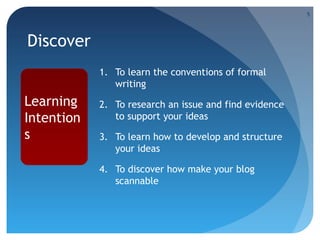
Discover
1. To learn the conventions of formal
writing

Learning
Intention
s

2. To research an issue and find evidence
to support your ideas
3. To learn how to develop and structure
your ideas
4. To discover how make your blog
scannable
6

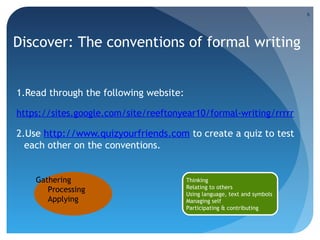
Discover: The conventions of formal writing
1.Read through the following website:
https://sites.google.com/site/reeftonyear10/formal-writing/rrrrr

2.Use http://www.quizyourfriends.com to create a quiz to test
each other on the conventions.

Gathering
Processing
Applying

Thinking
Relating to others
Using language, text and symbols
Managing self
Participating & contributing
7

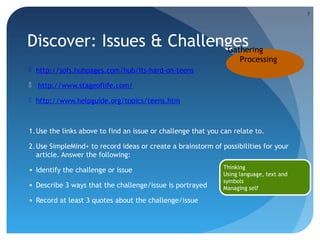
Discover: Issues & Challenges
Gathering
Processing
 http://sofs.hubpages.com/hub/Its-hard-on-teens
 http://www.stageoflife.com/
 http://www.helpguide.org/topics/teens.htm

1. Use the links above to find an issue or challenge that you can relate to.
2. Use SimpleMind+ to record ideas or create a brainstorm of possibilities for your
article. Answer the following:
• Identify the challenge or issue
• Describe 3 ways that the challenge/issue is portrayed
• Record at least 3 quotes about the challenge/issue

Thinking
Using language, text and
symbols
Managing self
8

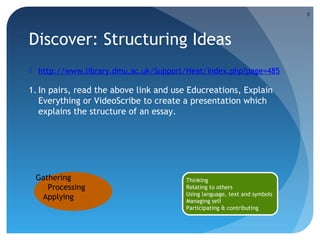
Discover: Structuring Ideas
 http://www.library.dmu.ac.uk/Support/Heat/index.php?page=485

1. In pairs, read the above link and use Educreations, Explain
Everything or VideoScribe to create a presentation which
explains the structure of an essay.

Gathering
Processing
Applying

Thinking
Relating to others
Using language, text and symbols
Managing self
Participating & contributing
9

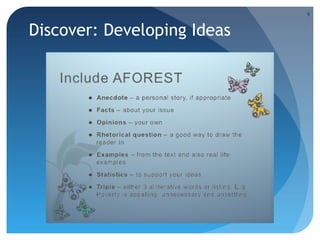
Discover: Developing Ideas
10

Discover: Make your blog scannable


http://www.problogger.net/archives/2006/02/20/scannable-content/

1. In pairs, read the above link to learn how to make
your blog easier to read and more appealing to the
reader.
2. List 5 ideas from the article that you will include
when you create your blog.
Gathering
Processing

Thinking
Relating to others
Using language, text and symbols
Managing self
Participating & contributing
11

Create: Time to write!
 Now that you have your information on what to write
and how to write, it’s time to get started.

Processing
Applying

Thinking
Using language, text and symbols
Managing self
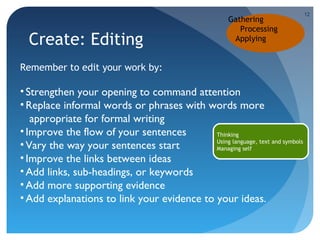
Create: Editing

Gathering
Processing
Applying

Remember to edit your work by:

• Strengthen your opening to command attention
• Replace informal words or phrases with words more
appropriate for formal writing
• Improve the flow of your sentences
Thinking
Using language, text and symbols
• Vary the way your sentences start
Managing self
• Improve the links between ideas
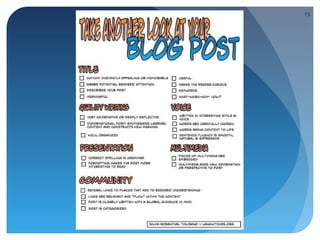
• Add links, sub-headings, or keywords
• Add more supporting evidence
• Add explanations to link your evidence to your ideas.

12
13
14

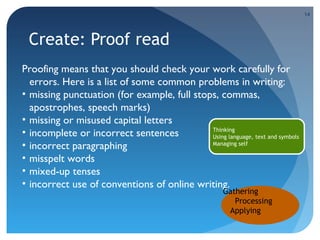
Create: Proof read
Proofing means that you should check your work carefully for
errors. Here is a list of some common problems in writing:
• missing punctuation (for example, full stops, commas,
apostrophes, speech marks)
• missing or misused capital letters
Thinking
• incomplete or incorrect sentences
Using language, text and symbols
Managing self
• incorrect paragraphing
• misspelt words
• mixed-up tenses
• incorrect use of conventions of online writing.
Gathering
Processing
Applying
15
16

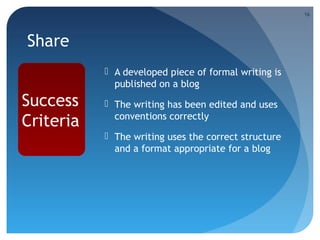
Share
 A developed piece of formal writing is
published on a blog

Success
Criteria

 The writing has been edited and uses
conventions correctly
 The writing uses the correct structure
and a format appropriate for a blog
17

Reflect

Processing
Applying

Thinking
Using language, text and symbols
Managing self

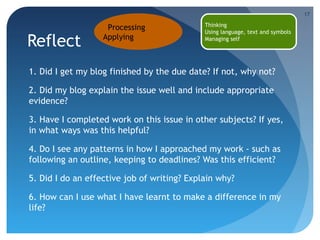
1. Did I get my blog finished by the due date? If not, why not?
2. Did my blog explain the issue well and include appropriate
evidence?
3. Have I completed work on this issue in other subjects? If yes,
in what ways was this helpful?
4. Do I see any patterns in how I approached my work - such as
following an outline, keeping to deadlines? Was this efficient?
5. Did I do an effective job of writing? Explain why?
6. How can I use what I have learnt to make a difference in my
life?
18

Bibliography
 Adapted from NZQA task
 peterpappas.com
 http://www.problogger.net/archives/2006/02/20/scannablecontent/
 http://www.library.dmu.ac.uk/Support/Heat/index.php?page=485
 http://sofs.hubpages.com/hub/Its-hard-on-teens
 http://www.stageoflife.com/
• https://sites.google.com/site/reeftonyear10/formal-writing/
• http://www.quizyourfriends.com
• pinterest.com

1.5 Formal Writing

  • 1.
    Overcoming Challenges Year 11Formal Writing 1.5 3 credits Updated for use with 1:1 devices 2014 Christine Wells
  • 2.
    2 Your Mission…  Thisassessment activity requires you to write a formal opinion article of at least 350 words.  You will be given a list of issues to choose from.  Your audience will be other students, staff, and the wider community.  Your writing will be published on your blog.
  • 3.
    3 Project Based Learning 1. Openended driving question or challenge 2. Creates a need to know essential content & skills 3. Covers significant content 4. Requires inquiry to learn and create something new 5. 21st Century skills: collaboration, critical thinking, communication and creativity 6. Allows student voice and choice 7. Revision and reflection 8. Create a product to share publicly
  • 4.
    4 Driving Question How canwe share our challenges in a formal and engaging way?
  • 5.
    5 Discover 1. To learnthe conventions of formal writing Learning Intention s 2. To research an issue and find evidence to support your ideas 3. To learn how to develop and structure your ideas 4. To discover how make your blog scannable
  • 6.
    6 Discover: The conventionsof formal writing 1.Read through the following website: https://sites.google.com/site/reeftonyear10/formal-writing/rrrrr 2.Use http://www.quizyourfriends.com to create a quiz to test each other on the conventions. Gathering Processing Applying Thinking Relating to others Using language, text and symbols Managing self Participating & contributing
  • 7.
    7 Discover: Issues &Challenges Gathering Processing  http://sofs.hubpages.com/hub/Its-hard-on-teens  http://www.stageoflife.com/  http://www.helpguide.org/topics/teens.htm 1. Use the links above to find an issue or challenge that you can relate to. 2. Use SimpleMind+ to record ideas or create a brainstorm of possibilities for your article. Answer the following: • Identify the challenge or issue • Describe 3 ways that the challenge/issue is portrayed • Record at least 3 quotes about the challenge/issue Thinking Using language, text and symbols Managing self
  • 8.
    8 Discover: Structuring Ideas http://www.library.dmu.ac.uk/Support/Heat/index.php?page=485 1. In pairs, read the above link and use Educreations, Explain Everything or VideoScribe to create a presentation which explains the structure of an essay. Gathering Processing Applying Thinking Relating to others Using language, text and symbols Managing self Participating & contributing
  • 9.
  • 10.
    10 Discover: Make yourblog scannable  http://www.problogger.net/archives/2006/02/20/scannable-content/ 1. In pairs, read the above link to learn how to make your blog easier to read and more appealing to the reader. 2. List 5 ideas from the article that you will include when you create your blog. Gathering Processing Thinking Relating to others Using language, text and symbols Managing self Participating & contributing
  • 11.
    11 Create: Time towrite!  Now that you have your information on what to write and how to write, it’s time to get started. Processing Applying Thinking Using language, text and symbols Managing self
  • 12.
    Create: Editing Gathering Processing Applying Remember toedit your work by: • Strengthen your opening to command attention • Replace informal words or phrases with words more appropriate for formal writing • Improve the flow of your sentences Thinking Using language, text and symbols • Vary the way your sentences start Managing self • Improve the links between ideas • Add links, sub-headings, or keywords • Add more supporting evidence • Add explanations to link your evidence to your ideas. 12
  • 13.
  • 14.
    14 Create: Proof read Proofingmeans that you should check your work carefully for errors. Here is a list of some common problems in writing: • missing punctuation (for example, full stops, commas, apostrophes, speech marks) • missing or misused capital letters Thinking • incomplete or incorrect sentences Using language, text and symbols Managing self • incorrect paragraphing • misspelt words • mixed-up tenses • incorrect use of conventions of online writing. Gathering Processing Applying
  • 15.
  • 16.
    16 Share  A developedpiece of formal writing is published on a blog Success Criteria  The writing has been edited and uses conventions correctly  The writing uses the correct structure and a format appropriate for a blog
  • 17.
    17 Reflect Processing Applying Thinking Using language, textand symbols Managing self 1. Did I get my blog finished by the due date? If not, why not? 2. Did my blog explain the issue well and include appropriate evidence? 3. Have I completed work on this issue in other subjects? If yes, in what ways was this helpful? 4. Do I see any patterns in how I approached my work - such as following an outline, keeping to deadlines? Was this efficient? 5. Did I do an effective job of writing? Explain why? 6. How can I use what I have learnt to make a difference in my life?
  • 18.
    18 Bibliography  Adapted fromNZQA task  peterpappas.com  http://www.problogger.net/archives/2006/02/20/scannablecontent/  http://www.library.dmu.ac.uk/Support/Heat/index.php?page=485  http://sofs.hubpages.com/hub/Its-hard-on-teens  http://www.stageoflife.com/ • https://sites.google.com/site/reeftonyear10/formal-writing/ • http://www.quizyourfriends.com • pinterest.com