Research on Mobile Learning
Scenarios in Science
Education in Europe
Dr. Eugenijus Kurilovas, Vilnius University: Centre for IT in Education, Lithuania
Virginija Bireniene, Klaipeda Simon Dach pro-gymnasium; Centre for IT in
Education, Lithuania

Florence, 21-22 October 2013
Outline
•

The aim of the paper

•

Related works. Personalisation & tablets based
learning activities

•

Research methodology
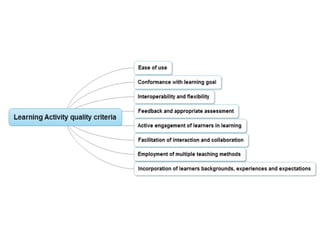
• Interconnections
• Learning activity quality criteria
• Multiple criteria decision analysis

•

Results and discussion

•

Conclusion and future research
The aim of the
paper
The paper aims to present current research on mobile learning
scenarios / activities in science education in Europe
Contribution:
1)

Comparison of quality: mobile tablet based learner centred
learning activities incl. learning personalisation, problem
solving, Web 2.0 enhanced collaboration, and flipped class
methods Vs traditional teacher centred knowledge
transmission learning activities

2)

Method of expert evaluation of learning activities based on
multiple criteria decision analysis and Fuzzy methods and its
experimental application
Related Works
•

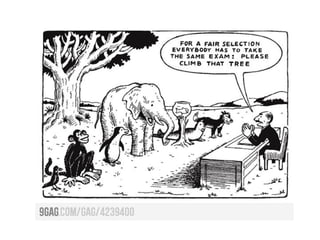
Personalised learning approach is much more
effective in comparison with traditional “one size
fits all’ approach

•

We use personalisation according to students
learning styles:
–

Activists

–

Reflectors

–

Pragmatists

–

Theorists
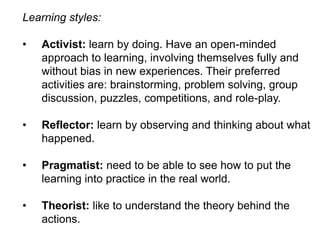
Learning styles:
•

Activist: learn by doing. Have an open-minded
approach to learning, involving themselves fully and
without bias in new experiences. Their preferred
activities are: brainstorming, problem solving, group
discussion, puzzles, competitions, and role-play.

•

Reflector: learn by observing and thinking about what
happened.

•

Pragmatist: need to be able to see how to put the
learning into practice in the real world.

•

Theorist: like to understand the theory behind the
actions.
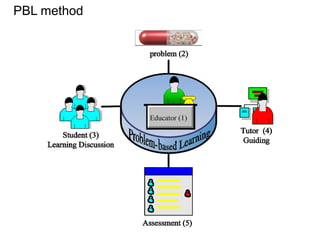
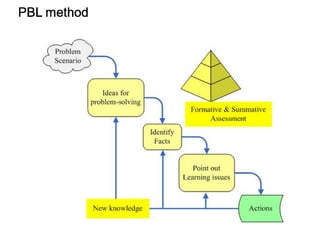
PBL method
Problem based learning method:
1.

Discussing the problem scenario in the groups, which
promotes communication skills and cooperative learning

2.

Brainstorming ideas to cross the learning boundaries, which
promotes creative learning and knowledge integration

3.

Identifying the learning issues for research, which promotes
active learning and critical thinking

4.

Research to construct the action plans, which promotes new
knowledge development

5.

Reporting the research findings to the groups, which
promotes peer-to-peer learning to complete the final products
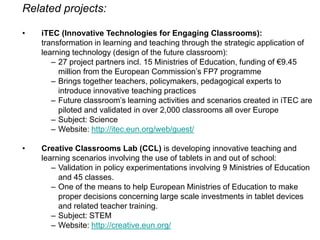
Related projects:
•

iTEC (Innovative Technologies for Engaging Classrooms):
transformation in learning and teaching through the strategic application of
learning technology (design of the future classroom):
– 27 project partners incl. 15 Ministries of Education, funding of €9.45
million from the European Commission’s FP7 programme
– Brings together teachers, policymakers, pedagogical experts to
introduce innovative teaching practices
– Future classroom’s learning activities and scenarios created in iTEC are
piloted and validated in over 2,000 classrooms all over Europe
– Subject: Science
– Website: http://itec.eun.org/web/guest/

•

Creative Classrooms Lab (CCL) is developing innovative teaching and
learning scenarios involving the use of tablets in and out of school:
– Validation in policy experimentations involving 9 Ministries of Education
and 45 classes.
– One of the means to help European Ministries of Education to make
proper decisions concerning large scale investments in tablet devices
and related teacher training.
– Subject: STEM
– Website: http://creative.eun.org/
Research
methodology
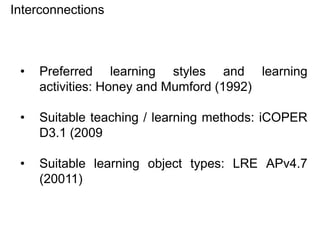
Interconnections

•

Preferred learning styles and learning
activities: Honey and Mumford (1992)

•

Suitable teaching / learning methods: iCOPER
D3.1 (2009

•

Suitable learning object types: LRE APv4.7
(20011)
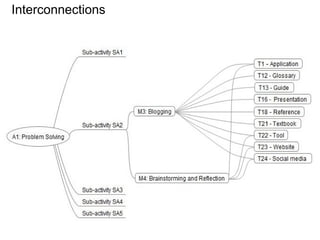
Interconnections
Interconnections

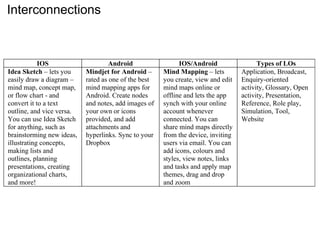
IOS
Idea Sketch – lets you
easily draw a diagram –
mind map, concept map,
or flow chart - and
convert it to a text
outline, and vice versa.
You can use Idea Sketch
for anything, such as
brainstorming new ideas,
illustrating concepts,
making lists and
outlines, planning
presentations, creating
organizational charts,
and more!

Android
Mindjet for Android –
rated as one of the best
mind mapping apps for
Android. Create nodes
and notes, add images of
your own or icons
provided, and add
attachments and
hyperlinks. Sync to your
Dropbox

IOS/Android
Mind Mapping – lets
you create, view and edit
mind maps online or
offline and lets the app
synch with your online
account whenever
connected. You can
share mind maps directly
from the device, inviting
users via email. You can
add icons, colours and
styles, view notes, links
and tasks and apply map
themes, drag and drop
and zoom

Types of LOs
Application, Broadcast,
Enquiry-oriented
activity, Glossary, Open
activity, Presentation,
Reference, Role play,
Simulation, Tool,
Website
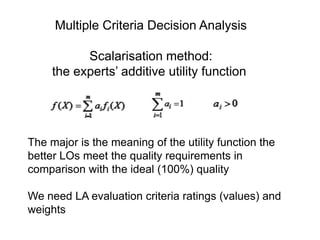
Multiple Criteria Decision Analysis

Scalarisation method:
the experts’ additive utility function

The major is the meaning of the utility function the
better LOs meet the quality requirements in
comparison with the ideal (100%) quality
We need LA evaluation criteria ratings (values) and
weights
Results and
discussion
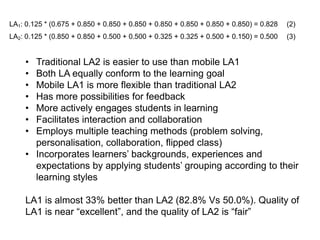
LA1: 0.125 * (0.675 + 0.850 + 0.850 + 0.850 + 0.850 + 0.850 + 0.850 + 0.850) = 0.828

(2)

LA2: 0.125 * (0.850 + 0.850 + 0.500 + 0.500 + 0.325 + 0.325 + 0.500 + 0.150) = 0.500

(3)

•
•
•
•
•
•
•

Traditional LA2 is easier to use than mobile LA1
Both LA equally conform to the learning goal
Mobile LA1 is more flexible than traditional LA2
Has more possibilities for feedback
More actively engages students in learning
Facilitates interaction and collaboration
Employs multiple teaching methods (problem solving,
personalisation, collaboration, flipped class)
• Incorporates learners’ backgrounds, experiences and
expectations by applying students’ grouping according to their
learning styles
LA1 is almost 33% better than LA2 (82.8% Vs 50.0%). Quality of
LA1 is near “excellent”, and the quality of LA2 is “fair”
• Mobile LA1 are extremely useful for Activists and Pragmatists:
• Why: Activists learn by doing and their preferred activities are
brainstorming, problem solving, group discussion, puzzles,
competitions, and role-play, mobile learning activities based
on problem solving, personalisation, collaboration, and flipped
class should be very valuable for them. The same is true for
Pragmatists since they need to be able to see how to put the
learning into practice in the real world
• LA1 are also useful for Reflectors
• Why: Reflectors preferred activities are paired discussions,
self analysis questionnaires, personality questionnaires, time
out, observing activities, feedback from others, coaching, and
interviews
• LA1 have only minor additive value to Theorists
• Why: Theorists like to understand the theory behind the
actions
Conclusion and
future research
•

Mobile learning activities based on problem solving,
personalisation, collaboration, and flipped class are
more flexible than traditional ones, they have more
possibilities for feedback, more actively engage
students in learning, facilitate interaction and
collaboration, employ multiple teaching methods,
and incorporate learners’ backgrounds, experiences
and expectations

•

Mobile learning activities using tablet devices could
have a noticeable additive value for Activists and
Pragmatists, and they could be also useful for
Reflectors, but they have only minor additive value
for Theorists
Future research:
• Full interconnections incl. tablet
apps
• Ontologies
Thank you for your
attention !!!
Questions ?
Eugenijus Kurilovas Eugenijus.Kurilovas@itc.smm.lt
Virginija Bireniene Virginija.Bireniene@gmail.com

14.30 kurilovas bireniene

  • 1.
    Research on MobileLearning Scenarios in Science Education in Europe Dr. Eugenijus Kurilovas, Vilnius University: Centre for IT in Education, Lithuania Virginija Bireniene, Klaipeda Simon Dach pro-gymnasium; Centre for IT in Education, Lithuania Florence, 21-22 October 2013
  • 2.
    Outline • The aim ofthe paper • Related works. Personalisation & tablets based learning activities • Research methodology • Interconnections • Learning activity quality criteria • Multiple criteria decision analysis • Results and discussion • Conclusion and future research
  • 3.
    The aim ofthe paper
  • 4.
    The paper aimsto present current research on mobile learning scenarios / activities in science education in Europe Contribution: 1) Comparison of quality: mobile tablet based learner centred learning activities incl. learning personalisation, problem solving, Web 2.0 enhanced collaboration, and flipped class methods Vs traditional teacher centred knowledge transmission learning activities 2) Method of expert evaluation of learning activities based on multiple criteria decision analysis and Fuzzy methods and its experimental application
  • 5.
  • 6.
    • Personalised learning approachis much more effective in comparison with traditional “one size fits all’ approach • We use personalisation according to students learning styles: – Activists – Reflectors – Pragmatists – Theorists
  • 7.
    Learning styles: • Activist: learnby doing. Have an open-minded approach to learning, involving themselves fully and without bias in new experiences. Their preferred activities are: brainstorming, problem solving, group discussion, puzzles, competitions, and role-play. • Reflector: learn by observing and thinking about what happened. • Pragmatist: need to be able to see how to put the learning into practice in the real world. • Theorist: like to understand the theory behind the actions.
  • 9.
  • 11.
    Problem based learningmethod: 1. Discussing the problem scenario in the groups, which promotes communication skills and cooperative learning 2. Brainstorming ideas to cross the learning boundaries, which promotes creative learning and knowledge integration 3. Identifying the learning issues for research, which promotes active learning and critical thinking 4. Research to construct the action plans, which promotes new knowledge development 5. Reporting the research findings to the groups, which promotes peer-to-peer learning to complete the final products
  • 12.
    Related projects: • iTEC (InnovativeTechnologies for Engaging Classrooms): transformation in learning and teaching through the strategic application of learning technology (design of the future classroom): – 27 project partners incl. 15 Ministries of Education, funding of €9.45 million from the European Commission’s FP7 programme – Brings together teachers, policymakers, pedagogical experts to introduce innovative teaching practices – Future classroom’s learning activities and scenarios created in iTEC are piloted and validated in over 2,000 classrooms all over Europe – Subject: Science – Website: http://itec.eun.org/web/guest/ • Creative Classrooms Lab (CCL) is developing innovative teaching and learning scenarios involving the use of tablets in and out of school: – Validation in policy experimentations involving 9 Ministries of Education and 45 classes. – One of the means to help European Ministries of Education to make proper decisions concerning large scale investments in tablet devices and related teacher training. – Subject: STEM – Website: http://creative.eun.org/
  • 13.
  • 14.
    Interconnections • Preferred learning stylesand learning activities: Honey and Mumford (1992) • Suitable teaching / learning methods: iCOPER D3.1 (2009 • Suitable learning object types: LRE APv4.7 (20011)
  • 15.
  • 16.
    Interconnections IOS Idea Sketch –lets you easily draw a diagram – mind map, concept map, or flow chart - and convert it to a text outline, and vice versa. You can use Idea Sketch for anything, such as brainstorming new ideas, illustrating concepts, making lists and outlines, planning presentations, creating organizational charts, and more! Android Mindjet for Android – rated as one of the best mind mapping apps for Android. Create nodes and notes, add images of your own or icons provided, and add attachments and hyperlinks. Sync to your Dropbox IOS/Android Mind Mapping – lets you create, view and edit mind maps online or offline and lets the app synch with your online account whenever connected. You can share mind maps directly from the device, inviting users via email. You can add icons, colours and styles, view notes, links and tasks and apply map themes, drag and drop and zoom Types of LOs Application, Broadcast, Enquiry-oriented activity, Glossary, Open activity, Presentation, Reference, Role play, Simulation, Tool, Website
  • 18.
    Multiple Criteria DecisionAnalysis Scalarisation method: the experts’ additive utility function The major is the meaning of the utility function the better LOs meet the quality requirements in comparison with the ideal (100%) quality We need LA evaluation criteria ratings (values) and weights
  • 19.
  • 20.
    LA1: 0.125 *(0.675 + 0.850 + 0.850 + 0.850 + 0.850 + 0.850 + 0.850 + 0.850) = 0.828 (2) LA2: 0.125 * (0.850 + 0.850 + 0.500 + 0.500 + 0.325 + 0.325 + 0.500 + 0.150) = 0.500 (3) • • • • • • • Traditional LA2 is easier to use than mobile LA1 Both LA equally conform to the learning goal Mobile LA1 is more flexible than traditional LA2 Has more possibilities for feedback More actively engages students in learning Facilitates interaction and collaboration Employs multiple teaching methods (problem solving, personalisation, collaboration, flipped class) • Incorporates learners’ backgrounds, experiences and expectations by applying students’ grouping according to their learning styles LA1 is almost 33% better than LA2 (82.8% Vs 50.0%). Quality of LA1 is near “excellent”, and the quality of LA2 is “fair”
  • 21.
    • Mobile LA1are extremely useful for Activists and Pragmatists: • Why: Activists learn by doing and their preferred activities are brainstorming, problem solving, group discussion, puzzles, competitions, and role-play, mobile learning activities based on problem solving, personalisation, collaboration, and flipped class should be very valuable for them. The same is true for Pragmatists since they need to be able to see how to put the learning into practice in the real world • LA1 are also useful for Reflectors • Why: Reflectors preferred activities are paired discussions, self analysis questionnaires, personality questionnaires, time out, observing activities, feedback from others, coaching, and interviews • LA1 have only minor additive value to Theorists • Why: Theorists like to understand the theory behind the actions
  • 22.
  • 23.
    • Mobile learning activitiesbased on problem solving, personalisation, collaboration, and flipped class are more flexible than traditional ones, they have more possibilities for feedback, more actively engage students in learning, facilitate interaction and collaboration, employ multiple teaching methods, and incorporate learners’ backgrounds, experiences and expectations • Mobile learning activities using tablet devices could have a noticeable additive value for Activists and Pragmatists, and they could be also useful for Reflectors, but they have only minor additive value for Theorists
  • 24.
    Future research: • Fullinterconnections incl. tablet apps • Ontologies
  • 25.
    Thank you foryour attention !!! Questions ? Eugenijus Kurilovas Eugenijus.Kurilovas@itc.smm.lt Virginija Bireniene Virginija.Bireniene@gmail.com