An Infrastructure for Sustainable
Innovation and Research
in Computer Science Education
Peter Brusilovsky
School of Computing and Information
University of Pittsburgh, USA
Overview
• What is SPLICE
• Who we are
• Our goals
• Our activities
What is SPLICE?
• Standards, Protocols, and Learning Infrastructure for
Computing Education
• Mission:
• Bring together like-minded people interested in CSEd
Infrastructure issues
• Facilitate planning and developing infrastructure components
• Support the CS Education and Data Analytics community by
supplying information to help with adopting shared standards,
protocols, and tools
• SPLICE is
• A Project
• A Community
• A Set of Activities
Who We Are?
• NSF supported project: “Collaborative Research:
Community-Building and Infrastructure Design for
Data-Intensive Research in Computer Science
Education”
• Peter Brusilovsky, University of Pittsburgh
• Ken Koedinger, Carnegie Mellon University
• Cliff Shaffer and Steve Edwards, Virginia Tech
• Supporters and old collaborators who helped to
generate the vision and worked with us in the past
• Larger community formed through workshops and
collaborative efforts
What are the Goals?
We promote:
• Development and broader re-use of innovative
learning content that is instrumented for rich data
collection;
• Infrastructures that faciltitate re-use of multiple
kinds of smart content and collection of rich flow of
learner data
• Standard formats for learner data collection and
storage
• Reusable approaches and tools for analysis of
learner data
PART I: Content Interoperability
and Integration
• Vision
• A variety of educational content and learner tools available for use
by instructors with easy integration into delivery platform of choice
(LMS, interactive textbook, practice system)
• Course authors and instructors could select and structure tools and
content to support their approach to learning
• Learner interaction with content and tools generate rich flow of data
• Actions
• Collecting and promoting best practices in multi-content and tool
integration
• Collecting and promoting various types of smart content and tools
• Bringing teams together to explore interoperability (grants, WGs)
• Informing community about existing interoperability approaches,
discussing what do we really need
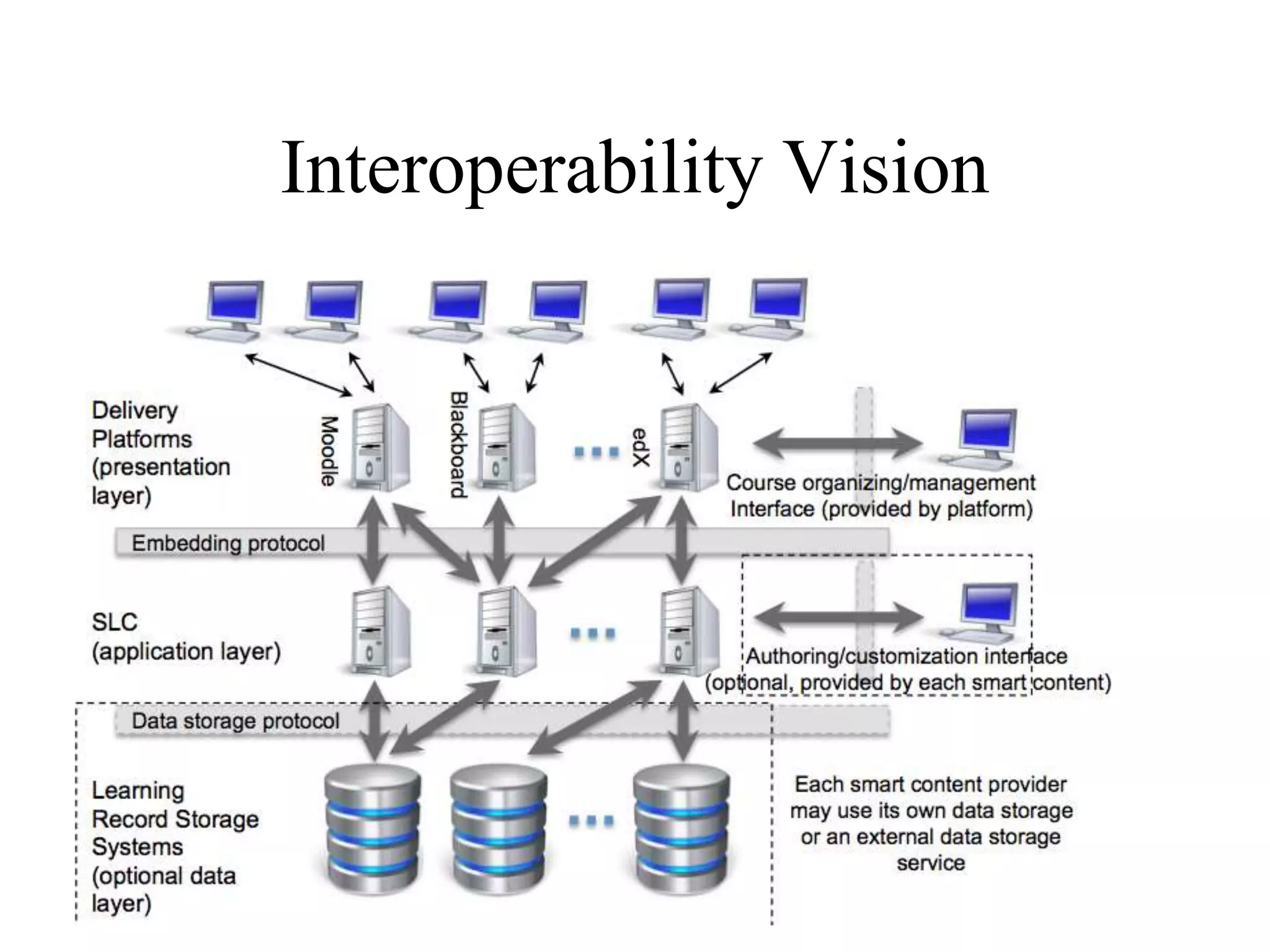
Interoperability Vision
PART II: Data Collection and
Storage
• Vision
• The ability to collect rich flow of data generated by learners
working with multiple types of learning content and tools
• Limited set of data formats that allows broader re-use of
analytic tools and approaches
• A set of archives where collected data are shared to the various
interested parties
• Actions
• Bringing teams together to discuss what kind of data could be
collected and explore data interoperability
• Developing data collection and storage standards
• Informing community about existing data interoperability
approaches and standards
PART III: Data Access and
Analysis
• Vision
• Data standards for data archival
• Data archives for broader re-use of collected data
• Access rights and privacy management
• A broad set of reusable data analysis approaches that could be
applied to existing data
• Actions
• Collecting and storing sample datasets for shared analysis
• data challenges
• Collecting best practices of CS data analysis (what and how
we can learn)
• Developing shared data archives (LearnSphere)
• Developing infrastructure for data analysis (Tigris)
• Developing re-usable data analysis and approaches
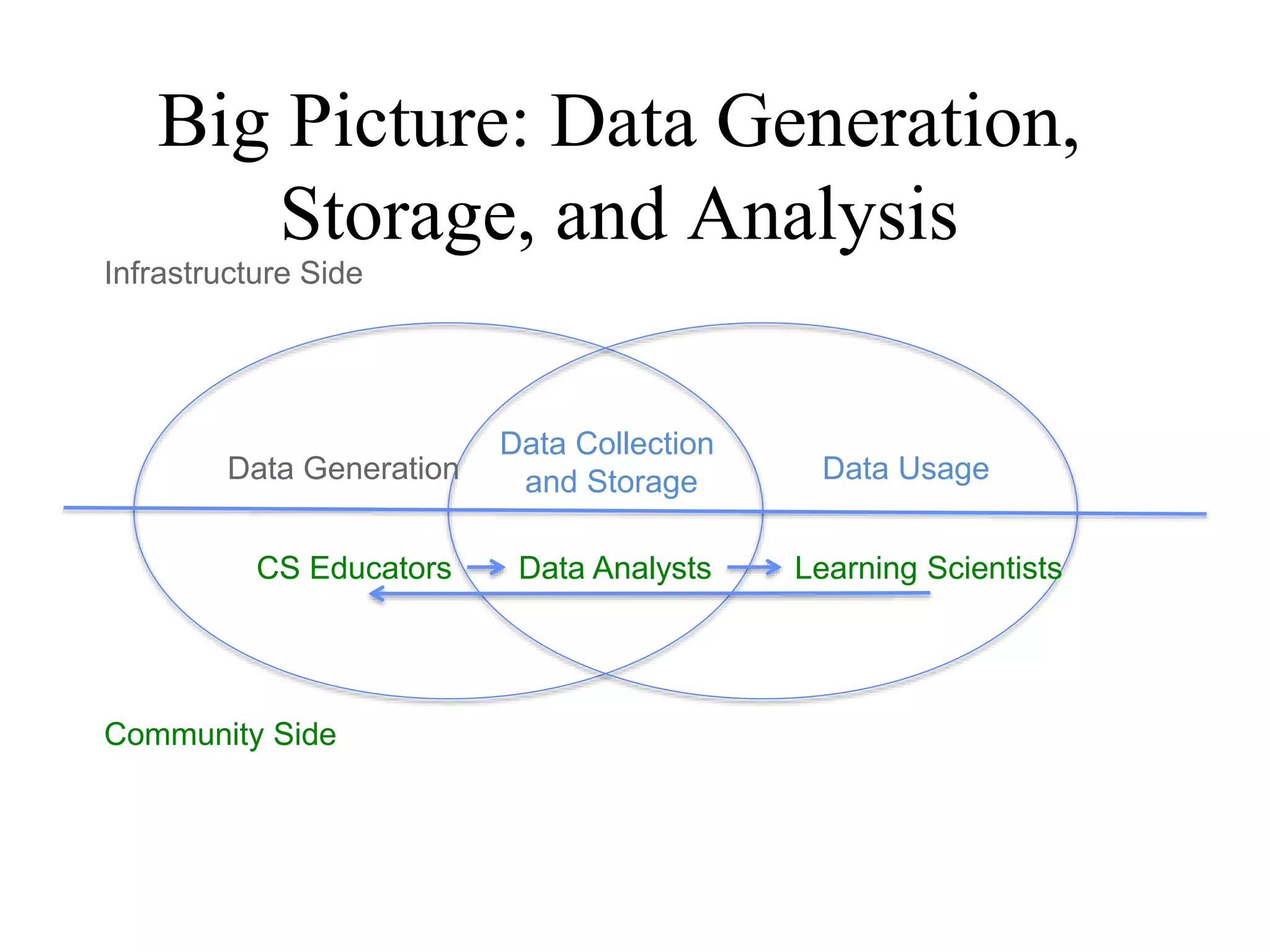
Big Picture: Data Generation,
Storage, and Analysis
Infrastructure Side
Community Side
Data Generation
Data Collection
and Storage Data Usage
CS Educators Data Analysts Learning Scientists
What Have We Accomplished So
Far? Information Sharing
• Website: https://cssplice.github.io
• Tutorials: LTI (Caliper coming soon)
• Best practices (integration and smart content)
• Workshop materials
• GitHub project
• Google Group (please, join!)
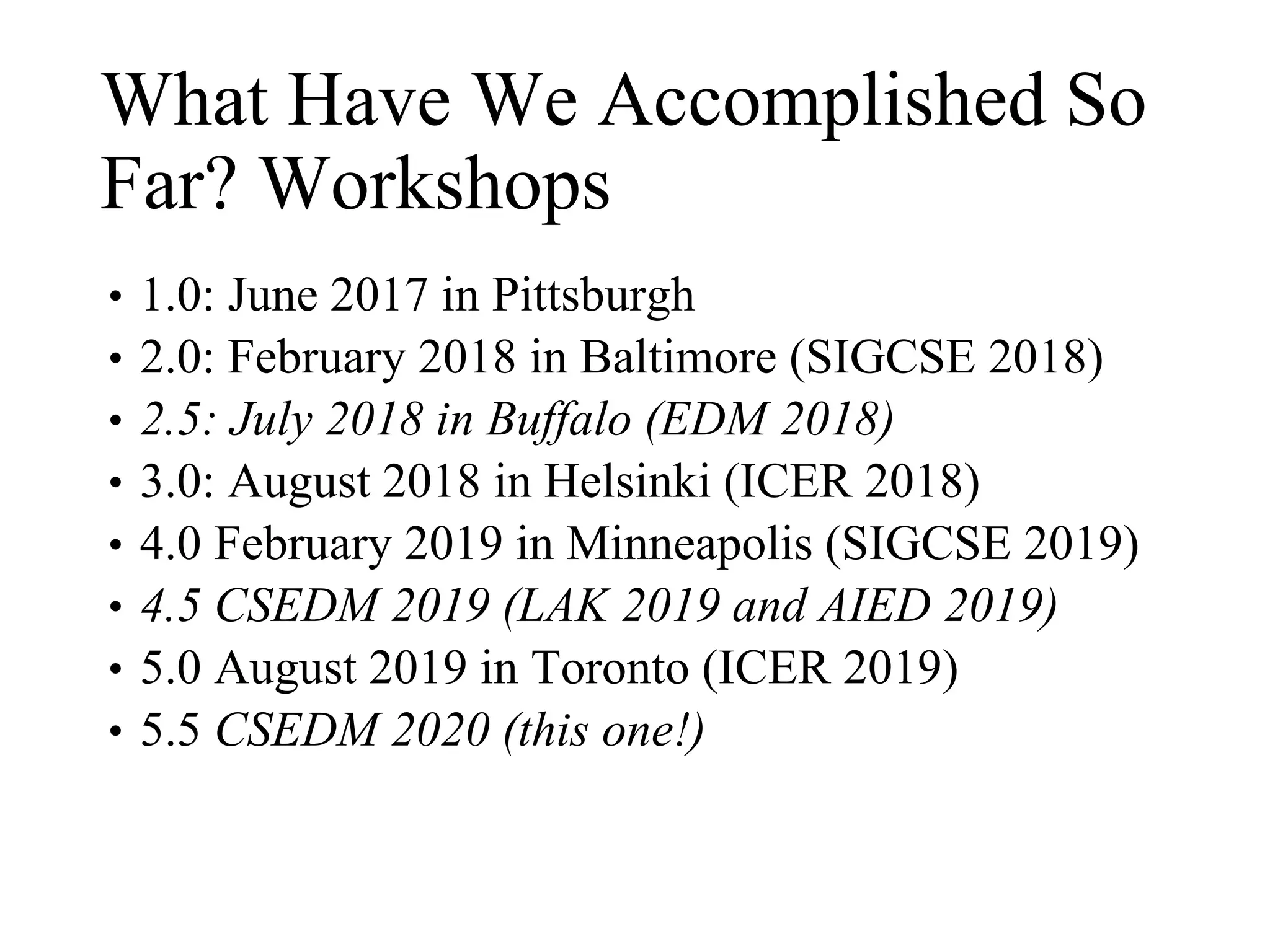
What Have We Accomplished So
Far? Workshops
• 1.0: June 2017 in Pittsburgh
• 2.0: February 2018 in Baltimore (SIGCSE 2018)
• 2.5: July 2018 in Buffalo (EDM 2018)
• 3.0: August 2018 in Helsinki (ICER 2018)
• 4.0 February 2019 in Minneapolis (SIGCSE 2019)
• 4.5 CSEDM 2019 (LAK 2019 and AIED 2019)
• 5.0 August 2019 in Toronto (ICER 2019)
• 5.5 CSEDM 2020 (this one!)
What Have We Accomplished So
Far? WGs and Collaborations
• Working Groups
– Small Code Snapshots. Leaders: Dave Hovemeyer and Kelly
Rivers.
– Programming Exercise Markup Language. Leaders: Phill
Conrad, Cory Bart, and Stephen Edwards.
– Packaging Curricular Materials. Leaders: Cory Bart, Phill
Conrad, Michael Hilton, Bob Edmison.
• Interested to create another one?
Join and Contribute
• Everyone is welcome to contribute!
• Join a Working group
• Contribute smart content
• Reuse smart content and run studies
• Apply for funding!
• Website: https://cssplice.github.io
• Tutorials: LTI (Caliper coming soon)
• Examples of smart learning content
• Examples of integration architectures
• Working group information
• GitHub project
• Google Group (please, join!)
Small team funding
• We support small projects with budgets $5K-$15K
• Focus on collaborative prohects of at least two teams,
but single teams also eligible
• Main goals
– Create shareable smart content
– Collect a useful dataset and upload it in a standard format to
DataShop
– Develop a reusable data mining approach for LearnSphere
• We already support a number of 2-team collaborations
• Apply by sending e-mail to peterb@pitt.edu

An Infrastructure for Sustainable Innovation and Research in Computer Science Education

  • 1.
    An Infrastructure forSustainable Innovation and Research in Computer Science Education Peter Brusilovsky School of Computing and Information University of Pittsburgh, USA
  • 2.
    Overview • What isSPLICE • Who we are • Our goals • Our activities
  • 3.
    What is SPLICE? •Standards, Protocols, and Learning Infrastructure for Computing Education • Mission: • Bring together like-minded people interested in CSEd Infrastructure issues • Facilitate planning and developing infrastructure components • Support the CS Education and Data Analytics community by supplying information to help with adopting shared standards, protocols, and tools • SPLICE is • A Project • A Community • A Set of Activities
  • 4.
    Who We Are? •NSF supported project: “Collaborative Research: Community-Building and Infrastructure Design for Data-Intensive Research in Computer Science Education” • Peter Brusilovsky, University of Pittsburgh • Ken Koedinger, Carnegie Mellon University • Cliff Shaffer and Steve Edwards, Virginia Tech • Supporters and old collaborators who helped to generate the vision and worked with us in the past • Larger community formed through workshops and collaborative efforts
  • 5.
    What are theGoals? We promote: • Development and broader re-use of innovative learning content that is instrumented for rich data collection; • Infrastructures that faciltitate re-use of multiple kinds of smart content and collection of rich flow of learner data • Standard formats for learner data collection and storage • Reusable approaches and tools for analysis of learner data
  • 6.
    PART I: ContentInteroperability and Integration • Vision • A variety of educational content and learner tools available for use by instructors with easy integration into delivery platform of choice (LMS, interactive textbook, practice system) • Course authors and instructors could select and structure tools and content to support their approach to learning • Learner interaction with content and tools generate rich flow of data • Actions • Collecting and promoting best practices in multi-content and tool integration • Collecting and promoting various types of smart content and tools • Bringing teams together to explore interoperability (grants, WGs) • Informing community about existing interoperability approaches, discussing what do we really need
  • 7.
  • 8.
    PART II: DataCollection and Storage • Vision • The ability to collect rich flow of data generated by learners working with multiple types of learning content and tools • Limited set of data formats that allows broader re-use of analytic tools and approaches • A set of archives where collected data are shared to the various interested parties • Actions • Bringing teams together to discuss what kind of data could be collected and explore data interoperability • Developing data collection and storage standards • Informing community about existing data interoperability approaches and standards
  • 9.
    PART III: DataAccess and Analysis • Vision • Data standards for data archival • Data archives for broader re-use of collected data • Access rights and privacy management • A broad set of reusable data analysis approaches that could be applied to existing data • Actions • Collecting and storing sample datasets for shared analysis • data challenges • Collecting best practices of CS data analysis (what and how we can learn) • Developing shared data archives (LearnSphere) • Developing infrastructure for data analysis (Tigris) • Developing re-usable data analysis and approaches
  • 10.
    Big Picture: DataGeneration, Storage, and Analysis Infrastructure Side Community Side Data Generation Data Collection and Storage Data Usage CS Educators Data Analysts Learning Scientists
  • 11.
    What Have WeAccomplished So Far? Information Sharing • Website: https://cssplice.github.io • Tutorials: LTI (Caliper coming soon) • Best practices (integration and smart content) • Workshop materials • GitHub project • Google Group (please, join!)
  • 12.
    What Have WeAccomplished So Far? Workshops • 1.0: June 2017 in Pittsburgh • 2.0: February 2018 in Baltimore (SIGCSE 2018) • 2.5: July 2018 in Buffalo (EDM 2018) • 3.0: August 2018 in Helsinki (ICER 2018) • 4.0 February 2019 in Minneapolis (SIGCSE 2019) • 4.5 CSEDM 2019 (LAK 2019 and AIED 2019) • 5.0 August 2019 in Toronto (ICER 2019) • 5.5 CSEDM 2020 (this one!)
  • 13.
    What Have WeAccomplished So Far? WGs and Collaborations • Working Groups – Small Code Snapshots. Leaders: Dave Hovemeyer and Kelly Rivers. – Programming Exercise Markup Language. Leaders: Phill Conrad, Cory Bart, and Stephen Edwards. – Packaging Curricular Materials. Leaders: Cory Bart, Phill Conrad, Michael Hilton, Bob Edmison. • Interested to create another one?
  • 14.
    Join and Contribute •Everyone is welcome to contribute! • Join a Working group • Contribute smart content • Reuse smart content and run studies • Apply for funding! • Website: https://cssplice.github.io • Tutorials: LTI (Caliper coming soon) • Examples of smart learning content • Examples of integration architectures • Working group information • GitHub project • Google Group (please, join!)
  • 15.
    Small team funding •We support small projects with budgets $5K-$15K • Focus on collaborative prohects of at least two teams, but single teams also eligible • Main goals – Create shareable smart content – Collect a useful dataset and upload it in a standard format to DataShop – Develop a reusable data mining approach for LearnSphere • We already support a number of 2-team collaborations • Apply by sending e-mail to peterb@pitt.edu