International
Comparative Studies in
School Digitalization
Shimpei TOYOFUKU
GLOCOM IUJ
Critical Gap between Home and School
Students using PC
in home
80.8%
5-6 Gr. Female
Students Own
Mobile Phone
59.0%
Students Own
Potable Game
Machine
73.3%
Forced Hand Writing
Printed Matters in vain
No e-mail No SNS
http://www.hakuhodody-
media.co.jp/newsrelease/report/20120725_6344.html
Survey for Elementary School Children in 2012
Behind 20 years 
Why Japanese schools are negative for digitalization ?
How to change our system by learning from uniqueness
of Scandinavian countries ?
Companies are heating up
for ICT use in home education
Young Edu-Tech Companies
JP School systems
http://www.mext.go.jp/english/introduction/1303952.htm
JP General Statistics
Population 127,130,000
E gr.1-6 J gr.7-9 H gr.10-12 Total
Schools 21,131 10,628 4,981 36,740
Students 6,676,920 3,536,182 3,319,640 13,532,742
Teachers 417,553 254,235 235,062 906,850
e-stat http://www.e-stat.go.jp/ population 2014.03 / education stats 2013.04
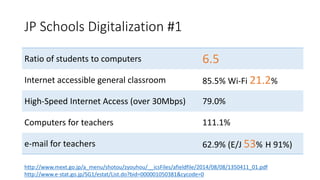
JP Schools Digitalization #1
http://www.mext.go.jp/a_menu/shotou/zyouhou/__icsFiles/afieldfile/2014/08/08/1350411_01.pdf
http://www.e-stat.go.jp/SG1/estat/List.do?bid=000001050381&cycode=0
Ratio of students to computers 6.5
Internet accessible general classroom 85.5% Wi-Fi 21.2%
High-Speed Internet Access (over 30Mbps) 79.0%
Computers for teachers 111.1%
e-mail for teachers 62.9% (E/J 53% H 91%)
JP Schools Digitalization #2
http://www.mext.go.jp/a_menu/shotou/zyouhou/__icsFiles/afieldfile/2014/08/08/1350411_01.pdf
http://www.e-stat.go.jp/SG1/estat/List.do?bid=000001050381&cycode=0
IWB : Interactive White Board 76.4% 2.2 /school
OHC : Over Head Camera 4.4 /school
Tablet PC for instruction 2.0 /school
System for office-work in school 80.3%
General ICT Teaching Set in Class / Netherlands 2010
Suspended
Projector
Desktop PC
for teacher
Fixed IWB
Temporary ICT Teaching Set in Class / model case in Japan 2012
Temporary
Screen
Temporary
Note-PC &
Projector
Digital Environment in school
JP FI/DK/SE
Facilities
Computers in general class
No
Only 1 PC room in
school
Yes
Projector, Screen or IWB Temporary
Need to set up
Fixed
Ready to use
Platform
Services
Website, Blogs or CMS Yes Yes
e-mail for students No Yes
SNS for Students & Parents No Yes
Difference of Teaching & Learning Style
99.2 99.1 98.9 98.7 98.5
97.1
94.5
83.5
81.4
DK FI NL NO SE AU OECD
average
KR JP
Percentage of students who use a desktop,
laptop or tablet computer at home
94 94
92
89
88 87
72
60
43
NL AU NO FI SE DK OECD
average
JP KR
Percentage of students who use a desktop,
laptop, or tablet computer at school
PISA 2012 Results: Skills for Life (Volume V): Student Performance in Problem Solving - © OECD 2014
Light Blue Items means No significance in test score between groups
Even if the model case …
• 21st Century Skills & Key
Competencies
• Digital Textbook
• Tablet PC and Wi-Fi
• Mooc and Flipped Classroom
• Collaborative Learning
Even if the model case …
JP FI/DK/SE
Smart Device Ownership / Control
Teaching
Material
Learners’
Stationary
Digitalized Textbook Reference
A part of
Learning
Resources
In-class Central Control /
Screen Sharing System
Yes No
Cloud Service to mobile their own work
(ex. Google Apps for Edu)
No Yes
Ethis class / 6 grade in 2013
Over 80% in lesson tablets are shut down by teacher
Students must do quickly simple tasks given by teacher
Japanese Teachers want use
ICT as Something Special Magic Wand
• Rarely use computers in regular classes
• Assign short work time to do simple task
• All works & items are completed in one-shot class
•Teaching Items – Black Board or Video
• Teaching Machine – Drill and Practice for Bottoming up results
• Method to Control Students’ Behavior
• Cause high stress on teachers
FI/DK/SE Case studies show
ICT is the Air to breeze for better learning
• Using for daily life including learning in school
• Long enough work time for projects in class
• Sharing items through cloud between members
•Environment for Knowledge Creation
• Notes and Stationaries for learners
• Guaranteed their own space
• Effect for Writing, Editing, Composing Abilities
Why JP Schools are Negative for Digitalization?
Thinkable some reasons #1
• Hand Writing Religion
• Over 3000 Kanji characters to learn
• First Japanese Word Processor was
released in 1978
Why JP Schools are Negative for Digitalization?
Thinkable some reasons #2
• Printed Matter Lovers
• High Speed Replicators
• Low-Cost / Low Quality
Why JP Schools are Negative for Digitalization?
Thinkable some reasons #3
• Teaching > Learning
• Finely defined national curriculum
• Getting class period competition between subjects
• Putting more amount of knowledge to learn
• Restricted school autonomy for managing curriculum
• National authorization system of textbooks
Free of charge textbook in mandatory education
How to change JP education system ?
• New Concept for Education
• 21st Century Skills & Key Competencies
• And learn from whole school education style
• Not only from hardware / service environment
• Also from Curriculum, Philosophy and School Management

International Comparative Studies in School Digitalization

  • 1.
    International Comparative Studies in SchoolDigitalization Shimpei TOYOFUKU GLOCOM IUJ
  • 2.
    Critical Gap betweenHome and School Students using PC in home 80.8% 5-6 Gr. Female Students Own Mobile Phone 59.0% Students Own Potable Game Machine 73.3% Forced Hand Writing Printed Matters in vain No e-mail No SNS http://www.hakuhodody- media.co.jp/newsrelease/report/20120725_6344.html Survey for Elementary School Children in 2012
  • 3.
    Behind 20 years Why Japanese schools are negative for digitalization ? How to change our system by learning from uniqueness of Scandinavian countries ?
  • 4.
    Companies are heatingup for ICT use in home education
  • 5.
  • 6.
  • 7.
    JP General Statistics Population127,130,000 E gr.1-6 J gr.7-9 H gr.10-12 Total Schools 21,131 10,628 4,981 36,740 Students 6,676,920 3,536,182 3,319,640 13,532,742 Teachers 417,553 254,235 235,062 906,850 e-stat http://www.e-stat.go.jp/ population 2014.03 / education stats 2013.04
  • 8.
    JP Schools Digitalization#1 http://www.mext.go.jp/a_menu/shotou/zyouhou/__icsFiles/afieldfile/2014/08/08/1350411_01.pdf http://www.e-stat.go.jp/SG1/estat/List.do?bid=000001050381&cycode=0 Ratio of students to computers 6.5 Internet accessible general classroom 85.5% Wi-Fi 21.2% High-Speed Internet Access (over 30Mbps) 79.0% Computers for teachers 111.1% e-mail for teachers 62.9% (E/J 53% H 91%)
  • 9.
    JP Schools Digitalization#2 http://www.mext.go.jp/a_menu/shotou/zyouhou/__icsFiles/afieldfile/2014/08/08/1350411_01.pdf http://www.e-stat.go.jp/SG1/estat/List.do?bid=000001050381&cycode=0 IWB : Interactive White Board 76.4% 2.2 /school OHC : Over Head Camera 4.4 /school Tablet PC for instruction 2.0 /school System for office-work in school 80.3%
  • 10.
    General ICT TeachingSet in Class / Netherlands 2010 Suspended Projector Desktop PC for teacher Fixed IWB
  • 11.
    Temporary ICT TeachingSet in Class / model case in Japan 2012 Temporary Screen Temporary Note-PC & Projector
  • 12.
    Digital Environment inschool JP FI/DK/SE Facilities Computers in general class No Only 1 PC room in school Yes Projector, Screen or IWB Temporary Need to set up Fixed Ready to use Platform Services Website, Blogs or CMS Yes Yes e-mail for students No Yes SNS for Students & Parents No Yes
  • 13.
    Difference of Teaching& Learning Style 99.2 99.1 98.9 98.7 98.5 97.1 94.5 83.5 81.4 DK FI NL NO SE AU OECD average KR JP Percentage of students who use a desktop, laptop or tablet computer at home 94 94 92 89 88 87 72 60 43 NL AU NO FI SE DK OECD average JP KR Percentage of students who use a desktop, laptop, or tablet computer at school PISA 2012 Results: Skills for Life (Volume V): Student Performance in Problem Solving - © OECD 2014 Light Blue Items means No significance in test score between groups
  • 14.
    Even if themodel case … • 21st Century Skills & Key Competencies • Digital Textbook • Tablet PC and Wi-Fi • Mooc and Flipped Classroom • Collaborative Learning
  • 15.
    Even if themodel case … JP FI/DK/SE Smart Device Ownership / Control Teaching Material Learners’ Stationary Digitalized Textbook Reference A part of Learning Resources In-class Central Control / Screen Sharing System Yes No Cloud Service to mobile their own work (ex. Google Apps for Edu) No Yes
  • 16.
    Ethis class /6 grade in 2013 Over 80% in lesson tablets are shut down by teacher
  • 17.
    Students must doquickly simple tasks given by teacher
  • 18.
    Japanese Teachers wantuse ICT as Something Special Magic Wand • Rarely use computers in regular classes • Assign short work time to do simple task • All works & items are completed in one-shot class •Teaching Items – Black Board or Video • Teaching Machine – Drill and Practice for Bottoming up results • Method to Control Students’ Behavior • Cause high stress on teachers
  • 19.
    FI/DK/SE Case studiesshow ICT is the Air to breeze for better learning • Using for daily life including learning in school • Long enough work time for projects in class • Sharing items through cloud between members •Environment for Knowledge Creation • Notes and Stationaries for learners • Guaranteed their own space • Effect for Writing, Editing, Composing Abilities
  • 20.
    Why JP Schoolsare Negative for Digitalization? Thinkable some reasons #1 • Hand Writing Religion • Over 3000 Kanji characters to learn • First Japanese Word Processor was released in 1978
  • 21.
    Why JP Schoolsare Negative for Digitalization? Thinkable some reasons #2 • Printed Matter Lovers • High Speed Replicators • Low-Cost / Low Quality
  • 22.
    Why JP Schoolsare Negative for Digitalization? Thinkable some reasons #3 • Teaching > Learning • Finely defined national curriculum • Getting class period competition between subjects • Putting more amount of knowledge to learn • Restricted school autonomy for managing curriculum • National authorization system of textbooks Free of charge textbook in mandatory education
  • 23.
    How to changeJP education system ? • New Concept for Education • 21st Century Skills & Key Competencies • And learn from whole school education style • Not only from hardware / service environment • Also from Curriculum, Philosophy and School Management