Big Data
The 5 Vs
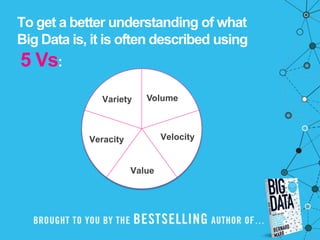
To get a better understanding of what
Big Data is, it is often described using
5 Vs:
Velocity
VolumeVariety
Veracity
Value
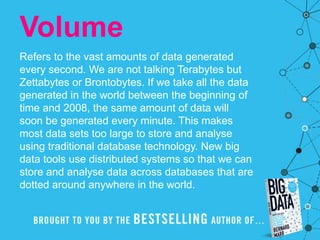
Volume
Refers to the vast amounts of data generated
every second. We are not talking Terabytes but
Zettabytes or Brontobytes. If we take all the data
generated in the world between the beginning of
time and 2008, the same amount of data will
soon be generated every minute. This makes
most data sets too large to store and analyse
using traditional database technology. New big
data tools use distributed systems so that we can
store and analyse data across databases that are
dotted around anywhere in the world.
Variety
Refers to the different types of data we can now
use. In the past we only focused on structured
data that neatly fitted into tables or relational
databases, such as financial data. In fact, 80% of
the world’s data is unstructured (text, images,
video, voice, etc.) With big data technology we
can now analyse and bring together data of
different types such as messages, social media
conversations, photos, sensor data, video or
voice recordings.
Velocity
Refers to the speed at which new data is
generated and the speed at which data
moves around. Just think of social media
messages going viral in seconds.
Technology allows us now to analyse the
data while it is being generated
(sometimes referred to as in-memory
analytics), without ever putting it into
databases.
Veracity
refers to the messiness or trustworthiness
of the data. With many forms of big data,
quality and accuracy are less controllable
(just think of Twitter posts with hash tags,
abbreviations, typos and colloquial speech
as well as the reliability and accuracy of
content) but big data and analytics
technology now allows us to work with
these type of data. The volumes often
make up for the lack of quality or
accuracy.
Value
Then there is another V to take into
account when looking at Big Data:
Value!
Having access to big data is no good
unless we can turn it into value.
Companies are starting to generate
amazing value from their big data.
We currently only see the
beginnings of a
transformation into a big data
economy. Any business that
doesn’t seriously consider the
implications of Big Data runs
the risk of being left behind.
Big Data - The 5 Vs Everyone Must Know

Big Data - The 5 Vs Everyone Must Know

  • 1.
  • 2.
    To get abetter understanding of what Big Data is, it is often described using 5 Vs: Velocity VolumeVariety Veracity Value
  • 3.
    Volume Refers to thevast amounts of data generated every second. We are not talking Terabytes but Zettabytes or Brontobytes. If we take all the data generated in the world between the beginning of time and 2008, the same amount of data will soon be generated every minute. This makes most data sets too large to store and analyse using traditional database technology. New big data tools use distributed systems so that we can store and analyse data across databases that are dotted around anywhere in the world.
  • 4.
    Variety Refers to thedifferent types of data we can now use. In the past we only focused on structured data that neatly fitted into tables or relational databases, such as financial data. In fact, 80% of the world’s data is unstructured (text, images, video, voice, etc.) With big data technology we can now analyse and bring together data of different types such as messages, social media conversations, photos, sensor data, video or voice recordings.
  • 5.
    Velocity Refers to thespeed at which new data is generated and the speed at which data moves around. Just think of social media messages going viral in seconds. Technology allows us now to analyse the data while it is being generated (sometimes referred to as in-memory analytics), without ever putting it into databases.
  • 6.
    Veracity refers to themessiness or trustworthiness of the data. With many forms of big data, quality and accuracy are less controllable (just think of Twitter posts with hash tags, abbreviations, typos and colloquial speech as well as the reliability and accuracy of content) but big data and analytics technology now allows us to work with these type of data. The volumes often make up for the lack of quality or accuracy.
  • 7.
    Value Then there isanother V to take into account when looking at Big Data: Value! Having access to big data is no good unless we can turn it into value. Companies are starting to generate amazing value from their big data.
  • 8.
    We currently onlysee the beginnings of a transformation into a big data economy. Any business that doesn’t seriously consider the implications of Big Data runs the risk of being left behind.