THE TOP 5 TECHNOLOGY
CHALLENGES IN 2023
© 2021 Bernard Marr, Bernard Marr & Co. All rights reserved
THE TOP 5 TECHNOLOGY CHALLENGES IN 2023
When it comes to technology, rapidly changing conditions pose
unprecedented challenges that must not be ignored. Learn the top 5 tech
challenges companies need to address to survive and thrive in 2023.
© 2021 Bernard Marr, Bernard Marr & Co. All rights reserved
As 2022 draws to a close, companies must forge a path in a market characterized by
unprecedented challenges and unbridled opportunities brought about by technology.
The Covid-19 pandemic has changed the landscape of the technological market,
accelerating demand for digital innovation and challenging even the most advanced
manufacturing facilities.
2023 brings a unique set of challenges to companies. Addressing these five key tech
challenges will distinguish the companies that survive - and thrive - from those that
fall by the wayside.
© 2021 Bernard Marr, Bernard Marr & Co. All rights reserved
1. SUPPLY CHAIN CHALLENGES
The Covid-19 pandemic continues to challenge global supply chains with bottlenecks,
delays, and disruptions; manufacturers and tech companies worldwide face a constant
struggle to source necessary parts and supplies.
One of the most severe challenges is the unprecedented shortage of semiconductors
(chips) and the resulting production delays across a swath of industries.
Early in the pandemic, chip manufacturers responded to changes in demand (specifically
reduced demand from automotive manufacturers and increased demand for consumer
electronics) and transitioned their production facilities to reflect these shifts.
© 2021 Bernard Marr, Bernard Marr & Co. All rights reserved
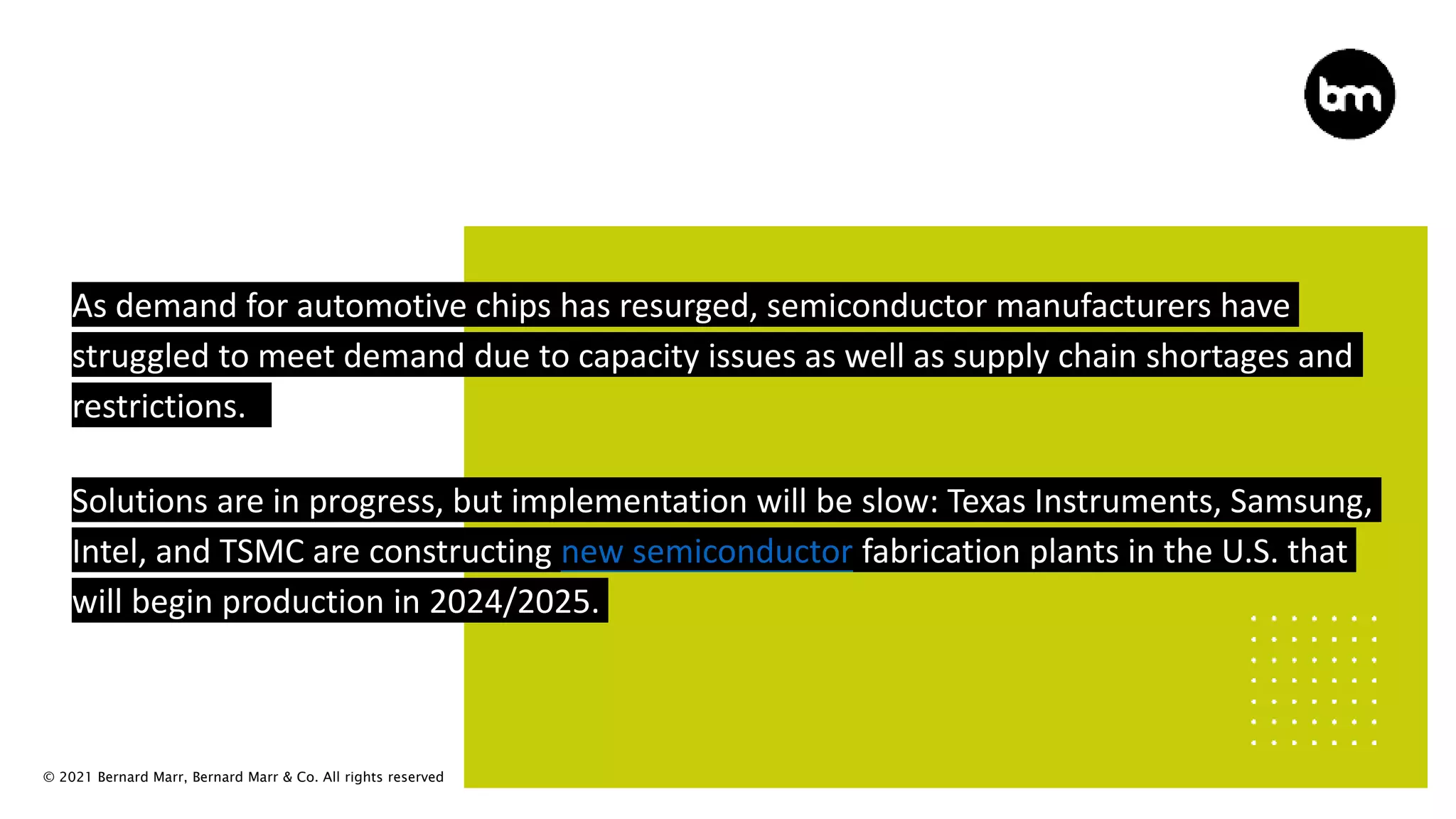
As demand for automotive chips has resurged, semiconductor manufacturers have
struggled to meet demand due to capacity issues as well as supply chain shortages and
restrictions.
Solutions are in progress, but implementation will be slow: Texas Instruments, Samsung,
Intel, and TSMC are constructing new semiconductor fabrication plants in the U.S. that
will begin production in 2024/2025.
© 2021 Bernard Marr, Bernard Marr & Co. All rights reserved
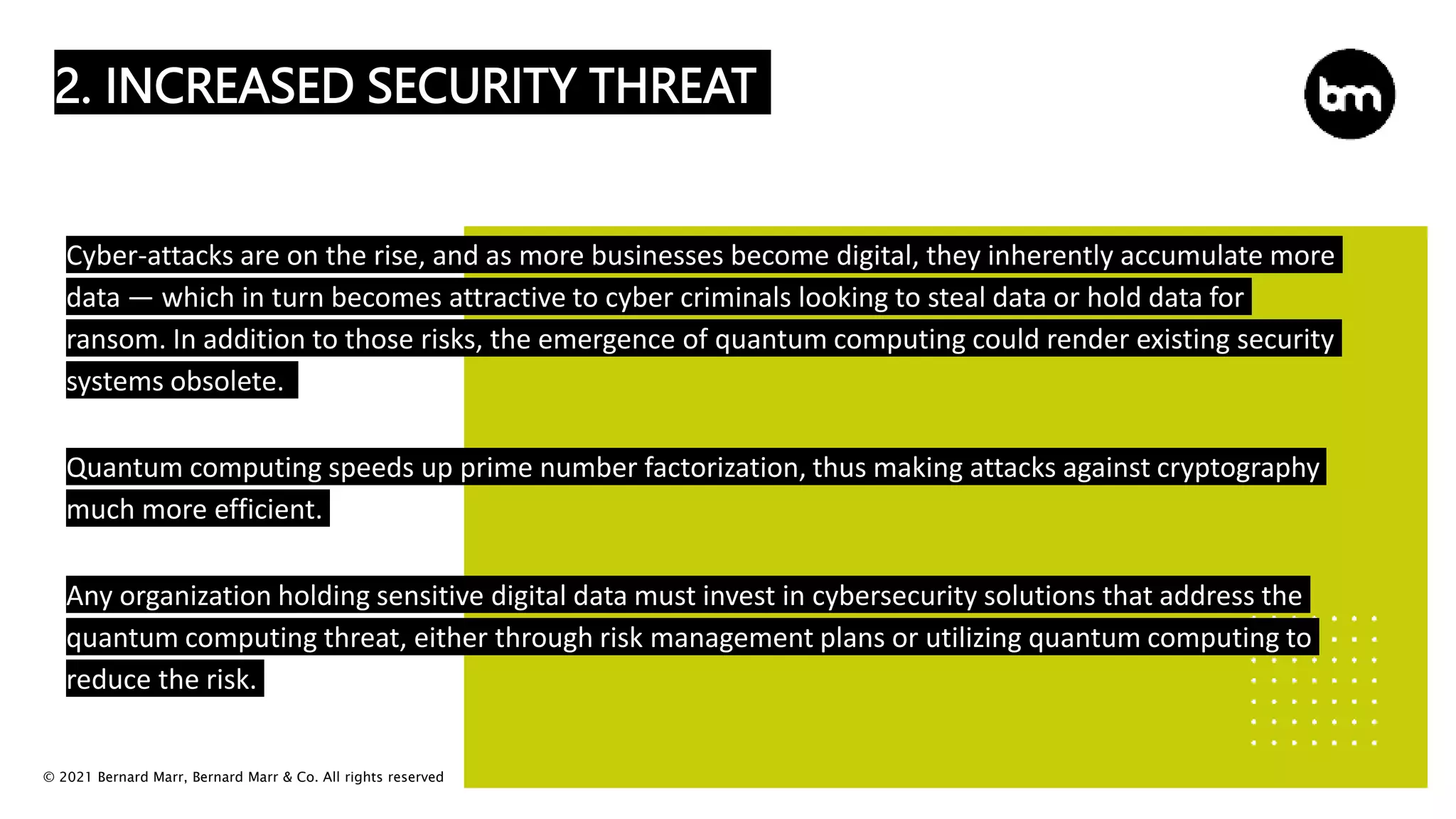
2. INCREASED SECURITY THREAT
Cyber-attacks are on the rise, and as more businesses become digital, they inherently accumulate more
data — which in turn becomes attractive to cyber criminals looking to steal data or hold data for
ransom. In addition to those risks, the emergence of quantum computing could render existing security
systems obsolete.
Quantum computing speeds up prime number factorization, thus making attacks against cryptography
much more efficient.
Any organization holding sensitive digital data must invest in cybersecurity solutions that address the
quantum computing threat, either through risk management plans or utilizing quantum computing to
reduce the risk.
© 2021 Bernard Marr, Bernard Marr & Co. All rights reserved
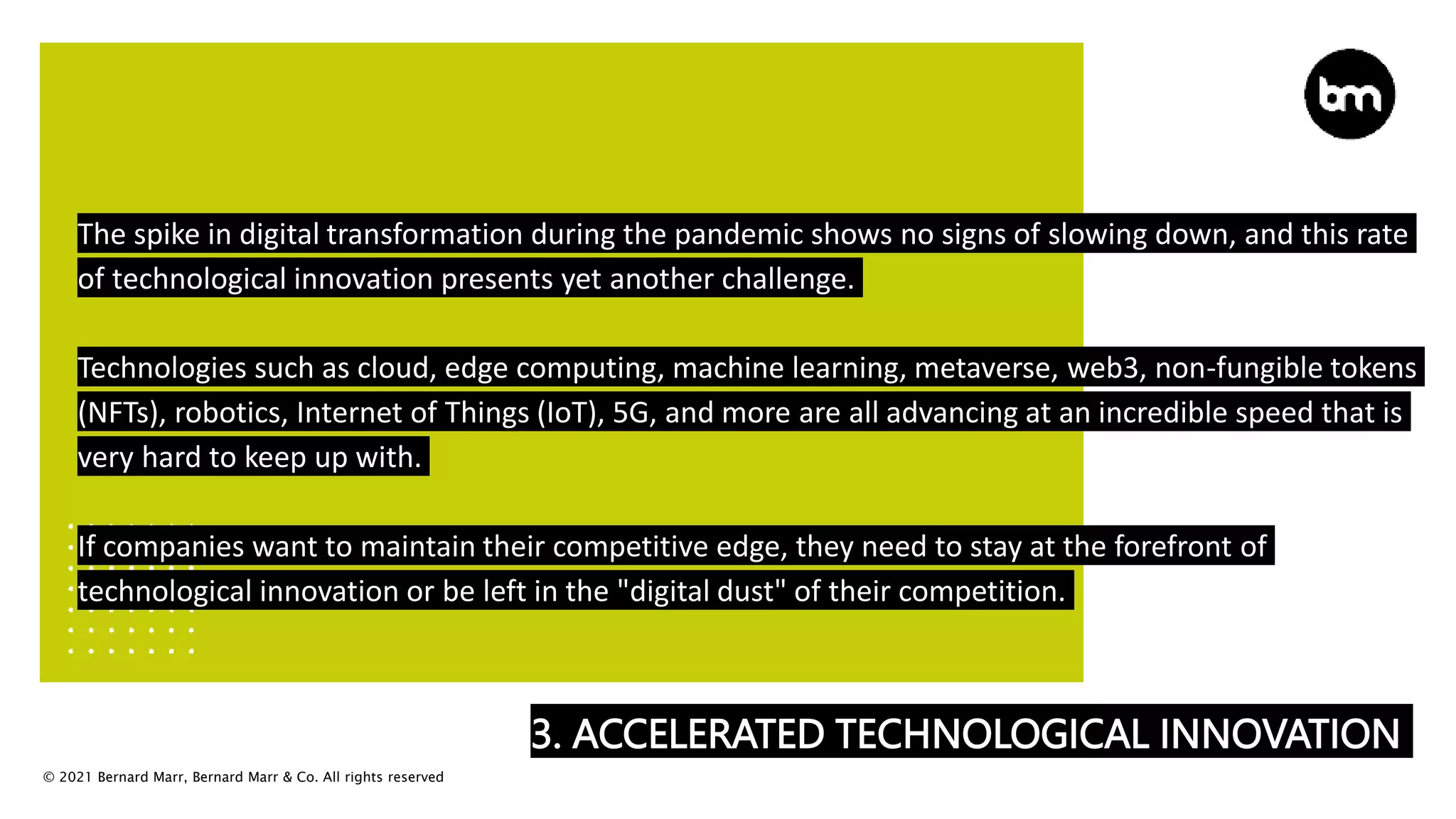
3. ACCELERATED TECHNOLOGICAL INNOVATION
The spike in digital transformation during the pandemic shows no signs of slowing down, and this rate
of technological innovation presents yet another challenge.
Technologies such as cloud, edge computing, machine learning, metaverse, web3, non-fungible tokens
(NFTs), robotics, Internet of Things (IoT), 5G, and more are all advancing at an incredible speed that is
very hard to keep up with.
If companies want to maintain their competitive edge, they need to stay at the forefront of
technological innovation or be left in the "digital dust" of their competition.
© 2021 Bernard Marr, Bernard Marr & Co. All rights reserved
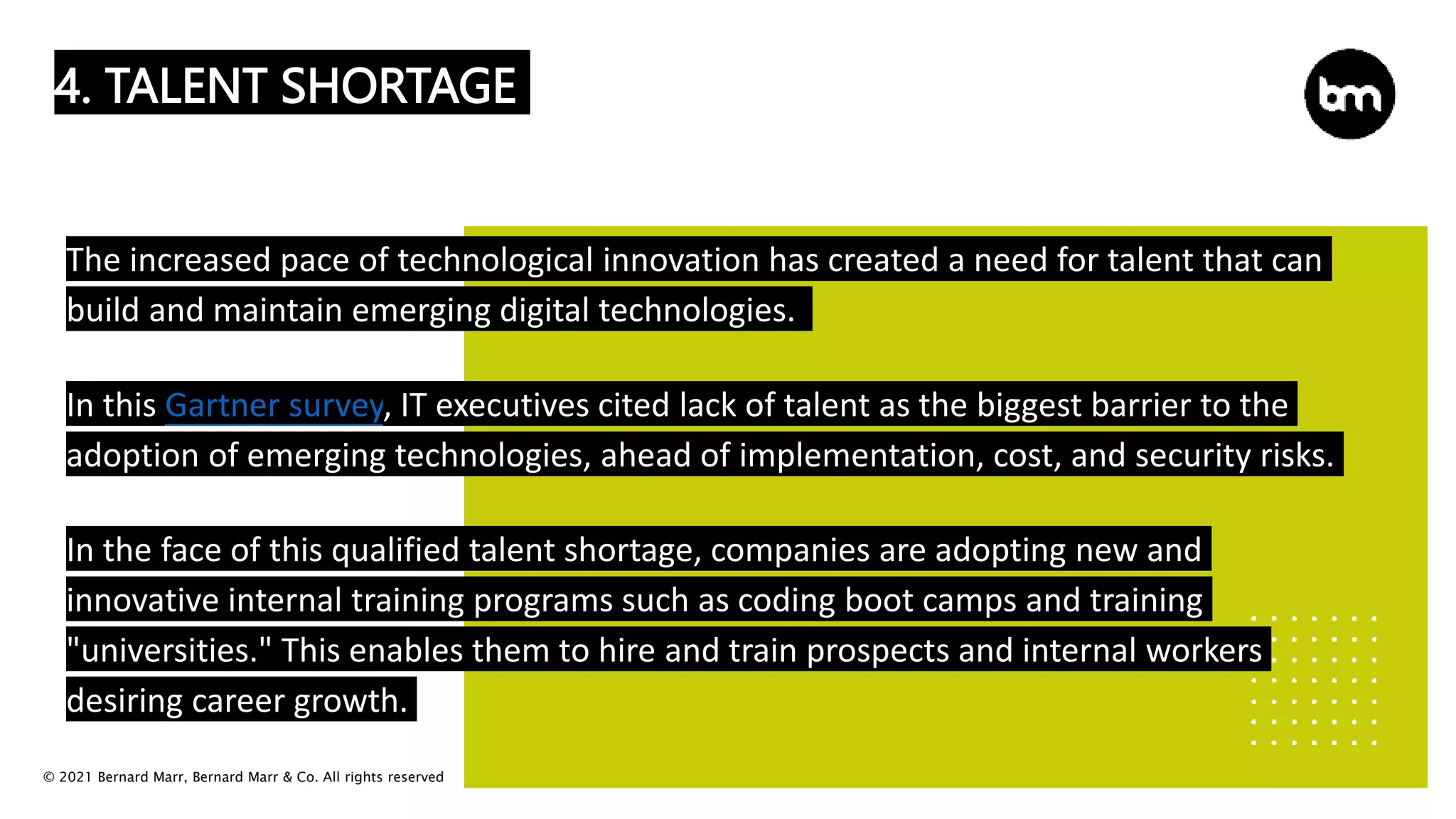
4. TALENT SHORTAGE
The increased pace of technological innovation has created a need for talent that can
build and maintain emerging digital technologies.
In this Gartner survey, IT executives cited lack of talent as the biggest barrier to the
adoption of emerging technologies, ahead of implementation, cost, and security risks.
In the face of this qualified talent shortage, companies are adopting new and
innovative internal training programs such as coding boot camps and training
"universities." This enables them to hire and train prospects and internal workers
desiring career growth.
© 2021 Bernard Marr, Bernard Marr & Co. All rights reserved
5. DEMAND FOR MORE SUSTAINABLE TECHNOLOGY
Sustainability is rapidly transitioning from the exception to the rule: consumer expectation
is rising, and sustainability is becoming a must-have in all aspects of business.
In 2023, consumers, business customers, and investors will increasingly demand
sustainable technology along with transparency. For example, as more companies re-
platform to the cloud, the environmental impact and energy usage can move out of sight.
In 2023, any negative environmental impact can no longer be ‘hidden in the cloud.’
© 2021 Bernard Marr, Bernard Marr & Co. All rights reserved
Companies need to use clean and sustainable technology at all levels, particularly in areas
with high resource usage, such as data centers and blockchains.
The technology industry’s explosive growth and rapidly changing landscape present significant
challenges to technological businesses.
Companies that want to survive this new and challenging market must proactively address
and prepare for the above challenges, monitor the industry to stay abreast of future
challenges and opportunities and continue to think outside the box to stay one step ahead of
the competition.
© 2021 Bernard Marr, Bernard Marr & Co. All rights reserved
To stay on top of the latest on new and emerging business and tech trends,
make sure to subscribe to my newsletter, follow me on Twitter, LinkedIn, and
YouTube, and check out my books ‘Tech Trends in Practice’ and ‘Business
Trends in Practice, which just won the 2022 Business Book of the Year award.
© 2021 Bernard Marr , Bernard Marr & Co. All rights reserved
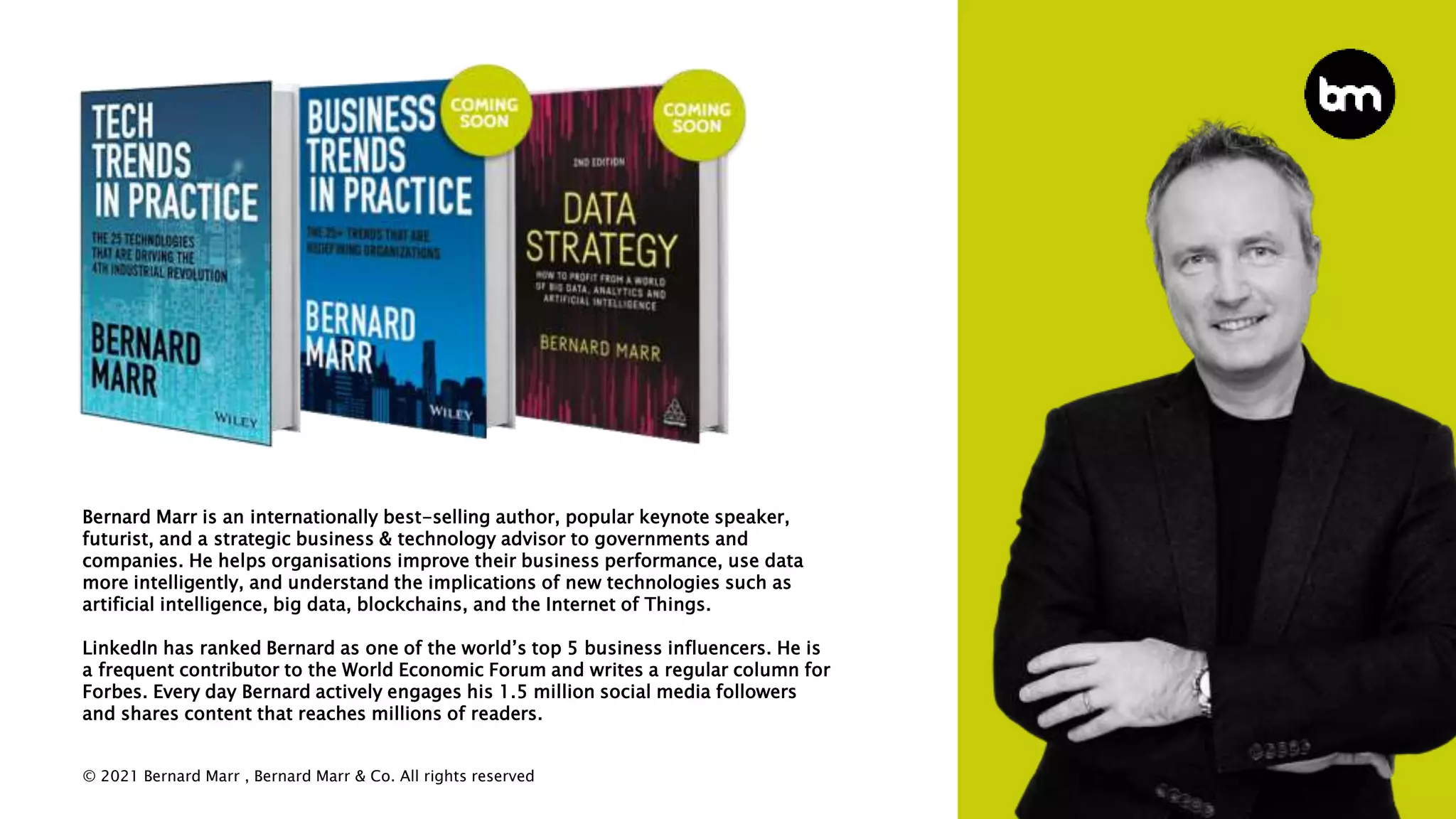
Bernard Marr is an internationally best-selling author, popular keynote speaker,
futurist, and a strategic business & technology advisor to governments and
companies. He helps organisations improve their business performance, use data
more intelligently, and understand the implications of new technologies such as
artificial intelligence, big data, blockchains, and the Internet of Things.
LinkedIn has ranked Bernard as one of the world’s top 5 business influencers. He is
a frequent contributor to the World Economic Forum and writes a regular column for
Forbes. Every day Bernard actively engages his 1.5 million social media followers
and shares content that reaches millions of readers.
hello@bernardmarr.com
www.bernardmarr.com

The Top 5 Technology Challenges In 2023

  • 1.
    THE TOP 5TECHNOLOGY CHALLENGES IN 2023
  • 2.
    © 2021 BernardMarr, Bernard Marr & Co. All rights reserved THE TOP 5 TECHNOLOGY CHALLENGES IN 2023 When it comes to technology, rapidly changing conditions pose unprecedented challenges that must not be ignored. Learn the top 5 tech challenges companies need to address to survive and thrive in 2023.
  • 3.
    © 2021 BernardMarr, Bernard Marr & Co. All rights reserved As 2022 draws to a close, companies must forge a path in a market characterized by unprecedented challenges and unbridled opportunities brought about by technology. The Covid-19 pandemic has changed the landscape of the technological market, accelerating demand for digital innovation and challenging even the most advanced manufacturing facilities. 2023 brings a unique set of challenges to companies. Addressing these five key tech challenges will distinguish the companies that survive - and thrive - from those that fall by the wayside.
  • 4.
    © 2021 BernardMarr, Bernard Marr & Co. All rights reserved 1. SUPPLY CHAIN CHALLENGES The Covid-19 pandemic continues to challenge global supply chains with bottlenecks, delays, and disruptions; manufacturers and tech companies worldwide face a constant struggle to source necessary parts and supplies. One of the most severe challenges is the unprecedented shortage of semiconductors (chips) and the resulting production delays across a swath of industries. Early in the pandemic, chip manufacturers responded to changes in demand (specifically reduced demand from automotive manufacturers and increased demand for consumer electronics) and transitioned their production facilities to reflect these shifts.
  • 5.
    © 2021 BernardMarr, Bernard Marr & Co. All rights reserved As demand for automotive chips has resurged, semiconductor manufacturers have struggled to meet demand due to capacity issues as well as supply chain shortages and restrictions. Solutions are in progress, but implementation will be slow: Texas Instruments, Samsung, Intel, and TSMC are constructing new semiconductor fabrication plants in the U.S. that will begin production in 2024/2025.
  • 6.
    © 2021 BernardMarr, Bernard Marr & Co. All rights reserved 2. INCREASED SECURITY THREAT Cyber-attacks are on the rise, and as more businesses become digital, they inherently accumulate more data — which in turn becomes attractive to cyber criminals looking to steal data or hold data for ransom. In addition to those risks, the emergence of quantum computing could render existing security systems obsolete. Quantum computing speeds up prime number factorization, thus making attacks against cryptography much more efficient. Any organization holding sensitive digital data must invest in cybersecurity solutions that address the quantum computing threat, either through risk management plans or utilizing quantum computing to reduce the risk.
  • 7.
    © 2021 BernardMarr, Bernard Marr & Co. All rights reserved 3. ACCELERATED TECHNOLOGICAL INNOVATION The spike in digital transformation during the pandemic shows no signs of slowing down, and this rate of technological innovation presents yet another challenge. Technologies such as cloud, edge computing, machine learning, metaverse, web3, non-fungible tokens (NFTs), robotics, Internet of Things (IoT), 5G, and more are all advancing at an incredible speed that is very hard to keep up with. If companies want to maintain their competitive edge, they need to stay at the forefront of technological innovation or be left in the "digital dust" of their competition.
  • 8.
    © 2021 BernardMarr, Bernard Marr & Co. All rights reserved 4. TALENT SHORTAGE The increased pace of technological innovation has created a need for talent that can build and maintain emerging digital technologies. In this Gartner survey, IT executives cited lack of talent as the biggest barrier to the adoption of emerging technologies, ahead of implementation, cost, and security risks. In the face of this qualified talent shortage, companies are adopting new and innovative internal training programs such as coding boot camps and training "universities." This enables them to hire and train prospects and internal workers desiring career growth.
  • 9.
    © 2021 BernardMarr, Bernard Marr & Co. All rights reserved 5. DEMAND FOR MORE SUSTAINABLE TECHNOLOGY Sustainability is rapidly transitioning from the exception to the rule: consumer expectation is rising, and sustainability is becoming a must-have in all aspects of business. In 2023, consumers, business customers, and investors will increasingly demand sustainable technology along with transparency. For example, as more companies re- platform to the cloud, the environmental impact and energy usage can move out of sight. In 2023, any negative environmental impact can no longer be ‘hidden in the cloud.’
  • 10.
    © 2021 BernardMarr, Bernard Marr & Co. All rights reserved Companies need to use clean and sustainable technology at all levels, particularly in areas with high resource usage, such as data centers and blockchains. The technology industry’s explosive growth and rapidly changing landscape present significant challenges to technological businesses. Companies that want to survive this new and challenging market must proactively address and prepare for the above challenges, monitor the industry to stay abreast of future challenges and opportunities and continue to think outside the box to stay one step ahead of the competition.
  • 11.
    © 2021 BernardMarr, Bernard Marr & Co. All rights reserved To stay on top of the latest on new and emerging business and tech trends, make sure to subscribe to my newsletter, follow me on Twitter, LinkedIn, and YouTube, and check out my books ‘Tech Trends in Practice’ and ‘Business Trends in Practice, which just won the 2022 Business Book of the Year award.
  • 12.
    © 2021 BernardMarr , Bernard Marr & Co. All rights reserved Bernard Marr is an internationally best-selling author, popular keynote speaker, futurist, and a strategic business & technology advisor to governments and companies. He helps organisations improve their business performance, use data more intelligently, and understand the implications of new technologies such as artificial intelligence, big data, blockchains, and the Internet of Things. LinkedIn has ranked Bernard as one of the world’s top 5 business influencers. He is a frequent contributor to the World Economic Forum and writes a regular column for Forbes. Every day Bernard actively engages his 1.5 million social media followers and shares content that reaches millions of readers.
  • 13.