The 5 V’s of
Big Data
HISTORY
It started in the year 2001
with 3 V’s, namely Volume,
Velocity, and Variety. Then
Veracity got added, making
it 4 V’s. Then Value got
added, making it 5 V’s. Later
came 8Vs, 10Vs, etc.
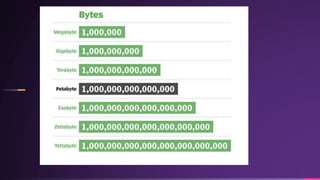
1) Volume
• It refers to the size of Big Data.
• Data can be considered Big Data or
not, is based on the volume.
• The rapidly increasing volume of
data is due to cloud-computing
traffic, IoT, mobile traffic, etc.
2) Velocity
• It refers to the speed at which
the data is getting
accumulated.
• This is mainly due to IoTs,
mobile data, social media etc.
3) Variety
It refers to Structured, Semi-
structured and Unstructured data
due to different sources of data
generated either by humans or by
machines.
• Structured data: It’s the traditional data that is organized and conforms to the formal
structure of data. This data can be stored in a relational database.
Example: Bank statement containing date, time, amount, etc.
• Semi-structured data: It’s semi-organized data. It doesn’t conform to the formal
structure of data.
Examples: Log files, JSON files, Sensor data, CSV files, etc.
• Unstructured data: It’s not organized data and doesn’t fit into the rows and
columns structure of a relational database.
Examples: Text files, Emails, images, videos, voicemails, audio files, etc.
4) Veracity
• It refers to the assurance of
quality/integrity/credibility/accurac
y of the data.
• Since the data is collected from
multiple sources, we need to check
the data for accuracy before using it
for business insights.
5) Value
• Just because we collected lots
of Data, it’s of no value unless
we garner some insights out of
it.
• Value refers to how useful the
data is in decision-making.
• We need to extract the value
of Big Data using proper
analytics.
5) Value
• Just because we collected lots
of Data, it’s of no value unless
we garner some insights out of
it.
• Value refers to how useful the
data is in decision-making.
• We need to extract the value
of Big Data using proper
analytics.
THANK YOU

Big-Data 5V of big data engineering.pptx

  • 1.
    The 5 V’sof Big Data
  • 3.
    HISTORY It started inthe year 2001 with 3 V’s, namely Volume, Velocity, and Variety. Then Veracity got added, making it 4 V’s. Then Value got added, making it 5 V’s. Later came 8Vs, 10Vs, etc.
  • 4.
    1) Volume • Itrefers to the size of Big Data. • Data can be considered Big Data or not, is based on the volume. • The rapidly increasing volume of data is due to cloud-computing traffic, IoT, mobile traffic, etc.
  • 6.
    2) Velocity • Itrefers to the speed at which the data is getting accumulated. • This is mainly due to IoTs, mobile data, social media etc.
  • 7.
    3) Variety It refersto Structured, Semi- structured and Unstructured data due to different sources of data generated either by humans or by machines.
  • 8.
    • Structured data:It’s the traditional data that is organized and conforms to the formal structure of data. This data can be stored in a relational database. Example: Bank statement containing date, time, amount, etc. • Semi-structured data: It’s semi-organized data. It doesn’t conform to the formal structure of data. Examples: Log files, JSON files, Sensor data, CSV files, etc. • Unstructured data: It’s not organized data and doesn’t fit into the rows and columns structure of a relational database. Examples: Text files, Emails, images, videos, voicemails, audio files, etc.
  • 9.
    4) Veracity • Itrefers to the assurance of quality/integrity/credibility/accurac y of the data. • Since the data is collected from multiple sources, we need to check the data for accuracy before using it for business insights.
  • 10.
    5) Value • Justbecause we collected lots of Data, it’s of no value unless we garner some insights out of it. • Value refers to how useful the data is in decision-making. • We need to extract the value of Big Data using proper analytics.
  • 11.
    5) Value • Justbecause we collected lots of Data, it’s of no value unless we garner some insights out of it. • Value refers to how useful the data is in decision-making. • We need to extract the value of Big Data using proper analytics.
  • 12.