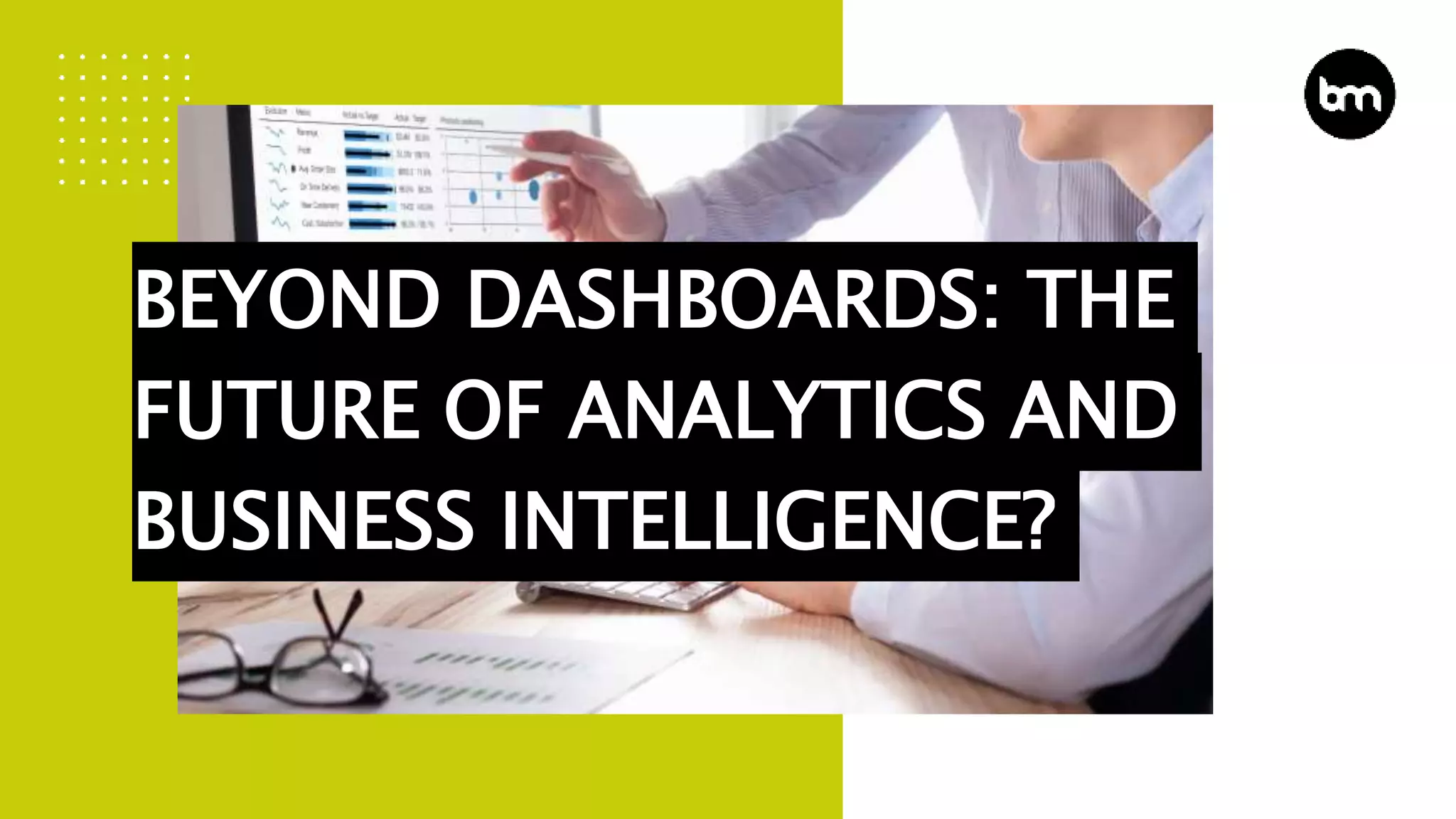
BEYOND DASHBOARDS: THE
FUTURE OF ANALYTICS AND
BUSINESS INTELLIGENCE?
© 2021 Bernard Marr, Bernard Marr & Co. All rights reserved
BEYOND DASHBOARDS: THE FUTURE OF
ANALYTICS AND BUSINESS INTELLIGENCE?
We have become accustomed to dashboards and data reports in our modern,
data-driven businesses. However, the question is whether there are better
ways to connect people with the insights they need. Here we look at a
potentially different future of BI and analytics, based on a conversation with
Sisense CEO Amir Orad.
© 2021 Bernard Marr, Bernard Marr & Co. All rights reserved
Analytics and business intelligence (BI) have long been understood to be fundamental to
business success. Today, powerful technologies, including artificial intelligence (AI) and machine
learning (ML), make it possible to gain deeper insights into all areas of business activity in order
to drive efficiency, reduce waste and gain a better understanding of customers.
Why then, isn’t every company doing so? Or, more importantly – why aren’t they doing so
successfully?
Truly benefiting from analytics – particularly the most advanced and powerful analytics
techniques involving AI – requires developing a top-to-bottom culture of data literacy
throughout an organization and this, in my experience, is where many businesses are still
failing. This is highlighted by one particular statistic that came up during my recent webinar
conversation with Amir Orad, CEO of Sisense.
© 2021 Bernard Marr, Bernard Marr & Co. All rights reserved
Orad told me that according to his observations, 80 percent of employees in the average
organization simply aren't leveraging the analytics that, in theory, are available to them. It’s
true that leadership teams and certain functions, such as marketing and finance departments,
have spent recent decades getting to grips with reporting and dashboard applications. The
same, however, often isn’t true of frontline staff and many of the professionals whose job it is
to manage the day-to-day operations and service delivery of organizations and enterprises.
Orad tells me, “This market has matured a lot … and the BI teams and analysts are now getting
really valuable tools at their disposal … the challenge is the rank and file.
“The people that operate the actual organizations haven’t leveraged the power of ML and AI
because it’s very detached from their day-to-day.
© 2021 Bernard Marr, Bernard Marr & Co. All rights reserved
“We’ve solved the first-mile problem – the c-suite, marketing, sales. We've not solved the last mile problem,
which is the wider adoption, and that's where we believe there's a massive opportunity, not only to get
adoption … but also to really move the needle on the impact of BI and AI in many organizations."
When paying attention to the role that analytics plays in the modern enterprise, it often becomes clear that it’s
the reporting and dashboarding approach itself that is behind many of the bottlenecks which, in turn, act as
obstacles to holistic deployment and rollout of “top-to-bottom” analytics.
Here’s the problem – analytics and data science teams often find themselves forced to spend time creating
tools, applications, and dashboards that will only ever be accessed by the 20 percent of the workforce for
which analytics is an accepted part of their role. The marketing, finance, and sales teams, and the business
leadership units, for example. These users are accustomed to their siloed datasets which, although they know
they can derive insights from, are not available across the workforce as a whole in a way that “new thinking”
can emerge. This prevents new, potentially even more valuable use cases from being able to “bubble up” to
become part of the corporate data strategy.
© 2021 Bernard Marr, Bernard Marr & Co. All rights reserved
This is a hindrance to the “democratization of data” that we know is vital to address if organizations
are going to unlock the true value that data can bring to their organization. Put simply – data and
the insights it contains are far too valuable to be kept locked away in the “ivory towers” of data
scientists, the c-suite, and the few rarified environments where it is already put to use.
Orad says, "People don't want to use BI. People want to run better businesses and give better
service to customers.
“They don’t want to dashboard – they’re just a way to make better decisions and better outcomes –
the goal is not more dashboards and more AI, it’s how do we get the insights into the hands of the
right people at the right time.”
Failing to address organizational data strategy challenges from this angle is a surefire way to end up
in the "data-rich, insight-poor" situation that is holding so many organizations back today.
© 2021 Bernard Marr, Bernard Marr & Co. All rights reserved
“The best way to make an impact is to embed the insights you need at the right place at the
right time – not in a separate screen where you have to log in and see a nice chart and
dashboard, etcetera,” Orad says.
So what does this look like in practice? Well, in ideal terms, what it means is delivering insights,
in real-time, directly to the operational systems as they are being used. In other words, doing
away with the data science dashboarding models we've become accustomed to and rethinking
the way analytics – or rather insights – are delivered directly to those who need them at the
right time.
For example, imagine you are making Youtube videos with the purpose of building an audience
and establishing your authority within your niche – a straightforward marketing tactic that's put
to work by thousands of businesses all around the world every day.
© 2021 Bernard Marr, Bernard Marr & Co. All rights reserved
In theory, using AI, it would be possible to harness the power of natural language processing (NLP)
and image recognition, along with the deep audience analytics available today, to receive feedback
in real time about who is going to be interested in your content, whether you are speaking too fast
or too slow, whether your images and graphics are going to work when it comes to engaging people
who you want your message to reach – and any other tactical or strategic objective you might have.
In healthcare, a doctor monitoring a camera during an operation or observational procedure could
receive real-time feedback on what they are seeing inside a patient's body and suggestions about
possible diagnoses or next-step procedures.
In an industrial or manufacturing environment, engineering staff on the ground can receive real-
time insights into which pieces of machinery are likely to break down or require maintenance,
meaning they can schedule preventative measures and potentially avoid expensive downtime
altogether.
© 2021 Bernard Marr, Bernard Marr & Co. All rights reserved
It could even work in an educational setting, Orad suggests, with a teacher receiving real-
time feedback on which of the students in their class are fully engaged with their learning
and which are in danger of failing assessments or dropping out.
Among the examples Orad gave me of occasions where he has seen these principles put
into action, one very different one stood out – a charity organization that operates a crisis
line connected to a phone number on San Francisco’s Golden Gate bridge. Signs at various
locations on the bridge prompt users to call the crisis line if they are having negative
thoughts while on the bridge. The organization running the phone line then uses machine
learning-driven predictions to monitor the calls in real-time and help the operators point
the callers toward the advice and information that's most relevant to their specific
situation. “It’s augmenting the human with options or suggestions to give a better service
… and literally save lives,” Orad tells me.
© 2021 Bernard Marr, Bernard Marr & Co. All rights reserved
“Giving me a report once a month about what could have been done better, or asking
the person on the phone, 'wait on the bridge, let me log into the dashboard and get
some insights', it doesn’t make sense.”
It’s true that it’s easier than ever to drag insights out of data, and thanks to the
proliferation of cloud services and analytics platforms, just about any organization can
leverage technology to make better predictions and decisions. As technology continues
to evolve, however, it’s quickly becoming clear that putting real-time insights in the
hands of the people who are best placed to use them is the crucial "last mile" that
stands between businesses and the ability to derive real growth and value from data.
Head to my YouTube channel to watch my webinar with Amir Orad, CEO of Sisense, in
full.
© 2021 Bernard Marr, Bernard Marr & Co. All rights reserved
To stay on top of the latest on the latest trends, make sure to subscribe to my
newsletter, follow me on Twitter, LinkedIn, and YouTube, and check out my
books ‘Data Strategy: How To Profit From A World Of Big Data, Analytics And
Artificial Intelligence’ and ‘Business Trends in Practice’.
© 2021 Bernard Marr , Bernard Marr & Co. All rights reserved
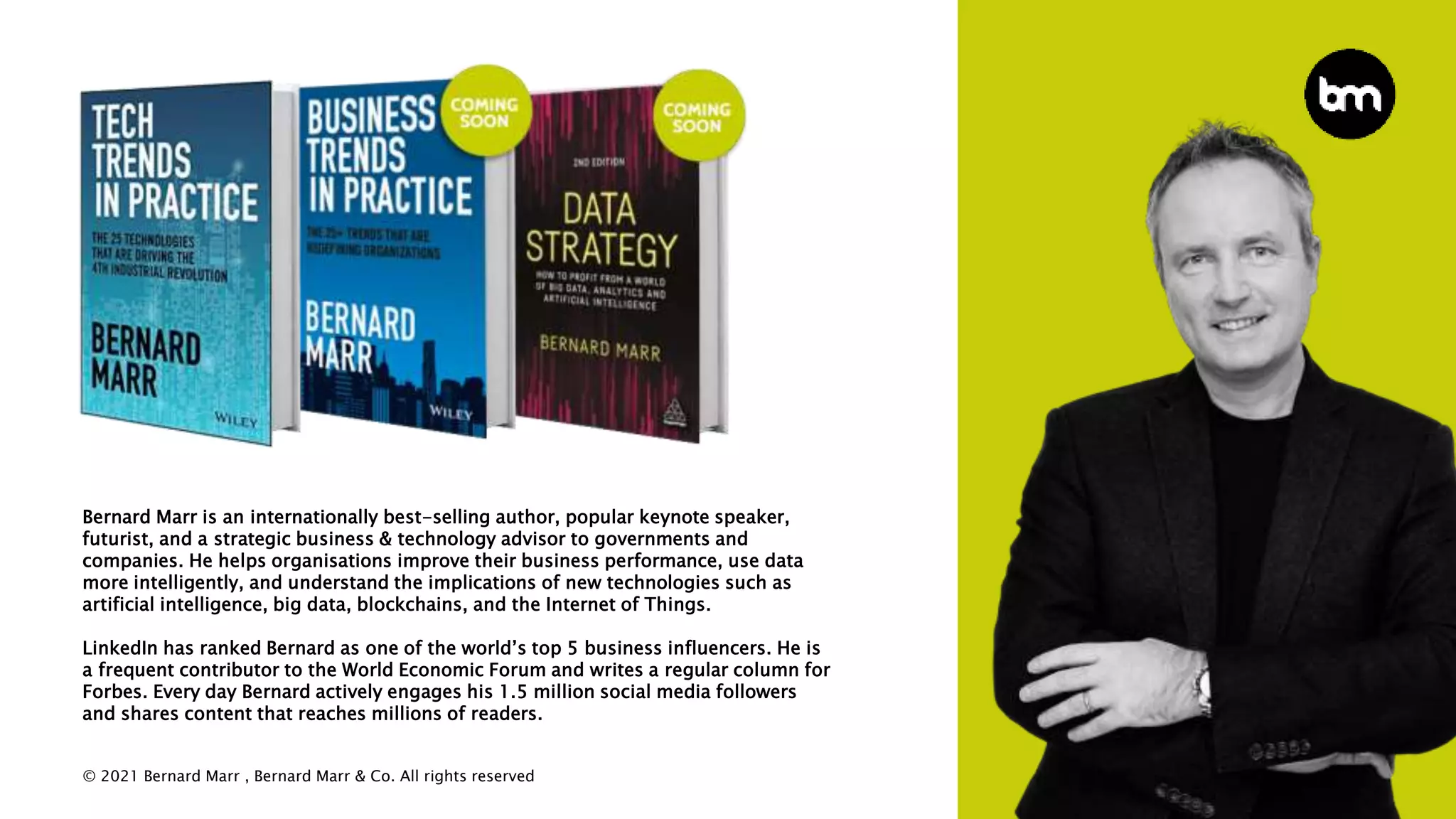
Bernard Marr is an internationally best-selling author, popular keynote speaker,
futurist, and a strategic business & technology advisor to governments and
companies. He helps organisations improve their business performance, use data
more intelligently, and understand the implications of new technologies such as
artificial intelligence, big data, blockchains, and the Internet of Things.
LinkedIn has ranked Bernard as one of the world’s top 5 business influencers. He is
a frequent contributor to the World Economic Forum and writes a regular column for
Forbes. Every day Bernard actively engages his 1.5 million social media followers
and shares content that reaches millions of readers.
hello@bernardmarr.com
www.bernardmarr.com

Beyond Dashboards: The Future Of Analytics And Business Intelligence?

  • 1.
    BEYOND DASHBOARDS: THE FUTUREOF ANALYTICS AND BUSINESS INTELLIGENCE?
  • 2.
    © 2021 BernardMarr, Bernard Marr & Co. All rights reserved BEYOND DASHBOARDS: THE FUTURE OF ANALYTICS AND BUSINESS INTELLIGENCE? We have become accustomed to dashboards and data reports in our modern, data-driven businesses. However, the question is whether there are better ways to connect people with the insights they need. Here we look at a potentially different future of BI and analytics, based on a conversation with Sisense CEO Amir Orad.
  • 3.
    © 2021 BernardMarr, Bernard Marr & Co. All rights reserved Analytics and business intelligence (BI) have long been understood to be fundamental to business success. Today, powerful technologies, including artificial intelligence (AI) and machine learning (ML), make it possible to gain deeper insights into all areas of business activity in order to drive efficiency, reduce waste and gain a better understanding of customers. Why then, isn’t every company doing so? Or, more importantly – why aren’t they doing so successfully? Truly benefiting from analytics – particularly the most advanced and powerful analytics techniques involving AI – requires developing a top-to-bottom culture of data literacy throughout an organization and this, in my experience, is where many businesses are still failing. This is highlighted by one particular statistic that came up during my recent webinar conversation with Amir Orad, CEO of Sisense.
  • 4.
    © 2021 BernardMarr, Bernard Marr & Co. All rights reserved Orad told me that according to his observations, 80 percent of employees in the average organization simply aren't leveraging the analytics that, in theory, are available to them. It’s true that leadership teams and certain functions, such as marketing and finance departments, have spent recent decades getting to grips with reporting and dashboard applications. The same, however, often isn’t true of frontline staff and many of the professionals whose job it is to manage the day-to-day operations and service delivery of organizations and enterprises. Orad tells me, “This market has matured a lot … and the BI teams and analysts are now getting really valuable tools at their disposal … the challenge is the rank and file. “The people that operate the actual organizations haven’t leveraged the power of ML and AI because it’s very detached from their day-to-day.
  • 5.
    © 2021 BernardMarr, Bernard Marr & Co. All rights reserved “We’ve solved the first-mile problem – the c-suite, marketing, sales. We've not solved the last mile problem, which is the wider adoption, and that's where we believe there's a massive opportunity, not only to get adoption … but also to really move the needle on the impact of BI and AI in many organizations." When paying attention to the role that analytics plays in the modern enterprise, it often becomes clear that it’s the reporting and dashboarding approach itself that is behind many of the bottlenecks which, in turn, act as obstacles to holistic deployment and rollout of “top-to-bottom” analytics. Here’s the problem – analytics and data science teams often find themselves forced to spend time creating tools, applications, and dashboards that will only ever be accessed by the 20 percent of the workforce for which analytics is an accepted part of their role. The marketing, finance, and sales teams, and the business leadership units, for example. These users are accustomed to their siloed datasets which, although they know they can derive insights from, are not available across the workforce as a whole in a way that “new thinking” can emerge. This prevents new, potentially even more valuable use cases from being able to “bubble up” to become part of the corporate data strategy.
  • 6.
    © 2021 BernardMarr, Bernard Marr & Co. All rights reserved This is a hindrance to the “democratization of data” that we know is vital to address if organizations are going to unlock the true value that data can bring to their organization. Put simply – data and the insights it contains are far too valuable to be kept locked away in the “ivory towers” of data scientists, the c-suite, and the few rarified environments where it is already put to use. Orad says, "People don't want to use BI. People want to run better businesses and give better service to customers. “They don’t want to dashboard – they’re just a way to make better decisions and better outcomes – the goal is not more dashboards and more AI, it’s how do we get the insights into the hands of the right people at the right time.” Failing to address organizational data strategy challenges from this angle is a surefire way to end up in the "data-rich, insight-poor" situation that is holding so many organizations back today.
  • 7.
    © 2021 BernardMarr, Bernard Marr & Co. All rights reserved “The best way to make an impact is to embed the insights you need at the right place at the right time – not in a separate screen where you have to log in and see a nice chart and dashboard, etcetera,” Orad says. So what does this look like in practice? Well, in ideal terms, what it means is delivering insights, in real-time, directly to the operational systems as they are being used. In other words, doing away with the data science dashboarding models we've become accustomed to and rethinking the way analytics – or rather insights – are delivered directly to those who need them at the right time. For example, imagine you are making Youtube videos with the purpose of building an audience and establishing your authority within your niche – a straightforward marketing tactic that's put to work by thousands of businesses all around the world every day.
  • 8.
    © 2021 BernardMarr, Bernard Marr & Co. All rights reserved In theory, using AI, it would be possible to harness the power of natural language processing (NLP) and image recognition, along with the deep audience analytics available today, to receive feedback in real time about who is going to be interested in your content, whether you are speaking too fast or too slow, whether your images and graphics are going to work when it comes to engaging people who you want your message to reach – and any other tactical or strategic objective you might have. In healthcare, a doctor monitoring a camera during an operation or observational procedure could receive real-time feedback on what they are seeing inside a patient's body and suggestions about possible diagnoses or next-step procedures. In an industrial or manufacturing environment, engineering staff on the ground can receive real- time insights into which pieces of machinery are likely to break down or require maintenance, meaning they can schedule preventative measures and potentially avoid expensive downtime altogether.
  • 9.
    © 2021 BernardMarr, Bernard Marr & Co. All rights reserved It could even work in an educational setting, Orad suggests, with a teacher receiving real- time feedback on which of the students in their class are fully engaged with their learning and which are in danger of failing assessments or dropping out. Among the examples Orad gave me of occasions where he has seen these principles put into action, one very different one stood out – a charity organization that operates a crisis line connected to a phone number on San Francisco’s Golden Gate bridge. Signs at various locations on the bridge prompt users to call the crisis line if they are having negative thoughts while on the bridge. The organization running the phone line then uses machine learning-driven predictions to monitor the calls in real-time and help the operators point the callers toward the advice and information that's most relevant to their specific situation. “It’s augmenting the human with options or suggestions to give a better service … and literally save lives,” Orad tells me.
  • 10.
    © 2021 BernardMarr, Bernard Marr & Co. All rights reserved “Giving me a report once a month about what could have been done better, or asking the person on the phone, 'wait on the bridge, let me log into the dashboard and get some insights', it doesn’t make sense.” It’s true that it’s easier than ever to drag insights out of data, and thanks to the proliferation of cloud services and analytics platforms, just about any organization can leverage technology to make better predictions and decisions. As technology continues to evolve, however, it’s quickly becoming clear that putting real-time insights in the hands of the people who are best placed to use them is the crucial "last mile" that stands between businesses and the ability to derive real growth and value from data. Head to my YouTube channel to watch my webinar with Amir Orad, CEO of Sisense, in full.
  • 11.
    © 2021 BernardMarr, Bernard Marr & Co. All rights reserved To stay on top of the latest on the latest trends, make sure to subscribe to my newsletter, follow me on Twitter, LinkedIn, and YouTube, and check out my books ‘Data Strategy: How To Profit From A World Of Big Data, Analytics And Artificial Intelligence’ and ‘Business Trends in Practice’.
  • 12.
    © 2021 BernardMarr , Bernard Marr & Co. All rights reserved Bernard Marr is an internationally best-selling author, popular keynote speaker, futurist, and a strategic business & technology advisor to governments and companies. He helps organisations improve their business performance, use data more intelligently, and understand the implications of new technologies such as artificial intelligence, big data, blockchains, and the Internet of Things. LinkedIn has ranked Bernard as one of the world’s top 5 business influencers. He is a frequent contributor to the World Economic Forum and writes a regular column for Forbes. Every day Bernard actively engages his 1.5 million social media followers and shares content that reaches millions of readers.
  • 13.