+
Intellectual Property
Ethical and Professional Computing
Michael Heron
+
Introduction
 One of the things that you will do as you go through your careers
is develop intellectual property.
 Understanding your rights and responsibilities with regards to this is
important.
 In this lecture we’re going to talk about what constitutes intellectual
property, how it is assigned, and why you need to care.
 And you do. Sorry.
 Some of the reasons for this we touched on in our lecture on the
killer robot.
 Others are new today.
 First, a video:
 http://www.youtube.com/watch?v=7Q25-S7jzgs
+
Ownership of Work
 Usually, salaried and contract employees work as ‘work for hire’
 That which is created as part of his or her job is owned by the
company.
 Work ownership is usually assigned, or in more flexible
environments emerges organically as a result of established
‘authorial credibility’
 The individual who did the work is not considered to be the
‘official author’
 The company is the legal author of the work, and thus the
exemptions and legal obligations fall to them.
+
Code Ownership
 In other contexts, ownership is strictly defined by a contribution
agreement.
 A license, in open source terms.
 You as an author can set out a licensing agreement which defines
the terms under which others can use your work.
 Many open source projects require a particular license.
 Contributions will not be accepted if not released according to that
license.
 This is as much to ensure conceptual tractability as anything else.
 Consider wikipedia.
 Unless otherwise stated, licenses are revocable.
 Someone can come along later and rescind your right to use their work.
+
Work Ownership and Copyright
 The legal author of a piece of work can determine the extent to
which it can be copied.
 In work for hire, it is the employer and not the employee.
 Copyright is automatically granted (although it can be hard to
prove you own the copyright if you don’t take additional steps to
prove it).
 There are certain exemptions to an author’s absolute right to
police how a work may be copied and used. These vary from
region to region.
 Fair use
 Review or parody
 Format shifting
+
Work Ownership and Derivative
Works
 An open source license is an expression of the author’s
copyright.
 In it, the author will outline the rights of users with regards to
modifying the work.
 Modified work is classed as a derivative work, and a license will
usually limit what terms under which derivative work may be
released.
 Often a ‘you can create derivative works provided this license remains
intact’ provision.
 Bug-fixes and such count as modifications to code, which results
in the changed version being a derivative work of the original.
+
Derivative Work Ownership
 Who owns a derivative work?
 In the case of ‘in house work’ where all developers are ‘work for hire’,
it’s still the employer.
 For projects with no work for hire, it becomes more complicated.
 What about adding a file to a collection of existing files?
 What about static or dynamic linking?
 What about extensions to an existing system?
 Systems with multiple components?
 What about work that makes use of other works but doesn’t infringe on
them?
 The exact nature of what counts as a derivative work is a legal
grey area, like so many things, and the ownership is also hard to
assign.
+
Derivative Work Copyright
 In order for an author to have derivative work copyright, it must
satisfy copyright law’s requirement of originality.
 You can’t just rewrite what exists in an unoriginal way and assert
derivative work copyright.
 The rights accrued to the owner of a derivative work are more
limited than that of the main copyright holder, and they are not
reciprocal.
 You are under no obligation to make your code available to the original
copyright holder, but must be wary of the dangers that go along with
licenses being rescinded.
 Bear in mind little of this has been legally tested in anything other
than the most restrictive ways.
 It’s all a legal grey area.
+
Transformative Derivative Works
 One other consideration in certain jurisdictions is the extent to
which a derivative work is transformative.
 The degree to which it provides a new benefit that was not previously
available.
 For example, a band doing a largely generic cover of a song is not
a derivative work – there is no originality and there is no
transformative benefit.
 A radically different scoring that gave a new perspective (c.f. the
various different versions of Leonard Cohen’s Hallelujah) might
classify as being transformative.
 http://www.youtube.com/watch?v=WJTiXoMCppw
 http://www.youtube.com/watch?v=vIw0ewEsNHs
 http://www.youtube.com/watch?v=xaWLsgxDzuw
+
Copyrights, Trademarks and
Patents
 Three issues that relate to intellectual property are the
concepts of Copyright, Trademarks and Patents.
 They are not interchangeable.
 Copyright is the legal concept that covers, as you might expect,
the right to copy.
 More importantly, the right to say who else can copy.
 Initially, copyright was intended to encourage innovation by
giving inventors an exclusive right to commercially benefit from
their inventions.
 Limited by a copyright term at which point it falls into the public
domain.
+
Copyrights, Trademarks and
Patents
 Three issues that relate to intellectual property are the
concepts of Copyright, Trademarks and Patents.
 They are not interchangeable.
 Copyright is the legal concept that covers, as you might expect,
the right to copy.
 More importantly, the right to say who else can copy.
 Initially, copyright was intended to encourage innovation by
giving inventors an exclusive right to commercially benefit from
their inventions.
 Limited by a copyright term at which point it falls into the public
domain.
+
Copyright, Trademarks and Patents
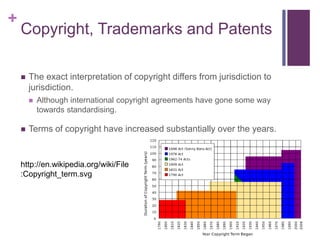
 The exact interpretation of copyright differs from jurisdiction to
jurisdiction.
 Although international copyright agreements have gone some way
towards standardising.
 Terms of copyright have increased substantially over the years.
http://en.wikipedia.org/wiki/File
:Copyright_term.svg
+
Copyright
 Copyright doesn’t apply to everything. It applies to:
 Text
 Images
 Video and Pictures
 Audio Recordings
 Computer Programs.
 You don’t need to do anything special to register a copyright.
 You get it as soon as you fix a representation of something. Proving you did that though
can be more difficult.
 Certain things cannot be protected by copyright.
 Ideas
 Facts
 Titles
 Names
 Short Phrases
+
Trademark
 A trademark by comparison is a kind of branding
 A distinctive sign that differentiates you from a competitor.
 There are many things that can be trademarks:
 Logos
 Words
 Phrases
 Names
 Slogans
 These only apply if they serve to:
 Distinguish you from another and to indicate the source of a good.
 Distinguish you from another in the provision of a service.
 To be used by others for certification.
 To indicate membership of some form of union or association.
+
Trademark
 Unlike copyright, trademarks must be registered.
 Through the Intellectual Property Office for the United Kingdom.
 Trademarks cannot be registered under certain circumstances:
 Terms that have become customary
 Terms that are not distinctive
 Logos that are three dimensional, if the logo mirrors the product
 Logos which are protected emblems
 If they are offensive
 If they are against the low
 If they are deceptive
+
Patent
 A patent is a set of exclusive rights given to an inventory of
something in exchange for public disclosure of that invention.
 They cover how things work, what they do, how they do it, what
they’re made of, and how they are made.
(http://www.ipo.gov.uk/types/patent/p-about/p-whatis.htm)
 In order to be awarded a patent, an invention needs to fulfil
certain criteria:
 They need to be new
 Have a non-intuitive inventive step
 Be capable of use in some way
+
Patent
 Certain things cannot be patented.
 Scientific or mathematical theories or methods
 Literary works (use copyright for this)
 A way of performing a mental act (such as a way of playing a game)
 The presentation of information
 Animals or plants
 Medical treatments or diagnosis
 Anything against public policy or morality
 Patents must be actively registered, and actively renewed.
 Additionally, they extend only to specified patent zones. If you want
international patents, you’ll need to pay for them.
+
Infringement
 Copyright infringement is the one that is most in the public
consciousness.
 As a result of bittorrent and other such sites for easy obtaining of
‘content’
 The sheer scale of infringement makes it difficult to fight.
 And the decentralized nature of the internet makes it easy for
infringers to ‘fight back’
 All kinds of methods used to identify infringement.
 Digital fingerprints
 Downloading files under the authority of a copyright holder
 ‘Dial home’ systems
+
Infringement
 Trademark infringement is usually easier to detect.
 After all, a trademark is a public declaration.
 It only applies in the case of customer confusion – when one
trademark is likely to confuse likely customers of another.
 Several criteria usually used:
 Strength and similarity of the mark
 Proximity of the goods and category of goods
 Evidence of actual confusion
 Marketing channels used
 Likelihood of expansion into competing product lines
 Consider Apple Computers versus Apple Corps
+
Infringement
 The biggest case in recent years regarding patent infringement
has been Apple versus Samsung.
 Patent infringement occurs when a party uses, manufactures,
sells or imports a patented technology.
 Such claims are highly contentious and the growing practise of
patent trolling has resulted in it being a highly charged issue.
 Patents by themselves have become commercial valuable,
even if someone has no intention of using it.
 Some large companies even go to the extent of buying smaller
companies because of patents they own.
+
Infringement
 Unfortunately, these protections are conceptual in the cases of
most people.
 These are legal protections if you can afford to pursue claims.
 In many cases, copyright infringement is considered an
‘acceptable risk’
 Because the copyright owner is unable to finance an often
expensive legal battle.
 This can make certain kinds of protection infeasible.
 Trademarks imply a burden of policing on the holder of the
trademark.
 The owner is required to make sure that the mark doesn’t lose
distinctiveness or dilute the brand.
+
Infringement
 There is a danger of a protected trademark being conflated with a general
concept.
 At which point the trademark ceases to have any use in being distinctive.
 Several examples:
 Hoover for vacuum cleaner
 Xerox for photocopying
 Aspirin for acetylsalicylic acid
 Yo-yo for – well, yo-yos
 Trademark erosion occurs when a trademark becomes so common that it
starts to become a generic name.
 Owners have the legal responsible of preventing erosion by policing their
trademark.
 Sometimes known as genericide.
+
Infringement
 Trademark owners must aggressively police their trademarks.
 Which is why a number of companies and IP owners crack down heavily
on ‘fan work’
 When a trademarked property is used without proper
authorization, trademark owners must be prepared to battle the
use legally.
 Often with a cease and desist letter from a lawyer.
 Often this is a no-win proposition.
 The brand is often damaged either way, in the protecting and in the
tolerating.
 Not always though - http://mashable.com/2012/07/22/jack-daniels-
trademark-letter/
+
Infringement
 Typically there is a progression of avenues available to those who
wish to protect their IP.
 Before lawyers need to be involved.
 First, it is necessary to ensure you have the right to take legal
action at all.
 Are you the legal owner of a piece of intellectual property? If not, take
your seat.
 Next, you need to confirm that an infringement has taken place.
 Get some second opinions. What seems like obvious infringement to
you may not seem so clear to others.
 http://www.youtube.com/watch?v=rbhsdNDF0KM
 http://www.youtube.com/watch?v=wW5wwi4ahLc
 http://www.youtube.com/watch?v=f4YquaDr5a8
+
Infringement
 Next, it’s important to gather evidence which is the key to a
successful case being made.
 Get a copy of the infringing work.
 Get a copy of your own work, annotated with examples of similarity.
 If formal metrics are available, use those to generate a similarity
report.
 A copy of any registered form of your work (if it’s different)
 Sometimes work will evolve after it has been registered. Both the
current and original form should be analysed
 If formal registration is available, make a note of the date of registration.
 Get dated documents that show your ownership over the IP.
 Put together a portfolio of drafts, diagrams and notes to show the
evolution of ideas
+
Infringement
 Next, contact the infringer and put forward some fair and reasonable way
to settle the dispute. This should incorporate an overview of your case.
 What is being infringed?
 How is it being infringed?
 What kind of IP is being infringed.
 State that the infringement must stop and outline by what criteria you will define it
as having stopped.
 State a deadline for compliance.
 Indicate, if necessary, your willingness to pursue legal avenues if your requests
are not met.
 Usually the goal here is to seek an end to infringement, not seek financial
compensation which can be difficult to prove.
 Further steps involve seeking legal advice from a qualified solicitor.
+
Prior Art
 One final topic that needs addresses is the concept of prior art.
 Prior art is the set of public information that may be relevant to a patent’s claim of
originality.
 If there is no originality, the patent is invalid.
 Trade secrets (information not disclosed to the public) does not count as
prior art in most situations.
 Prior art requires enough information that a person skilled in the art of a
field would be able to use it to invent the thing covered by a patent.
 The due diligence associated with patents requires a prior art search
before a patent is granted, ensuring:
 Novelty
 Validity
 Clearance
+
Example: Apple v Apple
 Two companies with the same name.
 Apple Corps, the Beatles’ record company
 Apple Computers, the computer company.
 Case was fought, on and off, from 1978 to 2006 over the issue
of trademark.
 Initially filed by Apple Corps against Apple Computers citing
trademark infringement.
 Apple settles out of court with an $80k settlement. As a condition of
the settlement, Apple Computers agree to never enter the music
business, and Apple Corps agree to never enter the computer
business.
+
Example: Apple v Apple
 In 1986, Apple Computer added significant sound capabilities to
their computers.
 Apple Corps sued again, claiming violation of the 1981 agreement.
 Apple was forced to end in many ways the evolution of their sound
capabilities in their computer.
 In 1991, Apple Computer was forced to pay around $26M to Apple
Corps for including the sampling sound system Chime to the Mac
OS.
 Apple Corps held the trademark on ‘any creative works whose principal
content is music’
 Case hung on how the software was distributed – on a physical disc,
which meant they were guilty of selling and distributing physical musical
materials.
+
Example: Apple v Apple
 In 2003, Apple Corps sued again for breach of contract in relation to the
creation of the iTunes Music Store.
 Case opened in 2006.
 Apple Computers was found not to have infringed.
 The parties acknowledge that certain goods and services within the Apple
Computer Field of Use are capable of delivering content within the Apple Corps
Field of Use. In such case, even though Apple Corps shall have the exclusive
right to use or authorize others to use the Apple Corps Marks on or in connection
with content within subsection 1.3(i) or (ii) [the Apple Corps catalogue and any
future music], Apple Computers [sic] shall have the exclusive right to use or
authorize others to use the Apple Computer Marks on or in connection with goods
or services within subsection 1.2 [Apple Computer Field of Use] (such as
software, hardware or broadcasting services) used to reproduce, run, play or
otherwise deliver such content provided it shall not use or authorize others to use
the Apple Computer Marks on or in connection with physical media delivering pre-
recorded content within subsection 1.3(i) or (ii) (such as a compact disc of the
Rolling Stones music)
+
Example: Apple v Apple
 In 2007, tensions cooled between the two companies. Apple Inc
and Apple Corps announced a settlement in which Apple Inc
would assume ownership of all Apple trademarks.
 Some of these in turn would be licenced back to Apple Corps.
 The terms of the settlement are confidential.
 Some estimates put the settlement at a cost of round $500M for
Apple Inc.
 The settling of this issue finally allowed for a massive gap in the
iTunes catalogue to be filled
 They were able to start making the Beatles available for digital
download, which was something that could not previously have been
countenanced.
 The eventual inclusion of the Beatles however was also
dependant on another legal battle against EMI.
+
Conclusion
 Copyright law is complex, but we’re all beholden to it.
 All the time. Seriously, it’s just crazy.
 The rights that you have as someone who develops intellectual
property are influenced by several factors.
 Including the terms under which you work for an employer.
 Intellectual Property mostly branches out into three topics.
 Copyright
 Trademarks
 Patents
 Each is registered differently, protected differently, and
legislated differently.

ETHICS05 - Intellectual Property

  • 1.
    + Intellectual Property Ethical andProfessional Computing Michael Heron
  • 2.
    + Introduction  One ofthe things that you will do as you go through your careers is develop intellectual property.  Understanding your rights and responsibilities with regards to this is important.  In this lecture we’re going to talk about what constitutes intellectual property, how it is assigned, and why you need to care.  And you do. Sorry.  Some of the reasons for this we touched on in our lecture on the killer robot.  Others are new today.  First, a video:  http://www.youtube.com/watch?v=7Q25-S7jzgs
  • 3.
    + Ownership of Work Usually, salaried and contract employees work as ‘work for hire’  That which is created as part of his or her job is owned by the company.  Work ownership is usually assigned, or in more flexible environments emerges organically as a result of established ‘authorial credibility’  The individual who did the work is not considered to be the ‘official author’  The company is the legal author of the work, and thus the exemptions and legal obligations fall to them.
  • 4.
    + Code Ownership  Inother contexts, ownership is strictly defined by a contribution agreement.  A license, in open source terms.  You as an author can set out a licensing agreement which defines the terms under which others can use your work.  Many open source projects require a particular license.  Contributions will not be accepted if not released according to that license.  This is as much to ensure conceptual tractability as anything else.  Consider wikipedia.  Unless otherwise stated, licenses are revocable.  Someone can come along later and rescind your right to use their work.
  • 5.
    + Work Ownership andCopyright  The legal author of a piece of work can determine the extent to which it can be copied.  In work for hire, it is the employer and not the employee.  Copyright is automatically granted (although it can be hard to prove you own the copyright if you don’t take additional steps to prove it).  There are certain exemptions to an author’s absolute right to police how a work may be copied and used. These vary from region to region.  Fair use  Review or parody  Format shifting
  • 6.
    + Work Ownership andDerivative Works  An open source license is an expression of the author’s copyright.  In it, the author will outline the rights of users with regards to modifying the work.  Modified work is classed as a derivative work, and a license will usually limit what terms under which derivative work may be released.  Often a ‘you can create derivative works provided this license remains intact’ provision.  Bug-fixes and such count as modifications to code, which results in the changed version being a derivative work of the original.
  • 7.
    + Derivative Work Ownership Who owns a derivative work?  In the case of ‘in house work’ where all developers are ‘work for hire’, it’s still the employer.  For projects with no work for hire, it becomes more complicated.  What about adding a file to a collection of existing files?  What about static or dynamic linking?  What about extensions to an existing system?  Systems with multiple components?  What about work that makes use of other works but doesn’t infringe on them?  The exact nature of what counts as a derivative work is a legal grey area, like so many things, and the ownership is also hard to assign.
  • 8.
    + Derivative Work Copyright In order for an author to have derivative work copyright, it must satisfy copyright law’s requirement of originality.  You can’t just rewrite what exists in an unoriginal way and assert derivative work copyright.  The rights accrued to the owner of a derivative work are more limited than that of the main copyright holder, and they are not reciprocal.  You are under no obligation to make your code available to the original copyright holder, but must be wary of the dangers that go along with licenses being rescinded.  Bear in mind little of this has been legally tested in anything other than the most restrictive ways.  It’s all a legal grey area.
  • 9.
    + Transformative Derivative Works One other consideration in certain jurisdictions is the extent to which a derivative work is transformative.  The degree to which it provides a new benefit that was not previously available.  For example, a band doing a largely generic cover of a song is not a derivative work – there is no originality and there is no transformative benefit.  A radically different scoring that gave a new perspective (c.f. the various different versions of Leonard Cohen’s Hallelujah) might classify as being transformative.  http://www.youtube.com/watch?v=WJTiXoMCppw  http://www.youtube.com/watch?v=vIw0ewEsNHs  http://www.youtube.com/watch?v=xaWLsgxDzuw
  • 10.
    + Copyrights, Trademarks and Patents Three issues that relate to intellectual property are the concepts of Copyright, Trademarks and Patents.  They are not interchangeable.  Copyright is the legal concept that covers, as you might expect, the right to copy.  More importantly, the right to say who else can copy.  Initially, copyright was intended to encourage innovation by giving inventors an exclusive right to commercially benefit from their inventions.  Limited by a copyright term at which point it falls into the public domain.
  • 11.
    + Copyrights, Trademarks and Patents Three issues that relate to intellectual property are the concepts of Copyright, Trademarks and Patents.  They are not interchangeable.  Copyright is the legal concept that covers, as you might expect, the right to copy.  More importantly, the right to say who else can copy.  Initially, copyright was intended to encourage innovation by giving inventors an exclusive right to commercially benefit from their inventions.  Limited by a copyright term at which point it falls into the public domain.
  • 12.
    + Copyright, Trademarks andPatents  The exact interpretation of copyright differs from jurisdiction to jurisdiction.  Although international copyright agreements have gone some way towards standardising.  Terms of copyright have increased substantially over the years. http://en.wikipedia.org/wiki/File :Copyright_term.svg
  • 13.
    + Copyright  Copyright doesn’tapply to everything. It applies to:  Text  Images  Video and Pictures  Audio Recordings  Computer Programs.  You don’t need to do anything special to register a copyright.  You get it as soon as you fix a representation of something. Proving you did that though can be more difficult.  Certain things cannot be protected by copyright.  Ideas  Facts  Titles  Names  Short Phrases
  • 14.
    + Trademark  A trademarkby comparison is a kind of branding  A distinctive sign that differentiates you from a competitor.  There are many things that can be trademarks:  Logos  Words  Phrases  Names  Slogans  These only apply if they serve to:  Distinguish you from another and to indicate the source of a good.  Distinguish you from another in the provision of a service.  To be used by others for certification.  To indicate membership of some form of union or association.
  • 15.
    + Trademark  Unlike copyright,trademarks must be registered.  Through the Intellectual Property Office for the United Kingdom.  Trademarks cannot be registered under certain circumstances:  Terms that have become customary  Terms that are not distinctive  Logos that are three dimensional, if the logo mirrors the product  Logos which are protected emblems  If they are offensive  If they are against the low  If they are deceptive
  • 16.
    + Patent  A patentis a set of exclusive rights given to an inventory of something in exchange for public disclosure of that invention.  They cover how things work, what they do, how they do it, what they’re made of, and how they are made. (http://www.ipo.gov.uk/types/patent/p-about/p-whatis.htm)  In order to be awarded a patent, an invention needs to fulfil certain criteria:  They need to be new  Have a non-intuitive inventive step  Be capable of use in some way
  • 17.
    + Patent  Certain thingscannot be patented.  Scientific or mathematical theories or methods  Literary works (use copyright for this)  A way of performing a mental act (such as a way of playing a game)  The presentation of information  Animals or plants  Medical treatments or diagnosis  Anything against public policy or morality  Patents must be actively registered, and actively renewed.  Additionally, they extend only to specified patent zones. If you want international patents, you’ll need to pay for them.
  • 18.
    + Infringement  Copyright infringementis the one that is most in the public consciousness.  As a result of bittorrent and other such sites for easy obtaining of ‘content’  The sheer scale of infringement makes it difficult to fight.  And the decentralized nature of the internet makes it easy for infringers to ‘fight back’  All kinds of methods used to identify infringement.  Digital fingerprints  Downloading files under the authority of a copyright holder  ‘Dial home’ systems
  • 19.
    + Infringement  Trademark infringementis usually easier to detect.  After all, a trademark is a public declaration.  It only applies in the case of customer confusion – when one trademark is likely to confuse likely customers of another.  Several criteria usually used:  Strength and similarity of the mark  Proximity of the goods and category of goods  Evidence of actual confusion  Marketing channels used  Likelihood of expansion into competing product lines  Consider Apple Computers versus Apple Corps
  • 20.
    + Infringement  The biggestcase in recent years regarding patent infringement has been Apple versus Samsung.  Patent infringement occurs when a party uses, manufactures, sells or imports a patented technology.  Such claims are highly contentious and the growing practise of patent trolling has resulted in it being a highly charged issue.  Patents by themselves have become commercial valuable, even if someone has no intention of using it.  Some large companies even go to the extent of buying smaller companies because of patents they own.
  • 21.
    + Infringement  Unfortunately, theseprotections are conceptual in the cases of most people.  These are legal protections if you can afford to pursue claims.  In many cases, copyright infringement is considered an ‘acceptable risk’  Because the copyright owner is unable to finance an often expensive legal battle.  This can make certain kinds of protection infeasible.  Trademarks imply a burden of policing on the holder of the trademark.  The owner is required to make sure that the mark doesn’t lose distinctiveness or dilute the brand.
  • 22.
    + Infringement  There isa danger of a protected trademark being conflated with a general concept.  At which point the trademark ceases to have any use in being distinctive.  Several examples:  Hoover for vacuum cleaner  Xerox for photocopying  Aspirin for acetylsalicylic acid  Yo-yo for – well, yo-yos  Trademark erosion occurs when a trademark becomes so common that it starts to become a generic name.  Owners have the legal responsible of preventing erosion by policing their trademark.  Sometimes known as genericide.
  • 23.
    + Infringement  Trademark ownersmust aggressively police their trademarks.  Which is why a number of companies and IP owners crack down heavily on ‘fan work’  When a trademarked property is used without proper authorization, trademark owners must be prepared to battle the use legally.  Often with a cease and desist letter from a lawyer.  Often this is a no-win proposition.  The brand is often damaged either way, in the protecting and in the tolerating.  Not always though - http://mashable.com/2012/07/22/jack-daniels- trademark-letter/
  • 24.
    + Infringement  Typically thereis a progression of avenues available to those who wish to protect their IP.  Before lawyers need to be involved.  First, it is necessary to ensure you have the right to take legal action at all.  Are you the legal owner of a piece of intellectual property? If not, take your seat.  Next, you need to confirm that an infringement has taken place.  Get some second opinions. What seems like obvious infringement to you may not seem so clear to others.  http://www.youtube.com/watch?v=rbhsdNDF0KM  http://www.youtube.com/watch?v=wW5wwi4ahLc  http://www.youtube.com/watch?v=f4YquaDr5a8
  • 25.
    + Infringement  Next, it’simportant to gather evidence which is the key to a successful case being made.  Get a copy of the infringing work.  Get a copy of your own work, annotated with examples of similarity.  If formal metrics are available, use those to generate a similarity report.  A copy of any registered form of your work (if it’s different)  Sometimes work will evolve after it has been registered. Both the current and original form should be analysed  If formal registration is available, make a note of the date of registration.  Get dated documents that show your ownership over the IP.  Put together a portfolio of drafts, diagrams and notes to show the evolution of ideas
  • 26.
    + Infringement  Next, contactthe infringer and put forward some fair and reasonable way to settle the dispute. This should incorporate an overview of your case.  What is being infringed?  How is it being infringed?  What kind of IP is being infringed.  State that the infringement must stop and outline by what criteria you will define it as having stopped.  State a deadline for compliance.  Indicate, if necessary, your willingness to pursue legal avenues if your requests are not met.  Usually the goal here is to seek an end to infringement, not seek financial compensation which can be difficult to prove.  Further steps involve seeking legal advice from a qualified solicitor.
  • 27.
    + Prior Art  Onefinal topic that needs addresses is the concept of prior art.  Prior art is the set of public information that may be relevant to a patent’s claim of originality.  If there is no originality, the patent is invalid.  Trade secrets (information not disclosed to the public) does not count as prior art in most situations.  Prior art requires enough information that a person skilled in the art of a field would be able to use it to invent the thing covered by a patent.  The due diligence associated with patents requires a prior art search before a patent is granted, ensuring:  Novelty  Validity  Clearance
  • 28.
    + Example: Apple vApple  Two companies with the same name.  Apple Corps, the Beatles’ record company  Apple Computers, the computer company.  Case was fought, on and off, from 1978 to 2006 over the issue of trademark.  Initially filed by Apple Corps against Apple Computers citing trademark infringement.  Apple settles out of court with an $80k settlement. As a condition of the settlement, Apple Computers agree to never enter the music business, and Apple Corps agree to never enter the computer business.
  • 29.
    + Example: Apple vApple  In 1986, Apple Computer added significant sound capabilities to their computers.  Apple Corps sued again, claiming violation of the 1981 agreement.  Apple was forced to end in many ways the evolution of their sound capabilities in their computer.  In 1991, Apple Computer was forced to pay around $26M to Apple Corps for including the sampling sound system Chime to the Mac OS.  Apple Corps held the trademark on ‘any creative works whose principal content is music’  Case hung on how the software was distributed – on a physical disc, which meant they were guilty of selling and distributing physical musical materials.
  • 30.
    + Example: Apple vApple  In 2003, Apple Corps sued again for breach of contract in relation to the creation of the iTunes Music Store.  Case opened in 2006.  Apple Computers was found not to have infringed.  The parties acknowledge that certain goods and services within the Apple Computer Field of Use are capable of delivering content within the Apple Corps Field of Use. In such case, even though Apple Corps shall have the exclusive right to use or authorize others to use the Apple Corps Marks on or in connection with content within subsection 1.3(i) or (ii) [the Apple Corps catalogue and any future music], Apple Computers [sic] shall have the exclusive right to use or authorize others to use the Apple Computer Marks on or in connection with goods or services within subsection 1.2 [Apple Computer Field of Use] (such as software, hardware or broadcasting services) used to reproduce, run, play or otherwise deliver such content provided it shall not use or authorize others to use the Apple Computer Marks on or in connection with physical media delivering pre- recorded content within subsection 1.3(i) or (ii) (such as a compact disc of the Rolling Stones music)
  • 31.
    + Example: Apple vApple  In 2007, tensions cooled between the two companies. Apple Inc and Apple Corps announced a settlement in which Apple Inc would assume ownership of all Apple trademarks.  Some of these in turn would be licenced back to Apple Corps.  The terms of the settlement are confidential.  Some estimates put the settlement at a cost of round $500M for Apple Inc.  The settling of this issue finally allowed for a massive gap in the iTunes catalogue to be filled  They were able to start making the Beatles available for digital download, which was something that could not previously have been countenanced.  The eventual inclusion of the Beatles however was also dependant on another legal battle against EMI.
  • 32.
    + Conclusion  Copyright lawis complex, but we’re all beholden to it.  All the time. Seriously, it’s just crazy.  The rights that you have as someone who develops intellectual property are influenced by several factors.  Including the terms under which you work for an employer.  Intellectual Property mostly branches out into three topics.  Copyright  Trademarks  Patents  Each is registered differently, protected differently, and legislated differently.