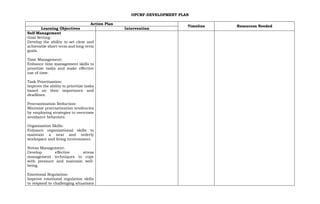
OPCRF-DEVELOPMENT PLAN
Action Plan
Timeline Resources Needed
Learning Objectives Intervention
Self-Management
Goal Setting:
Develop the ability to set clear and
achievable short-term and long-term
goals.
Time Management:
Enhance time management skills to
prioritize tasks and make effective
use of time.
Task Prioritization:
Improve the ability to prioritize tasks
based on their importance and
deadlines.
Procrastination Reduction:
Minimize procrastination tendencies
by employing strategies to overcome
avoidance behaviors.
Organization Skills:
Enhance organizational skills to
maintain a neat and orderly
workspace and living environment.
Stress Management:
Develop effective stress
management techniques to cope
with pressure and maintain well-
being.
Emotional Regulation:
Improve emotional regulation skills
to respond to challenging situations
in a composed and constructive
manner.
Self-Motivation:
Cultivate self-motivation to
maintain enthusiasm and
persistence in pursuing goals.
Accountability:
Increase accountability for personal
actions and commitments.
Resilience:
Build resilience to bounce back from
setbacks and learn from challenges.
Seeking Support:
Develop the ability to seek and
utilize support from others when
facing challenges.
Self-Reflection:
Encourage self-reflection to identify
strengths, weaknesses, and areas
for improvement.
Adaptability:
Enhance adaptability to navigate
changes and transitions effectively.
Assertiveness:
Improve assertiveness skills to
express needs, boundaries, and
opinions confidently.
Healthy Habits:
Establish and maintain healthy
lifestyle habits that support overall
well-being.
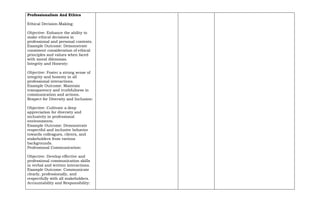
Professionalism And Ethics
Ethical Decision-Making:
Objective: Enhance the ability to
make ethical decisions in
professional and personal contexts.
Example Outcome: Demonstrate
consistent consideration of ethical
principles and values when faced
with moral dilemmas.
Integrity and Honesty:
Objective: Foster a strong sense of
integrity and honesty in all
professional interactions.
Example Outcome: Maintain
transparency and truthfulness in
communication and actions.
Respect for Diversity and Inclusion:
Objective: Cultivate a deep
appreciation for diversity and
inclusivity in professional
environments.
Example Outcome: Demonstrate
respectful and inclusive behavior
towards colleagues, clients, and
stakeholders from various
backgrounds.
Professional Communication:
Objective: Develop effective and
professional communication skills
in verbal and written interactions.
Example Outcome: Communicate
clearly, professionally, and
respectfully with all stakeholders.
Accountability and Responsibility:
Objective: Enhance accountability
and take responsibility for one's
actions and commitments.
Example Outcome: Acknowledge
mistakes and take corrective
actions when necessary.
Continuous Professional
Development:
Objective: Commit to ongoing
learning and development to stay
updated with industry best
practices and trends.
Example Outcome: Engage in
regular training, workshops, or
courses to improve professional
knowledge and skills.
Time Management and Punctuality:
Objective: Develop strong time
management skills and value
punctuality in professional settings.
Example Outcome: Demonstrate
the ability to meet deadlines and
arrive on time for meetings and
commitments.
Teamwork and Collaboration:
Objective: Foster effective teamwork
and collaboration with colleagues to
achieve common goals.
Example Outcome: Contribute
actively to group discussions, share
knowledge, and support team
members.
Adherence to Professional
Standards and Codes of Conduct:
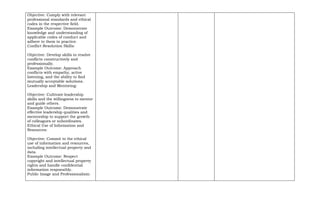
Objective: Comply with relevant
professional standards and ethical
codes in the respective field.
Example Outcome: Demonstrate
knowledge and understanding of
applicable codes of conduct and
adhere to them in practice.
Conflict Resolution Skills:
Objective: Develop skills to resolve
conflicts constructively and
professionally.
Example Outcome: Approach
conflicts with empathy, active
listening, and the ability to find
mutually acceptable solutions.
Leadership and Mentoring:
Objective: Cultivate leadership
skills and the willingness to mentor
and guide others.
Example Outcome: Demonstrate
effective leadership qualities and
mentorship to support the growth
of colleagues or subordinates.
Ethical Use of Information and
Resources:
Objective: Commit to the ethical
use of information and resources,
including intellectual property and
data.
Example Outcome: Respect
copyright and intellectual property
rights and handle confidential
information responsibly.
Public Image and Professionalism:
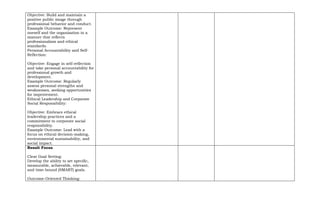
Objective: Build and maintain a
positive public image through
professional behavior and conduct.
Example Outcome: Represent
oneself and the organization in a
manner that reflects
professionalism and ethical
standards.
Personal Accountability and Self-
Reflection:
Objective: Engage in self-reflection
and take personal accountability for
professional growth and
development.
Example Outcome: Regularly
assess personal strengths and
weaknesses, seeking opportunities
for improvement.
Ethical Leadership and Corporate
Social Responsibility:
Objective: Embrace ethical
leadership practices and a
commitment to corporate social
responsibility.
Example Outcome: Lead with a
focus on ethical decision-making,
environmental sustainability, and
social impact.
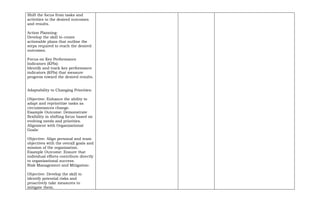
Result Focus
Clear Goal Setting:
Develop the ability to set specific,
measurable, achievable, relevant,
and time-bound (SMART) goals.
Outcome-Oriented Thinking:
Shift the focus from tasks and
activities to the desired outcomes
and results.
Action Planning:
Develop the skill to create
actionable plans that outline the
steps required to reach the desired
outcomes.
Focus on Key Performance
Indicators (KPIs):
Identify and track key performance
indicators (KPIs) that measure
progress toward the desired results.
Adaptability to Changing Priorities:
Objective: Enhance the ability to
adapt and reprioritize tasks as
circumstances change.
Example Outcome: Demonstrate
flexibility in shifting focus based on
evolving needs and priorities.
Alignment with Organizational
Goals:
Objective: Align personal and team
objectives with the overall goals and
mission of the organization.
Example Outcome: Ensure that
individual efforts contribute directly
to organizational success.
Risk Management and Mitigation:
Objective: Develop the skill to
identify potential risks and
proactively take measures to
mitigate them.
Example Outcome: Anticipate and
address potential obstacles that
may hinder results.
Resilience in the Face of
Challenges:
Objective: Cultivate resilience to
persistently pursue results despite
setbacks and obstacles.
Example Outcome: Demonstrate
the ability to bounce back from
failures and maintain motivation.
Measuring Progress and Success:
Objective: Improve the ability to
measure progress and success
objectively.
Example Outcome: Implement
regular progress reviews and
evaluations to gauge success.
Results-Oriented Communication:
Objective: Enhance communication
to focus on outcomes, progress,
and next steps.
Example Outcome: Clearly
articulate progress and results in
reports and presentations.
Resource Allocation and
Optimization:
Objective: Optimize resource
allocation to maximize efficiency
and effectiveness in achieving
results.
Example Outcome: Allocate
resources strategically to prioritize
high-impact activities.
Collaborative Results:
Objective: Foster a collaborative
approach to achieve results
collectively.
Example Outcome: Engage team
members to contribute their
expertise and efforts toward shared
goals.
Continuous Improvement and
Learning:
Objective: Encourage a culture of
continuous improvement and
learning to optimize results over
time.
Example Outcome: Seek feedback
and identify areas for growth and
refinement.
Celebrating Achievements:
Objective: Foster a culture of
recognition and celebration of
achievements and successes.
Example Outcome: Acknowledge
and appreciate team members'
contributions to results.
Personal Accountability for Results:
Objective: Encourage personal
ownership and accountability for
achieving results.
Example Outcome: Take
responsibility for individual
performance and contributions.
MARIA FE P. FIDER GERARDO P. VICENCIO
RATEE APPROVING AUTHORITY
NOTE:
This shall be accomplished/updated during: i) Phase I: Performance Planning and Commitment, based on the results of e-SAT; ii) Phase II: Performance Monitoring and Coaching, based on the agreements on the Performance Monitoring and Coaching Form and Mid-year Review
Form; and iii) Phase IV: Performance Rewarding and Development Planning, based on the actual results of IPCRF.

BENOSA_EDELMAR_IPCRF-DEVELOPMENT-PLAN.docx

  • 1.
    OPCRF-DEVELOPMENT PLAN Action Plan TimelineResources Needed Learning Objectives Intervention Self-Management Goal Setting: Develop the ability to set clear and achievable short-term and long-term goals. Time Management: Enhance time management skills to prioritize tasks and make effective use of time. Task Prioritization: Improve the ability to prioritize tasks based on their importance and deadlines. Procrastination Reduction: Minimize procrastination tendencies by employing strategies to overcome avoidance behaviors. Organization Skills: Enhance organizational skills to maintain a neat and orderly workspace and living environment. Stress Management: Develop effective stress management techniques to cope with pressure and maintain well- being. Emotional Regulation: Improve emotional regulation skills to respond to challenging situations
  • 2.
    in a composedand constructive manner. Self-Motivation: Cultivate self-motivation to maintain enthusiasm and persistence in pursuing goals. Accountability: Increase accountability for personal actions and commitments. Resilience: Build resilience to bounce back from setbacks and learn from challenges. Seeking Support: Develop the ability to seek and utilize support from others when facing challenges. Self-Reflection: Encourage self-reflection to identify strengths, weaknesses, and areas for improvement. Adaptability: Enhance adaptability to navigate changes and transitions effectively. Assertiveness: Improve assertiveness skills to express needs, boundaries, and opinions confidently. Healthy Habits: Establish and maintain healthy lifestyle habits that support overall well-being.
  • 3.
    Professionalism And Ethics EthicalDecision-Making: Objective: Enhance the ability to make ethical decisions in professional and personal contexts. Example Outcome: Demonstrate consistent consideration of ethical principles and values when faced with moral dilemmas. Integrity and Honesty: Objective: Foster a strong sense of integrity and honesty in all professional interactions. Example Outcome: Maintain transparency and truthfulness in communication and actions. Respect for Diversity and Inclusion: Objective: Cultivate a deep appreciation for diversity and inclusivity in professional environments. Example Outcome: Demonstrate respectful and inclusive behavior towards colleagues, clients, and stakeholders from various backgrounds. Professional Communication: Objective: Develop effective and professional communication skills in verbal and written interactions. Example Outcome: Communicate clearly, professionally, and respectfully with all stakeholders. Accountability and Responsibility:
  • 4.
    Objective: Enhance accountability andtake responsibility for one's actions and commitments. Example Outcome: Acknowledge mistakes and take corrective actions when necessary. Continuous Professional Development: Objective: Commit to ongoing learning and development to stay updated with industry best practices and trends. Example Outcome: Engage in regular training, workshops, or courses to improve professional knowledge and skills. Time Management and Punctuality: Objective: Develop strong time management skills and value punctuality in professional settings. Example Outcome: Demonstrate the ability to meet deadlines and arrive on time for meetings and commitments. Teamwork and Collaboration: Objective: Foster effective teamwork and collaboration with colleagues to achieve common goals. Example Outcome: Contribute actively to group discussions, share knowledge, and support team members. Adherence to Professional Standards and Codes of Conduct:
  • 5.
    Objective: Comply withrelevant professional standards and ethical codes in the respective field. Example Outcome: Demonstrate knowledge and understanding of applicable codes of conduct and adhere to them in practice. Conflict Resolution Skills: Objective: Develop skills to resolve conflicts constructively and professionally. Example Outcome: Approach conflicts with empathy, active listening, and the ability to find mutually acceptable solutions. Leadership and Mentoring: Objective: Cultivate leadership skills and the willingness to mentor and guide others. Example Outcome: Demonstrate effective leadership qualities and mentorship to support the growth of colleagues or subordinates. Ethical Use of Information and Resources: Objective: Commit to the ethical use of information and resources, including intellectual property and data. Example Outcome: Respect copyright and intellectual property rights and handle confidential information responsibly. Public Image and Professionalism:
  • 6.
    Objective: Build andmaintain a positive public image through professional behavior and conduct. Example Outcome: Represent oneself and the organization in a manner that reflects professionalism and ethical standards. Personal Accountability and Self- Reflection: Objective: Engage in self-reflection and take personal accountability for professional growth and development. Example Outcome: Regularly assess personal strengths and weaknesses, seeking opportunities for improvement. Ethical Leadership and Corporate Social Responsibility: Objective: Embrace ethical leadership practices and a commitment to corporate social responsibility. Example Outcome: Lead with a focus on ethical decision-making, environmental sustainability, and social impact. Result Focus Clear Goal Setting: Develop the ability to set specific, measurable, achievable, relevant, and time-bound (SMART) goals. Outcome-Oriented Thinking:
  • 7.
    Shift the focusfrom tasks and activities to the desired outcomes and results. Action Planning: Develop the skill to create actionable plans that outline the steps required to reach the desired outcomes. Focus on Key Performance Indicators (KPIs): Identify and track key performance indicators (KPIs) that measure progress toward the desired results. Adaptability to Changing Priorities: Objective: Enhance the ability to adapt and reprioritize tasks as circumstances change. Example Outcome: Demonstrate flexibility in shifting focus based on evolving needs and priorities. Alignment with Organizational Goals: Objective: Align personal and team objectives with the overall goals and mission of the organization. Example Outcome: Ensure that individual efforts contribute directly to organizational success. Risk Management and Mitigation: Objective: Develop the skill to identify potential risks and proactively take measures to mitigate them.
  • 8.
    Example Outcome: Anticipateand address potential obstacles that may hinder results. Resilience in the Face of Challenges: Objective: Cultivate resilience to persistently pursue results despite setbacks and obstacles. Example Outcome: Demonstrate the ability to bounce back from failures and maintain motivation. Measuring Progress and Success: Objective: Improve the ability to measure progress and success objectively. Example Outcome: Implement regular progress reviews and evaluations to gauge success. Results-Oriented Communication: Objective: Enhance communication to focus on outcomes, progress, and next steps. Example Outcome: Clearly articulate progress and results in reports and presentations. Resource Allocation and Optimization: Objective: Optimize resource allocation to maximize efficiency and effectiveness in achieving results. Example Outcome: Allocate resources strategically to prioritize high-impact activities. Collaborative Results:
  • 9.
    Objective: Foster acollaborative approach to achieve results collectively. Example Outcome: Engage team members to contribute their expertise and efforts toward shared goals. Continuous Improvement and Learning: Objective: Encourage a culture of continuous improvement and learning to optimize results over time. Example Outcome: Seek feedback and identify areas for growth and refinement. Celebrating Achievements: Objective: Foster a culture of recognition and celebration of achievements and successes. Example Outcome: Acknowledge and appreciate team members' contributions to results. Personal Accountability for Results: Objective: Encourage personal ownership and accountability for achieving results. Example Outcome: Take responsibility for individual performance and contributions.
  • 10.
    MARIA FE P.FIDER GERARDO P. VICENCIO RATEE APPROVING AUTHORITY NOTE: This shall be accomplished/updated during: i) Phase I: Performance Planning and Commitment, based on the results of e-SAT; ii) Phase II: Performance Monitoring and Coaching, based on the agreements on the Performance Monitoring and Coaching Form and Mid-year Review Form; and iii) Phase IV: Performance Rewarding and Development Planning, based on the actual results of IPCRF.