ECE2030
Introduction to Computer Engineering
Lecture 4: CMOS Network
Prof. Hsien-Hsin Sean Lee
School of Electrical and Computer Engineering
Georgia Tech
2 2
CMOS Inverter
• Connect the following terminals of a PMOS and an
NMOS
– Gates
– Drains
Vin Vout
Vdd
Gnd
Vout
Vin
Vin
Vin = HIGH
Vout = LOW (Gnd)
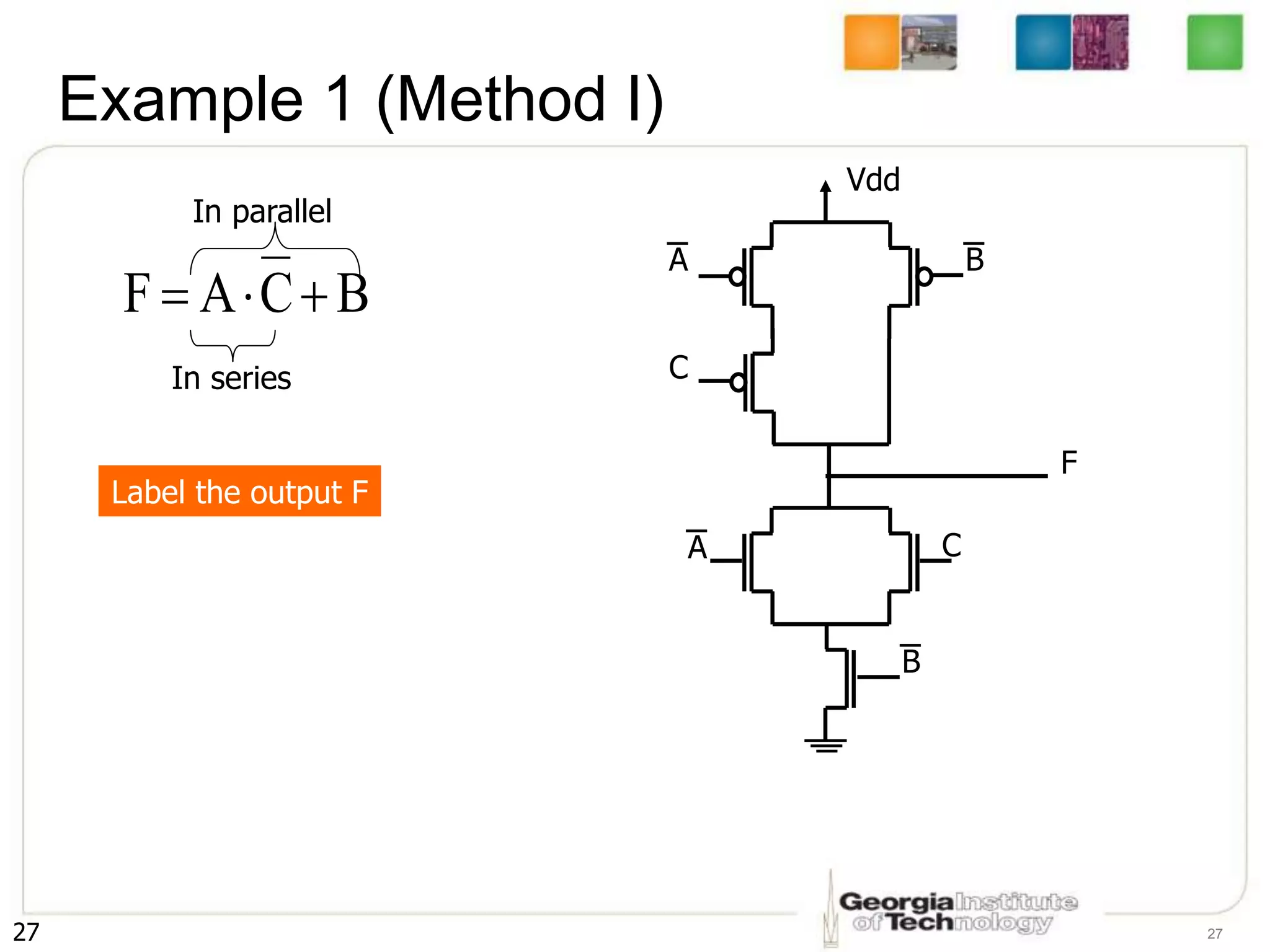
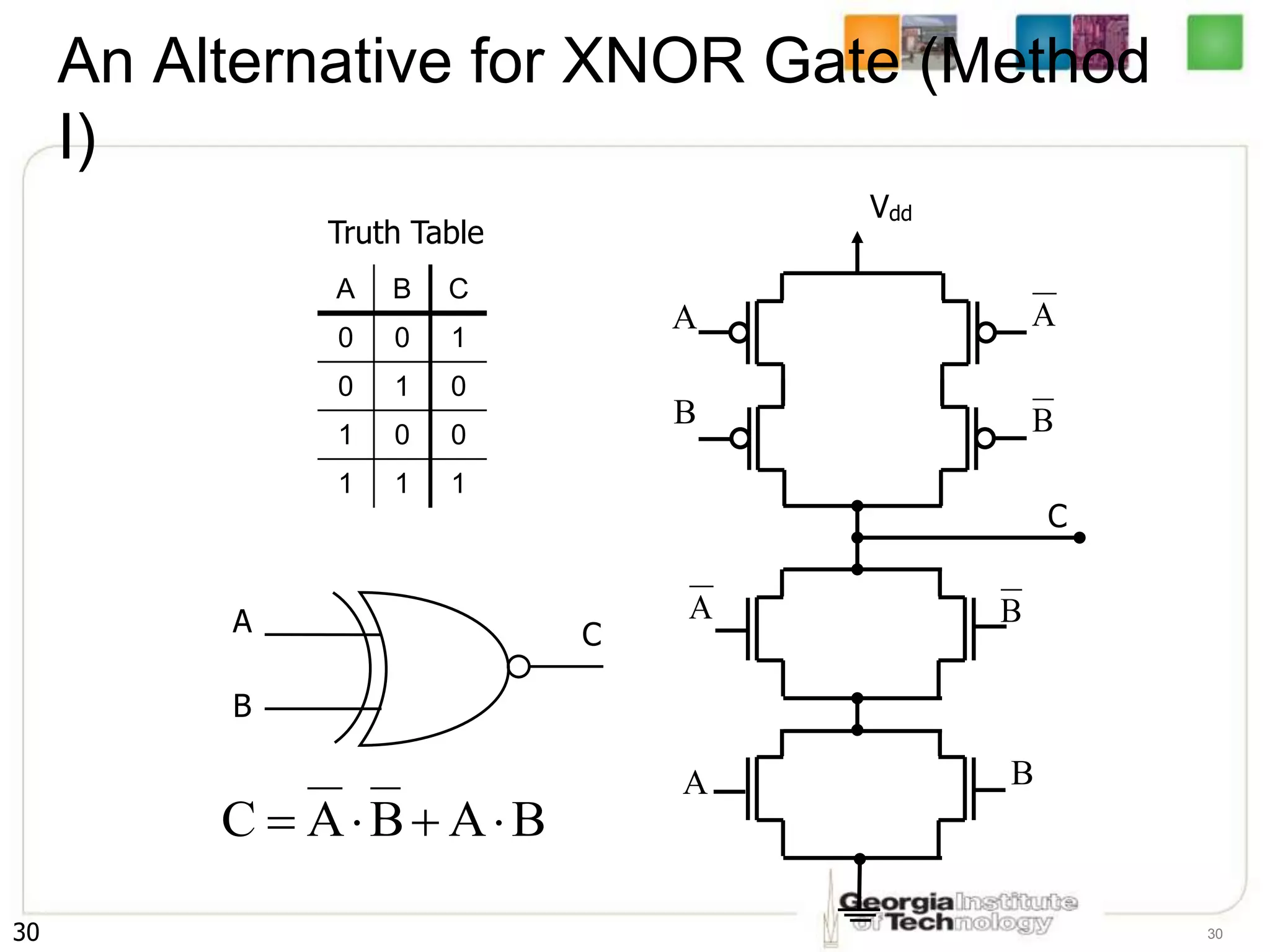
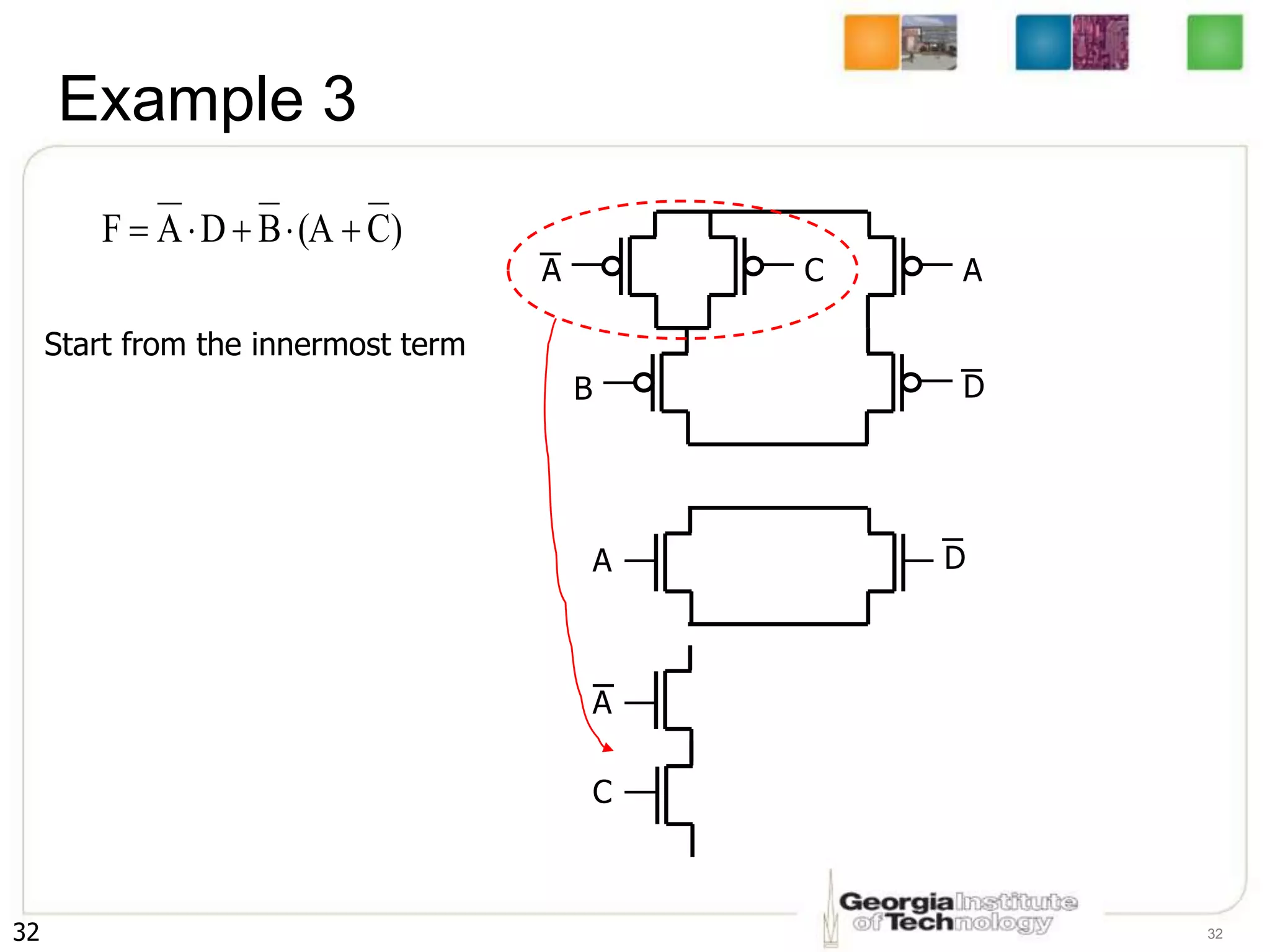
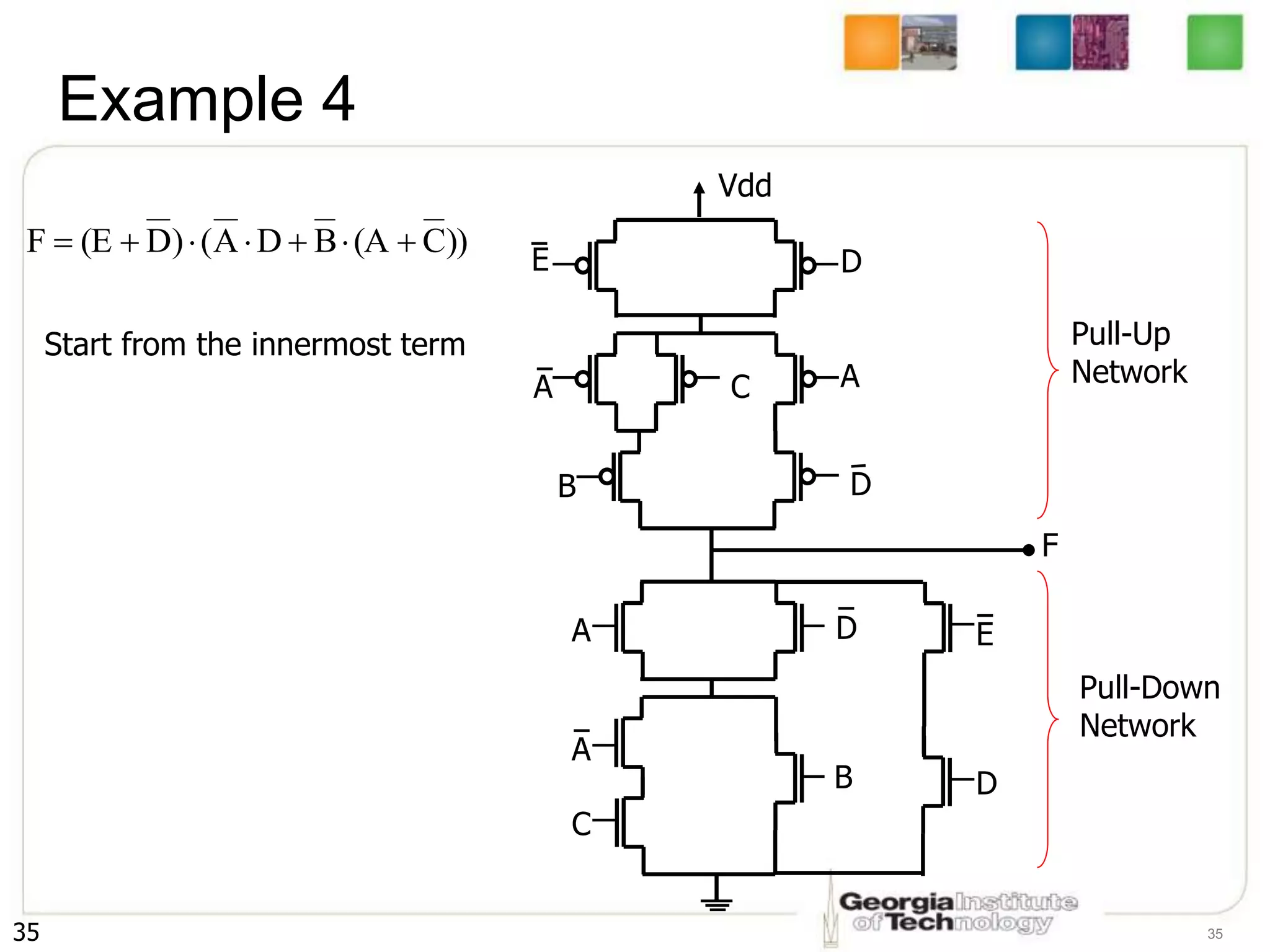
ON
OFF
Vdd
Gnd
Vout
Vin
Vin
Vin = LOW
Vout = HIGH (Vdd)
ON
OFF
Vdd
PMOS
Ground
NMOS
3 3
CMOS Voltage Transfer Characteristics
Vdd
Gnd
Vin Vout
PMOS
NMOS
OFF: V_GateToSource < V_Threshold
LINEAR (or OHMIC): 0< V_DrainToSource < V_GateToSource - V_Threshold
SATURATION: 0 < V_GateToSource - V_Threshold < V_DrainToSource
Note that in the CMOS Inverter  V_GateToSource = V_in
4 4
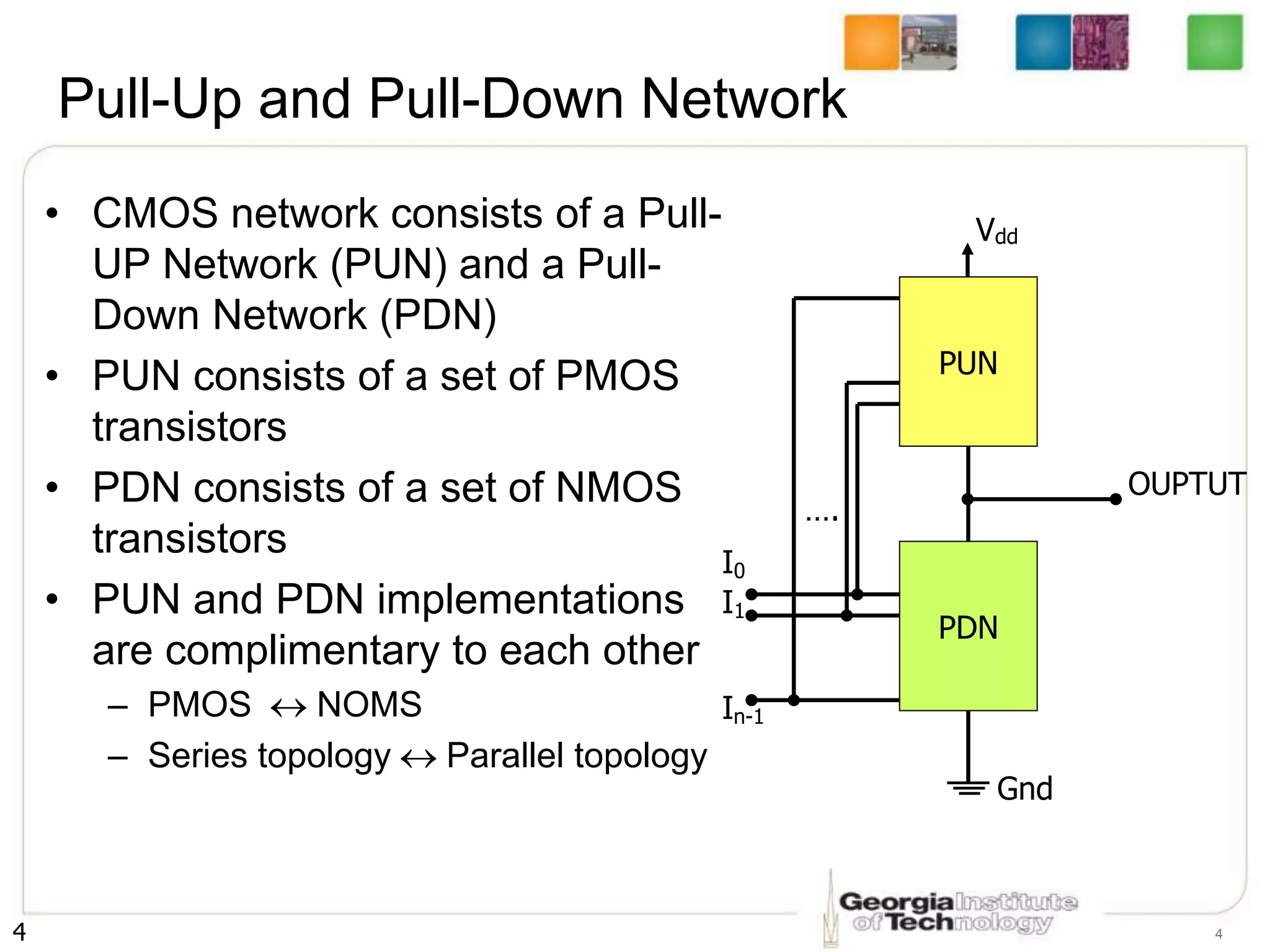
Pull-Up and Pull-Down Network
• CMOS network consists of a Pull-
UP Network (PUN) and a Pull-
Down Network (PDN)
• PUN consists of a set of PMOS
transistors
• PDN consists of a set of NMOS
transistors
• PUN and PDN implementations
are complimentary to each other
– PMOS  NOMS
– Series topology Parallel topology
….
I0
I1
In-1
OUPTUT
Vdd
PUN
Gnd
PDN
5 5
PUN/PDN of a CMOS Inverter
A B
0 1
1 Z
A B
0 Z
1 0
A B
0 1
1 0
Pull-Up
Network
Pull-Down
Network
Combined
CMOS
Network
Vdd
A
Gnd
B
CMOS Inverter
6 6
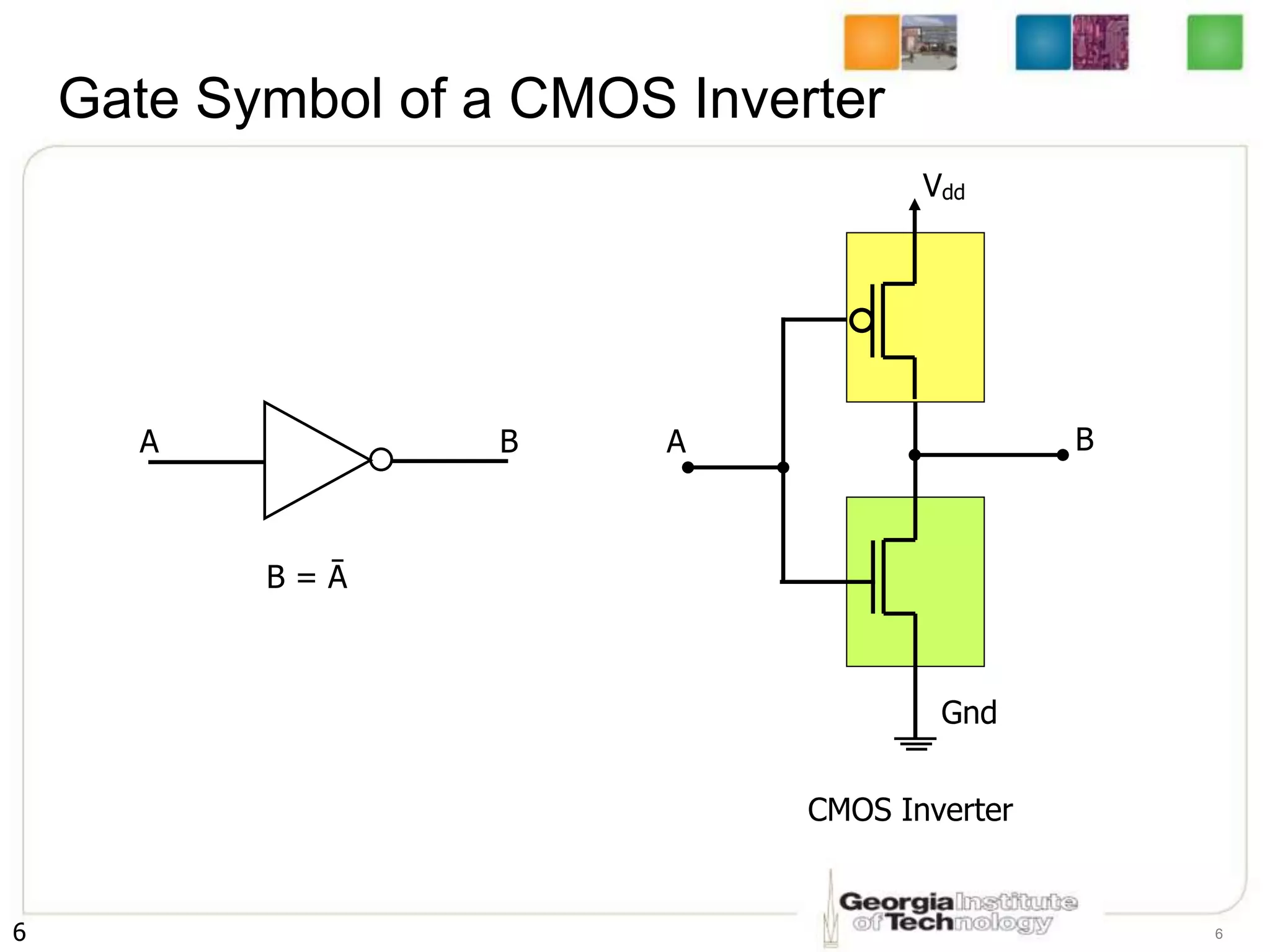
Gate Symbol of a CMOS Inverter
Vdd
A
Gnd
B
CMOS Inverter
A B
B = Ā
7 7
PUN/PDN of a NAND Gate
A B C
0 0 1
0 1 1
1 0 1
1 1 Z
A B C
0 0 Z
0 1 Z
1 0 Z
1 1 0
Pull-Up
Network
Pull-Down
Network
Vdd
A
B
A B
C
8 8
PUN/PDN of a NAND Gate
A B C
0 0 1
0 1 1
1 0 1
1 1 Z
A B C
0 0 Z
0 1 Z
1 0 Z
1 1 0
A B C
0 0 1
0 1 1
1 0 1
1 1 0
Pull-Up
Network
Pull-Down
Network
Combined
CMOS
Network
Vdd
A
B
A B
C
9 9
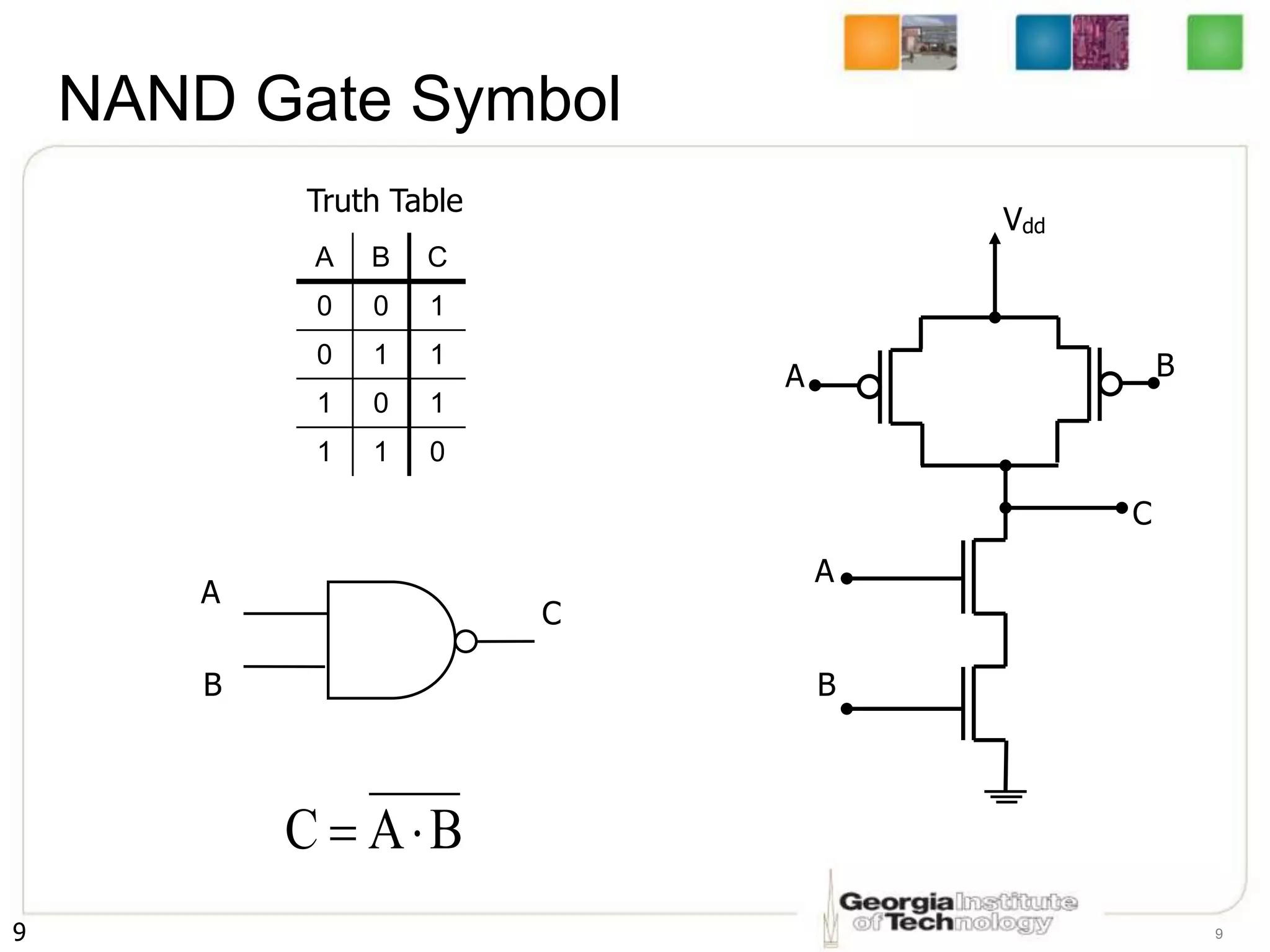
NAND Gate Symbol
A B C
0 0 1
0 1 1
1 0 1
1 1 0
Vdd
A
B
A B
C
A
B
C
Truth Table
B
A
C 

10 10
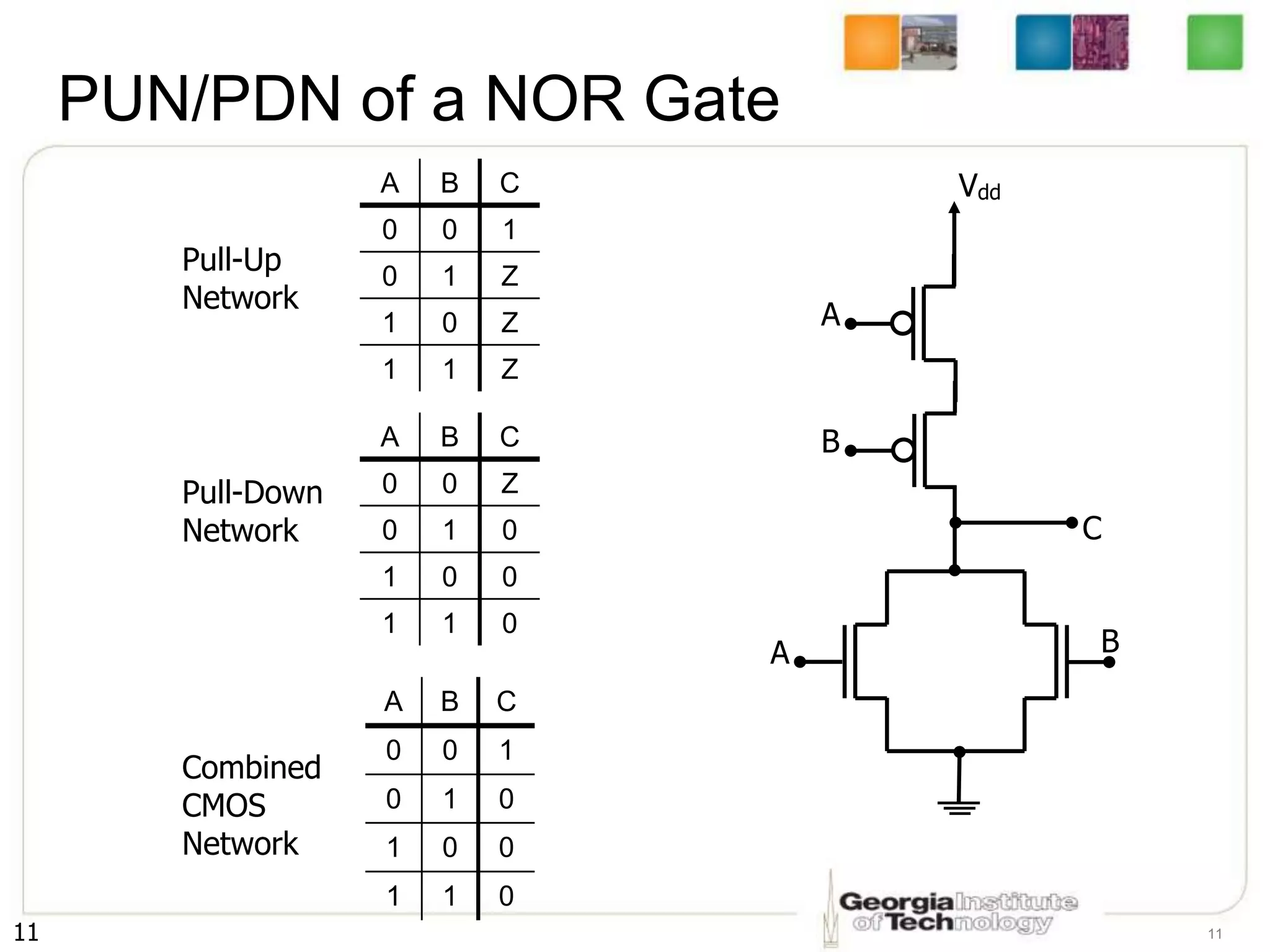
PUN/PDN of a NOR Gate
A B C
0 0 1
0 1 Z
1 0 Z
1 1 Z
A B C
0 0 Z
0 1 0
1 0 0
1 1 0
Pull-Up
Network
Pull-Down
Network
Vdd
A
C
B
A B
11 11
PUN/PDN of a NOR Gate
A B C
0 0 1
0 1 Z
1 0 Z
1 1 Z
A B C
0 0 Z
0 1 0
1 0 0
1 1 0
A B C
0 0 1
0 1 0
1 0 0
1 1 0
Pull-Up
Network
Pull-Down
Network
Combined
CMOS
Network
A
C
B
A B
Vdd
12 12
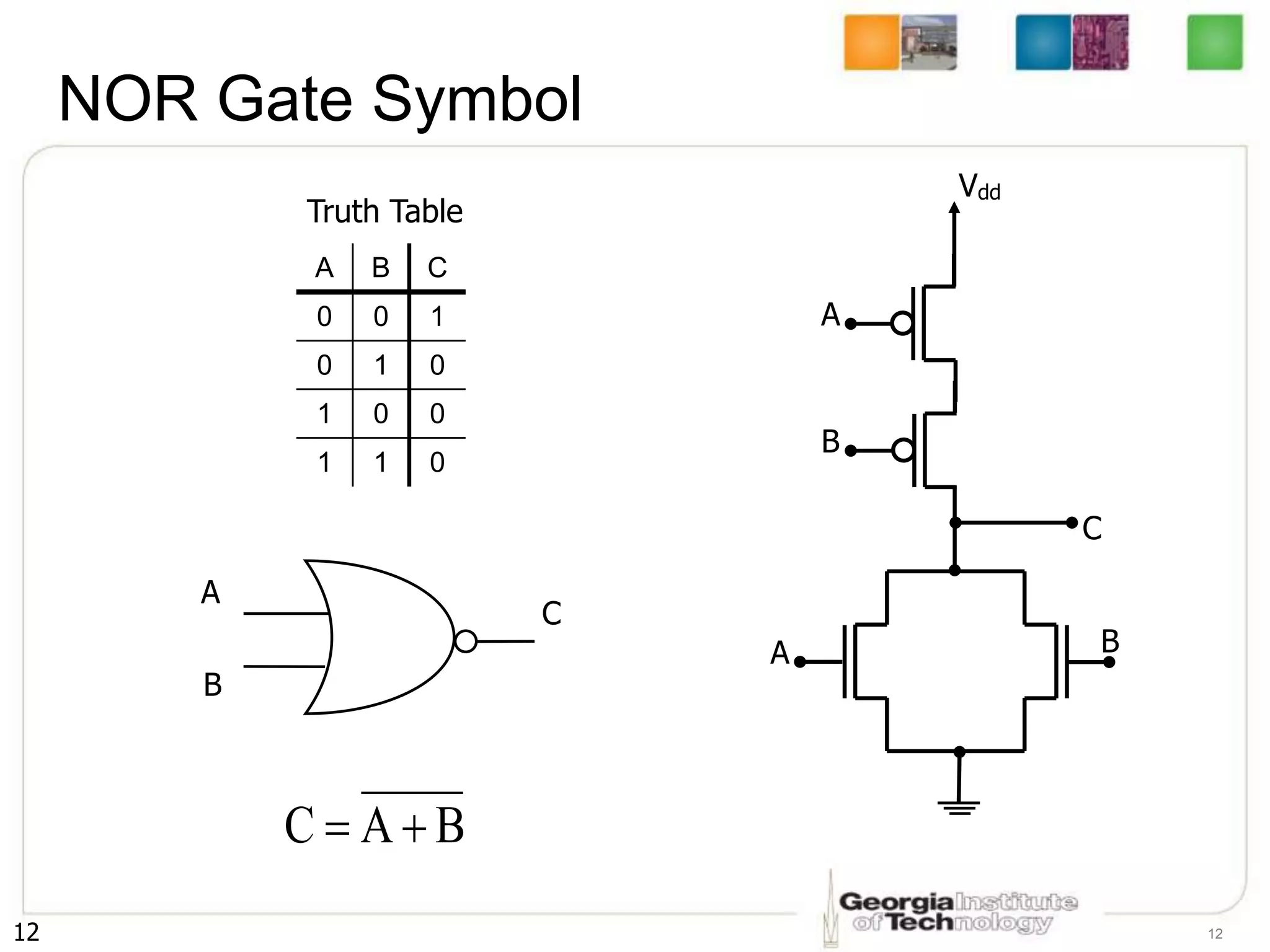
NOR Gate Symbol
A B C
0 0 1
0 1 0
1 0 0
1 1 0
A
B
C
Truth Table
A
C
B
A B
B
A
C 

Vdd
13 13
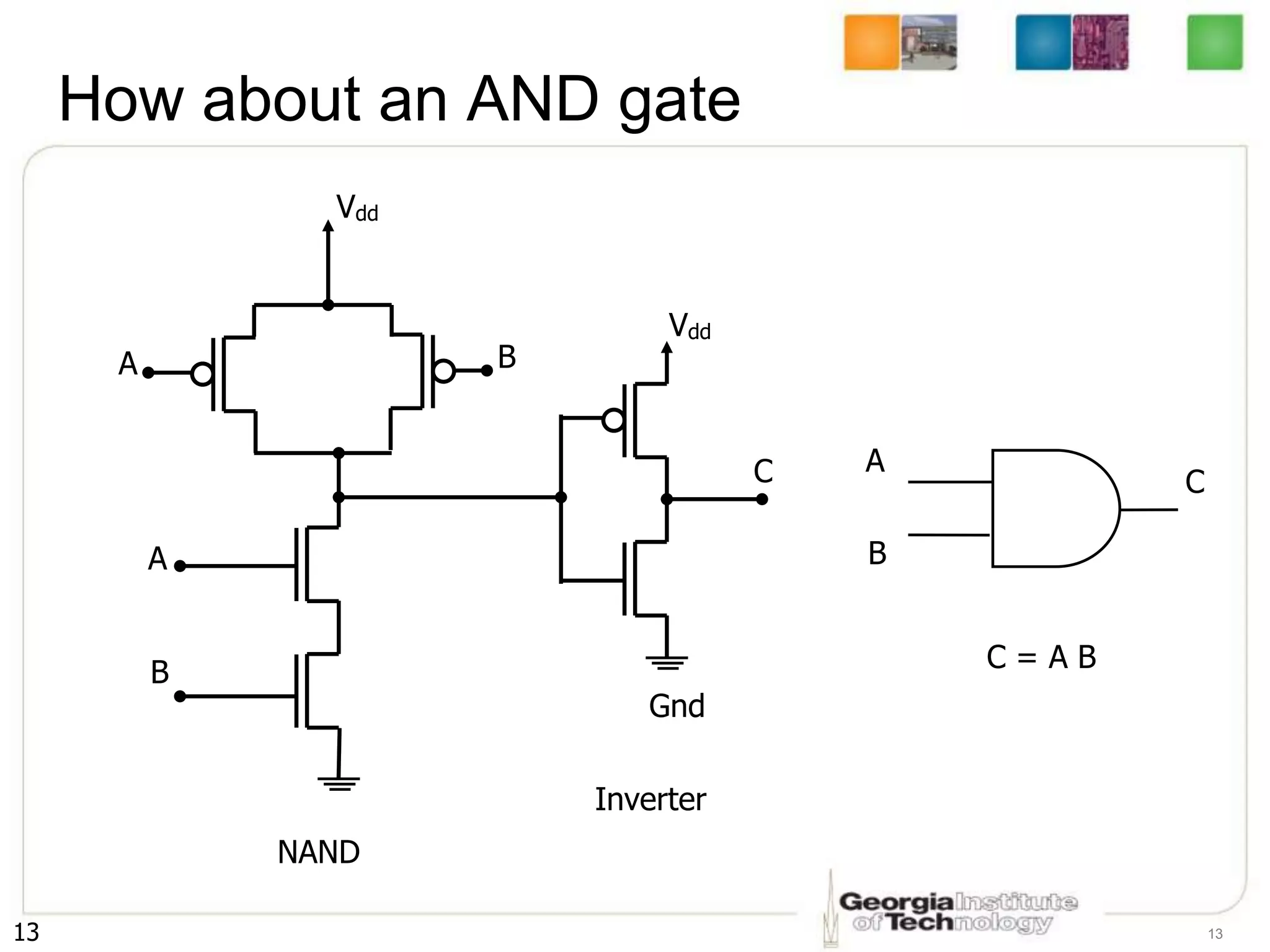
How about an AND gate
Vdd
A
B
A
Vdd
Gnd
C
NAND
Inverter
B
C = A B
A
B
C
14 14
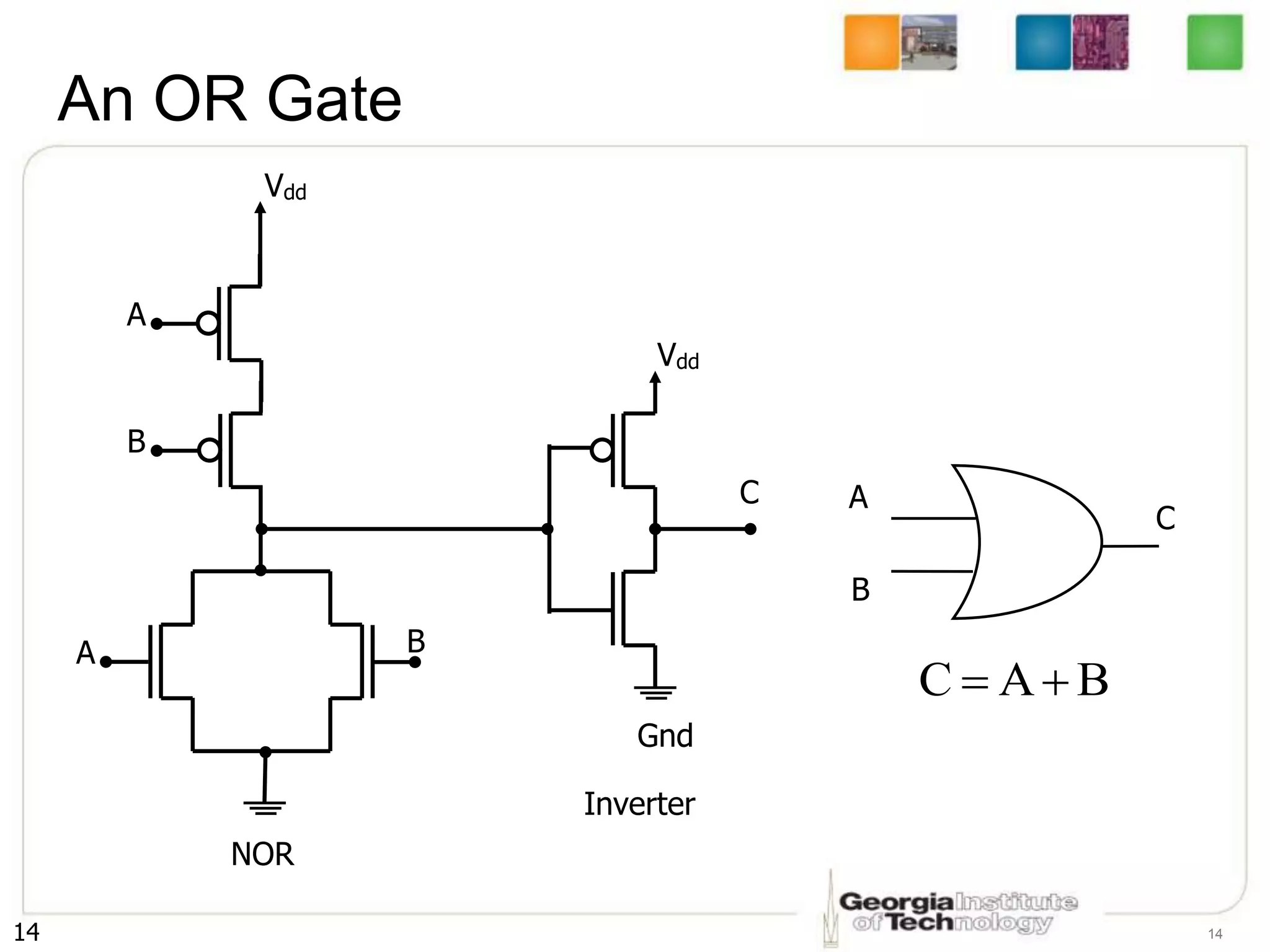
An OR Gate
A
B
A B
Vdd
Vdd
Gnd
C
Inverter
NOR
A
B
C
B
A
C 

15 15
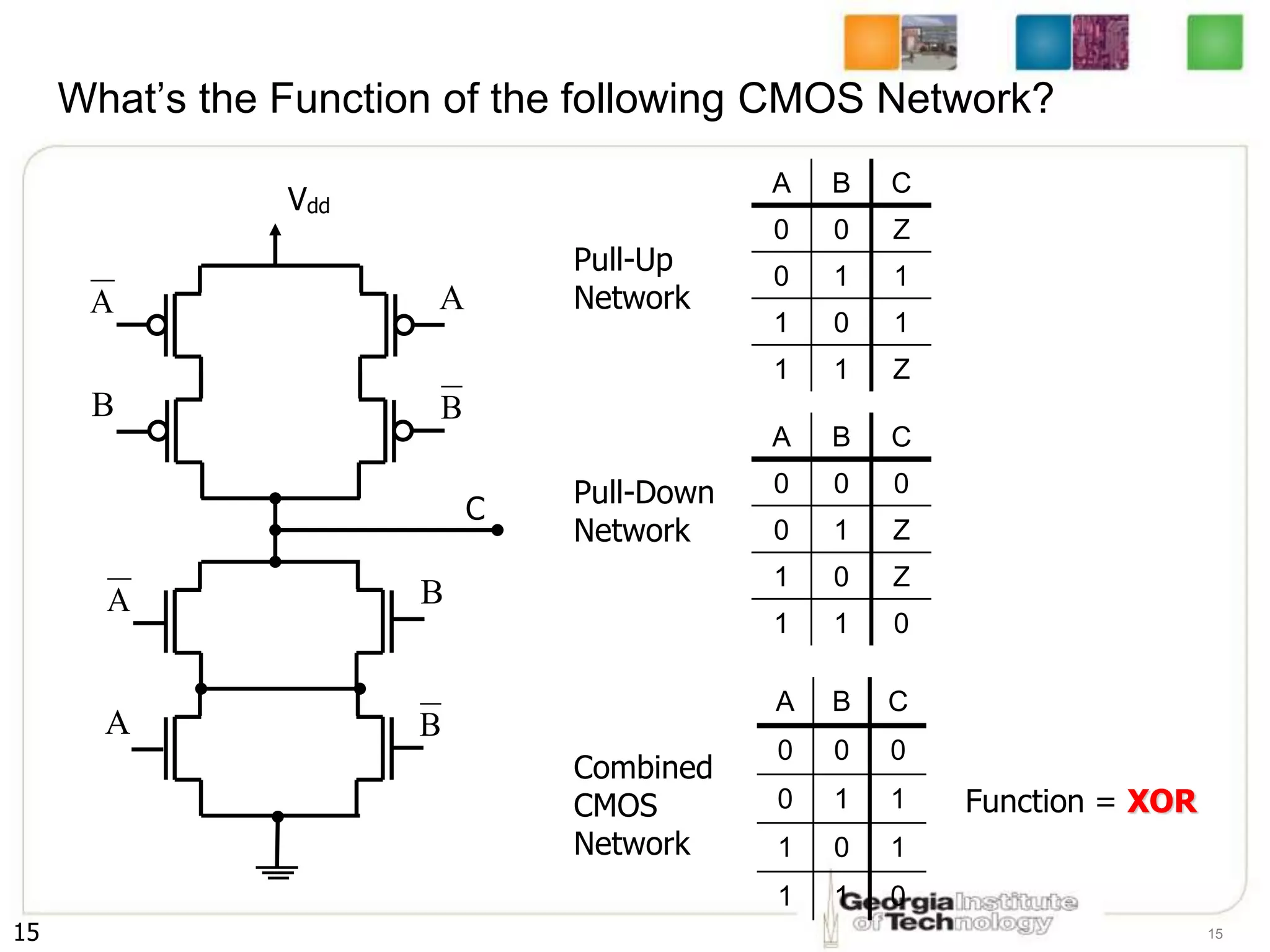
What’s the Function of the following CMOS Network?
A B C
0 0 Z
0 1 1
1 0 1
1 1 Z
A B C
0 0 0
0 1 Z
1 0 Z
1 1 0
A B C
0 0 0
0 1 1
1 0 1
1 1 0
Pull-Up
Network
Pull-Down
Network
Combined
CMOS
Network
Function = XOR
Vdd
A
B
A
A
A
B
B
B
C
16 16
Yet Another XOR CMOS Network
Vdd
A
B
A A
A
B
B
B
C
A B C
0 0 Z
0 1 1
1 0 1
1 1 Z
A B C
0 0 0
0 1 Z
1 0 Z
1 1 0
A B C
0 0 0
0 1 1
1 0 1
1 1 0
Pull-Up
Network
Pull-Down
Network
Combined
CMOS
Network
Function = XOR
17 17
Exclusive-OR (XOR) Gate
Vdd
A
B
A A
A
B
B
B
C
A B C
0 0 0
0 1 1
1 0 1
1 1 0
A
B
C
Truth Table
B
A
B
A
B
A
C 





18 18
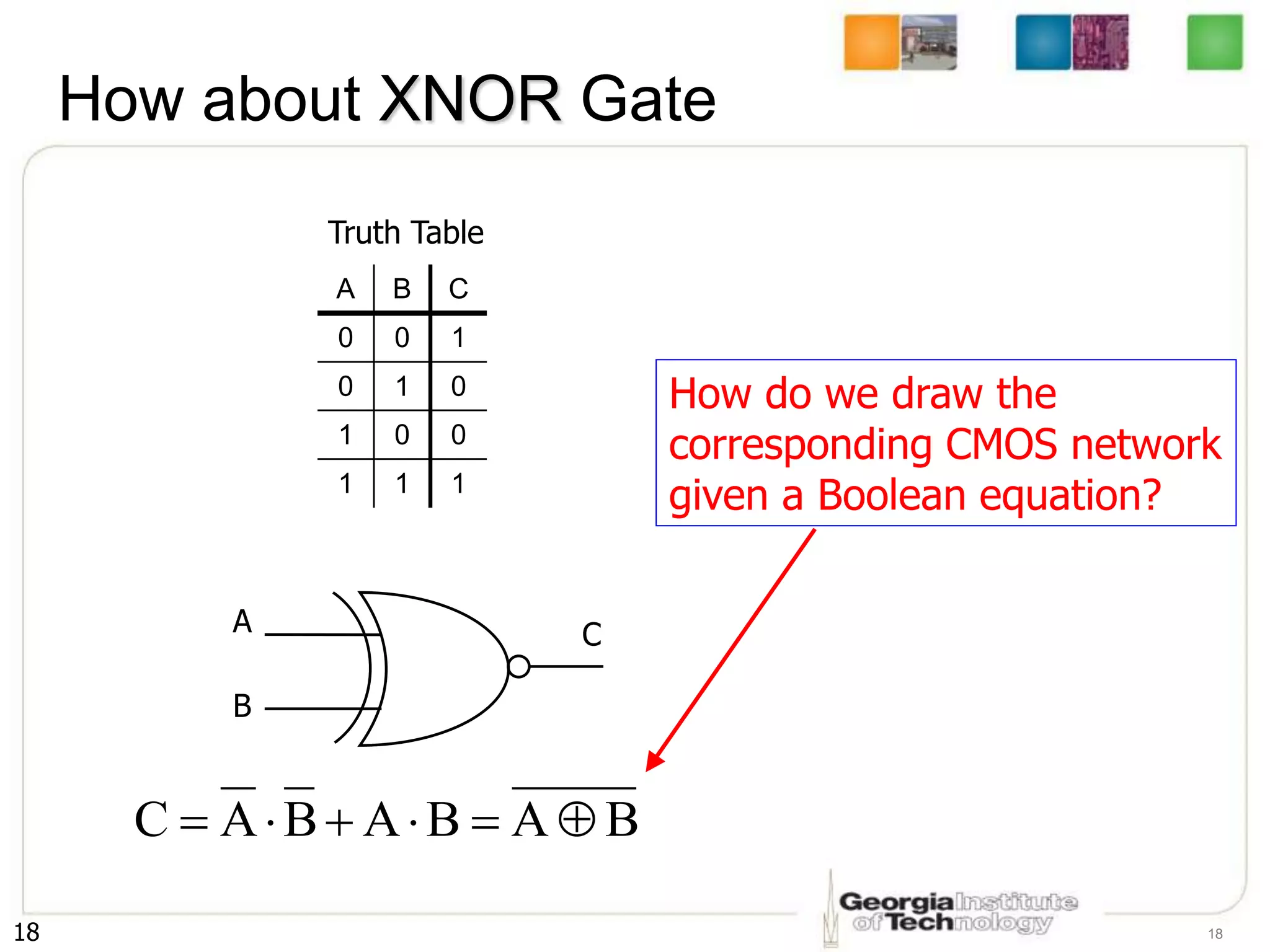
How about XNOR Gate
A B C
0 0 1
0 1 0
1 0 0
1 1 1
A
B
C
Truth Table
B
A
B
A
B
A
C 





How do we draw the
corresponding CMOS network
given a Boolean equation?
19 19
How about XNOR Gate
A B C
0 0 1
0 1 0
1 0 0
1 1 1
A
B
C
Truth Table
B
A
B
A
C 



Vdd
A
B
A A
A
B
B
B
C
Vdd
XOR
Inverter
20 20
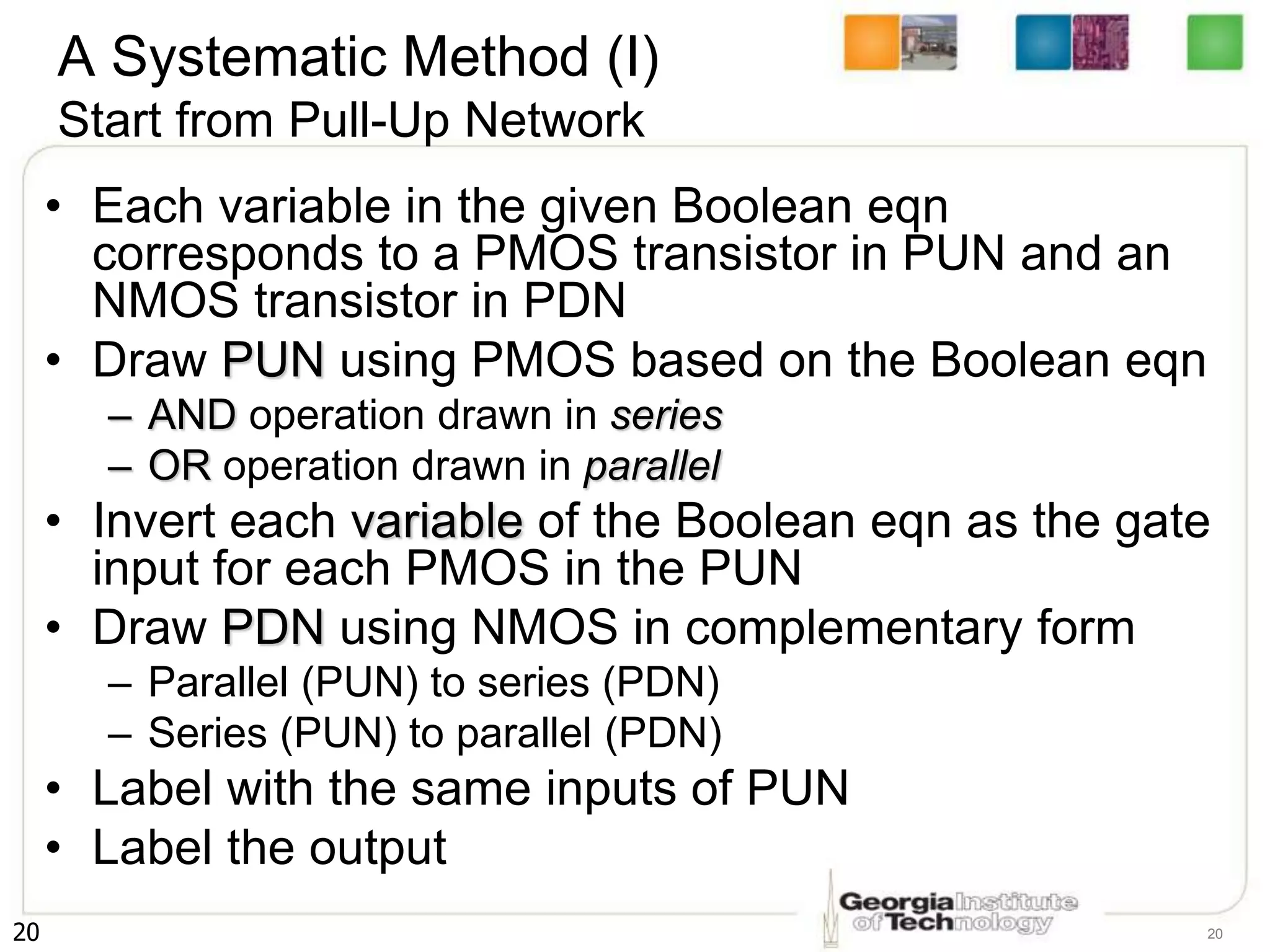
A Systematic Method (I)
Start from Pull-Up Network
• Each variable in the given Boolean eqn
corresponds to a PMOS transistor in PUN and an
NMOS transistor in PDN
• Draw PUN using PMOS based on the Boolean eqn
– AND operation drawn in series
– OR operation drawn in parallel
• Invert each variable of the Boolean eqn as the gate
input for each PMOS in the PUN
• Draw PDN using NMOS in complementary form
– Parallel (PUN) to series (PDN)
– Series (PUN) to parallel (PDN)
• Label with the same inputs of PUN
• Label the output
21 21
A Systematic Method (II)
Start from Pull-Down Network
• Each variable in the given Boolean eqn corresponds to a
PMOS transistor in PUN and an NMOS transistor in PDN
• Invert the Boolean eqn
• With the Right-Hand Side of the newly inverted equation,
Draw PDN using NMOS
– AND operation drawn in series
– OR operation drawn in parallel
• Label each variable of the Boolean eqn as the gate input for
each NMOS in the PDN
• Draw PUN using PMOS in complementary form
– Parallel (PUN) to series (PDN)
– Series (PUN) to parallel (PDN)
• Label with the same inputs of PUN
• Label the output
22 22
Systematic Approaches
• Note that both methods lead to exactly the same
implementation of a CMOS network
• The reason to invert Output equation in (II) is
because
– Output (F) is conducting to “ground”, i.e. 0, when there
is a path formed by input NMOS transistors
– Inversion will force the desired result from the equation
• Example
– F=Ā·C + B: When (A=0 and C=1) or B=1, F=1.
However, in the PDN (NMOS) of a CMOS network,
F=0, i.e. an inverse result.
– Revisit how a NAND CMOS network is implemented
• Inverting each PMOS input in (I) follow the same
reasoning
23 23
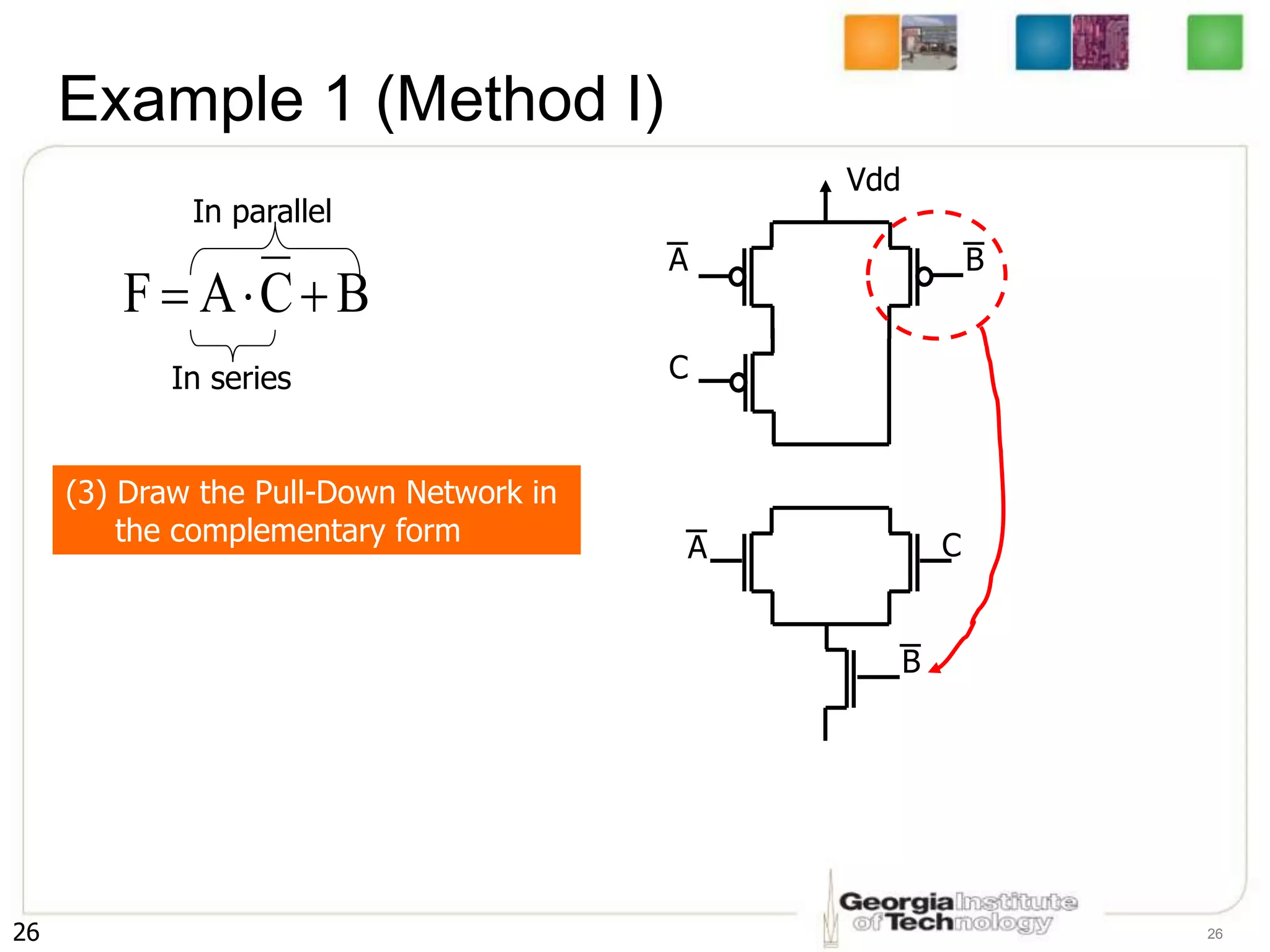
Example 1 (Method I)
B
C
A
F 


In series
In parallel
Vdd
(1) Draw the Pull-Up Network
24 24
Example 1 (Method I)
B
C
A
F 


In series
In parallel
Vdd
(2) Assign the complemented input
A
C
B
25 25
Example 1 (Method I)
B
C
A
F 


In series
In parallel
Vdd
(3) Draw the Pull-Down Network in
the complementary form
A
C
B
A C
26 26
Example 1 (Method I)
B
C
A
F 


In series
In parallel
Vdd
(3) Draw the Pull-Down Network in
the complementary form
A
C
B
A C
B
27 27
Example 1 (Method I)
B
C
A
F 


In series
In parallel
Vdd
Label the output F
A
C
B
A C
B
F
28 28
Example 1 (Method I)
B
C
A
F 


In series
In parallel
Vdd
A
C
B
A C
B
F
A B C F
0 0 0 0
0 0 1 0
0 1 0 1
0 1 1 1
1 0 0 1
1 0 1 0
1 1 0 1
1 1 1 1
Truth Table
29 29
Drawing the Schematic using Method II
B
C
A
F 


B
C)
A
(
F
B
C
A
F
B
C
A
F









Vdd
A
C
B
A C
B
F
This is exactly the same
CMOS network with the
schematic by Method I
30 30
An Alternative for XNOR Gate (Method
I)
A B C
0 0 1
0 1 0
1 0 0
1 1 1
A
B
C
Truth Table
B
A
B
A
C 



Vdd
A
B
A
B
A
A B
B
C
31 31
Example 3
)
C
(A
B
D
A
F 




Start from the innermost term
A
B D
A
C
A D
32 32
Example 3
)
C
(A
B
D
A
F 




Start from the innermost term
A
B D
A
C
A D
A
C
33 33
Example 3
)
C
(A
B
D
A
F 




Start from the innermost term
A
B D
A
C
A D
A
C
B
34 34
Example 3
)
C
(A
B
D
A
F 




Start from the innermost term
A
B D
A
C
A D
A
C
B
Vdd
F
Pull-Up
Network
Pull-Down
Network
35 35
Example 4
))
C
(A
B
D
A
(
)
D
(E
F 






Start from the innermost term
A
B D
A
C
A D
A
C
B
Vdd
F
E D
E
D
Pull-Down
Network
Pull-Up
Network
36 36
Another Example
B
C
A
F 

 How ??

13185501.ppt

  • 1.
    ECE2030 Introduction to ComputerEngineering Lecture 4: CMOS Network Prof. Hsien-Hsin Sean Lee School of Electrical and Computer Engineering Georgia Tech
  • 2.
    2 2 CMOS Inverter •Connect the following terminals of a PMOS and an NMOS – Gates – Drains Vin Vout Vdd Gnd Vout Vin Vin Vin = HIGH Vout = LOW (Gnd) ON OFF Vdd Gnd Vout Vin Vin Vin = LOW Vout = HIGH (Vdd) ON OFF Vdd PMOS Ground NMOS
  • 3.
    3 3 CMOS VoltageTransfer Characteristics Vdd Gnd Vin Vout PMOS NMOS OFF: V_GateToSource < V_Threshold LINEAR (or OHMIC): 0< V_DrainToSource < V_GateToSource - V_Threshold SATURATION: 0 < V_GateToSource - V_Threshold < V_DrainToSource Note that in the CMOS Inverter  V_GateToSource = V_in
  • 4.
    4 4 Pull-Up andPull-Down Network • CMOS network consists of a Pull- UP Network (PUN) and a Pull- Down Network (PDN) • PUN consists of a set of PMOS transistors • PDN consists of a set of NMOS transistors • PUN and PDN implementations are complimentary to each other – PMOS  NOMS – Series topology Parallel topology …. I0 I1 In-1 OUPTUT Vdd PUN Gnd PDN
  • 5.
    5 5 PUN/PDN ofa CMOS Inverter A B 0 1 1 Z A B 0 Z 1 0 A B 0 1 1 0 Pull-Up Network Pull-Down Network Combined CMOS Network Vdd A Gnd B CMOS Inverter
  • 6.
    6 6 Gate Symbolof a CMOS Inverter Vdd A Gnd B CMOS Inverter A B B = Ā
  • 7.
    7 7 PUN/PDN ofa NAND Gate A B C 0 0 1 0 1 1 1 0 1 1 1 Z A B C 0 0 Z 0 1 Z 1 0 Z 1 1 0 Pull-Up Network Pull-Down Network Vdd A B A B C
  • 8.
    8 8 PUN/PDN ofa NAND Gate A B C 0 0 1 0 1 1 1 0 1 1 1 Z A B C 0 0 Z 0 1 Z 1 0 Z 1 1 0 A B C 0 0 1 0 1 1 1 0 1 1 1 0 Pull-Up Network Pull-Down Network Combined CMOS Network Vdd A B A B C
  • 9.
    9 9 NAND GateSymbol A B C 0 0 1 0 1 1 1 0 1 1 1 0 Vdd A B A B C A B C Truth Table B A C  
  • 10.
    10 10 PUN/PDN ofa NOR Gate A B C 0 0 1 0 1 Z 1 0 Z 1 1 Z A B C 0 0 Z 0 1 0 1 0 0 1 1 0 Pull-Up Network Pull-Down Network Vdd A C B A B
  • 11.
    11 11 PUN/PDN ofa NOR Gate A B C 0 0 1 0 1 Z 1 0 Z 1 1 Z A B C 0 0 Z 0 1 0 1 0 0 1 1 0 A B C 0 0 1 0 1 0 1 0 0 1 1 0 Pull-Up Network Pull-Down Network Combined CMOS Network A C B A B Vdd
  • 12.
    12 12 NOR GateSymbol A B C 0 0 1 0 1 0 1 0 0 1 1 0 A B C Truth Table A C B A B B A C   Vdd
  • 13.
    13 13 How aboutan AND gate Vdd A B A Vdd Gnd C NAND Inverter B C = A B A B C
  • 14.
    14 14 An ORGate A B A B Vdd Vdd Gnd C Inverter NOR A B C B A C  
  • 15.
    15 15 What’s theFunction of the following CMOS Network? A B C 0 0 Z 0 1 1 1 0 1 1 1 Z A B C 0 0 0 0 1 Z 1 0 Z 1 1 0 A B C 0 0 0 0 1 1 1 0 1 1 1 0 Pull-Up Network Pull-Down Network Combined CMOS Network Function = XOR Vdd A B A A A B B B C
  • 16.
    16 16 Yet AnotherXOR CMOS Network Vdd A B A A A B B B C A B C 0 0 Z 0 1 1 1 0 1 1 1 Z A B C 0 0 0 0 1 Z 1 0 Z 1 1 0 A B C 0 0 0 0 1 1 1 0 1 1 1 0 Pull-Up Network Pull-Down Network Combined CMOS Network Function = XOR
  • 17.
    17 17 Exclusive-OR (XOR)Gate Vdd A B A A A B B B C A B C 0 0 0 0 1 1 1 0 1 1 1 0 A B C Truth Table B A B A B A C      
  • 18.
    18 18 How aboutXNOR Gate A B C 0 0 1 0 1 0 1 0 0 1 1 1 A B C Truth Table B A B A B A C       How do we draw the corresponding CMOS network given a Boolean equation?
  • 19.
    19 19 How aboutXNOR Gate A B C 0 0 1 0 1 0 1 0 0 1 1 1 A B C Truth Table B A B A C     Vdd A B A A A B B B C Vdd XOR Inverter
  • 20.
    20 20 A SystematicMethod (I) Start from Pull-Up Network • Each variable in the given Boolean eqn corresponds to a PMOS transistor in PUN and an NMOS transistor in PDN • Draw PUN using PMOS based on the Boolean eqn – AND operation drawn in series – OR operation drawn in parallel • Invert each variable of the Boolean eqn as the gate input for each PMOS in the PUN • Draw PDN using NMOS in complementary form – Parallel (PUN) to series (PDN) – Series (PUN) to parallel (PDN) • Label with the same inputs of PUN • Label the output
  • 21.
    21 21 A SystematicMethod (II) Start from Pull-Down Network • Each variable in the given Boolean eqn corresponds to a PMOS transistor in PUN and an NMOS transistor in PDN • Invert the Boolean eqn • With the Right-Hand Side of the newly inverted equation, Draw PDN using NMOS – AND operation drawn in series – OR operation drawn in parallel • Label each variable of the Boolean eqn as the gate input for each NMOS in the PDN • Draw PUN using PMOS in complementary form – Parallel (PUN) to series (PDN) – Series (PUN) to parallel (PDN) • Label with the same inputs of PUN • Label the output
  • 22.
    22 22 Systematic Approaches •Note that both methods lead to exactly the same implementation of a CMOS network • The reason to invert Output equation in (II) is because – Output (F) is conducting to “ground”, i.e. 0, when there is a path formed by input NMOS transistors – Inversion will force the desired result from the equation • Example – F=Ā·C + B: When (A=0 and C=1) or B=1, F=1. However, in the PDN (NMOS) of a CMOS network, F=0, i.e. an inverse result. – Revisit how a NAND CMOS network is implemented • Inverting each PMOS input in (I) follow the same reasoning
  • 23.
    23 23 Example 1(Method I) B C A F    In series In parallel Vdd (1) Draw the Pull-Up Network
  • 24.
    24 24 Example 1(Method I) B C A F    In series In parallel Vdd (2) Assign the complemented input A C B
  • 25.
    25 25 Example 1(Method I) B C A F    In series In parallel Vdd (3) Draw the Pull-Down Network in the complementary form A C B A C
  • 26.
    26 26 Example 1(Method I) B C A F    In series In parallel Vdd (3) Draw the Pull-Down Network in the complementary form A C B A C B
  • 27.
    27 27 Example 1(Method I) B C A F    In series In parallel Vdd Label the output F A C B A C B F
  • 28.
    28 28 Example 1(Method I) B C A F    In series In parallel Vdd A C B A C B F A B C F 0 0 0 0 0 0 1 0 0 1 0 1 0 1 1 1 1 0 0 1 1 0 1 0 1 1 0 1 1 1 1 1 Truth Table
  • 29.
    29 29 Drawing theSchematic using Method II B C A F    B C) A ( F B C A F B C A F          Vdd A C B A C B F This is exactly the same CMOS network with the schematic by Method I
  • 30.
    30 30 An Alternativefor XNOR Gate (Method I) A B C 0 0 1 0 1 0 1 0 0 1 1 1 A B C Truth Table B A B A C     Vdd A B A B A A B B C
  • 31.
    31 31 Example 3 ) C (A B D A F     Start from the innermost term A B D A C A D
  • 32.
    32 32 Example 3 ) C (A B D A F     Start from the innermost term A B D A C A D A C
  • 33.
    33 33 Example 3 ) C (A B D A F     Start from the innermost term A B D A C A D A C B
  • 34.
    34 34 Example 3 ) C (A B D A F     Start from the innermost term A B D A C A D A C B Vdd F Pull-Up Network Pull-Down Network
  • 35.
    35 35 Example 4 )) C (A B D A ( ) D (E F       Start from the innermost term A B D A C A D A C B Vdd F E D E D Pull-Down Network Pull-Up Network
  • 36.