1
Computer Architecture
Lecture 1
Naohiko Shimizu
2
What is the Architecture?
• It came from the arch of buildings. The
structure, design etc.
Computer Architecture
3
Building blocks of computer
systems
• Computer
– Processor
– Memory
– I/O devices
• Storage
– Magnetic drives (HDD, Tape)
– Solid State drives
– Optical drives
• Network
4
Basics of Digital System
• Logic functions
– Boolean expression
– Arithmetic functions
• Sequential circuits
– Finite State Machines
– Pipeline
• Memory technology
– Non volatile / Volatile memory
– Flip Flops
5
Switching theory
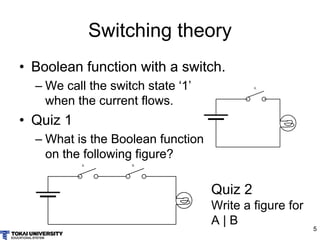
• Boolean function with a switch.
– We call the switch state ‘1’
when the current flows.
• Quiz 1
– What is the Boolean function
on the following figure?
A
A B
Quiz 2
Write a figure for
A | B
• Boolean function with a switch.
– We call the switch state ‘1’
when the current flows.
• Quiz 1
– What is the Boolean function
on the following figure?
A B
6
MOS Transistor
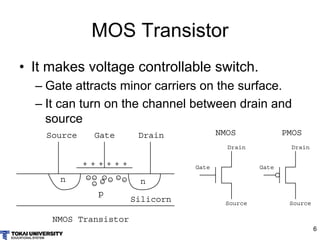
• It makes voltage controllable switch.
– Gate attracts minor carriers on the surface.
– It can turn on the channel between drain and
source
Gate DrainSource
Silicorn
n n
p
NMOS Transistor
+
-- - - ----
+ + + + + Gate
Drain
Source
Gate
Drain
Source
NMOS PMOS
7
CMOS Logic
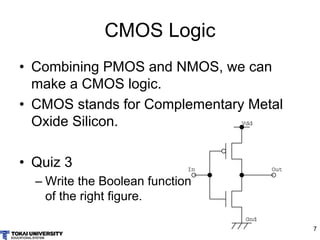
• Combining PMOS and NMOS, we can
make a CMOS logic.
• CMOS stands for Complementary Metal
Oxide Silicon.
• Quiz 3
– Write the Boolean function
of the right figure.
Vdd
Gnd
In Out
8
Quiz
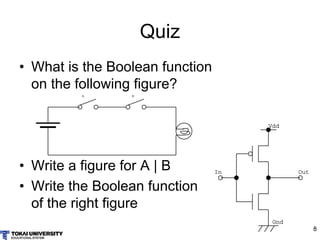
• What is the Boolean function
on the following figure?
• Write a figure for A | B
• Write the Boolean function
of the right figure
A B
Vdd
Gnd
In Out
1
Computer Architecture
Lecture 2
CMOS Logic Ciurcuits
2
Basic CMOS Circuit
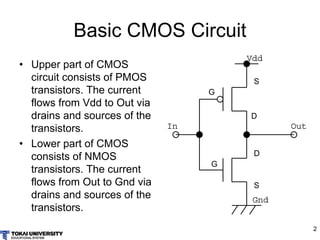
• Upper part of CMOS
circuit consists of PMOS
transistors. The current
flows from Vdd to Out via
drains and sources of the
transistors.
• Lower part of CMOS
consists of NMOS
transistors. The current
flows from Out to Gnd via
drains and sources of the
transistors.
Vdd
Gnd
In Out
D
S
G
D
S
G
3
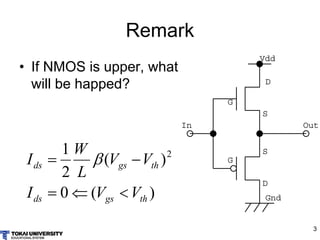
Remark
• If NMOS is upper, what
will be happed?
Vdd
Gnd
In Out
D
S
G
S
D
G
)(0
)(
2
1 2
thgsds
thgsds
VVI
VV
L
W
I

 
4
Basic CMOS Circuit
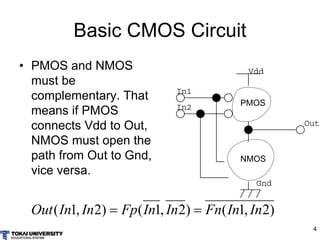
• PMOS and NMOS
must be
complementary. That
means if PMOS
connects Vdd to Out,
NMOS must open the
path from Out to Gnd,
vice versa.
Vdd
Gnd
Out
In1
In2 PMOS
NMOS
)2,1()2,1()2,1( InInFnInInFpInInOut 
5
Example: NAND
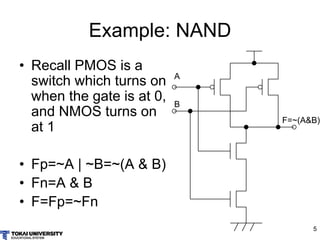
• Recall PMOS is a
switch which turns on
when the gate is at 0,
and NMOS turns on
at 1
• Fp=~A | ~B=~(A & B)
• Fn=A & B
• F=Fp=~Fn
A
B
F=~(A&B)
6
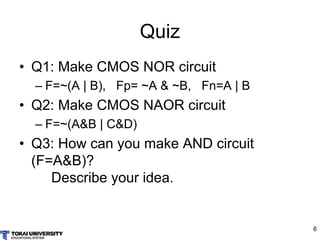
Quiz
• Q1: Make CMOS NOR circuit
– F=~(A | B), Fp= ~A & ~B, Fn=A | B
• Q2: Make CMOS NAOR circuit
– F=~(A&B | C&D)
• Q3: How can you make AND circuit
(F=A&B)?
Describe your idea.
1
Computer Architecture
Lecture 3
Latch: memorize the data
2
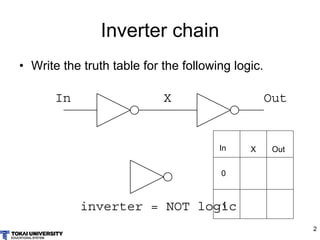
Inverter chain
• Write the truth table for the following logic.
In OutX
inverter = NOT logic
In X Out
0
1
3
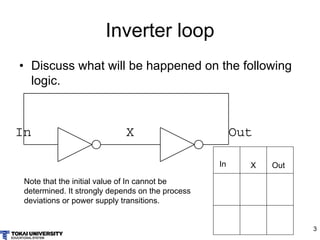
Inverter loop
• Discuss what will be happened on the following
logic.
In X Out
In OutX
Note that the initial value of In cannot be
determined. It strongly depends on the process
deviations or power supply transitions.
4
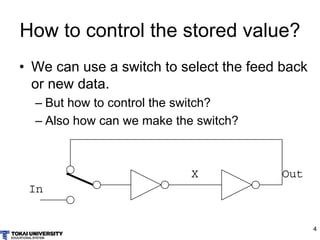
How to control the stored value?
• We can use a switch to select the feed back
or new data.
– But how to control the switch?
– Also how can we make the switch?
In
OutX
5
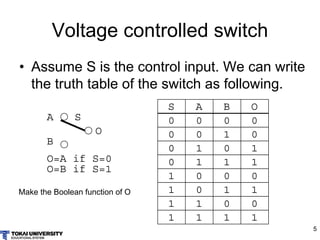
Voltage controlled switch
• Assume S is the control input. We can write
the truth table of the switch as following.
A
B
O
S
O=A if S=0
O=B if S=1
S A B O
0 0 0 0
0 0 1 0
0 1 0 1
0 1 1 1
1 0 0 0
1 0 1 1
1 1 0 0
1 1 1 1
Make the Boolean function of O
6
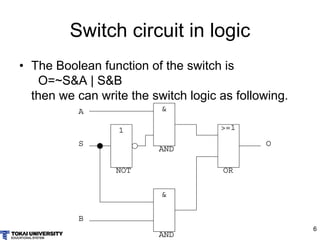
Switch circuit in logic
• The Boolean function of the switch is
O=~S&A | S&B
then we can write the switch logic as following.
&
AND
>=1
OR
&
AND
1
NOT
A
S
B
O
7
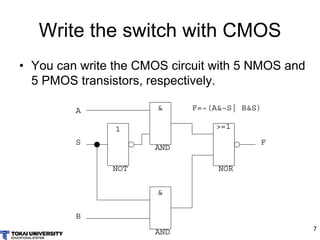
Write the switch with CMOS
• You can write the CMOS circuit with 5 NMOS and
5 PMOS transistors, respectively.
&
AND
>=1
NOR
&
AND
1
NOT
A
S
B
F
F=~(A&~S| B&S)
8
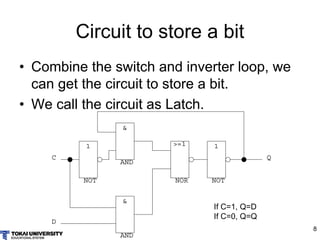
Circuit to store a bit
• Combine the switch and inverter loop, we
can get the circuit to store a bit.
• We call the circuit as Latch.
&
AND
&
AND
1
NOT
C
D
>=1
NOR
1
NOT
Q
If C=1, Q=D
If C=0, Q=Q
9
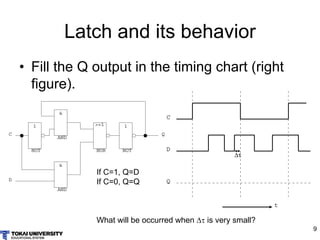
Latch and its behavior
• Fill the Q output in the timing chart (right
figure).
&
AND
&
AND
1
NOT
C
D
>=1
NOR
1
NOT
Q
If C=1, Q=D
If C=0, Q=Q
C
D
Q
t
Δτ
What will be occurred when  is very small?
10
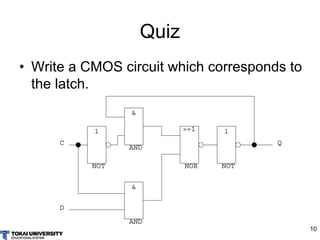
Quiz
• Write a CMOS circuit which corresponds to
the latch.
&
AND
&
AND
1
NOT
C
D
>=1
NOR
1
NOT
Q
1
Computer Architecture
Lecture 4
Flip Flop
2
Latch and its behavior
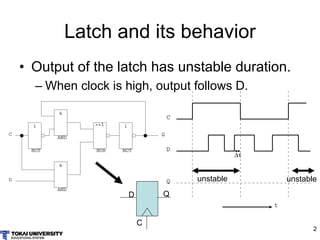
• Output of the latch has unstable duration.
– When clock is high, output follows D.
&
AND
&
AND
1
NOT
C
D
>=1
NOR
1
NOT
Q
C
D
Q
t
Δτ
unstable unstable
D Q
C
3
Two phase latch design
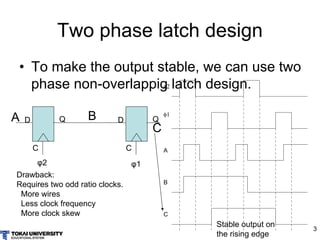
• To make the output stable, we can use two
phase non-overlappig latch design.
D Q
C
D Q
C
φ2 φ1
A B
C
Drawback:
Requires two odd ratio clocks.
More wires
Less clock frequency
More clock skew
φ2
φ1
A
B
C
Stable output on
the rising edge
4
Two phase latch design
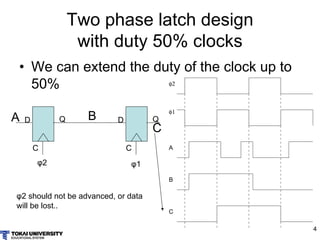
with duty 50% clocks
• We can extend the duty of the clock up to
50%
D Q
C
D Q
C
φ2 φ1
A B
C
φ2 should not be advanced, or data
will be lost..
φ2
φ1
A
B
C
5
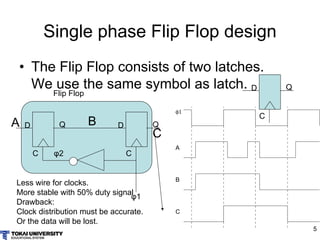
Single phase Flip Flop design
D Q
C
D Q
C
φ1
A B
C
Less wire for clocks.
More stable with 50% duty signal
Drawback:
Clock distribution must be accurate.
Or the data will be lost.
φ2
φ1
A
B
C
φ2
Flip Flop
D Q
C
• The Flip Flop consists of two latches.
We use the same symbol as latch.
6
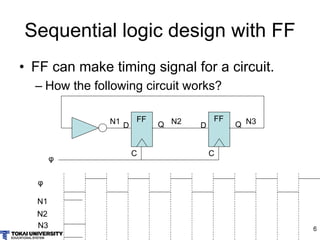
Sequential logic design with FF
• FF can make timing signal for a circuit.
– How the following circuit works?
D Q
C
D Q
C
φ
FF FFN1 N2 N3
φ
N1
N2
N3
7
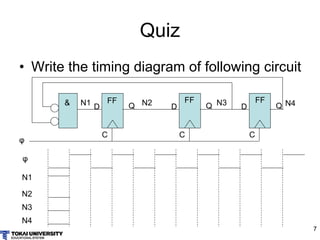
Quiz
• Write the timing diagram of following circuit
D Q
C
D Q
C
φ
FF FFN1 N2 N3
φ
N1
N2
N3
D Q
C
N4
N4
FF&
1
Computer Architecture
Lecture 5
State Machines
2
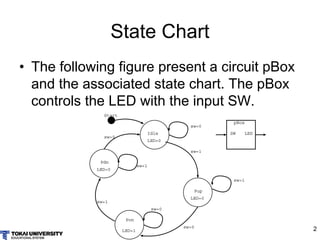
State Chart
• The following figure present a circuit pBox
and the associated state chart. The pBox
controls the LED with the input SW.
Start
Idle
Pup
Pon
sw=0
sw=1
sw=1
sw=0
Pdn
sw=1
sw=0
sw=0
sw=1
SW LED
LED=0
LED=0
LED=1
LED=0
pBox
3
The functional blocks
• The state chart consists of some functional
blocks.
– Start node designates the starting point of
the state chart.
– Arch designates the transition of the state.
It may have a condition of the transition.
– Circle designates a state. The state has
the name, functionalities.
4
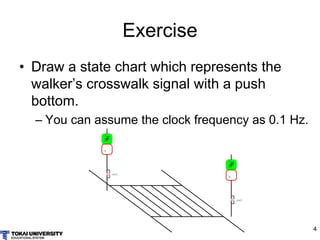
Exercise
• Draw a state chart which represents the
walker’s crosswalk signal with a push
bottom.
– You can assume the clock frequency as 0.1 Hz.
sw1
sw2
R
G
R
G
5
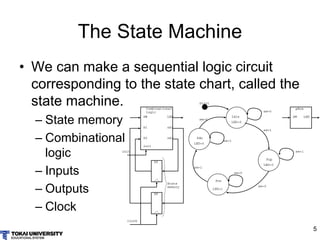
The State Machine
• We can make a sequential logic circuit
corresponding to the state chart, called the
state machine.
– State memory
– Combinational
logic
– Inputs
– Outputs
– Clock
Start
Idle
Pup
Pon
sw=0
sw=1
sw=1
sw=0
Pdn
sw=1
sw=0
sw=0
sw=1
SW LED
LED=0
LED=0
LED=1
LED=0
pBox
SW LED
S1 nS1
S0 nS0
FF
FF
Combinational
logic
init
clock
init
State
memory
6
Making steps
1. Assign the sequential number to the
states
1. The previous case, we can assign four
numbers to Idle, Pup, Pon, Pdn as 00, 01, 10,
11, for example.
2. Name the state memory.
1. We named S1, S0.
3. Make a truth table for the input, the current
state against the output, the next state.
7
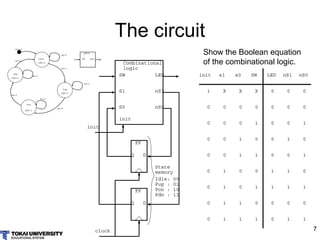
The circuit
SW LED
S1 nS1
S0 nS0
FF
FF
Combinational
logic
init
clock
init
State
memory
SWinit s1 s0 LED nS1 nS0
1 X X X 0 0 0
0 0 00 0 0 0
0 0 1
0 1 0
0 0 1
1 1 0
1 1 1
0 0 0
0 1 1
0 0 10
0 1 00
0 1 10
0 0 01
0 0 11
0 1 01
0 1 11
Idle: 00
Pup : 01
Pon : 10
Pdn : 11
Q D
Q D
Start
Idle
Pup
Pon
sw=0
sw=1
sw=1
sw=0
Pdn
sw=1
sw=0
sw=0
sw=1
SW LED
LED=0
LED=0
LED=1
LED=0
pBox Show the Boolean equation
of the combinational logic.
8
Quiz
• Draw the circuit for the crosswalk signal
system.
– Draw the state machine
– Designate the state assign
– Draw the circuit
1
Computer Architecture
Lecture 6
State Machines - 2
2
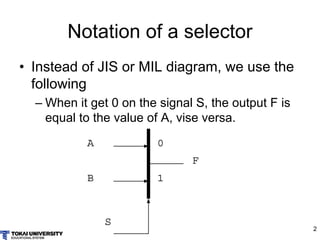
Notation of a selector
• Instead of JIS or MIL diagram, we use the
following
– When it get 0 on the signal S, the output F is
equal to the value of A, vise versa.
A
B
S
0
1
F
3
Bus Notations
• Use simple figure for multiple devices
– Ex: 4bit bus for Flip Flops, wires, multiplexors
thick line shows the bus
FF
QD
4
4InA
Out
InB
Sel
ck
0
1
4
4
FF
QD
Out[0]
FF
QD
Out[1]
FF
QD
Out[2]
FF
QD
Out[3]
InA[0]
InB[0]
Sel
0
1
InA[1]
InB[1]
Sel
0
1
InA[2]
InB[2]
Sel
0
1
InA[3]
InB[3]
Sel
0
1
ck
ck
ck
ck
4
BCD number
• BCD stands for Binary Coded Decimal
– 0 to 9 corresponds to 0000 to 1001
– The numbers from 1010 to 1111 are illegal
• BCD number is often used for banking
computations
5
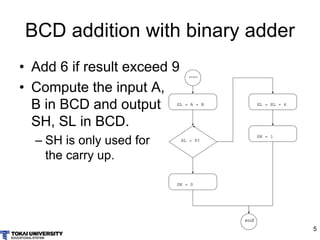
BCD addition with binary adder
• Add 6 if result exceed 9
• Compute the input A,
B in BCD and output
SH, SL in BCD.
– SH is only used for
the carry up.
start
SL = A + B
SL > 9?
SL = SL + 6
SH = 1
SH = 0
end
6
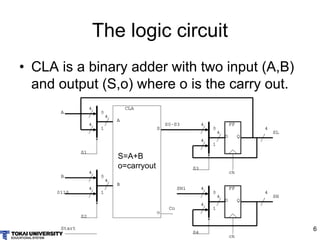
The logic circuit
• CLA is a binary adder with two input (A,B)
and output (S,o) where o is the carry out.
FF
QD
4
4
A
SL
ck
0
1
4
4
4
B
0110
0
1
4
4 FF
QD
4
SH
ck
4
0
1
4
4
4
0
1
4
4
CLA
A
B
S
o
S1
S2
S3
S4
Co
S0-S3
Start
SHi
S=A+B
o=carryout
7
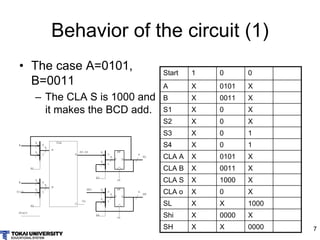
Behavior of the circuit (1)
• The case A=0101,
B=0011
– The CLA S is 1000 and
it makes the BCD add.
Start 1 0 0
A X 0101 X
B X 0011 X
S1 X 0 X
S2 X 0 X
S3 X 0 1
S4 X 0 1
CLA A X 0101 X
CLA B X 0011 X
CLA S X 1000 X
CLA o X 0 X
SL X X 1000
Shi X 0000 X
SH X X 0000
FF
QD
4
4
A
SL
ck
0
1
4
4
4
B
0110
0
1
4
4 FF
QD
4
SH
ck
4
0
1
4
4
4
0
1
4
4
CLA
A
B
S
o
S1
S2
S3
S4
Co
S0-S3
Start
SHi
8
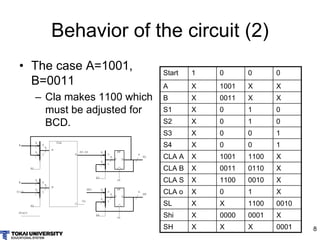
Behavior of the circuit (2)
• The case A=1001,
B=0011
– Cla makes 1100 which
must be adjusted for
BCD.
Start 1 0 0 0
A X 1001 X X
B X 0011 X X
S1 X 0 1 0
S2 X 0 1 0
S3 X 0 0 1
S4 X 0 0 1
CLA A X 1001 1100 X
CLA B X 0011 0110 X
CLA S X 1100 0010 X
CLA o X 0 1 X
SL X X 1100 0010
Shi X 0000 0001 X
SH X X X 0001
FF
QD
4
4
A
SL
ck
0
1
4
4
4
B
0110
0
1
4
4 FF
QD
4
SH
ck
4
0
1
4
4
4
0
1
4
4
CLA
A
B
S
o
S1
S2
S3
S4
Co
S0-S3
Start
SHi
9
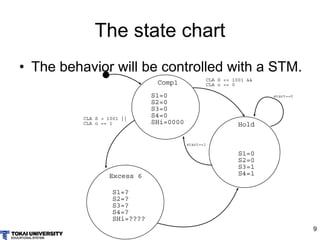
The state chart
• The behavior will be controlled with a STM.Start
start==1
start==0S1=0
S2=0
S3=0
S4=0
SHi=0000
Comp1
S1=0
S2=0
S3=1
S4=1
CLA S <= 1001 &&
CLA o == 0
Hold
CLA S > 1001 ||
CLA o == 1
Excess 6
S1=?
S2=?
S3=?
S4=?
SHi=????
10
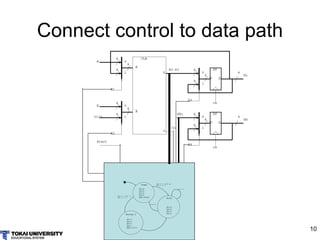
Connect control to data path
FF
QD
4
4
A
SL
ck
0
1
4
4
4
B
0110
0
1
4
4 FF
QD
4
SH
ck
4
0
1
4
4
4
0
1
4
4
CLA
A
B
S
o
S1
S2
S3
S4
Co
S0-S3
Start
SHi
Start
start==1
start==0S1=0
S2=0
S3=0
S4=0
SHi=0000
Comp1
S1=0
S2=0
S3=1
S4=1
CLA S <= 1001 &&
CLA o == 0
Hold
CLA S > 1001 ||
CLA o == 1
Excess 6
S1=?
S2=?
S3=?
S4=?
SHi=????
Start
start==1
start==0S1=0
S2=0
S3=0
S4=0
SHi=0000
Comp1
S1=0
S2=0
S3=1
S4=1
CLA S <= 1001 &&
CLA o == 0
Hold
CLA S > 1001 ||
CLA o == 1
Excess 6
S1=?
S2=?
S3=?
S4=?
SHi=????
11
Quiz
• Complete the state chart
• Write the Boolean statement for “S > 1001 ||
o==1”
where S consists of S[0], S[1], S[2], S[3].
• Option [Draw the state machine of the BCD
adder controller.]
1
Computer Architecture
Lecture 10
Processor
2
Processor
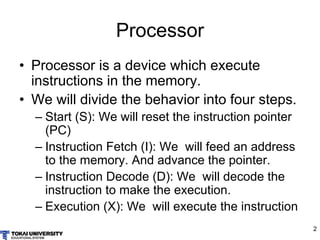
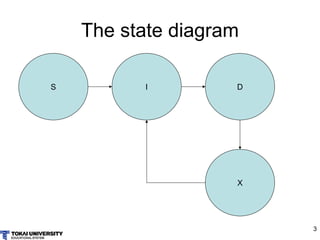
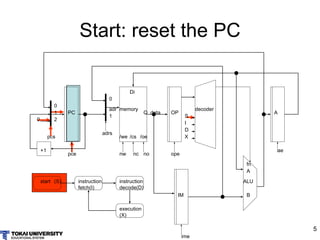
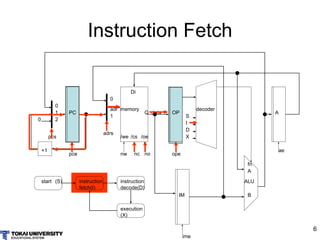
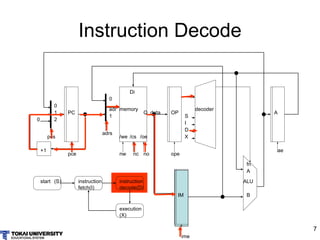
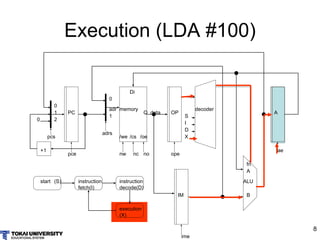
• Processor is a device which execute
instructions in the memory.
• We will divide the behavior into four steps.
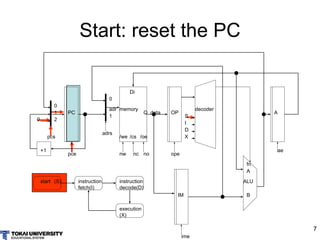
– Start (S): We will reset the instruction pointer
(PC)
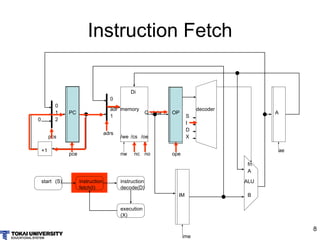
– Instruction Fetch (I): We will feed an address
to the memory. And advance the pointer.
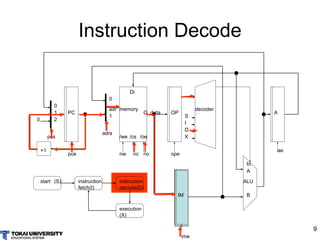
– Instruction Decode (D): We will decode the
instruction to make the execution.
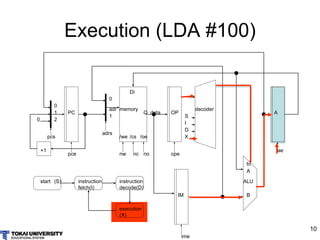
– Execution (X): We will execute the instruction
3
The state diagram
S I D
X
4
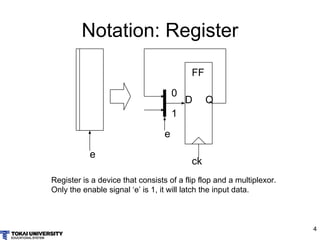
Notation: Register
FF
ck
D Q
e
e
1
0
Register is a device that consists of a flip flop and a multiplexor.
Only the enable signal ‘e’ is 1, it will latch the input data.
5
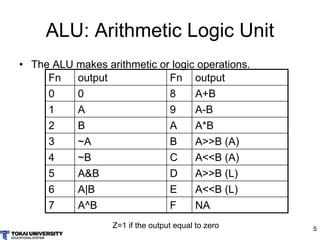
ALU: Arithmetic Logic Unit
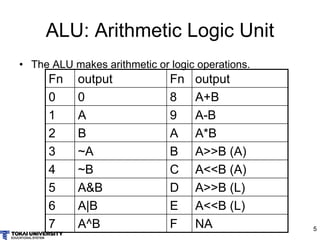
• The ALU makes arithmetic or logic operations.
Fn output Fn output
0 0 8 A+B
1 A 9 A-B
2 B A A*B
3 ~A B A>>B (A)
4 ~B C A<<B (A)
5 A&B D A>>B (L)
6 A|B E A<<B (L)
7 A^B F NA
6
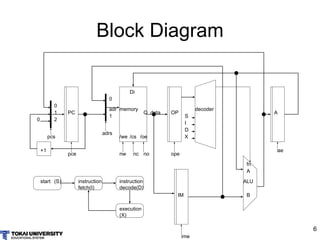
Block Diagram
PC OP
memoryadr
data
/cs /oe
+1
IM
Q
Di
/we
0
A
ope
ae
ime
pce
pcs
nw nonc
adrs
ALU
fn
A
B
0
0
1
1
2
decoder
start instruction
fetch(I)
instruction
decode(D)
execution
(X)
(S)
S
I
D
X
7
Start: reset the PC
PC OP
memoryadr
data
/cs /oe
+1
IM
Q
Di
/we
0
A
ope
ae
ime
pce
pcs
nw nonc
adrs
ALU
fn
A
B
0
0
1
1
2
decoder
start instruction
fetch(I)
instruction
decode(D)
execution
(X)
(S)
S
I
D
X
8
PC OP
memoryadr
data
/cs /oe
+1
IM
Q
Di
/we
0
A
ope
ae
ime
pce
pcs
nw nonc
adrs
ALU
fn
A
B
0
0
1
1
2
decoder
start instruction
fetch(I)
instruction
decode(D)
execution
(X)
(S)
S
I
D
X
Instruction Fetch
9
PC OP
memoryadr
data
/cs /oe
+1
IM
Q
Di
/we
0
A
ope
ae
ime
pce
pcs
nw nonc
adrs
ALU
fn
A
B
0
0
1
1
2
decoder
start instruction
fetch(I)
instruction
decode(D)
execution
(X)
(S)
S
I
D
X
Instruction Decode
10
PC OP
memoryadr
data
/cs /oe
+1
IM
Q
Di
/we
0
A
ope
ae
ime
pce
pcs
nw nonc
adrs
ALU
fn
A
B
0
0
1
1
2
decoder
start instruction
fetch(I)
instruction
decode(D)
execution
(X)
(S)
S
I
D
X
Execution (LDA #100)
11
Quiz
• Make the truth table of the decoder.
– We only have an instruction LDA #xxx.
– The op binary format of LDA #xxx is 0x1002
– The input of the decoder is op[15:0], S,I,D,X
where op[15:12] designates the instruction,
op[3:0] designates the fn of ALU.
• Write the execution stage of an instruction
STA xxx
– The instrucition will write A into the memory.
– The op binary format of STA is 0x3000
1
Computer Architecture
Lecture 11
Processor-2
Add instructions
2
Adding instructions
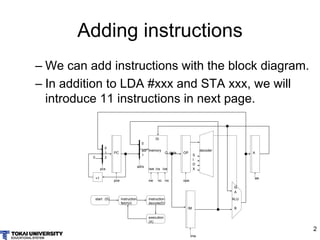
– We can add instructions with the block diagram.
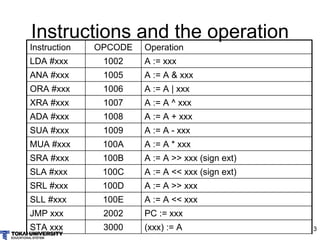
– In addition to LDA #xxx and STA xxx, we will
introduce 11 instructions in next page.
PC OP
memoryadr
data
/cs /oe
+1
IM
Q
Di
/we
0
A
ope
ae
ime
pce
pcs
nw nonc
adrs
ALU
fn
A
B
0
0
1
1
2
decoder
start instruction
fetch(I)
instruction
decode(D)
execution
(X)
(S)
S
I
D
X
3
Instructions and the operation
Instruction OPCODE Operation
LDA #xxx 1002 A := xxx
ANA #xxx 1005 A := A & xxx
ORA #xxx 1006 A := A | xxx
XRA #xxx 1007 A := A ^ xxx
ADA #xxx 1008 A := A + xxx
SUA #xxx 1009 A := A - xxx
MUA #xxx 100A A := A * xxx
SRA #xxx 100B A := A >> xxx (sign ext)
SLA #xxx 100C A := A << xxx (sign ext)
SRL #xxx 100D A := A >> xxx
SLL #xxx 100E A := A << xxx
JMP xxx 2002 PC := xxx
STA xxx 3000 (xxx) := A
4
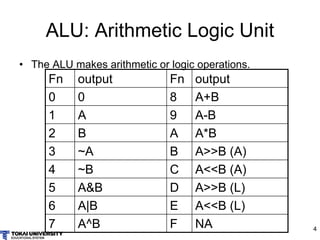
ALU: Arithmetic Logic Unit
• The ALU makes arithmetic or logic operations.
Fn output Fn output
0 0 8 A+B
1 A 9 A-B
2 B A A*B
3 ~A B A>>B (A)
4 ~B C A<<B (A)
5 A&B D A>>B (L)
6 A|B E A<<B (L)
7 A^B F NA
5
Start: reset the PC
PC OP
memoryadr
data
/cs /oe
+1
IM
Q
Di
/we
0
A
ope
ae
ime
pce
pcs
nw nonc
adrs
ALU
fn
A
B
0
0
1
1
2
decoder
start instruction
fetch(I)
instruction
decode(D)
execution
(X)
(S)
S
I
D
X
6
PC OP
memoryadr
data
/cs /oe
+1
IM
Q
Di
/we
0
A
ope
ae
ime
pce
pcs
nw nonc
adrs
ALU
fn
A
B
0
0
1
1
2
decoder
start instruction
fetch(I)
instruction
decode(D)
execution
(X)
(S)
S
I
D
X
Instruction Fetch
7
PC OP
memoryadr
data
/cs /oe
+1
IM
Q
Di
/we
0
A
ope
ae
ime
pce
pcs
nw nonc
adrs
ALU
fn
A
B
0
0
1
1
2
decoder
start instruction
fetch(I)
instruction
decode(D)
execution
(X)
(S)
S
I
D
X
Instruction Decode
8
PC OP
memoryadr
data
/cs /oe
+1
IM
Q
Di
/we
0
A
ope
ae
ime
pce
pcs
nw nonc
adrs
ALU
fn
A
B
0
0
1
1
2
decoder
start instruction
fetch(I)
instruction
decode(D)
execution
(X)
(S)
S
I
D
X
Execution (LDA #100)
9
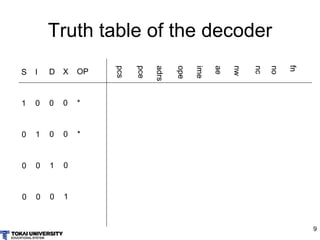
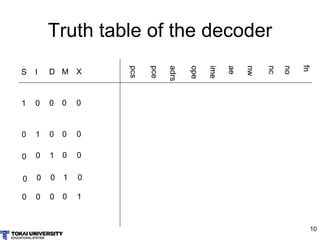
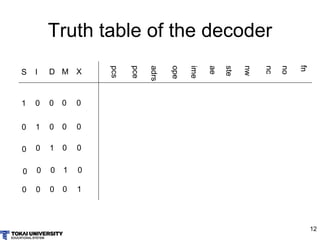
Truth table of the decoder
S I D X OP
pcs
pce
adrs
ope
ime
ae
nw
nc
no
fn
1 0 0 0 *
0 1 0 0 *
0 0 1 0
0 0 0 1
10
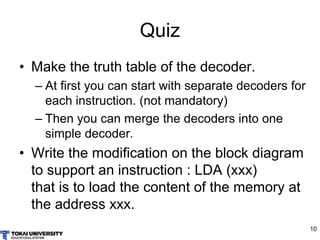
Quiz
• Make the truth table of the decoder.
– At first you can start with separate decoders for
each instruction. (not mandatory)
– Then you can merge the decoders into one
simple decoder.
• Write the modification on the block diagram
to support an instruction : LDA (xxx)
that is to load the content of the memory at
the address xxx.
1
Computer Architecture
Lecture 12
Processor-3
Add instructions
2
Adding instructions
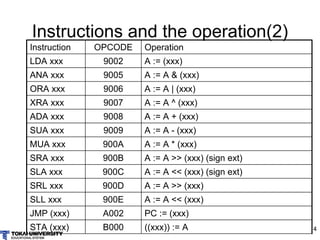
– We can add instructions utilizing memory data
with the block diagram. We modify the states.
PC OP
memoryadr
data
/cs /oe
+1
IM
Q
Di
/we
0
A
ope
ae
ime
pce
pcs
nw nonc
adrs
ALU
fn
A
B
0
0
1
1
2
decoder
start instruction
fetch(I)
instruction
decode(D)
execution
(X)
(S)
S
I
D
X
op
O
z
fe
F
F
memory
(M)
op[15]~op[15]
3
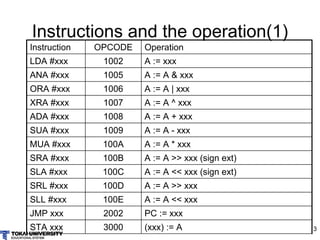
Instructions and the operation(1)
Instruction OPCODE Operation
LDA #xxx 1002 A := xxx
ANA #xxx 1005 A := A & xxx
ORA #xxx 1006 A := A | xxx
XRA #xxx 1007 A := A ^ xxx
ADA #xxx 1008 A := A + xxx
SUA #xxx 1009 A := A - xxx
MUA #xxx 100A A := A * xxx
SRA #xxx 100B A := A >> xxx (sign ext)
SLA #xxx 100C A := A << xxx (sign ext)
SRL #xxx 100D A := A >> xxx
SLL #xxx 100E A := A << xxx
JMP xxx 2002 PC := xxx
STA xxx 3000 (xxx) := A
4
Instructions and the operation(2)
Instruction OPCODE Operation
LDA xxx 9002 A := (xxx)
ANA xxx 9005 A := A & (xxx)
ORA xxx 9006 A := A | (xxx)
XRA xxx 9007 A := A ^ (xxx)
ADA xxx 9008 A := A + (xxx)
SUA xxx 9009 A := A - (xxx)
MUA xxx 900A A := A * (xxx)
SRA xxx 900B A := A >> (xxx) (sign ext)
SLA xxx 900C A := A << (xxx) (sign ext)
SRL xxx 900D A := A >> (xxx)
SLL xxx 900E A := A << (xxx)
JMP (xxx) A002 PC := (xxx)
STA (xxx) B000 ((xxx)) := A
5
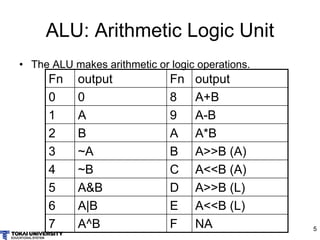
ALU: Arithmetic Logic Unit
• The ALU makes arithmetic or logic operations.
Fn output Fn output
0 0 8 A+B
1 A 9 A-B
2 B A A*B
3 ~A B A>>B (A)
4 ~B C A<<B (A)
5 A&B D A>>B (L)
6 A|B E A<<B (L)
7 A^B F NA
6
Start: reset the PC
PC OP
memoryadr
data
/cs /oe
+1
IM
Q
Di
/we
0
A
ope
ae
ime
pce
pcs
nw nonc
adrs
ALU
fn
A
B
0
0
1
1
2
decoder
start instruction
fetch(I)
instruction
decode(D)
execution
(X)
(S)
S
I
D
X
op
O
z
fe
F
F
memory
(M)
op[15]~op[15]
7
Instruction Fetch (LDA 100)
PC OP
memoryadr
data
/cs /oe
+1
IM
Q
Di
/we
0
A
ope
ae
ime
pce
pcs
nw nonc
adrs
ALU
fn
A
B
0
0
1
1
2
decoder
start instruction
fetch(I)
instruction
decode(D)
execution
(X)
(S)
S
I
D
X
op
O
z
fe
F
F
memory
(M)
op[15]~op[15]
8
Instruction Decode (LDA 100)
PC OP
memoryadr
data
/cs /oe
+1
IM
Q
Di
/we
0
A
ope
ae
ime
pce
pcs
nw nonc
adrs
ALU
fn
A
B
0
0
1
1
2
decoder
start instruction
fetch(I)
instruction
decode(D)
execution
(X)
(S)
S
I
D
X
op
O
z
fe
F
F
memory
(M)
op[15]~op[15]
100
9
PC OP
memoryadr
data
/cs /oe
+1
IM
Q
Di
/we
0
A
ope
ae
ime
pce
pcs
nw nonc
adrs
ALU
fn
A
B
0
0
1
1
2
decoder
start instruction
fetch(I)
instruction
decode(D)
execution
(X)
(S)
S
I
D
X
op
O
z
fe
F
F
memory
(M)
op[15]~op[15]
Memory (LDA 100)
100
(100)
10
Execution (LDA 100)
PC OP
memoryadr
data
/cs /oe
+1
IM
Q
Di
/we
0
A
ope
ae
ime
pce
pcs
nw nonc
adrs
ALU
fn
A
B
0
0
1
1
2
decoder
start instruction
fetch(I)
instruction
decode(D)
execution
(X)
(S)
S
I
D
X
op
O
z
fe
F
F
memory
(M)
op[15]~op[15]
(100)
11
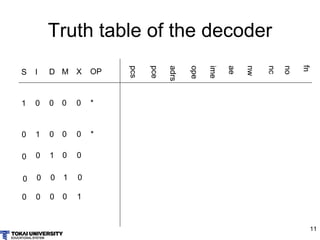
Truth table of the decoder
S I D X OP
pcs
pce
adrs
ope
ime
ae
nw
nc
no
fn
1 0 0 0 *
0 1 0 0 *
0 0 1 0
0 0 0 1
M
0
0
0
0
0 0 0 01
12
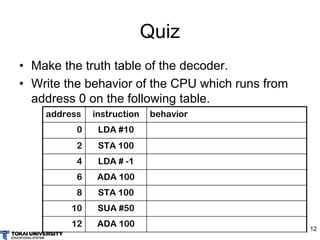
Quiz
• Make the truth table of the decoder.
• Write the behavior of the CPU which runs from
address 0 on the following table.
address instruction behavior
0 LDA #10
2 STA 100
4 LDA # -1
6 ADA 100
8 STA 100
10 SUA #50
12 ADA 100
1
Computer Architecture
Lecture 13
Processor-4
instructions for conditional branch
2
Conditional branch
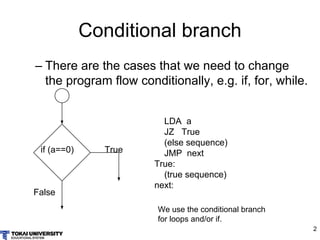
– There are the cases that we need to change
the program flow conditionally, e.g. if, for, while.
We use the conditional branch
for loops and/or if.
if (a==0) True
False
LDA a
JZ True
(else sequence)
JMP next
True:
(true sequence)
next:
3
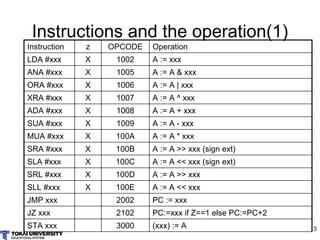
Instructions and the operation(1)
Instruction z OPCODE Operation
LDA #xxx X 1002 A := xxx
ANA #xxx X 1005 A := A & xxx
ORA #xxx X 1006 A := A | xxx
XRA #xxx X 1007 A := A ^ xxx
ADA #xxx X 1008 A := A + xxx
SUA #xxx X 1009 A := A - xxx
MUA #xxx X 100A A := A * xxx
SRA #xxx X 100B A := A >> xxx (sign ext)
SLA #xxx X 100C A := A << xxx (sign ext)
SRL #xxx X 100D A := A >> xxx
SLL #xxx X 100E A := A << xxx
JMP xxx 2002 PC := xxx
JZ xxx 2102 PC:=xxx if Z==1 else PC:=PC+2
STA xxx 3000 (xxx) := A
4
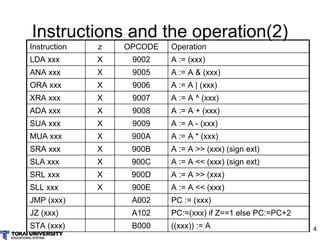
Instructions and the operation(2)
Instruction z OPCODE Operation
LDA xxx X 9002 A := (xxx)
ANA xxx X 9005 A := A & (xxx)
ORA xxx X 9006 A := A | (xxx)
XRA xxx X 9007 A := A ^ (xxx)
ADA xxx X 9008 A := A + (xxx)
SUA xxx X 9009 A := A - (xxx)
MUA xxx X 900A A := A * (xxx)
SRA xxx X 900B A := A >> (xxx) (sign ext)
SLA xxx X 900C A := A << (xxx) (sign ext)
SRL xxx X 900D A := A >> (xxx)
SLL xxx X 900E A := A << (xxx)
JMP (xxx) A002 PC := (xxx)
JZ (xxx) A102 PC:=(xxx) if Z==1 else PC:=PC+2
STA (xxx) B000 ((xxx)) := A
5
ALU: Arithmetic Logic Unit
• The ALU makes arithmetic or logic operations.
Fn output Fn output
0 0 8 A+B
1 A 9 A-B
2 B A A*B
3 ~A B A>>B (A)
4 ~B C A<<B (A)
5 A&B D A>>B (L)
6 A|B E A<<B (L)
7 A^B F NA
Z=1 if the output equal to zero
6
Instruction Fetch (JZ 100)
PC OP
memoryadr
data
/cs /oe
+1
IM
Q
Di
/we
0
A
ope
ae
ime
pce
pcs
nw nonc
adrs
ALU
fn
A
B
0
0
1
1
2
decoder
start instruction
fetch(I)
instruction
decode(D)
execution
(X)
(S)
S
I
D
M
op
O
z Z
Z
memory
(M)
op[15]~op[15]
X
7
Instruction Decode (JZ 100)
100
PC OP
memoryadr
data
/cs /oe
+1
IM
Q
Di
/we
0
A
ope
ae
ime
pce
pcs
nw nonc
adrs
ALU
fn
A
B
0
0
1
1
2
decoder
start instruction
fetch(I)
instruction
decode(D)
execution
(X)
(S)
S
I
D
M
op
O
z Z
Z
memory
(M)
op[15]~op[15]
X
8
Execution (JZ 100 taken)
100
PC OP
memoryadr
data
/cs /oe
+1
IM
Q
Di
/we
0
A
ope
ae
ime
pce
pcs
nw nonc
adrs
ALU
fn
A
B
0
0
1
1
2
decoder
start instruction
fetch(I)
instruction
decode(D)
execution
(X)
(S)
S
I
D
M
op
O
z Z
Z
memory
(M)
op[15]~op[15]
X
9
PC OP
memoryadr
data
/cs /oe
+1
IM
Q
Di
/we
0
A
ope
ae
ime
pce
pcs
nw nonc
adrs
ALU
fn
A
B
0
0
1
1
2
decoder
start instruction
fetch(I)
instruction
decode(D)
execution
(X)
(S)
S
I
D
M
op
O
z Z
Z
memory
(M)
op[15]~op[15]
X
Execution (JZ 100 not taken)
100
10
Truth table of the decoder
S I D X
pcs
pce
adrs
ope
ime
ae
nw
nc
no
fn
1 0 0 0
0 1 0 0
0 0 1 0
0 0 0 1
M
0
0
0
0
0 0 0 01
11
Clock by clock behavior
clock instruction state PC OP IM A Z behavior
0 - S - - Set PC to 0
1 I 0 Instruction fetch from 0
Set OP to 1002
2 LDA #0 D 1 1002 Decode and fetch IM from 1
Set IM to 0
3 LDA #0 X 2 0 Set A to 0, Z to 1
4 I 2 0 1 Instruction fetch from 2
Set OP to 2102
5 JZ 0 D 3 2102 Decode and fetch IM from 3
Set IM to 0
6 JZ 0 X 4 0 On Z=1, jump to 0
7 I 0 Instruction fetch from 0
Set OP to 1002
8 LDA #0 D 1 Decode and fetch IM from 1
Set IM to 0
9 LDA #0 X 2 0 Set A to 0, Z to 1
adr data instruction
0 1002 LDA #0
1 0(10)
2 2102 JZ 0
3 0
Memory contents
PC OP
memoryadr
data
/cs /oe
+1
IM
Q
Di
/we
0
A
ope
ae
ime
pce
pcs
nw nonc
adrs
ALU
fn
A
B
0
0
1
1
2
decoder
start instruction
fetch(I)
instruction
decode(D)
execution
(X)
(S)
S
I
D
M
op
O
z Z
Z
memory
(M)
op[15]~op[15]
X
12
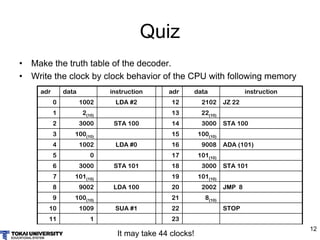
Quiz
• Make the truth table of the decoder.
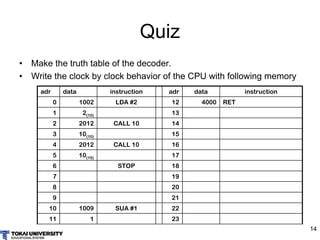
• Write the clock by clock behavior of the CPU with following memory
adr data instruction adr data instruction
0 1002 LDA #2 12 2102 JZ 22
1 2(10) 13 22(10)
2 3000 STA 100 14 3000 STA 100
3 100(10) 15 100(10)
4 1002 LDA #0 16 9008 ADA (101)
5 0 17 101(10)
6 3000 STA 101 18 3000 STA 101
7 101(10) 19 101(10)
8 9002 LDA 100 20 2002 JMP 8
9 100(10) 21 8(10)
10 1009 SUA #1 22 STOP
11 1 23
It may take 44 clocks!
1
Computer Architecture
Lecture 14
Processor-5
instructions for call/return
2
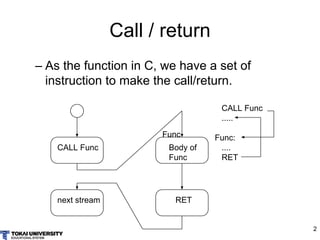
Call / return
– As the function in C, we have a set of
instruction to make the call/return.
CALL Func
.....
Func:
....
RET
CALL Func
RET
Func
Body of
Func
next stream
3
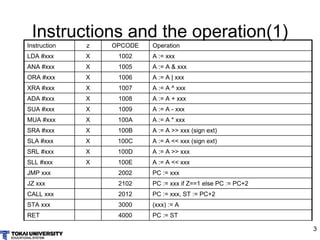
Instructions and the operation(1)
Instruction z OPCODE Operation
LDA #xxx X 1002 A := xxx
ANA #xxx X 1005 A := A & xxx
ORA #xxx X 1006 A := A | xxx
XRA #xxx X 1007 A := A ^ xxx
ADA #xxx X 1008 A := A + xxx
SUA #xxx X 1009 A := A - xxx
MUA #xxx X 100A A := A * xxx
SRA #xxx X 100B A := A >> xxx (sign ext)
SLA #xxx X 100C A := A << xxx (sign ext)
SRL #xxx X 100D A := A >> xxx
SLL #xxx X 100E A := A << xxx
JMP xxx 2002 PC := xxx
JZ xxx 2102 PC := xxx if Z==1 else PC := PC+2
CALL xxx 2012 PC := xxx, ST := PC+2
STA xxx 3000 (xxx) := A
RET 4000 PC := ST
4
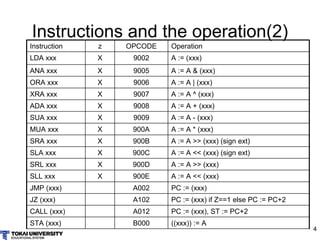
Instructions and the operation(2)
Instruction z OPCODE Operation
LDA xxx X 9002 A := (xxx)
ANA xxx X 9005 A := A & (xxx)
ORA xxx X 9006 A := A | (xxx)
XRA xxx X 9007 A := A ^ (xxx)
ADA xxx X 9008 A := A + (xxx)
SUA xxx X 9009 A := A - (xxx)
MUA xxx X 900A A := A * (xxx)
SRA xxx X 900B A := A >> (xxx) (sign ext)
SLA xxx X 900C A := A << (xxx) (sign ext)
SRL xxx X 900D A := A >> (xxx)
SLL xxx X 900E A := A << (xxx)
JMP (xxx) A002 PC := (xxx)
JZ (xxx) A102 PC := (xxx) if Z==1 else PC := PC+2
CALL (xxx) A012 PC := (xxx), ST := PC+2
STA (xxx) B000 ((xxx)) := A
5
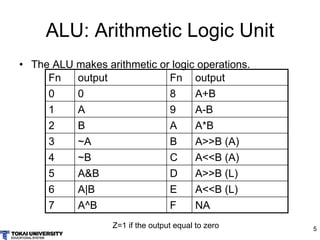
ALU: Arithmetic Logic Unit
• The ALU makes arithmetic or logic operations.
Fn output Fn output
0 0 8 A+B
1 A 9 A-B
2 B A A*B
3 ~A B A>>B (A)
4 ~B C A<<B (A)
5 A&B D A>>B (L)
6 A|B E A<<B (L)
7 A^B F NA
Z=1 if the output equal to zero
6
Instruction Fetch (CALL 100)
PC OP
memoryadr
data
/cs /oe
+1
IM
Q
Di
/we
0
A
ope
ae
ime
pce
pcs
nw nonc
adrs
ALU
fn
A
B
0
0
1
1
2
decoder
start instruction
fetch(I)
instruction
decode(D)
execution
(X)
(S)
S
I
D
M
op
O
z Z
Z
memory
(M)
op[15]~op[15]
X
ST
ste
3
7
Instruction Decode (CALL 100)
100
PC OP
memoryadr
data
/cs /oe
+1
IM
Q
Di
/we
0
A
ope
ae
ime
pce
pcs
nw nonc
adrs
ALU
fn
A
B
0
0
1
1
2
decoder
start instruction
fetch(I)
instruction
decode(D)
execution
(X)
(S)
S
I
D
M
op
O
z Z
Z
memory
(M)
op[15]~op[15]
X
ST
ste
3
8
Execution (CALL 100)
100
PC OP
memoryadr
data
/cs /oe
+1
IM
Q
Di
/we
0
A
ope
ae
ime
pce
pcs
nw nonc
adrs
ALU
fn
A
B
0
0
1
1
2
decoder
start instruction
fetch(I)
instruction
decode(D)
execution
(X)
(S)
S
I
D
M
op
O
z Z
Z
memory
(M)
op[15]~op[15]
X
ST
ste
3
9
Instruction Fetch (RET)
PC OP
memoryadr
data
/cs /oe
+1
IM
Q
Di
/we
0
A
ope
ae
ime
pce
pcs
nw nonc
adrs
ALU
fn
A
B
0
0
1
1
2
decoder
start instruction
fetch(I)
instruction
decode(D)
execution
(X)
(S)
S
I
D
M
op
O
z Z
Z
memory
(M)
op[15]~op[15]
X
ST
ste
3
10
Instruction Decode (RET)
PC OP
memoryadr
data
/cs /oe
+1
IM
Q
Di
/we
0
A
ope
ae
ime
pce
pcs
nw nonc
adrs
ALU
fn
A
B
0
0
1
1
2
decoder
start instruction
fetch(I)
instruction
decode(D)
execution
(X)
(S)
S
I
D
M
op
O
z Z
Z
memory
(M)
op[15]~op[15]
X
ST
ste
3
11
Execution (RET)
PC OP
memoryadr
data
/cs /oe
+1
IM
Q
Di
/we
0
A
ope
ae
ime
pce
pcs
nw nonc
adrs
ALU
fn
A
B
0
0
1
1
2
decoder
start instruction
fetch(I)
instruction
decode(D)
execution
(X)
(S)
S
I
D
M
op
O
z Z
Z
memory
(M)
op[15]~op[15]
X
ST
ste
3
12
Truth table of the decoder
S I D X
pcs
pce
adrs
ope
ime
ae
nw
nc
no
fn
1 0 0 0
0 1 0 0
0 0 1 0
0 0 0 1
M
0
0
0
0
0 0 0 01
ste
13
Clock by clock behavior
adr data instruction
0 2012 CALL
1 10 10
2 ---- STOP
10 4000 RET
Memory contents
PC OP
memoryadr
data
/cs /oe
+1
IM
Q
Di
/we
0
A
ope
ae
ime
pce
pcs
nw nonc
adrs
ALU
fn
A
B
0
0
1
1
2
decoder
start instruction
fetch(I)
instruction
decode(D)
execution
(X)
(S)
S
I
D
M
op
O
z Z
Z
memory
(M)
op[15]~op[15]
X
ST
ste
3
clock instruction state PC OP IM A ST behavior
0 - S - - Set PC to 0
1 I 0 Instruction fetch from 0
Set OP to 2012
2 CALL D 1 2012 Decode and fetch IM
from 1
Set IM to 10
3 X 2 10 Set PC to 10, ST to PC
4 I 10 2 Instruction fetch from 10,
Set OP to 4000
5 RET D 11 4000 Decode
6 X Set PC to value of ST
7 I 2 STOP
14
Quiz
• Make the truth table of the decoder.
• Write the clock by clock behavior of the CPU with following memory
adr data instruction adr data instruction
0 1002 LDA #2 12 4000 RET
1 2(10) 13
2 2012 CALL 10 14
3 10(10) 15
4 2012 CALL 10 16
5 10(10) 17
6 STOP 18
7 19
8 20
9 21
10 1009 SUA #1 22
11 1 23

Computer design and architecture with simple cpu

  • 1.
  • 2.
    2 What is theArchitecture? • It came from the arch of buildings. The structure, design etc. Computer Architecture
  • 3.
    3 Building blocks ofcomputer systems • Computer – Processor – Memory – I/O devices • Storage – Magnetic drives (HDD, Tape) – Solid State drives – Optical drives • Network
  • 4.
    4 Basics of DigitalSystem • Logic functions – Boolean expression – Arithmetic functions • Sequential circuits – Finite State Machines – Pipeline • Memory technology – Non volatile / Volatile memory – Flip Flops
  • 5.
    5 Switching theory • Booleanfunction with a switch. – We call the switch state ‘1’ when the current flows. • Quiz 1 – What is the Boolean function on the following figure? A A B Quiz 2 Write a figure for A | B • Boolean function with a switch. – We call the switch state ‘1’ when the current flows. • Quiz 1 – What is the Boolean function on the following figure? A B
  • 6.
    6 MOS Transistor • Itmakes voltage controllable switch. – Gate attracts minor carriers on the surface. – It can turn on the channel between drain and source Gate DrainSource Silicorn n n p NMOS Transistor + -- - - ---- + + + + + Gate Drain Source Gate Drain Source NMOS PMOS
  • 7.
    7 CMOS Logic • CombiningPMOS and NMOS, we can make a CMOS logic. • CMOS stands for Complementary Metal Oxide Silicon. • Quiz 3 – Write the Boolean function of the right figure. Vdd Gnd In Out
  • 8.
    8 Quiz • What isthe Boolean function on the following figure? • Write a figure for A | B • Write the Boolean function of the right figure A B Vdd Gnd In Out
  • 9.
  • 10.
    2 Basic CMOS Circuit •Upper part of CMOS circuit consists of PMOS transistors. The current flows from Vdd to Out via drains and sources of the transistors. • Lower part of CMOS consists of NMOS transistors. The current flows from Out to Gnd via drains and sources of the transistors. Vdd Gnd In Out D S G D S G
  • 11.
    3 Remark • If NMOSis upper, what will be happed? Vdd Gnd In Out D S G S D G )(0 )( 2 1 2 thgsds thgsds VVI VV L W I   
  • 12.
    4 Basic CMOS Circuit •PMOS and NMOS must be complementary. That means if PMOS connects Vdd to Out, NMOS must open the path from Out to Gnd, vice versa. Vdd Gnd Out In1 In2 PMOS NMOS )2,1()2,1()2,1( InInFnInInFpInInOut 
  • 13.
    5 Example: NAND • RecallPMOS is a switch which turns on when the gate is at 0, and NMOS turns on at 1 • Fp=~A | ~B=~(A & B) • Fn=A & B • F=Fp=~Fn A B F=~(A&B)
  • 14.
    6 Quiz • Q1: MakeCMOS NOR circuit – F=~(A | B), Fp= ~A & ~B, Fn=A | B • Q2: Make CMOS NAOR circuit – F=~(A&B | C&D) • Q3: How can you make AND circuit (F=A&B)? Describe your idea.
  • 15.
  • 16.
    2 Inverter chain • Writethe truth table for the following logic. In OutX inverter = NOT logic In X Out 0 1
  • 17.
    3 Inverter loop • Discusswhat will be happened on the following logic. In X Out In OutX Note that the initial value of In cannot be determined. It strongly depends on the process deviations or power supply transitions.
  • 18.
    4 How to controlthe stored value? • We can use a switch to select the feed back or new data. – But how to control the switch? – Also how can we make the switch? In OutX
  • 19.
    5 Voltage controlled switch •Assume S is the control input. We can write the truth table of the switch as following. A B O S O=A if S=0 O=B if S=1 S A B O 0 0 0 0 0 0 1 0 0 1 0 1 0 1 1 1 1 0 0 0 1 0 1 1 1 1 0 0 1 1 1 1 Make the Boolean function of O
  • 20.
    6 Switch circuit inlogic • The Boolean function of the switch is O=~S&A | S&B then we can write the switch logic as following. & AND >=1 OR & AND 1 NOT A S B O
  • 21.
    7 Write the switchwith CMOS • You can write the CMOS circuit with 5 NMOS and 5 PMOS transistors, respectively. & AND >=1 NOR & AND 1 NOT A S B F F=~(A&~S| B&S)
  • 22.
    8 Circuit to storea bit • Combine the switch and inverter loop, we can get the circuit to store a bit. • We call the circuit as Latch. & AND & AND 1 NOT C D >=1 NOR 1 NOT Q If C=1, Q=D If C=0, Q=Q
  • 23.
    9 Latch and itsbehavior • Fill the Q output in the timing chart (right figure). & AND & AND 1 NOT C D >=1 NOR 1 NOT Q If C=1, Q=D If C=0, Q=Q C D Q t Δτ What will be occurred when  is very small?
  • 24.
    10 Quiz • Write aCMOS circuit which corresponds to the latch. & AND & AND 1 NOT C D >=1 NOR 1 NOT Q
  • 25.
  • 26.
    2 Latch and itsbehavior • Output of the latch has unstable duration. – When clock is high, output follows D. & AND & AND 1 NOT C D >=1 NOR 1 NOT Q C D Q t Δτ unstable unstable D Q C
  • 27.
    3 Two phase latchdesign • To make the output stable, we can use two phase non-overlappig latch design. D Q C D Q C φ2 φ1 A B C Drawback: Requires two odd ratio clocks. More wires Less clock frequency More clock skew φ2 φ1 A B C Stable output on the rising edge
  • 28.
    4 Two phase latchdesign with duty 50% clocks • We can extend the duty of the clock up to 50% D Q C D Q C φ2 φ1 A B C φ2 should not be advanced, or data will be lost.. φ2 φ1 A B C
  • 29.
    5 Single phase FlipFlop design D Q C D Q C φ1 A B C Less wire for clocks. More stable with 50% duty signal Drawback: Clock distribution must be accurate. Or the data will be lost. φ2 φ1 A B C φ2 Flip Flop D Q C • The Flip Flop consists of two latches. We use the same symbol as latch.
  • 30.
    6 Sequential logic designwith FF • FF can make timing signal for a circuit. – How the following circuit works? D Q C D Q C φ FF FFN1 N2 N3 φ N1 N2 N3
  • 31.
    7 Quiz • Write thetiming diagram of following circuit D Q C D Q C φ FF FFN1 N2 N3 φ N1 N2 N3 D Q C N4 N4 FF&
  • 32.
  • 33.
    2 State Chart • Thefollowing figure present a circuit pBox and the associated state chart. The pBox controls the LED with the input SW. Start Idle Pup Pon sw=0 sw=1 sw=1 sw=0 Pdn sw=1 sw=0 sw=0 sw=1 SW LED LED=0 LED=0 LED=1 LED=0 pBox
  • 34.
    3 The functional blocks •The state chart consists of some functional blocks. – Start node designates the starting point of the state chart. – Arch designates the transition of the state. It may have a condition of the transition. – Circle designates a state. The state has the name, functionalities.
  • 35.
    4 Exercise • Draw astate chart which represents the walker’s crosswalk signal with a push bottom. – You can assume the clock frequency as 0.1 Hz. sw1 sw2 R G R G
  • 36.
    5 The State Machine •We can make a sequential logic circuit corresponding to the state chart, called the state machine. – State memory – Combinational logic – Inputs – Outputs – Clock Start Idle Pup Pon sw=0 sw=1 sw=1 sw=0 Pdn sw=1 sw=0 sw=0 sw=1 SW LED LED=0 LED=0 LED=1 LED=0 pBox SW LED S1 nS1 S0 nS0 FF FF Combinational logic init clock init State memory
  • 37.
    6 Making steps 1. Assignthe sequential number to the states 1. The previous case, we can assign four numbers to Idle, Pup, Pon, Pdn as 00, 01, 10, 11, for example. 2. Name the state memory. 1. We named S1, S0. 3. Make a truth table for the input, the current state against the output, the next state.
  • 38.
    7 The circuit SW LED S1nS1 S0 nS0 FF FF Combinational logic init clock init State memory SWinit s1 s0 LED nS1 nS0 1 X X X 0 0 0 0 0 00 0 0 0 0 0 1 0 1 0 0 0 1 1 1 0 1 1 1 0 0 0 0 1 1 0 0 10 0 1 00 0 1 10 0 0 01 0 0 11 0 1 01 0 1 11 Idle: 00 Pup : 01 Pon : 10 Pdn : 11 Q D Q D Start Idle Pup Pon sw=0 sw=1 sw=1 sw=0 Pdn sw=1 sw=0 sw=0 sw=1 SW LED LED=0 LED=0 LED=1 LED=0 pBox Show the Boolean equation of the combinational logic.
  • 39.
    8 Quiz • Draw thecircuit for the crosswalk signal system. – Draw the state machine – Designate the state assign – Draw the circuit
  • 40.
  • 41.
    2 Notation of aselector • Instead of JIS or MIL diagram, we use the following – When it get 0 on the signal S, the output F is equal to the value of A, vise versa. A B S 0 1 F
  • 42.
    3 Bus Notations • Usesimple figure for multiple devices – Ex: 4bit bus for Flip Flops, wires, multiplexors thick line shows the bus FF QD 4 4InA Out InB Sel ck 0 1 4 4 FF QD Out[0] FF QD Out[1] FF QD Out[2] FF QD Out[3] InA[0] InB[0] Sel 0 1 InA[1] InB[1] Sel 0 1 InA[2] InB[2] Sel 0 1 InA[3] InB[3] Sel 0 1 ck ck ck ck
  • 43.
    4 BCD number • BCDstands for Binary Coded Decimal – 0 to 9 corresponds to 0000 to 1001 – The numbers from 1010 to 1111 are illegal • BCD number is often used for banking computations
  • 44.
    5 BCD addition withbinary adder • Add 6 if result exceed 9 • Compute the input A, B in BCD and output SH, SL in BCD. – SH is only used for the carry up. start SL = A + B SL > 9? SL = SL + 6 SH = 1 SH = 0 end
  • 45.
    6 The logic circuit •CLA is a binary adder with two input (A,B) and output (S,o) where o is the carry out. FF QD 4 4 A SL ck 0 1 4 4 4 B 0110 0 1 4 4 FF QD 4 SH ck 4 0 1 4 4 4 0 1 4 4 CLA A B S o S1 S2 S3 S4 Co S0-S3 Start SHi S=A+B o=carryout
  • 46.
    7 Behavior of thecircuit (1) • The case A=0101, B=0011 – The CLA S is 1000 and it makes the BCD add. Start 1 0 0 A X 0101 X B X 0011 X S1 X 0 X S2 X 0 X S3 X 0 1 S4 X 0 1 CLA A X 0101 X CLA B X 0011 X CLA S X 1000 X CLA o X 0 X SL X X 1000 Shi X 0000 X SH X X 0000 FF QD 4 4 A SL ck 0 1 4 4 4 B 0110 0 1 4 4 FF QD 4 SH ck 4 0 1 4 4 4 0 1 4 4 CLA A B S o S1 S2 S3 S4 Co S0-S3 Start SHi
  • 47.
    8 Behavior of thecircuit (2) • The case A=1001, B=0011 – Cla makes 1100 which must be adjusted for BCD. Start 1 0 0 0 A X 1001 X X B X 0011 X X S1 X 0 1 0 S2 X 0 1 0 S3 X 0 0 1 S4 X 0 0 1 CLA A X 1001 1100 X CLA B X 0011 0110 X CLA S X 1100 0010 X CLA o X 0 1 X SL X X 1100 0010 Shi X 0000 0001 X SH X X X 0001 FF QD 4 4 A SL ck 0 1 4 4 4 B 0110 0 1 4 4 FF QD 4 SH ck 4 0 1 4 4 4 0 1 4 4 CLA A B S o S1 S2 S3 S4 Co S0-S3 Start SHi
  • 48.
    9 The state chart •The behavior will be controlled with a STM.Start start==1 start==0S1=0 S2=0 S3=0 S4=0 SHi=0000 Comp1 S1=0 S2=0 S3=1 S4=1 CLA S <= 1001 && CLA o == 0 Hold CLA S > 1001 || CLA o == 1 Excess 6 S1=? S2=? S3=? S4=? SHi=????
  • 49.
    10 Connect control todata path FF QD 4 4 A SL ck 0 1 4 4 4 B 0110 0 1 4 4 FF QD 4 SH ck 4 0 1 4 4 4 0 1 4 4 CLA A B S o S1 S2 S3 S4 Co S0-S3 Start SHi Start start==1 start==0S1=0 S2=0 S3=0 S4=0 SHi=0000 Comp1 S1=0 S2=0 S3=1 S4=1 CLA S <= 1001 && CLA o == 0 Hold CLA S > 1001 || CLA o == 1 Excess 6 S1=? S2=? S3=? S4=? SHi=???? Start start==1 start==0S1=0 S2=0 S3=0 S4=0 SHi=0000 Comp1 S1=0 S2=0 S3=1 S4=1 CLA S <= 1001 && CLA o == 0 Hold CLA S > 1001 || CLA o == 1 Excess 6 S1=? S2=? S3=? S4=? SHi=????
  • 50.
    11 Quiz • Complete thestate chart • Write the Boolean statement for “S > 1001 || o==1” where S consists of S[0], S[1], S[2], S[3]. • Option [Draw the state machine of the BCD adder controller.]
  • 51.
  • 52.
    2 Processor • Processor isa device which execute instructions in the memory. • We will divide the behavior into four steps. – Start (S): We will reset the instruction pointer (PC) – Instruction Fetch (I): We will feed an address to the memory. And advance the pointer. – Instruction Decode (D): We will decode the instruction to make the execution. – Execution (X): We will execute the instruction
  • 53.
  • 54.
    4 Notation: Register FF ck D Q e e 1 0 Registeris a device that consists of a flip flop and a multiplexor. Only the enable signal ‘e’ is 1, it will latch the input data.
  • 55.
    5 ALU: Arithmetic LogicUnit • The ALU makes arithmetic or logic operations. Fn output Fn output 0 0 8 A+B 1 A 9 A-B 2 B A A*B 3 ~A B A>>B (A) 4 ~B C A<<B (A) 5 A&B D A>>B (L) 6 A|B E A<<B (L) 7 A^B F NA
  • 56.
    6 Block Diagram PC OP memoryadr data /cs/oe +1 IM Q Di /we 0 A ope ae ime pce pcs nw nonc adrs ALU fn A B 0 0 1 1 2 decoder start instruction fetch(I) instruction decode(D) execution (X) (S) S I D X
  • 57.
    7 Start: reset thePC PC OP memoryadr data /cs /oe +1 IM Q Di /we 0 A ope ae ime pce pcs nw nonc adrs ALU fn A B 0 0 1 1 2 decoder start instruction fetch(I) instruction decode(D) execution (X) (S) S I D X
  • 58.
    8 PC OP memoryadr data /cs /oe +1 IM Q Di /we 0 A ope ae ime pce pcs nwnonc adrs ALU fn A B 0 0 1 1 2 decoder start instruction fetch(I) instruction decode(D) execution (X) (S) S I D X Instruction Fetch
  • 59.
    9 PC OP memoryadr data /cs /oe +1 IM Q Di /we 0 A ope ae ime pce pcs nwnonc adrs ALU fn A B 0 0 1 1 2 decoder start instruction fetch(I) instruction decode(D) execution (X) (S) S I D X Instruction Decode
  • 60.
    10 PC OP memoryadr data /cs /oe +1 IM Q Di /we 0 A ope ae ime pce pcs nwnonc adrs ALU fn A B 0 0 1 1 2 decoder start instruction fetch(I) instruction decode(D) execution (X) (S) S I D X Execution (LDA #100)
  • 61.
    11 Quiz • Make thetruth table of the decoder. – We only have an instruction LDA #xxx. – The op binary format of LDA #xxx is 0x1002 – The input of the decoder is op[15:0], S,I,D,X where op[15:12] designates the instruction, op[3:0] designates the fn of ALU. • Write the execution stage of an instruction STA xxx – The instrucition will write A into the memory. – The op binary format of STA is 0x3000
  • 62.
  • 63.
    2 Adding instructions – Wecan add instructions with the block diagram. – In addition to LDA #xxx and STA xxx, we will introduce 11 instructions in next page. PC OP memoryadr data /cs /oe +1 IM Q Di /we 0 A ope ae ime pce pcs nw nonc adrs ALU fn A B 0 0 1 1 2 decoder start instruction fetch(I) instruction decode(D) execution (X) (S) S I D X
  • 64.
    3 Instructions and theoperation Instruction OPCODE Operation LDA #xxx 1002 A := xxx ANA #xxx 1005 A := A & xxx ORA #xxx 1006 A := A | xxx XRA #xxx 1007 A := A ^ xxx ADA #xxx 1008 A := A + xxx SUA #xxx 1009 A := A - xxx MUA #xxx 100A A := A * xxx SRA #xxx 100B A := A >> xxx (sign ext) SLA #xxx 100C A := A << xxx (sign ext) SRL #xxx 100D A := A >> xxx SLL #xxx 100E A := A << xxx JMP xxx 2002 PC := xxx STA xxx 3000 (xxx) := A
  • 65.
    4 ALU: Arithmetic LogicUnit • The ALU makes arithmetic or logic operations. Fn output Fn output 0 0 8 A+B 1 A 9 A-B 2 B A A*B 3 ~A B A>>B (A) 4 ~B C A<<B (A) 5 A&B D A>>B (L) 6 A|B E A<<B (L) 7 A^B F NA
  • 66.
    5 Start: reset thePC PC OP memoryadr data /cs /oe +1 IM Q Di /we 0 A ope ae ime pce pcs nw nonc adrs ALU fn A B 0 0 1 1 2 decoder start instruction fetch(I) instruction decode(D) execution (X) (S) S I D X
  • 67.
    6 PC OP memoryadr data /cs /oe +1 IM Q Di /we 0 A ope ae ime pce pcs nwnonc adrs ALU fn A B 0 0 1 1 2 decoder start instruction fetch(I) instruction decode(D) execution (X) (S) S I D X Instruction Fetch
  • 68.
    7 PC OP memoryadr data /cs /oe +1 IM Q Di /we 0 A ope ae ime pce pcs nwnonc adrs ALU fn A B 0 0 1 1 2 decoder start instruction fetch(I) instruction decode(D) execution (X) (S) S I D X Instruction Decode
  • 69.
    8 PC OP memoryadr data /cs /oe +1 IM Q Di /we 0 A ope ae ime pce pcs nwnonc adrs ALU fn A B 0 0 1 1 2 decoder start instruction fetch(I) instruction decode(D) execution (X) (S) S I D X Execution (LDA #100)
  • 70.
    9 Truth table ofthe decoder S I D X OP pcs pce adrs ope ime ae nw nc no fn 1 0 0 0 * 0 1 0 0 * 0 0 1 0 0 0 0 1
  • 71.
    10 Quiz • Make thetruth table of the decoder. – At first you can start with separate decoders for each instruction. (not mandatory) – Then you can merge the decoders into one simple decoder. • Write the modification on the block diagram to support an instruction : LDA (xxx) that is to load the content of the memory at the address xxx.
  • 72.
  • 73.
    2 Adding instructions – Wecan add instructions utilizing memory data with the block diagram. We modify the states. PC OP memoryadr data /cs /oe +1 IM Q Di /we 0 A ope ae ime pce pcs nw nonc adrs ALU fn A B 0 0 1 1 2 decoder start instruction fetch(I) instruction decode(D) execution (X) (S) S I D X op O z fe F F memory (M) op[15]~op[15]
  • 74.
    3 Instructions and theoperation(1) Instruction OPCODE Operation LDA #xxx 1002 A := xxx ANA #xxx 1005 A := A & xxx ORA #xxx 1006 A := A | xxx XRA #xxx 1007 A := A ^ xxx ADA #xxx 1008 A := A + xxx SUA #xxx 1009 A := A - xxx MUA #xxx 100A A := A * xxx SRA #xxx 100B A := A >> xxx (sign ext) SLA #xxx 100C A := A << xxx (sign ext) SRL #xxx 100D A := A >> xxx SLL #xxx 100E A := A << xxx JMP xxx 2002 PC := xxx STA xxx 3000 (xxx) := A
  • 75.
    4 Instructions and theoperation(2) Instruction OPCODE Operation LDA xxx 9002 A := (xxx) ANA xxx 9005 A := A & (xxx) ORA xxx 9006 A := A | (xxx) XRA xxx 9007 A := A ^ (xxx) ADA xxx 9008 A := A + (xxx) SUA xxx 9009 A := A - (xxx) MUA xxx 900A A := A * (xxx) SRA xxx 900B A := A >> (xxx) (sign ext) SLA xxx 900C A := A << (xxx) (sign ext) SRL xxx 900D A := A >> (xxx) SLL xxx 900E A := A << (xxx) JMP (xxx) A002 PC := (xxx) STA (xxx) B000 ((xxx)) := A
  • 76.
    5 ALU: Arithmetic LogicUnit • The ALU makes arithmetic or logic operations. Fn output Fn output 0 0 8 A+B 1 A 9 A-B 2 B A A*B 3 ~A B A>>B (A) 4 ~B C A<<B (A) 5 A&B D A>>B (L) 6 A|B E A<<B (L) 7 A^B F NA
  • 77.
    6 Start: reset thePC PC OP memoryadr data /cs /oe +1 IM Q Di /we 0 A ope ae ime pce pcs nw nonc adrs ALU fn A B 0 0 1 1 2 decoder start instruction fetch(I) instruction decode(D) execution (X) (S) S I D X op O z fe F F memory (M) op[15]~op[15]
  • 78.
    7 Instruction Fetch (LDA100) PC OP memoryadr data /cs /oe +1 IM Q Di /we 0 A ope ae ime pce pcs nw nonc adrs ALU fn A B 0 0 1 1 2 decoder start instruction fetch(I) instruction decode(D) execution (X) (S) S I D X op O z fe F F memory (M) op[15]~op[15]
  • 79.
    8 Instruction Decode (LDA100) PC OP memoryadr data /cs /oe +1 IM Q Di /we 0 A ope ae ime pce pcs nw nonc adrs ALU fn A B 0 0 1 1 2 decoder start instruction fetch(I) instruction decode(D) execution (X) (S) S I D X op O z fe F F memory (M) op[15]~op[15] 100
  • 80.
    9 PC OP memoryadr data /cs /oe +1 IM Q Di /we 0 A ope ae ime pce pcs nwnonc adrs ALU fn A B 0 0 1 1 2 decoder start instruction fetch(I) instruction decode(D) execution (X) (S) S I D X op O z fe F F memory (M) op[15]~op[15] Memory (LDA 100) 100 (100)
  • 81.
    10 Execution (LDA 100) PCOP memoryadr data /cs /oe +1 IM Q Di /we 0 A ope ae ime pce pcs nw nonc adrs ALU fn A B 0 0 1 1 2 decoder start instruction fetch(I) instruction decode(D) execution (X) (S) S I D X op O z fe F F memory (M) op[15]~op[15] (100)
  • 82.
    11 Truth table ofthe decoder S I D X OP pcs pce adrs ope ime ae nw nc no fn 1 0 0 0 * 0 1 0 0 * 0 0 1 0 0 0 0 1 M 0 0 0 0 0 0 0 01
  • 83.
    12 Quiz • Make thetruth table of the decoder. • Write the behavior of the CPU which runs from address 0 on the following table. address instruction behavior 0 LDA #10 2 STA 100 4 LDA # -1 6 ADA 100 8 STA 100 10 SUA #50 12 ADA 100
  • 84.
  • 85.
    2 Conditional branch – Thereare the cases that we need to change the program flow conditionally, e.g. if, for, while. We use the conditional branch for loops and/or if. if (a==0) True False LDA a JZ True (else sequence) JMP next True: (true sequence) next:
  • 86.
    3 Instructions and theoperation(1) Instruction z OPCODE Operation LDA #xxx X 1002 A := xxx ANA #xxx X 1005 A := A & xxx ORA #xxx X 1006 A := A | xxx XRA #xxx X 1007 A := A ^ xxx ADA #xxx X 1008 A := A + xxx SUA #xxx X 1009 A := A - xxx MUA #xxx X 100A A := A * xxx SRA #xxx X 100B A := A >> xxx (sign ext) SLA #xxx X 100C A := A << xxx (sign ext) SRL #xxx X 100D A := A >> xxx SLL #xxx X 100E A := A << xxx JMP xxx 2002 PC := xxx JZ xxx 2102 PC:=xxx if Z==1 else PC:=PC+2 STA xxx 3000 (xxx) := A
  • 87.
    4 Instructions and theoperation(2) Instruction z OPCODE Operation LDA xxx X 9002 A := (xxx) ANA xxx X 9005 A := A & (xxx) ORA xxx X 9006 A := A | (xxx) XRA xxx X 9007 A := A ^ (xxx) ADA xxx X 9008 A := A + (xxx) SUA xxx X 9009 A := A - (xxx) MUA xxx X 900A A := A * (xxx) SRA xxx X 900B A := A >> (xxx) (sign ext) SLA xxx X 900C A := A << (xxx) (sign ext) SRL xxx X 900D A := A >> (xxx) SLL xxx X 900E A := A << (xxx) JMP (xxx) A002 PC := (xxx) JZ (xxx) A102 PC:=(xxx) if Z==1 else PC:=PC+2 STA (xxx) B000 ((xxx)) := A
  • 88.
    5 ALU: Arithmetic LogicUnit • The ALU makes arithmetic or logic operations. Fn output Fn output 0 0 8 A+B 1 A 9 A-B 2 B A A*B 3 ~A B A>>B (A) 4 ~B C A<<B (A) 5 A&B D A>>B (L) 6 A|B E A<<B (L) 7 A^B F NA Z=1 if the output equal to zero
  • 89.
    6 Instruction Fetch (JZ100) PC OP memoryadr data /cs /oe +1 IM Q Di /we 0 A ope ae ime pce pcs nw nonc adrs ALU fn A B 0 0 1 1 2 decoder start instruction fetch(I) instruction decode(D) execution (X) (S) S I D M op O z Z Z memory (M) op[15]~op[15] X
  • 90.
    7 Instruction Decode (JZ100) 100 PC OP memoryadr data /cs /oe +1 IM Q Di /we 0 A ope ae ime pce pcs nw nonc adrs ALU fn A B 0 0 1 1 2 decoder start instruction fetch(I) instruction decode(D) execution (X) (S) S I D M op O z Z Z memory (M) op[15]~op[15] X
  • 91.
    8 Execution (JZ 100taken) 100 PC OP memoryadr data /cs /oe +1 IM Q Di /we 0 A ope ae ime pce pcs nw nonc adrs ALU fn A B 0 0 1 1 2 decoder start instruction fetch(I) instruction decode(D) execution (X) (S) S I D M op O z Z Z memory (M) op[15]~op[15] X
  • 92.
    9 PC OP memoryadr data /cs /oe +1 IM Q Di /we 0 A ope ae ime pce pcs nwnonc adrs ALU fn A B 0 0 1 1 2 decoder start instruction fetch(I) instruction decode(D) execution (X) (S) S I D M op O z Z Z memory (M) op[15]~op[15] X Execution (JZ 100 not taken) 100
  • 93.
    10 Truth table ofthe decoder S I D X pcs pce adrs ope ime ae nw nc no fn 1 0 0 0 0 1 0 0 0 0 1 0 0 0 0 1 M 0 0 0 0 0 0 0 01
  • 94.
    11 Clock by clockbehavior clock instruction state PC OP IM A Z behavior 0 - S - - Set PC to 0 1 I 0 Instruction fetch from 0 Set OP to 1002 2 LDA #0 D 1 1002 Decode and fetch IM from 1 Set IM to 0 3 LDA #0 X 2 0 Set A to 0, Z to 1 4 I 2 0 1 Instruction fetch from 2 Set OP to 2102 5 JZ 0 D 3 2102 Decode and fetch IM from 3 Set IM to 0 6 JZ 0 X 4 0 On Z=1, jump to 0 7 I 0 Instruction fetch from 0 Set OP to 1002 8 LDA #0 D 1 Decode and fetch IM from 1 Set IM to 0 9 LDA #0 X 2 0 Set A to 0, Z to 1 adr data instruction 0 1002 LDA #0 1 0(10) 2 2102 JZ 0 3 0 Memory contents PC OP memoryadr data /cs /oe +1 IM Q Di /we 0 A ope ae ime pce pcs nw nonc adrs ALU fn A B 0 0 1 1 2 decoder start instruction fetch(I) instruction decode(D) execution (X) (S) S I D M op O z Z Z memory (M) op[15]~op[15] X
  • 95.
    12 Quiz • Make thetruth table of the decoder. • Write the clock by clock behavior of the CPU with following memory adr data instruction adr data instruction 0 1002 LDA #2 12 2102 JZ 22 1 2(10) 13 22(10) 2 3000 STA 100 14 3000 STA 100 3 100(10) 15 100(10) 4 1002 LDA #0 16 9008 ADA (101) 5 0 17 101(10) 6 3000 STA 101 18 3000 STA 101 7 101(10) 19 101(10) 8 9002 LDA 100 20 2002 JMP 8 9 100(10) 21 8(10) 10 1009 SUA #1 22 STOP 11 1 23 It may take 44 clocks!
  • 96.
  • 97.
    2 Call / return –As the function in C, we have a set of instruction to make the call/return. CALL Func ..... Func: .... RET CALL Func RET Func Body of Func next stream
  • 98.
    3 Instructions and theoperation(1) Instruction z OPCODE Operation LDA #xxx X 1002 A := xxx ANA #xxx X 1005 A := A & xxx ORA #xxx X 1006 A := A | xxx XRA #xxx X 1007 A := A ^ xxx ADA #xxx X 1008 A := A + xxx SUA #xxx X 1009 A := A - xxx MUA #xxx X 100A A := A * xxx SRA #xxx X 100B A := A >> xxx (sign ext) SLA #xxx X 100C A := A << xxx (sign ext) SRL #xxx X 100D A := A >> xxx SLL #xxx X 100E A := A << xxx JMP xxx 2002 PC := xxx JZ xxx 2102 PC := xxx if Z==1 else PC := PC+2 CALL xxx 2012 PC := xxx, ST := PC+2 STA xxx 3000 (xxx) := A RET 4000 PC := ST
  • 99.
    4 Instructions and theoperation(2) Instruction z OPCODE Operation LDA xxx X 9002 A := (xxx) ANA xxx X 9005 A := A & (xxx) ORA xxx X 9006 A := A | (xxx) XRA xxx X 9007 A := A ^ (xxx) ADA xxx X 9008 A := A + (xxx) SUA xxx X 9009 A := A - (xxx) MUA xxx X 900A A := A * (xxx) SRA xxx X 900B A := A >> (xxx) (sign ext) SLA xxx X 900C A := A << (xxx) (sign ext) SRL xxx X 900D A := A >> (xxx) SLL xxx X 900E A := A << (xxx) JMP (xxx) A002 PC := (xxx) JZ (xxx) A102 PC := (xxx) if Z==1 else PC := PC+2 CALL (xxx) A012 PC := (xxx), ST := PC+2 STA (xxx) B000 ((xxx)) := A
  • 100.
    5 ALU: Arithmetic LogicUnit • The ALU makes arithmetic or logic operations. Fn output Fn output 0 0 8 A+B 1 A 9 A-B 2 B A A*B 3 ~A B A>>B (A) 4 ~B C A<<B (A) 5 A&B D A>>B (L) 6 A|B E A<<B (L) 7 A^B F NA Z=1 if the output equal to zero
  • 101.
    6 Instruction Fetch (CALL100) PC OP memoryadr data /cs /oe +1 IM Q Di /we 0 A ope ae ime pce pcs nw nonc adrs ALU fn A B 0 0 1 1 2 decoder start instruction fetch(I) instruction decode(D) execution (X) (S) S I D M op O z Z Z memory (M) op[15]~op[15] X ST ste 3
  • 102.
    7 Instruction Decode (CALL100) 100 PC OP memoryadr data /cs /oe +1 IM Q Di /we 0 A ope ae ime pce pcs nw nonc adrs ALU fn A B 0 0 1 1 2 decoder start instruction fetch(I) instruction decode(D) execution (X) (S) S I D M op O z Z Z memory (M) op[15]~op[15] X ST ste 3
  • 103.
    8 Execution (CALL 100) 100 PCOP memoryadr data /cs /oe +1 IM Q Di /we 0 A ope ae ime pce pcs nw nonc adrs ALU fn A B 0 0 1 1 2 decoder start instruction fetch(I) instruction decode(D) execution (X) (S) S I D M op O z Z Z memory (M) op[15]~op[15] X ST ste 3
  • 104.
    9 Instruction Fetch (RET) PCOP memoryadr data /cs /oe +1 IM Q Di /we 0 A ope ae ime pce pcs nw nonc adrs ALU fn A B 0 0 1 1 2 decoder start instruction fetch(I) instruction decode(D) execution (X) (S) S I D M op O z Z Z memory (M) op[15]~op[15] X ST ste 3
  • 105.
    10 Instruction Decode (RET) PCOP memoryadr data /cs /oe +1 IM Q Di /we 0 A ope ae ime pce pcs nw nonc adrs ALU fn A B 0 0 1 1 2 decoder start instruction fetch(I) instruction decode(D) execution (X) (S) S I D M op O z Z Z memory (M) op[15]~op[15] X ST ste 3
  • 106.
    11 Execution (RET) PC OP memoryadr data /cs/oe +1 IM Q Di /we 0 A ope ae ime pce pcs nw nonc adrs ALU fn A B 0 0 1 1 2 decoder start instruction fetch(I) instruction decode(D) execution (X) (S) S I D M op O z Z Z memory (M) op[15]~op[15] X ST ste 3
  • 107.
    12 Truth table ofthe decoder S I D X pcs pce adrs ope ime ae nw nc no fn 1 0 0 0 0 1 0 0 0 0 1 0 0 0 0 1 M 0 0 0 0 0 0 0 01 ste
  • 108.
    13 Clock by clockbehavior adr data instruction 0 2012 CALL 1 10 10 2 ---- STOP 10 4000 RET Memory contents PC OP memoryadr data /cs /oe +1 IM Q Di /we 0 A ope ae ime pce pcs nw nonc adrs ALU fn A B 0 0 1 1 2 decoder start instruction fetch(I) instruction decode(D) execution (X) (S) S I D M op O z Z Z memory (M) op[15]~op[15] X ST ste 3 clock instruction state PC OP IM A ST behavior 0 - S - - Set PC to 0 1 I 0 Instruction fetch from 0 Set OP to 2012 2 CALL D 1 2012 Decode and fetch IM from 1 Set IM to 10 3 X 2 10 Set PC to 10, ST to PC 4 I 10 2 Instruction fetch from 10, Set OP to 4000 5 RET D 11 4000 Decode 6 X Set PC to value of ST 7 I 2 STOP
  • 109.
    14 Quiz • Make thetruth table of the decoder. • Write the clock by clock behavior of the CPU with following memory adr data instruction adr data instruction 0 1002 LDA #2 12 4000 RET 1 2(10) 13 2 2012 CALL 10 14 3 10(10) 15 4 2012 CALL 10 16 5 10(10) 17 6 STOP 18 7 19 8 20 9 21 10 1009 SUA #1 22 11 1 23