SQL Constraints
DATABASE SYSTEM 2
ANGELO T. RETITA
IT-INSTRUCTOR
Objectives
1. Will able to understand and defined SQL Constraints.
2. Will able to identify and analyze the different types of SQL Contraints.
SQL Constraints
SQL constraints are used to specify rules for data in a table.
SQL Constraints
Constraints are used to limit the type of data that can go into a
table. This ensures the accuracy and reliability of the data in the
table. If there is any violation between the constraint and the
data action, the action is aborted.
SQL Constraints
Constraints can be column level or table level. Column level
constraints apply to a column, and table level constraints apply
to the whole table.
SQL Constraints
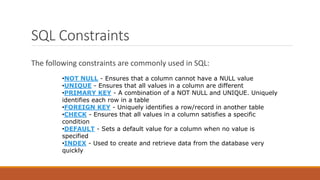
The following constraints are commonly used in SQL:
•NOT NULL - Ensures that a column cannot have a NULL value
•UNIQUE - Ensures that all values in a column are different
•PRIMARY KEY - A combination of a NOT NULL and UNIQUE. Uniquely
identifies each row in a table
•FOREIGN KEY - Uniquely identifies a row/record in another table
•CHECK - Ensures that all values in a column satisfies a specific
condition
•DEFAULT - Sets a default value for a column when no value is
specified
•INDEX - Used to create and retrieve data from the database very
quickly
SQL Create Constraints
Constraints can be specified when the table is created with the CREATE TABLE statement, or
after the table is created with the ALTER TABLE statement.
SQL Create Constraints Syntax
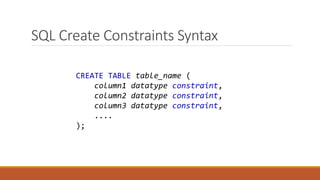
CREATE TABLE table_name (
column1 datatype constraint,
column2 datatype constraint,
column3 datatype constraint,
....
);

1.3 sql constraints

  • 1.
    SQL Constraints DATABASE SYSTEM2 ANGELO T. RETITA IT-INSTRUCTOR
  • 2.
    Objectives 1. Will ableto understand and defined SQL Constraints. 2. Will able to identify and analyze the different types of SQL Contraints.
  • 3.
    SQL Constraints SQL constraintsare used to specify rules for data in a table.
  • 4.
    SQL Constraints Constraints areused to limit the type of data that can go into a table. This ensures the accuracy and reliability of the data in the table. If there is any violation between the constraint and the data action, the action is aborted.
  • 5.
    SQL Constraints Constraints canbe column level or table level. Column level constraints apply to a column, and table level constraints apply to the whole table.
  • 6.
    SQL Constraints The followingconstraints are commonly used in SQL: •NOT NULL - Ensures that a column cannot have a NULL value •UNIQUE - Ensures that all values in a column are different •PRIMARY KEY - A combination of a NOT NULL and UNIQUE. Uniquely identifies each row in a table •FOREIGN KEY - Uniquely identifies a row/record in another table •CHECK - Ensures that all values in a column satisfies a specific condition •DEFAULT - Sets a default value for a column when no value is specified •INDEX - Used to create and retrieve data from the database very quickly
  • 7.
    SQL Create Constraints Constraintscan be specified when the table is created with the CREATE TABLE statement, or after the table is created with the ALTER TABLE statement.
  • 8.
    SQL Create ConstraintsSyntax CREATE TABLE table_name ( column1 datatype constraint, column2 datatype constraint, column3 datatype constraint, .... );