Chapter 13: Earth Structure, Earth Materials, and Plate Tectonics Physical Geography Ninth Edition Robert E. Gabler James. F. Petersen L. Michael Trapasso Dorothy Sack
Earth Structure, Earth Materials, and Plate Tectonics
13.1 Earth’s Planetary Structure Earth’s radius is 6400 km (4000 miles) Structure and composition deduced by remote sensing Seismic waves Seismograph P (primary) waves S (secondary) waves
13.1 Earth’s Planetary Structure Seismic Waves Earth’s Internal Structure (crust, mantle, outer core, inner core)
13.1 Earth’s Planetary Structure Earth’s Core 1/3 of Earth’s mass Enormous pressure Iron and nickel Inner core: Solid Outer core: molten lava
13.1 Earth’s Planetary Structure Earth’s Mantle Largest of interior zones Solid rocky material Less dense than core Plastic solid Outermost layer behaves like an elastic solid (rigid) Lithosphere (upper most mantle and crust)
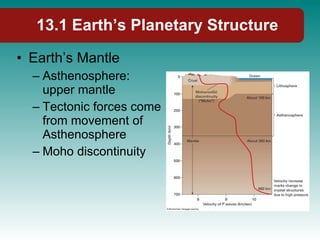
13.1 Earth’s Planetary Structure Earth’s Mantle Asthenosphere: upper mantle Tectonic forces come from movement of Asthenosphere Moho discontinuity
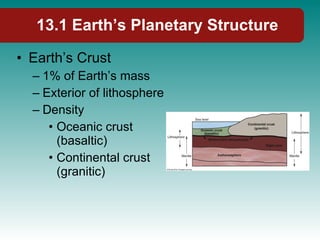
13.1 Earth’s Planetary Structure Earth’s Crust 1% of Earth’s mass Exterior of lithosphere Density Oceanic crust (basaltic) Continental crust (granitic)
13.2 Minerals and Rocks Minerals Building blocks of rocks Inorganic Naturally occurring Rock Aggregate (collection) of minerals or an aggregate of the same mineral Most Common Elements
13.2 Minerals and Rocks Minerals Distinct and recognizable characteristics Hardness Luster Cleavage Tendency to fracture Specific gravity Geometric shapes Chemical Composition Silicon, oxygen, and carbon Silicates
13.2 Minerals and Rocks Rocks Building material Weathered and  eroded Bedrock Regolith Outcrop 3 Major Categories of Rocks Igneous Sedimentary Metamorphic
13.2 Minerals and Rocks Igneous Rocks Molten rock material cools and solidifies Magma (below surface) Lava (at surface) 2 Major categories of Igneous: Extrusive Intrusive
13.2 Minerals and Rocks Extrusive Extrusive igneous rock (volcanic rock): solidifies at surface Pyroclastics (fine fragments) Intrusive Intrusive igneous rock: molten magma solidifies (freezes) Also called plutonic rock
13.2 Minerals and Rocks Chemical Composition of Igneous Felsic, Mafic, Dionite, Andesite Extrusive:  Basalt, Andesite, Rhyolite Intrusive:  Gabbro, Diorite, Granite
13.2 Minerals and Rocks Geometric patterns Columnar joints Devil’s Postpile, CA and Devil's Tower, WY
13.2 Minerals and Rocks Sedimentary Rocks Accumulated sediment Unconsolidated, minerals that have been eroded, transported and deposited Clasts Clastic
13.2 Minerals and Rocks Sedimentary Rocks Organic sedimentary Coal Limestone Chemical sedimentary rocks Dolomite
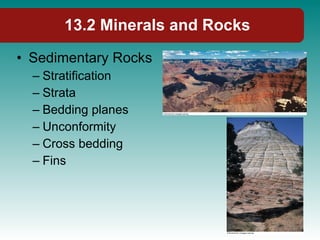
13.2 Minerals and Rocks Sedimentary Rocks Stratification Strata Bedding planes Unconformity Cross bedding Fins
13.2 Minerals and Rocks Metamorphic Rocks Changed form due to enormous heat and pressure Harder Foliation Two major Types: Foliated (presence of platy or wavy surfaces) Nonfoliated (absence of platy or wavy surfaces)
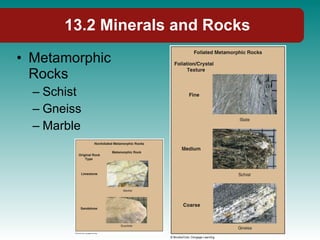
13.2 Minerals and Rocks Metamorphic Rocks Schist Gneiss Marble
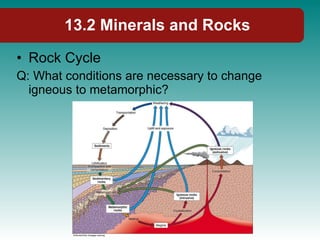
13.2 Minerals and Rocks Rock Cycle Q: What conditions are necessary to change igneous to metamorphic?
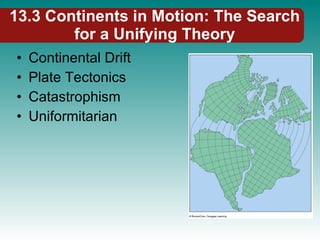
13.3 Continents in Motion: The Search for a Unifying Theory Continental Drift Plate Tectonics Catastrophism Uniformitarian
13.3 Continents in Motion: The Search for a Unifying Theory Continental Drift Idea that continents and other landmasses have shifted Wegener Pangaea Gondwana Laurasia Q: How has continental movement affected the climates of landmasses?
13.3 Continents in Motion: The Search for a Unifying Theory Supporting Evidence for Continental Drift Radioactive dating Paleomagnetism Reconstructed locations of continents 200 mya continents joined together Similar fossil reptiles and plants
13.3 Continents in Motion: The Search for a Unifying Theory Supporting Evidence for Continental Drift Glaciation Rocks of ancient mountain ranges Paleogeographic reconstruction
13.4 Plate Tectonics Plate Tectonics Modern theory to explain movement of continents Lithosphere is broken Plates move in distinct and discrete units Plates Diverge, converge, or move laterally 7 major plates
13.4 Plate Tectonics Plate Tectonics Q: Does every lithospheric plate include a continent?
13.3 Continents in Motion: The Search for a Unifying Theory Seafloor Spreading and Convection Currents Undersea mapping Mid-ocean ridges Parallel bands of matching magnetic patterns Rocks on ocean floor very young! Oldest rocks lie next to continents
13.3 Continents in Motion: The Search for a Unifying Theory Seafloor Spreading and Convection Currents
13.3 Continents in Motion: The Search for a Unifying Theory Seafloor Spreading Polarity reversals
13.3 Continents in Motion: The Search for a Unifying Theory Seafloor Spreading Convection Q: Why is plate tectonics a better name than continental drift for the lateral movement of Earth’s solid outer shell?
13.3 Continents in Motion: The Search for a Unifying Theory Tectonic Plate Movement Pulling apart, pushing together, or sliding alongside
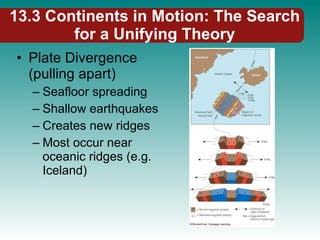
13.3 Continents in Motion: The Search for a Unifying Theory Plate Divergence (pulling apart) Seafloor spreading Shallow earthquakes Creates new ridges Most occur near oceanic ridges (e.g. Iceland)
13.3 Continents in Motion: The Search for a Unifying Theory Plate Divergence (pulling apart) Rift Valley, Africa
13.3 Continents in Motion: The Search for a Unifying Theory Plate Convergence (pushing together) Denser plate forced under lighter plate This is known as subduction Examples: Nazca Plate subducts beneath South America Japan
13.3 Continents in Motion: The Search for a Unifying Theory Plate Convergence Deep ocean trenches Mountain ranges (ocean-continent) Cascades Andes Islands (ocean-ocean) Aleutians Kuriles
13.3 Continents in Motion: The Search for a Unifying Theory Plate Convergence Larger Landmasses (continent-continent) Continental Collision Himalayas Tibetan Plateau
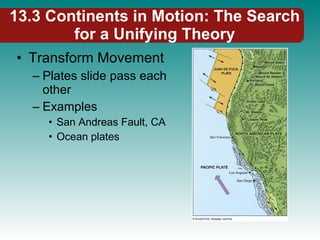
13.3 Continents in Motion: The Search for a Unifying Theory Transform Movement Plates slide pass each other Examples San Andreas Fault, CA Ocean plates
13.3 Continents in Motion: The Search for a Unifying Theory Hot Spots Almost stationary molten masses that rise to surface Hawaiian Islands
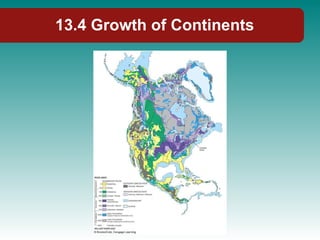
13.4 Growth of Continents Origin of continents still debated Continental shields (ancient crystalline rock) Example: Canadian Shield Accretion Microplate terranes
13.4 Growth of Continents
13.5 Paleogeography Paleogeography Reconstruct the past environment of a geographical region based on geologic and climate evidence Earth History Eras Periods Epochs
13.5 Paleogeography Q: How has the environment at the location where you live changes through geologic time?
Physical Geography End of Chapter 13: Earth Structure, Earth Materials, and Plate Tectonics

13

  • 1.
    Chapter 13: EarthStructure, Earth Materials, and Plate Tectonics Physical Geography Ninth Edition Robert E. Gabler James. F. Petersen L. Michael Trapasso Dorothy Sack
  • 2.
    Earth Structure, EarthMaterials, and Plate Tectonics
  • 3.
    13.1 Earth’s PlanetaryStructure Earth’s radius is 6400 km (4000 miles) Structure and composition deduced by remote sensing Seismic waves Seismograph P (primary) waves S (secondary) waves
  • 4.
    13.1 Earth’s PlanetaryStructure Seismic Waves Earth’s Internal Structure (crust, mantle, outer core, inner core)
  • 5.
    13.1 Earth’s PlanetaryStructure Earth’s Core 1/3 of Earth’s mass Enormous pressure Iron and nickel Inner core: Solid Outer core: molten lava
  • 6.
    13.1 Earth’s PlanetaryStructure Earth’s Mantle Largest of interior zones Solid rocky material Less dense than core Plastic solid Outermost layer behaves like an elastic solid (rigid) Lithosphere (upper most mantle and crust)
  • 7.
    13.1 Earth’s PlanetaryStructure Earth’s Mantle Asthenosphere: upper mantle Tectonic forces come from movement of Asthenosphere Moho discontinuity
  • 8.
    13.1 Earth’s PlanetaryStructure Earth’s Crust 1% of Earth’s mass Exterior of lithosphere Density Oceanic crust (basaltic) Continental crust (granitic)
  • 9.
    13.2 Minerals andRocks Minerals Building blocks of rocks Inorganic Naturally occurring Rock Aggregate (collection) of minerals or an aggregate of the same mineral Most Common Elements
  • 10.
    13.2 Minerals andRocks Minerals Distinct and recognizable characteristics Hardness Luster Cleavage Tendency to fracture Specific gravity Geometric shapes Chemical Composition Silicon, oxygen, and carbon Silicates
  • 11.
    13.2 Minerals andRocks Rocks Building material Weathered and eroded Bedrock Regolith Outcrop 3 Major Categories of Rocks Igneous Sedimentary Metamorphic
  • 12.
    13.2 Minerals andRocks Igneous Rocks Molten rock material cools and solidifies Magma (below surface) Lava (at surface) 2 Major categories of Igneous: Extrusive Intrusive
  • 13.
    13.2 Minerals andRocks Extrusive Extrusive igneous rock (volcanic rock): solidifies at surface Pyroclastics (fine fragments) Intrusive Intrusive igneous rock: molten magma solidifies (freezes) Also called plutonic rock
  • 14.
    13.2 Minerals andRocks Chemical Composition of Igneous Felsic, Mafic, Dionite, Andesite Extrusive: Basalt, Andesite, Rhyolite Intrusive: Gabbro, Diorite, Granite
  • 15.
    13.2 Minerals andRocks Geometric patterns Columnar joints Devil’s Postpile, CA and Devil's Tower, WY
  • 16.
    13.2 Minerals andRocks Sedimentary Rocks Accumulated sediment Unconsolidated, minerals that have been eroded, transported and deposited Clasts Clastic
  • 17.
    13.2 Minerals andRocks Sedimentary Rocks Organic sedimentary Coal Limestone Chemical sedimentary rocks Dolomite
  • 18.
    13.2 Minerals andRocks Sedimentary Rocks Stratification Strata Bedding planes Unconformity Cross bedding Fins
  • 19.
    13.2 Minerals andRocks Metamorphic Rocks Changed form due to enormous heat and pressure Harder Foliation Two major Types: Foliated (presence of platy or wavy surfaces) Nonfoliated (absence of platy or wavy surfaces)
  • 20.
    13.2 Minerals andRocks Metamorphic Rocks Schist Gneiss Marble
  • 21.
    13.2 Minerals andRocks Rock Cycle Q: What conditions are necessary to change igneous to metamorphic?
  • 22.
    13.3 Continents inMotion: The Search for a Unifying Theory Continental Drift Plate Tectonics Catastrophism Uniformitarian
  • 23.
    13.3 Continents inMotion: The Search for a Unifying Theory Continental Drift Idea that continents and other landmasses have shifted Wegener Pangaea Gondwana Laurasia Q: How has continental movement affected the climates of landmasses?
  • 24.
    13.3 Continents inMotion: The Search for a Unifying Theory Supporting Evidence for Continental Drift Radioactive dating Paleomagnetism Reconstructed locations of continents 200 mya continents joined together Similar fossil reptiles and plants
  • 25.
    13.3 Continents inMotion: The Search for a Unifying Theory Supporting Evidence for Continental Drift Glaciation Rocks of ancient mountain ranges Paleogeographic reconstruction
  • 26.
    13.4 Plate TectonicsPlate Tectonics Modern theory to explain movement of continents Lithosphere is broken Plates move in distinct and discrete units Plates Diverge, converge, or move laterally 7 major plates
  • 27.
    13.4 Plate TectonicsPlate Tectonics Q: Does every lithospheric plate include a continent?
  • 28.
    13.3 Continents inMotion: The Search for a Unifying Theory Seafloor Spreading and Convection Currents Undersea mapping Mid-ocean ridges Parallel bands of matching magnetic patterns Rocks on ocean floor very young! Oldest rocks lie next to continents
  • 29.
    13.3 Continents inMotion: The Search for a Unifying Theory Seafloor Spreading and Convection Currents
  • 30.
    13.3 Continents inMotion: The Search for a Unifying Theory Seafloor Spreading Polarity reversals
  • 31.
    13.3 Continents inMotion: The Search for a Unifying Theory Seafloor Spreading Convection Q: Why is plate tectonics a better name than continental drift for the lateral movement of Earth’s solid outer shell?
  • 32.
    13.3 Continents inMotion: The Search for a Unifying Theory Tectonic Plate Movement Pulling apart, pushing together, or sliding alongside
  • 33.
    13.3 Continents inMotion: The Search for a Unifying Theory Plate Divergence (pulling apart) Seafloor spreading Shallow earthquakes Creates new ridges Most occur near oceanic ridges (e.g. Iceland)
  • 34.
    13.3 Continents inMotion: The Search for a Unifying Theory Plate Divergence (pulling apart) Rift Valley, Africa
  • 35.
    13.3 Continents inMotion: The Search for a Unifying Theory Plate Convergence (pushing together) Denser plate forced under lighter plate This is known as subduction Examples: Nazca Plate subducts beneath South America Japan
  • 36.
    13.3 Continents inMotion: The Search for a Unifying Theory Plate Convergence Deep ocean trenches Mountain ranges (ocean-continent) Cascades Andes Islands (ocean-ocean) Aleutians Kuriles
  • 37.
    13.3 Continents inMotion: The Search for a Unifying Theory Plate Convergence Larger Landmasses (continent-continent) Continental Collision Himalayas Tibetan Plateau
  • 38.
    13.3 Continents inMotion: The Search for a Unifying Theory Transform Movement Plates slide pass each other Examples San Andreas Fault, CA Ocean plates
  • 39.
    13.3 Continents inMotion: The Search for a Unifying Theory Hot Spots Almost stationary molten masses that rise to surface Hawaiian Islands
  • 40.
    13.4 Growth ofContinents Origin of continents still debated Continental shields (ancient crystalline rock) Example: Canadian Shield Accretion Microplate terranes
  • 41.
    13.4 Growth ofContinents
  • 42.
    13.5 Paleogeography PaleogeographyReconstruct the past environment of a geographical region based on geologic and climate evidence Earth History Eras Periods Epochs
  • 43.
    13.5 Paleogeography Q:How has the environment at the location where you live changes through geologic time?
  • 44.
    Physical Geography Endof Chapter 13: Earth Structure, Earth Materials, and Plate Tectonics

Editor's Notes

  • #3 Insert cover image for Chapter 13 (p. 348).
  • #4 Insert Figure 13.1
  • #5 Insert Figure 13.2
  • #6 Insert Figure 13.2
  • #7 Insert Figure 13.3
  • #8 Insert Figure 13.4
  • #9 Insert Figure 13.5
  • #10 Insert Table 13.2
  • #11 Insert Figure 13.6
  • #12 Insert Figure 13.7 and 13.8
  • #13 Insert Figure 13.9
  • #14 Insert Figure 13.10
  • #15 Insert Figure 13.11
  • #16 Insert Figure 13.12
  • #17 Insert Figure 13.13
  • #18 Insert Figure 13.14
  • #19 Insert Figure 13.15 and 13.16
  • #20 Insert Figure 13.18
  • #21 Insert Figure 13.19
  • #22 Insert Figure 13.20
  • #23 Insert Figure 13.21
  • #24 Insert Figure 13.22
  • #25 Insert Figure 13.23
  • #26 Insert Figure 13.24
  • #27 Insert Figure 13.25
  • #28 Insert Figure 13.25
  • #29 Insert Figure 13.26
  • #30 Insert Figure 13.26
  • #31 Insert Figure 13.27
  • #32 Insert Figure 13.28
  • #33 Insert Figure 13.29
  • #34 Insert Figure 13.30
  • #35 Insert Figure 13.31
  • #36 Insert Figure 13.32
  • #37 Insert Figure 13.33
  • #38 Insert Figure 13.33
  • #39 Insert Figure 13.34
  • #40 Insert Figure 13.35
  • #41 Insert Figure 13.36
  • #42 Insert Figure 13.36
  • #43 Insert Table 13.2
  • #44 Insert Figure 13.37