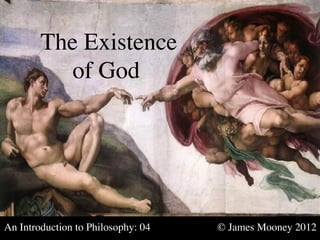
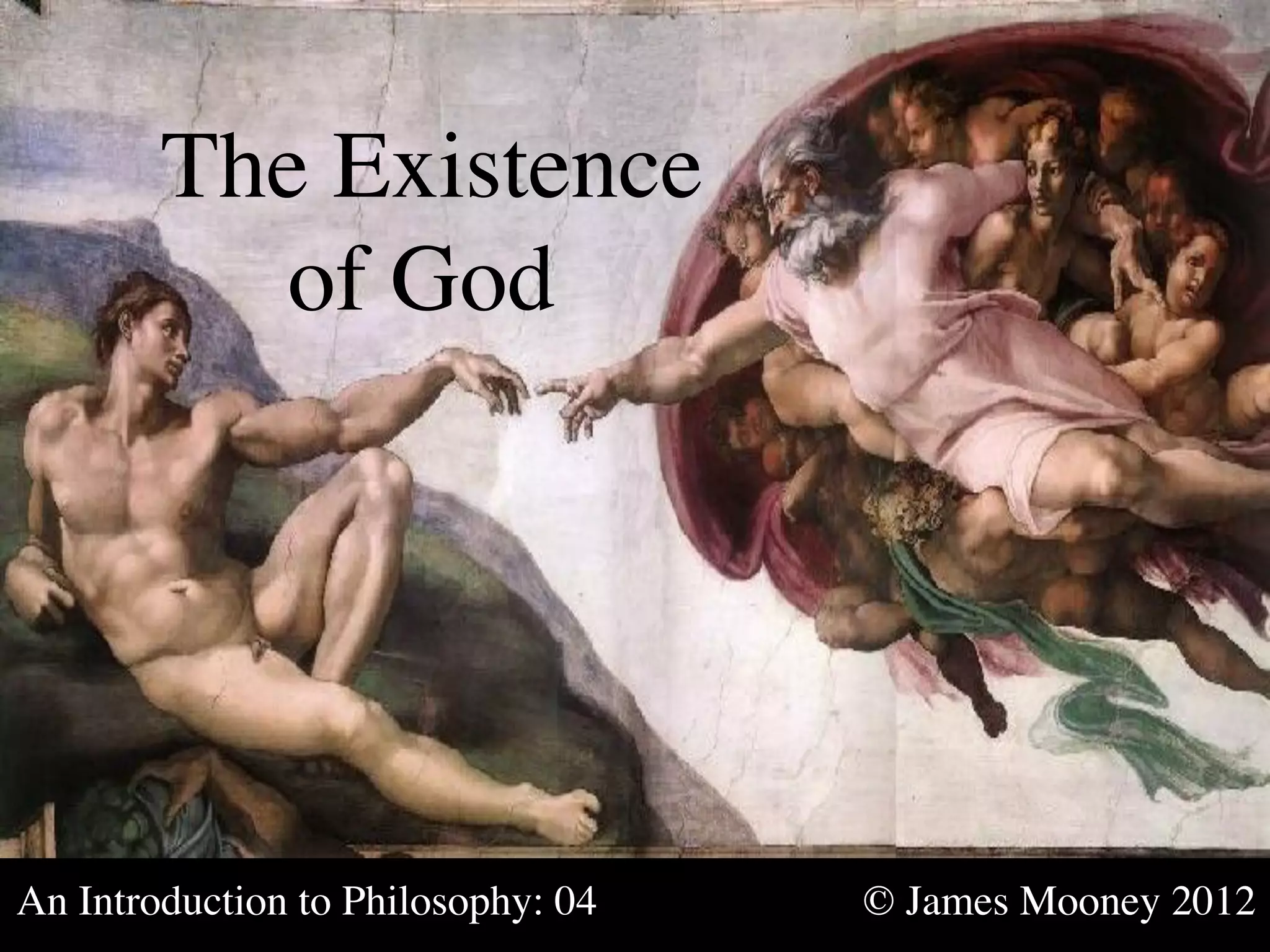

The Existence
          	

of God	


An Introduction to Philosophy: 04   	


   © James Mooney 2012
The Existence of God	

•  God has had a substantial role in much of the philosophy
   we have already considered.	

   –  Descartes attempts to escape solipsism by appeal to the clear and
      distinct idea of God; he also invokes the Almighty in his attempt to
      explain the problem of causal interaction.	

   –  In addition, Berkeley required the intervention of God in order to
      account for the continued existence of the world.	

•  However, most modern philosophers are atheists; many
   actually hold religion responsible for a great deal of the
   world’s ails.	

•  Given the role that religion continues to play in our lives it
   is important for philosophy to consider the argument for
   and against the existence of God.
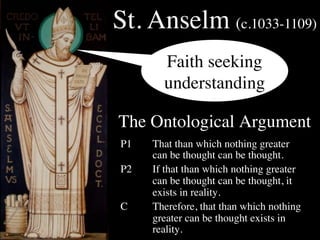
St. Anselm (c.1033-1109)                               	


           Faith seeking 	

           understanding	


The Ontological Argument	

P1	


That than which nothing greater       	


can be thought can be thought.	

P2	


If that than which nothing greater 	


can be thought can be thought, it 	


exists in reality.	

C 	


Therefore, that than which nothing 	


greater can be thought exists in 	


reality.
Gaunilo’s 	

perfect island
God       	


Omnipotent
         	

Omniscient
         	

Benevolent
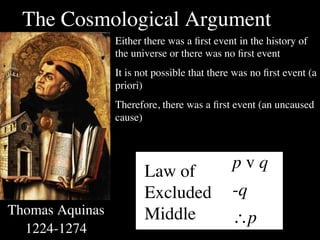
The Cosmological Argument	

                    Either there was a first event in the history of
                    the universe or there was no first event	

                    It is not possible that there was no first event (a
                    priori)	

                    Therefore, there was a first event (an uncaused
                    cause)	


                                                 p v q	

                           Law of
                           Excluded              -q	

Thomas Aquinas	

          Middle	

             ∴p	

  1224-1274
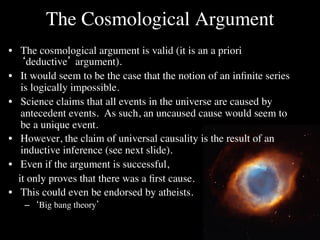
The Cosmological Argument	

•  The cosmological argument is valid (it is an a priori
      ‘deductive’ argument). 	

•  It would seem to be the case that the notion of an infinite series
      is logically impossible.	

•  Science claims that all events in the universe are caused by
      antecedent events. As such, an uncaused cause would seem to
      be a unique event.	

•  However, the claim of universal causality is the result of an
      inductive inference (see next slide).	

•  Even if the argument is successful, 	


it only proves that there was a first cause. 	


•  This could even be endorsed by atheists.	

       –  ‘Big bang theory’
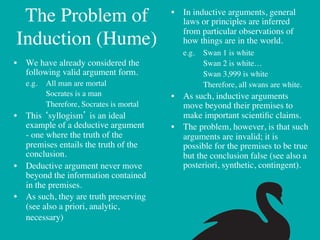
The Problem of                                   •  In inductive arguments, general
                                                          laws or principles are inferred
                                                          from particular observations of
  Induction (Hume) 	

                                    how things are in the world.	


e.g. 	

Swan 1 is white	

•  We have already considered the                      	


Swan 2 is white…	

   following valid argument form.	


Swan 3,999 is white	


e.g. 	

All man are mortal	


Therefore, all swans are white.	


Socrates is a man	

               •  As such, inductive arguments


Therefore, Socrates is mortal	

      move beyond their premises to
•  This ‘syllogism’ is an ideal                        make important scientific claims.	

   example of a deductive argument                  •  The problem, however, is that such
   - one where the truth of the                        arguments are invalid; it is
   premises entails the truth of the                   possible for the premises to be true
   conclusion.	

                                      but the conclusion false (see also a
•  Deductive argument never move                       posteriori, synthetic, contingent). 	

   beyond the information contained
   in the premises.	

•  As such, they are truth preserving
   (see also a priori, analytic,
   necessary)
Teleological Argument	

“Suppose I had found a watch upon the ground, and it should be inquired how the watch
happened to be in that place (...) There must have existed, at some time, and at some place
or other, an artificer or artificers, who formed [the watch] for the purpose which we find it
actually to answer; who comprehended its construction, and designed its use. (...) Every
indication of contrivance, every manifestation of design, which existed in the watch, exists
in the works of nature; with the difference, on the side of nature, of being greater or more,
and that in a degree which exceeds all computation. 	


                                                                                    !
                                               William Paley, Natural Theology (1802)


                                        Argument from Analogy	

                              P1        	

(x) is like (y)	

                              P2        	

(y) has the property (P)	

                              C         	

Therefore, (x) has the property (P)
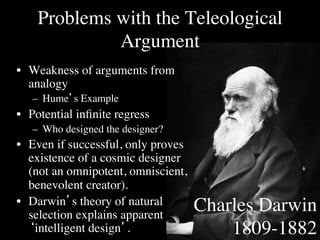
Problems with the Teleological
             Argument	

•  Weakness of arguments from
   analogy	

   –  Hume’s Example	

•  Potential infinite regress	

   –  Who designed the designer?	

•  Even if successful, only proves
   existence of a cosmic designer
   (not an omnipotent, omniscient,
   benevolent creator).	

•  Darwin’s theory of natural         Charles Darwin
   selection explains apparent
   ‘intelligent design’. 	

              1809-1882
Argument from Evil	

 1.    God knows about the
       existence of evil	

 2.    God could do something
       about the existence of evil	

 3.    God should want to do
       something about the
       existence of evil	


The existence of evil is
       incompatible with the
       standard conception of
       the Christian God.	


The traditional theistic
          response is that the
          existence of evil is a
          necessary implication of
          human free will.
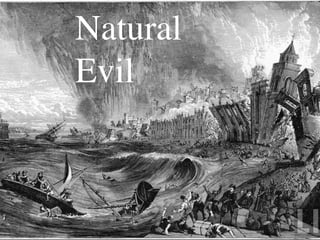
Natural
Evil
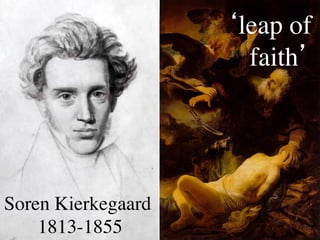
‘leap of
                      faith’	


Soren Kierkegaard
    1813-1855"
Details	

James Mooney	

Open Studies	

The University of Edinburgh	

j.mooney@ed.ac.uk	


www.filmandphilosophy.com	

@film_philosophy

Philosophy04

  • 1.
    The Existence of God An Introduction to Philosophy: 04 © James Mooney 2012
  • 2.
    The Existence ofGod •  God has had a substantial role in much of the philosophy we have already considered. –  Descartes attempts to escape solipsism by appeal to the clear and distinct idea of God; he also invokes the Almighty in his attempt to explain the problem of causal interaction. –  In addition, Berkeley required the intervention of God in order to account for the continued existence of the world. •  However, most modern philosophers are atheists; many actually hold religion responsible for a great deal of the world’s ails. •  Given the role that religion continues to play in our lives it is important for philosophy to consider the argument for and against the existence of God.
  • 3.
    St. Anselm (c.1033-1109) Faith seeking understanding The Ontological Argument P1 That than which nothing greater can be thought can be thought. P2 If that than which nothing greater can be thought can be thought, it exists in reality. C Therefore, that than which nothing greater can be thought exists in reality.
  • 4.
  • 5.
    God Omnipotent Omniscient Benevolent
  • 6.
    The Cosmological Argument Either there was a first event in the history of the universe or there was no first event It is not possible that there was no first event (a priori) Therefore, there was a first event (an uncaused cause) p v q Law of Excluded -q Thomas Aquinas Middle ∴p 1224-1274
  • 7.
    The Cosmological Argument • The cosmological argument is valid (it is an a priori ‘deductive’ argument). •  It would seem to be the case that the notion of an infinite series is logically impossible. •  Science claims that all events in the universe are caused by antecedent events. As such, an uncaused cause would seem to be a unique event. •  However, the claim of universal causality is the result of an inductive inference (see next slide). •  Even if the argument is successful, it only proves that there was a first cause. •  This could even be endorsed by atheists. –  ‘Big bang theory’
  • 8.
    The Problem of •  In inductive arguments, general laws or principles are inferred from particular observations of Induction (Hume) how things are in the world. e.g. Swan 1 is white •  We have already considered the Swan 2 is white… following valid argument form. Swan 3,999 is white e.g. All man are mortal Therefore, all swans are white. Socrates is a man •  As such, inductive arguments Therefore, Socrates is mortal move beyond their premises to •  This ‘syllogism’ is an ideal make important scientific claims. example of a deductive argument •  The problem, however, is that such - one where the truth of the arguments are invalid; it is premises entails the truth of the possible for the premises to be true conclusion. but the conclusion false (see also a •  Deductive argument never move posteriori, synthetic, contingent). beyond the information contained in the premises. •  As such, they are truth preserving (see also a priori, analytic, necessary)
  • 9.
    Teleological Argument “Suppose Ihad found a watch upon the ground, and it should be inquired how the watch happened to be in that place (...) There must have existed, at some time, and at some place or other, an artificer or artificers, who formed [the watch] for the purpose which we find it actually to answer; who comprehended its construction, and designed its use. (...) Every indication of contrivance, every manifestation of design, which existed in the watch, exists in the works of nature; with the difference, on the side of nature, of being greater or more, and that in a degree which exceeds all computation. ! William Paley, Natural Theology (1802) Argument from Analogy P1 (x) is like (y) P2 (y) has the property (P) C Therefore, (x) has the property (P)
  • 10.
    Problems with theTeleological Argument •  Weakness of arguments from analogy –  Hume’s Example •  Potential infinite regress –  Who designed the designer? •  Even if successful, only proves existence of a cosmic designer (not an omnipotent, omniscient, benevolent creator). •  Darwin’s theory of natural Charles Darwin selection explains apparent ‘intelligent design’. 1809-1882
  • 11.
    Argument from Evil 1.  God knows about the existence of evil 2.  God could do something about the existence of evil 3.  God should want to do something about the existence of evil The existence of evil is incompatible with the standard conception of the Christian God. The traditional theistic response is that the existence of evil is a necessary implication of human free will.
  • 12.
  • 13.
    ‘leap of faith’ Soren Kierkegaard 1813-1855"
  • 14.
    Details James Mooney Open Studies TheUniversity of Edinburgh j.mooney@ed.ac.uk www.filmandphilosophy.com @film_philosophy