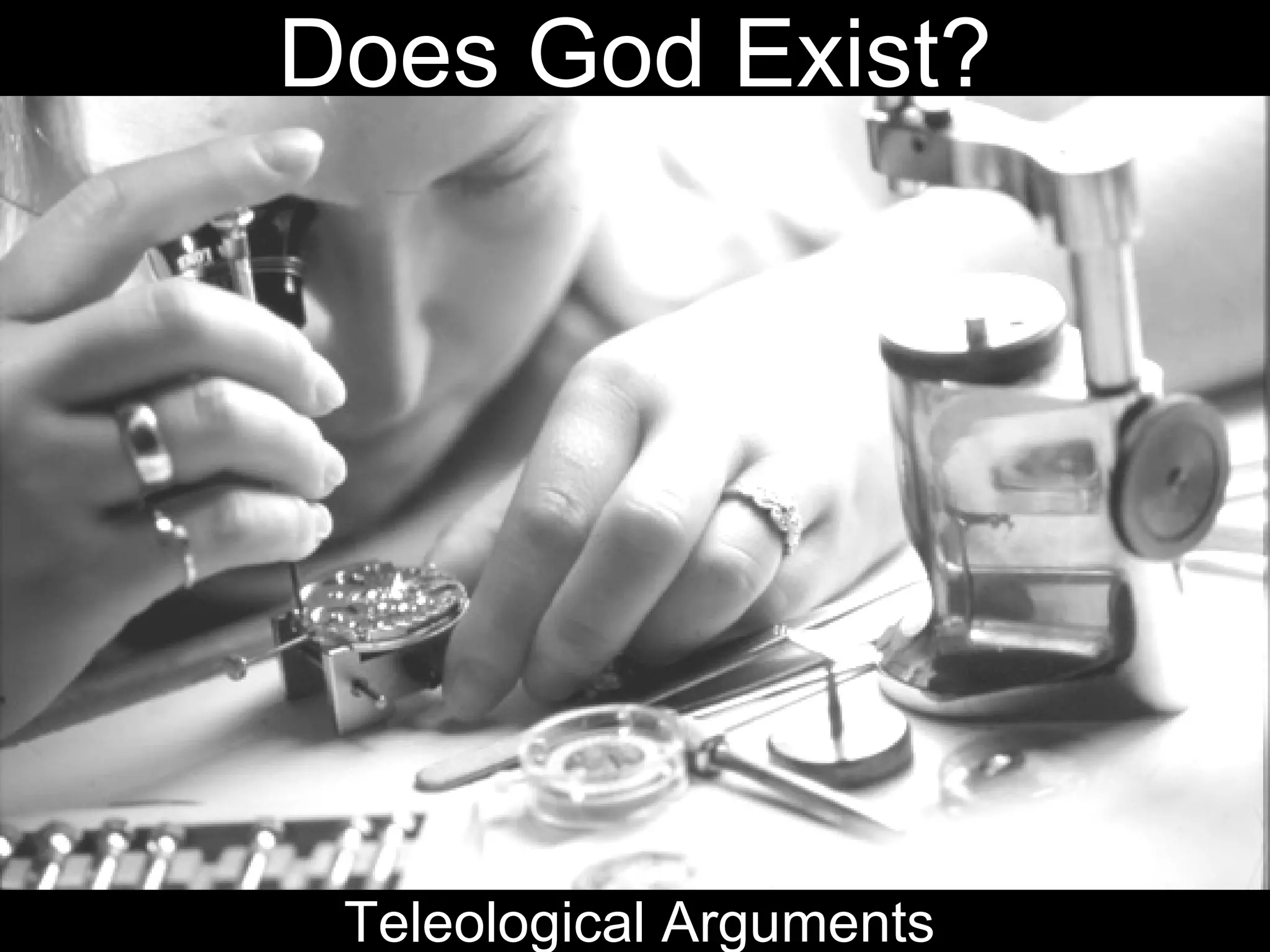
Does God Exist? Teleological Arguments
What you need to know… Knowledge and understanding of  classical  and  modern  presentations of arguments for the existence of God based on apparent order and purpose in the world (Aquinas, Paley, Swindburne). Challenges  to these arguments from  philosophy  and  scientific  explanations.
Typical Questions… Jan ‘03 1  Read the passage and answer questions (a) to (d) which follow. “ When we come to inspect the watch, we perceive... that its several parts are framed and put together for a purpose... The mechanism being observed... the conclusion, we think, is inevitable that the watch must have had a maker…” Paley,  Natural Theology , Chapter 3 (a) Summarise the Design Argument as put forward by Paley.  (10 marks) (b) Outline the challenges which this argument has faced.  (10 marks) (c) Outline Swinburne.s Design Argument.  (10 marks) (d) Assess how far the Design Argument proves the existence of God.  (10 marks) Jan ‘02 2  (a) Explain the claim that “the order and purpose in the world are evidence that God exists”.  (20 marks) (b) Explain how science has appeared to challenge the design argument, and assess how successful this challenge has been.  (20 marks)
Typical Questions Jan ‘04 1  Read the passage and answer questions (a) and (b) which follow. “ Investigation of the world can reveal that its various parts are arranged in an orderly way. Many of these parts are seen to have a purpose. William Paley argued for the existence of a designer of this apparent order and purpose in the world” (a) Outline the design argument for the existence of God, as presented by Paley.  (10 marks) (b) Explain how science has challenged the design argument.  (10 marks) June ’02 3  (a) Explain the claim that “Science observes order in the universe around us, and that order is evidence of design”.  (20 marks) (b) Outline the main objections to the design argument and assess how far these objections are successful.
Teleological Arguments Telos  Greek “purpose”.  Recap  a posteriori  argument All arguments observe design, purpose, regularity, beauty and order in the world, then conclude God must exist. Genesis… a sole creator Key figures: Aquinas, Paley, Swindburne, Hume, Darwin, Dawkins. - accident
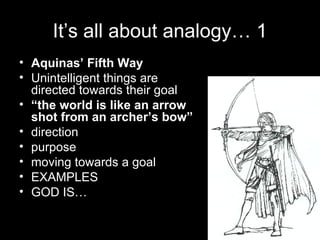
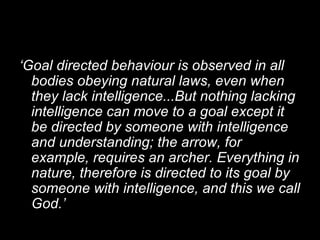
It’s all about analogy… 1 Aquinas’ Fifth Way Unintelligent things are  directed towards their goal “ the world is like an arrow  shot from an archer’s bow” direction purpose moving towards a goal EXAMPLES GOD IS…
‘ Goal directed behaviour is observed in all bodies obeying natural laws, even when they lack intelligence...But nothing lacking intelligence can move to a goal except it be directed by someone with intelligence and understanding; the arrow, for example, requires an archer. Everything in nature, therefore is directed to its goal by someone with intelligence, and this we call God.’
 
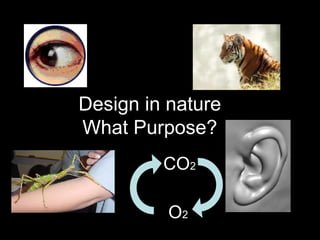
Design in nature What Purpose? CO 2 O 2
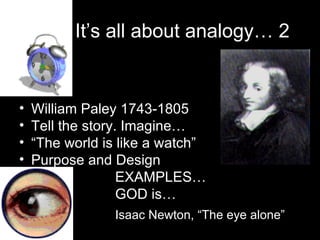
William Paley 1743-1805 Tell the story. Imagine… “ The world is like a watch” Purpose and Design EXAMPLES… GOD is… Isaac Newton, “The eye alone” It’s all about analogy… 2
. . . when we come to inspect the watch, we perceive. . . that its several parts are framed and put together for a purpose, e.g. that they are so formed and adjusted as to produce motion, and that motion so regulated as to point out the hour of the day; that if the different parts had been differently shaped from what they are, or placed after any other manner or in any other order than that in which they are placed, either no motion at all would have been carried on in the machine, or none which would have answered the use that is now served by it. . . . the inference we think is inevitable, that the watch must have had a maker -- that there must have existed, at some time and at some place or other, an artificer or artificers who formed it for the purpose which we find it actually to answer, who comprehended its construction and designed its use.
Richard Swinburne British professor and philosopher 1934- Proving God from Regularity of Co-Presence   Spatial Order Interdependence of the world as a whole Examples Therefore God… Proving God from Regularity of Succession   Temporal Order Universe governed by laws/rules Examples Therefore God… Modern Developments 1
Peter Vardy British Philosopher and Professor 1945- Proving God from Providence Analogy “God the caring mother has prepared the nursery” Examples Proving God from Beauty Analogy “God the artist” Examples Modern Developments 2
Criticisms of the argument Main opponent David Hume (1711-1776) Dialogues Concerning Natural Religion There is evidence of design, but to conclude God is the designer  goes beyond evidence –  unsound analogy Watchmakers make watches – that’s our experience, but to conclude God made the world  goes beyond our experience God is complex – like a watch? So, who made God? Anthropomorphism – human analogies; God ceases to be God Which God?  An imperfect world points to an immoral God – not the God of classical theism Chance is as valid as apparent order
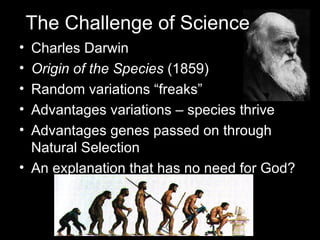
Charles Darwin Origin of the Species  (1859) Random variations “freaks” Advantages variations – species thrive  Advantages genes passed on through Natural Selection An explanation that has no need for God? The Challenge of Science
Richard Dawkins (1941-) The Blind Watchmaker  (1986) Agrees with Paley – staggering complexity Natural Selection driven by intense competition (survival of the fittest) Only the “winners” are seen – appear designed Evil in the world is either from a imperfect “blind” God or a result of competition for survival  Natural Selection is a complete answer Modern Criticisms
Is Dawkins Right? He certainly has a point! Scientism v’s Creation-Science Teilhard de Chardin (1881-1955) Evolution is  how  God made humans Weak Anthropic Principle Remarkable coincidence that we’re here at all. NB – Leibniz “Why”? Strong Anthropic Principle – random? John Polkinhorne (nuclear physicist turned priest). If at the Big Bang the basic elements had been slightly different, the universe would be lifeless. The earth is perfect for human life – remarkable. Hydrogen – carbon balance, distance from sun, saltiness of sea

As Teleological

  • 1.
    Does God Exist?Teleological Arguments
  • 2.
    What you needto know… Knowledge and understanding of classical and modern presentations of arguments for the existence of God based on apparent order and purpose in the world (Aquinas, Paley, Swindburne). Challenges to these arguments from philosophy and scientific explanations.
  • 3.
    Typical Questions… Jan‘03 1 Read the passage and answer questions (a) to (d) which follow. “ When we come to inspect the watch, we perceive... that its several parts are framed and put together for a purpose... The mechanism being observed... the conclusion, we think, is inevitable that the watch must have had a maker…” Paley, Natural Theology , Chapter 3 (a) Summarise the Design Argument as put forward by Paley. (10 marks) (b) Outline the challenges which this argument has faced. (10 marks) (c) Outline Swinburne.s Design Argument. (10 marks) (d) Assess how far the Design Argument proves the existence of God. (10 marks) Jan ‘02 2 (a) Explain the claim that “the order and purpose in the world are evidence that God exists”. (20 marks) (b) Explain how science has appeared to challenge the design argument, and assess how successful this challenge has been. (20 marks)
  • 4.
    Typical Questions Jan‘04 1 Read the passage and answer questions (a) and (b) which follow. “ Investigation of the world can reveal that its various parts are arranged in an orderly way. Many of these parts are seen to have a purpose. William Paley argued for the existence of a designer of this apparent order and purpose in the world” (a) Outline the design argument for the existence of God, as presented by Paley. (10 marks) (b) Explain how science has challenged the design argument. (10 marks) June ’02 3 (a) Explain the claim that “Science observes order in the universe around us, and that order is evidence of design”. (20 marks) (b) Outline the main objections to the design argument and assess how far these objections are successful.
  • 5.
    Teleological Arguments Telos Greek “purpose”. Recap a posteriori argument All arguments observe design, purpose, regularity, beauty and order in the world, then conclude God must exist. Genesis… a sole creator Key figures: Aquinas, Paley, Swindburne, Hume, Darwin, Dawkins. - accident
  • 6.
    It’s all aboutanalogy… 1 Aquinas’ Fifth Way Unintelligent things are directed towards their goal “ the world is like an arrow shot from an archer’s bow” direction purpose moving towards a goal EXAMPLES GOD IS…
  • 7.
    ‘ Goal directedbehaviour is observed in all bodies obeying natural laws, even when they lack intelligence...But nothing lacking intelligence can move to a goal except it be directed by someone with intelligence and understanding; the arrow, for example, requires an archer. Everything in nature, therefore is directed to its goal by someone with intelligence, and this we call God.’
  • 8.
  • 9.
    Design in natureWhat Purpose? CO 2 O 2
  • 10.
    William Paley 1743-1805Tell the story. Imagine… “ The world is like a watch” Purpose and Design EXAMPLES… GOD is… Isaac Newton, “The eye alone” It’s all about analogy… 2
  • 11.
    . . .when we come to inspect the watch, we perceive. . . that its several parts are framed and put together for a purpose, e.g. that they are so formed and adjusted as to produce motion, and that motion so regulated as to point out the hour of the day; that if the different parts had been differently shaped from what they are, or placed after any other manner or in any other order than that in which they are placed, either no motion at all would have been carried on in the machine, or none which would have answered the use that is now served by it. . . . the inference we think is inevitable, that the watch must have had a maker -- that there must have existed, at some time and at some place or other, an artificer or artificers who formed it for the purpose which we find it actually to answer, who comprehended its construction and designed its use.
  • 12.
    Richard Swinburne Britishprofessor and philosopher 1934- Proving God from Regularity of Co-Presence Spatial Order Interdependence of the world as a whole Examples Therefore God… Proving God from Regularity of Succession Temporal Order Universe governed by laws/rules Examples Therefore God… Modern Developments 1
  • 13.
    Peter Vardy BritishPhilosopher and Professor 1945- Proving God from Providence Analogy “God the caring mother has prepared the nursery” Examples Proving God from Beauty Analogy “God the artist” Examples Modern Developments 2
  • 14.
    Criticisms of theargument Main opponent David Hume (1711-1776) Dialogues Concerning Natural Religion There is evidence of design, but to conclude God is the designer goes beyond evidence – unsound analogy Watchmakers make watches – that’s our experience, but to conclude God made the world goes beyond our experience God is complex – like a watch? So, who made God? Anthropomorphism – human analogies; God ceases to be God Which God? An imperfect world points to an immoral God – not the God of classical theism Chance is as valid as apparent order
  • 15.
    Charles Darwin Originof the Species (1859) Random variations “freaks” Advantages variations – species thrive Advantages genes passed on through Natural Selection An explanation that has no need for God? The Challenge of Science
  • 16.
    Richard Dawkins (1941-)The Blind Watchmaker (1986) Agrees with Paley – staggering complexity Natural Selection driven by intense competition (survival of the fittest) Only the “winners” are seen – appear designed Evil in the world is either from a imperfect “blind” God or a result of competition for survival Natural Selection is a complete answer Modern Criticisms
  • 17.
    Is Dawkins Right?He certainly has a point! Scientism v’s Creation-Science Teilhard de Chardin (1881-1955) Evolution is how God made humans Weak Anthropic Principle Remarkable coincidence that we’re here at all. NB – Leibniz “Why”? Strong Anthropic Principle – random? John Polkinhorne (nuclear physicist turned priest). If at the Big Bang the basic elements had been slightly different, the universe would be lifeless. The earth is perfect for human life – remarkable. Hydrogen – carbon balance, distance from sun, saltiness of sea