INTRO
• Teleological
• God is intelligent designer
• Aposteriori and inductive
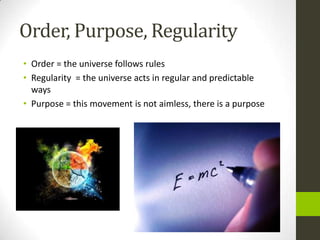
Order, Purpose, Regularity
• Order = the universe follows rules
• Regularity = the universe acts in regular and predictable
ways
• Purpose = this movement is not aimless, there is a purpose
Aquinas’ 5th Way
• “Some intelligent being exists by whom all natural beings are
directed to their end; this being we call God”.
• There are unintelligent things that still have a purpose, so they
must be directed by intelligent things.
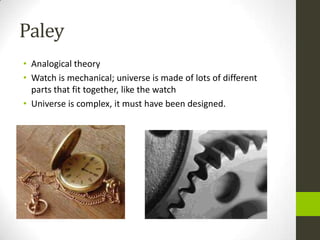
Paley
• Analogical theory
• Watch is mechanical; universe is made of lots of different
parts that fit together, like the watch
• Universe is complex, it must have been designed.
Richard Swinburne
• The universe is ordered, not chaotic. It follows a
pattern, suggesting a higher intelligence.
F.R. Tennant
• Aesthetic Argument: Universe is “saturated with beauty”, but
beauty has no purpose.
• Anthropic Principle: The universe is perfectly suited to sustain
life, as though nature plans in advance.
Weakness - Aposteriori
• Our experience is limited; we have never experienced an un-
designed world.
• The conclusion is not certain, only probable.
Weakness – Evil and suffering
• Do not help to sustain life.
• Why would a designer include them?
Weakness – David Hume
• Analogical argument is weak.
• Illusion of design, what is an un-designed world?
• Team of designers.
Weakness – Richard Dawkins
• Humans are purpose-driven, so will assume that the universe
has a purpose.
• Small chances could cause the universe.
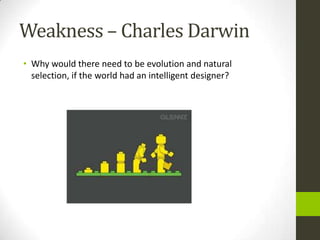
Weakness – Charles Darwin
• Why would there need to be evolution and natural
selection, if the world had an intelligent designer?
Strength – Relatable
• We all experience the universe, which the argument is based
on. (Aposteriori).
• We can all see the order, purpose, and regularity.
Strength – Cumulative Effect
• All arguments for God’s existence are comprehensive and
persuasive when viewed as a whole.

Design argument 2

  • 3.
    INTRO • Teleological • Godis intelligent designer • Aposteriori and inductive
  • 4.
    Order, Purpose, Regularity •Order = the universe follows rules • Regularity = the universe acts in regular and predictable ways • Purpose = this movement is not aimless, there is a purpose
  • 5.
    Aquinas’ 5th Way •“Some intelligent being exists by whom all natural beings are directed to their end; this being we call God”. • There are unintelligent things that still have a purpose, so they must be directed by intelligent things.
  • 6.
    Paley • Analogical theory •Watch is mechanical; universe is made of lots of different parts that fit together, like the watch • Universe is complex, it must have been designed.
  • 7.
    Richard Swinburne • Theuniverse is ordered, not chaotic. It follows a pattern, suggesting a higher intelligence.
  • 8.
    F.R. Tennant • AestheticArgument: Universe is “saturated with beauty”, but beauty has no purpose. • Anthropic Principle: The universe is perfectly suited to sustain life, as though nature plans in advance.
  • 10.
    Weakness - Aposteriori •Our experience is limited; we have never experienced an un- designed world. • The conclusion is not certain, only probable.
  • 11.
    Weakness – Eviland suffering • Do not help to sustain life. • Why would a designer include them?
  • 12.
    Weakness – DavidHume • Analogical argument is weak. • Illusion of design, what is an un-designed world? • Team of designers.
  • 13.
    Weakness – RichardDawkins • Humans are purpose-driven, so will assume that the universe has a purpose. • Small chances could cause the universe.
  • 14.
    Weakness – CharlesDarwin • Why would there need to be evolution and natural selection, if the world had an intelligent designer?
  • 15.
    Strength – Relatable •We all experience the universe, which the argument is based on. (Aposteriori). • We can all see the order, purpose, and regularity.
  • 16.
    Strength – CumulativeEffect • All arguments for God’s existence are comprehensive and persuasive when viewed as a whole.