Proving God Exists...Again The Teleological Argument
An argument from  Design look at the ipod can you work out what it is for? look at it.... what about if you you were from the past?
An argument from  Design look at the flare can you work out what it is for? look at it.... what about if you didn’t know what it was?
An argument from  Design look at the Alethiometer can you work out what it is for? look at it.... what about if you didn’t know what it was?
An argument from  Design where would you think all these things came from?
An argument from  Design where would you think all these things came from? why not just battered together over time? like a rock shaped like something?
Telos, teloi Greek again literally ‘end’ (or point of) When things are pretty complicated you can usually tell what they are for (why they’ve been designed that way...)
either... it’s because it is just so ordered and intricate... or it’s because it ‘does stuff’...
Is it Intricate? Discuss
Is it Intricate? oxygen/CO2 cycle there’s loads of them inside/outside our bodies
Is it Intricate? Physiology of various (all?) living systems
Is it Intricate? ecosystems one thing dies, sometimes whole food webs can die out...
Is it Intricate? and that’s just earth... think bigger surely this is a little more impressive than any watch?
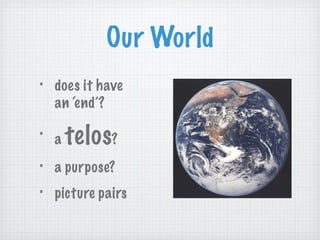
Our World does it have an ‘end’? a  telos ? a purpose? picture pairs
so there you go... by analogy... 1 The World around us resembles the artefacts of human creation, in that they display COMPLEXITY 2 The complexity of human artefacts comes from having been designed by an INTELLIGENT DESIGNER 3 We have no reason to assume that what holds for human artefacts should not hold for the world around us 4 Therefore, the complexity in the world, comes from having been designed and created by an intelligent being
so there you go... by analogy... SO... what would you say... Deductive/Inductive? a priori/posteriori?
design in the world? not a new idea ancient greeks Aquinas even taught in some schools in US as alternative to evolution
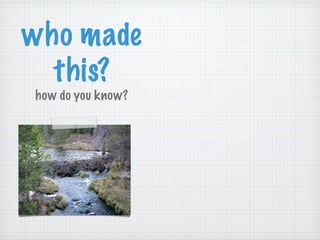
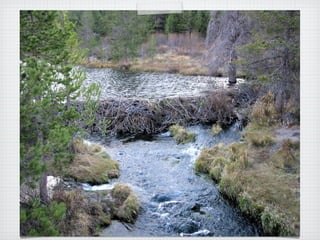
who made this? how do you know?
 
who made this? how do you know?
David Hume on analogy look in your support books
Look round the world: contemplate the whole  and every part of it: you will find it to be nothing  but one great machine, subdivided into an  infinite number of lesser machines, which again  admit of subdivisions to a degree beyond what  human senses and faculties can trace and  explain. All these various machines, and even  their most minute parts, are adjusted to each  other with an accuracy which ravishes into  admiration all men who have ever contemplated  them. The curious adapting of means to ends,  throughout all nature, resembles exactly, though  it much exceeds, the productions of human  contrivance; of human designs, thought,  wisdom, and intelligence. Since, therefore, the  effects resemble each other, we are led to infer,  by all the rules of analogy, that the causes also  resemble; and that the Author of Nature is  somewhat similar to the mind of man, though  possessed of much larger faculties, proportioned  to the grandeur of the work which he has  executed. By this argument a posteriori, and by  this argument alone, do we prove at once the  existence of a Deity, and his similarity to human  mind and intelligence.  (Hume,  Dialogues Concerning Natural Religion )
Objection - claim 3 grounds for analogy are too weak the world is pretty different to all the designed things we see around there are similarities, but not enough there is complexity, but it’s different world is more organic, appears that it has ‘grown’
Objection If we make an analogy with with a vegetable... and that analogy is just as good, or even better... then we are drawing analogy between the world and not designed things this argument begins to look less convincing
Task try to think of an analogy that supports the design argument think of one that you think does not explain the differences, and which you find more convincing as an analogy work in your tables, get the best of each
Task - for example... analogy that supports the design argument one that you think does not reasons why best analogy reasons why best analogy
Task try to think of an analogy that supports the design argument think of one that you think does not explain the differences, and which you find more convincing as an analogy work in your tables, get the best of each
Now think carefully... Idea is that you can tell something about Humans by human creations... What do you reckon you could work out about the ‘Designer’ of our world?
Objection 2: The Designer(s) “A great number of men join in building a house or a ship, in rearing a city, in framing a commonwealth; why may not several deities combine in contriving and framing a world?” Hume
2 Big Problems Argument from analogy
Analogy analogy  |əˈnaləjē| noun ( pl.  -gies ) a comparison between two things, typically on the basis of their structure and for the purpose of explanation or clarification  :  an  analogy between  the workings of nature and those of human societies  |  he interprets logical functions  by analogy with  machines. •  a correspondence or partial similarity  :  the syndrome is called deep dysgraphia because of its  analogy to  deep dyslexia. See note at  likeness  . •  a thing that is comparable to something else in significant respects  :  works of art were seen as an analogy for works of nature.
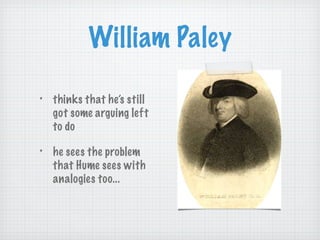
meet William Paley Cambridge Moral Philosopher 1743 - 1805 the watch analogy
In crossing a heath, suppose I pitched my foot against a stone, and were asked how the stone came to be there; I might possibly answer, that, for anything I knew to the contrary, it had lain there forever: nor would it perhaps be very easy to show the absurdity of this answer. But suppose I had found a watch upon the ground, and it should be inquired how the watch happened to be in that place; I should hardly think of the answer I had before given, that for anything I knew, the watch might have always been there. (...) There must have existed, at some time, and at some place or other, an artificer or artificers, who formed [the watch] for the purpose which we find it actually to answer; who comprehended its construction, and designed its use. (...) Every indication of contrivance, every manifestation of design, which existed in the watch, exists in the works of nature; with the difference, on the side of nature, of being greater or more, and that in a degree which exceeds all computation. –  William Paley, Natural Theology (1802)
William Paley thinks that he’s still got some arguing left to do he sees the problem that Hume sees with analogies too...
1. Human Artefacts have characteristic Y 2 Natural Objects also have characteristic Y 3. Human artefacts have Y because they have characteristic Z 4. Therefore, natural objects also have characteristic Z Simple Argument from Analogy
William Paley he’s going to talk about design again but he’s going to talk about design  for  a purpose
1. Natural objects display ‘design-like’ properties 2. Design-like properties are the result of intelligent design 3. Therefore, Natural objects are the product of design Paley’s Argument Do you see how he carefully avoids making any reference or comparison. He just sticks to observations.
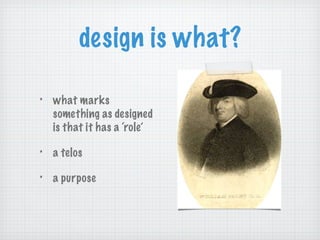
design is what? what marks something as designed is that it has a ‘role’ a telos a purpose
EXAMPLE sword-billed hummingbird without its long thin beak it would be unable to feed on the flowers that grow in their habitat if one was born with a beak slightly the wrong length it couldn’t feed on a wider scale species would go extinct
& there’s more... this is only one tiny example of complexity we could think of many more NB: for Paley;  precise complexity  +  relation to purpose  =  purposive design this must be ‘God’
So What Paley? well this means he avoids the problems of the other argument, the argument from analogy we need to ask again, DO WE FIND THIS CONVINCING ?
Is that it? lets check his premises: 1. Natural objects display ‘design-like’ properties 2. Design-like properties are the result of intelligent design 3. Therefore, Natural objects are the product of design a priori / a posteriori ?
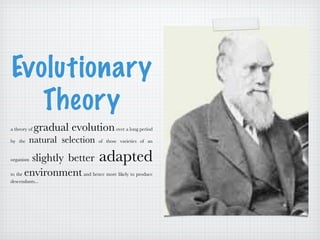
Evolutionary Theory a theory of  gradual evolution  over a long period by the  natural selection  of those varieties of an organism  slightly better  adapted  to the  environment  and hence more likely to produce descendants...
EXAMPLE  -  back to our bird sword-billed hummingbird its beak shape is quite simply the only one that works one without its long thin beak it would have dies and so not passed on its less suitable design to offspring if one was born with a beak slightly the wrong length it couldn’t feed on a wider scale species would go extinct
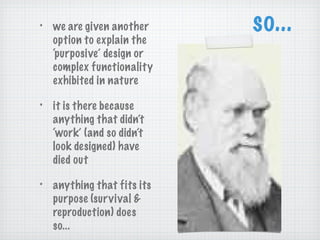
so... we are given another option to explain the ‘purposive’ design or complex functionality exhibited in nature it is there because anything that didn’t ‘work’ (and so didn’t look designed) have died out anything that fits its purpose (survival & reproduction) does so...
Final thought clearly this does not show that intelligent design is not still the case there is nothing about evolution that explicitly denies the idea of a creator but the onus must lie with advocates of ID as if there was some guiding force in the evolutionary process there are several anomalies that require an explanation...
Final thought this is not to say there are no answers to these questions, but it is worth bearing this in mind when considering the contemporary debate...
Dawkins & the rise of reductionist science
Dawkins’ work
Dawkins

Teleological

  • 1.
    Proving God Exists...AgainThe Teleological Argument
  • 2.
    An argument from Design look at the ipod can you work out what it is for? look at it.... what about if you you were from the past?
  • 3.
    An argument from Design look at the flare can you work out what it is for? look at it.... what about if you didn’t know what it was?
  • 4.
    An argument from Design look at the Alethiometer can you work out what it is for? look at it.... what about if you didn’t know what it was?
  • 5.
    An argument from Design where would you think all these things came from?
  • 6.
    An argument from Design where would you think all these things came from? why not just battered together over time? like a rock shaped like something?
  • 7.
    Telos, teloi Greekagain literally ‘end’ (or point of) When things are pretty complicated you can usually tell what they are for (why they’ve been designed that way...)
  • 8.
    either... it’s becauseit is just so ordered and intricate... or it’s because it ‘does stuff’...
  • 9.
  • 10.
    Is it Intricate?oxygen/CO2 cycle there’s loads of them inside/outside our bodies
  • 11.
    Is it Intricate?Physiology of various (all?) living systems
  • 12.
    Is it Intricate?ecosystems one thing dies, sometimes whole food webs can die out...
  • 13.
    Is it Intricate?and that’s just earth... think bigger surely this is a little more impressive than any watch?
  • 14.
    Our World doesit have an ‘end’? a telos ? a purpose? picture pairs
  • 15.
    so there yougo... by analogy... 1 The World around us resembles the artefacts of human creation, in that they display COMPLEXITY 2 The complexity of human artefacts comes from having been designed by an INTELLIGENT DESIGNER 3 We have no reason to assume that what holds for human artefacts should not hold for the world around us 4 Therefore, the complexity in the world, comes from having been designed and created by an intelligent being
  • 16.
    so there yougo... by analogy... SO... what would you say... Deductive/Inductive? a priori/posteriori?
  • 17.
    design in theworld? not a new idea ancient greeks Aquinas even taught in some schools in US as alternative to evolution
  • 18.
    who made this?how do you know?
  • 19.
  • 20.
    who made this?how do you know?
  • 21.
    David Hume onanalogy look in your support books
  • 22.
    Look round theworld: contemplate the whole and every part of it: you will find it to be nothing but one great machine, subdivided into an infinite number of lesser machines, which again admit of subdivisions to a degree beyond what human senses and faculties can trace and explain. All these various machines, and even their most minute parts, are adjusted to each other with an accuracy which ravishes into admiration all men who have ever contemplated them. The curious adapting of means to ends, throughout all nature, resembles exactly, though it much exceeds, the productions of human contrivance; of human designs, thought, wisdom, and intelligence. Since, therefore, the effects resemble each other, we are led to infer, by all the rules of analogy, that the causes also resemble; and that the Author of Nature is somewhat similar to the mind of man, though possessed of much larger faculties, proportioned to the grandeur of the work which he has executed. By this argument a posteriori, and by this argument alone, do we prove at once the existence of a Deity, and his similarity to human mind and intelligence. (Hume, Dialogues Concerning Natural Religion )
  • 23.
    Objection - claim3 grounds for analogy are too weak the world is pretty different to all the designed things we see around there are similarities, but not enough there is complexity, but it’s different world is more organic, appears that it has ‘grown’
  • 24.
    Objection If wemake an analogy with with a vegetable... and that analogy is just as good, or even better... then we are drawing analogy between the world and not designed things this argument begins to look less convincing
  • 25.
    Task try tothink of an analogy that supports the design argument think of one that you think does not explain the differences, and which you find more convincing as an analogy work in your tables, get the best of each
  • 26.
    Task - forexample... analogy that supports the design argument one that you think does not reasons why best analogy reasons why best analogy
  • 27.
    Task try tothink of an analogy that supports the design argument think of one that you think does not explain the differences, and which you find more convincing as an analogy work in your tables, get the best of each
  • 28.
    Now think carefully...Idea is that you can tell something about Humans by human creations... What do you reckon you could work out about the ‘Designer’ of our world?
  • 29.
    Objection 2: TheDesigner(s) “A great number of men join in building a house or a ship, in rearing a city, in framing a commonwealth; why may not several deities combine in contriving and framing a world?” Hume
  • 30.
    2 Big ProblemsArgument from analogy
  • 31.
    Analogy analogy |əˈnaləjē| noun ( pl. -gies ) a comparison between two things, typically on the basis of their structure and for the purpose of explanation or clarification : an analogy between the workings of nature and those of human societies | he interprets logical functions by analogy with machines. • a correspondence or partial similarity : the syndrome is called deep dysgraphia because of its analogy to deep dyslexia. See note at likeness . • a thing that is comparable to something else in significant respects : works of art were seen as an analogy for works of nature.
  • 32.
    meet William PaleyCambridge Moral Philosopher 1743 - 1805 the watch analogy
  • 33.
    In crossing aheath, suppose I pitched my foot against a stone, and were asked how the stone came to be there; I might possibly answer, that, for anything I knew to the contrary, it had lain there forever: nor would it perhaps be very easy to show the absurdity of this answer. But suppose I had found a watch upon the ground, and it should be inquired how the watch happened to be in that place; I should hardly think of the answer I had before given, that for anything I knew, the watch might have always been there. (...) There must have existed, at some time, and at some place or other, an artificer or artificers, who formed [the watch] for the purpose which we find it actually to answer; who comprehended its construction, and designed its use. (...) Every indication of contrivance, every manifestation of design, which existed in the watch, exists in the works of nature; with the difference, on the side of nature, of being greater or more, and that in a degree which exceeds all computation. – William Paley, Natural Theology (1802)
  • 34.
    William Paley thinksthat he’s still got some arguing left to do he sees the problem that Hume sees with analogies too...
  • 35.
    1. Human Artefactshave characteristic Y 2 Natural Objects also have characteristic Y 3. Human artefacts have Y because they have characteristic Z 4. Therefore, natural objects also have characteristic Z Simple Argument from Analogy
  • 36.
    William Paley he’sgoing to talk about design again but he’s going to talk about design for a purpose
  • 37.
    1. Natural objectsdisplay ‘design-like’ properties 2. Design-like properties are the result of intelligent design 3. Therefore, Natural objects are the product of design Paley’s Argument Do you see how he carefully avoids making any reference or comparison. He just sticks to observations.
  • 38.
    design is what?what marks something as designed is that it has a ‘role’ a telos a purpose
  • 39.
    EXAMPLE sword-billed hummingbirdwithout its long thin beak it would be unable to feed on the flowers that grow in their habitat if one was born with a beak slightly the wrong length it couldn’t feed on a wider scale species would go extinct
  • 40.
    & there’s more...this is only one tiny example of complexity we could think of many more NB: for Paley; precise complexity + relation to purpose = purposive design this must be ‘God’
  • 41.
    So What Paley?well this means he avoids the problems of the other argument, the argument from analogy we need to ask again, DO WE FIND THIS CONVINCING ?
  • 42.
    Is that it?lets check his premises: 1. Natural objects display ‘design-like’ properties 2. Design-like properties are the result of intelligent design 3. Therefore, Natural objects are the product of design a priori / a posteriori ?
  • 43.
    Evolutionary Theory atheory of gradual evolution over a long period by the natural selection of those varieties of an organism slightly better adapted to the environment and hence more likely to produce descendants...
  • 44.
    EXAMPLE - back to our bird sword-billed hummingbird its beak shape is quite simply the only one that works one without its long thin beak it would have dies and so not passed on its less suitable design to offspring if one was born with a beak slightly the wrong length it couldn’t feed on a wider scale species would go extinct
  • 45.
    so... we aregiven another option to explain the ‘purposive’ design or complex functionality exhibited in nature it is there because anything that didn’t ‘work’ (and so didn’t look designed) have died out anything that fits its purpose (survival & reproduction) does so...
  • 46.
    Final thought clearlythis does not show that intelligent design is not still the case there is nothing about evolution that explicitly denies the idea of a creator but the onus must lie with advocates of ID as if there was some guiding force in the evolutionary process there are several anomalies that require an explanation...
  • 47.
    Final thought thisis not to say there are no answers to these questions, but it is worth bearing this in mind when considering the contemporary debate...
  • 48.
    Dawkins & therise of reductionist science
  • 49.
  • 50.