GCSE PE
Unit 1.2.3 The respiratory system
Start as we mean to go on.....
Can you name the 4 factors that may have an
  effect on the cardiovascular system and
     increase the risk of heart disease?

           1. High Cholesterol
          2. Recreational drugs
          3. Sedentary lifestyle
                4. Stress
Today’s learning objectives:
By the end of this lesson you should be able to:

  Explain and understand how the respiratory
                system works

          Understand tidal volume

          Understand vital capacity
Starter task…
• Get into groups of 3/4.
• Using the envelopes provided you
  need to use your own knowledge to
  put the statements in to the correct
  order.
• Make sure you read each statement
  thoroughly and put it into a logical
  sequence.
• Once you have finished make sure
  you check that it is right.
So did you get it in the right order?
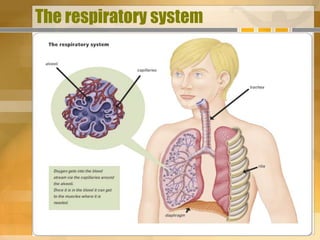
• When breathing in,
•  (inhaling)
• the intercostal muscles
• (the muscles between the ribs)
• contract and lift the chest upwards and outwards
• while the diaphragm tightens and lowers.
• (a sheet of muscle which separates the chest
  region from the rest of the body cavity)
• These actions open the lungs and create a vacuum
  inside so that air (with oxygen) can
• rush in through the nose and mouth, where it is
  warmed, moistened and filtered.
So did you get it in the right order?
• The air passes through the Trachea
• (the tube that takes air into the chest)
• and into one of the two bronchi into the left or right
  lung.
• After passing through the many bronchioles
  (smaller tubes) it arrives into
• some of the millions of tiny sacs called alveoli
  which are surrounded by
• capillaries (very narrow tubes) that carry blood.
So did you get it in the right order?
• Here oxygen, in the alveoli, passes into the blood
  so it
• can be transported around the body.
• At the same time waste rich blood releases it’s
• carbon dioxide into the alveoli.
• It takes the opposite journey out of the body;
• exhaled air contains and increased amount of
  carbon dioxide.
• The whole process is called
• gaseous exchange.
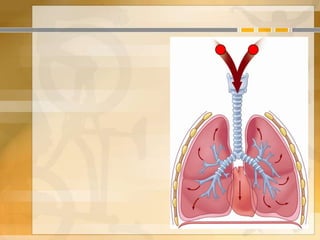
The respiratory system
The respiratory system…


      Respiratory System
So what do we breath in?
  Argon                                  Oxygen
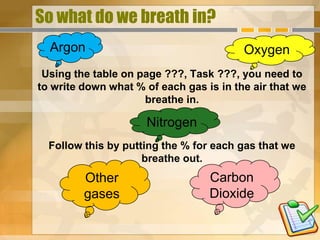
 Using the table on page ???, Task ???, you need to
to write down what % of each gas is in the air that we
                     breathe in.

                     Nitrogen
  Follow this by putting the % for each gas that we
                     breathe out.
         Other                    Carbon
         gases                    Dioxide
So what do we breath in?
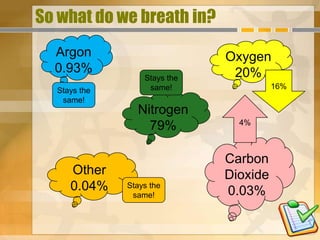
  Argon                       Oxygen
  0.93%                        20%
                  Stays the
                   same!                16%
  Stays the
   same!
                Nitrogen
                                4%
                  79%

                              Carbon
     Other                    Dioxide
     0.04%    Stays the
                              0.03%
               same!
Tidal Volume
‘is the amount of air inspired and expired with
each normal breath at rest or during exercise’
            How do we measure it?

 Practical – lets see how we measure it using a
                    Spirometer
                      Task 2
Vital Capacity
  ‘is the greatest amount of air that can be
made to pass into and out of the lungs by the
  most forceful inspiration and expiration’
            How do we measure it?

 Practical – lets see how we measure it using a
                 Peak Flow meter
                      Task 2
Today’s learning objectives:
By the end of this lesson you should be able to:

  Explain and understand how the respiratory
                system works

          Understand tidal volume

          Understand vital capacity
Homework
Complete the following:

• Any missing notes from the lesson.
• Hwk 1 Page 2
• Hwk 2 Page 3
1.2.3 Lesson 1 - The respiratory system

1.2.3 Lesson 1 - The respiratory system

  • 1.
    GCSE PE Unit 1.2.3The respiratory system
  • 2.
    Start as wemean to go on..... Can you name the 4 factors that may have an effect on the cardiovascular system and increase the risk of heart disease? 1. High Cholesterol 2. Recreational drugs 3. Sedentary lifestyle 4. Stress
  • 3.
    Today’s learning objectives: Bythe end of this lesson you should be able to:  Explain and understand how the respiratory system works Understand tidal volume Understand vital capacity
  • 4.
    Starter task… • Getinto groups of 3/4. • Using the envelopes provided you need to use your own knowledge to put the statements in to the correct order. • Make sure you read each statement thoroughly and put it into a logical sequence. • Once you have finished make sure you check that it is right.
  • 5.
    So did youget it in the right order? • When breathing in, • (inhaling) • the intercostal muscles • (the muscles between the ribs) • contract and lift the chest upwards and outwards • while the diaphragm tightens and lowers. • (a sheet of muscle which separates the chest region from the rest of the body cavity) • These actions open the lungs and create a vacuum inside so that air (with oxygen) can • rush in through the nose and mouth, where it is warmed, moistened and filtered.
  • 6.
    So did youget it in the right order? • The air passes through the Trachea • (the tube that takes air into the chest) • and into one of the two bronchi into the left or right lung. • After passing through the many bronchioles (smaller tubes) it arrives into • some of the millions of tiny sacs called alveoli which are surrounded by • capillaries (very narrow tubes) that carry blood.
  • 7.
    So did youget it in the right order? • Here oxygen, in the alveoli, passes into the blood so it • can be transported around the body. • At the same time waste rich blood releases it’s • carbon dioxide into the alveoli. • It takes the opposite journey out of the body; • exhaled air contains and increased amount of carbon dioxide. • The whole process is called • gaseous exchange.
  • 8.
  • 9.
    The respiratory system… Respiratory System
  • 10.
    So what dowe breath in? Argon Oxygen Using the table on page ???, Task ???, you need to to write down what % of each gas is in the air that we breathe in. Nitrogen Follow this by putting the % for each gas that we breathe out. Other Carbon gases Dioxide
  • 11.
    So what dowe breath in? Argon Oxygen 0.93% 20% Stays the same! 16% Stays the same! Nitrogen 4% 79% Carbon Other Dioxide 0.04% Stays the 0.03% same!
  • 12.
    Tidal Volume ‘is theamount of air inspired and expired with each normal breath at rest or during exercise’ How do we measure it? Practical – lets see how we measure it using a Spirometer Task 2
  • 13.
    Vital Capacity ‘is the greatest amount of air that can be made to pass into and out of the lungs by the most forceful inspiration and expiration’ How do we measure it? Practical – lets see how we measure it using a Peak Flow meter Task 2
  • 14.
    Today’s learning objectives: Bythe end of this lesson you should be able to:  Explain and understand how the respiratory system works Understand tidal volume Understand vital capacity
  • 15.
    Homework Complete the following: •Any missing notes from the lesson. • Hwk 1 Page 2 • Hwk 2 Page 3