GCSE PE Different body types
Learning Objectives By the end of this lesson you should be able to: Name the 3 different body types and explain what they are Understand how to position yourself and other sports performers on the somatotype scale Explain the factors that affect your optimum weight
Somatotypes What does it mean? Bodies come in all shapes and sizes but can be grouped into 3 basic types. Endomorph Mesomorph Ectomorph
Somatotypes Task: In a group of 3 you will be assigned a somatotype. On a piece of A4 paper your need to summarise it in 10 words or less that you will need to explain to other groups. You will have 4 minutes to do this. Once completed one of your group will erect a market stand and invite punters from other groups to your stand to find out the relevant information. The remaining 2 will go out and find out about the other 2 somatotypes before returning to summarise to the rest of the group.
Endomorph A lot of body fat A lot of fat on the upper arms and thighs Wide hips and narrow shoulders Fairly slim wrists and ankles
Mesomorph Very little body fat A muscular body Broad shoulders and narrow hips A large head Strong forearms and thighs
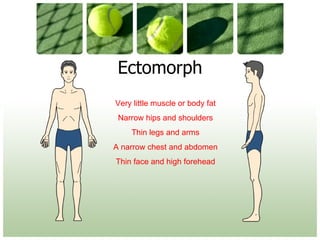
Ectomorph Very little muscle or body fat Narrow hips and shoulders Thin legs and arms A narrow chest and abdomen Thin face and high forehead
Measuring Somatotypes A score out of  7  will then be given in the following categories: Fatness –  ENDOMORPH Muscularity –  MESOMORPH Linearity (thinness) –  ECTOMORPH So a person’s somatotype might be 2: 6 :2.  For example, 2/7 for fat,  6/7 for muscle  and 2/7 for thinness.
Measuring Somatotypes Task 1 With a partner determine your somatotype
Which somatotype?
Somatotypes in Sport Certain somatotypes tend to be found in certain sports.  The  ideal somatotype  for a performer will depend on their sport or event. In some cases, the position that they play in a particular sport might  also be important. Consider, for example, the various body sizes and shapes in a rugby team.
Somatotype charts
Somatotypes in Sport Task 2 Jot down the positions from the previous slide in your booklet. Task 3 Complete task 3 on the same diagram and label clearly.
Optimum Weight What is it? Most favourable weight for your lifestyle / sport What factors affect it? Height Gender Bone Structure Muscle Girth Genetics
Learning Objectives By the end of this lesson you should be able to: Name the 3 different body types and explain what they are Understand how to position yourself and other sports performers on the somatotype scale Explain the factors that affect your optimum weight
Homework Complete the following homework tasks in your booklet: HWK’s 1 – 5 Also complete any other notes left blank in the booklet They will be marked with this picture: Lesson Summary

1.2.1 Lesson 1 - somatotypes

  • 1.
  • 2.
    Learning Objectives Bythe end of this lesson you should be able to: Name the 3 different body types and explain what they are Understand how to position yourself and other sports performers on the somatotype scale Explain the factors that affect your optimum weight
  • 3.
    Somatotypes What doesit mean? Bodies come in all shapes and sizes but can be grouped into 3 basic types. Endomorph Mesomorph Ectomorph
  • 4.
    Somatotypes Task: Ina group of 3 you will be assigned a somatotype. On a piece of A4 paper your need to summarise it in 10 words or less that you will need to explain to other groups. You will have 4 minutes to do this. Once completed one of your group will erect a market stand and invite punters from other groups to your stand to find out the relevant information. The remaining 2 will go out and find out about the other 2 somatotypes before returning to summarise to the rest of the group.
  • 5.
    Endomorph A lotof body fat A lot of fat on the upper arms and thighs Wide hips and narrow shoulders Fairly slim wrists and ankles
  • 6.
    Mesomorph Very littlebody fat A muscular body Broad shoulders and narrow hips A large head Strong forearms and thighs
  • 7.
    Ectomorph Very littlemuscle or body fat Narrow hips and shoulders Thin legs and arms A narrow chest and abdomen Thin face and high forehead
  • 8.
    Measuring Somatotypes Ascore out of 7 will then be given in the following categories: Fatness – ENDOMORPH Muscularity – MESOMORPH Linearity (thinness) – ECTOMORPH So a person’s somatotype might be 2: 6 :2. For example, 2/7 for fat, 6/7 for muscle and 2/7 for thinness.
  • 9.
    Measuring Somatotypes Task1 With a partner determine your somatotype
  • 10.
  • 11.
    Somatotypes in SportCertain somatotypes tend to be found in certain sports. The ideal somatotype for a performer will depend on their sport or event. In some cases, the position that they play in a particular sport might also be important. Consider, for example, the various body sizes and shapes in a rugby team.
  • 12.
  • 13.
    Somatotypes in SportTask 2 Jot down the positions from the previous slide in your booklet. Task 3 Complete task 3 on the same diagram and label clearly.
  • 14.
    Optimum Weight Whatis it? Most favourable weight for your lifestyle / sport What factors affect it? Height Gender Bone Structure Muscle Girth Genetics
  • 15.
    Learning Objectives Bythe end of this lesson you should be able to: Name the 3 different body types and explain what they are Understand how to position yourself and other sports performers on the somatotype scale Explain the factors that affect your optimum weight
  • 16.
    Homework Complete thefollowing homework tasks in your booklet: HWK’s 1 – 5 Also complete any other notes left blank in the booklet They will be marked with this picture: Lesson Summary