PERFORMANCE BASED SEISMIC
ANALYSIS OF RC BUILDINGS
1
Contents
1. Introduction
2. Methods of analysis
2
Introduction
Performance-based Design
➢The basic concept of performance based seismic design is to
provide engineers with the capability to design buildings that have
a predictable and reliable performance in earthquakes.
➢Thus the Performance-based seismic design is a process that
permits design of new buildings or upgrade of existing buildings
with a realistic understanding of the risk of life, occupancy and
economic loss that may occur as a result of future earthquakes.
3
Introduction
Performance-based Design
➢Performance-based design begins with the selection of design
criteria stated in the form of one or more performance
objectives. Each performance objective is a statement of the
acceptable risk of incurring specific levels of damage, and the
consequential losses that occur as a result of this damage, at a
specified level of seismic hazard.
4
Performance Objectives
➢Fully Operational,
➢Operational
➢Immediate-occupancy,
➢life-safety and
➢collapse-prevention
5
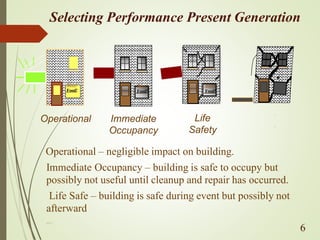
Selecting Performance Present Generation
Beer!
Food!
Operational
B
Be
e
e
e
r
r!
!
Foo
od!
!
B
Be
e
e
e
r
r!
!
Foo
od!
!
Beer!
Food!
Joe’s
Immediate
Occupancy
B
Be
e
e
e
r
r!
!
F
Foo
od!
!
B
Be
e
e
e
r
r!
!
F o
Fo
o
d!
!
Beer!
Food!
Life
Safety
Collapse
6
Prevention
Operational – negligible impact on building.
Immediate Occupancy – building is safe to occupy but
possibly not useful until cleanup and repair has occurred.
Life Safe – building is safe during event but possibly not
afterward
Co
llapsePrevention–buildingis onvergeof
collapse
, probableto
tal loss
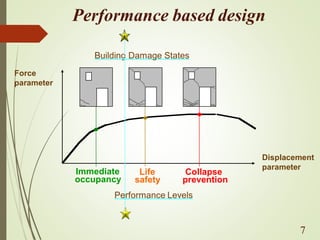
Performance based design
Immediate
occupancy
Life
safety
Collapse
prevention
Displacement
parameter
Building Damage States
Force
parameter
Performance Levels
7
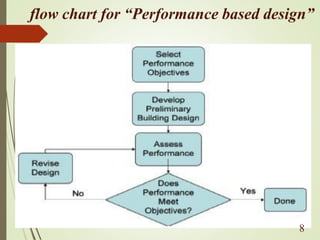
flow chart for “Performance based design”
8
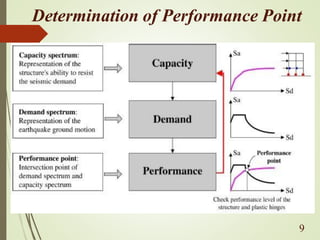
Determination of Performance Point
9
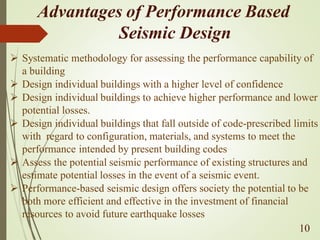
Advantages of Performance Based
Seismic Design
➢ Systematic methodology for assessing the performance capability of
a building
➢ Design individual buildings with a higher level of confidence
➢ Design individual buildings to achieve higher performance and lower
potential losses.
➢ Design individual buildings that fall outside of code-prescribed limits
with regard to configuration, materials, and systems to meet the
performance intended by present building codes
➢ Assess the potential seismic performance of existing structures and
estimate potential losses in the event of a seismic event.
➢ Performance-based seismic design offers society the potential to be
both more efficient and effective in the investment of financial
resources to avoid future earthquake losses
10
11
Differences between traditional approach
and performance based approach
1) Conventional limit-states design is typically a two-level design
approach having concern for the service operational and ultimate-
strength limit states for a building, performance- based design can
be viewed as a multi-level design approach that additionally has
explicit concern for the performance of a building at intermediate
limit states related to such issues as occupancy and life-safety
standards.
2) The performance based analysis is based on quantifying the
deformation of the members and the building as a whole, under the
lateral forces of an earthquake of a certain level of seismic hazard.
Traditional Approach-Force based Design has no measure of the
deformation capability of members or of building
.
3) The deformation or strains are better quantities to assess damage
than stress or forces. Since the deformation are expected to go
beyond the elastic values.
4) The performance based analysis gives the analyst more choice
of ‘performance’ of the building as compared to the limit states
of collapse and serviceability in a design based on limit state
method.
5)Traditional based design uses Elastic behavior where as
Performance based design uses inelastic behavior
12
Methods of analysis
13
Methods of analysis
Generally for analyzing the structure the following analysis
methods are used depending upon the requirements.
1) Linear static procedure
2) Linear dynamic procedure
3) Nonlinear static procedure
1. Pushover analysis
2. Capacity spectrum method
4) Nonlinear dynamic procedure
1. Time history Analysis
Push-overandTimeHistoryanalysestoolstoperformnon-linearanalysis
areconsidered.
14
➢pushover analysis is the one which is suitable for the
performance based seismic design, because elastic analyses are
insufficient, therefore they cannot realistically predict the force
and deformation distributions after the initiation of damage in
the building.
➢Inelastic analytical procedures become necessary to
identify the modes of failure and the potential for
progressive collapse.
➢Inelastic time-history analysis are most realistic analytical
approach for evaluating the performance of a building.
However, the inelastic time-history analysis is usually too
complex and time- consuming in the design of most
buildings.
15
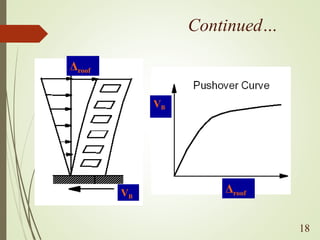
What is Push-Over Analysis?
➢ Push-overanalysisis atechniquebywhichacomputermodelof the buildingis
subjectedtoalateralloadofacertainshape(i.e.,parabolic, invertedtriangularor
uniform).
➢ Buildingispushedinonehorizontaldirection.Theintensityofthelateral loadis
slowly increased and the sequence of cracks, yielding, plastic hinge
formations,andfailureofvarious structural componentsisrecorded.
➢ Proportion of applied force on each floor is constant , only its magnitude is
increased gradually (i.e., Load pattern may be 1st mode shape, parabolic,
uniform,invertedtriangular etc.).
➢ Materialnonlinearityismodeledbyinsertingplastichingeatpotentiallocation.
16
Continued…
➢ Aseriesofiterationsareusuallyrequiredduringwhich,thestructural deficiencies
observedinoneiteration,arerectifiedandfollowedby another.
➢ This iterative analysis and design process continues until the design satisfies a
pre-established performancecriteria.
➢ The performance criteria for push-over analysis is generally established as the
desiredstateofthebuildinggivenaroof-toporspectral displacementamplitude.
➢ Pushoveranalysis requires a large number of assumptions and
member response curves are to be provided to the program before it can
analyze.
. 17
VB
Δroof
Δroof
VB
Continued…
18
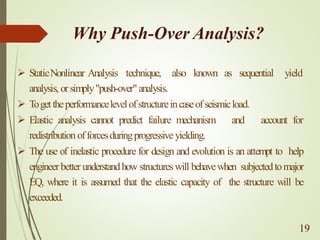
Why Push-Over Analysis?
➢ StaticNonlinear Analysis technique, also known as sequential yield
analysis, orsimply"push-over"analysis.
➢ Togettheperformancelevelofstructureincaseofseismicload.
➢ Elastic analysis cannot predict failure mechanism and account for
redistributionofforcesduringprogressive yielding.
➢ The use of inelastic procedure for design and evolution is an attempt to help
engineerbetterunderstandhow structureswill behavewhen subjectedtomajor
EQ, where it is assumed that the elastic capacity of the structure will be
exceeded.
19
What is Time History Analysis?
➢ Time History analysis is a step by step analysis of the dynamical response of a
structureto a specified loading thatmayvarywithtime.
➢ Theperformanceanalysismaybe
1. Linear
2. Non-linear
20
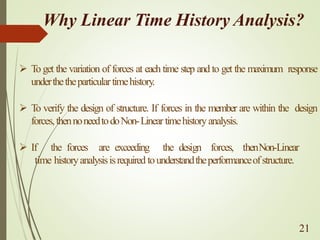
Why Linear Time History Analysis?
➢ To get the variation of forces at each time step and to get the maximum response
underthetheparticulartimehistory.
➢ To verify the design of structure. If forces in the member are within the design
forces,thennoneedtodoNon-Linear timehistoryanalysis.
➢ If the forces are exceeding the design forces, thenNon-Linear
time historyanalysisisrequired tounderstandtheperformanceofstructure.
21
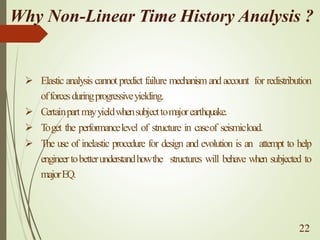
Why Non-Linear Time History Analysis ?
➢ Elastic analysis cannot predict failure mechanism andaccount for redistribution
offorcesduringprogressiveyielding.
➢ Certainpartmayyieldwhensubjecttomajorearthquake.
➢ T
oget the performancelevel of structure in caseof seismicload.
➢ The use of inelastic procedure for design and evolution is an attempt to help
engineertobetterunderstandhowthe structures will behave when subjected to
majorEQ.
22
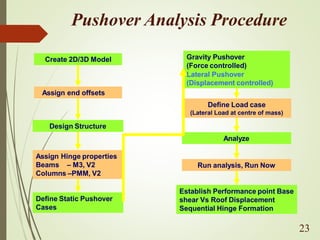
Pushover Analysis Procedure
Create 2D/3D Model
Assign end offsets
Design Structure
Assign Hinge properties
Beams – M3, V2
Columns –PMM, V2
Define Static Pushover
Cases
Gravity Pushover
(Force controlled)
Lateral Pushover
(Displacement controlled)
Define Load case
(Lateral Load at centre of mass)
Analyze
Run analysis, Run Now
Establish Performance point Base
shear Vs Roof Displacement
Sequential Hinge Formation
23
26
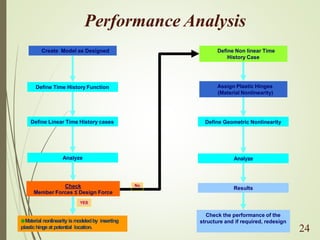
Performance Analysis
Create Model as Designed
Define Time History Function
Define Linear Time History cases
Analyze
Check
Member Forces ≤ Design Force
Define Non linear Time
History Case
Assign Plastic Hinges
(Material Nonlinearity)
Define Geometric Nonlinearity
Analyze
Results
Check the performance of the
structure and if required, redesign
YES
No
●Material nonlinearity ismodeledby inserting
plastichingeat potential location.
24
Thank you

PERFORMANCE BASED DESIGN structural analysis and design

  • 1.
  • 2.
  • 3.
    Introduction Performance-based Design ➢The basicconcept of performance based seismic design is to provide engineers with the capability to design buildings that have a predictable and reliable performance in earthquakes. ➢Thus the Performance-based seismic design is a process that permits design of new buildings or upgrade of existing buildings with a realistic understanding of the risk of life, occupancy and economic loss that may occur as a result of future earthquakes. 3
  • 4.
    Introduction Performance-based Design ➢Performance-based designbegins with the selection of design criteria stated in the form of one or more performance objectives. Each performance objective is a statement of the acceptable risk of incurring specific levels of damage, and the consequential losses that occur as a result of this damage, at a specified level of seismic hazard. 4
  • 5.
  • 6.
    Selecting Performance PresentGeneration Beer! Food! Operational B Be e e e r r! ! Foo od! ! B Be e e e r r! ! Foo od! ! Beer! Food! Joe’s Immediate Occupancy B Be e e e r r! ! F Foo od! ! B Be e e e r r! ! F o Fo o d! ! Beer! Food! Life Safety Collapse 6 Prevention Operational – negligible impact on building. Immediate Occupancy – building is safe to occupy but possibly not useful until cleanup and repair has occurred. Life Safe – building is safe during event but possibly not afterward Co llapsePrevention–buildingis onvergeof collapse , probableto tal loss
  • 7.
  • 8.
    flow chart for“Performance based design” 8
  • 9.
  • 10.
    Advantages of PerformanceBased Seismic Design ➢ Systematic methodology for assessing the performance capability of a building ➢ Design individual buildings with a higher level of confidence ➢ Design individual buildings to achieve higher performance and lower potential losses. ➢ Design individual buildings that fall outside of code-prescribed limits with regard to configuration, materials, and systems to meet the performance intended by present building codes ➢ Assess the potential seismic performance of existing structures and estimate potential losses in the event of a seismic event. ➢ Performance-based seismic design offers society the potential to be both more efficient and effective in the investment of financial resources to avoid future earthquake losses 10
  • 11.
    11 Differences between traditionalapproach and performance based approach 1) Conventional limit-states design is typically a two-level design approach having concern for the service operational and ultimate- strength limit states for a building, performance- based design can be viewed as a multi-level design approach that additionally has explicit concern for the performance of a building at intermediate limit states related to such issues as occupancy and life-safety standards. 2) The performance based analysis is based on quantifying the deformation of the members and the building as a whole, under the lateral forces of an earthquake of a certain level of seismic hazard. Traditional Approach-Force based Design has no measure of the deformation capability of members or of building .
  • 12.
    3) The deformationor strains are better quantities to assess damage than stress or forces. Since the deformation are expected to go beyond the elastic values. 4) The performance based analysis gives the analyst more choice of ‘performance’ of the building as compared to the limit states of collapse and serviceability in a design based on limit state method. 5)Traditional based design uses Elastic behavior where as Performance based design uses inelastic behavior 12
  • 13.
  • 14.
    Methods of analysis Generallyfor analyzing the structure the following analysis methods are used depending upon the requirements. 1) Linear static procedure 2) Linear dynamic procedure 3) Nonlinear static procedure 1. Pushover analysis 2. Capacity spectrum method 4) Nonlinear dynamic procedure 1. Time history Analysis Push-overandTimeHistoryanalysestoolstoperformnon-linearanalysis areconsidered. 14
  • 15.
    ➢pushover analysis isthe one which is suitable for the performance based seismic design, because elastic analyses are insufficient, therefore they cannot realistically predict the force and deformation distributions after the initiation of damage in the building. ➢Inelastic analytical procedures become necessary to identify the modes of failure and the potential for progressive collapse. ➢Inelastic time-history analysis are most realistic analytical approach for evaluating the performance of a building. However, the inelastic time-history analysis is usually too complex and time- consuming in the design of most buildings. 15
  • 16.
    What is Push-OverAnalysis? ➢ Push-overanalysisis atechniquebywhichacomputermodelof the buildingis subjectedtoalateralloadofacertainshape(i.e.,parabolic, invertedtriangularor uniform). ➢ Buildingispushedinonehorizontaldirection.Theintensityofthelateral loadis slowly increased and the sequence of cracks, yielding, plastic hinge formations,andfailureofvarious structural componentsisrecorded. ➢ Proportion of applied force on each floor is constant , only its magnitude is increased gradually (i.e., Load pattern may be 1st mode shape, parabolic, uniform,invertedtriangular etc.). ➢ Materialnonlinearityismodeledbyinsertingplastichingeatpotentiallocation. 16
  • 17.
    Continued… ➢ Aseriesofiterationsareusuallyrequiredduringwhich,thestructural deficiencies observedinoneiteration,arerectifiedandfollowedbyanother. ➢ This iterative analysis and design process continues until the design satisfies a pre-established performancecriteria. ➢ The performance criteria for push-over analysis is generally established as the desiredstateofthebuildinggivenaroof-toporspectral displacementamplitude. ➢ Pushoveranalysis requires a large number of assumptions and member response curves are to be provided to the program before it can analyze. . 17
  • 18.
  • 19.
    Why Push-Over Analysis? ➢StaticNonlinear Analysis technique, also known as sequential yield analysis, orsimply"push-over"analysis. ➢ Togettheperformancelevelofstructureincaseofseismicload. ➢ Elastic analysis cannot predict failure mechanism and account for redistributionofforcesduringprogressive yielding. ➢ The use of inelastic procedure for design and evolution is an attempt to help engineerbetterunderstandhow structureswill behavewhen subjectedtomajor EQ, where it is assumed that the elastic capacity of the structure will be exceeded. 19
  • 20.
    What is TimeHistory Analysis? ➢ Time History analysis is a step by step analysis of the dynamical response of a structureto a specified loading thatmayvarywithtime. ➢ Theperformanceanalysismaybe 1. Linear 2. Non-linear 20
  • 21.
    Why Linear TimeHistory Analysis? ➢ To get the variation of forces at each time step and to get the maximum response underthetheparticulartimehistory. ➢ To verify the design of structure. If forces in the member are within the design forces,thennoneedtodoNon-Linear timehistoryanalysis. ➢ If the forces are exceeding the design forces, thenNon-Linear time historyanalysisisrequired tounderstandtheperformanceofstructure. 21
  • 22.
    Why Non-Linear TimeHistory Analysis ? ➢ Elastic analysis cannot predict failure mechanism andaccount for redistribution offorcesduringprogressiveyielding. ➢ Certainpartmayyieldwhensubjecttomajorearthquake. ➢ T oget the performancelevel of structure in caseof seismicload. ➢ The use of inelastic procedure for design and evolution is an attempt to help engineertobetterunderstandhowthe structures will behave when subjected to majorEQ. 22
  • 23.
    Pushover Analysis Procedure Create2D/3D Model Assign end offsets Design Structure Assign Hinge properties Beams – M3, V2 Columns –PMM, V2 Define Static Pushover Cases Gravity Pushover (Force controlled) Lateral Pushover (Displacement controlled) Define Load case (Lateral Load at centre of mass) Analyze Run analysis, Run Now Establish Performance point Base shear Vs Roof Displacement Sequential Hinge Formation 23
  • 24.
    26 Performance Analysis Create Modelas Designed Define Time History Function Define Linear Time History cases Analyze Check Member Forces ≤ Design Force Define Non linear Time History Case Assign Plastic Hinges (Material Nonlinearity) Define Geometric Nonlinearity Analyze Results Check the performance of the structure and if required, redesign YES No ●Material nonlinearity ismodeledby inserting plastichingeat potential location. 24
  • 25.