System characteristics 
Circular Economy in the Cloud
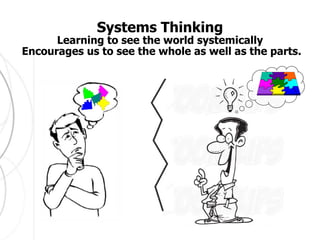
Systems Thinking 
Learning to see the world systemically 
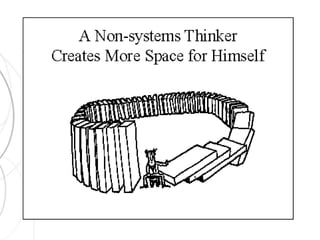
Encourages us to see the whole as well as the parts.
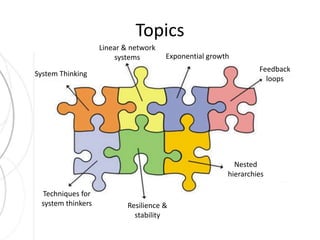
Topics 
System Thinking 
Linear & network 
systems 
Feedback 
loops 
Exponential growth 
Nested 
hierarchies 
Resilience & 
stability 
Techniques for 
system thinkers
System Thinking
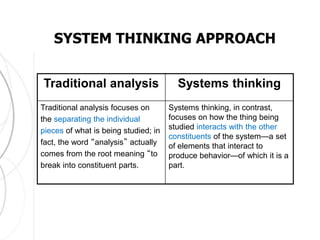
SYSTEM THINKING APPROACH 
Traditional analysis Systems thinking 
Traditional analysis focuses on 
the separating the individual 
pieces of what is being studied; in 
fact, the word “analysis” actually 
comes from the root meaning “to 
break into constituent parts. 
Systems thinking, in contrast, 
focuses on how the thing being 
studied interacts with the other 
constituents of the system—a set 
of elements that interact to 
produce behavior—of which it is a 
part.
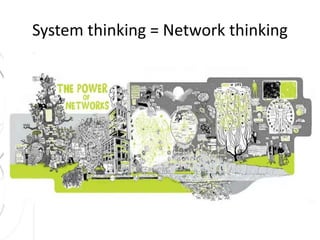
System thinking = Network thinking
Linear & Network Systems
Linear systems: linear causality 
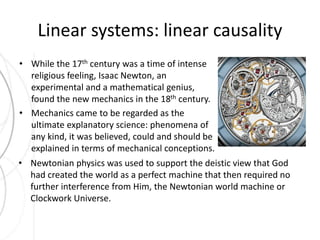
• While the 17th century was a time of intense 
religious feeling, Isaac Newton, an 
experimental and a mathematical genius, 
found the new mechanics in the 18th century. 
• Mechanics came to be regarded as the 
ultimate explanatory science: phenomena of 
any kind, it was believed, could and should be 
explained in terms of mechanical conceptions. 
• Newtonian physics was used to support the deistic view that God 
had created the world as a perfect machine that then required no 
further interference from Him, the Newtonian world machine or 
Clockwork Universe.
Simple cause-effect relationships 
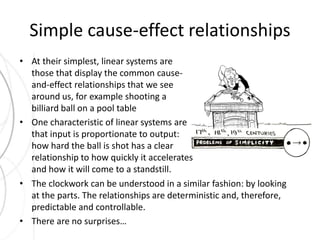
• At their simplest, linear systems are 
those that display the common cause-and- 
effect relationships that we see 
around us, for example shooting a 
billiard ball on a pool table 
• One characteristic of linear systems are 
that input is proportionate to output: 
how hard the ball is shot has a clear 
relationship to how quickly it accelerates 
and how it will come to a standstill. 
• The clockwork can be understood in a similar fashion: by looking 
at the parts. The relationships are deterministic and, therefore, 
predictable and controllable. 
• There are no surprises…
‘Boxed thinking’ 1/2 
Stephen Sterling described it as ‘boxed thinking’ as opposed to more 
connective or systems thinking. Here are five assumptions of boxed-thinking: 
1. ‘To every problem, there’s a solution’ belief in the power of problem-solving 
approaches 
2. ‘We can understand something by breaking it down into its component 
parts’ understanding a complex whole by looking at the detail 
3. ‘The whole (of something) is no more than the sum of its parts’ there are 
no emergent properties 
4. ‘Most processes are linear’ events and phenomena have a definable 
beginning and finishing point 
5. ‘Most issues and events are fundamentally separate or may be regarded 
as such, and may be dealt with adequately in a segregated way’ issues 
are essentially unrelated
‘Boxed thinking’ 2/2 
6. ‘It is acceptable to draw your circle of attention or concern quite tightly, 
as in ‘that’s not my concern’ we do not need to look beyond our 
immediate concerns as an individual, a householder, a consumer, a 
businessman, etc. 
7. ‘We can define or value something by distinguishing it from what it is not, 
or from its opposite’ a belief that economics is separate from ecology, 
people are separate from nature, facts are separate from values, etc 
8. ‘Objectivity is both possible and necessary to understand issues’ it is 
important to exclude our feelings and values in our analysis and 
judgment 
9. ‘We can understand things best through a rational response. Any other 
approach is irrational’ we need to downplay our intuition and non-rational 
knowing 
10. ‘If we know what the state of something is now, we can usually predict 
future outcomes’ a belief in certainty, prediction, and the possibility of 
control
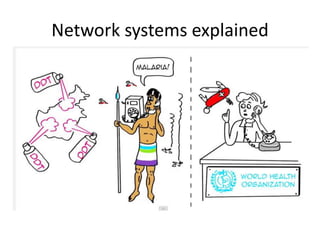
Network systems explained
Network systems: network causality 
• Opposite to the clock metaphor of linear system, network 
systems are more complex in their behavior 
• Links between the components can change the state of the 
system (enhance or diminish the stability) 
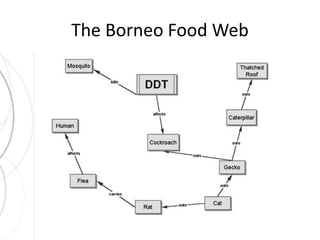
• Like in the video, unforeseen effect occured on Borneo after 
spraying the DDT 
• While a linear cause-effect relations was assumed (DDT would 
kill the musquitoes and thereby decrease malaria – problem 
solved)... 
• ... it had severe side-effects that caused other problems (a 
typical example of #5 in ‘Boxed Thinking’)
The Borneo Food Web
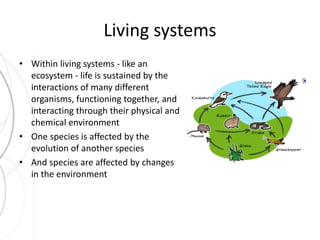
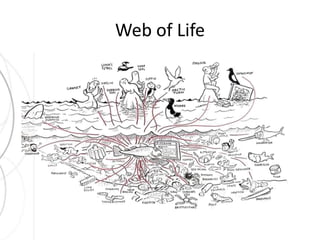
Living systems 
• Within living systems - like an 
ecosystem - life is sustained by the 
interactions of many different 
organisms, functioning together, and 
interacting through their physical and 
chemical environment 
• One species is affected by the 
evolution of another species 
• And species are affected by changes 
in the environment
Web of Life
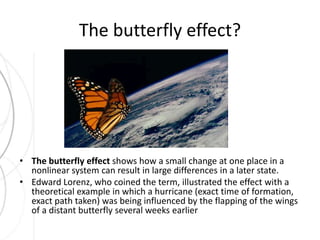
The butterfly effect? 
• The butterfly effect shows how a small change at one place in a 
nonlinear system can result in large differences in a later state. 
• Edward Lorenz, who coined the term, illustrated the effect with a 
theoretical example in which a hurricane (exact time of formation, 
exact path taken) was being influenced by the flapping of the wings 
of a distant butterfly several weeks earlier
Exponential Growth
Rani’s Tale 
“A long time ago in India a raja demands that his villagers turn over almost all their 
rice for safe storage, leaving them just enough to get by on. When a year of drought 
arrives, famine and hunger ensue and his people beg him to release some of the rice 
from the royal store but he refuses. As his people become more and more famished, 
the Raja decides to have a feast at his court. As a parade of elephants returns from the 
royal storehouses loaded down with sacks of rice, Rani, a clever village girl, walks 
behind them, collecting falling rice in her skirt. When she is caught she explains that 
she is collecting the rice to return to the Raja. 
The Raja, striving to be wise and fair, decides to reward her for returning his rice. He 
tells Rani: “Ask me for anything and you shall have it.” To the Raja’s surprise, Rani asks 
for just one grain of rice. When the Raja says that is not enough of a reward, she 
acquiesces and asks that he give her one grain of rice on the first day, then each day, 
for the following 30 days, he is to give her double the rice he gave her the day before. 
The Raja considers this to be a modest request and readily agrees. By the end of the 
30 days, Rani has more than a billion grains of rice and the Raja has no more to give. 
The Raja, having learned an important lesson both about math and about fairness, 
promises to only take as much rice as he needs from now on.”
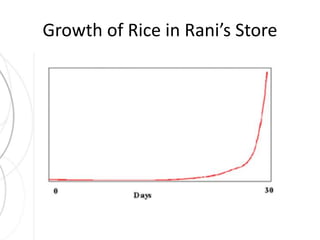
Growth of Rice in Rani’s Store
Reinforcing feedback 
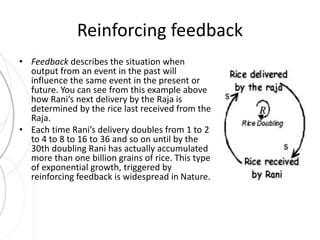
• Feedback describes the situation when 
output from an event in the past will 
influence the same event in the present or 
future. You can see from this example above 
how Rani’s next delivery by the Raja is 
determined by the rice last received from the 
Raja. 
• Each time Rani’s delivery doubles from 1 to 2 
to 4 to 8 to 16 to 36 and so on until by the 
30th doubling Rani has actually accumulated 
more than one billion grains of rice. This type 
of exponential growth, triggered by 
reinforcing feedback is widespread in Nature.
Exponential growth
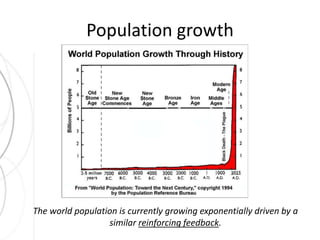
Population growth 
The world population is currently growing exponentially driven by a 
similar reinforcing feedback.
Options for sustained growth 
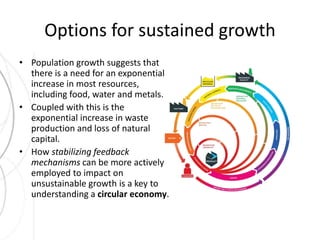
• Population growth suggests that 
there is a need for an exponential 
increase in most resources, 
including food, water and metals. 
• Coupled with this is the 
exponential increase in waste 
production and loss of natural 
capital. 
• How stabilizing feedback 
mechanisms can be more actively 
employed to impact on 
unsustainable growth is a key to 
understanding a circular economy.
Feedback Loops
Feedback loops 
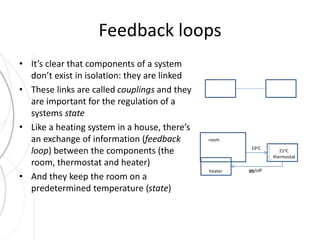
• It’s clear that components of a system 
don’t exist in isolation: they are linked 
• These links are called couplings and they 
are important for the regulation of a 
systems state 
• Like a heating system in a house, there’s 
an exchange of information (feedback 
loop) between the components (the 
room, thermostat and heater) 
• And they keep the room on a 
predetermined temperature (state) 
room 
heater 
21oC 
thermostat 
19oC 
on/off
Example simple heating system 
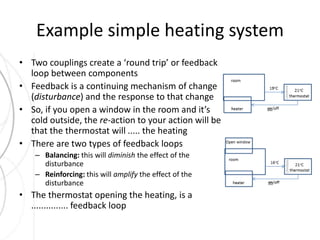
• Two couplings create a ‘round trip’ or feedback 
loop between components 
• Feedback is a continuing mechanism of change 
(disturbance) and the response to that change 
• So, if you open a window in the room and it’s 
cold outside, the re-action to your action will be 
that the thermostat will ..... the heating 
• There are two types of feedback loops 
– Balancing: this will diminish the effect of the 
disturbance 
– Reinforcing: this will amplify the effect of the 
disturbance 
• The thermostat opening the heating, is a 
............... feedback loop
Types of feedback loops 
Reinforcing and balancing loops are the building blocks of complex systems 
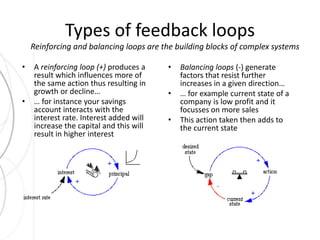
• A reinforcing loop (+) produces a 
result which influences more of 
the same action thus resulting in 
growth or decline… 
• … for instance your savings 
account interacts with the 
interest rate. Interest added will 
increase the capital and this will 
result in higher interest 
• Balancing loops (-) generate 
factors that resist further 
increases in a given direction… 
• … for example current state of a 
company is low profit and it 
focusses on more sales 
• This action taken then adds to 
the current state
Example: DDT sprayed on Borneo 
• Here we saw that the issue was regarded in a 
separate way without any prior attention for the 
interrelated context 
• The problem (malaria) was solved by spraying 
DDT (quick fix), with immediate positive effect. 
Nonetheless, the ‘side effects’ of this solution 
turned out in the future. 
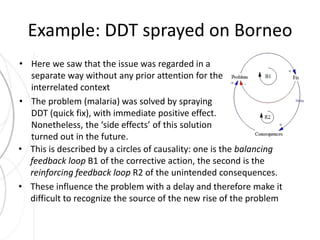
• This is described by a circles of causality: one is the balancing 
feedback loop B1 of the corrective action, the second is the 
reinforcing feedback loop R2 of the unintended consequences. 
• These influence the problem with a delay and therefore make it 
difficult to recognize the source of the new rise of the problem
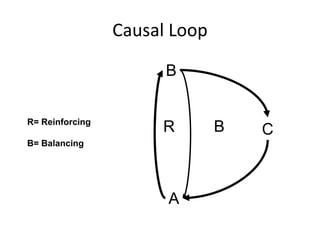
Causal Loop 
R= Reinforcing 
B= Balancing 
B 
R B C 
A
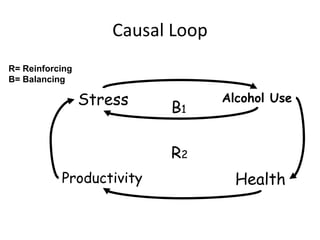
Causal Loop 
R= Reinforcing 
B= Balancing 
Stress 
B1 
R2 
Alcohol Use 
Productivity Health
Nested Hierarchies
Nested hierarchies 
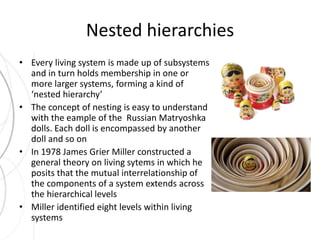
• Every living system is made up of subsystems 
and in turn holds membership in one or 
more larger systems, forming a kind of 
‘nested hierarchy’ 
• The concept of nesting is easy to understand 
with the eample of the Russian Matryoshka 
dolls. Each doll is encompassed by another 
doll and so on 
• In 1978 James Grier Miller constructed a 
general theory on living sytems in which he 
posits that the mutual interrelationship of 
the components of a system extends across 
the hierarchical levels 
• Miller identified eight levels within living 
systems
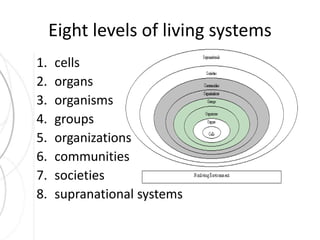
Eight levels of living systems 
1. cells 
2. organs 
3. organisms 
4. groups 
5. organizations 
6. communities 
7. societies 
8. supranational systems
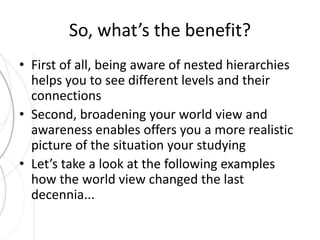
So, what’s the benefit? 
• First of all, being aware of nested hierarchies 
helps you to see different levels and their 
connections 
• Second, broadening your world view and 
awareness enables offers you a more realistic 
picture of the situation your studying 
• Let’s take a look at the following examples 
how the world view changed the last 
decennia...
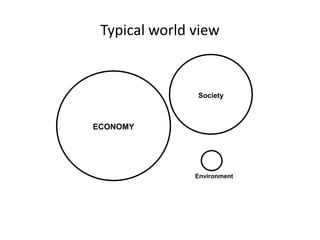
Typical world view 
ECONOMY 
Society 
Environment
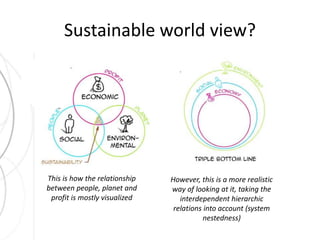
Sustainable world view? 
This is how the relationship 
between people, planet and 
profit is mostly visualized 
However, this is a more realistic 
way of looking at it, taking the 
interdependent hierarchic 
relations into account (system 
nestedness)
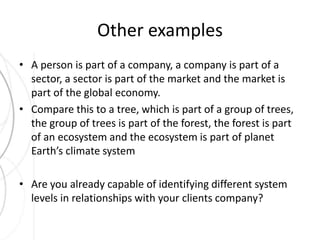
Other examples 
• A person is part of a company, a company is part of a 
sector, a sector is part of the market and the market is 
part of the global economy. 
• Compare this to a tree, which is part of a group of trees, 
the group of trees is part of the forest, the forest is part 
of an ecosystem and the ecosystem is part of planet 
Earth’s climate system 
• Are you already capable of identifying different system 
levels in relationships with your clients company?
Resilience & Stability
Resilience 
• Resilience is a characteristic of natural systems: its the capacity of 
an (eco)system to tolerate disturbances without collapsing into a 
different state 
• Diversity is a key issue in maintaining and restoring resilience 
• In an evolutionary sense, for instance, a higher diversity of species 
increases the resilience of a food chain/web 
• If resilience is low or weakened, then smaller or briefer 
disturbances can push the (eco)system into a different state, where 
its dynamics change 
• Differentiation is also a strategy used by companies to adapt to a 
moving environment
Business relevance: case-study 
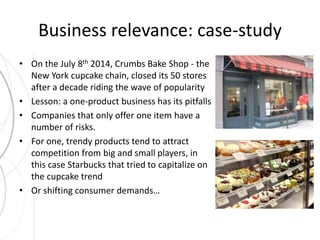
• On the July 8th 2014, Crumbs Bake Shop - the 
New York cupcake chain, closed its 50 stores 
after a decade riding the wave of popularity 
• Lesson: a one-product business has its pitfalls 
• Companies that only offer one item have a 
number of risks. 
• For one, trendy products tend to attract 
competition from big and small players, in 
this case Starbucks that tried to capitalize on 
the cupcake trend 
• Or shifting consumer demands…
Differentiation & Innovation 
• In general, sticking to one business line can be risky, especially in an 
fast-changing industry 
• At market level, differentiation is the way through which the quality 
of goods is improved over time thanks to innovation 
• Launching new goods with entirely new performances is a radical 
innovation, often leading to changes in market shares and industry 
structures 
• In an evolutionary sense, differentiation is a strategy to adapt to a 
moving environment 
• Differentiation is stimulated in Nature by evolution and natural 
selection, thus increasing resilience 
• The same is true for businesses: innovation and differentiation are 
crucial to stay alive in a moving market environment
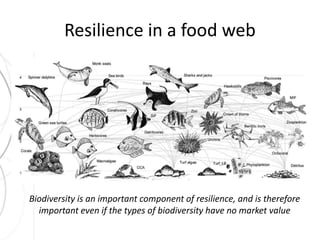
Resilience in a food web 
Biodiversity is an important component of resilience, and is therefore 
important even if the types of biodiversity have no market value
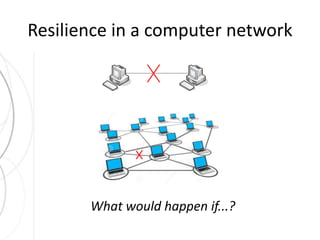
Resilience in a computer network 
What would happen if...?
Stability 
• Stable doesn’t mean static 
• Stability and change are interrelated 
• The human body has a dynamic 
stability, maintaining equilibrium - of 
your temperature for instance - in 
interaction with the environment 
• Stability is measured in how quickly a 
system will return to its original 
equilibrium position, like a pendulum
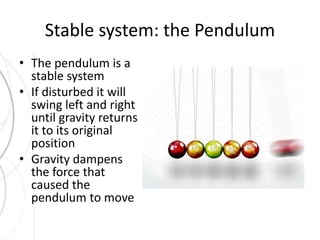
Stable system: the Pendulum 
• The pendulum is a 
stable system 
• If disturbed it will 
swing left and right 
until gravity returns 
it to its original 
position 
• Gravity dampens 
the force that 
caused the 
pendulum to move
Stability 
• Stability defines the collective states of the 
system (human being, an organization, a country, 
etc) assessed by its resistance to change 
• Fluctuations – dynamic activity – are the source of 
new forms of behavior and development 
• The context and conditions determine the 
stability of a system in time, as well as the 
properties determine its state 
• Each state is dependent on the previous state 
(incremental innovation)
Homeostasis
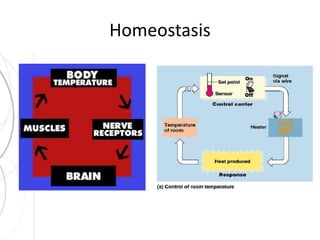
Homeostasis 
• Homeostasis is the property of a system in which variables are 
regulated so that the internal conditions remain stable and 
relatively constant. 
• It’s a process that maintains the stability of the human body’s 
internal environment in response to changes in external 
conditions 
• Example from technology: cruise control to keep a car’s speed 
stable in response to different road conditions 
(uphill/downhill) 
• Example from ecology: evolution of biodiversity (species 
population) on an island from start to climax
Techniques for System Thinkers
Techniques for system thinkers 
• Systems thinkers use visual diagrams to identify issues in relation 
with their context: 
– The Fishbone diagram 
– Process flowcharts 
– Process models 
– Correlation diagrams 
– Network diagrams 
• Visualizing issues helps to enhance understanding and to 
communicate it in a way that can be easily remembered

System characteristics

  • 1.
    System characteristics CircularEconomy in the Cloud
  • 2.
    Systems Thinking Learningto see the world systemically Encourages us to see the whole as well as the parts.
  • 3.
    Topics System Thinking Linear & network systems Feedback loops Exponential growth Nested hierarchies Resilience & stability Techniques for system thinkers
  • 4.
  • 6.
    SYSTEM THINKING APPROACH Traditional analysis Systems thinking Traditional analysis focuses on the separating the individual pieces of what is being studied; in fact, the word “analysis” actually comes from the root meaning “to break into constituent parts. Systems thinking, in contrast, focuses on how the thing being studied interacts with the other constituents of the system—a set of elements that interact to produce behavior—of which it is a part.
  • 7.
    System thinking =Network thinking
  • 8.
  • 9.
    Linear systems: linearcausality • While the 17th century was a time of intense religious feeling, Isaac Newton, an experimental and a mathematical genius, found the new mechanics in the 18th century. • Mechanics came to be regarded as the ultimate explanatory science: phenomena of any kind, it was believed, could and should be explained in terms of mechanical conceptions. • Newtonian physics was used to support the deistic view that God had created the world as a perfect machine that then required no further interference from Him, the Newtonian world machine or Clockwork Universe.
  • 10.
    Simple cause-effect relationships • At their simplest, linear systems are those that display the common cause-and- effect relationships that we see around us, for example shooting a billiard ball on a pool table • One characteristic of linear systems are that input is proportionate to output: how hard the ball is shot has a clear relationship to how quickly it accelerates and how it will come to a standstill. • The clockwork can be understood in a similar fashion: by looking at the parts. The relationships are deterministic and, therefore, predictable and controllable. • There are no surprises…
  • 11.
    ‘Boxed thinking’ 1/2 Stephen Sterling described it as ‘boxed thinking’ as opposed to more connective or systems thinking. Here are five assumptions of boxed-thinking: 1. ‘To every problem, there’s a solution’ belief in the power of problem-solving approaches 2. ‘We can understand something by breaking it down into its component parts’ understanding a complex whole by looking at the detail 3. ‘The whole (of something) is no more than the sum of its parts’ there are no emergent properties 4. ‘Most processes are linear’ events and phenomena have a definable beginning and finishing point 5. ‘Most issues and events are fundamentally separate or may be regarded as such, and may be dealt with adequately in a segregated way’ issues are essentially unrelated
  • 12.
    ‘Boxed thinking’ 2/2 6. ‘It is acceptable to draw your circle of attention or concern quite tightly, as in ‘that’s not my concern’ we do not need to look beyond our immediate concerns as an individual, a householder, a consumer, a businessman, etc. 7. ‘We can define or value something by distinguishing it from what it is not, or from its opposite’ a belief that economics is separate from ecology, people are separate from nature, facts are separate from values, etc 8. ‘Objectivity is both possible and necessary to understand issues’ it is important to exclude our feelings and values in our analysis and judgment 9. ‘We can understand things best through a rational response. Any other approach is irrational’ we need to downplay our intuition and non-rational knowing 10. ‘If we know what the state of something is now, we can usually predict future outcomes’ a belief in certainty, prediction, and the possibility of control
  • 13.
  • 14.
    Network systems: networkcausality • Opposite to the clock metaphor of linear system, network systems are more complex in their behavior • Links between the components can change the state of the system (enhance or diminish the stability) • Like in the video, unforeseen effect occured on Borneo after spraying the DDT • While a linear cause-effect relations was assumed (DDT would kill the musquitoes and thereby decrease malaria – problem solved)... • ... it had severe side-effects that caused other problems (a typical example of #5 in ‘Boxed Thinking’)
  • 15.
  • 16.
    Living systems •Within living systems - like an ecosystem - life is sustained by the interactions of many different organisms, functioning together, and interacting through their physical and chemical environment • One species is affected by the evolution of another species • And species are affected by changes in the environment
  • 17.
  • 18.
    The butterfly effect? • The butterfly effect shows how a small change at one place in a nonlinear system can result in large differences in a later state. • Edward Lorenz, who coined the term, illustrated the effect with a theoretical example in which a hurricane (exact time of formation, exact path taken) was being influenced by the flapping of the wings of a distant butterfly several weeks earlier
  • 19.
  • 20.
    Rani’s Tale “Along time ago in India a raja demands that his villagers turn over almost all their rice for safe storage, leaving them just enough to get by on. When a year of drought arrives, famine and hunger ensue and his people beg him to release some of the rice from the royal store but he refuses. As his people become more and more famished, the Raja decides to have a feast at his court. As a parade of elephants returns from the royal storehouses loaded down with sacks of rice, Rani, a clever village girl, walks behind them, collecting falling rice in her skirt. When she is caught she explains that she is collecting the rice to return to the Raja. The Raja, striving to be wise and fair, decides to reward her for returning his rice. He tells Rani: “Ask me for anything and you shall have it.” To the Raja’s surprise, Rani asks for just one grain of rice. When the Raja says that is not enough of a reward, she acquiesces and asks that he give her one grain of rice on the first day, then each day, for the following 30 days, he is to give her double the rice he gave her the day before. The Raja considers this to be a modest request and readily agrees. By the end of the 30 days, Rani has more than a billion grains of rice and the Raja has no more to give. The Raja, having learned an important lesson both about math and about fairness, promises to only take as much rice as he needs from now on.”
  • 21.
    Growth of Ricein Rani’s Store
  • 22.
    Reinforcing feedback •Feedback describes the situation when output from an event in the past will influence the same event in the present or future. You can see from this example above how Rani’s next delivery by the Raja is determined by the rice last received from the Raja. • Each time Rani’s delivery doubles from 1 to 2 to 4 to 8 to 16 to 36 and so on until by the 30th doubling Rani has actually accumulated more than one billion grains of rice. This type of exponential growth, triggered by reinforcing feedback is widespread in Nature.
  • 23.
  • 24.
    Population growth Theworld population is currently growing exponentially driven by a similar reinforcing feedback.
  • 25.
    Options for sustainedgrowth • Population growth suggests that there is a need for an exponential increase in most resources, including food, water and metals. • Coupled with this is the exponential increase in waste production and loss of natural capital. • How stabilizing feedback mechanisms can be more actively employed to impact on unsustainable growth is a key to understanding a circular economy.
  • 26.
  • 27.
    Feedback loops •It’s clear that components of a system don’t exist in isolation: they are linked • These links are called couplings and they are important for the regulation of a systems state • Like a heating system in a house, there’s an exchange of information (feedback loop) between the components (the room, thermostat and heater) • And they keep the room on a predetermined temperature (state) room heater 21oC thermostat 19oC on/off
  • 28.
    Example simple heatingsystem • Two couplings create a ‘round trip’ or feedback loop between components • Feedback is a continuing mechanism of change (disturbance) and the response to that change • So, if you open a window in the room and it’s cold outside, the re-action to your action will be that the thermostat will ..... the heating • There are two types of feedback loops – Balancing: this will diminish the effect of the disturbance – Reinforcing: this will amplify the effect of the disturbance • The thermostat opening the heating, is a ............... feedback loop
  • 29.
    Types of feedbackloops Reinforcing and balancing loops are the building blocks of complex systems • A reinforcing loop (+) produces a result which influences more of the same action thus resulting in growth or decline… • … for instance your savings account interacts with the interest rate. Interest added will increase the capital and this will result in higher interest • Balancing loops (-) generate factors that resist further increases in a given direction… • … for example current state of a company is low profit and it focusses on more sales • This action taken then adds to the current state
  • 30.
    Example: DDT sprayedon Borneo • Here we saw that the issue was regarded in a separate way without any prior attention for the interrelated context • The problem (malaria) was solved by spraying DDT (quick fix), with immediate positive effect. Nonetheless, the ‘side effects’ of this solution turned out in the future. • This is described by a circles of causality: one is the balancing feedback loop B1 of the corrective action, the second is the reinforcing feedback loop R2 of the unintended consequences. • These influence the problem with a delay and therefore make it difficult to recognize the source of the new rise of the problem
  • 31.
    Causal Loop R=Reinforcing B= Balancing B R B C A
  • 32.
    Causal Loop R=Reinforcing B= Balancing Stress B1 R2 Alcohol Use Productivity Health
  • 33.
  • 34.
    Nested hierarchies •Every living system is made up of subsystems and in turn holds membership in one or more larger systems, forming a kind of ‘nested hierarchy’ • The concept of nesting is easy to understand with the eample of the Russian Matryoshka dolls. Each doll is encompassed by another doll and so on • In 1978 James Grier Miller constructed a general theory on living sytems in which he posits that the mutual interrelationship of the components of a system extends across the hierarchical levels • Miller identified eight levels within living systems
  • 35.
    Eight levels ofliving systems 1. cells 2. organs 3. organisms 4. groups 5. organizations 6. communities 7. societies 8. supranational systems
  • 36.
    So, what’s thebenefit? • First of all, being aware of nested hierarchies helps you to see different levels and their connections • Second, broadening your world view and awareness enables offers you a more realistic picture of the situation your studying • Let’s take a look at the following examples how the world view changed the last decennia...
  • 37.
    Typical world view ECONOMY Society Environment
  • 38.
    Sustainable world view? This is how the relationship between people, planet and profit is mostly visualized However, this is a more realistic way of looking at it, taking the interdependent hierarchic relations into account (system nestedness)
  • 39.
    Other examples •A person is part of a company, a company is part of a sector, a sector is part of the market and the market is part of the global economy. • Compare this to a tree, which is part of a group of trees, the group of trees is part of the forest, the forest is part of an ecosystem and the ecosystem is part of planet Earth’s climate system • Are you already capable of identifying different system levels in relationships with your clients company?
  • 40.
  • 41.
    Resilience • Resilienceis a characteristic of natural systems: its the capacity of an (eco)system to tolerate disturbances without collapsing into a different state • Diversity is a key issue in maintaining and restoring resilience • In an evolutionary sense, for instance, a higher diversity of species increases the resilience of a food chain/web • If resilience is low or weakened, then smaller or briefer disturbances can push the (eco)system into a different state, where its dynamics change • Differentiation is also a strategy used by companies to adapt to a moving environment
  • 42.
    Business relevance: case-study • On the July 8th 2014, Crumbs Bake Shop - the New York cupcake chain, closed its 50 stores after a decade riding the wave of popularity • Lesson: a one-product business has its pitfalls • Companies that only offer one item have a number of risks. • For one, trendy products tend to attract competition from big and small players, in this case Starbucks that tried to capitalize on the cupcake trend • Or shifting consumer demands…
  • 43.
    Differentiation & Innovation • In general, sticking to one business line can be risky, especially in an fast-changing industry • At market level, differentiation is the way through which the quality of goods is improved over time thanks to innovation • Launching new goods with entirely new performances is a radical innovation, often leading to changes in market shares and industry structures • In an evolutionary sense, differentiation is a strategy to adapt to a moving environment • Differentiation is stimulated in Nature by evolution and natural selection, thus increasing resilience • The same is true for businesses: innovation and differentiation are crucial to stay alive in a moving market environment
  • 44.
    Resilience in afood web Biodiversity is an important component of resilience, and is therefore important even if the types of biodiversity have no market value
  • 45.
    Resilience in acomputer network What would happen if...?
  • 46.
    Stability • Stabledoesn’t mean static • Stability and change are interrelated • The human body has a dynamic stability, maintaining equilibrium - of your temperature for instance - in interaction with the environment • Stability is measured in how quickly a system will return to its original equilibrium position, like a pendulum
  • 47.
    Stable system: thePendulum • The pendulum is a stable system • If disturbed it will swing left and right until gravity returns it to its original position • Gravity dampens the force that caused the pendulum to move
  • 48.
    Stability • Stabilitydefines the collective states of the system (human being, an organization, a country, etc) assessed by its resistance to change • Fluctuations – dynamic activity – are the source of new forms of behavior and development • The context and conditions determine the stability of a system in time, as well as the properties determine its state • Each state is dependent on the previous state (incremental innovation)
  • 49.
  • 50.
    Homeostasis • Homeostasisis the property of a system in which variables are regulated so that the internal conditions remain stable and relatively constant. • It’s a process that maintains the stability of the human body’s internal environment in response to changes in external conditions • Example from technology: cruise control to keep a car’s speed stable in response to different road conditions (uphill/downhill) • Example from ecology: evolution of biodiversity (species population) on an island from start to climax
  • 51.
  • 52.
    Techniques for systemthinkers • Systems thinkers use visual diagrams to identify issues in relation with their context: – The Fishbone diagram – Process flowcharts – Process models – Correlation diagrams – Network diagrams • Visualizing issues helps to enhance understanding and to communicate it in a way that can be easily remembered