IIT, Jahangirnagar University
15th march, 2019
An Presentation on Software Testing & Quality Assurance
Course Code: PMIT-6111
Group No: 03
Submitted To,
Fahima Tabassum
Associate Professor
Institute of Information Technology,
Jahangirnagar University, savar, Dhaka.
Submitted By,
Student ID: 183202, 1832, 183235
Institute of Information Technology,
Jahangirnagar University, savar, Dhaka.
1/23/2020 1
IIT, Jahangirnagar University1/23/2020 2
Why test based development becoming popular recently?
IIT, Jahangirnagar University
Early bug notification
Developers test their code but in the database world, this often consists of manual tests or one-off scripts. Using test based
development, building up, over time, a suite of automated tests that developer can rerun at will.
Better Designed, cleaner and more extensible code
 It helps to understand how the code will be used and how it interacts with other modules.
 It results in better design decision and more maintainable code.
 Allows writing smaller code having single responsibility rather than monolithic procedures with multiple responsibilities.
This makes the code simpler to understand.
 Also forces to write only production code to pass tests based on user requirements.
Good for Developers
Though developers have to spend more time in writing TDD test cases, it takes a lot less time for debugging and developing
new features. You will write cleaner, less complicated code.
1/23/2020 3
Why test based development becoming popular recently?
IIT, Jahangirnagar University
Confidence to Refactor
 If you refactor code, there can be possibilities of breaks in the code. So having a set of automated tests you can fix those
breaks before release. Proper warning will be given if breaks found when automated tests are used.
 Using test based development, should results in faster, more extensible code with fewer bugs that can be updated with
minimal risks.
Good for teamwork
In the absence of any team member, other team members can easily pick up and work on the code. It also aids knowledge
sharing, thereby making the team more effective overall.
Others
 Quickly sending quality code to production.
 Efficiently building coverage on the business’s application.
 Reducing resources required for testing.
 Fast feedback etc.
1/23/2020 4
IIT, Jahangirnagar University
Test Case Point Analysis
1/23/2020 5
Test Case Point Analysis
IIT, Jahangirnagar University
The Test Case Point is a measure of estimating the software testing size and effort. The Test
Case Point Analysis uses test cases as input and generates Test Case Point count for the test
cases being used as input. The TCP counts are nothing but ranking the requirements and the
impacted test cases for those requirements into simple, average and complex and quantifying
it into a complexity measure.
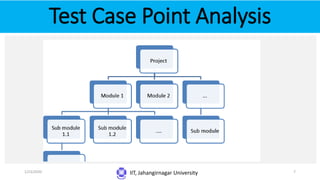
Any application can be divided into several modules and any module can be classified as
Simple, Average and Complex based on the number and complexity of the associated
requirements for that module.
1/23/2020 6
Test Case Point Analysis
IIT, Jahangirnagar University1/23/2020 7
Test Case Point Analysis
IIT, Jahangirnagar University
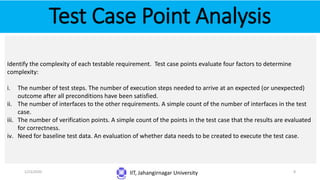
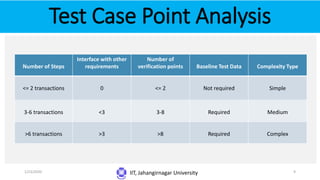
Identify the complexity of each testable requirement. Test case points evaluate four factors to determine
complexity:
i. The number of test steps. The number of execution steps needed to arrive at an expected (or unexpected)
outcome after all preconditions have been satisfied.
ii. The number of interfaces to the other requirements. A simple count of the number of interfaces in the test
case.
iii. The number of verification points. A simple count of the points in the test case that the results are evaluated
for correctness.
iv. Need for baseline test data. An evaluation of whether data needs to be created to execute the test case.
1/23/2020 8
Test Case Point Analysis
IIT, Jahangirnagar University
Number of Steps
Interface with other
requirements
Number of
verification points Baseline Test Data Complexity Type
<= 2 transactions 0 <= 2 Not required Simple
3-6 transactions <3 3-8 Required Medium
>6 transactions >3 >8 Required Complex
1/23/2020 9
Test Case Point Analysis
IIT, Jahangirnagar University
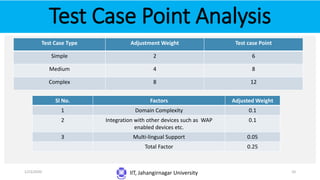
Test Case Type Adjustment Weight Test case Point
Simple 2 6
Medium 4 8
Complex 8 12
Sl No. Factors Adjusted Weight
1 Domain Complexity 0.1
2 Integration with other devices such as WAP
enabled devices etc.
0.1
3 Multi-lingual Support 0.05
Total Factor 0.25
1/23/2020 10
Test Case Point Analysis
IIT, Jahangirnagar University
Test Case Point for each type can be calculated as following:
• Simple Test Case Point = [Number of simple requirements in the project * Adjustment factor for Simple
requirements] ( A1 )
• Average Test Case Points = [Number of average requirements in the project * Adjustment factor for average
requirements ]( A2 )
• Complex Test Case Points = [Number of complex requirements in the project * Adjustment factor for
complex requirements ]( A3 )
• Hence the total test case point for the system under test = A1 + A2 + A3
Now we will calculate TCP based on previously discussed data,
1/23/2020 11
Test Case Point Analysis
IIT, Jahangirnagar University
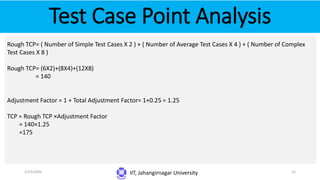
Rough TCP= ( Number of Simple Test Cases X 2 ) + ( Number of Average Test Cases X 4 ) + ( Number of Complex
Test Cases X 8 )
Rough TCP= (6X2)+(8X4)+(12X8)
= 140
Adjustment Factor = 1 + Total Adjustment Factor= 1+0.25 = 1.25
TCP = Rough TCP ×Adjustment Factor
= 140×1.25
=175
1/23/2020 12
Estimate Testing Effort
IIT, Jahangirnagar University
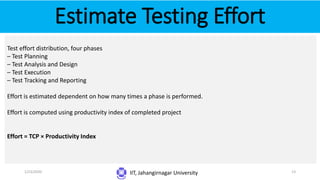
Test effort distribution, four phases
– Test Planning
– Test Analysis and Design
– Test Execution
– Test Tracking and Reporting
Effort is estimated dependent on how many times a phase is performed.
Effort is computed using productivity index of completed project
Effort = TCP × Productivity Index
1/23/2020 13
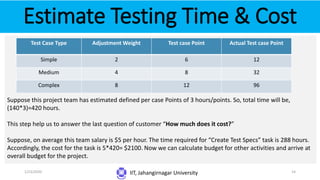
Estimate Testing Time & Cost
IIT, Jahangirnagar University
Suppose this project team has estimated defined per case Points of 3 hours/points. So, total time will be,
(140*3)=420 hours.
This step help us to answer the last question of customer “How much does it cost?”
Suppose, on average this team salary is $5 per hour. The time required for “Create Test Specs” task is 288 hours.
Accordingly, the cost for the task is 5*420= $2100. Now we can calculate budget for other activities and arrive at
overall budget for the project.
Test Case Type Adjustment Weight Test case Point Actual Test case Point
Simple 2 6 12
Medium 4 8 32
Complex 8 12 96
1/23/2020 14
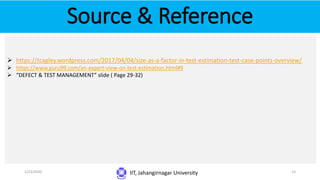
Source & Reference
IIT, Jahangirnagar University
 https://tcagley.wordpress.com/2017/04/04/size-as-a-factor-in-test-estimation-test-case-points-overview/
 https://www.guru99.com/an-expert-view-on-test-estimation.html#9
 “DEFECT & TEST MANAGEMENT” slide ( Page 29-32)
1/23/2020 15
IIT, Jahangirnagar University1/23/2020 16
Any Question
IIT, Jahangirnagar University1/23/2020 17

Test case point analysis

  • 1.
    IIT, Jahangirnagar University 15thmarch, 2019 An Presentation on Software Testing & Quality Assurance Course Code: PMIT-6111 Group No: 03 Submitted To, Fahima Tabassum Associate Professor Institute of Information Technology, Jahangirnagar University, savar, Dhaka. Submitted By, Student ID: 183202, 1832, 183235 Institute of Information Technology, Jahangirnagar University, savar, Dhaka. 1/23/2020 1
  • 2.
  • 3.
    Why test baseddevelopment becoming popular recently? IIT, Jahangirnagar University Early bug notification Developers test their code but in the database world, this often consists of manual tests or one-off scripts. Using test based development, building up, over time, a suite of automated tests that developer can rerun at will. Better Designed, cleaner and more extensible code  It helps to understand how the code will be used and how it interacts with other modules.  It results in better design decision and more maintainable code.  Allows writing smaller code having single responsibility rather than monolithic procedures with multiple responsibilities. This makes the code simpler to understand.  Also forces to write only production code to pass tests based on user requirements. Good for Developers Though developers have to spend more time in writing TDD test cases, it takes a lot less time for debugging and developing new features. You will write cleaner, less complicated code. 1/23/2020 3
  • 4.
    Why test baseddevelopment becoming popular recently? IIT, Jahangirnagar University Confidence to Refactor  If you refactor code, there can be possibilities of breaks in the code. So having a set of automated tests you can fix those breaks before release. Proper warning will be given if breaks found when automated tests are used.  Using test based development, should results in faster, more extensible code with fewer bugs that can be updated with minimal risks. Good for teamwork In the absence of any team member, other team members can easily pick up and work on the code. It also aids knowledge sharing, thereby making the team more effective overall. Others  Quickly sending quality code to production.  Efficiently building coverage on the business’s application.  Reducing resources required for testing.  Fast feedback etc. 1/23/2020 4
  • 5.
    IIT, Jahangirnagar University TestCase Point Analysis 1/23/2020 5
  • 6.
    Test Case PointAnalysis IIT, Jahangirnagar University The Test Case Point is a measure of estimating the software testing size and effort. The Test Case Point Analysis uses test cases as input and generates Test Case Point count for the test cases being used as input. The TCP counts are nothing but ranking the requirements and the impacted test cases for those requirements into simple, average and complex and quantifying it into a complexity measure. Any application can be divided into several modules and any module can be classified as Simple, Average and Complex based on the number and complexity of the associated requirements for that module. 1/23/2020 6
  • 7.
    Test Case PointAnalysis IIT, Jahangirnagar University1/23/2020 7
  • 8.
    Test Case PointAnalysis IIT, Jahangirnagar University Identify the complexity of each testable requirement. Test case points evaluate four factors to determine complexity: i. The number of test steps. The number of execution steps needed to arrive at an expected (or unexpected) outcome after all preconditions have been satisfied. ii. The number of interfaces to the other requirements. A simple count of the number of interfaces in the test case. iii. The number of verification points. A simple count of the points in the test case that the results are evaluated for correctness. iv. Need for baseline test data. An evaluation of whether data needs to be created to execute the test case. 1/23/2020 8
  • 9.
    Test Case PointAnalysis IIT, Jahangirnagar University Number of Steps Interface with other requirements Number of verification points Baseline Test Data Complexity Type <= 2 transactions 0 <= 2 Not required Simple 3-6 transactions <3 3-8 Required Medium >6 transactions >3 >8 Required Complex 1/23/2020 9
  • 10.
    Test Case PointAnalysis IIT, Jahangirnagar University Test Case Type Adjustment Weight Test case Point Simple 2 6 Medium 4 8 Complex 8 12 Sl No. Factors Adjusted Weight 1 Domain Complexity 0.1 2 Integration with other devices such as WAP enabled devices etc. 0.1 3 Multi-lingual Support 0.05 Total Factor 0.25 1/23/2020 10
  • 11.
    Test Case PointAnalysis IIT, Jahangirnagar University Test Case Point for each type can be calculated as following: • Simple Test Case Point = [Number of simple requirements in the project * Adjustment factor for Simple requirements] ( A1 ) • Average Test Case Points = [Number of average requirements in the project * Adjustment factor for average requirements ]( A2 ) • Complex Test Case Points = [Number of complex requirements in the project * Adjustment factor for complex requirements ]( A3 ) • Hence the total test case point for the system under test = A1 + A2 + A3 Now we will calculate TCP based on previously discussed data, 1/23/2020 11
  • 12.
    Test Case PointAnalysis IIT, Jahangirnagar University Rough TCP= ( Number of Simple Test Cases X 2 ) + ( Number of Average Test Cases X 4 ) + ( Number of Complex Test Cases X 8 ) Rough TCP= (6X2)+(8X4)+(12X8) = 140 Adjustment Factor = 1 + Total Adjustment Factor= 1+0.25 = 1.25 TCP = Rough TCP ×Adjustment Factor = 140×1.25 =175 1/23/2020 12
  • 13.
    Estimate Testing Effort IIT,Jahangirnagar University Test effort distribution, four phases – Test Planning – Test Analysis and Design – Test Execution – Test Tracking and Reporting Effort is estimated dependent on how many times a phase is performed. Effort is computed using productivity index of completed project Effort = TCP × Productivity Index 1/23/2020 13
  • 14.
    Estimate Testing Time& Cost IIT, Jahangirnagar University Suppose this project team has estimated defined per case Points of 3 hours/points. So, total time will be, (140*3)=420 hours. This step help us to answer the last question of customer “How much does it cost?” Suppose, on average this team salary is $5 per hour. The time required for “Create Test Specs” task is 288 hours. Accordingly, the cost for the task is 5*420= $2100. Now we can calculate budget for other activities and arrive at overall budget for the project. Test Case Type Adjustment Weight Test case Point Actual Test case Point Simple 2 6 12 Medium 4 8 32 Complex 8 12 96 1/23/2020 14
  • 15.
    Source & Reference IIT,Jahangirnagar University  https://tcagley.wordpress.com/2017/04/04/size-as-a-factor-in-test-estimation-test-case-points-overview/  https://www.guru99.com/an-expert-view-on-test-estimation.html#9  “DEFECT & TEST MANAGEMENT” slide ( Page 29-32) 1/23/2020 15
  • 16.
  • 17.
    Any Question IIT, JahangirnagarUniversity1/23/2020 17