Innovative Systems Design and Engineering                                                        www.iiste.org
ISSN 2222-1727 (Paper) ISSN 2222-2871 (Online)
Vol 2, No 5, 2011


     Elemental, structural and optical properties of Cd1-xCoxS thin
                     films prepared by spray pyrolysis technique
                                                M. Kamruzzaman

                         Department of Physics, Begum Rokeya University, Rangpur -5400, Bangladesh.
                       Corresponding author and e-mail: mkzaman_phybuet@yahoo.com


                                                     T. R. Luna
      Department of Physics, Bangladesh University of Engineering and Technology (BUET), Dhaka-1000, Bangladesh.
                                      E-mail: tamjidarahman@gmail.com


                                                      J. Podder
      Department of Physics, Bangladesh University of Engineering and Technology (BUET), Dhaka-1000, Bangladesh.
                                      E-mail: jpodder@phy.buet.ac.bd


     The research is financed by Bangladesh University of Engineering and Technology (BUET),.Dhaka-1000,
                                                 Bangladesh.
Abstract
The Cd1-xCoxS (x=0.00, 0.10, 0.20 and 0.40) thin films were deposited onto glass substrate at temperature
523K by using a low cost spray pyrolysis deposition (SPD) technique. The deposited films have been
characterized their elemental, structural and optical properties measurements by energy dispersive X-ray,
X-ray diffraction and UV-VIS spectrophotometer. Energy dispersive X-ray (EDX) analysis confirmed the
presence of Cd, S and Co compositions in the films with appropriate stoichiometric. The as deposited films
were amorphous in nature. The optical band gap of the films was decreased from 2.54 eV to 2.40 eV.
Refractive index and the refractive index were affected by the doping concentration.
Keywords:       SEM, spray pyrolysis, band gap and solar cell

1.    Introduction
Cadmium sulfide (CdS) is a transparent metal sulfide semiconductor of the II-VI group compound
semiconductors. Feitosa et al. (2004) reported that CdS has intensive attention due to their very important
role on the photovoltaic technology, optoelectronic devices and solar cell fabrication. Archbold et al. (2005)
examined that CdS is a hexagonal closed packed structure and has a wide band gap of 2.53eV, low resistivity
and high transparency in the visible range and high light trapping characteristics. Several authors have been
doped CdS with a wide variety of (F, Pt, Pb, Zn, Al, Co, In, Sn, etc.) elements to meet the demands of several
application fields such as thin film solar cells ( Ristova and Ristov 1998), electrochemical cells (Jadhav et al.
2001), gas sensor (Kanemitsu et al. 2002) and it also has been employed in high efficiency solar cells
formed with Cu2S (Hall et al. 1979 ), Cu (InGa) Se2 (Nakoda et al. 1994), etc. Wu et al. (2006) proposed that
CdS doped with transition metal ions (Fe, Ni, Mn ,Co and Cr), so-called dilute magnetic semiconductors
(DMSs), such semiconductors offer the great opportunity to integrate the magnetic, electrical and optical
advantages into a single semiconductor material, which provides many potential applications in the field of
semiconductor spintronic and optoelectronic devices. Now a day’s most of the semiconductors research is
dedicated towards the fabrication of small-sized particle that includes the growth of semiconductor
                                                        117
Innovative Systems Design and Engineering                                                     www.iiste.org
ISSN 2222-1727 (Paper) ISSN 2222-2871 (Online)
Vol 2, No 5, 2011

nanocrystalline materials. These materials show a large optical band gap when the crystallite size becomes
less than the Bohr exciton radius which is experimentally proved by Murray et al. (1995) & Mathur et al.
(2004). Zenrui et al. (2002) found that CoS is an intrinsic semiconductor and a suitable candidate for
photovoltaic or photothermal applications which has an optical band gap of 1.15 eV with cubic structure.
Thus the alloying of Co with CdS may tune the optical band gap which may provide the suitability of this
material for solar cells, optical window layers of photovoltaic cells, photodetectors, photoresistors etc
applications.
In thin film preparation a variety of deposition techniques have been used to grow CdS and Co doped CdS
thin films such as, chemical bath deposition (Zenrui, Yu et al. 2002 & Ezema et al. 2006), surfactant-assisted
method (Sathyamoorthy et al. 2010), implantation-assisted method (Chandramohan et al. 2009), modified
Bridgeman method (Lewicki et al. 1991), spray pyrolysis technique (Bacaksiz et al. 2008) etc. Spray
pyrolysis deposition technique have also been considered as a viable technique for production of Co doped
CdS thin films due to its many advantages over the conventional methods, viz., low cost experimental set up,
high spatial selectivity, precise control over maneuvering the impurity concentration and possibility to
overcome the solubility limit. In addition, this technique could be used for the production of large scale area
for thin film deposition without employing any high vacuum system (Bedir et al. 2002).

In this work, Cd1-xCoxS thin films have been synthesized and investigated elemental, structural and optical
properties by using EDX, XRD and UV-VIS spectroscopy.


2.   Experimental
2.1 Preparation procedure
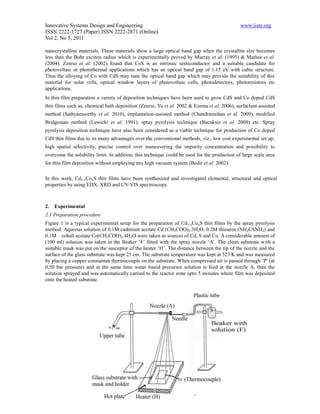
Figure 1 is a typical experimental setup for the preparation of Cd1-xCoxS thin films by the spray pyrolysis
method. Aqueous solution of 0.1M cadmium acetate Cd (CH3COO)2.3H2O, 0.2M thiourea (NH2CSNH2) and
0.1M cobalt acetate Co(CH3COO)2.4H2O were taken as sources of Cd, S and Co. A considerable amount of
(100 ml) solution was taken in the Beaker ‘F’ fitted with the spray nozzle ‘A’. The clean substrate with a
suitable mask was put on the susceptor of the heater ‘H’. The distance between the tip of the nozzle and the
surface of the glass substrate was kept 25 cm. The substrate temperature was kept at 523 K and was measured
by placing a copper constantan thermocouple on the substrate. When compressed air is passed through ‘P’ (at
0.50 bar pressure) and at the same time water based precursor solution is feed at the nozzle A, then the
solution sprayed and was automatically carried to the reactor zone upto 5 minutes where film was deposited
onto the heated substrate.


                                                     118
Innovative Systems Design and Engineering                                                     www.iiste.org
ISSN 2222-1727 (Paper) ISSN 2222-2871 (Online)
Vol 2, No 5, 2011


                            Figure 1. Experimental set up of spray pyrolysis method.
In the hot-zone, the atomized solution is dried and the constituent metal salts decompose and form intimate
Cd1-xCoxS films. The possible chemical reaction may take place on the heated substrate as follows:
                                                                                   523K
Cd 1 x (CH 3 COO) 3  3H 2 O  Co x (CH 3 COO) 2  4 H 2 O  NH 2 CSNH 2                  Cd 1 x Co x S 
                                                                                 Decompose
NH 3   NH 4  7CO2  4CH 4  2 H 2  3Steam 


2.2 Characterization
The thicknesses of the films were measured by the setup of Fizeau fringes method at the department of
Physics, BUET. Energy dispersive X- rays (EDX) were taken by the scanning electron microscopy (SEM)
setup (Inspect IS50 FEI Company). The X-ray diffraction (XRD) of as deposited films were taken by using a
molybdenum CuK ( = 1.54178 Å), radiation diffractometer, PHILIPS model “X’Pert PRO XRD System.
The optical absorbance and transmittance spectra of the as-deposited films with respect to plain glass
substrate were taken at room temperature using double beam UV-VIS spectrophotometer (UV-1601PC
Shimadzu, Japan) in BCSIR, for wavelength 300 nm to1100 nm.


3. Results and discussion

3.1 Compositional Studies
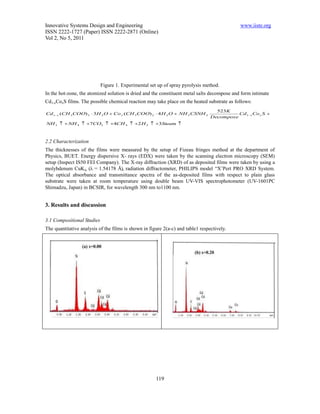
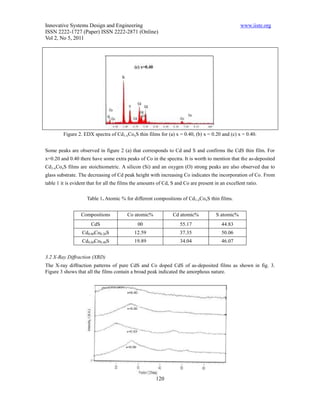
The quantitative analysis of the films is shown in figure 2(a-c) and table1 respectively.


                                                      119
Innovative Systems Design and Engineering                                                         www.iiste.org
ISSN 2222-1727 (Paper) ISSN 2222-2871 (Online)
Vol 2, No 5, 2011


         Figure 2. EDX spectra of Cd1-xCoxS thin films for (a) x = 0.40, (b) x = 0.20 and (c) x = 0.40.


Some peaks are observed in figure 2 (a) that corresponds to Cd and S and confirms the CdS thin film. For
x=0.20 and 0.40 there have some extra peaks of Co in the spectra. It is worth to mention that the as-deposited
Cd1-xCoxS films are stoichiometric. A silicon (Si) and an oxygen (O) strong peaks are also observed due to
glass substrate. The decreasing of Cd peak height with increasing Co indicates the incorporation of Co. From
table 1 it is evident that for all the films the amounts of Cd, S and Co are present in an excellent ratio.

                     Table 1. Atomic % for different compositions of Cd1-xCoxS thin films.


                  Compositions           Co atomic%             Cd atomic%            S atomic%
                       CdS                    00                   55.17                44.83
                  Cd0.80Co0.20S              12.59                 37.35                50.06
                  Cd0.60Co0.40S              19.89                 34.04                46.07


3.2 X-Ray Diffraction (XRD)
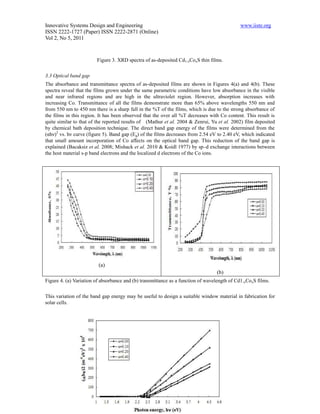
The X-ray diffraction patterns of pure CdS and Co doped CdS of as-deposited films as shown in fig. 3.
Figure 3 shows that all the films contain a broad peak indicated the amorphous nature.


                                                       120
Innovative Systems Design and Engineering                                                    www.iiste.org
ISSN 2222-1727 (Paper) ISSN 2222-2871 (Online)
Vol 2, No 5, 2011


                        Figure 3. XRD spectra of as-deposited Cd1-xCoxS thin films.

3.3 Optical band gap
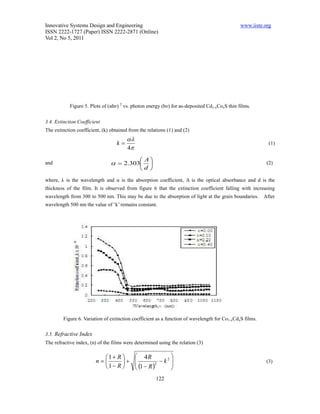
The absorbance and transmittance spectra of as-deposited films are shown in Figures 4(a) and 4(b). These
spectra reveal that the films grown under the same parametric conditions have low absorbance in the visible
and near infrared regions and are high in the ultraviolet region. However, absorption increases with
increasing Co. Transmittance of all the films demonstrate more than 65% above wavelengths 550 nm and
from 550 nm to 450 nm there is a sharp fall in the %T of the films, which is due to the strong absorbance of
the films in this region. It has been observed that the over all %T decreases with Co content. This result is
quite similar to that of the reported results of (Mathur et al. 2004 & Zenrui, Yu et al. 2002) film deposited
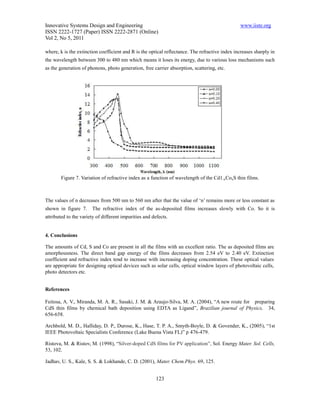
by chemical bath deposition technique. The direct band gap energy of the films were determined from the
(αhν)2 vs. hν curve (figure 5). Band gap (Eg) of the films decreases from 2.54 eV to 2.40 eV, which indicated
that small amount incorporation of Co affects on the optical band gap. This reduction of the band gap is
explained (Bacaksiz et al. 2008; Mishack et al. 2010 & Koidl 1977) by sp–d exchange interactions between
the host material s-p band electrons and the localized d electrons of the Co ions.


                         (a)
                                                                                 (b)
Figure 4. (a) Variation of absorbance and (b) transmittance as a function of wavelength of Cd1-xCoxS films.


This variation of the band gap energy may be useful to design a suitable window material in fabrication for
solar cells.


                                                    121
Innovative Systems Design and Engineering                                                      www.iiste.org
ISSN 2222-1727 (Paper) ISSN 2222-2871 (Online)
Vol 2, No 5, 2011


            Figure 5. Plots of (αhν) 2 vs. photon energy (hν) for as-deposited Cd1-xCoxS thin films.


3.4. Extinction Coefficient
The extinction coefficient, (k) obtained from the relations (1) and (2)
                                        
                                   k                                                                       (1)
                                        4
                                                A
and                               2.303                                                                (2)
                                               d 
where, λ is the wavelength and α is the absorption coefficient, A is the optical absorbance and d is the
thickness of the film. It is observed from figure 6 that the extinction coefficient falling with increasing
wavelength from 300 to 500 nm. This may be due to the absorption of light at the grain boundaries.        After
wavelength 500 nm the value of ‘k’ remains constant.


        Figure 6. Variation of extinction coefficient as a function of wavelength for Co 1-xCdxS films.

3.5. Refractive Index
The refractive index, (n) of the films were determined using the relation (3)

                          1 R              4R             
                        n                                
                                              1  R 2  k 
                                                            2
                                                                                                           (3)
                          1 R                             
                                                      122
Innovative Systems Design and Engineering                                                       www.iiste.org
ISSN 2222-1727 (Paper) ISSN 2222-2871 (Online)
Vol 2, No 5, 2011

where, k is the extinction coefficient and R is the optical reflectance. The refractive index increases sharply in
the wavelength between 300 to 480 nm which means it loses its energy, due to various loss mechanisms such
as the generation of phonons, photo generation, free carrier absorption, scattering, etc.


        Figure 7. Variation of refractive index as a function of wavelength of the Cd1-xCoxS thin films.


The values of n decreases from 500 nm to 560 nm after that the value of ‘n’ remains more or less constant as
shown in figure 7.     The refractive index of the as-deposited films increases slowly with Co. So it is
attributed to the variety of different impurities and defects.


4. Conclusions

The amounts of Cd, S and Co are present in all the films with an excellent ratio. The as deposited films are
amorphousness. The direct band gap energy of the films decreases from 2.54 eV to 2.40 eV. Extinction
coefficient and refractive index tend to increase with increasing doping concentration. These optical values
are appropriate for designing optical devices such as solar cells, optical window layers of photovoltaic cells,
photo detectors etc.


References

Feitosa, A. V., Miranda, M. A. R., Sasaki, J. M. & Araujo-Silva, M. A. (2004), “A new route for preparing
CdS thin films by chemical bath deposition using EDTA as Ligand”, Brazilian journal of Physics, 34,
656-658.

Archbold, M. D., Halliday, D. P., Durose, K., Hase, T. P. A., Smyth-Boyle, D. & Govender, K., (2005), “1st
IEEE Photovoltaic Specialists Conference (Lake Buena Vista FL)” p 476-479.

Ristova, M. & Ristov, M. (1998), “Silver-doped CdS films for PV application”, Sol. Energy Mater. Sol. Cells,
53, 102.

Jadhav, U. S., Kale, S. S. & Lokhande, C. D. (2001), Mater. Chem.Phys. 69, 125.


                                                        123
Innovative Systems Design and Engineering                                                    www.iiste.org
ISSN 2222-1727 (Paper) ISSN 2222-2871 (Online)
Vol 2, No 5, 2011

Kanemitsu, T., Nagai, T., Kushida, T., Nakamura, S., Yamada, Y., & Taguchi, T., (2002), “Free excitons in
cubic CdS films”, Appl. Phys. Lett. 80, 267

Hall, R. B. & Meakin, J. B. (1979), Thin Solid Films, 63, 203.

Nakoda, T., Okano. N., Tanaka, Y. & Kunioka, A. (1994), Proc. Ist World Conf. On Photovoltaic Energy
Conversion (Hawaii).

Wu, X. J., Shen, D. Z., Zhang, Z. Z., Zhang, J. Y., Liu, K. W., Li, B. H., Lu, Y. M., Zhao, D. X . & Yao,
B. (2006), “p-type conductivity and donor-acceptor pair emission in Cd1-xFexS dilute magnetic
semiconductors”, Appl. Phys. Lett. 89, 262118

Murray, C. B., Kagan, C. R. & Bawendi, M. G. (1995), “Self Organization of CdSe Nanocrystallites into
Three Dimensional Quantum Dot Superlattices”, Science 270, 1335-1338.

Mathur, N., Joshi, K., Rakesh, Subbaraju, G. V. & Sehgal, H. K. (2004), “Solution grown Pb1-xCoxS
semiconductor nanoparticle films”, Physica E, 23, 56-60.

Zenrui, Yu., Jinhui, Du., Shuhua, Guo., Jiayou, Zhang, Yasuhiro & Matsumoto (2002), “CoS thin films
prepared with modified chemical bath deposition”, Thin Solid Films, 415, 173-176.

 Ezema, F. I. & Osuji, R. U. (2006), “Preparation and optical characterization of chemical bath deposited
CdCoS2 thin films”, J.Appl. Sci,. 6, 1827-1832

Sathyamoorthy, R., Sudhagar, P., Balerna, A., Balasubramanian, C. & Bellucci, S. (2010), “ Surfactant-
assisted synthesis of Cd1-xCoxS nanocluster alloys and their structural, optical and magnetic properties”,
Journal of Alloys and Compounds, 493, 240-245.

Chandramohan, S., Kanjilal, A., Sarangi, S. N., Majumder, S., Sathyamoorty, R. & Som, T. (2009),
“Implantation-assisted Co-doped CdS Thin films: Structural, optical and vibrational properties”,     J. Appl.
Phys. 106, 063506.

Lewicki, A., Schindler, A. I., Miotkowski, I., Crooker, B. C. & Furdyna, J. K. (1991), “Specific heat of
Cd1-xCoxS and Cd1-xCoxSe at low temperatures”, Physical Rev. B, l43, 5713-5718.

Bacaksiz, E., Tomakin, M. Altunbas, M., Parlak, M. & Colakoglu, T. (2008), “tructural, optical and magnetic
properties of Cd1-xCoxS films prepared by spray pyrolysis”, Physica B ,403, 3740-3745.

Bedir, M., Kayali, R., & Oztas, M. (2002), “Effect of the Zn concentration on the characteristic parameters of
ZnxCd1-xS thin films developed by spraying pyrolysis method under the nitrogen atmosphere”. Turk J. Phys.
26, 121-126.

Bacaksiz, E.,Tomakin, M., Altunbas , M. & Parlak , M. & Colakoglu, T. (2008), “Structural, Optical and
Magnetic Properties of Cd1-xCoxS Thin Films Prepared by Spray Pyrolysis”, Physica B, 403, 3740.

Mishack, N., Nabuchi, Chinedu, & Ekuma, E. (2010), Chalcogenide Letters.7, 31.
Koidl, P. (1977), “Optical absorption of Co2+ in ZnO”, Phys. Rev.   B, 15, 2493.


                                                     124

11.m. kamruzzaman 117 124

  • 1.
    Innovative Systems Designand Engineering www.iiste.org ISSN 2222-1727 (Paper) ISSN 2222-2871 (Online) Vol 2, No 5, 2011 Elemental, structural and optical properties of Cd1-xCoxS thin films prepared by spray pyrolysis technique M. Kamruzzaman Department of Physics, Begum Rokeya University, Rangpur -5400, Bangladesh. Corresponding author and e-mail: mkzaman_phybuet@yahoo.com T. R. Luna Department of Physics, Bangladesh University of Engineering and Technology (BUET), Dhaka-1000, Bangladesh. E-mail: tamjidarahman@gmail.com J. Podder Department of Physics, Bangladesh University of Engineering and Technology (BUET), Dhaka-1000, Bangladesh. E-mail: jpodder@phy.buet.ac.bd The research is financed by Bangladesh University of Engineering and Technology (BUET),.Dhaka-1000, Bangladesh. Abstract The Cd1-xCoxS (x=0.00, 0.10, 0.20 and 0.40) thin films were deposited onto glass substrate at temperature 523K by using a low cost spray pyrolysis deposition (SPD) technique. The deposited films have been characterized their elemental, structural and optical properties measurements by energy dispersive X-ray, X-ray diffraction and UV-VIS spectrophotometer. Energy dispersive X-ray (EDX) analysis confirmed the presence of Cd, S and Co compositions in the films with appropriate stoichiometric. The as deposited films were amorphous in nature. The optical band gap of the films was decreased from 2.54 eV to 2.40 eV. Refractive index and the refractive index were affected by the doping concentration. Keywords: SEM, spray pyrolysis, band gap and solar cell 1. Introduction Cadmium sulfide (CdS) is a transparent metal sulfide semiconductor of the II-VI group compound semiconductors. Feitosa et al. (2004) reported that CdS has intensive attention due to their very important role on the photovoltaic technology, optoelectronic devices and solar cell fabrication. Archbold et al. (2005) examined that CdS is a hexagonal closed packed structure and has a wide band gap of 2.53eV, low resistivity and high transparency in the visible range and high light trapping characteristics. Several authors have been doped CdS with a wide variety of (F, Pt, Pb, Zn, Al, Co, In, Sn, etc.) elements to meet the demands of several application fields such as thin film solar cells ( Ristova and Ristov 1998), electrochemical cells (Jadhav et al. 2001), gas sensor (Kanemitsu et al. 2002) and it also has been employed in high efficiency solar cells formed with Cu2S (Hall et al. 1979 ), Cu (InGa) Se2 (Nakoda et al. 1994), etc. Wu et al. (2006) proposed that CdS doped with transition metal ions (Fe, Ni, Mn ,Co and Cr), so-called dilute magnetic semiconductors (DMSs), such semiconductors offer the great opportunity to integrate the magnetic, electrical and optical advantages into a single semiconductor material, which provides many potential applications in the field of semiconductor spintronic and optoelectronic devices. Now a day’s most of the semiconductors research is dedicated towards the fabrication of small-sized particle that includes the growth of semiconductor 117
  • 2.
    Innovative Systems Designand Engineering www.iiste.org ISSN 2222-1727 (Paper) ISSN 2222-2871 (Online) Vol 2, No 5, 2011 nanocrystalline materials. These materials show a large optical band gap when the crystallite size becomes less than the Bohr exciton radius which is experimentally proved by Murray et al. (1995) & Mathur et al. (2004). Zenrui et al. (2002) found that CoS is an intrinsic semiconductor and a suitable candidate for photovoltaic or photothermal applications which has an optical band gap of 1.15 eV with cubic structure. Thus the alloying of Co with CdS may tune the optical band gap which may provide the suitability of this material for solar cells, optical window layers of photovoltaic cells, photodetectors, photoresistors etc applications. In thin film preparation a variety of deposition techniques have been used to grow CdS and Co doped CdS thin films such as, chemical bath deposition (Zenrui, Yu et al. 2002 & Ezema et al. 2006), surfactant-assisted method (Sathyamoorthy et al. 2010), implantation-assisted method (Chandramohan et al. 2009), modified Bridgeman method (Lewicki et al. 1991), spray pyrolysis technique (Bacaksiz et al. 2008) etc. Spray pyrolysis deposition technique have also been considered as a viable technique for production of Co doped CdS thin films due to its many advantages over the conventional methods, viz., low cost experimental set up, high spatial selectivity, precise control over maneuvering the impurity concentration and possibility to overcome the solubility limit. In addition, this technique could be used for the production of large scale area for thin film deposition without employing any high vacuum system (Bedir et al. 2002). In this work, Cd1-xCoxS thin films have been synthesized and investigated elemental, structural and optical properties by using EDX, XRD and UV-VIS spectroscopy. 2. Experimental 2.1 Preparation procedure Figure 1 is a typical experimental setup for the preparation of Cd1-xCoxS thin films by the spray pyrolysis method. Aqueous solution of 0.1M cadmium acetate Cd (CH3COO)2.3H2O, 0.2M thiourea (NH2CSNH2) and 0.1M cobalt acetate Co(CH3COO)2.4H2O were taken as sources of Cd, S and Co. A considerable amount of (100 ml) solution was taken in the Beaker ‘F’ fitted with the spray nozzle ‘A’. The clean substrate with a suitable mask was put on the susceptor of the heater ‘H’. The distance between the tip of the nozzle and the surface of the glass substrate was kept 25 cm. The substrate temperature was kept at 523 K and was measured by placing a copper constantan thermocouple on the substrate. When compressed air is passed through ‘P’ (at 0.50 bar pressure) and at the same time water based precursor solution is feed at the nozzle A, then the solution sprayed and was automatically carried to the reactor zone upto 5 minutes where film was deposited onto the heated substrate. 118
  • 3.
    Innovative Systems Designand Engineering www.iiste.org ISSN 2222-1727 (Paper) ISSN 2222-2871 (Online) Vol 2, No 5, 2011 Figure 1. Experimental set up of spray pyrolysis method. In the hot-zone, the atomized solution is dried and the constituent metal salts decompose and form intimate Cd1-xCoxS films. The possible chemical reaction may take place on the heated substrate as follows: 523K Cd 1 x (CH 3 COO) 3  3H 2 O  Co x (CH 3 COO) 2  4 H 2 O  NH 2 CSNH 2 Cd 1 x Co x S  Decompose NH 3   NH 4  7CO2  4CH 4  2 H 2  3Steam  2.2 Characterization The thicknesses of the films were measured by the setup of Fizeau fringes method at the department of Physics, BUET. Energy dispersive X- rays (EDX) were taken by the scanning electron microscopy (SEM) setup (Inspect IS50 FEI Company). The X-ray diffraction (XRD) of as deposited films were taken by using a molybdenum CuK ( = 1.54178 Å), radiation diffractometer, PHILIPS model “X’Pert PRO XRD System. The optical absorbance and transmittance spectra of the as-deposited films with respect to plain glass substrate were taken at room temperature using double beam UV-VIS spectrophotometer (UV-1601PC Shimadzu, Japan) in BCSIR, for wavelength 300 nm to1100 nm. 3. Results and discussion 3.1 Compositional Studies The quantitative analysis of the films is shown in figure 2(a-c) and table1 respectively. 119
  • 4.
    Innovative Systems Designand Engineering www.iiste.org ISSN 2222-1727 (Paper) ISSN 2222-2871 (Online) Vol 2, No 5, 2011 Figure 2. EDX spectra of Cd1-xCoxS thin films for (a) x = 0.40, (b) x = 0.20 and (c) x = 0.40. Some peaks are observed in figure 2 (a) that corresponds to Cd and S and confirms the CdS thin film. For x=0.20 and 0.40 there have some extra peaks of Co in the spectra. It is worth to mention that the as-deposited Cd1-xCoxS films are stoichiometric. A silicon (Si) and an oxygen (O) strong peaks are also observed due to glass substrate. The decreasing of Cd peak height with increasing Co indicates the incorporation of Co. From table 1 it is evident that for all the films the amounts of Cd, S and Co are present in an excellent ratio. Table 1. Atomic % for different compositions of Cd1-xCoxS thin films. Compositions Co atomic% Cd atomic% S atomic% CdS 00 55.17 44.83 Cd0.80Co0.20S 12.59 37.35 50.06 Cd0.60Co0.40S 19.89 34.04 46.07 3.2 X-Ray Diffraction (XRD) The X-ray diffraction patterns of pure CdS and Co doped CdS of as-deposited films as shown in fig. 3. Figure 3 shows that all the films contain a broad peak indicated the amorphous nature. 120
  • 5.
    Innovative Systems Designand Engineering www.iiste.org ISSN 2222-1727 (Paper) ISSN 2222-2871 (Online) Vol 2, No 5, 2011 Figure 3. XRD spectra of as-deposited Cd1-xCoxS thin films. 3.3 Optical band gap The absorbance and transmittance spectra of as-deposited films are shown in Figures 4(a) and 4(b). These spectra reveal that the films grown under the same parametric conditions have low absorbance in the visible and near infrared regions and are high in the ultraviolet region. However, absorption increases with increasing Co. Transmittance of all the films demonstrate more than 65% above wavelengths 550 nm and from 550 nm to 450 nm there is a sharp fall in the %T of the films, which is due to the strong absorbance of the films in this region. It has been observed that the over all %T decreases with Co content. This result is quite similar to that of the reported results of (Mathur et al. 2004 & Zenrui, Yu et al. 2002) film deposited by chemical bath deposition technique. The direct band gap energy of the films were determined from the (αhν)2 vs. hν curve (figure 5). Band gap (Eg) of the films decreases from 2.54 eV to 2.40 eV, which indicated that small amount incorporation of Co affects on the optical band gap. This reduction of the band gap is explained (Bacaksiz et al. 2008; Mishack et al. 2010 & Koidl 1977) by sp–d exchange interactions between the host material s-p band electrons and the localized d electrons of the Co ions. (a) (b) Figure 4. (a) Variation of absorbance and (b) transmittance as a function of wavelength of Cd1-xCoxS films. This variation of the band gap energy may be useful to design a suitable window material in fabrication for solar cells. 121
  • 6.
    Innovative Systems Designand Engineering www.iiste.org ISSN 2222-1727 (Paper) ISSN 2222-2871 (Online) Vol 2, No 5, 2011 Figure 5. Plots of (αhν) 2 vs. photon energy (hν) for as-deposited Cd1-xCoxS thin films. 3.4. Extinction Coefficient The extinction coefficient, (k) obtained from the relations (1) and (2)  k (1) 4  A and   2.303  (2) d  where, λ is the wavelength and α is the absorption coefficient, A is the optical absorbance and d is the thickness of the film. It is observed from figure 6 that the extinction coefficient falling with increasing wavelength from 300 to 500 nm. This may be due to the absorption of light at the grain boundaries. After wavelength 500 nm the value of ‘k’ remains constant. Figure 6. Variation of extinction coefficient as a function of wavelength for Co 1-xCdxS films. 3.5. Refractive Index The refractive index, (n) of the films were determined using the relation (3) 1 R   4R  n     1  R 2  k  2 (3) 1 R    122
  • 7.
    Innovative Systems Designand Engineering www.iiste.org ISSN 2222-1727 (Paper) ISSN 2222-2871 (Online) Vol 2, No 5, 2011 where, k is the extinction coefficient and R is the optical reflectance. The refractive index increases sharply in the wavelength between 300 to 480 nm which means it loses its energy, due to various loss mechanisms such as the generation of phonons, photo generation, free carrier absorption, scattering, etc. Figure 7. Variation of refractive index as a function of wavelength of the Cd1-xCoxS thin films. The values of n decreases from 500 nm to 560 nm after that the value of ‘n’ remains more or less constant as shown in figure 7. The refractive index of the as-deposited films increases slowly with Co. So it is attributed to the variety of different impurities and defects. 4. Conclusions The amounts of Cd, S and Co are present in all the films with an excellent ratio. The as deposited films are amorphousness. The direct band gap energy of the films decreases from 2.54 eV to 2.40 eV. Extinction coefficient and refractive index tend to increase with increasing doping concentration. These optical values are appropriate for designing optical devices such as solar cells, optical window layers of photovoltaic cells, photo detectors etc. References Feitosa, A. V., Miranda, M. A. R., Sasaki, J. M. & Araujo-Silva, M. A. (2004), “A new route for preparing CdS thin films by chemical bath deposition using EDTA as Ligand”, Brazilian journal of Physics, 34, 656-658. Archbold, M. D., Halliday, D. P., Durose, K., Hase, T. P. A., Smyth-Boyle, D. & Govender, K., (2005), “1st IEEE Photovoltaic Specialists Conference (Lake Buena Vista FL)” p 476-479. Ristova, M. & Ristov, M. (1998), “Silver-doped CdS films for PV application”, Sol. Energy Mater. Sol. Cells, 53, 102. Jadhav, U. S., Kale, S. S. & Lokhande, C. D. (2001), Mater. Chem.Phys. 69, 125. 123
  • 8.
    Innovative Systems Designand Engineering www.iiste.org ISSN 2222-1727 (Paper) ISSN 2222-2871 (Online) Vol 2, No 5, 2011 Kanemitsu, T., Nagai, T., Kushida, T., Nakamura, S., Yamada, Y., & Taguchi, T., (2002), “Free excitons in cubic CdS films”, Appl. Phys. Lett. 80, 267 Hall, R. B. & Meakin, J. B. (1979), Thin Solid Films, 63, 203. Nakoda, T., Okano. N., Tanaka, Y. & Kunioka, A. (1994), Proc. Ist World Conf. On Photovoltaic Energy Conversion (Hawaii). Wu, X. J., Shen, D. Z., Zhang, Z. Z., Zhang, J. Y., Liu, K. W., Li, B. H., Lu, Y. M., Zhao, D. X . & Yao, B. (2006), “p-type conductivity and donor-acceptor pair emission in Cd1-xFexS dilute magnetic semiconductors”, Appl. Phys. Lett. 89, 262118 Murray, C. B., Kagan, C. R. & Bawendi, M. G. (1995), “Self Organization of CdSe Nanocrystallites into Three Dimensional Quantum Dot Superlattices”, Science 270, 1335-1338. Mathur, N., Joshi, K., Rakesh, Subbaraju, G. V. & Sehgal, H. K. (2004), “Solution grown Pb1-xCoxS semiconductor nanoparticle films”, Physica E, 23, 56-60. Zenrui, Yu., Jinhui, Du., Shuhua, Guo., Jiayou, Zhang, Yasuhiro & Matsumoto (2002), “CoS thin films prepared with modified chemical bath deposition”, Thin Solid Films, 415, 173-176. Ezema, F. I. & Osuji, R. U. (2006), “Preparation and optical characterization of chemical bath deposited CdCoS2 thin films”, J.Appl. Sci,. 6, 1827-1832 Sathyamoorthy, R., Sudhagar, P., Balerna, A., Balasubramanian, C. & Bellucci, S. (2010), “ Surfactant- assisted synthesis of Cd1-xCoxS nanocluster alloys and their structural, optical and magnetic properties”, Journal of Alloys and Compounds, 493, 240-245. Chandramohan, S., Kanjilal, A., Sarangi, S. N., Majumder, S., Sathyamoorty, R. & Som, T. (2009), “Implantation-assisted Co-doped CdS Thin films: Structural, optical and vibrational properties”, J. Appl. Phys. 106, 063506. Lewicki, A., Schindler, A. I., Miotkowski, I., Crooker, B. C. & Furdyna, J. K. (1991), “Specific heat of Cd1-xCoxS and Cd1-xCoxSe at low temperatures”, Physical Rev. B, l43, 5713-5718. Bacaksiz, E., Tomakin, M. Altunbas, M., Parlak, M. & Colakoglu, T. (2008), “tructural, optical and magnetic properties of Cd1-xCoxS films prepared by spray pyrolysis”, Physica B ,403, 3740-3745. Bedir, M., Kayali, R., & Oztas, M. (2002), “Effect of the Zn concentration on the characteristic parameters of ZnxCd1-xS thin films developed by spraying pyrolysis method under the nitrogen atmosphere”. Turk J. Phys. 26, 121-126. Bacaksiz, E.,Tomakin, M., Altunbas , M. & Parlak , M. & Colakoglu, T. (2008), “Structural, Optical and Magnetic Properties of Cd1-xCoxS Thin Films Prepared by Spray Pyrolysis”, Physica B, 403, 3740. Mishack, N., Nabuchi, Chinedu, & Ekuma, E. (2010), Chalcogenide Letters.7, 31. Koidl, P. (1977), “Optical absorption of Co2+ in ZnO”, Phys. Rev. B, 15, 2493. 124