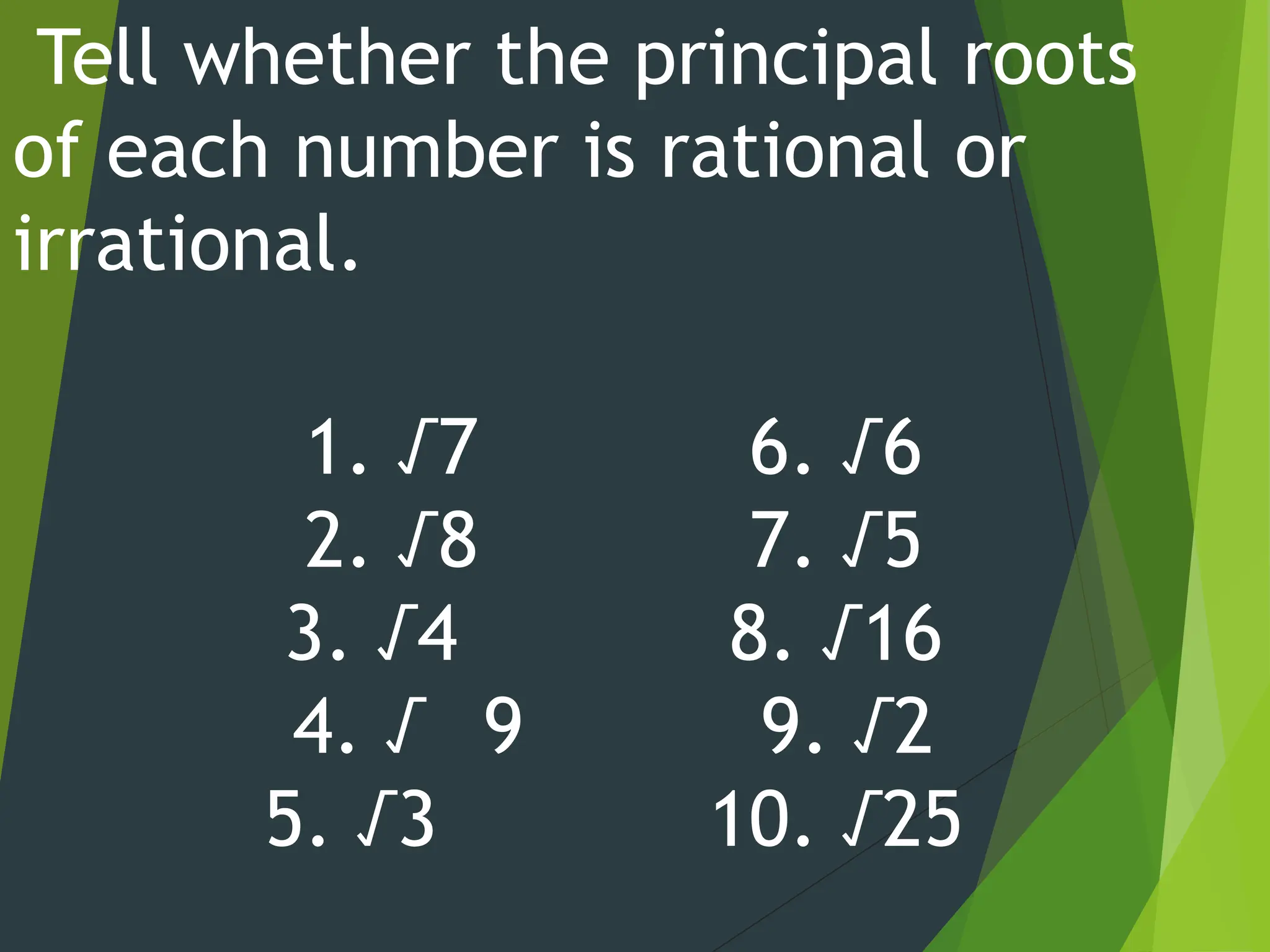
Warm Up
Simplify each expression.
1. 62
36 2. 112
121
3. (–9)(–9) 81 4. 25
36
Write each fraction as a decimal.
5. 2
5
5
9
6.
7. 5 3
8
8. –1 5
6
0.4
5.375
0.5
–1.83
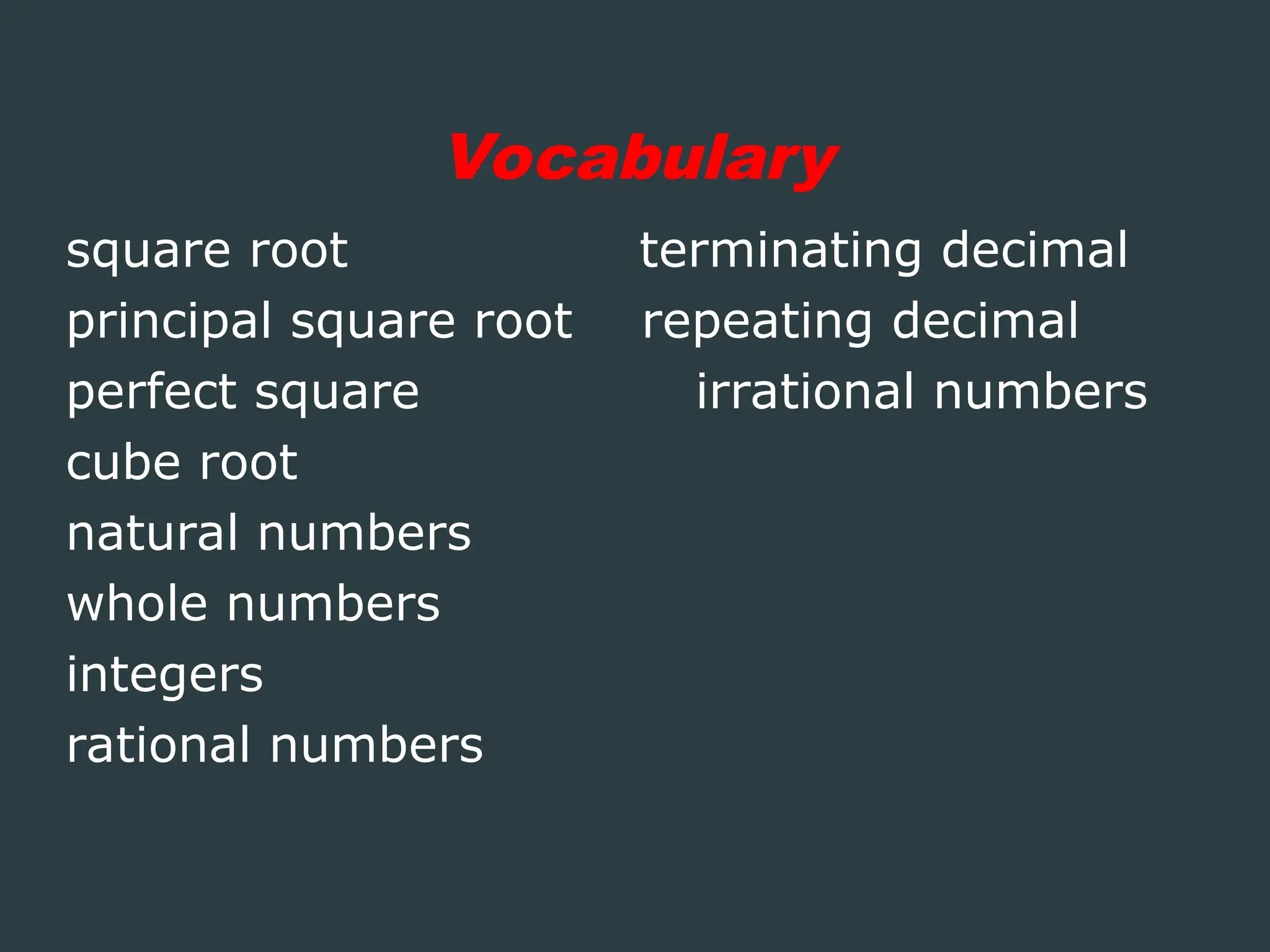
square root terminating decimal
principal square root repeating decimal
perfect square irrational numbers
cube root
natural numbers
whole numbers
integers
rational numbers
Vocabulary
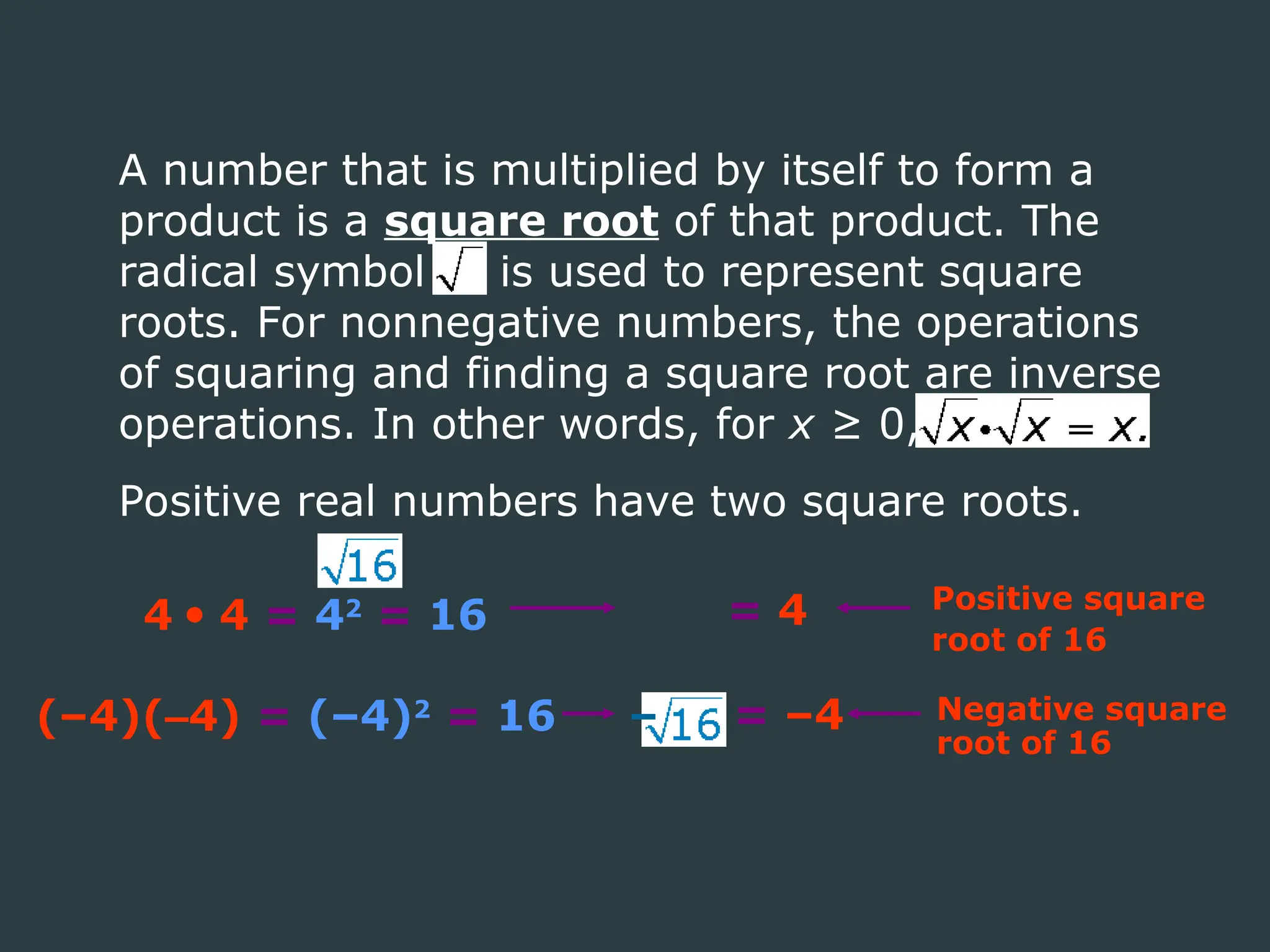
4  4 = 42
= 16 = 4 Positive square
root of 16
(–4)(–4) = (–4)2
= 16 = –4 Negative square
root of 16
–
A number that is multiplied by itself to form a
product is a square root of that product. The
radical symbol is used to represent square
roots. For nonnegative numbers, the operations
of squaring and finding a square root are inverse
operations. In other words, for x ≥ 0,
Positive real numbers have two square roots.
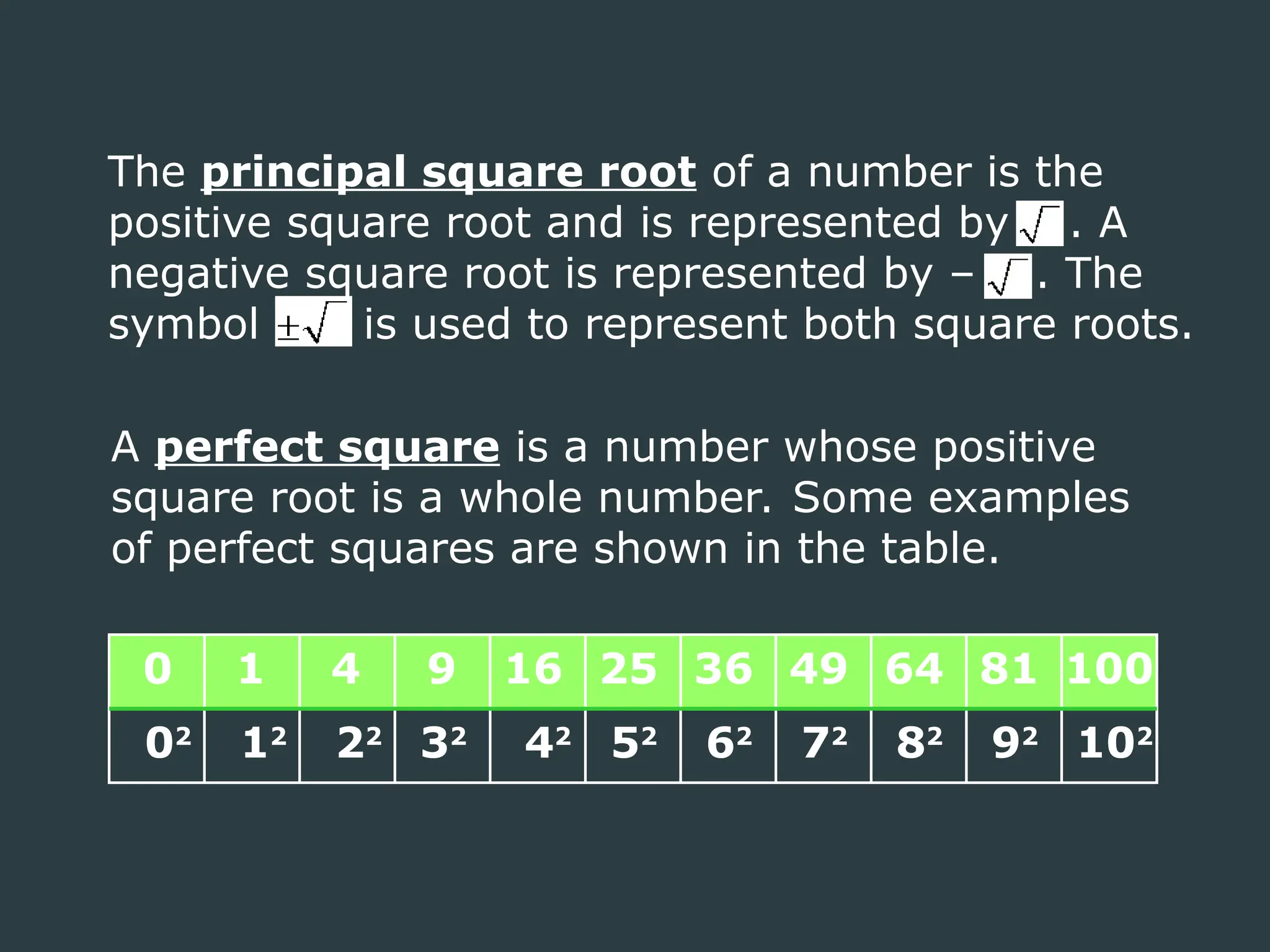
A perfect square is a number whose positive
square root is a whole number. Some examples
of perfect squares are shown in the table.
0
02
1
12
100
4
22
9
32
16
42
25
52
36
62
49
72
64
82
81
92
102
The principal square root of a number is the
positive square root and is represented by . A
negative square root is represented by – . The
symbol is used to represent both square roots.
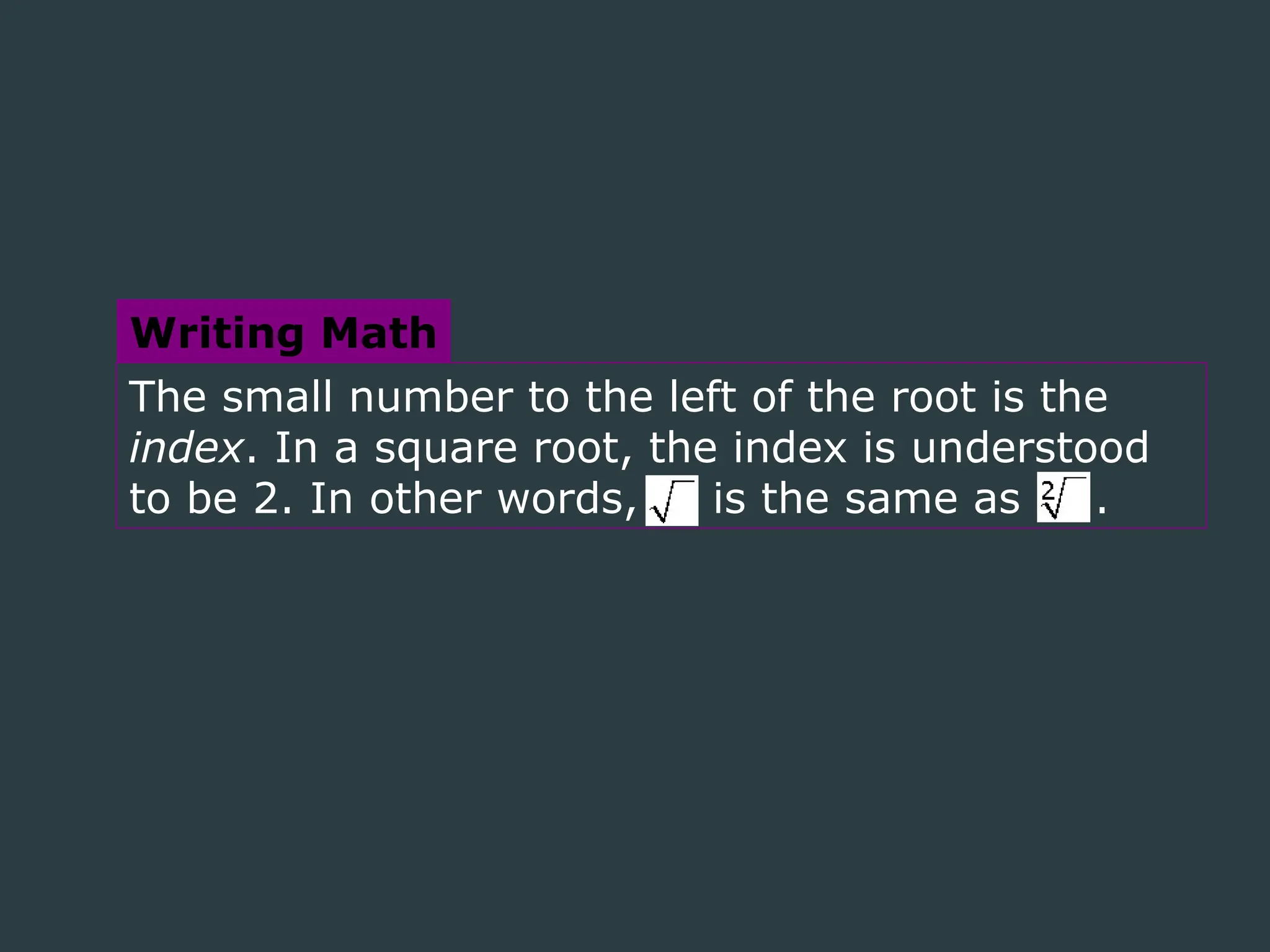
The small number to the left of the root is the
index. In a square root, the index is understood
to be 2. In other words, is the same as .
Writing Math
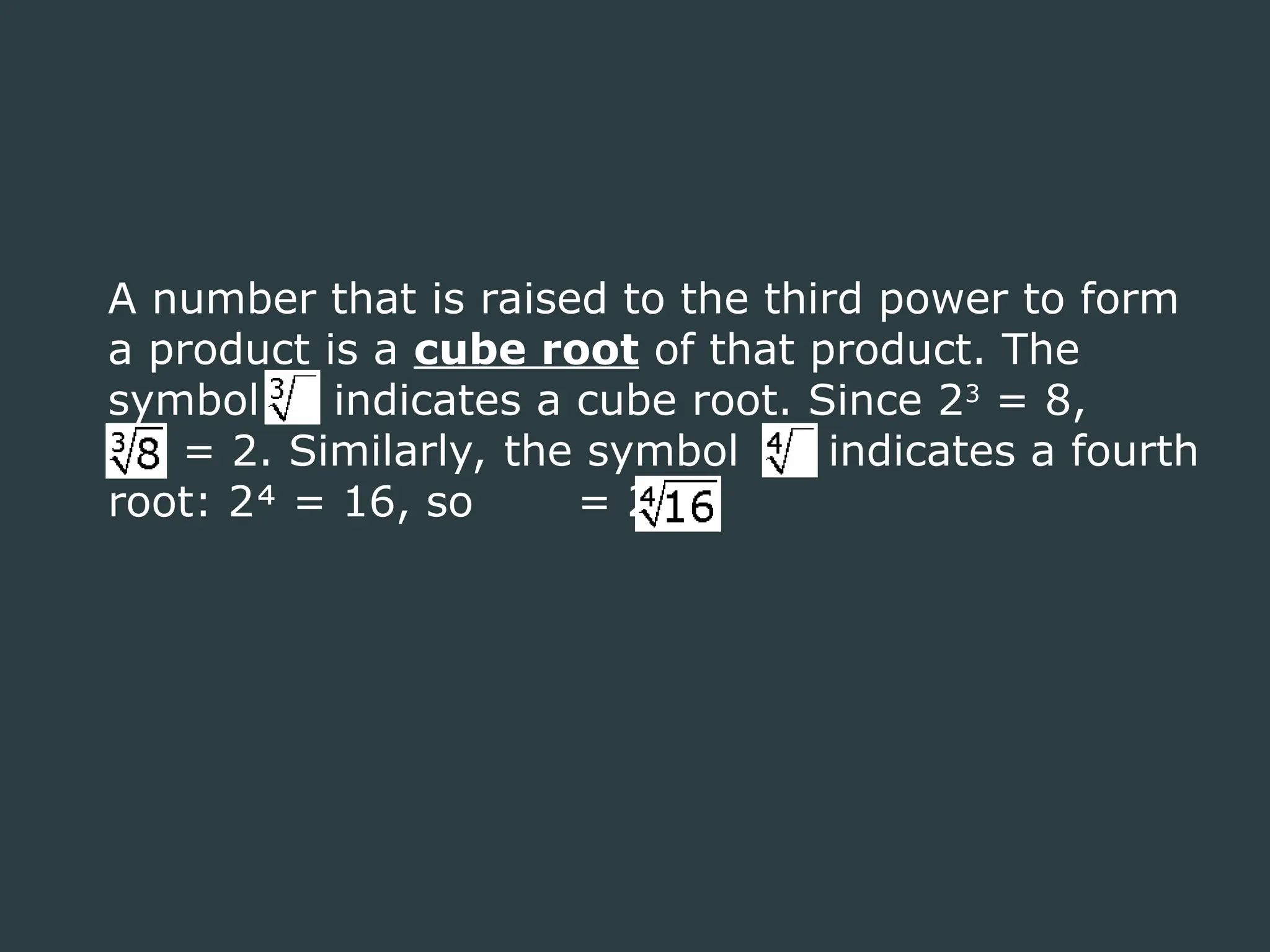
A number that is raised to the third power to form
a product is a cube root of that product. The
symbol indicates a cube root. Since 23
= 8,
= 2. Similarly, the symbol indicates a fourth
root: 2 = 16, so = 2.
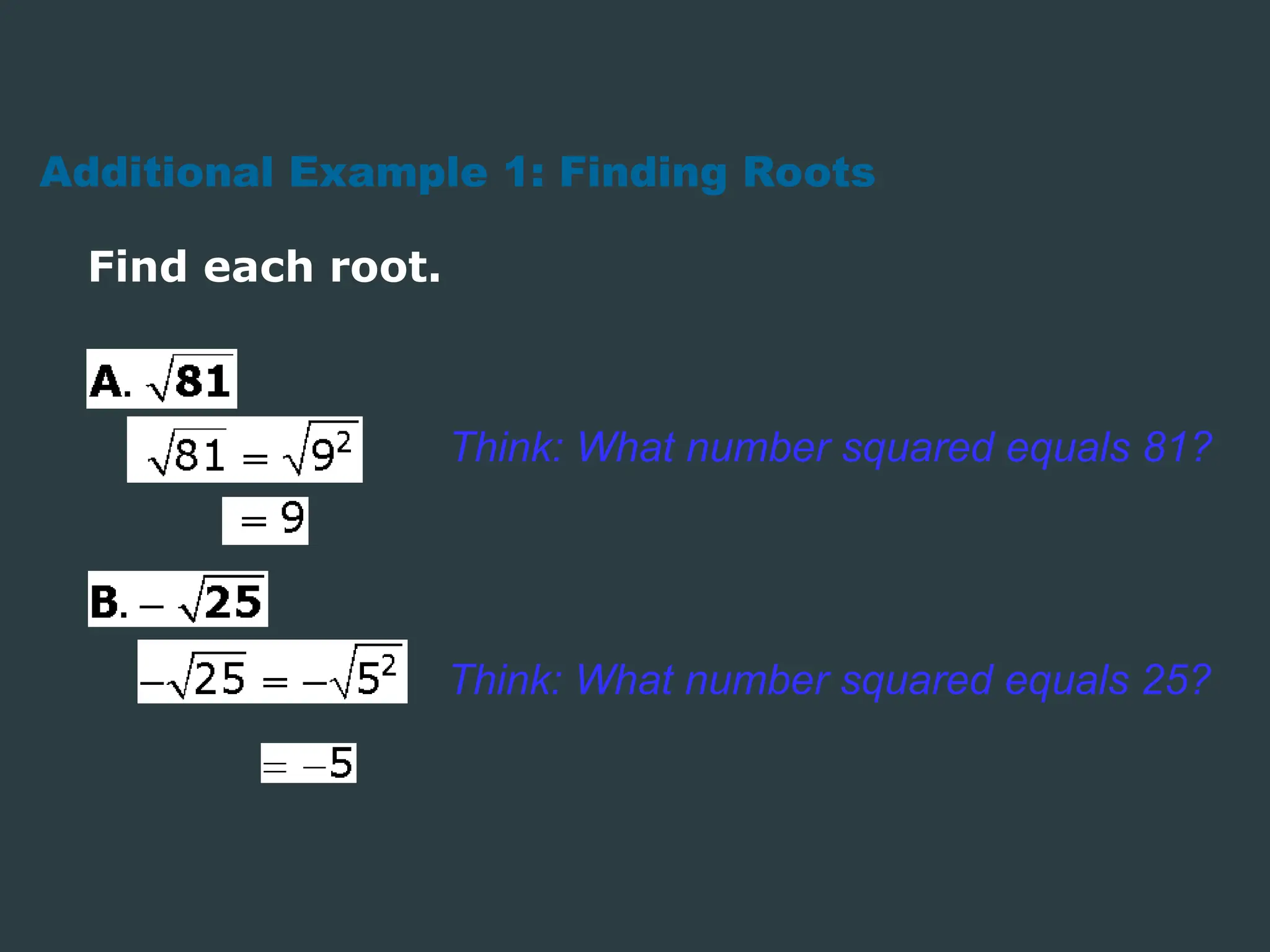
Additional Example 1: Finding Roots
Find each root.
Think: What number squared equals 81?
Think: What number squared equals 25?
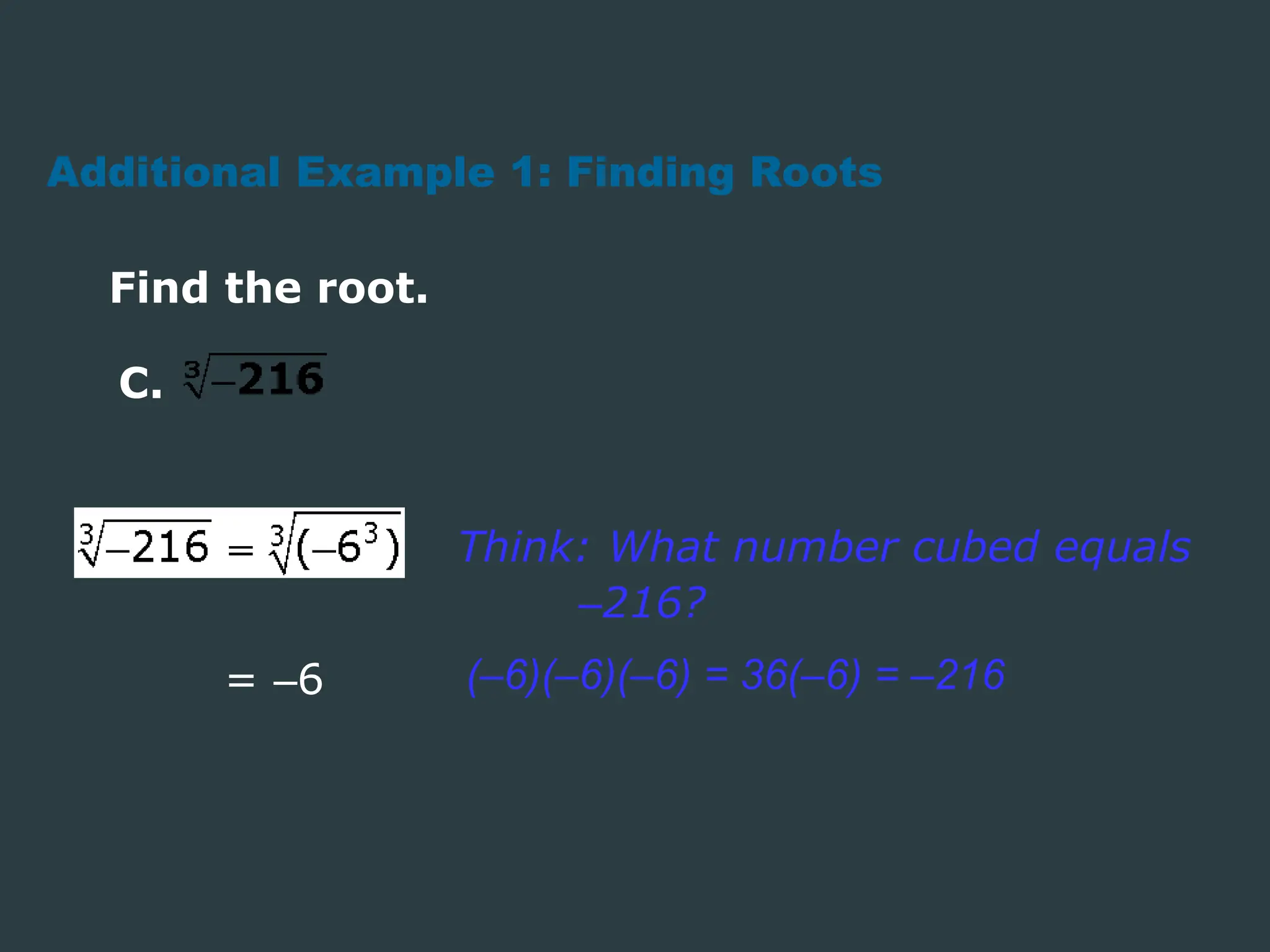
Find the root.
Think: What number cubed equals
–216?
Additional Example 1: Finding Roots
= –6 (–6)(–6)(–6) = 36(–6) = –216
C.
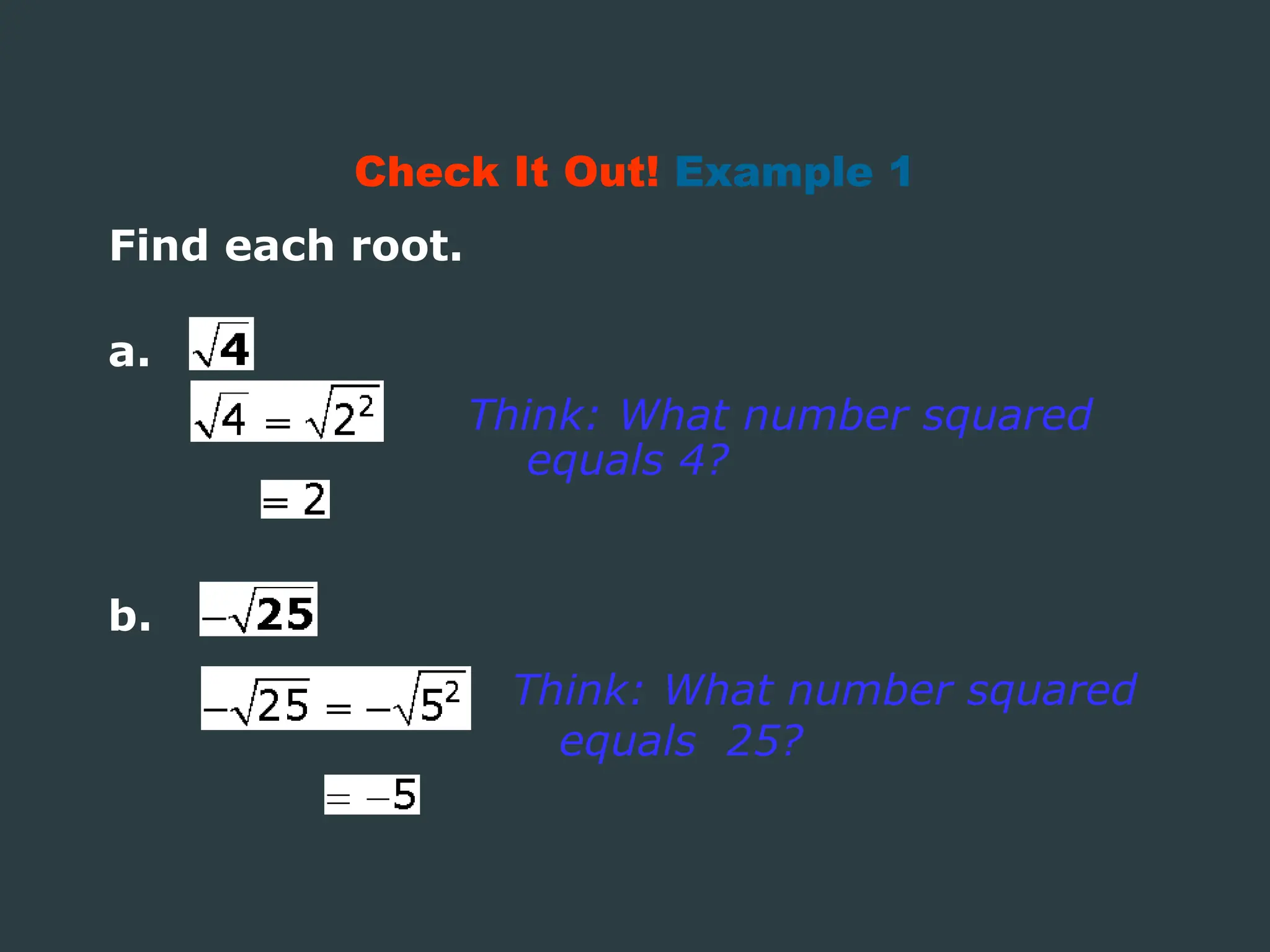
Find each root.
Check It Out! Example 1
Think: What number squared
equals 4?
Think: What number squared
equals 25?
a.
b.
Find the root.
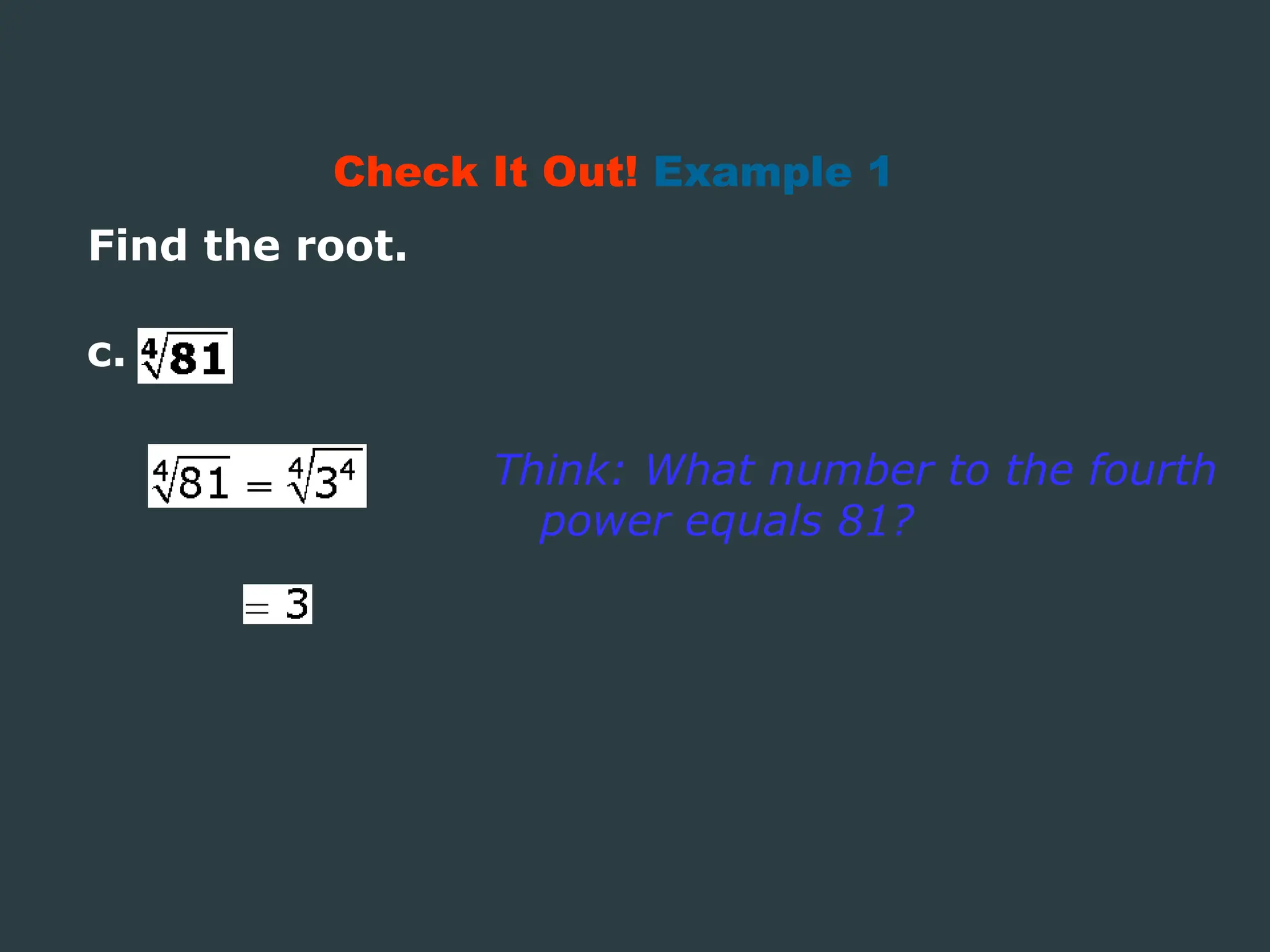
Check It Out! Example 1
Think: What number to the fourth
power equals 81?
c.
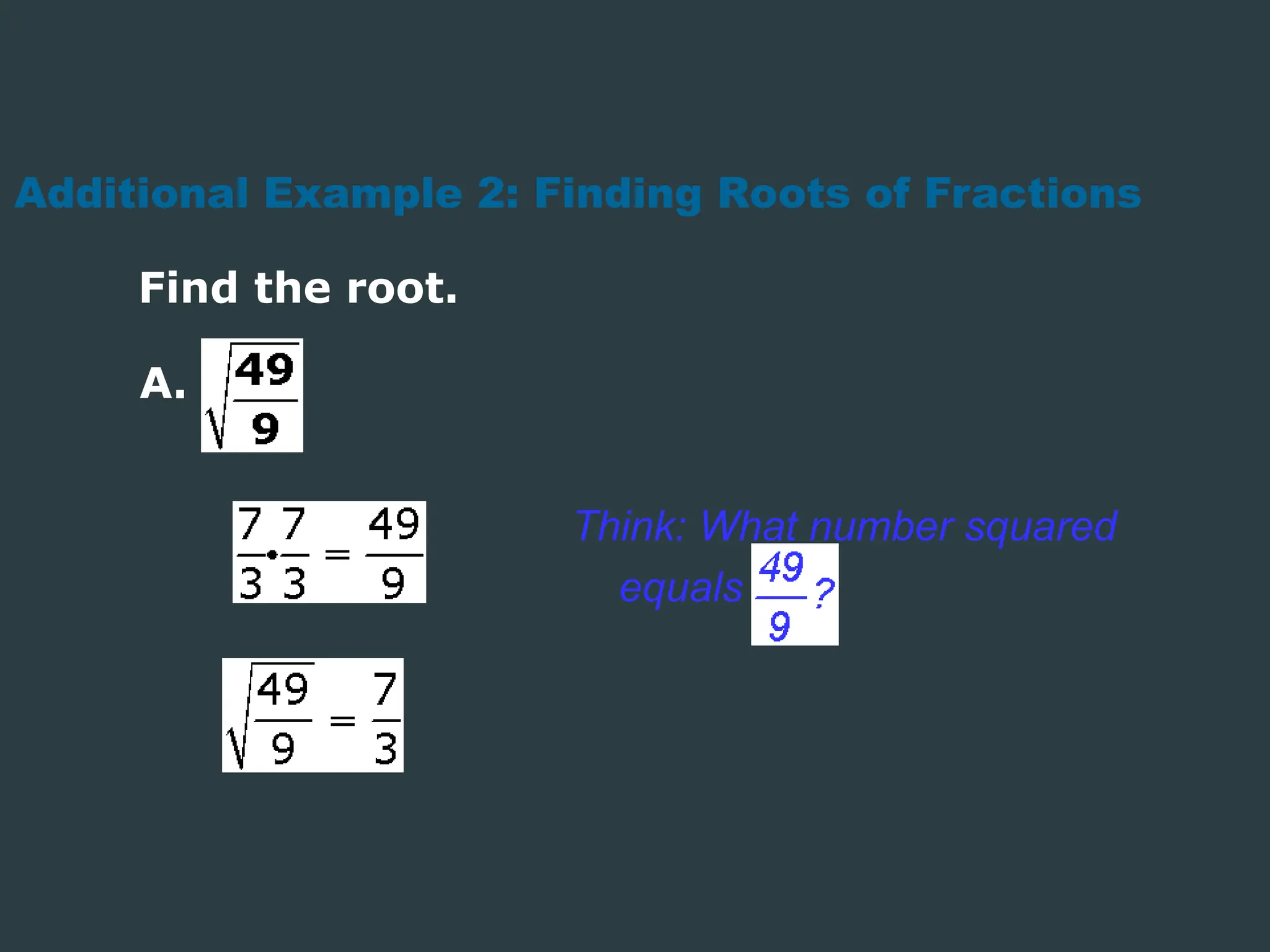
Additional Example 2: Finding Roots of Fractions
Find the root.
Think: What number squared
equals
A.
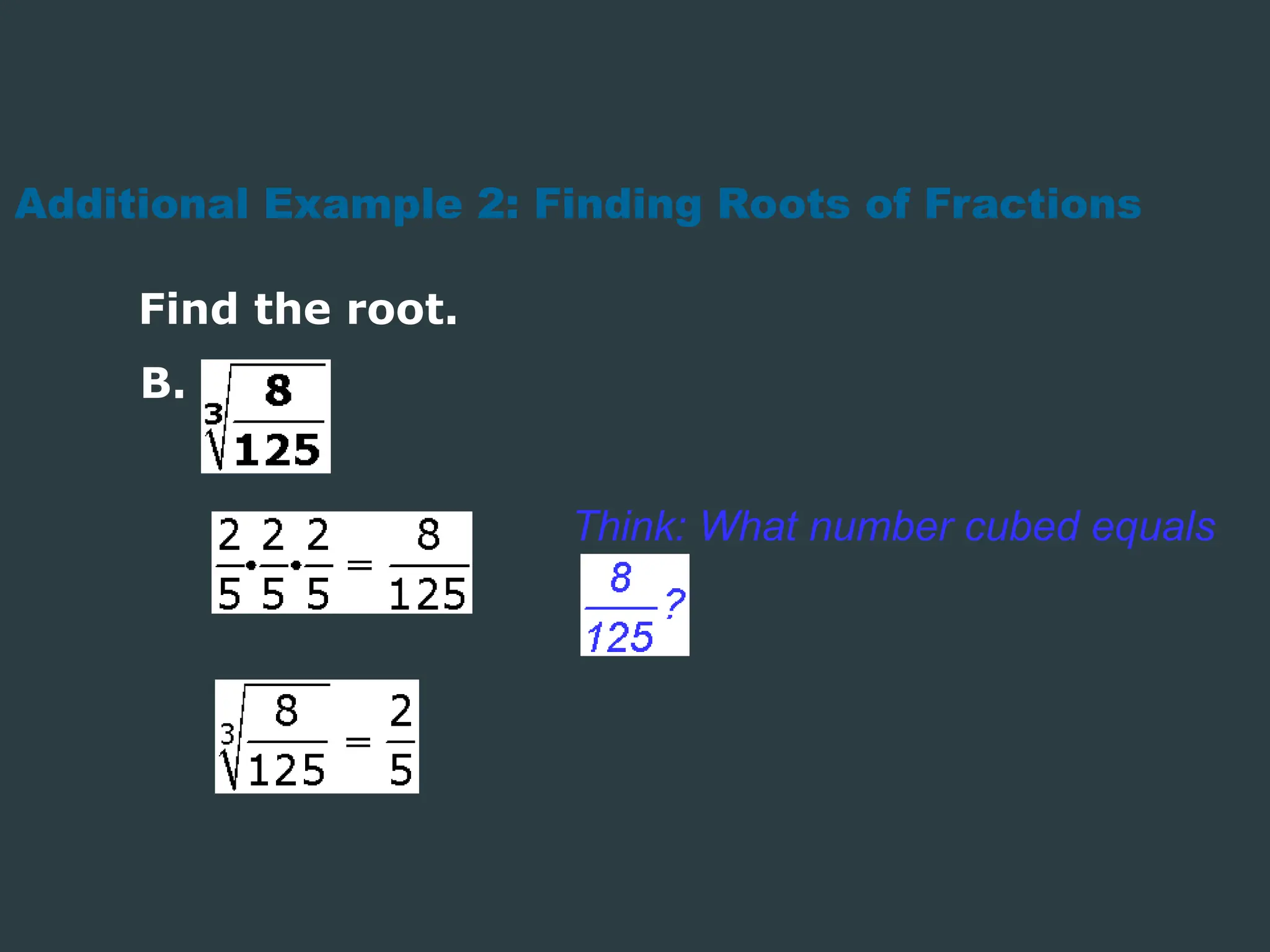
Additional Example 2: Finding Roots of Fractions
Find the root.
Think: What number cubed equals
B.
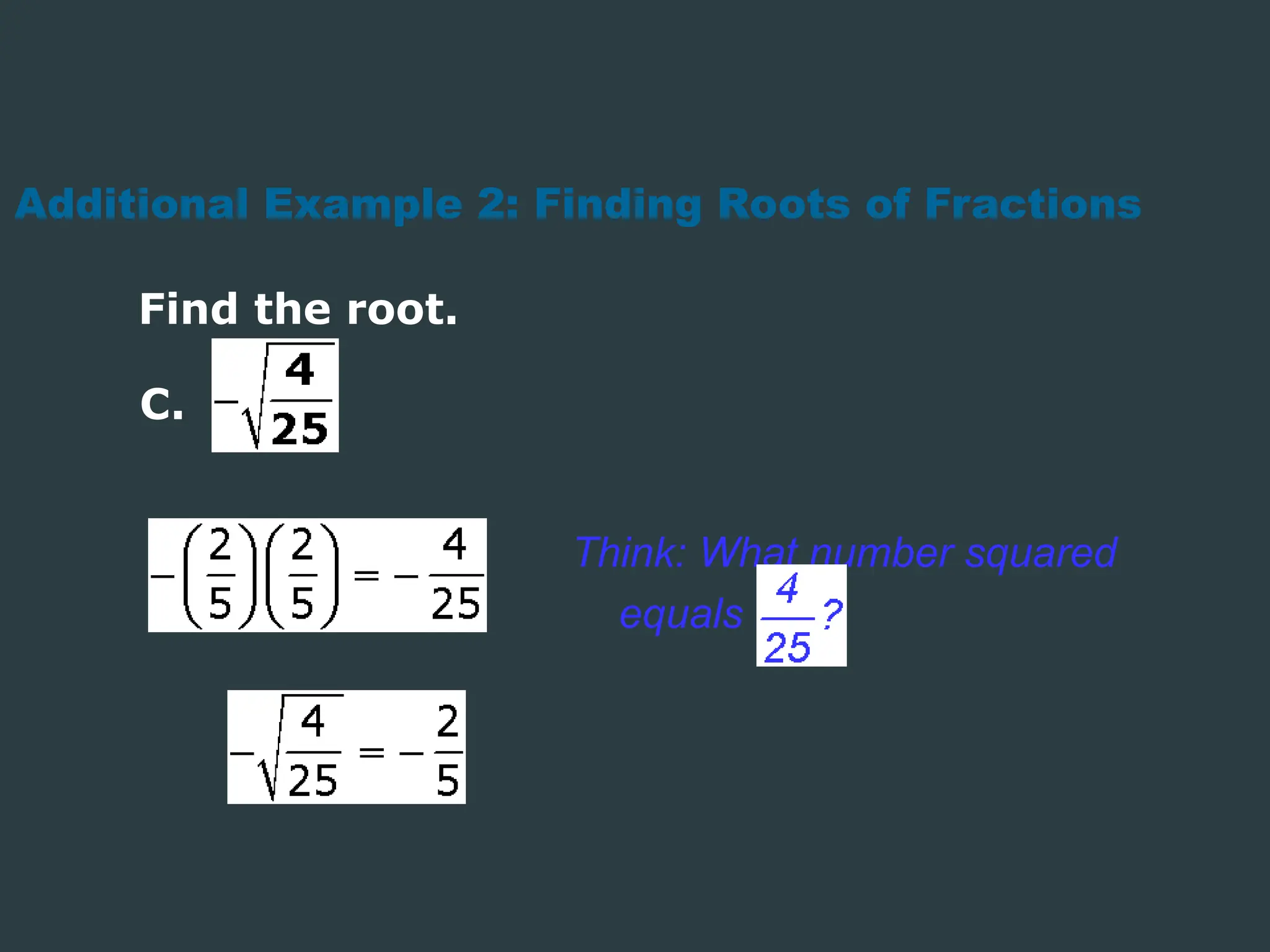
Additional Example 2: Finding Roots of Fractions
Find the root.
Think: What number squared
equals
C.
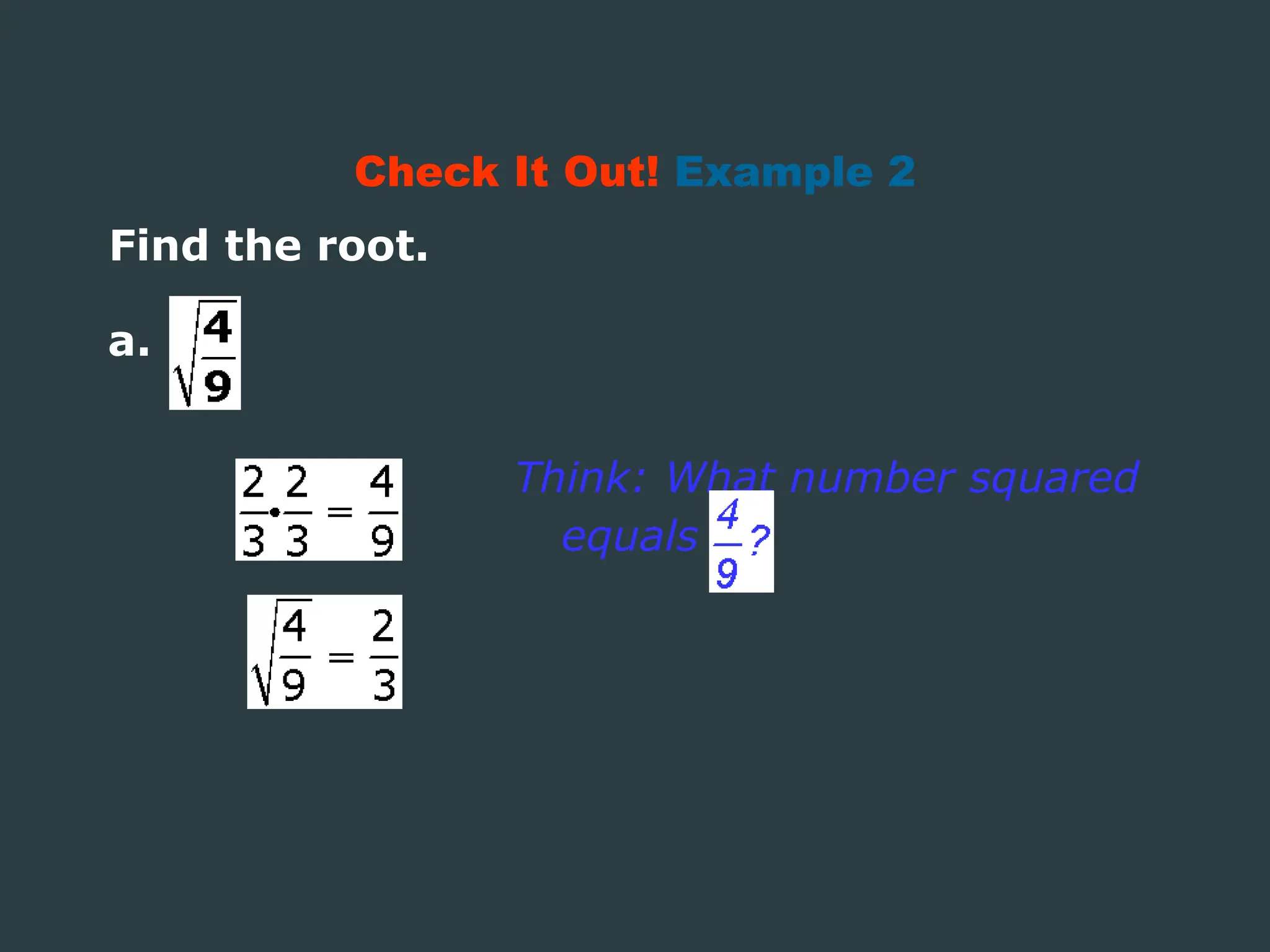
Find the root.
Check It Out! Example 2
Think: What number squared
equals
a.
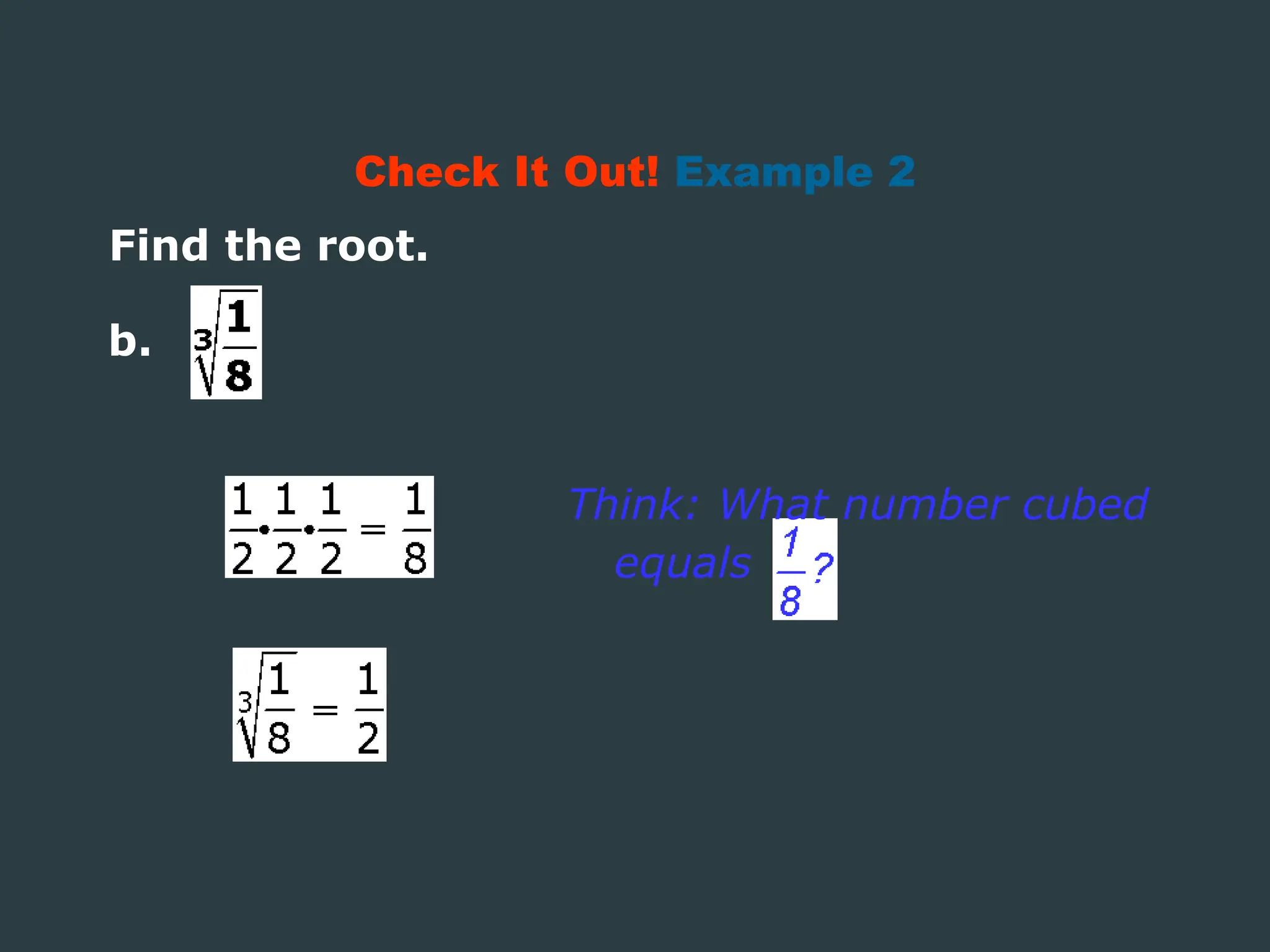
Find the root.
Check It Out! Example 2
Think: What number cubed
equals
b.
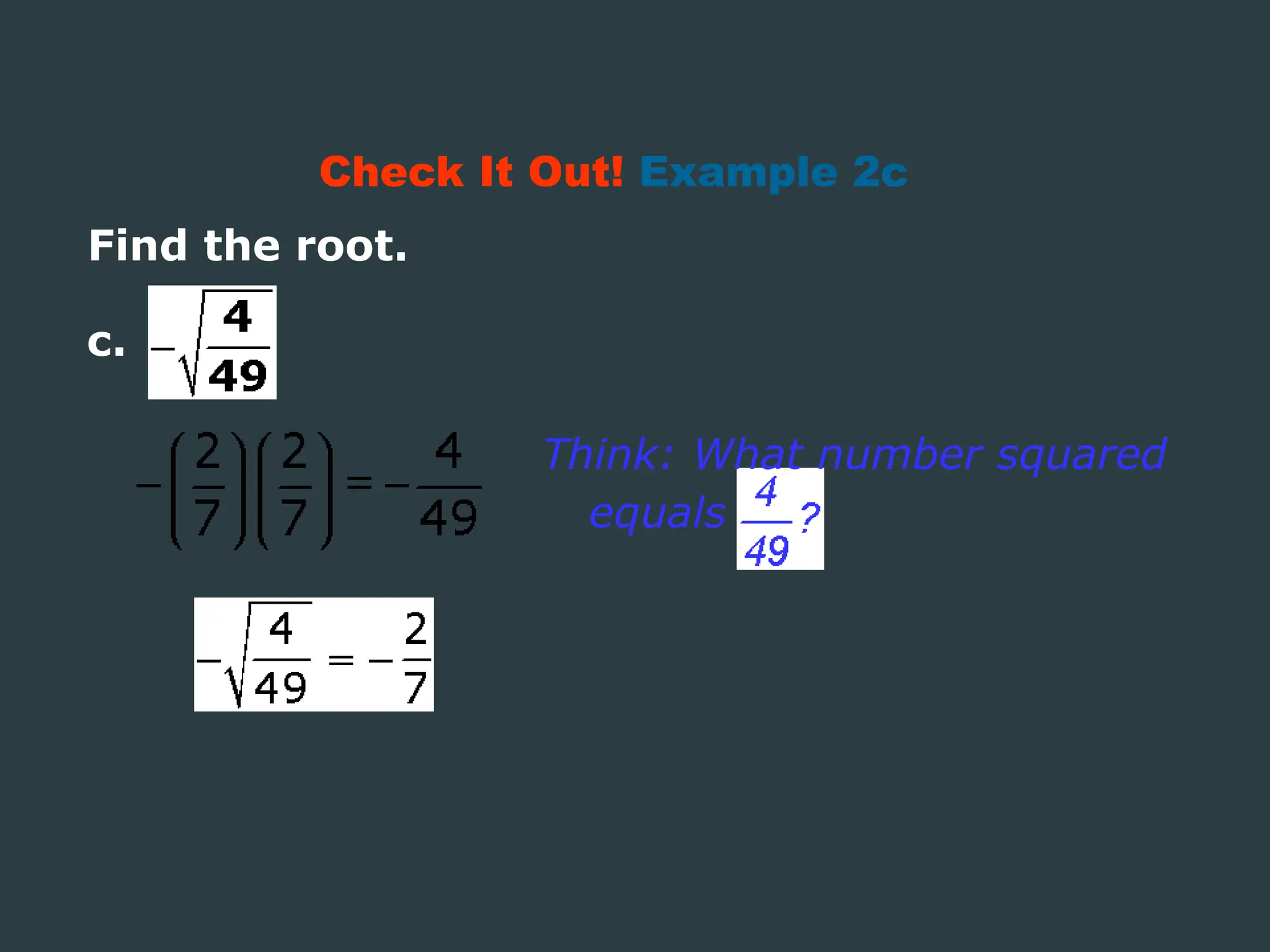
Find the root.
Check It Out! Example 2c
Think: What number squared
equals
c.
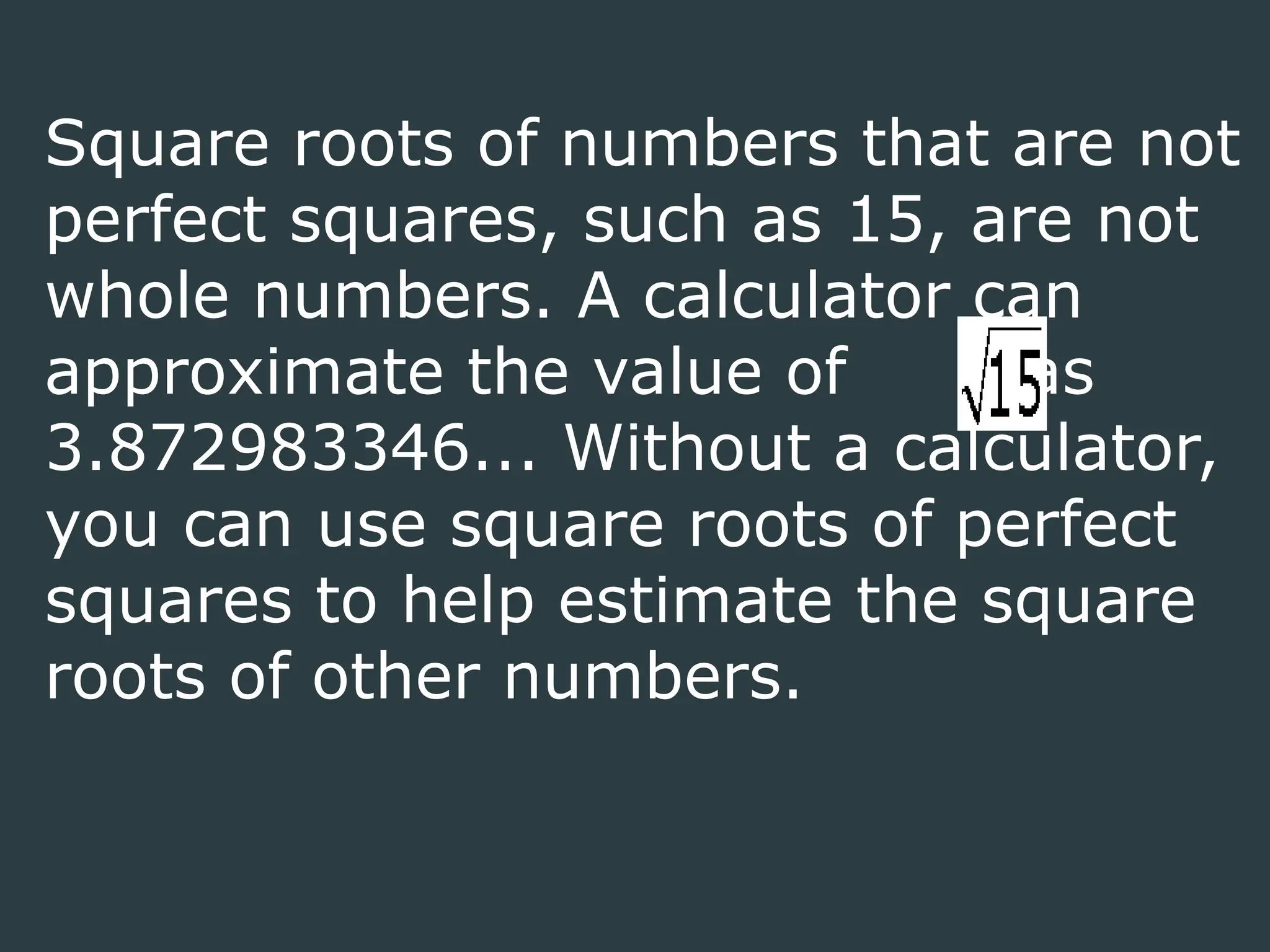
Square roots of numbers that are not
perfect squares, such as 15, are not
whole numbers. A calculator can
approximate the value of as
3.872983346... Without a calculator,
you can use square roots of perfect
squares to help estimate the square
roots of other numbers.
Additional Example 3: Art
Application
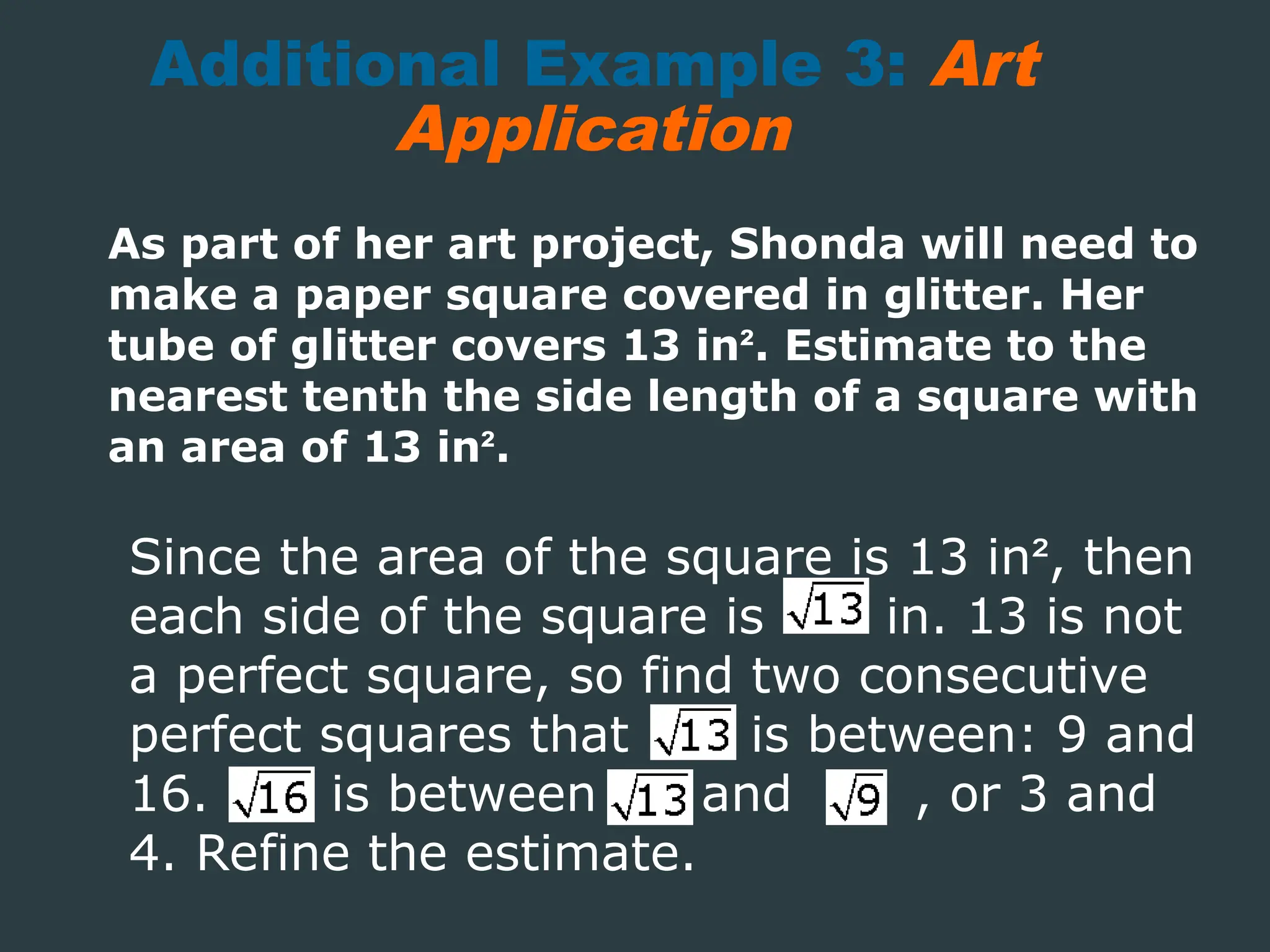
As part of her art project, Shonda will need to
make a paper square covered in glitter. Her
tube of glitter covers 13 in². Estimate to the
nearest tenth the side length of a square with
an area of 13 in².
Since the area of the square is 13 in², then
each side of the square is in. 13 is not
a perfect square, so find two consecutive
perfect squares that is between: 9 and
16. is between and , or 3 and
4. Refine the estimate.
Additional Example
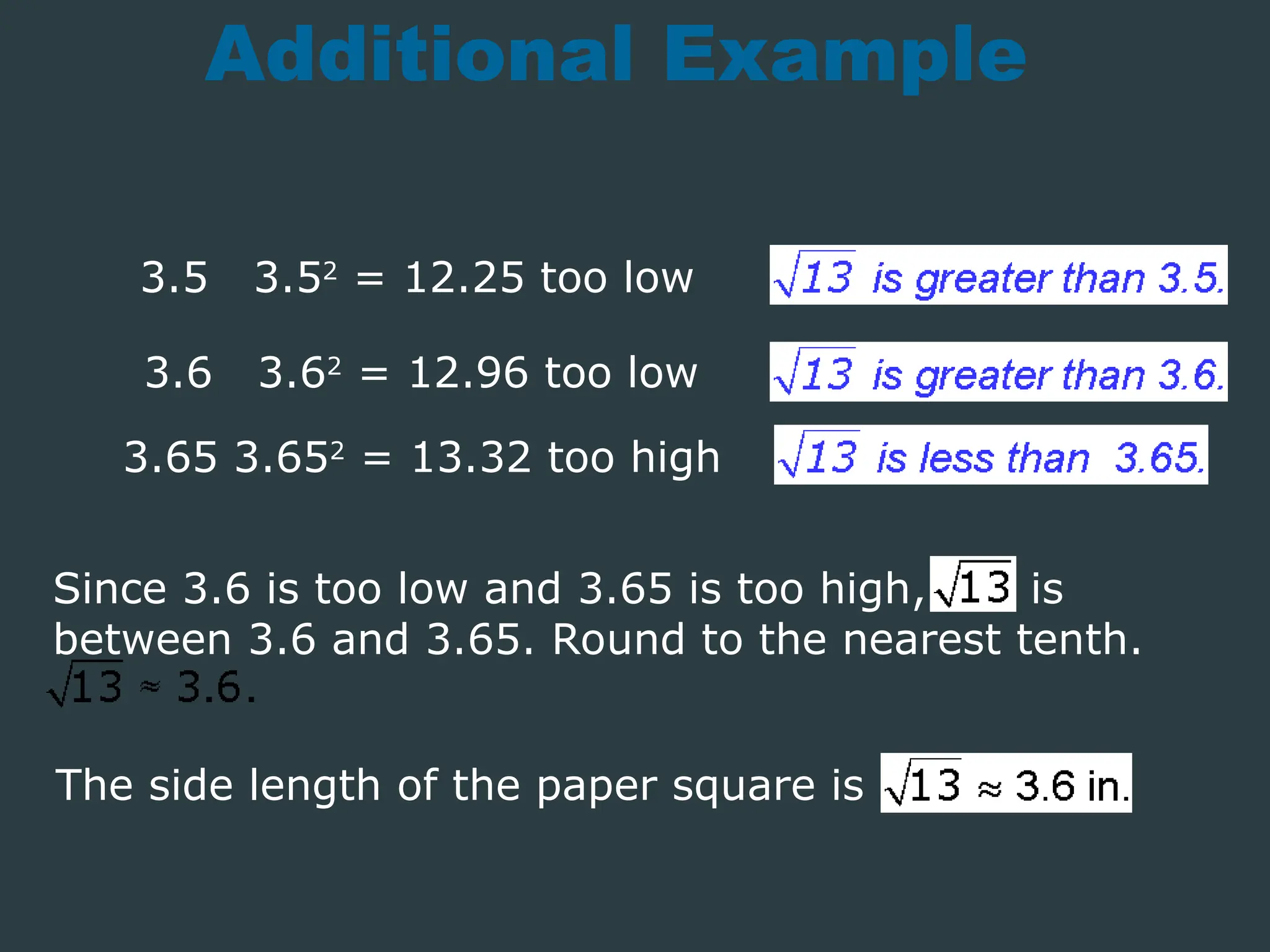
3.5 3.52
= 12.25 too low
3.6 3.62
= 12.96 too low
3.65 3.652
= 13.32 too high
The side length of the paper square is
Since 3.6 is too low and 3.65 is too high, is
between 3.6 and 3.65. Round to the nearest tenth.
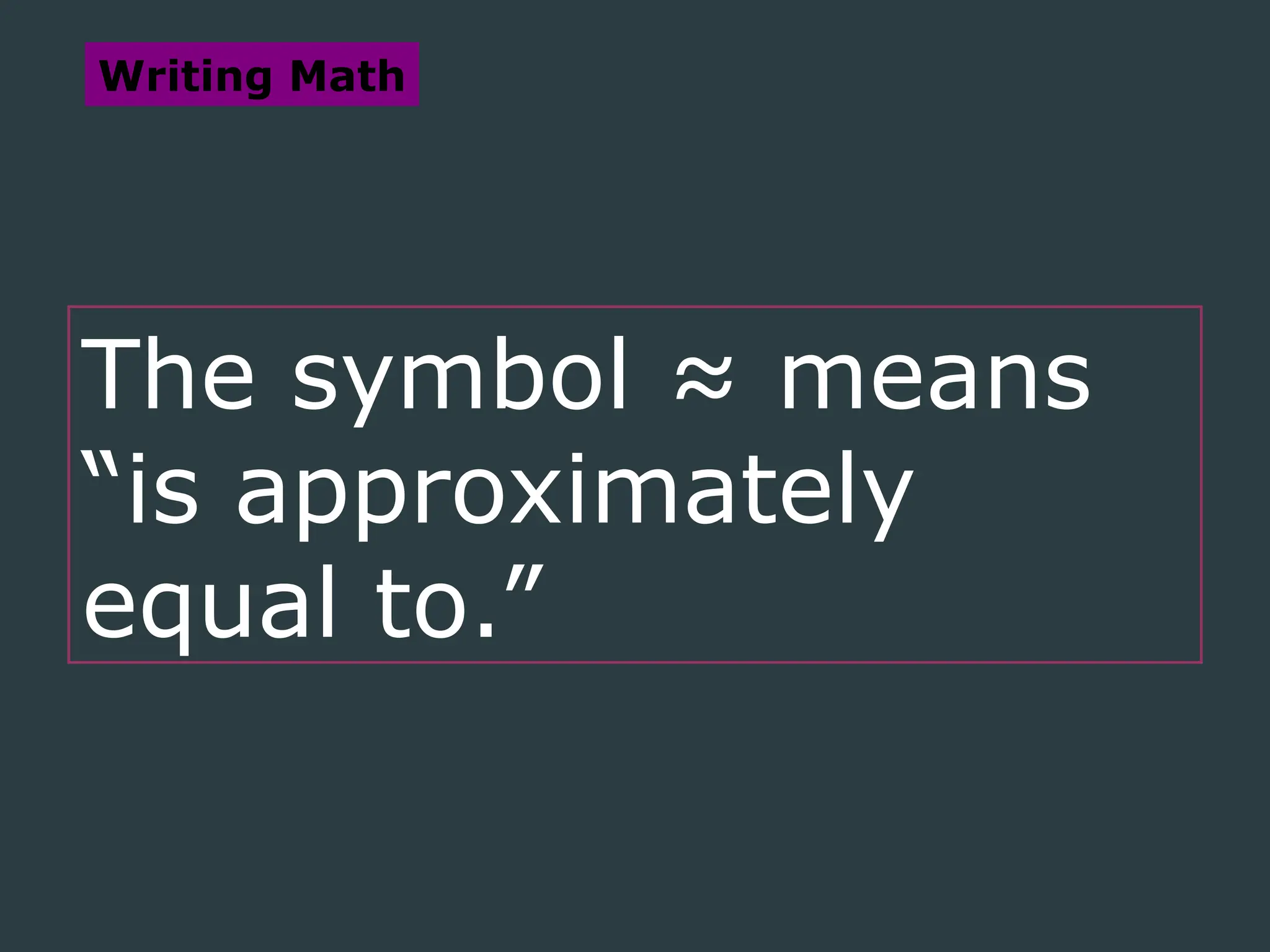
The symbol ≈ means
“is approximately
equal to.”
Writing Math
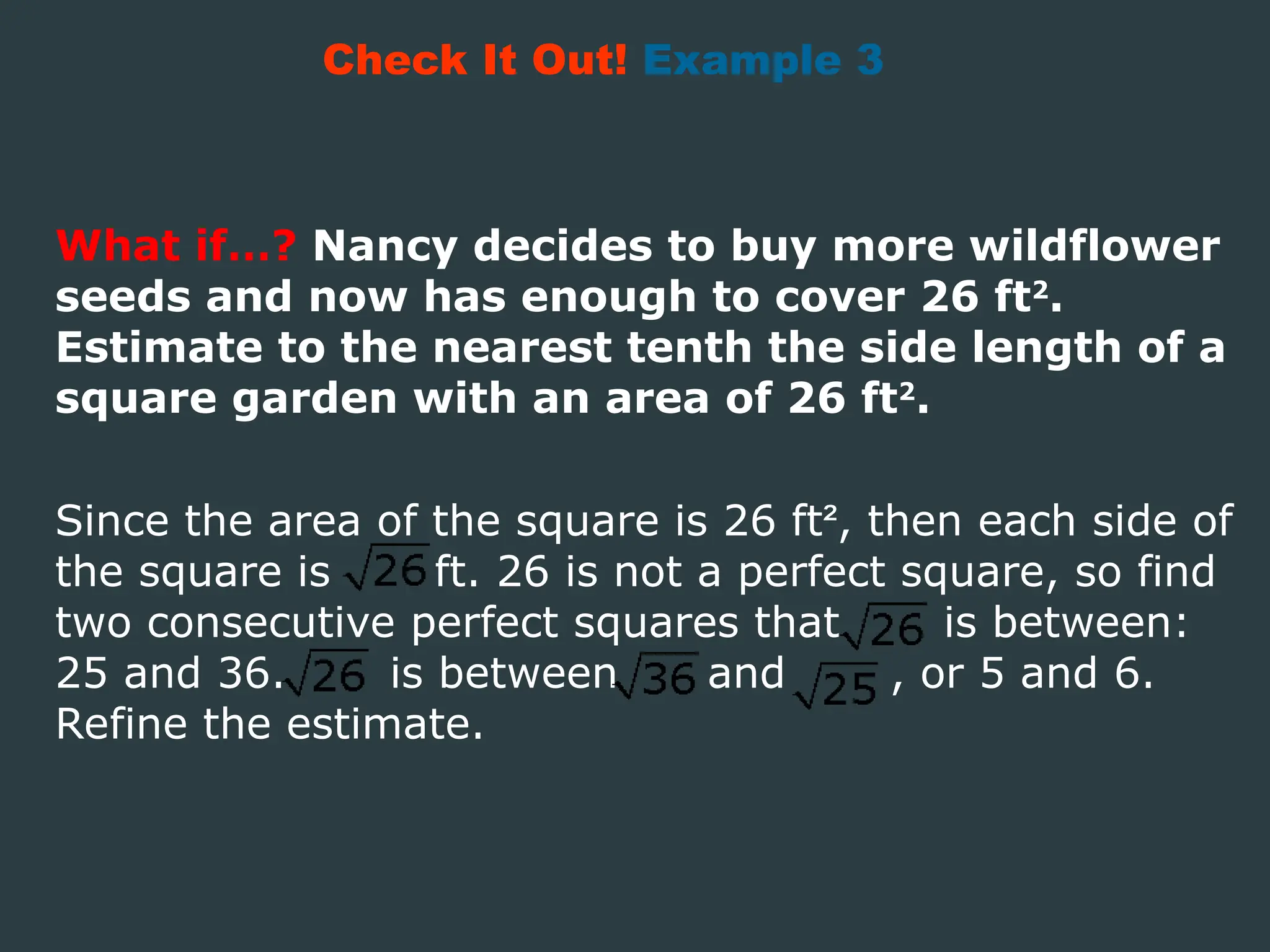
What if…? Nancy decides to buy more wildflower
seeds and now has enough to cover 26 ft2
.
Estimate to the nearest tenth the side length of a
square garden with an area of 26 ft2
.
Check It Out! Example 3
Since the area of the square is 26 ft², then each side of
the square is ft. 26 is not a perfect square, so find
two consecutive perfect squares that is between:
25 and 36. is between and , or 5 and 6.
Refine the estimate.
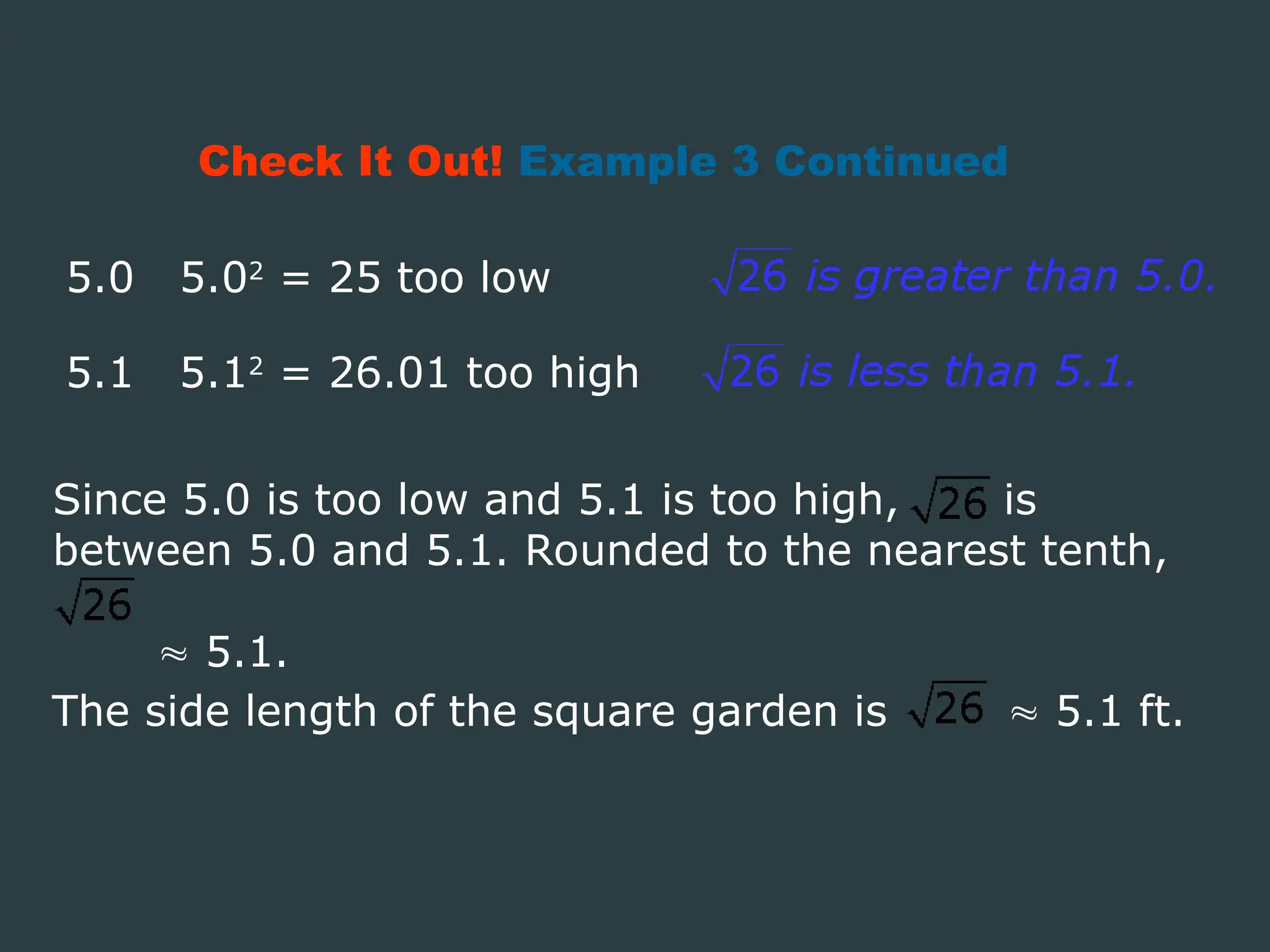
Check It Out! Example 3 Continued
5.0 5.02
= 25 too low
5.1 5.12
= 26.01 too high
Since 5.0 is too low and 5.1 is too high, is
between 5.0 and 5.1. Rounded to the nearest tenth,
 5.1.
The side length of the square garden is  5.1 ft.
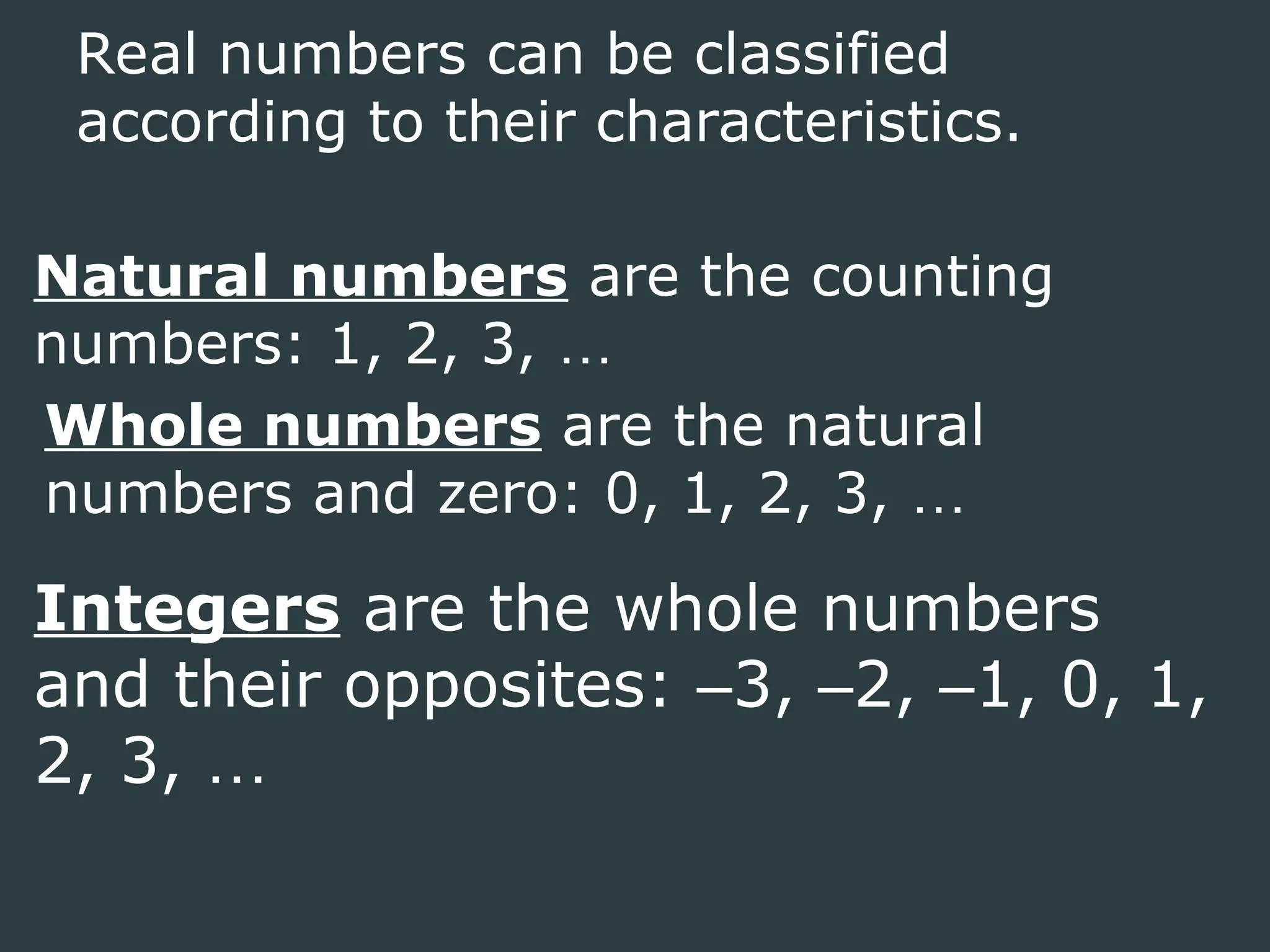
Real numbers can be classified
according to their characteristics.
Natural numbers are the counting
numbers: 1, 2, 3, …
Whole numbers are the natural
numbers and zero: 0, 1, 2, 3, …
Integers are the whole numbers
and their opposites: –3, –2, –1, 0, 1,
2, 3, …
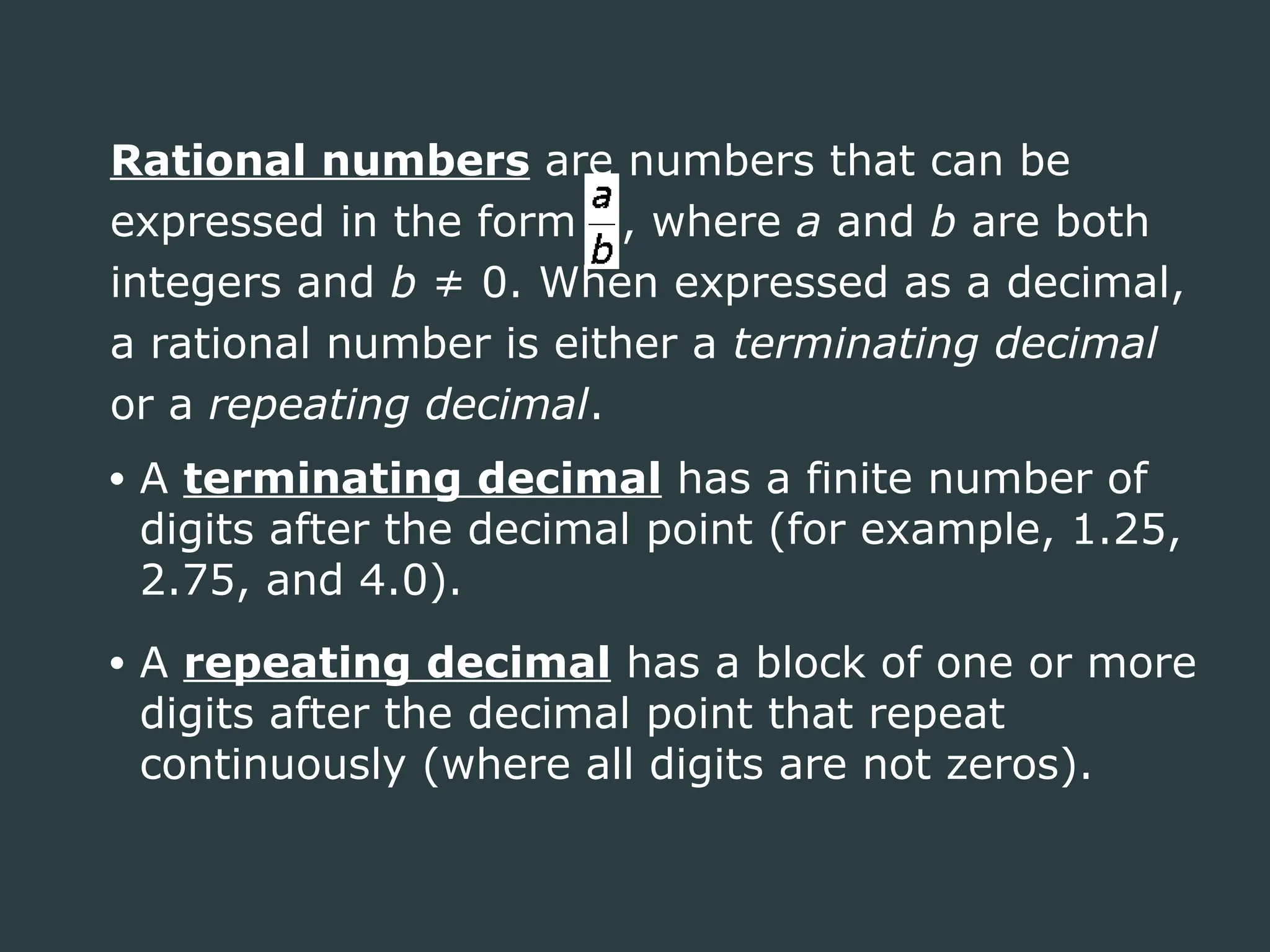
Rational numbers are numbers that can be
expressed in the form , where a and b are both
integers and b ≠ 0. When expressed as a decimal,
a rational number is either a terminating decimal
or a repeating decimal.
• A terminating decimal has a finite number of
digits after the decimal point (for example, 1.25,
2.75, and 4.0).
• A repeating decimal has a block of one or more
digits after the decimal point that repeat
continuously (where all digits are not zeros).
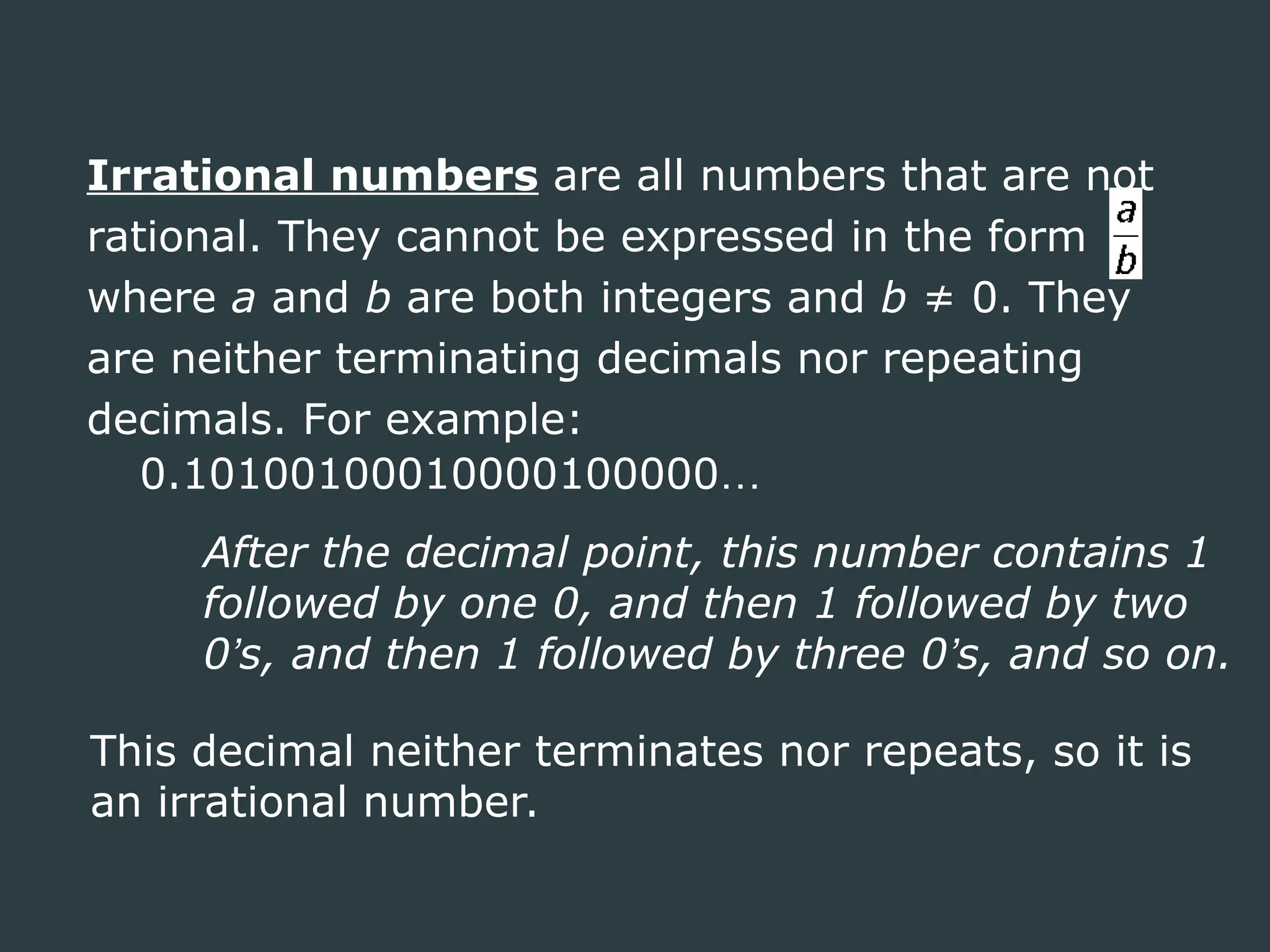
Irrational numbers are all numbers that are not
rational. They cannot be expressed in the form
where a and b are both integers and b ≠ 0. They
are neither terminating decimals nor repeating
decimals. For example:
0.10100100010000100000…
After the decimal point, this number contains 1
followed by one 0, and then 1 followed by two
0’s, and then 1 followed by three 0’s, and so on.
This decimal neither terminates nor repeats, so it is
an irrational number.
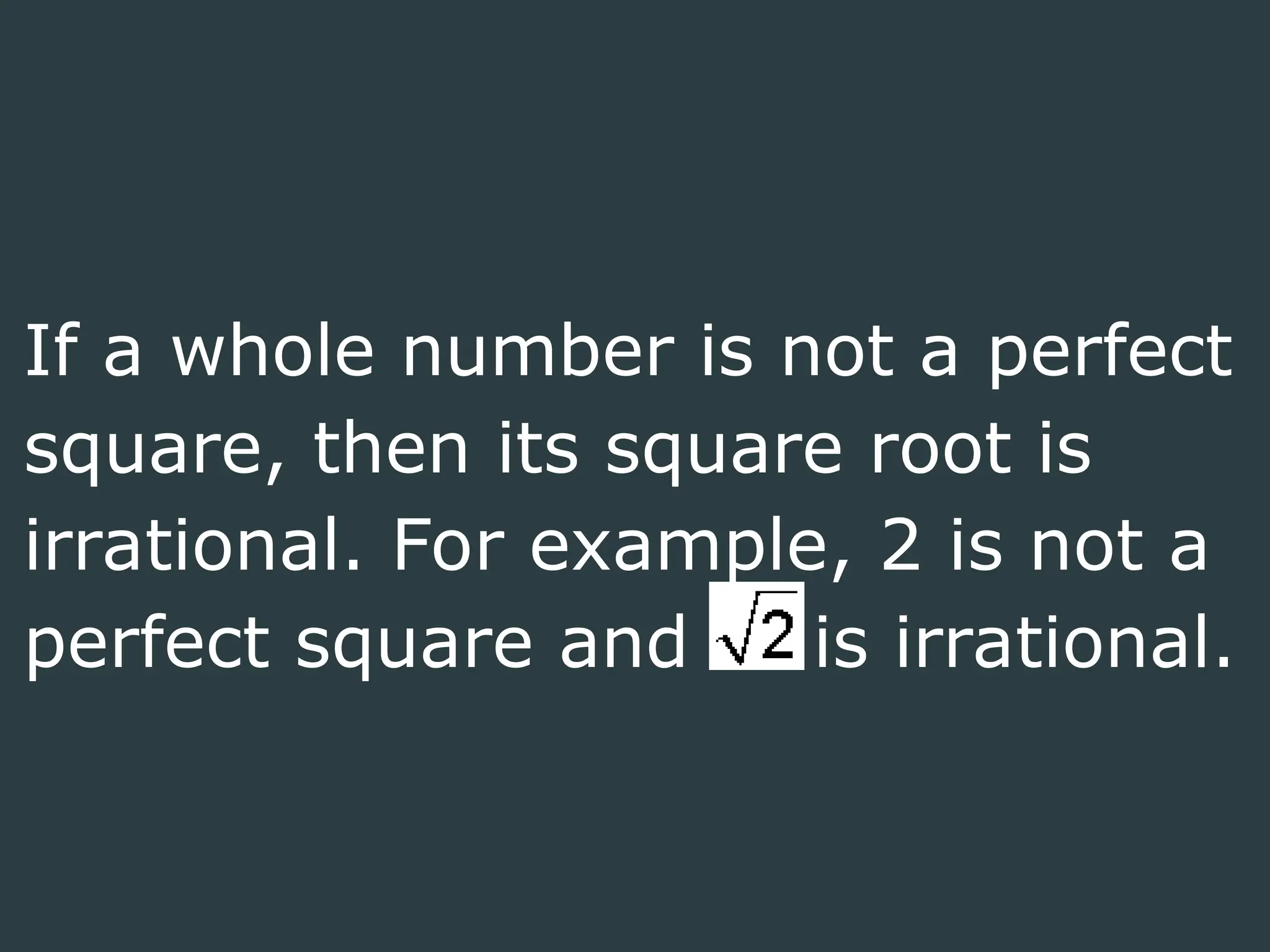
If a whole number is not a perfect
square, then its square root is
irrational. For example, 2 is not a
perfect square and is irrational.
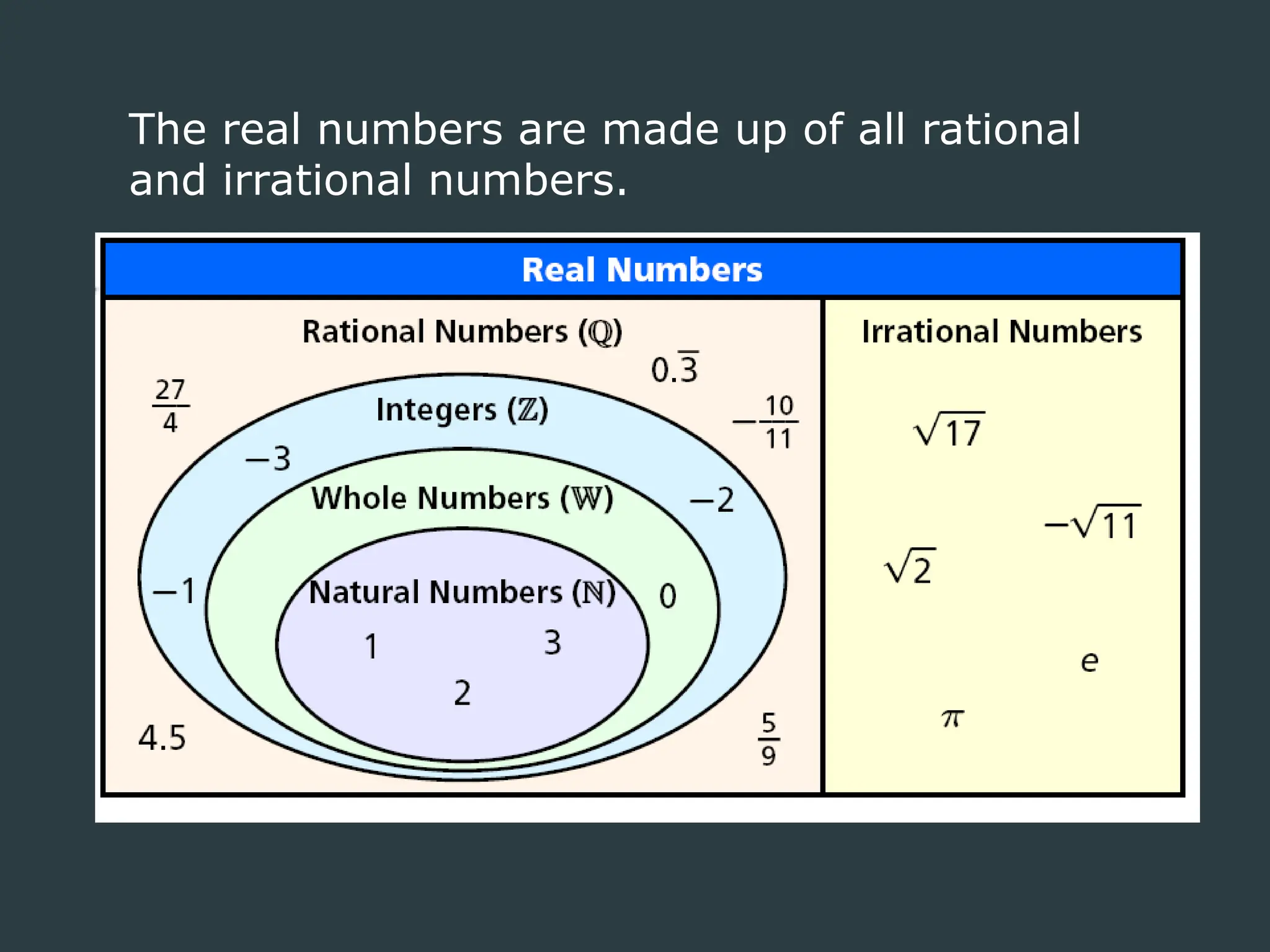
The real numbers are made up of all rational
and irrational numbers.
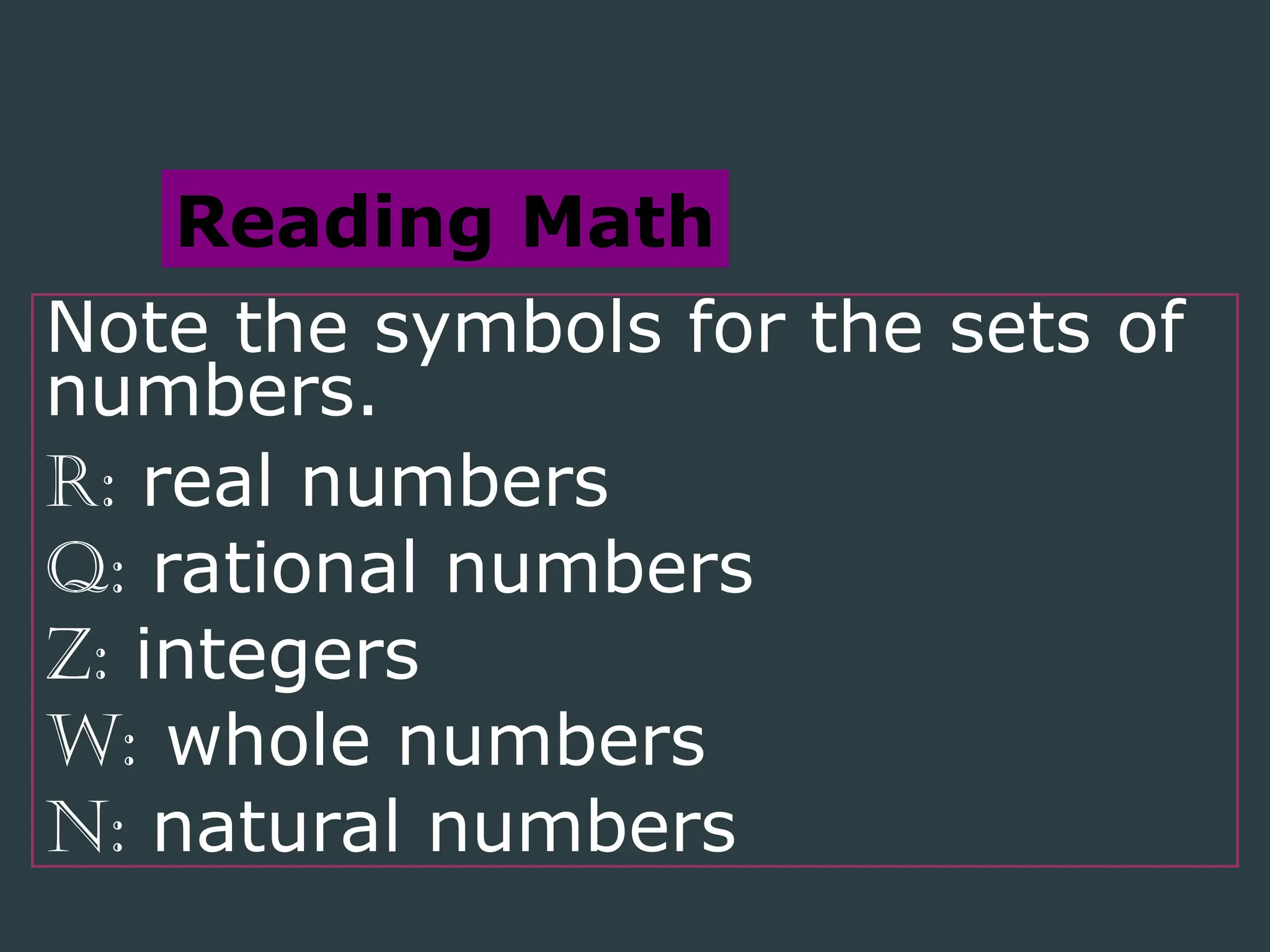
Note the symbols for the sets of
numbers.
R: real numbers
Q: rational numbers
Z: integers
W: whole numbers
N: natural numbers
Reading Math
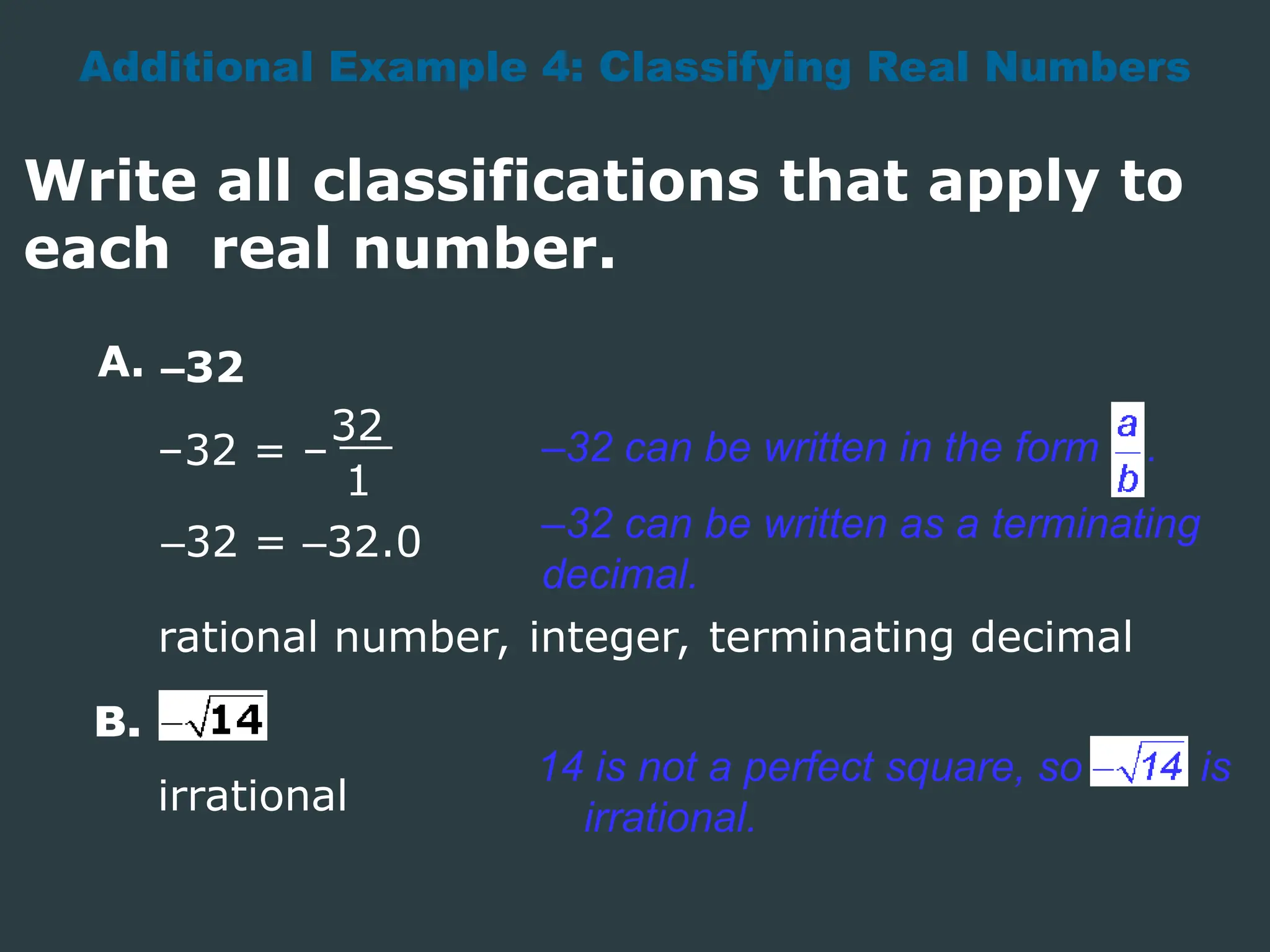
Additional Example 4: Classifying Real Numbers
Write all classifications that apply to
each real number.
A.
–32 = –
32
1
rational number, integer, terminating decimal
B.
irrational
–32
–32 can be written in the form .
14 is not a perfect square, so is
irrational.
–32 can be written as a terminating
decimal.
–32 = –32.0
Write all classifications that apply to each real
number.
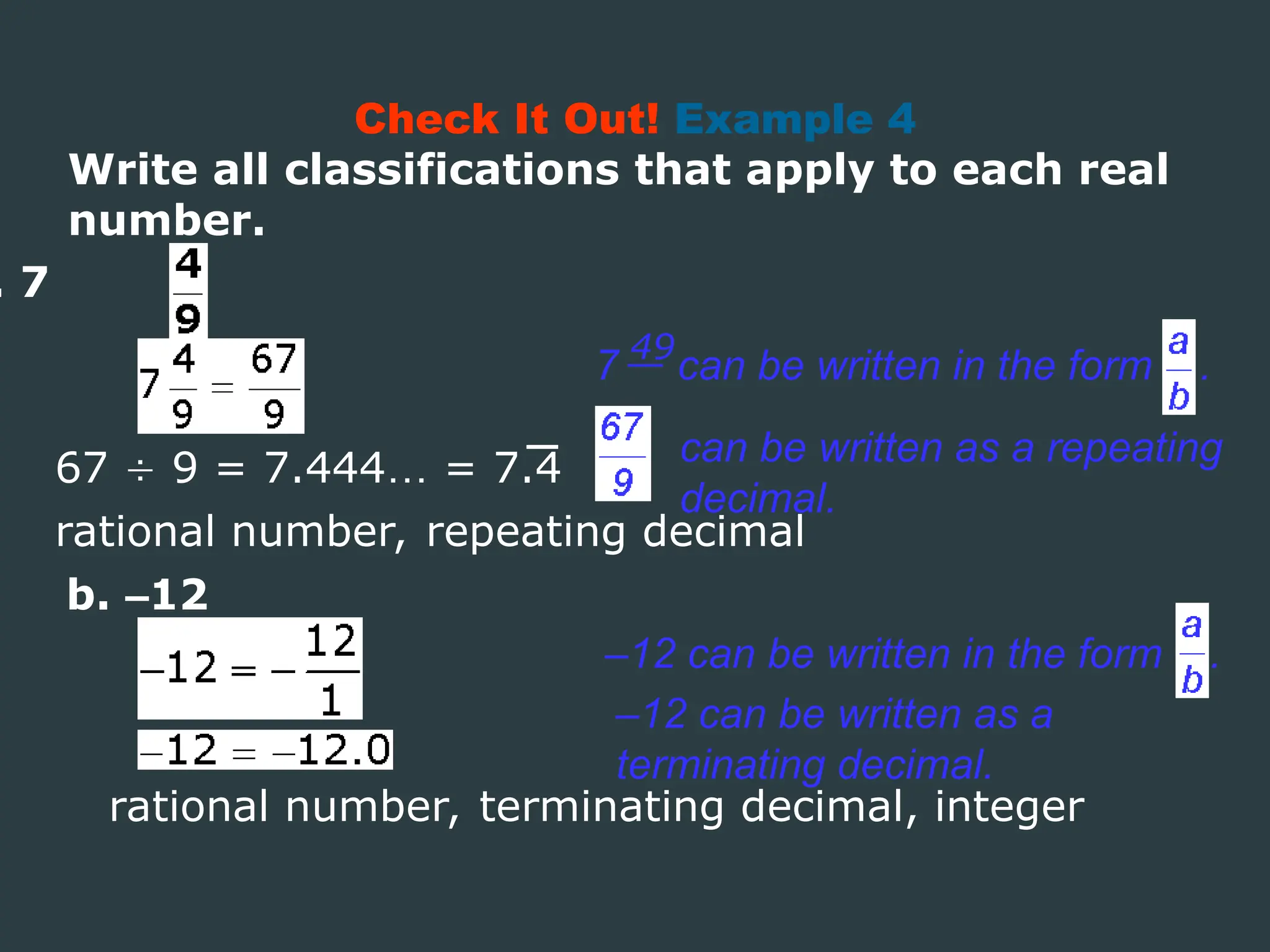
. 7
rational number, repeating decimal
Check It Out! Example 4
67  9 = 7.444… = 7.4
7 can be written in the form .
49
can be written as a repeating
decimal.
b. –12
–12 can be written in the form .
–12 can be written as a
terminating decimal.
rational number, terminating decimal, integer
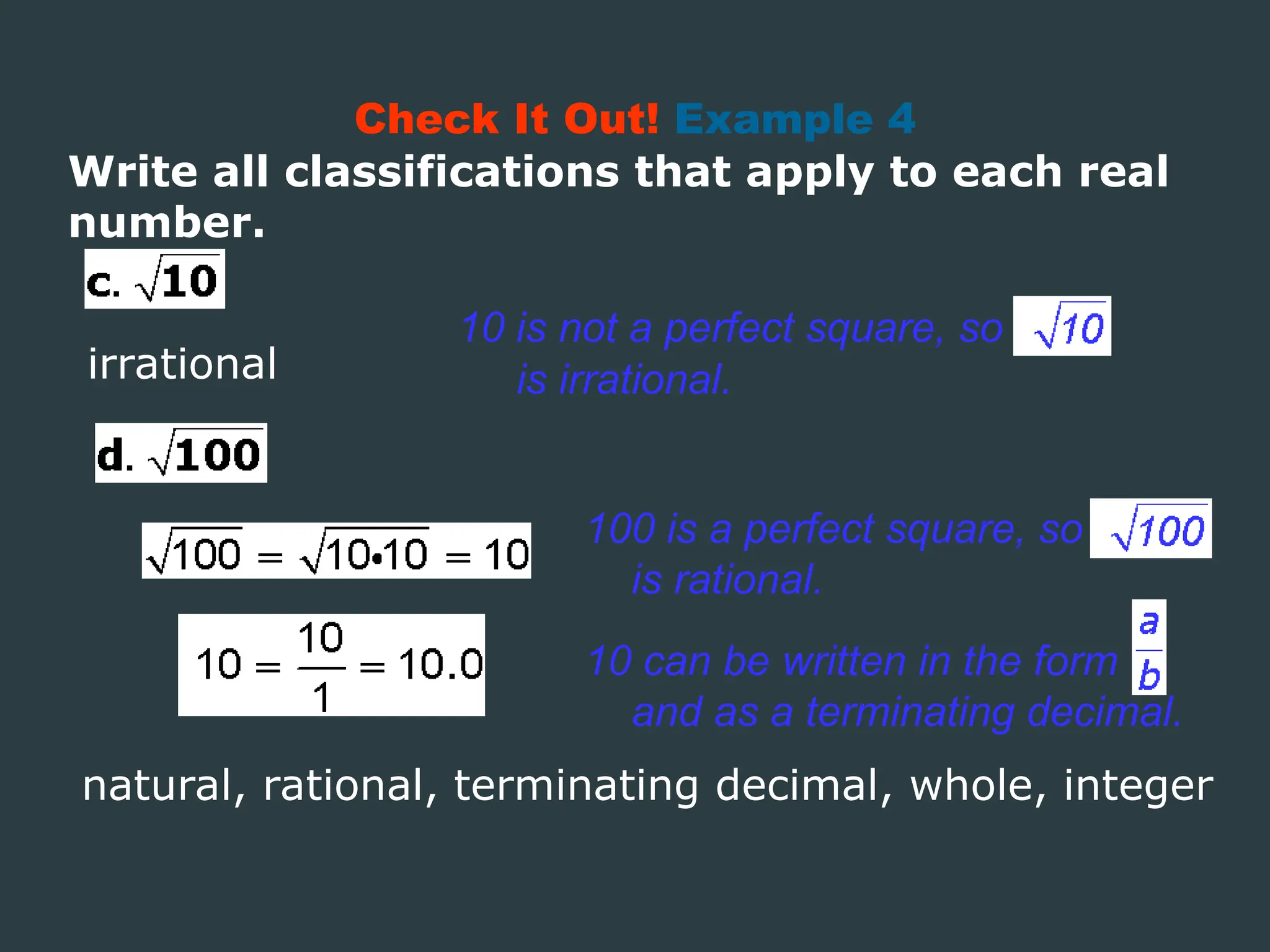
Write all classifications that apply to each real
number.
Check It Out! Example 4
irrational
100 is a perfect square, so
is rational.
10 is not a perfect square, so
is irrational.
10 can be written in the form
and as a terminating decimal.
natural, rational, terminating decimal, whole, integer
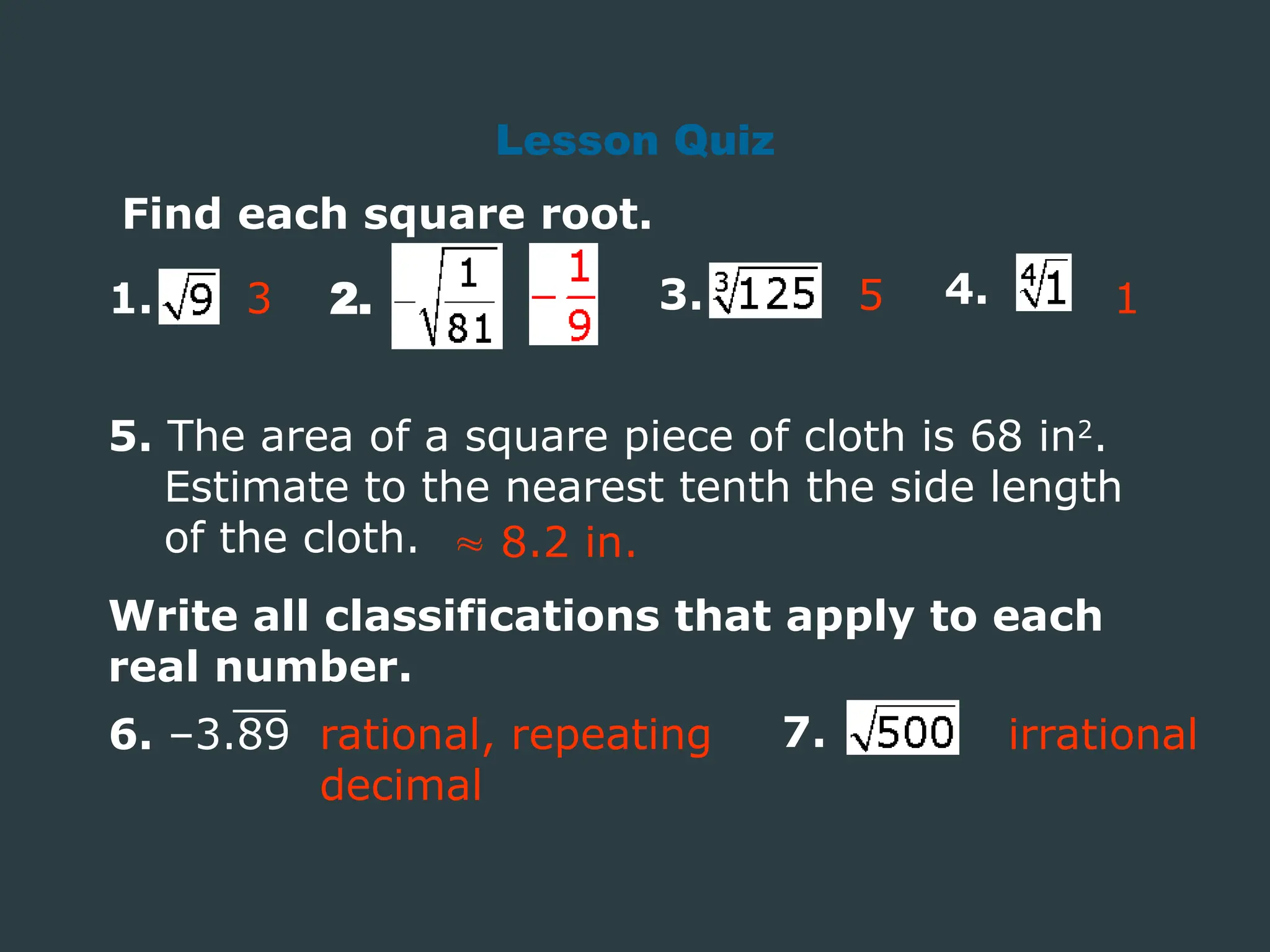
Find each square root.
1. 2. 3. 4.
3
5. The area of a square piece of cloth is 68 in2
.
Estimate to the nearest tenth the side length
of the cloth.  8.2 in.
Lesson Quiz
Write all classifications that apply to each
real number.
6. –3.89 7.
rational, repeating
decimal
irrational
1
5
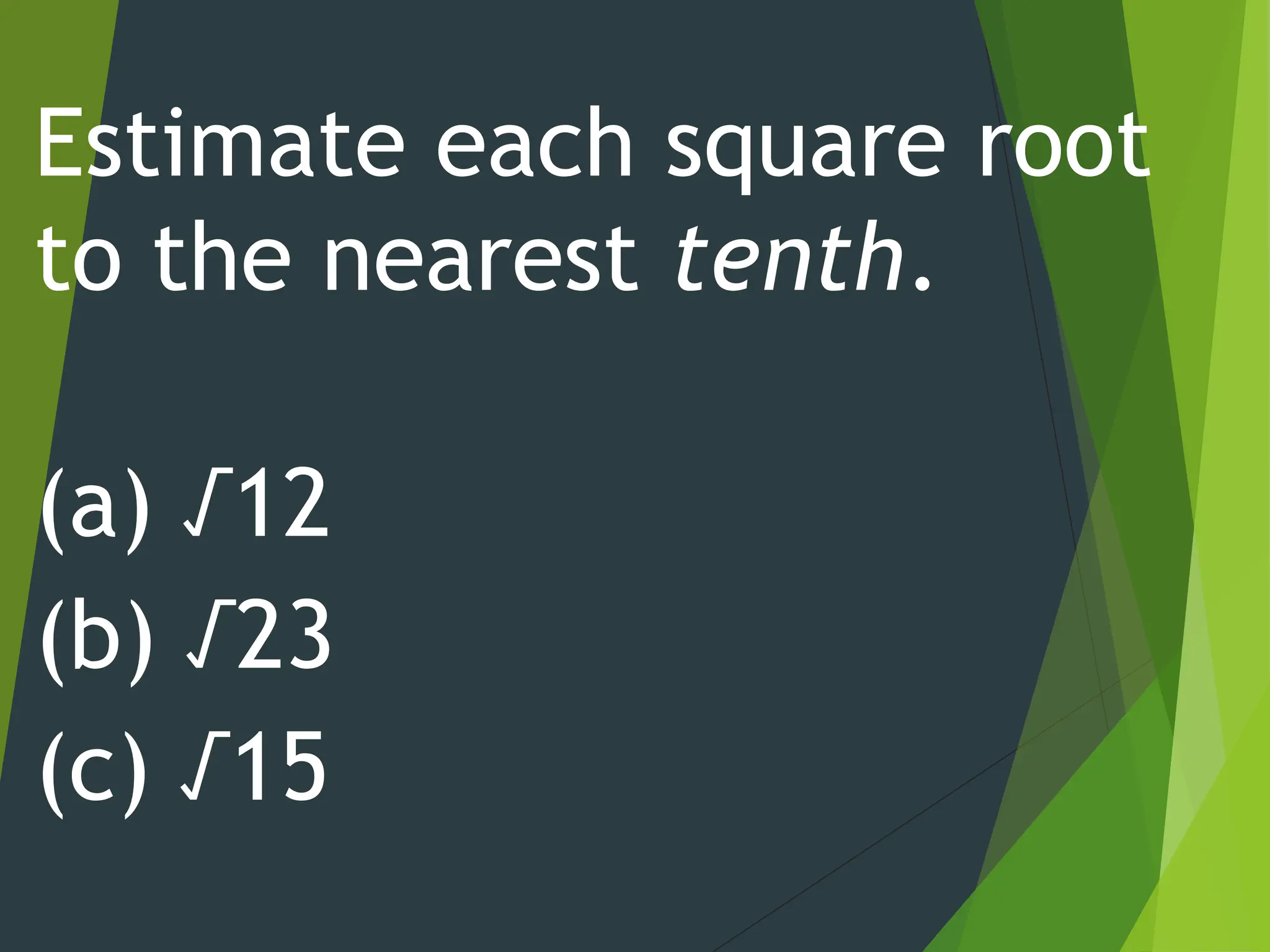
Estimate each square root
to the nearest tenth.
(a) √12
(b) √23
(c) √15
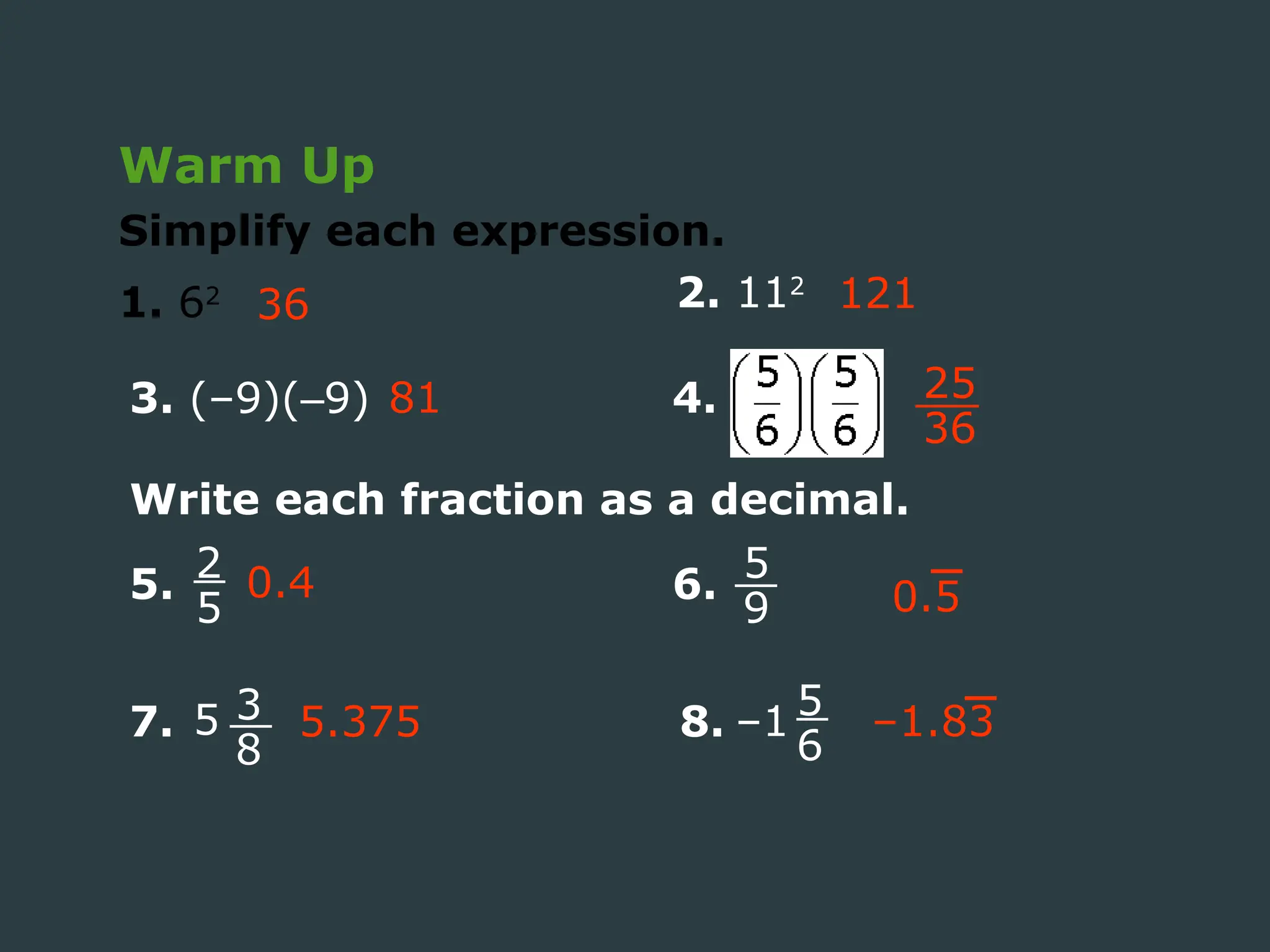
Tell whether the principal roots
of each number is rational or
irrational.
1. √7 6. √6
2. √8 7. √5
3. √4 8. √16
4. √ 9 9. √2
5. √3 10. √25
Content, images, text,
etc. used belong to the
rightful owner. No
copyright infringement
intended

G7 Math Q1-Week 7-Roots-and-Irrational-Numbers.ppt

  • 2.
    Warm Up Simplify eachexpression. 1. 62 36 2. 112 121 3. (–9)(–9) 81 4. 25 36 Write each fraction as a decimal. 5. 2 5 5 9 6. 7. 5 3 8 8. –1 5 6 0.4 5.375 0.5 –1.83
  • 3.
    square root terminatingdecimal principal square root repeating decimal perfect square irrational numbers cube root natural numbers whole numbers integers rational numbers Vocabulary
  • 4.
    4  4= 42 = 16 = 4 Positive square root of 16 (–4)(–4) = (–4)2 = 16 = –4 Negative square root of 16 – A number that is multiplied by itself to form a product is a square root of that product. The radical symbol is used to represent square roots. For nonnegative numbers, the operations of squaring and finding a square root are inverse operations. In other words, for x ≥ 0, Positive real numbers have two square roots.
  • 5.
    A perfect squareis a number whose positive square root is a whole number. Some examples of perfect squares are shown in the table. 0 02 1 12 100 4 22 9 32 16 42 25 52 36 62 49 72 64 82 81 92 102 The principal square root of a number is the positive square root and is represented by . A negative square root is represented by – . The symbol is used to represent both square roots.
  • 6.
    The small numberto the left of the root is the index. In a square root, the index is understood to be 2. In other words, is the same as . Writing Math
  • 7.
    A number thatis raised to the third power to form a product is a cube root of that product. The symbol indicates a cube root. Since 23 = 8, = 2. Similarly, the symbol indicates a fourth root: 2 = 16, so = 2.
  • 8.
    Additional Example 1:Finding Roots Find each root. Think: What number squared equals 81? Think: What number squared equals 25?
  • 9.
    Find the root. Think:What number cubed equals –216? Additional Example 1: Finding Roots = –6 (–6)(–6)(–6) = 36(–6) = –216 C.
  • 10.
    Find each root. CheckIt Out! Example 1 Think: What number squared equals 4? Think: What number squared equals 25? a. b.
  • 11.
    Find the root. CheckIt Out! Example 1 Think: What number to the fourth power equals 81? c.
  • 12.
    Additional Example 2:Finding Roots of Fractions Find the root. Think: What number squared equals A.
  • 13.
    Additional Example 2:Finding Roots of Fractions Find the root. Think: What number cubed equals B.
  • 14.
    Additional Example 2:Finding Roots of Fractions Find the root. Think: What number squared equals C.
  • 15.
    Find the root. CheckIt Out! Example 2 Think: What number squared equals a.
  • 16.
    Find the root. CheckIt Out! Example 2 Think: What number cubed equals b.
  • 17.
    Find the root. CheckIt Out! Example 2c Think: What number squared equals c.
  • 18.
    Square roots ofnumbers that are not perfect squares, such as 15, are not whole numbers. A calculator can approximate the value of as 3.872983346... Without a calculator, you can use square roots of perfect squares to help estimate the square roots of other numbers.
  • 19.
    Additional Example 3:Art Application As part of her art project, Shonda will need to make a paper square covered in glitter. Her tube of glitter covers 13 in². Estimate to the nearest tenth the side length of a square with an area of 13 in². Since the area of the square is 13 in², then each side of the square is in. 13 is not a perfect square, so find two consecutive perfect squares that is between: 9 and 16. is between and , or 3 and 4. Refine the estimate.
  • 20.
    Additional Example 3.5 3.52 =12.25 too low 3.6 3.62 = 12.96 too low 3.65 3.652 = 13.32 too high The side length of the paper square is Since 3.6 is too low and 3.65 is too high, is between 3.6 and 3.65. Round to the nearest tenth.
  • 21.
    The symbol ≈means “is approximately equal to.” Writing Math
  • 22.
    What if…? Nancydecides to buy more wildflower seeds and now has enough to cover 26 ft2 . Estimate to the nearest tenth the side length of a square garden with an area of 26 ft2 . Check It Out! Example 3 Since the area of the square is 26 ft², then each side of the square is ft. 26 is not a perfect square, so find two consecutive perfect squares that is between: 25 and 36. is between and , or 5 and 6. Refine the estimate.
  • 23.
    Check It Out!Example 3 Continued 5.0 5.02 = 25 too low 5.1 5.12 = 26.01 too high Since 5.0 is too low and 5.1 is too high, is between 5.0 and 5.1. Rounded to the nearest tenth,  5.1. The side length of the square garden is  5.1 ft.
  • 24.
    Real numbers canbe classified according to their characteristics. Natural numbers are the counting numbers: 1, 2, 3, … Whole numbers are the natural numbers and zero: 0, 1, 2, 3, … Integers are the whole numbers and their opposites: –3, –2, –1, 0, 1, 2, 3, …
  • 25.
    Rational numbers arenumbers that can be expressed in the form , where a and b are both integers and b ≠ 0. When expressed as a decimal, a rational number is either a terminating decimal or a repeating decimal. • A terminating decimal has a finite number of digits after the decimal point (for example, 1.25, 2.75, and 4.0). • A repeating decimal has a block of one or more digits after the decimal point that repeat continuously (where all digits are not zeros).
  • 26.
    Irrational numbers areall numbers that are not rational. They cannot be expressed in the form where a and b are both integers and b ≠ 0. They are neither terminating decimals nor repeating decimals. For example: 0.10100100010000100000… After the decimal point, this number contains 1 followed by one 0, and then 1 followed by two 0’s, and then 1 followed by three 0’s, and so on. This decimal neither terminates nor repeats, so it is an irrational number.
  • 27.
    If a wholenumber is not a perfect square, then its square root is irrational. For example, 2 is not a perfect square and is irrational.
  • 28.
    The real numbersare made up of all rational and irrational numbers.
  • 29.
    Note the symbolsfor the sets of numbers. R: real numbers Q: rational numbers Z: integers W: whole numbers N: natural numbers Reading Math
  • 30.
    Additional Example 4:Classifying Real Numbers Write all classifications that apply to each real number. A. –32 = – 32 1 rational number, integer, terminating decimal B. irrational –32 –32 can be written in the form . 14 is not a perfect square, so is irrational. –32 can be written as a terminating decimal. –32 = –32.0
  • 31.
    Write all classificationsthat apply to each real number. . 7 rational number, repeating decimal Check It Out! Example 4 67  9 = 7.444… = 7.4 7 can be written in the form . 49 can be written as a repeating decimal. b. –12 –12 can be written in the form . –12 can be written as a terminating decimal. rational number, terminating decimal, integer
  • 32.
    Write all classificationsthat apply to each real number. Check It Out! Example 4 irrational 100 is a perfect square, so is rational. 10 is not a perfect square, so is irrational. 10 can be written in the form and as a terminating decimal. natural, rational, terminating decimal, whole, integer
  • 33.
    Find each squareroot. 1. 2. 3. 4. 3 5. The area of a square piece of cloth is 68 in2 . Estimate to the nearest tenth the side length of the cloth.  8.2 in. Lesson Quiz Write all classifications that apply to each real number. 6. –3.89 7. rational, repeating decimal irrational 1 5
  • 34.
    Estimate each squareroot to the nearest tenth. (a) √12 (b) √23 (c) √15
  • 35.
    Tell whether theprincipal roots of each number is rational or irrational. 1. √7 6. √6 2. √8 7. √5 3. √4 8. √16 4. √ 9 9. √2 5. √3 10. √25
  • 36.
    Content, images, text, etc.used belong to the rightful owner. No copyright infringement intended