CHAPTER
Problem Solving
3
Problem Solving with
Patterns
Section3.2
Terms of a Sequence
Terms of a Sequence
An ordered list of numbers such as 5, 14, 27, 44, 65, ...
is called a sequence. The numbers in a sequence that
are separated by commas are the terms of the sequence.
In the above sequence, 5 is the first term, 14 is the
second term, 27 is the third term, 44 is the fourth term,
and 65 is the fifth term.
The three dots “...” indicate that the sequence continues
beyond 65, which is the last written term. It is customary
to use the subscript notation an to designate the nth
term of a sequence.
Terms of a Sequence
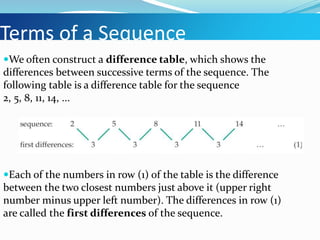
We often construct a difference table, which shows the
differences between successive terms of the sequence. The
following table is a difference table for the sequence
2, 5, 8, 11, 14, ...
Each of the numbers in row (1) of the table is the difference
between the two closest numbers just above it (upper right
number minus upper left number). The differences in row (1)
are called the first differences of the sequence.
Terms of a Sequence
In this case, the first differences are all the same.
Thus, if we use the above difference table to predict the
next number in the sequence, we predict that 14 + 3 = 17
is the next term of the sequence.
This prediction might be wrong; however, the pattern
shown by the first differences seems to indicate that
each successive term is 3 larger than the preceding term.
Terms of a Sequence
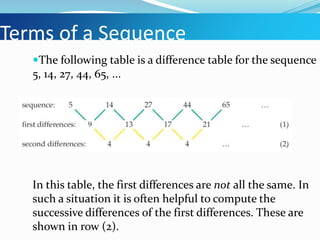
The following table is a difference table for the sequence
5, 14, 27, 44, 65, ...
In this table, the first differences are not all the same. In
such a situation it is often helpful to compute the
successive differences of the first differences. These are
shown in row (2).
Terms of a Sequence
These differences of the first differences are called the
second differences.
The differences of the second differences are called the
third differences.
To predict the next term of a sequence, we often look
for a pattern in a row of differences.
Example 1 – Predict the Next Term of a Sequence
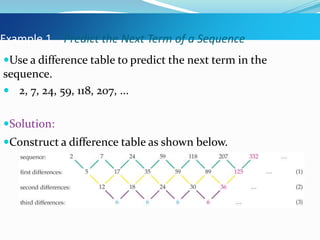
Use a difference table to predict the next term in the
sequence.
 2, 7, 24, 59, 118, 207, ...
Solution:
Construct a difference table as shown below.
Example 1 – Solution
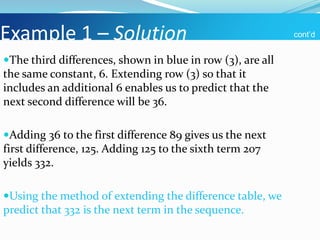
The third differences, shown in blue in row (3), are all
the same constant, 6. Extending row (3) so that it
includes an additional 6 enables us to predict that the
next second difference will be 36.
Adding 36 to the first difference 89 gives us the next
first difference, 125. Adding 125 to the sixth term 207
yields 332.
Using the method of extending the difference table, we
predict that 332 is the next term in the sequence.
cont’d
nth-Term Formula for a Sequence
In Example 1 we used a difference table to predict the
next term of a sequence.
In some cases we can use patterns to predict a formula,
called an nth-term formula, that generates the terms of
a sequence.
Example 2 – Find an nth-Term Formula
Assume the pattern shown by the square tiles in the
following figures continues.
a. What is the nth-term formula for the number of tiles
in
the nth figure of the sequence?
b. How many tiles are in the eighth figure of the
sequence?
c. Which figure will consist of exactly 320 tiles?
Example 2 – Solution
 a. Examine the figures for patterns.
Note that the second figure has two tiles on each of the
horizontal sections and one tile between the horizontal
sections.
 The third figure has three tiles on each horizontal
section and two tiles between the horizontal sections.
 The fourth figure has four tiles on each horizontal
section and three tiles between the horizontal sections.
Example 2 – Solution
 Thus the number of tiles in the nth figure is given by two
groups of n plus a group of n less one.
 That is,

an = 2n + (n – 1)
 an = 3n – 1
b. The number of tiles in the eighth figure of the sequence
is 3(8) – 1 = 23.
c. To determine which figure in the sequence will have 320
tiles, we solve the equation 3n – 1 = 320.

cont’d
Example 2 – Solution
 3n – 1 = 320
 3n = 321
 n = 107
The 107th figure is composed of 320 tiles.
Add 1 to each side.
Divide each side by 3.
cont’d
The Fibonacci Sequence
Here is a statement of Fibonacci’s rabbit problem.
At the beginning of a month, you are given a pair of
newborn rabbits. After a month the rabbits have
produced no offspring; however, every month thereafter,
the pair of rabbits produces another pair of rabbits.
The offspring reproduce in exactly the same manner. If
none of the rabbits dies, how many pairs of rabbits will
there be at the start of each succeeding month?
The Fibonacci Sequence
The solution of this problem is a sequence of numbers
that we now call the Fibonacci sequence.
The following figure shows the numbers of pairs of
rabbits on the first day of each of the first six months.
The larger rabbits represent mature rabbits that
produce another pair of rabbits each month.
The numbers in the blue region—1, 1, 2, 3, 5, 8—are the
first six terms of the Fibonacci sequence.
The Fibonacci Sequence

The Fibonacci Sequence
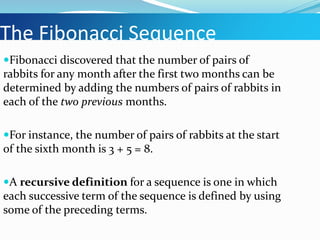
Fibonacci discovered that the number of pairs of
rabbits for any month after the first two months can be
determined by adding the numbers of pairs of rabbits in
each of the two previous months.
For instance, the number of pairs of rabbits at the start
of the sixth month is 3 + 5 = 8.
A recursive definition for a sequence is one in which
each successive term of the sequence is defined by using
some of the preceding terms.
The Fibonacci Sequence
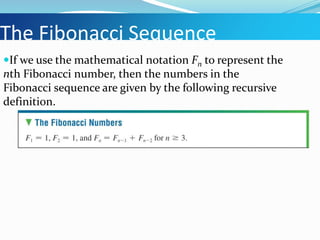
If we use the mathematical notation Fn to represent the
nth Fibonacci number, then the numbers in the
Fibonacci sequence are given by the following recursive
definition.
Example 3 – Find a Fibonacci Number
Use the definition of Fibonacci numbers to find the
seventh and eighth Fibonacci numbers.

Solution:
The first six Fibonacci numbers are 1, 1, 2, 3, 5, and 8.
The seventh Fibonacci number is the sum of the two
previous Fibonacci numbers.
Thus,
 F7 = F6 + F5
 = 8 + 5
 = 13
Example 3 – Solution
The eighth Fibonacci number is
 F8 = F7 + F6
 = 13 + 8
 = 21
cont’d

Chap 03 02

  • 1.
  • 2.
  • 3.
    Terms of aSequence
  • 4.
    Terms of aSequence An ordered list of numbers such as 5, 14, 27, 44, 65, ... is called a sequence. The numbers in a sequence that are separated by commas are the terms of the sequence. In the above sequence, 5 is the first term, 14 is the second term, 27 is the third term, 44 is the fourth term, and 65 is the fifth term. The three dots “...” indicate that the sequence continues beyond 65, which is the last written term. It is customary to use the subscript notation an to designate the nth term of a sequence.
  • 5.
    Terms of aSequence We often construct a difference table, which shows the differences between successive terms of the sequence. The following table is a difference table for the sequence 2, 5, 8, 11, 14, ... Each of the numbers in row (1) of the table is the difference between the two closest numbers just above it (upper right number minus upper left number). The differences in row (1) are called the first differences of the sequence.
  • 6.
    Terms of aSequence In this case, the first differences are all the same. Thus, if we use the above difference table to predict the next number in the sequence, we predict that 14 + 3 = 17 is the next term of the sequence. This prediction might be wrong; however, the pattern shown by the first differences seems to indicate that each successive term is 3 larger than the preceding term.
  • 7.
    Terms of aSequence The following table is a difference table for the sequence 5, 14, 27, 44, 65, ... In this table, the first differences are not all the same. In such a situation it is often helpful to compute the successive differences of the first differences. These are shown in row (2).
  • 8.
    Terms of aSequence These differences of the first differences are called the second differences. The differences of the second differences are called the third differences. To predict the next term of a sequence, we often look for a pattern in a row of differences.
  • 9.
    Example 1 –Predict the Next Term of a Sequence Use a difference table to predict the next term in the sequence.  2, 7, 24, 59, 118, 207, ... Solution: Construct a difference table as shown below.
  • 10.
    Example 1 –Solution The third differences, shown in blue in row (3), are all the same constant, 6. Extending row (3) so that it includes an additional 6 enables us to predict that the next second difference will be 36. Adding 36 to the first difference 89 gives us the next first difference, 125. Adding 125 to the sixth term 207 yields 332. Using the method of extending the difference table, we predict that 332 is the next term in the sequence. cont’d
  • 11.
  • 12.
    nth-Term Formula fora Sequence In Example 1 we used a difference table to predict the next term of a sequence. In some cases we can use patterns to predict a formula, called an nth-term formula, that generates the terms of a sequence.
  • 13.
    Example 2 –Find an nth-Term Formula Assume the pattern shown by the square tiles in the following figures continues. a. What is the nth-term formula for the number of tiles in the nth figure of the sequence? b. How many tiles are in the eighth figure of the sequence? c. Which figure will consist of exactly 320 tiles?
  • 14.
    Example 2 –Solution  a. Examine the figures for patterns. Note that the second figure has two tiles on each of the horizontal sections and one tile between the horizontal sections.  The third figure has three tiles on each horizontal section and two tiles between the horizontal sections.  The fourth figure has four tiles on each horizontal section and three tiles between the horizontal sections.
  • 15.
    Example 2 –Solution  Thus the number of tiles in the nth figure is given by two groups of n plus a group of n less one.  That is,  an = 2n + (n – 1)  an = 3n – 1 b. The number of tiles in the eighth figure of the sequence is 3(8) – 1 = 23. c. To determine which figure in the sequence will have 320 tiles, we solve the equation 3n – 1 = 320.  cont’d
  • 16.
    Example 2 –Solution  3n – 1 = 320  3n = 321  n = 107 The 107th figure is composed of 320 tiles. Add 1 to each side. Divide each side by 3. cont’d
  • 17.
  • 18.
    The Fibonacci Sequence Hereis a statement of Fibonacci’s rabbit problem. At the beginning of a month, you are given a pair of newborn rabbits. After a month the rabbits have produced no offspring; however, every month thereafter, the pair of rabbits produces another pair of rabbits. The offspring reproduce in exactly the same manner. If none of the rabbits dies, how many pairs of rabbits will there be at the start of each succeeding month?
  • 19.
    The Fibonacci Sequence Thesolution of this problem is a sequence of numbers that we now call the Fibonacci sequence. The following figure shows the numbers of pairs of rabbits on the first day of each of the first six months. The larger rabbits represent mature rabbits that produce another pair of rabbits each month. The numbers in the blue region—1, 1, 2, 3, 5, 8—are the first six terms of the Fibonacci sequence.
  • 20.
  • 21.
    The Fibonacci Sequence Fibonaccidiscovered that the number of pairs of rabbits for any month after the first two months can be determined by adding the numbers of pairs of rabbits in each of the two previous months. For instance, the number of pairs of rabbits at the start of the sixth month is 3 + 5 = 8. A recursive definition for a sequence is one in which each successive term of the sequence is defined by using some of the preceding terms.
  • 22.
    The Fibonacci Sequence Ifwe use the mathematical notation Fn to represent the nth Fibonacci number, then the numbers in the Fibonacci sequence are given by the following recursive definition.
  • 23.
    Example 3 –Find a Fibonacci Number Use the definition of Fibonacci numbers to find the seventh and eighth Fibonacci numbers.  Solution: The first six Fibonacci numbers are 1, 1, 2, 3, 5, and 8. The seventh Fibonacci number is the sum of the two previous Fibonacci numbers. Thus,  F7 = F6 + F5  = 8 + 5  = 13
  • 24.
    Example 3 –Solution The eighth Fibonacci number is  F8 = F7 + F6  = 13 + 8  = 21 cont’d