
AGE OF CRIMINAL
RESPONSIBILITY
Crime: Young Offenders
Juvenile Justice
 Law and policy which relates to “minors” (i.e.
people under 18 years of age)
 Our legal system recognises that people who
aren’t yet adults may have a different level of
responsibility for their actions
 Juvenile justice aims to combine welfare
programs (which relate to the wellbeing of the
child) and justice programs (which generally
involve sanctions and punishment)
Age of criminal responsibility
 10 years of age
 Children (Criminal Proceedings) Act 1987(NSW)
 “no child who is under the age of 10 years can be
guilty of an offence” (s.5)
 Convention on the Rights of the Child (CRoC)
 Children from10-13 may be charged in
Australia, if it’s demonstrated that they
understand right from wrong
 Young people from 14-17 are considered to
understand right from wrong
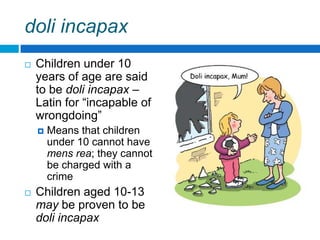
doli incapax
 Children under 10 years
of age are said to be doli
incapax – Latin for
“incapable of wrongdoing”
 Means that children under
10 cannot have mens rea -
don’t understand that it’s
“seriously wrong” (R v
Gorrie 1919); they cannot
be charged with a crime
 Children aged 10-14 are
presumed to be doli
incapax – can be proven
to be otherwise.
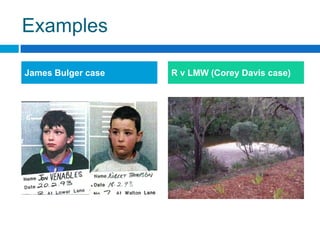
Examples
James Bulger case (1993)
R v LMW (1999) Corey Davis
case
When there are high-profile youth cases, there are often calls to remove
doli incapax. Is this right? Or is doli incapax important? Why?
Should we remove doli incapax?

5.1 young offenders

  • 1.
  • 2.
    Juvenile Justice  Lawand policy which relates to “minors” (i.e. people under 18 years of age)  Our legal system recognises that people who aren’t yet adults may have a different level of responsibility for their actions  Juvenile justice aims to combine welfare programs (which relate to the wellbeing of the child) and justice programs (which generally involve sanctions and punishment)
  • 3.
    Age of criminalresponsibility  10 years of age  Children (Criminal Proceedings) Act 1987(NSW)  “no child who is under the age of 10 years can be guilty of an offence” (s.5)  Convention on the Rights of the Child (CRoC)  Children from10-13 may be charged in Australia, if it’s demonstrated that they understand right from wrong  Young people from 14-17 are considered to understand right from wrong
  • 4.
    doli incapax  Childrenunder 10 years of age are said to be doli incapax – Latin for “incapable of wrongdoing”  Means that children under 10 cannot have mens rea - don’t understand that it’s “seriously wrong” (R v Gorrie 1919); they cannot be charged with a crime  Children aged 10-14 are presumed to be doli incapax – can be proven to be otherwise.
  • 5.
    Examples James Bulger case(1993) R v LMW (1999) Corey Davis case
  • 6.
    When there arehigh-profile youth cases, there are often calls to remove doli incapax. Is this right? Or is doli incapax important? Why? Should we remove doli incapax?