
International Community
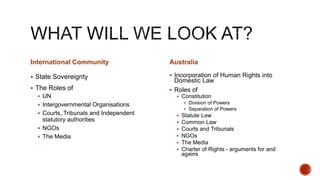
 State Sovereignty
 The Roles of
 UN
 Intergovernmental Organisations
 Courts, Tribunals and Independent
statutory authorities
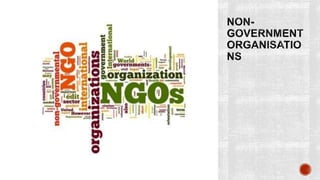
 NGOs
 The Media
Australia
 Incorporation of Human Rights into
Domestic Law
 Roles of
 Constitution
 Division of Powers
 Separation of Powers
 Statute Law
 Common Law
 Courts and Tribunals
 NGOs
 The Media
 Charter of Rights - arguments for and
agains
 Key part of being a nation state
 Supreme control over its own territory
 Absolute control over its legal system
 Right to choose whether or not to recognise other nations or IGOS
 Freedom to choose WITHOUT OUTSIDE INTERFERENCE
 Each nation must accept and enforce human rights individually – the UN cannot
enforce this
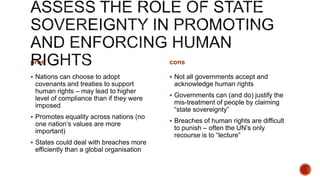
pros
 Nations can choose to adopt
covenants and treaties to support
human rights – may lead to higher
level of compliance than if they were
imposed
 Promotes equality across nations (no
one nation’s values are more
important)
 States could deal with breaches more
efficiently than a global organisation
cons
 Not all governments accept and
acknowledge human rights
 Governments can (and do) justify the
mis-treatment of people by claiming
“state sovereignty”
 Breaches of human rights are difficult
to punish – often the UN’s only
recourse is to “lecture”
 “States are simultaneously a threat to human rights and their principal protector”
 State Capacity, State Failure, and Human Rights, Journal of Peace Research
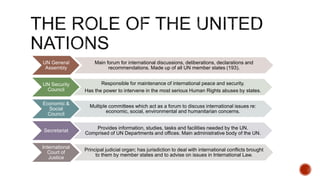
UN General
Assembly
Main forum for international discussions, deliberations, declarations and
recommendations. Made up of all UN member states (193).
UN Security
Council
Responsible for maintenance of international peace and security.
Has the power to intervene in the most serious Human Rights abuses by states.
Economic &
Social
Council
Multiple committees which act as a forum to discuss international issues re:
economic, social, environmental and humanitarian concerns.
Secretariat
Provides information, studies, tasks and facilities needed by the UN.
Comprised of UN Departments and offices. Main administrative body of the UN.
International
Court of
Justice
Principal judicial organ; has jurisdiction to deal with international conflicts brought
to them by member states and to advise on issues in International Law.
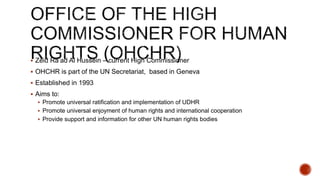
 Zeid Ra’ad Al Hussein – current High Commissioner
 OHCHR is part of the UN Secretariat, based in Geneva
 Established in 1993
 Aims to:
 Promote universal ratification and implementation of UDHR
 Promote universal enjoyment of human rights and international cooperation
 Provide support and information for other UN human rights bodies
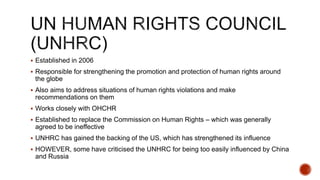
 Established in 2006
 Responsible for strengthening the promotion and protection of human rights around
the globe
 Also aims to address situations of human rights violations and make
recommendations on them
 Works closely with OHCHR
 Established to replace the Commission on Human Rights – which was generally
agreed to be ineffective
 UNHRC has gained the backing of the US, which has strengthened its influence
 HOWEVER, some have criticised the UNHRC for being too easily influenced by China
and Russia
 Separate & independent from government.
 May take the role of observers at the UN, but others are completely separate
 No authority to enforce Human Rights
 They do often promote - can push & influence people with authority.
 In the 1990s, the number & strength of NGOs grew significantly.
Direct action
 letters etc, that go directly to people
who are able to stop the abuse
 Eg:
Indirect action
 naming and shaming, eg: reports and
press releases
 Eg:
 Criticism by NGOs has been found to
be more effective than criticism from
IGOs (in Latin America - shame on you
2008)
 Different NGOs have different
strategies which in turn have different
levels of influence.
 Eg: if China were to criticise Australia,
our government woulld be unlikely to
listen because Ti An An Men Square...
BUT NGOs are generally not involved
in Human Rights Abuses, so
governments are more likely to listen
to them.
“Human rights criticism does lead
governments to reduce repression of
subsequent challenges in cases where
there are relatively strong economic ties
to other countries. However, the duration
of this impact is relatively short - less
than 6 months. Examination of the
source of human rights criticism shows
that criticism by NGOs, religious groups,
and foreign governments was more
effective than criticism from inter-
governmental organizations.”
Shame on You: The Impact of Human
Rights Criticism on Political
Repression in Latin America 2008
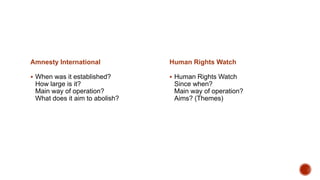
Amnesty International
 When was it established?
How large is it?
Main way of operation?
What does it aim to abolish?
Human Rights Watch
 Human Rights Watch
Since when?
Main way of operation?
Aims? (Themes)
Failures
 targets larger nations
 indirect action has had limited effect
 less successful with disappearances &
death penalty
 target countries according to "donor
interest"... Prioritised based on what
people care about, not what's actually
worst
Successes
 admits this( says it focuses on nations
where it can make a difference)
 direct action has resulted in changes
("urgent action campaigns")
 more successful with torture, prisoners
of conscience, arbitrary arrest
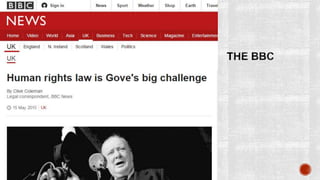
 Role - to report human rights abuses to the public by making them part of the news.
Human rights are considered "important" when they're "newsworthy“
 May act as a deterrent to the government - they make act (refuse to act) for fear of
making the news.
 Media may be a conscience trigger. Result in people acting after reading a story and
then lobby the government of join an NGO etc.
 Supposed to be independent & to report facts. BUT, a media source may be
government owned or influenced, or published and influenced by NGOs.
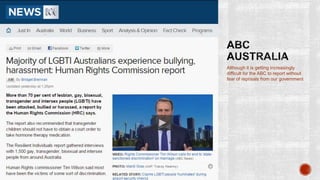
Although it is getting increasingly
difficult for the ABC to report without
fear of reprisals from our government
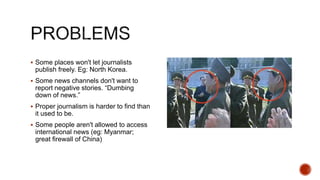
 Some places won't let journalists
publish freely. Eg: North Korea.
 Some news channels don't want to
report negative stories. “Dumbing
down of news.”
 Proper journalism is harder to find than
it used to be.
 Some people aren't allowed to access
international news (eg: Myanmar;
great firewall of China)
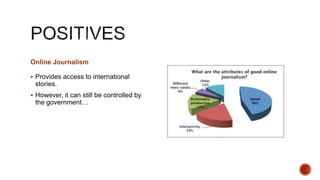
Online Journalism
 Provides access to international
stories.
 However, it can still be controlled by
the government…
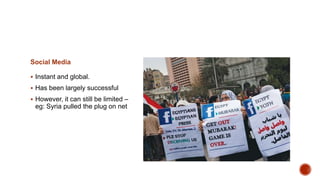
Social Media
 Instant and global.
 Has been largely successful
 However, it can still be limited –
eg: Syria pulled the plug on net
How does Australia incorporate Human Rights into Domestic Law?
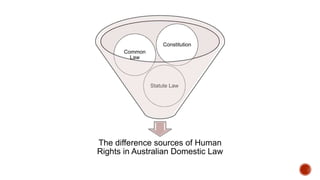
The difference sources of Human
Rights in Australian Domestic Law
Statute Law
Common
Law
Constitution
 Only contains a few references to Human Rights
 s.116 freedom of religion
 s.24 right to vote
 s.51(xxxi) right to acquisition of property on just terms
 s.117 the right not to be discriminated against as a result of residence in one state
 Division and Separation of Powers
 Division of Powers – distribution of legislative rights between The Commonwealth and the
States
 Separation of Powers – separation of the Commonwealth into 3 arms: legislature
(parliament), executive (government & its departments), judiciary (court system) – all are
equal before the law [“rule of law”]
 Some rights have been found to be “implied” in the Constitution
 Roach v Electoral Commissioner (2007)
 Traditionally, common law was the primary source of protection of individual and
collective rights (although this is changing)
 Common law is limited in how much it can protect our rights by the fact that parliament
can reverse its decisions through legislation – some people say this is a serious
limitation, and this makes common law rights insignificant
 Common law has also impeded human rights in Australia
 Right to legal representation
 Right to appeal
 Right to silence
 Discretion to admit evidence unlawfully gained

2 promoting and enforcing human rights

  • 2.
    International Community  StateSovereignty  The Roles of  UN  Intergovernmental Organisations  Courts, Tribunals and Independent statutory authorities  NGOs  The Media Australia  Incorporation of Human Rights into Domestic Law  Roles of  Constitution  Division of Powers  Separation of Powers  Statute Law  Common Law  Courts and Tribunals  NGOs  The Media  Charter of Rights - arguments for and agains
  • 4.
     Key partof being a nation state  Supreme control over its own territory  Absolute control over its legal system  Right to choose whether or not to recognise other nations or IGOS  Freedom to choose WITHOUT OUTSIDE INTERFERENCE  Each nation must accept and enforce human rights individually – the UN cannot enforce this
  • 5.
    pros  Nations canchoose to adopt covenants and treaties to support human rights – may lead to higher level of compliance than if they were imposed  Promotes equality across nations (no one nation’s values are more important)  States could deal with breaches more efficiently than a global organisation cons  Not all governments accept and acknowledge human rights  Governments can (and do) justify the mis-treatment of people by claiming “state sovereignty”  Breaches of human rights are difficult to punish – often the UN’s only recourse is to “lecture”
  • 6.
     “States aresimultaneously a threat to human rights and their principal protector”  State Capacity, State Failure, and Human Rights, Journal of Peace Research
  • 8.
    UN General Assembly Main forumfor international discussions, deliberations, declarations and recommendations. Made up of all UN member states (193). UN Security Council Responsible for maintenance of international peace and security. Has the power to intervene in the most serious Human Rights abuses by states. Economic & Social Council Multiple committees which act as a forum to discuss international issues re: economic, social, environmental and humanitarian concerns. Secretariat Provides information, studies, tasks and facilities needed by the UN. Comprised of UN Departments and offices. Main administrative body of the UN. International Court of Justice Principal judicial organ; has jurisdiction to deal with international conflicts brought to them by member states and to advise on issues in International Law.
  • 9.
     Zeid Ra’adAl Hussein – current High Commissioner  OHCHR is part of the UN Secretariat, based in Geneva  Established in 1993  Aims to:  Promote universal ratification and implementation of UDHR  Promote universal enjoyment of human rights and international cooperation  Provide support and information for other UN human rights bodies
  • 10.
     Established in2006  Responsible for strengthening the promotion and protection of human rights around the globe  Also aims to address situations of human rights violations and make recommendations on them  Works closely with OHCHR  Established to replace the Commission on Human Rights – which was generally agreed to be ineffective  UNHRC has gained the backing of the US, which has strengthened its influence  HOWEVER, some have criticised the UNHRC for being too easily influenced by China and Russia
  • 12.
     Separate &independent from government.  May take the role of observers at the UN, but others are completely separate  No authority to enforce Human Rights  They do often promote - can push & influence people with authority.  In the 1990s, the number & strength of NGOs grew significantly.
  • 13.
    Direct action  lettersetc, that go directly to people who are able to stop the abuse  Eg: Indirect action  naming and shaming, eg: reports and press releases  Eg:
  • 14.
     Criticism byNGOs has been found to be more effective than criticism from IGOs (in Latin America - shame on you 2008)  Different NGOs have different strategies which in turn have different levels of influence.  Eg: if China were to criticise Australia, our government woulld be unlikely to listen because Ti An An Men Square... BUT NGOs are generally not involved in Human Rights Abuses, so governments are more likely to listen to them. “Human rights criticism does lead governments to reduce repression of subsequent challenges in cases where there are relatively strong economic ties to other countries. However, the duration of this impact is relatively short - less than 6 months. Examination of the source of human rights criticism shows that criticism by NGOs, religious groups, and foreign governments was more effective than criticism from inter- governmental organizations.” Shame on You: The Impact of Human Rights Criticism on Political Repression in Latin America 2008
  • 15.
    Amnesty International  Whenwas it established? How large is it? Main way of operation? What does it aim to abolish? Human Rights Watch  Human Rights Watch Since when? Main way of operation? Aims? (Themes)
  • 16.
    Failures  targets largernations  indirect action has had limited effect  less successful with disappearances & death penalty  target countries according to "donor interest"... Prioritised based on what people care about, not what's actually worst Successes  admits this( says it focuses on nations where it can make a difference)  direct action has resulted in changes ("urgent action campaigns")  more successful with torture, prisoners of conscience, arbitrary arrest
  • 18.
     Role -to report human rights abuses to the public by making them part of the news. Human rights are considered "important" when they're "newsworthy“  May act as a deterrent to the government - they make act (refuse to act) for fear of making the news.  Media may be a conscience trigger. Result in people acting after reading a story and then lobby the government of join an NGO etc.  Supposed to be independent & to report facts. BUT, a media source may be government owned or influenced, or published and influenced by NGOs.
  • 21.
    Although it isgetting increasingly difficult for the ABC to report without fear of reprisals from our government
  • 22.
     Some placeswon't let journalists publish freely. Eg: North Korea.  Some news channels don't want to report negative stories. “Dumbing down of news.”  Proper journalism is harder to find than it used to be.  Some people aren't allowed to access international news (eg: Myanmar; great firewall of China)
  • 23.
    Online Journalism  Providesaccess to international stories.  However, it can still be controlled by the government…
  • 24.
    Social Media  Instantand global.  Has been largely successful  However, it can still be limited – eg: Syria pulled the plug on net
  • 26.
    How does Australiaincorporate Human Rights into Domestic Law?
  • 27.
    The difference sourcesof Human Rights in Australian Domestic Law Statute Law Common Law Constitution
  • 28.
     Only containsa few references to Human Rights  s.116 freedom of religion  s.24 right to vote  s.51(xxxi) right to acquisition of property on just terms  s.117 the right not to be discriminated against as a result of residence in one state  Division and Separation of Powers  Division of Powers – distribution of legislative rights between The Commonwealth and the States  Separation of Powers – separation of the Commonwealth into 3 arms: legislature (parliament), executive (government & its departments), judiciary (court system) – all are equal before the law [“rule of law”]  Some rights have been found to be “implied” in the Constitution  Roach v Electoral Commissioner (2007)
  • 29.
     Traditionally, commonlaw was the primary source of protection of individual and collective rights (although this is changing)  Common law is limited in how much it can protect our rights by the fact that parliament can reverse its decisions through legislation – some people say this is a serious limitation, and this makes common law rights insignificant  Common law has also impeded human rights in Australia  Right to legal representation  Right to appeal  Right to silence  Discretion to admit evidence unlawfully gained