Up until the end of the 19th century military land battles
were fought at close quarters by individual engagements.
‘Danger’ colours such as scarlet were widely used,
At around the turn of the 20th century advances in
technology and science provided more lethal long-range
weapons with improved sighting. These combined effects
caused rapid changes in military strategy and tactics, as
engagements could be made at a distance. It now became
important to hide troops and equipment by blending in with
the background.
 During World War II advances textile fibers, fabrics,
and treatments saw notable landmarks such as the
use of the new fiber ‘Nylon’ for light strong parachute
canopies.
 Ventile was the first waterproof water vapour-
permeable fabric.
 The well-known worsted serge ‘battledress’ uniform
was introduced in 1939.
 United States army introduced the ‘layered’ combat
clothing concept in 1943.
 United States army introduced the ‘layered’ combat
clothing concept in 1943
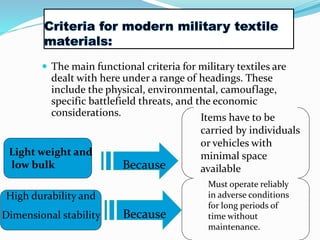
 The main functional criteria for military textiles are
dealt with here under a range of headings. These
include the physical, environmental, camouflage,
specific battlefield threats, and the economic
considerations.
Light weight and
low bulk Because
High durability and
Dimensional stability Because
Items have to be
carried by individuals
or vehicles with
minimal space
available
Must operate reliably
in adverse conditions
for long periods of
time without
maintenance.
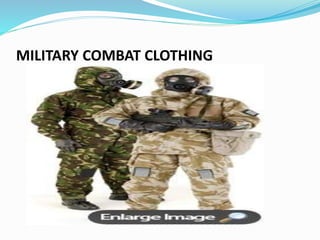
MILITARY COMBAT CLOTHING
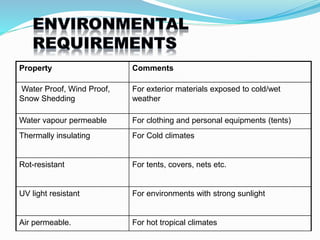
Property Comments
Water Proof, Wind Proof,
Snow Shedding
For exterior materials exposed to cold/wet
weather
Water vapour permeable For clothing and personal equipments (tents)
Thermally insulating For Cold climates
Rot-resistant For tents, covers, nets etc.
UV light resistant For environments with strong sunlight
Air permeable. For hot tropical climates
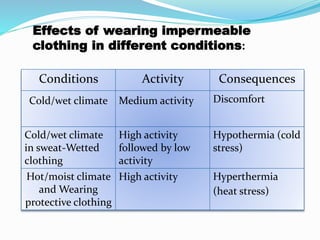
Effects of wearing impermeable
clothing in different conditions:
Conditions Activity Consequences
Cold/wet climate Medium activity Discomfort
Cold/wet climate
in sweat-Wetted
clothing
High activity
followed by low
activity
Hypothermia (cold
stress)
Hot/moist climate
and Wearing
protective clothing
High activity Hyperthermia
(heat stress)
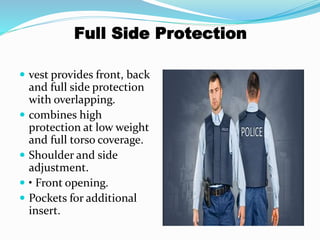
Full Side Protection
 vest provides front, back
and full side protection
with overlapping.
 combines high
protection at low weight
and full torso coverage.
 Shoulder and side
adjustment.
 • Front opening.
 Pockets for additional
insert.
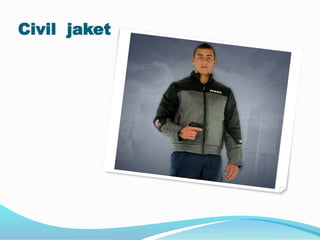
Civil jaket
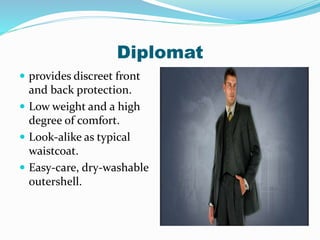
Diplomat
 provides discreet front
and back protection.
 Low weight and a high
degree of comfort.
 Look-alike as typical
waistcoat.
 Easy-care, dry-washable
outershell.
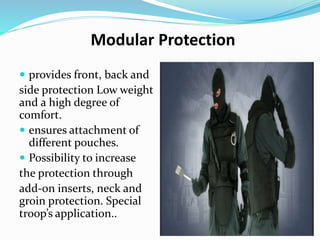
Modular Protection
 provides front, back and
side protection Low weight
and a high degree of
comfort.
 ensures attachment of
different pouches.
 Possibility to increase
the protection through
add-on inserts, neck and
groin protection. Special
troop’s application..
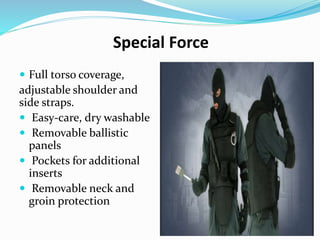
Special Force
 Full torso coverage,
adjustable shoulder and
side straps.
 Easy-care, dry washable
 Removable ballistic
panels
 Pockets for additional
inserts
 Removable neck and
groin protection
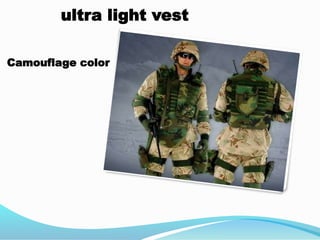
ultra light vest
Camouflage color
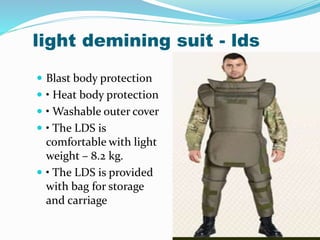
light demining suit - lds
 Blast body protection
 • Heat body protection
 • Washable outer cover
 • The LDS is
comfortable with light
weight – 8.2 kg.
 • The LDS is provided
with bag for storage
and carriage
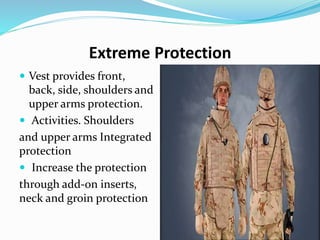
Extreme Protection
 Vest provides front,
back, side, shoulders and
upper arms protection.
 Activities. Shoulders
and upper arms Integrated
protection
 Increase the protection
through add-on inserts,
neck and groin protection
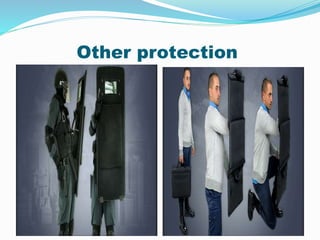
Other protection
 Ballistic window with same ballistic
protection.
 Aluminum ambidextrous handle.
 Carry belt with shoulder pad.
 Available in black and camouflage color.
 The protective panels are encased into a
polyamide cover for protection against
humidity, UV-light and mechanical stress.
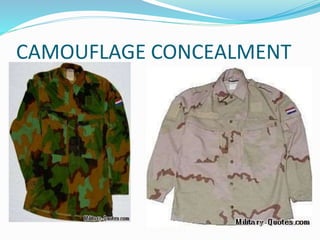
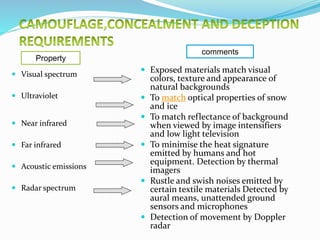
CAMOUFLAGE CONCEALMENT
 Visual spectrum
 Ultraviolet
 Near infrared
 Far infrared
 Acoustic emissions
 Radar spectrum
 Exposed materials match visual
colors, texture and appearance of
natural backgrounds
 To match optical properties of snow
and ice
 To match reflectance of background
when viewed by image intensifiers
and low light television
 To minimise the heat signature
emitted by humans and hot
equipment. Detection by thermal
imagers
 Rustle and swish noises emitted by
certain textile materials Detected by
aural means, unattended ground
sensors and microphones
 Detection of movement by Doppler
radar
Property
comments
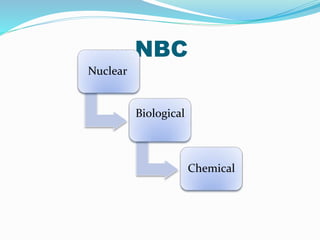
NBC
Nuclear
Biological
Chemical
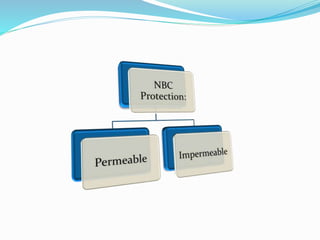
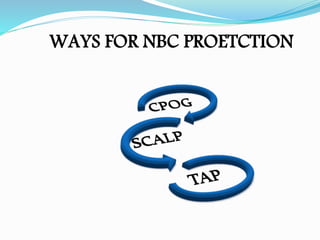
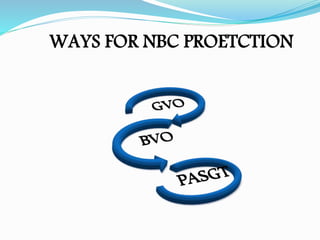
WAYS FOR NBC PROETCTION
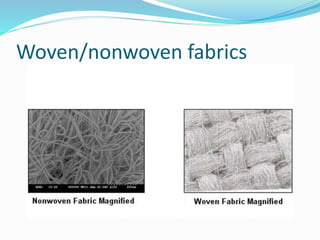
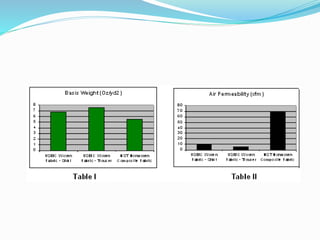
Woven/nonwoven fabrics
military
military

military

  • 3.
    Up until theend of the 19th century military land battles were fought at close quarters by individual engagements. ‘Danger’ colours such as scarlet were widely used, At around the turn of the 20th century advances in technology and science provided more lethal long-range weapons with improved sighting. These combined effects caused rapid changes in military strategy and tactics, as engagements could be made at a distance. It now became important to hide troops and equipment by blending in with the background.
  • 4.
     During WorldWar II advances textile fibers, fabrics, and treatments saw notable landmarks such as the use of the new fiber ‘Nylon’ for light strong parachute canopies.  Ventile was the first waterproof water vapour- permeable fabric.  The well-known worsted serge ‘battledress’ uniform was introduced in 1939.  United States army introduced the ‘layered’ combat clothing concept in 1943.  United States army introduced the ‘layered’ combat clothing concept in 1943
  • 5.
     The mainfunctional criteria for military textiles are dealt with here under a range of headings. These include the physical, environmental, camouflage, specific battlefield threats, and the economic considerations. Light weight and low bulk Because High durability and Dimensional stability Because Items have to be carried by individuals or vehicles with minimal space available Must operate reliably in adverse conditions for long periods of time without maintenance.
  • 6.
  • 7.
    Property Comments Water Proof,Wind Proof, Snow Shedding For exterior materials exposed to cold/wet weather Water vapour permeable For clothing and personal equipments (tents) Thermally insulating For Cold climates Rot-resistant For tents, covers, nets etc. UV light resistant For environments with strong sunlight Air permeable. For hot tropical climates
  • 8.
    Effects of wearingimpermeable clothing in different conditions: Conditions Activity Consequences Cold/wet climate Medium activity Discomfort Cold/wet climate in sweat-Wetted clothing High activity followed by low activity Hypothermia (cold stress) Hot/moist climate and Wearing protective clothing High activity Hyperthermia (heat stress)
  • 9.
    Full Side Protection vest provides front, back and full side protection with overlapping.  combines high protection at low weight and full torso coverage.  Shoulder and side adjustment.  • Front opening.  Pockets for additional insert.
  • 10.
  • 12.
    Diplomat  provides discreetfront and back protection.  Low weight and a high degree of comfort.  Look-alike as typical waistcoat.  Easy-care, dry-washable outershell.
  • 13.
    Modular Protection  providesfront, back and side protection Low weight and a high degree of comfort.  ensures attachment of different pouches.  Possibility to increase the protection through add-on inserts, neck and groin protection. Special troop’s application..
  • 14.
    Special Force  Fulltorso coverage, adjustable shoulder and side straps.  Easy-care, dry washable  Removable ballistic panels  Pockets for additional inserts  Removable neck and groin protection
  • 15.
  • 17.
    light demining suit- lds  Blast body protection  • Heat body protection  • Washable outer cover  • The LDS is comfortable with light weight – 8.2 kg.  • The LDS is provided with bag for storage and carriage
  • 18.
    Extreme Protection  Vestprovides front, back, side, shoulders and upper arms protection.  Activities. Shoulders and upper arms Integrated protection  Increase the protection through add-on inserts, neck and groin protection
  • 19.
  • 20.
     Ballistic windowwith same ballistic protection.  Aluminum ambidextrous handle.  Carry belt with shoulder pad.  Available in black and camouflage color.  The protective panels are encased into a polyamide cover for protection against humidity, UV-light and mechanical stress.
  • 21.
  • 22.
     Visual spectrum Ultraviolet  Near infrared  Far infrared  Acoustic emissions  Radar spectrum  Exposed materials match visual colors, texture and appearance of natural backgrounds  To match optical properties of snow and ice  To match reflectance of background when viewed by image intensifiers and low light television  To minimise the heat signature emitted by humans and hot equipment. Detection by thermal imagers  Rustle and swish noises emitted by certain textile materials Detected by aural means, unattended ground sensors and microphones  Detection of movement by Doppler radar Property comments
  • 23.
  • 25.
    WAYS FOR NBCPROETCTION
  • 26.
    WAYS FOR NBCPROETCTION
  • 27.
    WAYS FOR NBCPROETCTION
  • 29.