Unit 1: Cell biology
1.1: Introduction to cells
The Cell Theory
Surface area to volume ratio
Cell differentiation and cell specialization
Stem cells
Xavier DANIEL, Ph.D.
IB
Unit 1: Cell biology
1.1: Introduction to cells
The Cell Theory
Surface area to volume ratio
Cell differentiation and cell specialization
Stem cells
Xavier DANIEL, Ph.D.
IB
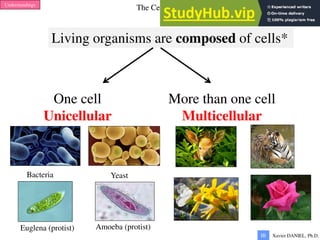
Living organisms are composed of cells*
One cell
Unicellular
More than one cell
Multicellular
Bacteria Yeast
Euglena (protist) Amoeba (protist)
The Cell Theory
Xavier DANIEL, Ph.D.
IB
Understandings
The Cell Theory
Xavier DANIEL, Ph.D.
IB
➢ All living organisms are composed of cells
➢ Cells are the smallest unit of life
➢ Cells come from pre-existing cells
The cell theory
https://www.youtube.com/watch?v=4OpBylw
H9DU 6’11’’
https://www.youtube.com/watch?v=dscY_2Q
QbKU 3’32’’
Understandings
The Cell Theory
Xavier DANIEL, Ph.D.
IB
Nature of Science
Looking for trends and discrepancies –
although most organisms conform to cell theory,
there are exceptions*
The Cell Theory
Xavier DANIEL, Ph.D.
IB
Applications and skills
Questioning the cell theory using atypical examples*
Research and explain how these examples of cells do not fit completely the cell theory:
- Striated muscle cells Amine Noemie S
- Giant algae Yan Josephine
- Aseptal fungal hyphae Noemie B Bora
- Red blood cells Mohamed Aman
- Sieve element Rhea Alex
The Cell Theory
Xavier DANIEL, Ph.D.
IB
Organisms consisting of only one cell carry out all
functions of life in that cell*
The eight functions of life
Movement
Respiration
Sensitivity
Homeostasis
Growth and development
Reproduction
Excretion
Nutrition
Mrs. H. Gren
Understandings
Movement
➢ Movement of - the whole organism (bacteria, animals…) Locomotion
- part of the organism (animals, plants…)
➢ Most animals can move their whole body (humans, rabbits, monkeys…)
➢ Some animals can only move part of their body
➢ Plants move when they grow
Roots grow towards center of Earth
Shoots grow towards light source
Sea anemone move
their tentacles only
The Cell Theory
Xavier DANIEL, Ph.D.
IB
Understandings
Respiration
➢ Almost all cells of living organisms need ENERGY
For movement, growth, repair, reproduction…
➢ Energy is produced by cells during Respiration
➢ Respiration breaks down energy-rich molecules
e.g. glucose, lipids
To produce ATP = energy currency of cells
➢ Respiration can occur with/without oxygen
➢ Equation of respiration with oxygen:
Glucose + oxygen carbon dioxide + water + energy (ATP) + Heat
Breathing is not respiration
Breathing is gas exchanges between organism and environment
The Cell Theory
Xavier DANIEL, Ph.D.
IB
Understandings
Sensitivity
➢ Living organisms can detect / sense changes in environment
Environment outside the body
Environment inside the body
➢ Change in environment = stimulus (pl. stimuli)
➢ Organisms respond to the stimuli
➢ Sensitivity = capacity to respond to a stimulus
➢ Animals: light, sound, touch, pressure, chemicals…
➢ Plants: light, touch, chemicals…
The Cell Theory
Xavier DANIEL, Ph.D.
IB
Stimulus
Response
Understandings
➢ Homeostasis = “homo” + “ stasie”
“homéo” = similar + “stasis” = state
Homeostasis = organism’s internal conditions are kept constant
ex. Body temperature
If body temperature increases,
Sweating to cool down the body
Body temperature comes back to normal
ex. Blood glucose concentration
If not enough glucose in blood,
Liver and pancreas act to add glucose into bloodstream
Blood glucose concentration comes back to normal
Homeostasis
The Cell Theory
Xavier DANIEL, Ph.D.
IB
Understandings
Growth and development
➢ Growth = permanent increase in size and dry mass of an organism
➢ Increase in number of cells
➢ Increase in the size of cells
➢ Usually increase in number of cell AND increase in the size of cells
➢ Always needs to make new proteins
➢ Animals stop growing at a certain size
➢ Plants never stop growing
➢ Development = acquiring tissues, organs
Water does not count
The Cell Theory
Xavier DANIEL, Ph.D.
IB
Understandings
Reproduction
➢ “Re” = again, new
Reproduction = production of new individual organism(s)
➢ Sexual reproduction: Two parents make sex cells (gametes)
One male gamete and one female gamete fuse = fertilisation
Result of fertilisation = zygote = new individual
Zygote will develop to become a new individual that can produce gametes
Offspring is not identical to the parents
Variation is brought by sexual reproduction
➢ Asexual reproduction: One parent produces offspring by itself
Parent and offspring are identical
All members of offspring are identical to each other
No variation is brought by asexual reproduction
Sum of all offspring = clone
The Cell Theory
Xavier DANIEL, Ph.D.
IB
Understandings
Excretion
➢ Metabolism = sum of all chemical reactions in organism
e.g. respiration, digestion, assimilation…
➢ All organisms produce toxic/poisonous materials
= Metabolic wastes
➢ Excretion = removal of metabolic wastes
➢ Animals: Urea in urine, Sweating out toxins, Breathing out CO2
➢ Plants: store metabolic wastes in leaves until leaves fall off
Egestion (defecation) is NOT excretion
The Cell Theory
Xavier DANIEL, Ph.D.
IB
Understandings
1. Ingestion = Taking in food that contains nutrients
Solid food and drinks through the mouth
Nutrients: big (proteins, carbohydrates)
Nutrients: small (ions, vitamins)
Plants MAKE their own food by photosynthesis
Animals GET their food by eating other organisms
2. Digesting nutrients: From big molecules to
smaller molecules
Starch into glucose
Proteins of chicken into individual amino acids
3. Absorbing products of digestion
From small intestine into blood stream or lymph stream
4. Assimilating products of digestion into our own molecules in the cells
Amino acids from proteins of chicken rearranged into human protein
5. Egestion of food that is not digested or absorbed
Egestion = Defecation
Getting rid of faeces
Nutrition
The Cell Theory
Xavier DANIEL, Ph.D.
IB
Understandings
The Cell Theory
Xavier DANIEL, Ph.D.
IB
Paramecium
Investigation of functions of life in Paramecium and
one named photosynthetic unicellular organism*
Applications and skills
Homework
Compare and contrast the 8 functions of life
The Cell Theory
Xavier DANIEL, Ph.D.
IB
Theory of knowledge
There is a difference between the living and the non-living environment.
How are we able to know the difference?*
Unit 1: Cell biology
1.1: Introduction to cells
The Cell Theory
Surface area to volume ratio
Cell differentiation and cell specialization
Stem cells
Xavier DANIEL, Ph.D.
IB
Xavier DANIEL, Ph.D.
IB
Surface area to volume ratio
Surface area to volume ratio is important
in the limitation of cell size*
Understandings
Xavier DANIEL, Ph.D.
IB
Surface area to volume ratio
Surface area to volume ratio is important
in the limitation of cell size*
Understandings
➢ Surface area to volume ratio is often misunderstood
➢ It is a representation of how much surface area is available for exchange of
substances per unit of volume
➢ As size increases, surface area increases.
➢ However, as size increases, surface area to volume ratio decreases
Xavier DANIEL, Ph.D.
IB
Surface area to volume ratio
Understandings
What do you observe?
Xavier DANIEL, Ph.D.
IB
Surface area to volume ratio
Understandings
The volume shown below remains constant,
but the surface area available for exchange is increasing
by breaking the single cube into many tiny cubes
Xavier DANIEL, Ph.D.
IB
Surface area to volume ratio
Understandings
The surface area of a cube can be calculated by multiplying the area of one
face by six (as a cube has six faces).
The volume of a cube can be calculated by multiplying the length by the
width by the height.
Volume = a3
Surface area = 6a2
The surface area to volume ratio can then be calculated by dividing both
numbers by the volume. This gives a comparison to a volume of 1 unit.
SA:V = 6:1 (for a 1 x 1 x 1 unit cube).
Xavier DANIEL, Ph.D.
IB
Surface area to volume ratio
Understandings
This cube is 1 mm x 1 mm x 1 mm.
Its surface area is 6 mm2.
Its volume is 1 mm3.
Therefore its SA:V is 6:1.
This means that every 1 mm3 has 6 mm2 available for
exchange.
This cube is 2 mm x 2 mm x 2 mm.
Its surface area is 24 mm2.
Its volume is 8 mm3.
Therefore its SA:V is 3:1.
So when the cube’s measurements doubled, its
requirements increased eight-fold but its surface area only
increased four-fold!
Volume, since it is cubed, increases faster than surface
area.
Xavier DANIEL, Ph.D.
IB
Surface area to volume ratio
Understandings
This cube is 3 mm x 3mm x 3mm.
Its surface area is 54 mm2.
Its volume is 27 mm3.
Therefore its SA:V is 2:1.
So although its size and surface area
have both increased, each 1 mm3
now only has 2 mm2 available for
exchange, so it cannot exchange
substances as quickly.
Xavier DANIEL, Ph.D.
IB
Surface area to volume ratio
Understandings
Xavier DANIEL, Ph.D.
IB
Surface area to volume ratio
Side (mm) 1 2 3
Surface area 6 24 54
Volume 1 8 27
SA/V ratio 6 3 2
0
1
2
3
4
5
6
7
1 2 3
Surface
area
to
volume
ratio
Length of side (mm)
Understandings
Xavier DANIEL, Ph.D.
IB
Surface area to volume ratio
Conclusion
What is best for organisms?
Have many cells of a small size
OR
Have few cells of a big size?
Understandings7
Xavier DANIEL, Ph.D.
IB
Surface area to volume ratio
Conclusion
What is best for organisms?
Have many cells of a small size
To facilitate exchange of materials between cells and their environment
Oxygen and nutrients in
CO2 and other waste out
Surface area to volume ratio is important
in the limitation of cell size*
Understandings
Unit 1: Cell biology
1.1: Introduction to cells
The Cell Theory
Surface area to volume ratio
Cell differentiation and cell specialization
Stem cells
Xavier DANIEL, Ph.D.
IB
Cell differentiation and cell specialization
Xavier DANIEL, Ph.D.
IB
➢ Unicellular organisms: the unique cell performs all 8 functions of life
➢ Multicellular organisms: not all cells perform all 8 functions of life
Cells are specialized
Most cells are dedicated to a specific function of life
i.e. gametes (sex cells) - Reproduction, not Movement or Nutrition
i.e. muscles cells – Movement, not Reproduction or Nutrition
i.e. stomach cells – Nutrition, not Movement or Reproduction
Most cells perform Respiration
Understandings
Cell differentiation and cell specialization
Xavier DANIEL, Ph.D.
IB
Specialized cells in humans
Specialized cells in plants
Understandings
neuron Nervous
tissue
brain Nervous
system
Homo sapiens
smallest largest
cellu tissue organ Organ system organism
MYP Sciences 1 Xavier DANIEL, Ph.D.
Assessment opportunities
Criterion A: Knowing and understanding What are the characteristics of living things?
Levels of organization of living things
Reminder
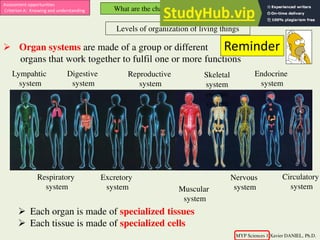
➢ Organ systems are made of a group or different
organs that work together to fulfil one or more functions
Lympahtic
system
Respiratory
system
Digestive
system
Reproductive
system
Muscular
system
Skeletal
system
osseux
system
Nervous
system
Endocrine
system
Circulatory
system
Excretory
system
➢ Each organ is made of specialized tissues
➢ Each tissue is made of specialized cells
MYP Sciences 1 Xavier DANIEL, Ph.D.
Assessment opportunities
Criterion A: Knowing and understanding What are the characteristics of living things?
Levels of organization of living things
Reminder
Cell differentiation and cell specialization
Xavier DANIEL, Ph.D.
IB
➢ Multicellular organisms: not all cells perform all 8 functions of life
Cells are specialized
Most cells perform a unique function of life only
i.e. gametes (sex cells) - Reproduction, not Movement
i.e. muscles cells – Movement, not Reproduction
Multicellular organisms have properties
that emerge from the interaction of their cellular components*
Understandings
Cell differentiation and cell specialization
Xavier DANIEL, Ph.D.
IB
What is cell
differentiation?
Understandings
Cell differentiation and cell specialization
Xavier DANIEL, Ph.D.
IB
Cell differentiation is the way by which cells become specialized
Understandings
Cell differentiation and cell specialization
Xavier DANIEL, Ph.D.
IB
Cell differentiation is the way by which cells become specialized
Understandings
Cell differentiation and cell specialization
Xavier DANIEL, Ph.D.
IB
Cell differentiation is the way by which cells become specialized
Understandings
Assessment opportunities
Criterion A: Knowing and understanding
➢ All cells of an organism contain the same chromosomes
➢ But all cells are specialized
e.g. White blood cells to fight against pathogens (1)
ex. Heart’s muscle cells to pump blood out of the heart (2)
ex. Skeletal muscles’ cells for body movement (3)
ex. Neurons carry nervous impulses (4)
1
2
3
4
How do we grow, how do we develop?
MYP Sciences 2 Xavier DANIEL, Ph.D.
Reminder
➢ All cells of an organism contain the same chromosomes
➢ But all cells are specialized
➢ A cell does not need all proteins all the time
- A stomach cell needs the proteins the stomach needs
- An iris cell needs the proteins the iris needs
Proteins the stomach needs Proteins the iris needs
Assessment opportunities
Criterion A: Knowing and understanding How do we grow, how do we develop?
MYP Sciences 2 Xavier DANIEL, Ph.D.
Reminder
➢ All cells of an organism contain the same chromosomes
➢ But all cells are specialized
➢ A cell does not need all proteins all the time
- A stomach cell needs the proteins the stomach needs
- An iris cell needs the proteins the iris needs
BUT
- A stomach cell does not need all proteins needed by the iris
- An iris cell does not need all proteins needed by the stomach
Proteins the stomach needs Proteins the iris needs
Proteins both the stomach and the iris needs
Assessment opportunities
Criterion A: Knowing and understanding How do we grow, how do we develop?
MYP Sciences 2 Xavier DANIEL, Ph.D.
Reminder
Specialized tissues can
develop by cell
differentiation in
multicellular
organisms*
Genes are scattered along chromosomes
Genome = sum of all genes of an organism
base pairs
Cell differentiation and cell specialization
Xavier DANIEL, Ph.D.
IB
Understandings
Gene = Fragment of chromosome containing instructions to produce a specific protein
Assessment opportunities
Criterion A: Knowing and understanding How do we grow, how do we develop?
MYP Sciences 2 Xavier DANIEL, Ph.D.
Reminder
Proteins the stomach needs Proteins the iris needs
Proteins both the stomach and the iris needs
Genes the stomach needs Genes the iris needs
Genes both the stomach and the iris need
Assessment opportunities
Criterion A: Knowing and understanding How do we grow, how do we develop?
MYP Sciences 2 Xavier DANIEL, Ph.D.
Reminder
Proteins the stomach needs Proteins the iris needs
Proteins both the stomach and the iris needs
Gene = Fragment of chromosome containing instructions to produce a specific protein
An organism has different types of specialized cells
because each cell type “activates” ONLY the genes that
are necessary for this cell type
In humans: A few hundred of genes among the 20 500
available genes
All other genes are inactivated
Assessment opportunities
Criterion A: Knowing and understanding How do we grow, how do we develop?
MYP Sciences 2 Xavier DANIEL, Ph.D.
Reminder
Differentiation involves the expression of some genes and not others in a cell’s genome*
Unit 1: Cell biology
1.1: Introduction to cells
The Cell Theory
Surface area to volume ratio
Cell differentiation and cell specialization
Stem cells
Xavier DANIEL, Ph.D.
IB
Embryonic and adult stem cells
Xavier DANIEL, Ph.D.
IB
Stem cells
Understandings
Embryonic and adult stem cells
➢ Growth = increase in size of organisms over time
irreversible
increase in volume and/or number of cells
➢ Development = changes in shape, form and complexity of organisms
accompanies growth
➢ Nucleus controls growth and development
➢ Stem cell: Can undergo mitosis (self-renewal)
Can stay undifferentiated
Can differentiate into specialized cells
Xavier DANIEL, Ph.D.
IB
Stem cells
Understandings
Obtaining embryonic stem cells 1/3
Fertility clinics: In Vitro Fertilization process for couples that cannot procreate naturally
More embryos than needed for implantation are produced
Extra embryos
Frozen for future implantation
OR
Source of embryonic stem cells
If allowed by laws
If agreed by donors
Xavier DANIEL, Ph.D.
IB
Stem cells
Understandings
Genetic screening:
➢ IVF produces numerous embryos
➢ A single cell from 8-cell embryo is removed
➢ This cell is used to check any genetic anomaly
e.g. Down syndrome, Cystic fibrosis…
➢ The seven cells left are implanted into the mother’s uterus
Develop normally into blastocyst, fetus, and healthy baby
Could use the removed 8th cell to obtain/produce embryonic stem cells
Xavier DANIEL, Ph.D.
IB
Obtaining embryonic stem cells 2/3
Stem cells
Understandings
Blood of umbilical cord at birth
Contains embryonic stem cells
Can be collected and used
Xavier DANIEL, Ph.D.
IB
Obtaining embryonic stem cells 3/3
Stem cells
Understandings
Obtaining adult stem cells
Drawbacks:
➢ Small quantities
➢ Non-dividing state
Induced to divide when needed
➢ Hard to access
Already used in treatments
Cancer patients after chemio/radiotherapy: inhibit cell division of cancer cells = priority
BUT NO cell division at all
Blood cells need to be replaced all the time
Extraction from own bone marrow, culture, differentiation, implantation of blood cells
Xavier DANIEL, Ph.D.
IB
Stem cells
Understandings
Use of embryonic stem cells in medical therapies?
Xavier DANIEL, Ph.D.
IB
Stem cells
The capacity of stem cells to divide and differentiate along different pathways is necessary in
embryonic development and also makes stem cells suitable for therapeutic uses*
Understandings
Xavier DANIEL, Ph.D.
IB
Stargardt's macular dystrophy
The problem:
Affects around one in 10,000 children
Recessive genetic (inherited) condition
The mutation causes an active transport protein on photoreceptor cells to malfunction
The photoreceptor cells degenerate
This causes progressive, and eventually total, loss of central vision
Stem cells
Applications and skills
Xavier DANIEL, Ph.D.
IB
Stargardt's macular dystrophy
The treatment:
Embryonic stem cells are treated to divide and differentiate to become retinal cells
The retinal cells are injected into the retina
The retinal cells attach to the retina and become functional
Central vision improves as a result of more functional retinal cells
The future:
This treatment is still in at the stage of limited clinical trials, but will likely in usage in the future
Stem cells
Applications and skills
Xavier DANIEL, Ph.D.
IB
Stem cells
Stargardt's macular dystrophy
The capacity of stem cells to divide and differentiate along different pathways is necessary in
embryonic development and also makes stem cells suitable for therapeutic uses*
Applications and skills
Xavier DANIEL, Ph.D.
IB
Leukemia
➢ "White blood cells cancer“
➢ 30.000 instead of 5-10.000 per mm3 of blood
➢ Can be treated with bone marrow transplants:
Stem cells are extracted from the patient’s bone marrow
The patient’s bone marrow cells are killed and replaced with the stem cells
Stem cells
Applications and skills
Xavier DANIEL, Ph.D.
IB
Stem cells
Applications and skills
Use of stem cells to treat Stargardt’s disease and one other named condition*
Xavier DANIEL, Ph.D.
IB
Stem cells
Ethical implications of research—research involving stem
cells is growing in importance and raises ethical issues*
Nature of Science
Xavier DANIEL, Ph.D.
IB
Stem cells
Applications and skills
Ethics of the therapeutic use of stem cells from specially created embryos, from the
umbilical cord blood of a new-born baby and from an adult’s own tissues*
Unit 1: Cell biology
1.1: Introduction to cells
Xavier DANIEL, Ph.D.
IB
Video links
https://www.youtube.com/watch?v=dscY_2QQbKU
The cell theory
https://www.youtube.com/watch?v=4OpBylwH9DU
The cell theory

1.1 Introduction To Cells.Pdf

  • 1.
    Unit 1: Cellbiology 1.1: Introduction to cells The Cell Theory Surface area to volume ratio Cell differentiation and cell specialization Stem cells Xavier DANIEL, Ph.D. IB
  • 2.
    Unit 1: Cellbiology 1.1: Introduction to cells The Cell Theory Surface area to volume ratio Cell differentiation and cell specialization Stem cells Xavier DANIEL, Ph.D. IB
  • 3.
    Living organisms arecomposed of cells* One cell Unicellular More than one cell Multicellular Bacteria Yeast Euglena (protist) Amoeba (protist) The Cell Theory Xavier DANIEL, Ph.D. IB Understandings
  • 4.
    The Cell Theory XavierDANIEL, Ph.D. IB ➢ All living organisms are composed of cells ➢ Cells are the smallest unit of life ➢ Cells come from pre-existing cells The cell theory https://www.youtube.com/watch?v=4OpBylw H9DU 6’11’’ https://www.youtube.com/watch?v=dscY_2Q QbKU 3’32’’ Understandings
  • 5.
    The Cell Theory XavierDANIEL, Ph.D. IB Nature of Science Looking for trends and discrepancies – although most organisms conform to cell theory, there are exceptions*
  • 6.
    The Cell Theory XavierDANIEL, Ph.D. IB Applications and skills Questioning the cell theory using atypical examples* Research and explain how these examples of cells do not fit completely the cell theory: - Striated muscle cells Amine Noemie S - Giant algae Yan Josephine - Aseptal fungal hyphae Noemie B Bora - Red blood cells Mohamed Aman - Sieve element Rhea Alex
  • 7.
    The Cell Theory XavierDANIEL, Ph.D. IB Organisms consisting of only one cell carry out all functions of life in that cell* The eight functions of life Movement Respiration Sensitivity Homeostasis Growth and development Reproduction Excretion Nutrition Mrs. H. Gren Understandings
  • 8.
    Movement ➢ Movement of- the whole organism (bacteria, animals…) Locomotion - part of the organism (animals, plants…) ➢ Most animals can move their whole body (humans, rabbits, monkeys…) ➢ Some animals can only move part of their body ➢ Plants move when they grow Roots grow towards center of Earth Shoots grow towards light source Sea anemone move their tentacles only The Cell Theory Xavier DANIEL, Ph.D. IB Understandings
  • 9.
    Respiration ➢ Almost allcells of living organisms need ENERGY For movement, growth, repair, reproduction… ➢ Energy is produced by cells during Respiration ➢ Respiration breaks down energy-rich molecules e.g. glucose, lipids To produce ATP = energy currency of cells ➢ Respiration can occur with/without oxygen ➢ Equation of respiration with oxygen: Glucose + oxygen carbon dioxide + water + energy (ATP) + Heat Breathing is not respiration Breathing is gas exchanges between organism and environment The Cell Theory Xavier DANIEL, Ph.D. IB Understandings
  • 10.
    Sensitivity ➢ Living organismscan detect / sense changes in environment Environment outside the body Environment inside the body ➢ Change in environment = stimulus (pl. stimuli) ➢ Organisms respond to the stimuli ➢ Sensitivity = capacity to respond to a stimulus ➢ Animals: light, sound, touch, pressure, chemicals… ➢ Plants: light, touch, chemicals… The Cell Theory Xavier DANIEL, Ph.D. IB Stimulus Response Understandings
  • 11.
    ➢ Homeostasis =“homo” + “ stasie” “homéo” = similar + “stasis” = state Homeostasis = organism’s internal conditions are kept constant ex. Body temperature If body temperature increases, Sweating to cool down the body Body temperature comes back to normal ex. Blood glucose concentration If not enough glucose in blood, Liver and pancreas act to add glucose into bloodstream Blood glucose concentration comes back to normal Homeostasis The Cell Theory Xavier DANIEL, Ph.D. IB Understandings
  • 12.
    Growth and development ➢Growth = permanent increase in size and dry mass of an organism ➢ Increase in number of cells ➢ Increase in the size of cells ➢ Usually increase in number of cell AND increase in the size of cells ➢ Always needs to make new proteins ➢ Animals stop growing at a certain size ➢ Plants never stop growing ➢ Development = acquiring tissues, organs Water does not count The Cell Theory Xavier DANIEL, Ph.D. IB Understandings
  • 13.
    Reproduction ➢ “Re” =again, new Reproduction = production of new individual organism(s) ➢ Sexual reproduction: Two parents make sex cells (gametes) One male gamete and one female gamete fuse = fertilisation Result of fertilisation = zygote = new individual Zygote will develop to become a new individual that can produce gametes Offspring is not identical to the parents Variation is brought by sexual reproduction ➢ Asexual reproduction: One parent produces offspring by itself Parent and offspring are identical All members of offspring are identical to each other No variation is brought by asexual reproduction Sum of all offspring = clone The Cell Theory Xavier DANIEL, Ph.D. IB Understandings
  • 14.
    Excretion ➢ Metabolism =sum of all chemical reactions in organism e.g. respiration, digestion, assimilation… ➢ All organisms produce toxic/poisonous materials = Metabolic wastes ➢ Excretion = removal of metabolic wastes ➢ Animals: Urea in urine, Sweating out toxins, Breathing out CO2 ➢ Plants: store metabolic wastes in leaves until leaves fall off Egestion (defecation) is NOT excretion The Cell Theory Xavier DANIEL, Ph.D. IB Understandings
  • 15.
    1. Ingestion =Taking in food that contains nutrients Solid food and drinks through the mouth Nutrients: big (proteins, carbohydrates) Nutrients: small (ions, vitamins) Plants MAKE their own food by photosynthesis Animals GET their food by eating other organisms 2. Digesting nutrients: From big molecules to smaller molecules Starch into glucose Proteins of chicken into individual amino acids 3. Absorbing products of digestion From small intestine into blood stream or lymph stream 4. Assimilating products of digestion into our own molecules in the cells Amino acids from proteins of chicken rearranged into human protein 5. Egestion of food that is not digested or absorbed Egestion = Defecation Getting rid of faeces Nutrition The Cell Theory Xavier DANIEL, Ph.D. IB Understandings
  • 16.
    The Cell Theory XavierDANIEL, Ph.D. IB Paramecium Investigation of functions of life in Paramecium and one named photosynthetic unicellular organism* Applications and skills Homework Compare and contrast the 8 functions of life
  • 17.
    The Cell Theory XavierDANIEL, Ph.D. IB Theory of knowledge There is a difference between the living and the non-living environment. How are we able to know the difference?*
  • 18.
    Unit 1: Cellbiology 1.1: Introduction to cells The Cell Theory Surface area to volume ratio Cell differentiation and cell specialization Stem cells Xavier DANIEL, Ph.D. IB
  • 19.
    Xavier DANIEL, Ph.D. IB Surfacearea to volume ratio Surface area to volume ratio is important in the limitation of cell size* Understandings
  • 20.
    Xavier DANIEL, Ph.D. IB Surfacearea to volume ratio Surface area to volume ratio is important in the limitation of cell size* Understandings
  • 21.
    ➢ Surface areato volume ratio is often misunderstood ➢ It is a representation of how much surface area is available for exchange of substances per unit of volume ➢ As size increases, surface area increases. ➢ However, as size increases, surface area to volume ratio decreases Xavier DANIEL, Ph.D. IB Surface area to volume ratio Understandings
  • 22.
    What do youobserve? Xavier DANIEL, Ph.D. IB Surface area to volume ratio Understandings
  • 23.
    The volume shownbelow remains constant, but the surface area available for exchange is increasing by breaking the single cube into many tiny cubes Xavier DANIEL, Ph.D. IB Surface area to volume ratio Understandings
  • 24.
    The surface areaof a cube can be calculated by multiplying the area of one face by six (as a cube has six faces). The volume of a cube can be calculated by multiplying the length by the width by the height. Volume = a3 Surface area = 6a2 The surface area to volume ratio can then be calculated by dividing both numbers by the volume. This gives a comparison to a volume of 1 unit. SA:V = 6:1 (for a 1 x 1 x 1 unit cube). Xavier DANIEL, Ph.D. IB Surface area to volume ratio Understandings
  • 25.
    This cube is1 mm x 1 mm x 1 mm. Its surface area is 6 mm2. Its volume is 1 mm3. Therefore its SA:V is 6:1. This means that every 1 mm3 has 6 mm2 available for exchange. This cube is 2 mm x 2 mm x 2 mm. Its surface area is 24 mm2. Its volume is 8 mm3. Therefore its SA:V is 3:1. So when the cube’s measurements doubled, its requirements increased eight-fold but its surface area only increased four-fold! Volume, since it is cubed, increases faster than surface area. Xavier DANIEL, Ph.D. IB Surface area to volume ratio Understandings
  • 26.
    This cube is3 mm x 3mm x 3mm. Its surface area is 54 mm2. Its volume is 27 mm3. Therefore its SA:V is 2:1. So although its size and surface area have both increased, each 1 mm3 now only has 2 mm2 available for exchange, so it cannot exchange substances as quickly. Xavier DANIEL, Ph.D. IB Surface area to volume ratio Understandings
  • 27.
    Xavier DANIEL, Ph.D. IB Surfacearea to volume ratio Side (mm) 1 2 3 Surface area 6 24 54 Volume 1 8 27 SA/V ratio 6 3 2 0 1 2 3 4 5 6 7 1 2 3 Surface area to volume ratio Length of side (mm) Understandings
  • 28.
    Xavier DANIEL, Ph.D. IB Surfacearea to volume ratio Conclusion What is best for organisms? Have many cells of a small size OR Have few cells of a big size? Understandings7
  • 29.
    Xavier DANIEL, Ph.D. IB Surfacearea to volume ratio Conclusion What is best for organisms? Have many cells of a small size To facilitate exchange of materials between cells and their environment Oxygen and nutrients in CO2 and other waste out Surface area to volume ratio is important in the limitation of cell size* Understandings
  • 30.
    Unit 1: Cellbiology 1.1: Introduction to cells The Cell Theory Surface area to volume ratio Cell differentiation and cell specialization Stem cells Xavier DANIEL, Ph.D. IB
  • 31.
    Cell differentiation andcell specialization Xavier DANIEL, Ph.D. IB ➢ Unicellular organisms: the unique cell performs all 8 functions of life ➢ Multicellular organisms: not all cells perform all 8 functions of life Cells are specialized Most cells are dedicated to a specific function of life i.e. gametes (sex cells) - Reproduction, not Movement or Nutrition i.e. muscles cells – Movement, not Reproduction or Nutrition i.e. stomach cells – Nutrition, not Movement or Reproduction Most cells perform Respiration Understandings
  • 32.
    Cell differentiation andcell specialization Xavier DANIEL, Ph.D. IB Specialized cells in humans Specialized cells in plants Understandings
  • 33.
    neuron Nervous tissue brain Nervous system Homosapiens smallest largest cellu tissue organ Organ system organism MYP Sciences 1 Xavier DANIEL, Ph.D. Assessment opportunities Criterion A: Knowing and understanding What are the characteristics of living things? Levels of organization of living things Reminder
  • 34.
    ➢ Organ systemsare made of a group or different organs that work together to fulfil one or more functions Lympahtic system Respiratory system Digestive system Reproductive system Muscular system Skeletal system osseux system Nervous system Endocrine system Circulatory system Excretory system ➢ Each organ is made of specialized tissues ➢ Each tissue is made of specialized cells MYP Sciences 1 Xavier DANIEL, Ph.D. Assessment opportunities Criterion A: Knowing and understanding What are the characteristics of living things? Levels of organization of living things Reminder
  • 35.
    Cell differentiation andcell specialization Xavier DANIEL, Ph.D. IB ➢ Multicellular organisms: not all cells perform all 8 functions of life Cells are specialized Most cells perform a unique function of life only i.e. gametes (sex cells) - Reproduction, not Movement i.e. muscles cells – Movement, not Reproduction Multicellular organisms have properties that emerge from the interaction of their cellular components* Understandings
  • 36.
    Cell differentiation andcell specialization Xavier DANIEL, Ph.D. IB What is cell differentiation? Understandings
  • 37.
    Cell differentiation andcell specialization Xavier DANIEL, Ph.D. IB Cell differentiation is the way by which cells become specialized Understandings
  • 38.
    Cell differentiation andcell specialization Xavier DANIEL, Ph.D. IB Cell differentiation is the way by which cells become specialized Understandings
  • 39.
    Cell differentiation andcell specialization Xavier DANIEL, Ph.D. IB Cell differentiation is the way by which cells become specialized Understandings
  • 40.
    Assessment opportunities Criterion A:Knowing and understanding ➢ All cells of an organism contain the same chromosomes ➢ But all cells are specialized e.g. White blood cells to fight against pathogens (1) ex. Heart’s muscle cells to pump blood out of the heart (2) ex. Skeletal muscles’ cells for body movement (3) ex. Neurons carry nervous impulses (4) 1 2 3 4 How do we grow, how do we develop? MYP Sciences 2 Xavier DANIEL, Ph.D. Reminder
  • 41.
    ➢ All cellsof an organism contain the same chromosomes ➢ But all cells are specialized ➢ A cell does not need all proteins all the time - A stomach cell needs the proteins the stomach needs - An iris cell needs the proteins the iris needs Proteins the stomach needs Proteins the iris needs Assessment opportunities Criterion A: Knowing and understanding How do we grow, how do we develop? MYP Sciences 2 Xavier DANIEL, Ph.D. Reminder
  • 42.
    ➢ All cellsof an organism contain the same chromosomes ➢ But all cells are specialized ➢ A cell does not need all proteins all the time - A stomach cell needs the proteins the stomach needs - An iris cell needs the proteins the iris needs BUT - A stomach cell does not need all proteins needed by the iris - An iris cell does not need all proteins needed by the stomach Proteins the stomach needs Proteins the iris needs Proteins both the stomach and the iris needs Assessment opportunities Criterion A: Knowing and understanding How do we grow, how do we develop? MYP Sciences 2 Xavier DANIEL, Ph.D. Reminder Specialized tissues can develop by cell differentiation in multicellular organisms*
  • 43.
    Genes are scatteredalong chromosomes Genome = sum of all genes of an organism base pairs Cell differentiation and cell specialization Xavier DANIEL, Ph.D. IB Understandings
  • 44.
    Gene = Fragmentof chromosome containing instructions to produce a specific protein Assessment opportunities Criterion A: Knowing and understanding How do we grow, how do we develop? MYP Sciences 2 Xavier DANIEL, Ph.D. Reminder Proteins the stomach needs Proteins the iris needs Proteins both the stomach and the iris needs
  • 45.
    Genes the stomachneeds Genes the iris needs Genes both the stomach and the iris need Assessment opportunities Criterion A: Knowing and understanding How do we grow, how do we develop? MYP Sciences 2 Xavier DANIEL, Ph.D. Reminder Proteins the stomach needs Proteins the iris needs Proteins both the stomach and the iris needs Gene = Fragment of chromosome containing instructions to produce a specific protein
  • 46.
    An organism hasdifferent types of specialized cells because each cell type “activates” ONLY the genes that are necessary for this cell type In humans: A few hundred of genes among the 20 500 available genes All other genes are inactivated Assessment opportunities Criterion A: Knowing and understanding How do we grow, how do we develop? MYP Sciences 2 Xavier DANIEL, Ph.D. Reminder Differentiation involves the expression of some genes and not others in a cell’s genome*
  • 47.
    Unit 1: Cellbiology 1.1: Introduction to cells The Cell Theory Surface area to volume ratio Cell differentiation and cell specialization Stem cells Xavier DANIEL, Ph.D. IB
  • 48.
    Embryonic and adultstem cells Xavier DANIEL, Ph.D. IB Stem cells Understandings
  • 49.
    Embryonic and adultstem cells ➢ Growth = increase in size of organisms over time irreversible increase in volume and/or number of cells ➢ Development = changes in shape, form and complexity of organisms accompanies growth ➢ Nucleus controls growth and development ➢ Stem cell: Can undergo mitosis (self-renewal) Can stay undifferentiated Can differentiate into specialized cells Xavier DANIEL, Ph.D. IB Stem cells Understandings
  • 50.
    Obtaining embryonic stemcells 1/3 Fertility clinics: In Vitro Fertilization process for couples that cannot procreate naturally More embryos than needed for implantation are produced Extra embryos Frozen for future implantation OR Source of embryonic stem cells If allowed by laws If agreed by donors Xavier DANIEL, Ph.D. IB Stem cells Understandings
  • 51.
    Genetic screening: ➢ IVFproduces numerous embryos ➢ A single cell from 8-cell embryo is removed ➢ This cell is used to check any genetic anomaly e.g. Down syndrome, Cystic fibrosis… ➢ The seven cells left are implanted into the mother’s uterus Develop normally into blastocyst, fetus, and healthy baby Could use the removed 8th cell to obtain/produce embryonic stem cells Xavier DANIEL, Ph.D. IB Obtaining embryonic stem cells 2/3 Stem cells Understandings
  • 52.
    Blood of umbilicalcord at birth Contains embryonic stem cells Can be collected and used Xavier DANIEL, Ph.D. IB Obtaining embryonic stem cells 3/3 Stem cells Understandings
  • 53.
    Obtaining adult stemcells Drawbacks: ➢ Small quantities ➢ Non-dividing state Induced to divide when needed ➢ Hard to access Already used in treatments Cancer patients after chemio/radiotherapy: inhibit cell division of cancer cells = priority BUT NO cell division at all Blood cells need to be replaced all the time Extraction from own bone marrow, culture, differentiation, implantation of blood cells Xavier DANIEL, Ph.D. IB Stem cells Understandings
  • 54.
    Use of embryonicstem cells in medical therapies? Xavier DANIEL, Ph.D. IB Stem cells The capacity of stem cells to divide and differentiate along different pathways is necessary in embryonic development and also makes stem cells suitable for therapeutic uses* Understandings
  • 55.
    Xavier DANIEL, Ph.D. IB Stargardt'smacular dystrophy The problem: Affects around one in 10,000 children Recessive genetic (inherited) condition The mutation causes an active transport protein on photoreceptor cells to malfunction The photoreceptor cells degenerate This causes progressive, and eventually total, loss of central vision Stem cells Applications and skills
  • 56.
    Xavier DANIEL, Ph.D. IB Stargardt'smacular dystrophy The treatment: Embryonic stem cells are treated to divide and differentiate to become retinal cells The retinal cells are injected into the retina The retinal cells attach to the retina and become functional Central vision improves as a result of more functional retinal cells The future: This treatment is still in at the stage of limited clinical trials, but will likely in usage in the future Stem cells Applications and skills
  • 57.
    Xavier DANIEL, Ph.D. IB Stemcells Stargardt's macular dystrophy The capacity of stem cells to divide and differentiate along different pathways is necessary in embryonic development and also makes stem cells suitable for therapeutic uses* Applications and skills
  • 58.
    Xavier DANIEL, Ph.D. IB Leukemia ➢"White blood cells cancer“ ➢ 30.000 instead of 5-10.000 per mm3 of blood ➢ Can be treated with bone marrow transplants: Stem cells are extracted from the patient’s bone marrow The patient’s bone marrow cells are killed and replaced with the stem cells Stem cells Applications and skills
  • 59.
    Xavier DANIEL, Ph.D. IB Stemcells Applications and skills Use of stem cells to treat Stargardt’s disease and one other named condition*
  • 60.
    Xavier DANIEL, Ph.D. IB Stemcells Ethical implications of research—research involving stem cells is growing in importance and raises ethical issues* Nature of Science
  • 61.
    Xavier DANIEL, Ph.D. IB Stemcells Applications and skills Ethics of the therapeutic use of stem cells from specially created embryos, from the umbilical cord blood of a new-born baby and from an adult’s own tissues*
  • 62.
    Unit 1: Cellbiology 1.1: Introduction to cells Xavier DANIEL, Ph.D. IB Video links https://www.youtube.com/watch?v=dscY_2QQbKU The cell theory https://www.youtube.com/watch?v=4OpBylwH9DU The cell theory