
Sharing the Table:   Chicago’s Plan to End Homelessness Mary Ellen Caron, Commissioner Chicago Department of Family and Support Services
History of Collaboration Plan was developed out of public-private collaboration Created in 2001 and endorsed by Mayor Richard M. Daley in 2003 Consistent leadership structures involving non-profits, government, funders, and consumers, despite change in people in those positions Ambassadors of the plan
Core Goal of the Plan  Housing First Long-term framework to change Chicago’s homeless system through the housing first approach. As described in the National Alliance to End Homelessness’s 10-year plan, Chicago adopted a Housing First approach.
Hallmarks of Chicago’s Approach to Implementation Move from a shelter-based system to a housing-based system Increase use of homelessness prevention resources Realignment of funding priorities to support best-practices Public-private oversight and accountability
Chicago’s “Building Blocks” of  Collaboration for Systems Change High-level staff that are accountable for the Plan’s success Organized groups of private philanthropy and non-profits Provider Infrastructure Networks of Allies, which includes the Chicago Alliance to End Homelessness
Current Innovative Policies, Programs and Funding Priorities To End Family Homelessness – 100,000 Homes Prioritizing vulnerable families for permanent supportive housing and creation of central referral system for Permanent Supportive Housing and other housing resources 100,000 Homes – First city to pilot vulnerability index for families Looks at chronic homelessness among families, and also episodic homelessness (cycling/chronic crises) Moving a community conversation to have centralized referral system for all permanent supportive housing options to prioritize those most vulnerable based on comprehensive family vulnerability We expect to have a framework operational by the end of 2011 This is a public-private priority
Current Innovative Policies, Programs  and Funding Priorities To End Family Homelessness – CHA Program Partnering with Chicago Housing Authority to create a pilot program for families (and singles) most at risk of falling back into homelessness after their transitional rental assistance is over We are looking at targeting families who are on a fixed, low income families whose size is large enough that housing affordability will always be an issue – i.e. where they would fall into paying more than 50% of income on rent families with histories of more than one episode of homelessness We will work with partners who deliver scattered-site HUD transitional housing and also HPRP recipients We expect this pilot to begin by the Spring of 2011 and serve 100-150 households in the first year This pilot is directly informed by providers of these services and our policies to serve the most at-risk families with HPRP
Current Innovative Policies, Programs and Funding Priorities To End Family Homelessness Set new expectations of interim housing - increased movement to housing and minimize discharge of families from one program to another homeless program We found that interim housing programs were still moving families from one program to another, extending homelessness for families The City and the continuum of care changed performance expectations to reflect this issue.  We expect that programs will refer less than 5% of families to other homeless programs.  This policy was developed after providers and government looked at outcomes together
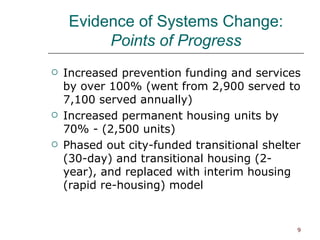
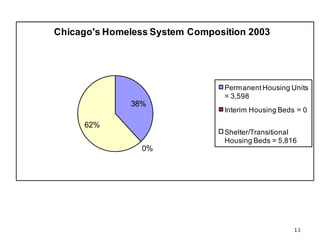
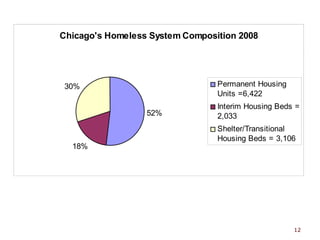
Evidence of Systems Change: Points of Progress Increased prevention funding and services by over 100% (went from 2,900 served to 7,100 served annually) Increased permanent housing units by 70% - (2,500 units) Phased out city-funded transitional shelter (30-day) and transitional housing (2-year), and replaced with interim housing (rapid re-housing) model
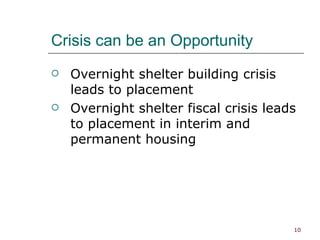
Crisis can be an Opportunity Overnight shelter building crisis leads to placement Overnight shelter fiscal crisis leads to placement in interim and permanent housing
 
 
What works, What doesn’t Invite each other to meet and develop relationships Clear communication Open to negotiation on prioritization of interventions and strategies to end family homelessness The opposite is true of what doesn’t work: lack of communication, closed door to negotiation on strategies Focus on the families and individual clients
THANK YOU!

1.1 Ending Family Homelessness: An Overview

  • 1.
    Sharing the Table: Chicago’s Plan to End Homelessness Mary Ellen Caron, Commissioner Chicago Department of Family and Support Services
  • 2.
    History of CollaborationPlan was developed out of public-private collaboration Created in 2001 and endorsed by Mayor Richard M. Daley in 2003 Consistent leadership structures involving non-profits, government, funders, and consumers, despite change in people in those positions Ambassadors of the plan
  • 3.
    Core Goal ofthe Plan Housing First Long-term framework to change Chicago’s homeless system through the housing first approach. As described in the National Alliance to End Homelessness’s 10-year plan, Chicago adopted a Housing First approach.
  • 4.
    Hallmarks of Chicago’sApproach to Implementation Move from a shelter-based system to a housing-based system Increase use of homelessness prevention resources Realignment of funding priorities to support best-practices Public-private oversight and accountability
  • 5.
    Chicago’s “Building Blocks”of Collaboration for Systems Change High-level staff that are accountable for the Plan’s success Organized groups of private philanthropy and non-profits Provider Infrastructure Networks of Allies, which includes the Chicago Alliance to End Homelessness
  • 6.
    Current Innovative Policies,Programs and Funding Priorities To End Family Homelessness – 100,000 Homes Prioritizing vulnerable families for permanent supportive housing and creation of central referral system for Permanent Supportive Housing and other housing resources 100,000 Homes – First city to pilot vulnerability index for families Looks at chronic homelessness among families, and also episodic homelessness (cycling/chronic crises) Moving a community conversation to have centralized referral system for all permanent supportive housing options to prioritize those most vulnerable based on comprehensive family vulnerability We expect to have a framework operational by the end of 2011 This is a public-private priority
  • 7.
    Current Innovative Policies,Programs and Funding Priorities To End Family Homelessness – CHA Program Partnering with Chicago Housing Authority to create a pilot program for families (and singles) most at risk of falling back into homelessness after their transitional rental assistance is over We are looking at targeting families who are on a fixed, low income families whose size is large enough that housing affordability will always be an issue – i.e. where they would fall into paying more than 50% of income on rent families with histories of more than one episode of homelessness We will work with partners who deliver scattered-site HUD transitional housing and also HPRP recipients We expect this pilot to begin by the Spring of 2011 and serve 100-150 households in the first year This pilot is directly informed by providers of these services and our policies to serve the most at-risk families with HPRP
  • 8.
    Current Innovative Policies,Programs and Funding Priorities To End Family Homelessness Set new expectations of interim housing - increased movement to housing and minimize discharge of families from one program to another homeless program We found that interim housing programs were still moving families from one program to another, extending homelessness for families The City and the continuum of care changed performance expectations to reflect this issue. We expect that programs will refer less than 5% of families to other homeless programs. This policy was developed after providers and government looked at outcomes together
  • 9.
    Evidence of SystemsChange: Points of Progress Increased prevention funding and services by over 100% (went from 2,900 served to 7,100 served annually) Increased permanent housing units by 70% - (2,500 units) Phased out city-funded transitional shelter (30-day) and transitional housing (2-year), and replaced with interim housing (rapid re-housing) model
  • 10.
    Crisis can bean Opportunity Overnight shelter building crisis leads to placement Overnight shelter fiscal crisis leads to placement in interim and permanent housing
  • 11.
  • 12.
  • 13.
    What works, Whatdoesn’t Invite each other to meet and develop relationships Clear communication Open to negotiation on prioritization of interventions and strategies to end family homelessness The opposite is true of what doesn’t work: lack of communication, closed door to negotiation on strategies Focus on the families and individual clients
  • 14.

Editor's Notes

  • #6 Working on credible data – but are making improvements with Prevention data, unscientific outcomes and cost-data; also working on dedicated new ways of leveraging financing – but newly working on coordination of mainstream resources by leveraging HUD funds.