Ghana LEAP
(Livelihood Empowerment
Against Poverty)
Aminata Balde
Edna Andualem
Djeneba Drame
Milka Djikindei
Vera Fiador
The
Intervention
The LEAP program is an unconditional cash transfer
targeted to ultra-poor households in Ghana with
certain demographic characteristics:
• Households caring for an orphan
• Elderly headed households
• Households with severely disabled member
• Household with an infant or pregnant mother
This intervention is an expansion of the LEAP
programme to the unreached communities and
government wants to exploit that to conduct an
impact evaluation.
Some
Background
 An impact evaluation was previously carried
out on the initial rollout of the programme, This
previous evaluation employed a discontinuity
design and only measured impact on young
mothers.
KeyQuestions
to be
Answered
This Evaluation is prospective in nature
The key question here is “What is the effect of the
LEAP programme on the typical beneficiary?’
• Our Specific Objectives are to:
• Measure the impact of LEAP on Household food security
(household level)
• Measure the impact of the LEAP on strengthened
livelihood (household level)
• Measure impact of LEAP on child school enrollment
(children)
Conceptual
Framework
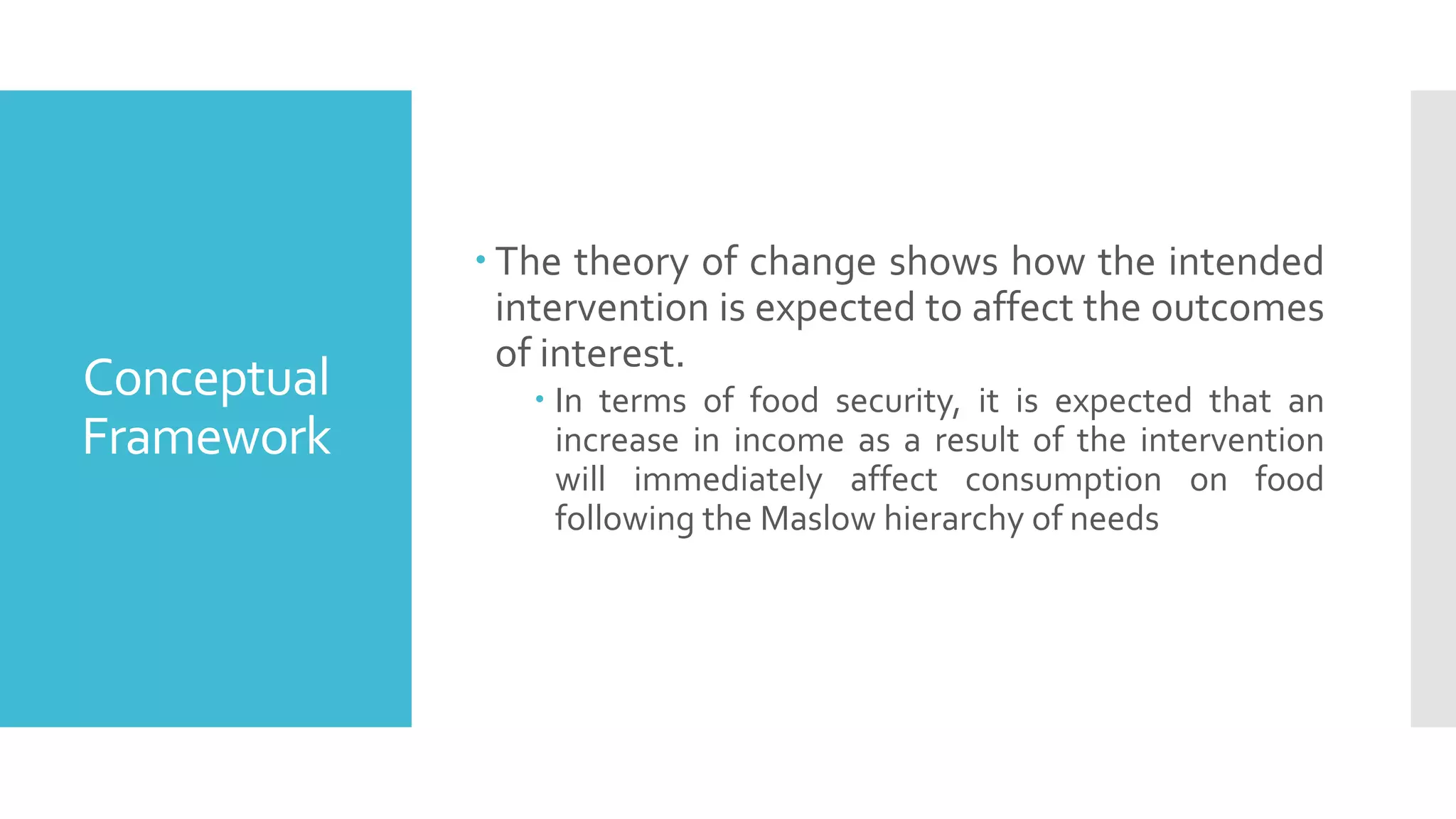
 The theory of change shows how the intended
intervention is expected to affect the outcomes
of interest.
 In terms of food security, it is expected that an
increase in income as a result of the intervention
will immediately affect consumption on food
following the Maslow hierarchy of needs
Conceptual
Framework
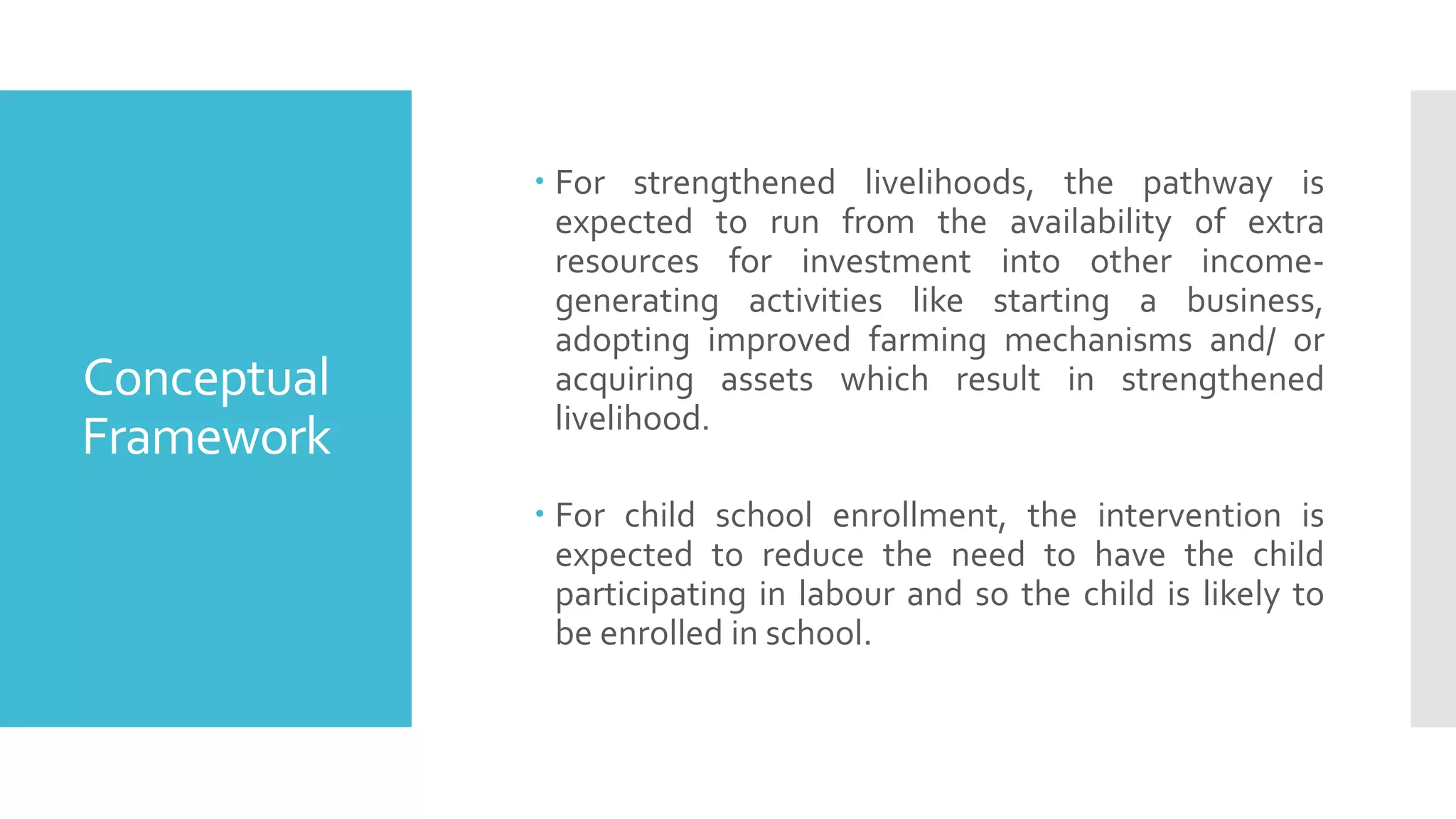
 For strengthened livelihoods, the pathway is
expected to run from the availability of extra
resources for investment into other income-
generating activities like starting a business,
adopting improved farming mechanisms and/ or
acquiring assets which result in strengthened
livelihood.
 For child school enrollment, the intervention is
expected to reduce the need to have the child
participating in labour and so the child is likely to
be enrolled in school.
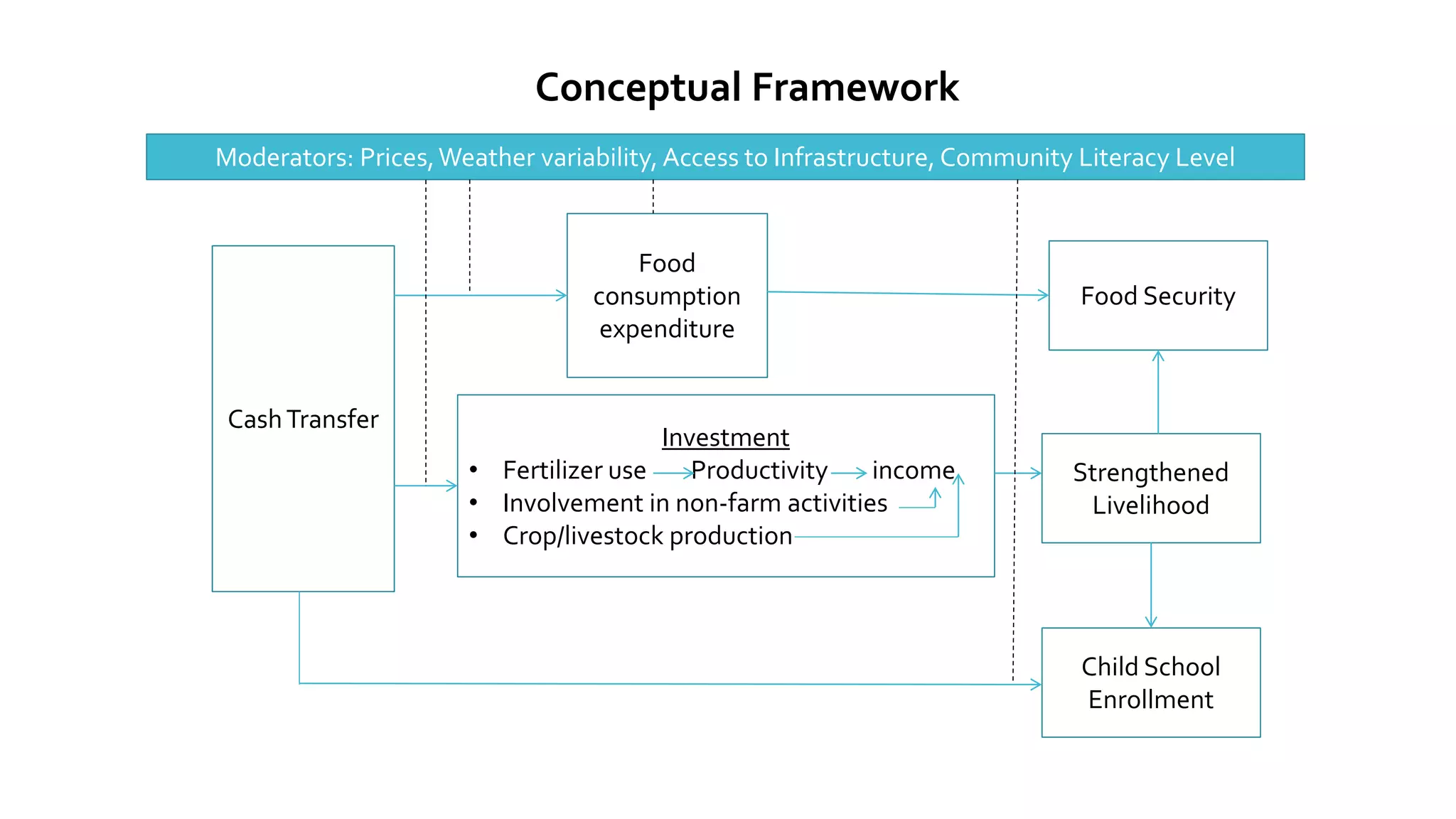
CashTransfer
Food
consumption
expenditure
Investment
• Fertilizer use Productivity income
• Involvement in non-farm activities
• Crop/livestock production
Food Security
Strengthened
Livelihood
Child School
Enrollment
Conceptual Framework
Moderators: Prices,Weather variability, Access to Infrastructure, Community Literacy Level
Identification
Strategy : How
to identify the
Evaluation
Sample
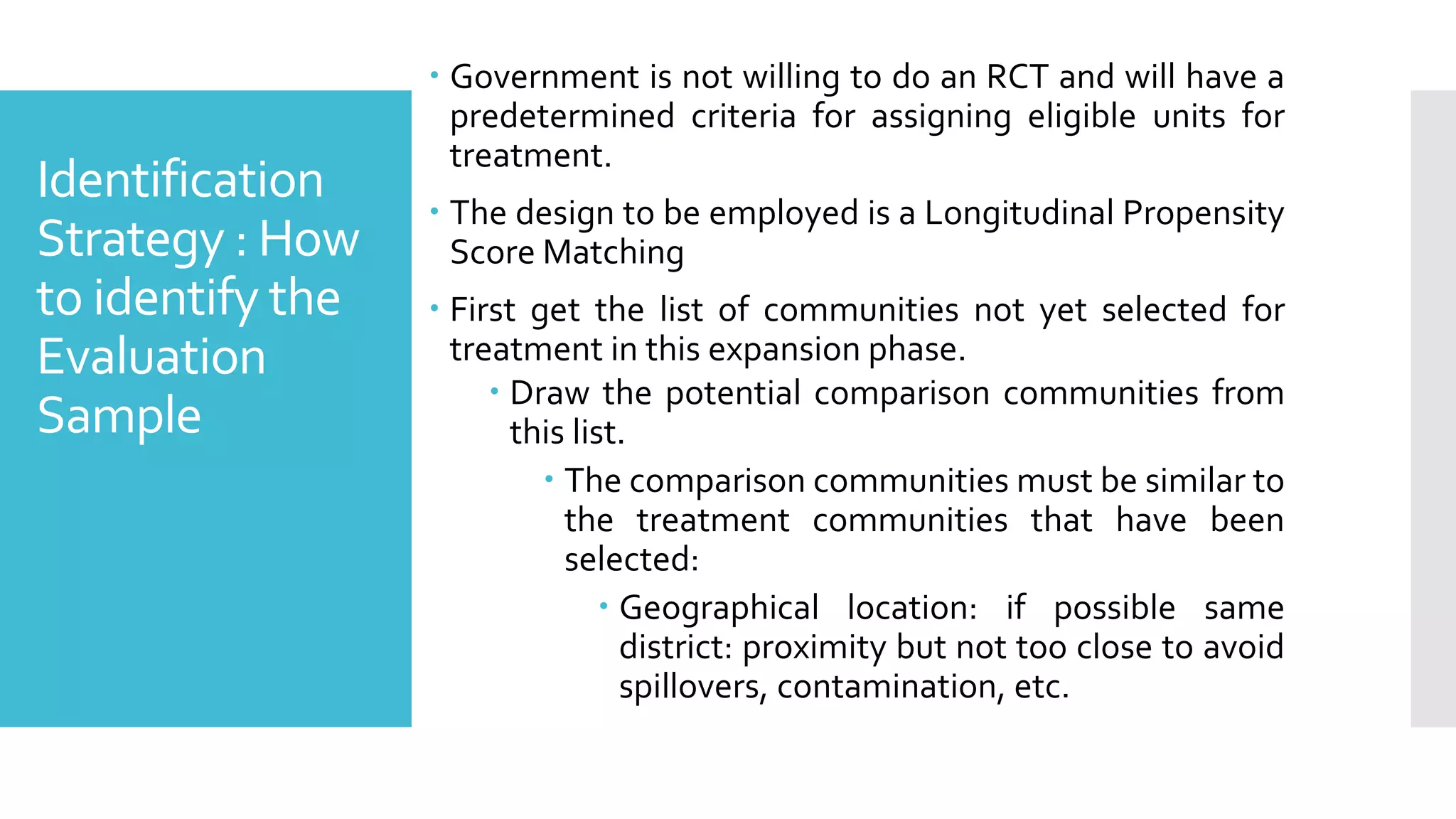
 Government is not willing to do an RCT and will have a
predetermined criteria for assigning eligible units for
treatment.
 The design to be employed is a Longitudinal Propensity
Score Matching
 First get the list of communities not yet selected for
treatment in this expansion phase.
 Draw the potential comparison communities from
this list.
 The comparison communities must be similar to
the treatment communities that have been
selected:
 Geographical location: if possible same
district: proximity but not too close to avoid
spillovers, contamination, etc.
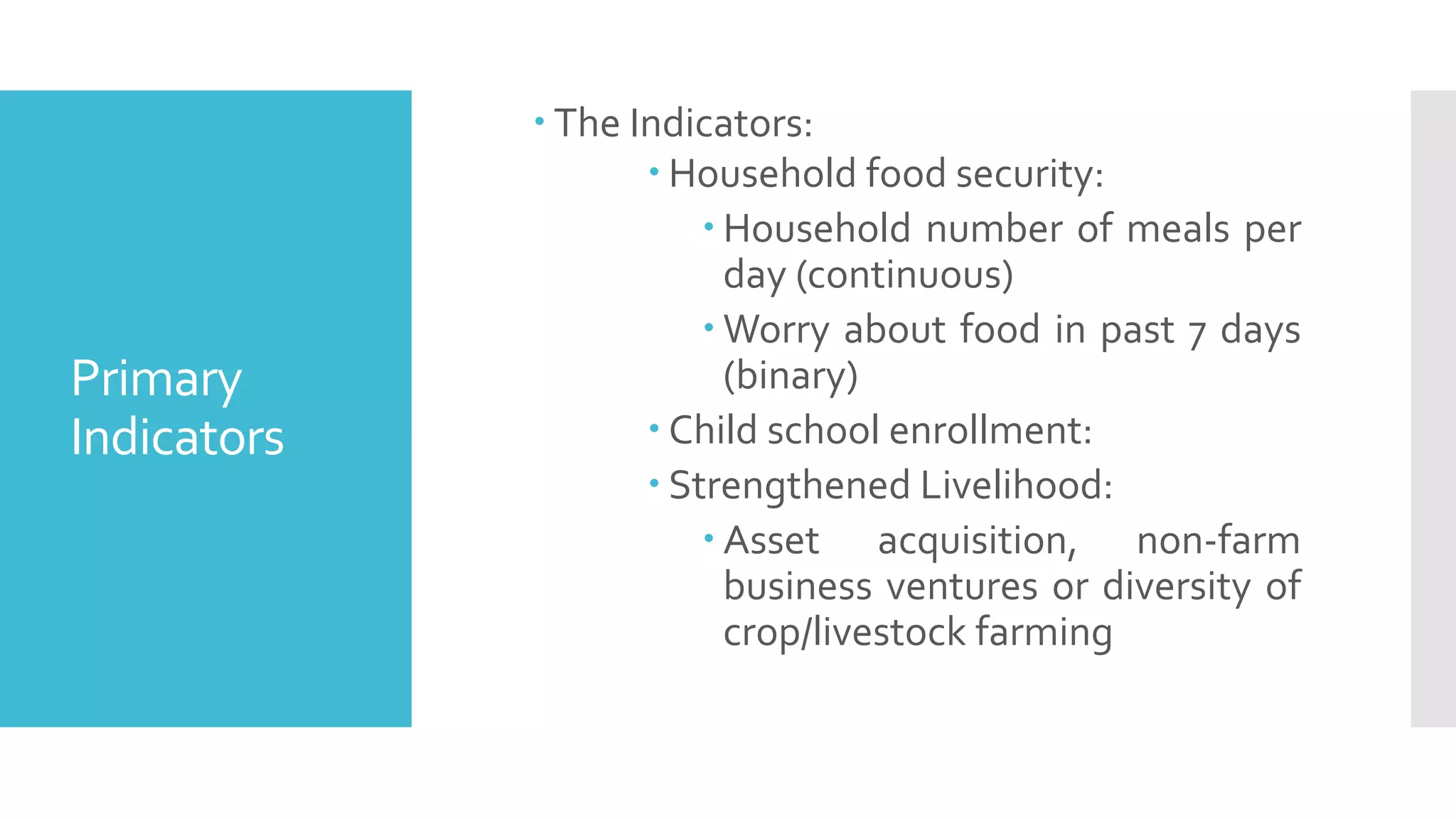
Primary
Indicators
 The Indicators:
 Household food security:
 Household number of meals per
day (continuous)
 Worry about food in past 7 days
(binary)
 Child school enrollment:
 Strengthened Livelihood:
 Asset acquisition, non-farm
business ventures or diversity of
crop/livestock farming
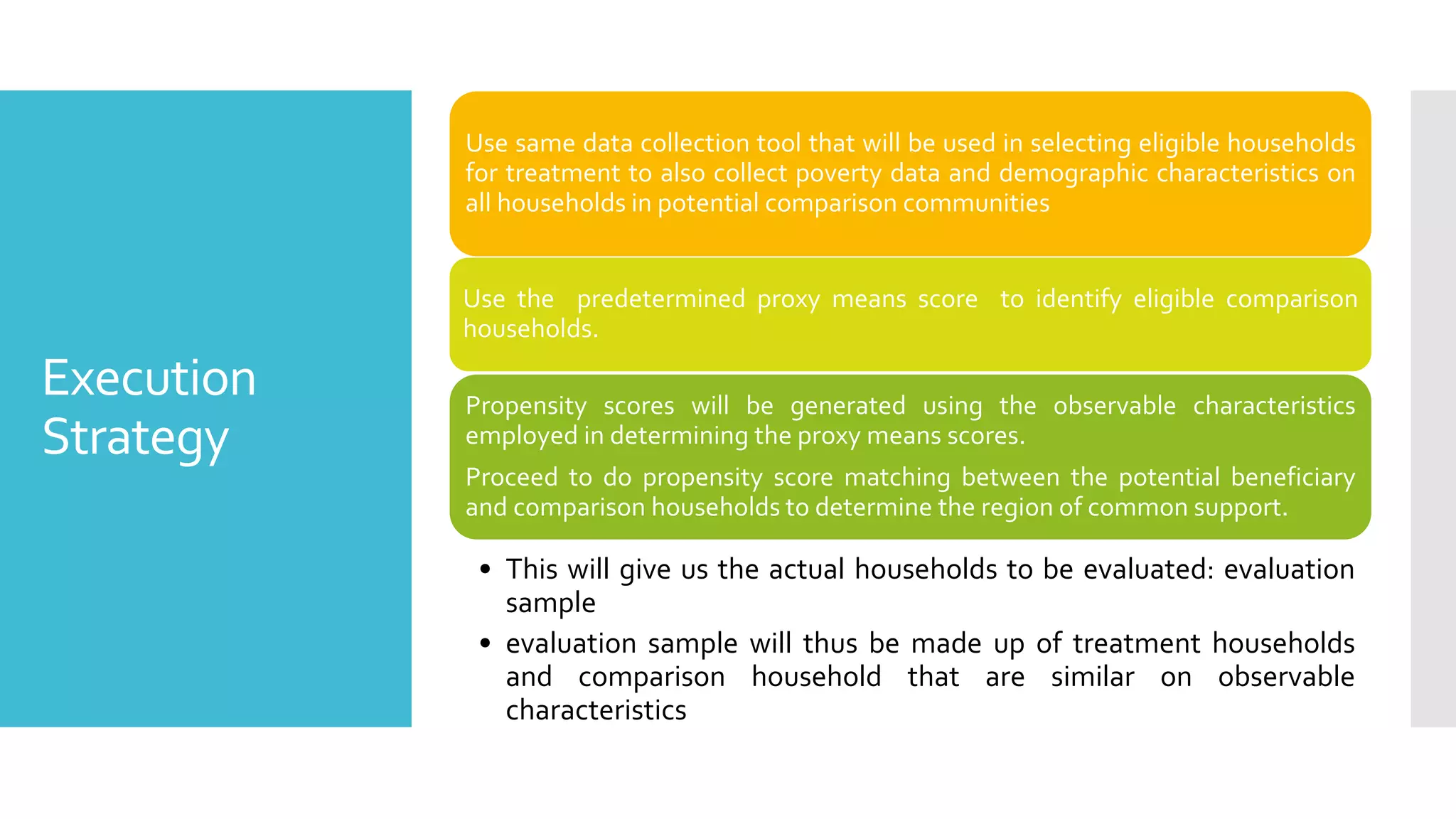
Execution
Strategy
Use same data collection tool that will be used in selecting eligible households
for treatment to also collect poverty data and demographic characteristics on
all households in potential comparison communities
Use the predetermined proxy means score to identify eligible comparison
households.
Propensity scores will be generated using the observable characteristics
employed in determining the proxy means scores.
Proceed to do propensity score matching between the potential beneficiary
and comparison households to determine the region of common support.
• This will give us the actual households to be evaluated: evaluation
sample
• evaluation sample will thus be made up of treatment households
and comparison household that are similar on observable
characteristics
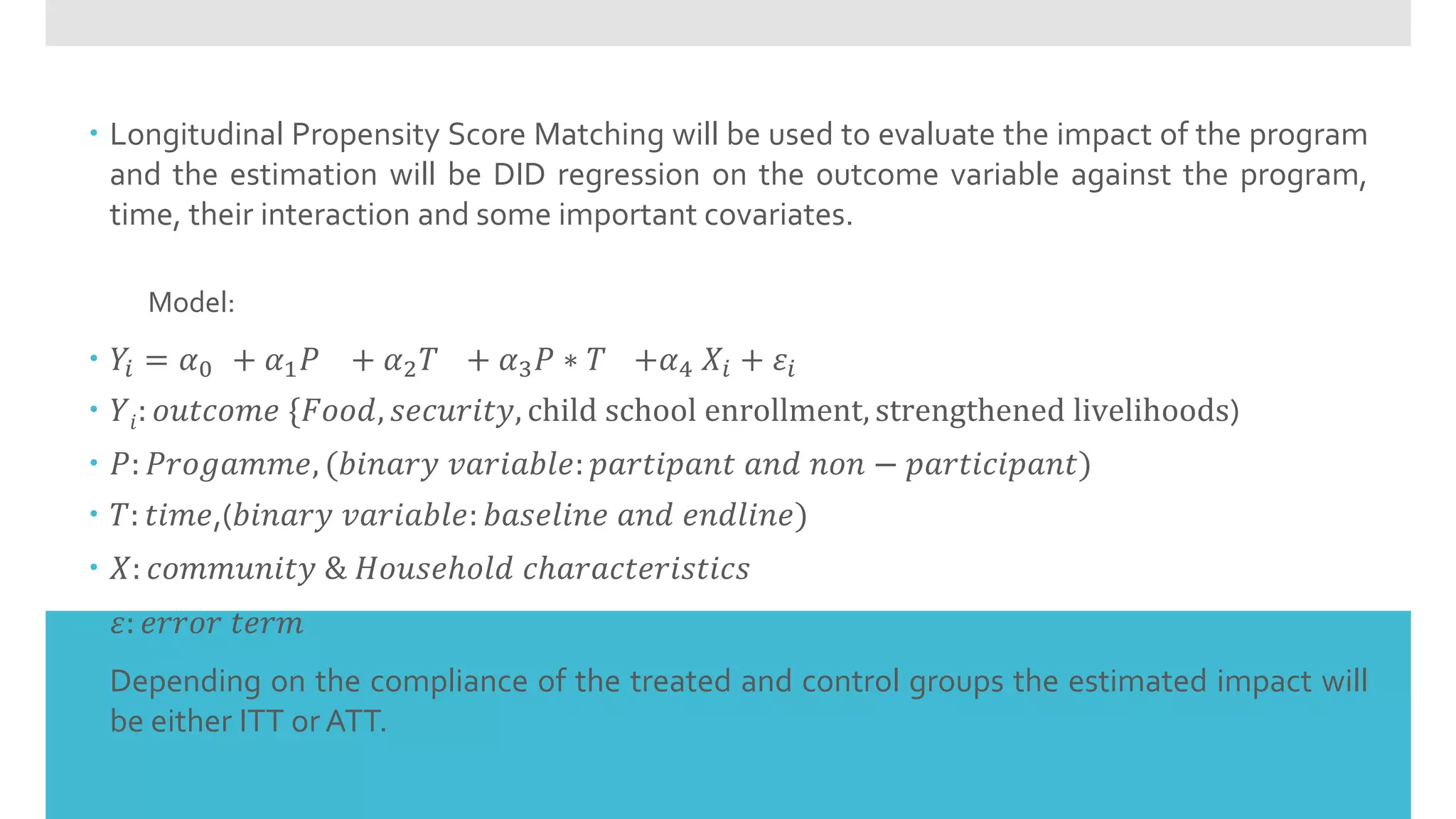
 Longitudinal Propensity Score Matching will be used to evaluate the impact of the program
and the estimation will be DID regression on the outcome variable against the program,
time, their interaction and some important covariates.
Model:
 𝑌𝑖 = 𝛼0 + 𝛼1 𝑃 + 𝛼2 𝑇 + 𝛼3 𝑃 ∗ 𝑇 +𝛼4 𝑋𝑖 + 𝜀𝑖
 𝑌𝑖: 𝑜𝑢𝑡𝑐𝑜𝑚𝑒 {𝐹𝑜𝑜𝑑, 𝑠𝑒𝑐𝑢𝑟𝑖𝑡𝑦, child school enrollment, strengthened livelihoods)
 𝑃: 𝑃𝑟𝑜𝑔𝑎𝑚𝑚𝑒, (𝑏𝑖𝑛𝑎𝑟𝑦 𝑣𝑎𝑟𝑖𝑎𝑏𝑙𝑒: 𝑝𝑎𝑟𝑡𝑖𝑝𝑎𝑛𝑡 𝑎𝑛𝑑 𝑛𝑜𝑛 − 𝑝𝑎𝑟𝑡𝑖𝑐𝑖𝑝𝑎𝑛𝑡)
 𝑇: 𝑡𝑖𝑚𝑒,(𝑏𝑖𝑛𝑎𝑟𝑦 𝑣𝑎𝑟𝑖𝑎𝑏𝑙𝑒: 𝑏𝑎𝑠𝑒𝑙𝑖𝑛𝑒 𝑎𝑛𝑑 𝑒𝑛𝑑𝑙𝑖𝑛𝑒)
 𝑋: 𝑐𝑜𝑚𝑚𝑢𝑛𝑖𝑡𝑦 & 𝐻𝑜𝑢𝑠𝑒ℎ𝑜𝑙𝑑 𝑐ℎ𝑎𝑟𝑎𝑐𝑡𝑒𝑟𝑖𝑠𝑡𝑖𝑐𝑠
 𝜀: 𝑒𝑟𝑟𝑜𝑟 𝑡𝑒𝑟𝑚
 Depending on the compliance of the treated and control groups the estimated impact will
be either ITT or ATT.
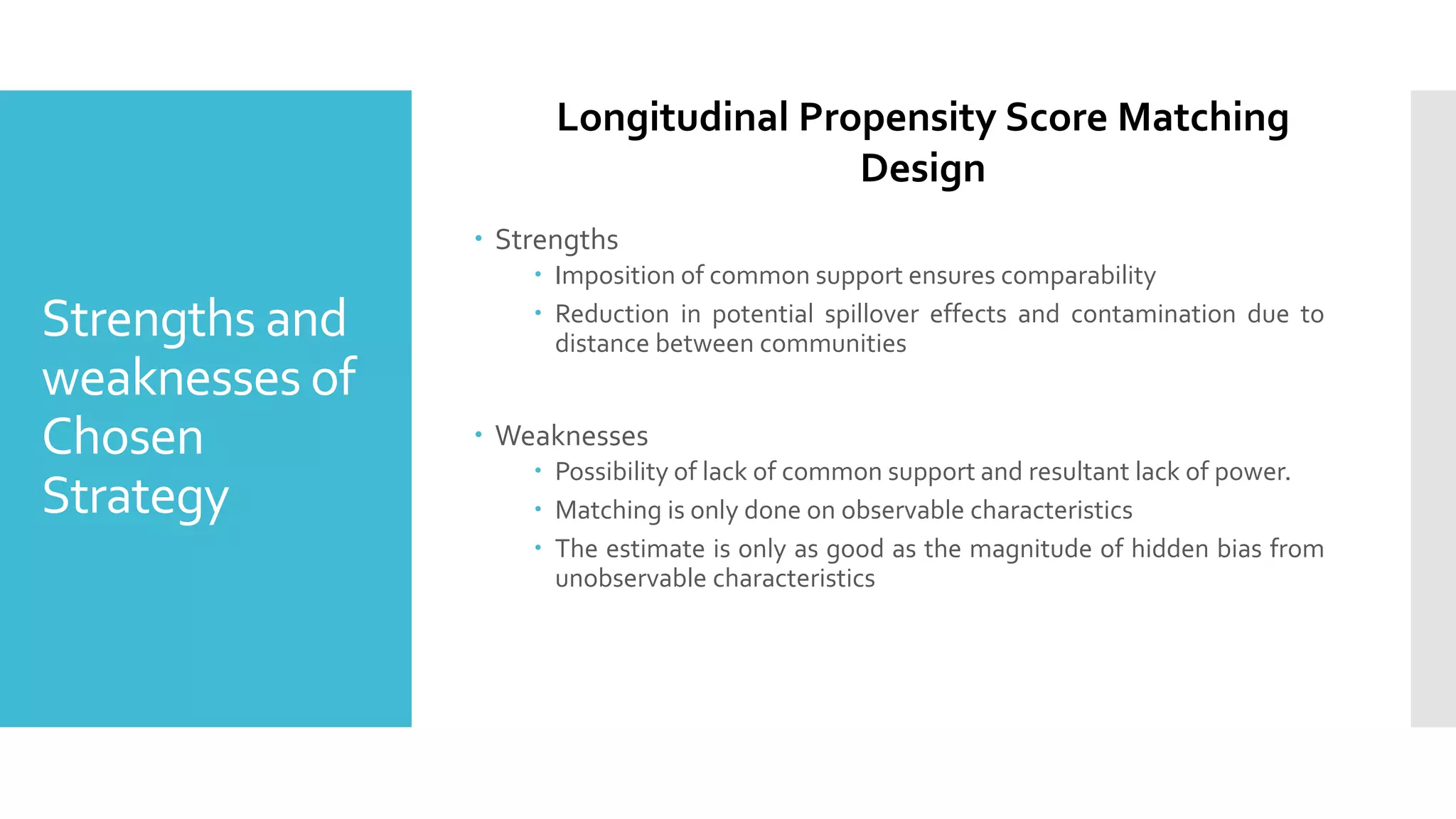
Strengths and
weaknesses of
Chosen
Strategy
 Strengths
 Imposition of common support ensures comparability
 Reduction in potential spillover effects and contamination due to
distance between communities
 Weaknesses
 Possibility of lack of common support and resultant lack of power.
 Matching is only done on observable characteristics
 The estimate is only as good as the magnitude of hidden bias from
unobservable characteristics
Longitudinal Propensity Score Matching
Design
Duration
 We propose an evaluation period of 18months after roll out of the
programme
 The period will allow the intervention to show a measurable
impact.
ThankYou

Impact Evaluation Training with AERC: Ghana's LEAP Programme Technical Research Proposal

  • 1.
    Ghana LEAP (Livelihood Empowerment AgainstPoverty) Aminata Balde Edna Andualem Djeneba Drame Milka Djikindei Vera Fiador
  • 2.
    The Intervention The LEAP programis an unconditional cash transfer targeted to ultra-poor households in Ghana with certain demographic characteristics: • Households caring for an orphan • Elderly headed households • Households with severely disabled member • Household with an infant or pregnant mother This intervention is an expansion of the LEAP programme to the unreached communities and government wants to exploit that to conduct an impact evaluation.
  • 3.
    Some Background  An impactevaluation was previously carried out on the initial rollout of the programme, This previous evaluation employed a discontinuity design and only measured impact on young mothers.
  • 4.
    KeyQuestions to be Answered This Evaluationis prospective in nature The key question here is “What is the effect of the LEAP programme on the typical beneficiary?’ • Our Specific Objectives are to: • Measure the impact of LEAP on Household food security (household level) • Measure the impact of the LEAP on strengthened livelihood (household level) • Measure impact of LEAP on child school enrollment (children)
  • 5.
    Conceptual Framework  The theoryof change shows how the intended intervention is expected to affect the outcomes of interest.  In terms of food security, it is expected that an increase in income as a result of the intervention will immediately affect consumption on food following the Maslow hierarchy of needs
  • 6.
    Conceptual Framework  For strengthenedlivelihoods, the pathway is expected to run from the availability of extra resources for investment into other income- generating activities like starting a business, adopting improved farming mechanisms and/ or acquiring assets which result in strengthened livelihood.  For child school enrollment, the intervention is expected to reduce the need to have the child participating in labour and so the child is likely to be enrolled in school.
  • 7.
    CashTransfer Food consumption expenditure Investment • Fertilizer useProductivity income • Involvement in non-farm activities • Crop/livestock production Food Security Strengthened Livelihood Child School Enrollment Conceptual Framework Moderators: Prices,Weather variability, Access to Infrastructure, Community Literacy Level
  • 8.
    Identification Strategy : How toidentify the Evaluation Sample  Government is not willing to do an RCT and will have a predetermined criteria for assigning eligible units for treatment.  The design to be employed is a Longitudinal Propensity Score Matching  First get the list of communities not yet selected for treatment in this expansion phase.  Draw the potential comparison communities from this list.  The comparison communities must be similar to the treatment communities that have been selected:  Geographical location: if possible same district: proximity but not too close to avoid spillovers, contamination, etc.
  • 9.
    Primary Indicators  The Indicators: Household food security:  Household number of meals per day (continuous)  Worry about food in past 7 days (binary)  Child school enrollment:  Strengthened Livelihood:  Asset acquisition, non-farm business ventures or diversity of crop/livestock farming
  • 10.
    Execution Strategy Use same datacollection tool that will be used in selecting eligible households for treatment to also collect poverty data and demographic characteristics on all households in potential comparison communities Use the predetermined proxy means score to identify eligible comparison households. Propensity scores will be generated using the observable characteristics employed in determining the proxy means scores. Proceed to do propensity score matching between the potential beneficiary and comparison households to determine the region of common support. • This will give us the actual households to be evaluated: evaluation sample • evaluation sample will thus be made up of treatment households and comparison household that are similar on observable characteristics
  • 11.
     Longitudinal PropensityScore Matching will be used to evaluate the impact of the program and the estimation will be DID regression on the outcome variable against the program, time, their interaction and some important covariates. Model:  𝑌𝑖 = 𝛼0 + 𝛼1 𝑃 + 𝛼2 𝑇 + 𝛼3 𝑃 ∗ 𝑇 +𝛼4 𝑋𝑖 + 𝜀𝑖  𝑌𝑖: 𝑜𝑢𝑡𝑐𝑜𝑚𝑒 {𝐹𝑜𝑜𝑑, 𝑠𝑒𝑐𝑢𝑟𝑖𝑡𝑦, child school enrollment, strengthened livelihoods)  𝑃: 𝑃𝑟𝑜𝑔𝑎𝑚𝑚𝑒, (𝑏𝑖𝑛𝑎𝑟𝑦 𝑣𝑎𝑟𝑖𝑎𝑏𝑙𝑒: 𝑝𝑎𝑟𝑡𝑖𝑝𝑎𝑛𝑡 𝑎𝑛𝑑 𝑛𝑜𝑛 − 𝑝𝑎𝑟𝑡𝑖𝑐𝑖𝑝𝑎𝑛𝑡)  𝑇: 𝑡𝑖𝑚𝑒,(𝑏𝑖𝑛𝑎𝑟𝑦 𝑣𝑎𝑟𝑖𝑎𝑏𝑙𝑒: 𝑏𝑎𝑠𝑒𝑙𝑖𝑛𝑒 𝑎𝑛𝑑 𝑒𝑛𝑑𝑙𝑖𝑛𝑒)  𝑋: 𝑐𝑜𝑚𝑚𝑢𝑛𝑖𝑡𝑦 & 𝐻𝑜𝑢𝑠𝑒ℎ𝑜𝑙𝑑 𝑐ℎ𝑎𝑟𝑎𝑐𝑡𝑒𝑟𝑖𝑠𝑡𝑖𝑐𝑠  𝜀: 𝑒𝑟𝑟𝑜𝑟 𝑡𝑒𝑟𝑚  Depending on the compliance of the treated and control groups the estimated impact will be either ITT or ATT.
  • 12.
    Strengths and weaknesses of Chosen Strategy Strengths  Imposition of common support ensures comparability  Reduction in potential spillover effects and contamination due to distance between communities  Weaknesses  Possibility of lack of common support and resultant lack of power.  Matching is only done on observable characteristics  The estimate is only as good as the magnitude of hidden bias from unobservable characteristics Longitudinal Propensity Score Matching Design
  • 13.
    Duration  We proposean evaluation period of 18months after roll out of the programme  The period will allow the intervention to show a measurable impact.
  • 14.