Scott Turner, AICP, PE
Nitsch Engineering
Thomas Bott, AICP
Kingston, Massachusetts
George C. Homsy, PhD, AICP
Binghamton University
Worcester, Massachusetts
October 20, 2016
Translating Sustainability Goals into Action
• Sustainable Communities Division
• Translating a Goal into Action
• Sustainability Survey & Discussion
Agenda
Sustainable Communities Division
“The APA Sustainable Communities Division (APA-SCD) supports
planners who are committed to planning for sustainable
communities by integrating all aspects of sustainability into our work
through the combined economic, social, and ecological factors that
shape our communities.”
SCD Leadership is Building the Division
Add Value to Members Planning Efforts
Sustainable Communities Division
DIVISIONS
VS.
CHAPTERS
Sustainable Communities Division
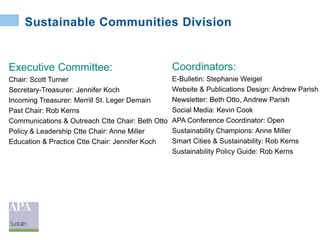
Executive Committee:
Chair: Scott Turner
Secretary-Treasurer: Jennifer Koch
Incoming Treasurer: Merrill St. Leger Demain
Past Chair: Rob Kerns
Communications & Outreach Ctte Chair: Beth Otto
Policy & Leadership Ctte Chair: Anne Miller
Education & Practice Ctte Chair: Jennifer Koch
Coordinators:
E-Bulletin: Stephanie Weigel
Website & Publications Design: Andrew Parish
Newsletter: Beth Otto, Andrew Parish
Social Media: Kevin Cook
APA Conference Coordinator: Open
Sustainability Champions: Anne Miller
Smart Cities & Sustainability: Rob Kerns
Sustainability Policy Guide: Rob Kerns
Sustainable Communities Division
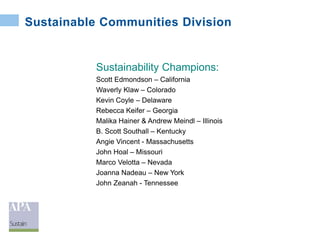
Sustainability Champions:
Scott Edmondson – California
Waverly Klaw – Colorado
Kevin Coyle – Delaware
Rebecca Keifer – Georgia
Malika Hainer & Andrew Meindl – Illinois
B. Scott Southall – Kentucky
Angie Vincent - Massachusetts
John Hoal – Missouri
Marco Velotta – Nevada
Joanna Nadeau – New York
John Zeanah - Tennessee
Sustainable Communities Division
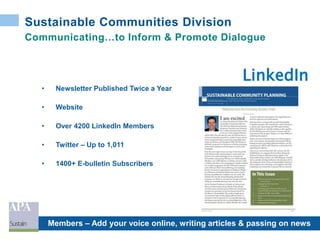
• Newsletter Published Twice a Year
• Website
• Over 4200 LinkedIn Members
• Twitter – Up to 1,011
• 1400+ E-bulletin Subscribers
Members – Add your voice online, writing articles & passing on news
LinkedIn
Communicating…to Inform & Promote Dialogue
Sustainable Communities Division
Leading…with Local & National Initiatives
• Sustainability Champions
• APA Sustainability Policy Guide Update
• APA Smart Cities & Sustainability Initiative
Members – New leaders wanted to advocate for sustainability
“We want representation and action across
the Country and in each APA chapter”
Sustainable Communities Division
Educating…by supporting research and practice-building
• 3rd Annual Awards for Excellence in
Sustainability
• Webinars
• LEED ND Case Studies in Fall Newsletter
• 2015 IUCMA Local Government Sustainability
Survey
Members – Access the latest research & best practices for sustainability
[caption]
Sustainable Communities Division
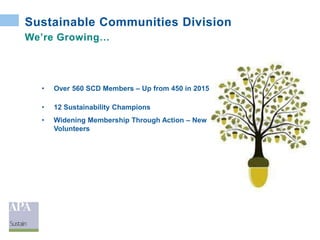
We’re Growing…
• Over 560 SCD Members – Up from 450 in 2015
• 12 Sustainability Champions
• Widening Membership Through Action – New
Volunteers
Sustainable Communities Division
Where are we headed…
 Continue Growth
 Expand Membership
 Increase Volunteer Base
 More Webinars
 Increase Sponsorship Prgram
Sustainable Communities Division
Why get involved…
Network with professionals across the country who share the
same passion for sustainability issues
Volunteer and become highly involved in the Division at either
the state or national level.
Opportunities include:
• Help with the newsletter
• Help with annual awards
• Assist with communications
• Become involved with the Sustainability Champions program
• Assisting with the national conference
• Opportunities to propose by-right conference session and
facilitated discussions.
Sustainable Communities Division
Why get involved…
Divisions provides opportunities for those who want to get
involved.
If you have a great passion or idea and have the time and desire
to Champion that idea, we are all for it and welcome your ideas.
ICMA Sustainability Survey 2015
Figuring out what’s happening….
ICMA Sustainability Survey 2015
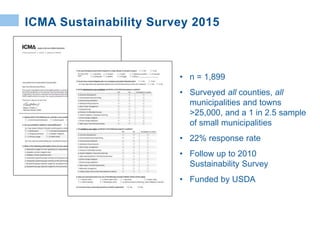
• n = 1,899
• Surveyed all counties, all
municipalities and towns
>25,000, and a 1 in 2.5 sample
of small municipalities
• 22% response rate
• Follow up to 2010
Sustainability Survey
• Funded by USDA
Putting it together…
Sustainability Survey 2015
• Some continuity to 2010 Survey
• Focus groups: ICMA, American
Planning Association
• Practitioner interviews
• APA Division input
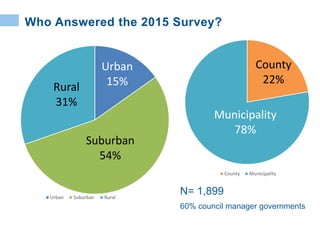
Urban Suburban Rural
N= 1,899
County Municipality
60% council manager governments
Who Answered the 2015 Survey?
Suburban
54%
Rural
31%
Urban
15%
County
22%
Municipality
78%
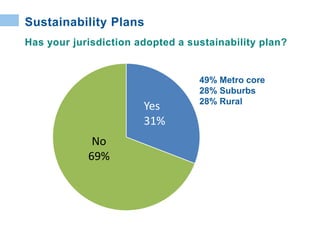
49% Metro core
28% Suburbs
28% Rural
Sustainability Plans
Has your jurisdiction adopted a sustainability plan?
Yes
31%
No
69%
0%
5%
10%
15%
20%
25%
30%
35%
40%
45%
50%
2010 2015
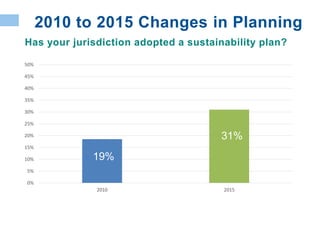
19%
31%
2010 to 2015 Changes in Planning
Has your jurisdiction adopted a sustainability plan?
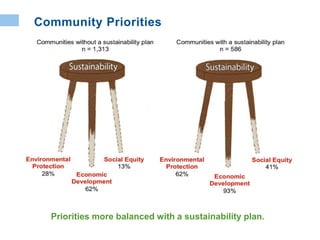
Priorities more balanced with a sustainability plan.
Community Priorities
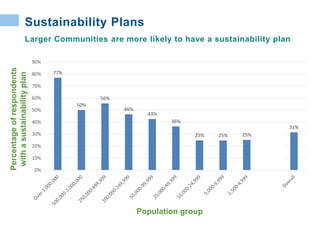
77%
50%
56%
46%
43%
36%
25% 25% 25% 27%
31%
0%
10%
20%
30%
40%
50%
60%
70%
80%
90%
Population group
Percentageofrespondents
withasustainabilityplan
Larger Communities are more likely to have a sustainability plan
Sustainability Plans
• Do you have a sustainability plan?
• What form does it take? (Stand alone, in comp plan, etc.)
• What challenges did you face drafting and adopting it? How did
you overcome them?
Discussion 1
Sustainability plans
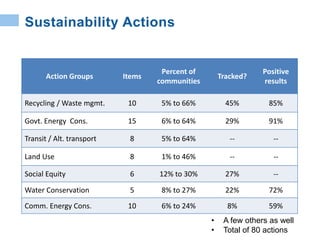
Action Groups Items
Percent of
communities
Tracked?
Positive
results
Recycling / Waste mgmt. 10 5% to 66% 45% 85%
Govt. Energy Cons. 15 6% to 64% 29% 91%
Transit / Alt. transport 8 5% to 64% -- --
Land Use 8 1% to 46% -- --
Social Equity 6 12% to 30% 27% --
Water Conservation 5 8% to 27% 22% 72%
Comm. Energy Cons. 10 6% to 24% 8% 59%
Sustainability Actions
• A few others as well
• Total of 80 actions
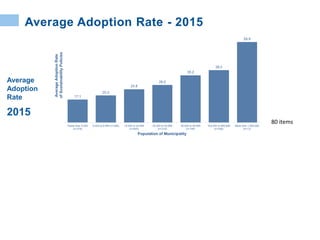
Average Adoption Rate - 2015
80 items
2015
Average
Adoption
Rate
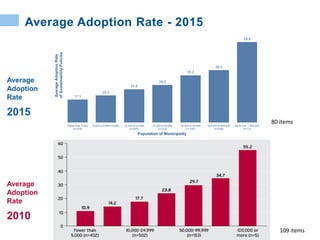
80 items
Average Adoption Rate - 2015
2015
2010
109 items
Average
Adoption
Rate
Average
Adoption
Rate
Sustainability plan
6%
8%
8%
9%
14%
14%
17%
18%
28%
35%
45%
49%
63%
64%
0% 20% 40% 60% 80%
Require govt renovation projects be certified green
Generate electricity through waste
Install a geo-thermal system
Require govt construction proj. be certified green
Establish a fuel efficiency target for govt vehicles
Purchase energy star equipment
Install charging stations for electric vehicles
Install solar equipment
More efficient pumps in water or sewer systems
Upgrade traffic signals
Upgrade streetlights or other exterior lighting
Upgrade HVAC
Conduct energy audits
Purchase energy efficient appliances
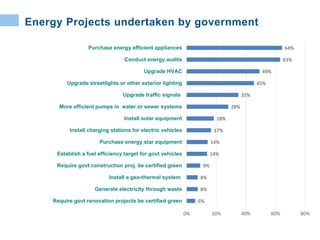
Energy Projects undertaken by government
Percent of
communities
Adopted a climate mitigation plan 6%
Adopted a climate adaptation plan 3%
Local government GHG inventory 14%
Community wide GHG inventory 9%
Local government GHG targets 11%
Community GHG targets 7%
Climate Change Policy
• Have you planned (in any document) for a
changing climate?
• What kinds of things are in the plan?
• What challenges did you face drafting and
adopting a climate plan? How did you
overcome them?
Discussion 2
Planning for Climate Change
CEO/CAO office
7%
Multiple
departments
9%
Within one
department
9%
Task force
9%
No dedicated staffing,
but have goals
24%
No staffing or goals
42%
24%
This is down a bit
from 2010. When
27% had dedicated
staffing
What are the staff for sustainability?
of local governments
dedicate no human
resources to sustainability
66%
• Do you have staff dedicated to sustainability?
• Where are they stationed? What department
do you think they should be in? Why?
Discussion 3
Sustainability Staffing
16%
20%
53%
48%
61%
68%
80%
68%
82%
73%
9%
12%
50%
55%
65%
82%
84%
85%
85%
91%
0% 20% 40% 60% 80% 100%
Climate change adaptation
Climate change mitigation
Provision of affordable housing
Open space/farmland preservation
Environmental protection
Storm water management
Hazard mitigation/evacuation planning
Seeking funding and grants
Economic development
Land use planning/permitting
Departments Coordination Regional Coordination
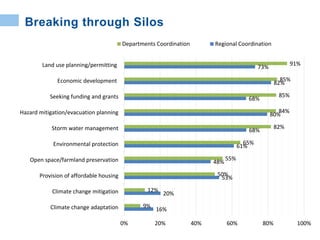
Breaking through Silos
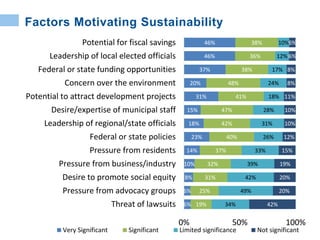
Factors Motivating Sustainability
6%
6%
8%
10%
14%
23%
18%
15%
31%
20%
37%
46%
46%
19%
25%
31%
32%
37%
40%
42%
47%
41%
48%
38%
36%
38%
34%
49%
42%
39%
33%
26%
31%
28%
18%
24%
17%
12%
10%
42%
20%
20%
19%
15%
12%
10%
10%
11%
8%
8%
6%
6%
0% 50% 100%
Threat of lawsuits
Pressure from advocacy groups
Desire to promote social equity
Pressure from business/industry
Pressure from residents
Federal or state policies
Leadership of regional/state officials
Desire/expertise of municipal staff
Potential to attract development projects
Concern over the environment
Federal or state funding opportunities
Leadership of local elected officials
Potential for fiscal savings
Very Significant Significant Limited significance Not significant
6%
6%
8%
10%
14%
23%
18%
15%
31%
20%
37%
46%
46%
19%
25%
31%
32%
37%
40%
42%
47%
41%
48%
38%
36%
38%
34%
49%
42%
39%
33%
26%
31%
28%
18%
24%
17%
12%
10%
42%
20%
20%
19%
15%
12%
10%
10%
11%
8%
8%
6%
6%
0% 50% 100%
Threat of lawsuits
Pressure from advocacy groups
Desire to promote social equity
Pressure from business/industry
Pressure from residents
Federal or state policies
Leadership of regional/state officials
Desire/expertise of municipal staff
Potential to attract development projects
Concern over the environment
Federal or state funding opportunities
Leadership of local elected officials
Potential for fiscal savings
Very Significant Significant Limited significance Not significant
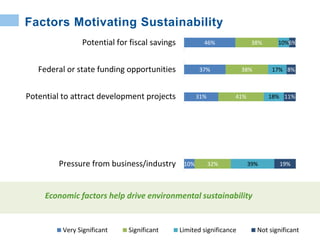
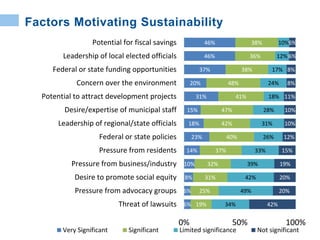
Factors Motivating Sustainability
Economic factors help drive environmental sustainability
6%
6%
8%
10%
14%
23%
18%
15%
31%
20%
37%
46%
46%
19%
25%
31%
32%
37%
40%
42%
47%
41%
48%
38%
36%
38%
34%
49%
42%
39%
33%
26%
31%
28%
18%
24%
17%
12%
10%
42%
20%
20%
19%
15%
12%
10%
10%
11%
8%
8%
6%
6%
0% 50% 100%
Threat of lawsuits
Pressure from advocacy groups
Desire to promote social equity
Pressure from business/industry
Pressure from residents
Federal or state policies
Leadership of regional/state officials
Desire/expertise of municipal staff
Potential to attract development projects
Concern over the environment
Federal or state funding opportunities
Leadership of local elected officials
Potential for fiscal savings
Very Significant Significant Limited significance Not significant
Factors Motivating Sustainability
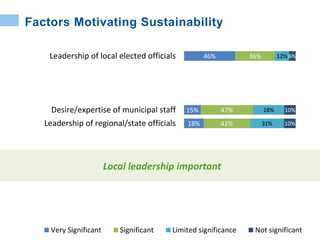
Local leadership important
6%
6%
8%
10%
14%
23%
18%
15%
31%
20%
37%
46%
46%
19%
25%
31%
32%
37%
40%
42%
47%
41%
48%
38%
36%
38%
34%
49%
42%
39%
33%
26%
31%
28%
18%
24%
17%
12%
10%
42%
20%
20%
19%
15%
12%
10%
10%
11%
8%
8%
6%
6%
0% 50% 100%
Threat of lawsuits
Pressure from advocacy groups
Desire to promote social equity
Pressure from business/industry
Pressure from residents
Federal or state policies
Leadership of regional/state officials
Desire/expertise of municipal staff
Potential to attract development projects
Concern over the environment
Federal or state funding opportunities
Leadership of local elected officials
Potential for fiscal savings
Very Significant Significant Limited significance Not significant
Factors Motivating Sustainability
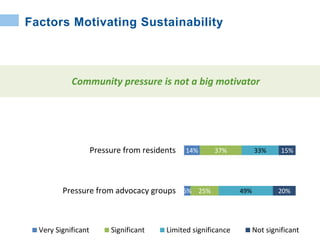
Community pressure is not a big motivator
Factors Motivating Sustainability
6%
6%
8%
10%
14%
23%
18%
15%
31%
20%
37%
46%
46%
19%
25%
31%
32%
37%
40%
42%
47%
41%
48%
38%
36%
38%
34%
49%
42%
39%
33%
26%
31%
28%
18%
24%
17%
12%
10%
42%
20%
20%
19%
15%
12%
10%
10%
11%
8%
8%
6%
6%
0% 50% 100%
Threat of lawsuits
Pressure from advocacy groups
Desire to promote social equity
Pressure from business/industry
Pressure from residents
Federal or state policies
Leadership of regional/state officials
Desire/expertise of municipal staff
Potential to attract development projects
Concern over the environment
Federal or state funding opportunities
Leadership of local elected officials
Potential for fiscal savings
Very Significant Significant Limited significance Not significant
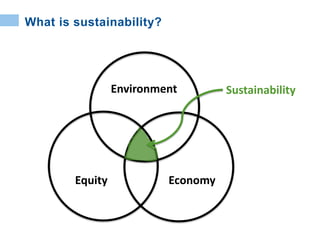
Economy
Environment
Equity
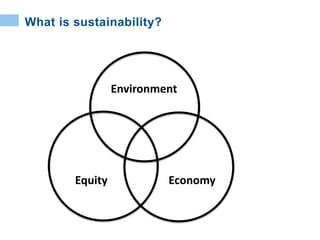
What is sustainability?
Economy
Environment
Equity
What is sustainability?
Sustainability
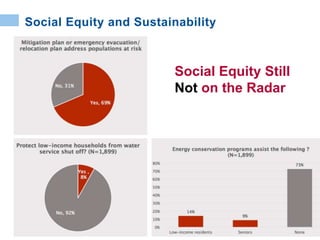
Social Equity Still
Not on the Radar
Social Equity and Sustainability
• Do your written plans refer to social equity?
• If yes, in what way is the concept mentioned?
• What drove you to include it? Or what slows
you from considering the concept?
Discussion 2
Planning for Climate Change
George Homsy
Department of Public Administration
Binghamton University
ghomsy@binghamton.edu
Masters Degree
• Public Administration
• Geography
• Environmental Studies
Master of Sustainable Communities
Translating Sustainability Goals into Action
Scott Turner, AICP, PE
Nitsch Engineering
sturner@nitscheng.com
Thomas Bott, AICP
Kingston, Massachusetts
tbott@kingstonmass.org
George C. Homsy, PhD, AICP
Binghamton University
ghomsy@binghamton.edu
Worcester, Massachusetts
October 20, 2016

Translating sustainability goals into action

  • 1.
    Scott Turner, AICP,PE Nitsch Engineering Thomas Bott, AICP Kingston, Massachusetts George C. Homsy, PhD, AICP Binghamton University Worcester, Massachusetts October 20, 2016 Translating Sustainability Goals into Action
  • 2.
    • Sustainable CommunitiesDivision • Translating a Goal into Action • Sustainability Survey & Discussion Agenda
  • 3.
    Sustainable Communities Division “TheAPA Sustainable Communities Division (APA-SCD) supports planners who are committed to planning for sustainable communities by integrating all aspects of sustainability into our work through the combined economic, social, and ecological factors that shape our communities.” SCD Leadership is Building the Division Add Value to Members Planning Efforts
  • 4.
  • 5.
    Sustainable Communities Division ExecutiveCommittee: Chair: Scott Turner Secretary-Treasurer: Jennifer Koch Incoming Treasurer: Merrill St. Leger Demain Past Chair: Rob Kerns Communications & Outreach Ctte Chair: Beth Otto Policy & Leadership Ctte Chair: Anne Miller Education & Practice Ctte Chair: Jennifer Koch Coordinators: E-Bulletin: Stephanie Weigel Website & Publications Design: Andrew Parish Newsletter: Beth Otto, Andrew Parish Social Media: Kevin Cook APA Conference Coordinator: Open Sustainability Champions: Anne Miller Smart Cities & Sustainability: Rob Kerns Sustainability Policy Guide: Rob Kerns
  • 6.
    Sustainable Communities Division SustainabilityChampions: Scott Edmondson – California Waverly Klaw – Colorado Kevin Coyle – Delaware Rebecca Keifer – Georgia Malika Hainer & Andrew Meindl – Illinois B. Scott Southall – Kentucky Angie Vincent - Massachusetts John Hoal – Missouri Marco Velotta – Nevada Joanna Nadeau – New York John Zeanah - Tennessee
  • 7.
    Sustainable Communities Division •Newsletter Published Twice a Year • Website • Over 4200 LinkedIn Members • Twitter – Up to 1,011 • 1400+ E-bulletin Subscribers Members – Add your voice online, writing articles & passing on news LinkedIn Communicating…to Inform & Promote Dialogue
  • 8.
    Sustainable Communities Division Leading…withLocal & National Initiatives • Sustainability Champions • APA Sustainability Policy Guide Update • APA Smart Cities & Sustainability Initiative Members – New leaders wanted to advocate for sustainability “We want representation and action across the Country and in each APA chapter”
  • 9.
    Sustainable Communities Division Educating…bysupporting research and practice-building • 3rd Annual Awards for Excellence in Sustainability • Webinars • LEED ND Case Studies in Fall Newsletter • 2015 IUCMA Local Government Sustainability Survey Members – Access the latest research & best practices for sustainability [caption]
  • 10.
    Sustainable Communities Division We’reGrowing… • Over 560 SCD Members – Up from 450 in 2015 • 12 Sustainability Champions • Widening Membership Through Action – New Volunteers
  • 11.
    Sustainable Communities Division Whereare we headed…  Continue Growth  Expand Membership  Increase Volunteer Base  More Webinars  Increase Sponsorship Prgram
  • 12.
    Sustainable Communities Division Whyget involved… Network with professionals across the country who share the same passion for sustainability issues Volunteer and become highly involved in the Division at either the state or national level. Opportunities include: • Help with the newsletter • Help with annual awards • Assist with communications • Become involved with the Sustainability Champions program • Assisting with the national conference • Opportunities to propose by-right conference session and facilitated discussions.
  • 13.
    Sustainable Communities Division Whyget involved… Divisions provides opportunities for those who want to get involved. If you have a great passion or idea and have the time and desire to Champion that idea, we are all for it and welcome your ideas.
  • 14.
    ICMA Sustainability Survey2015 Figuring out what’s happening….
  • 15.
    ICMA Sustainability Survey2015 • n = 1,899 • Surveyed all counties, all municipalities and towns >25,000, and a 1 in 2.5 sample of small municipalities • 22% response rate • Follow up to 2010 Sustainability Survey • Funded by USDA
  • 16.
    Putting it together… SustainabilitySurvey 2015 • Some continuity to 2010 Survey • Focus groups: ICMA, American Planning Association • Practitioner interviews • APA Division input
  • 17.
    Urban Suburban Rural N=1,899 County Municipality 60% council manager governments Who Answered the 2015 Survey? Suburban 54% Rural 31% Urban 15% County 22% Municipality 78%
  • 18.
    49% Metro core 28%Suburbs 28% Rural Sustainability Plans Has your jurisdiction adopted a sustainability plan? Yes 31% No 69%
  • 19.
    0% 5% 10% 15% 20% 25% 30% 35% 40% 45% 50% 2010 2015 19% 31% 2010 to2015 Changes in Planning Has your jurisdiction adopted a sustainability plan?
  • 20.
    Priorities more balancedwith a sustainability plan. Community Priorities
  • 21.
    77% 50% 56% 46% 43% 36% 25% 25% 25%27% 31% 0% 10% 20% 30% 40% 50% 60% 70% 80% 90% Population group Percentageofrespondents withasustainabilityplan Larger Communities are more likely to have a sustainability plan Sustainability Plans
  • 22.
    • Do youhave a sustainability plan? • What form does it take? (Stand alone, in comp plan, etc.) • What challenges did you face drafting and adopting it? How did you overcome them? Discussion 1 Sustainability plans
  • 23.
    Action Groups Items Percentof communities Tracked? Positive results Recycling / Waste mgmt. 10 5% to 66% 45% 85% Govt. Energy Cons. 15 6% to 64% 29% 91% Transit / Alt. transport 8 5% to 64% -- -- Land Use 8 1% to 46% -- -- Social Equity 6 12% to 30% 27% -- Water Conservation 5 8% to 27% 22% 72% Comm. Energy Cons. 10 6% to 24% 8% 59% Sustainability Actions • A few others as well • Total of 80 actions
  • 24.
    Average Adoption Rate- 2015 80 items 2015 Average Adoption Rate
  • 25.
    80 items Average AdoptionRate - 2015 2015 2010 109 items Average Adoption Rate Average Adoption Rate
  • 26.
    Sustainability plan 6% 8% 8% 9% 14% 14% 17% 18% 28% 35% 45% 49% 63% 64% 0% 20%40% 60% 80% Require govt renovation projects be certified green Generate electricity through waste Install a geo-thermal system Require govt construction proj. be certified green Establish a fuel efficiency target for govt vehicles Purchase energy star equipment Install charging stations for electric vehicles Install solar equipment More efficient pumps in water or sewer systems Upgrade traffic signals Upgrade streetlights or other exterior lighting Upgrade HVAC Conduct energy audits Purchase energy efficient appliances Energy Projects undertaken by government
  • 27.
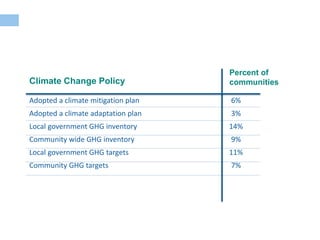
    Percent of communities Adopted aclimate mitigation plan 6% Adopted a climate adaptation plan 3% Local government GHG inventory 14% Community wide GHG inventory 9% Local government GHG targets 11% Community GHG targets 7% Climate Change Policy
  • 28.
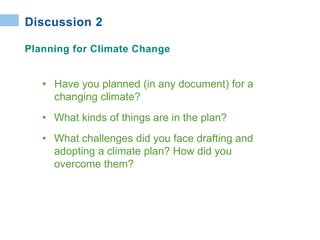
    • Have youplanned (in any document) for a changing climate? • What kinds of things are in the plan? • What challenges did you face drafting and adopting a climate plan? How did you overcome them? Discussion 2 Planning for Climate Change
  • 29.
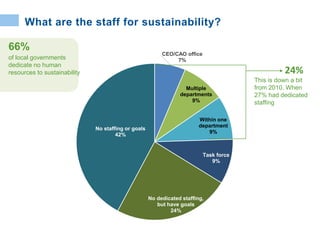
    CEO/CAO office 7% Multiple departments 9% Within one department 9% Taskforce 9% No dedicated staffing, but have goals 24% No staffing or goals 42% 24% This is down a bit from 2010. When 27% had dedicated staffing What are the staff for sustainability? of local governments dedicate no human resources to sustainability 66%
  • 30.
    • Do youhave staff dedicated to sustainability? • Where are they stationed? What department do you think they should be in? Why? Discussion 3 Sustainability Staffing
  • 31.
    16% 20% 53% 48% 61% 68% 80% 68% 82% 73% 9% 12% 50% 55% 65% 82% 84% 85% 85% 91% 0% 20% 40%60% 80% 100% Climate change adaptation Climate change mitigation Provision of affordable housing Open space/farmland preservation Environmental protection Storm water management Hazard mitigation/evacuation planning Seeking funding and grants Economic development Land use planning/permitting Departments Coordination Regional Coordination Breaking through Silos
  • 32.
    Factors Motivating Sustainability 6% 6% 8% 10% 14% 23% 18% 15% 31% 20% 37% 46% 46% 19% 25% 31% 32% 37% 40% 42% 47% 41% 48% 38% 36% 38% 34% 49% 42% 39% 33% 26% 31% 28% 18% 24% 17% 12% 10% 42% 20% 20% 19% 15% 12% 10% 10% 11% 8% 8% 6% 6% 0%50% 100% Threat of lawsuits Pressure from advocacy groups Desire to promote social equity Pressure from business/industry Pressure from residents Federal or state policies Leadership of regional/state officials Desire/expertise of municipal staff Potential to attract development projects Concern over the environment Federal or state funding opportunities Leadership of local elected officials Potential for fiscal savings Very Significant Significant Limited significance Not significant
  • 33.
    6% 6% 8% 10% 14% 23% 18% 15% 31% 20% 37% 46% 46% 19% 25% 31% 32% 37% 40% 42% 47% 41% 48% 38% 36% 38% 34% 49% 42% 39% 33% 26% 31% 28% 18% 24% 17% 12% 10% 42% 20% 20% 19% 15% 12% 10% 10% 11% 8% 8% 6% 6% 0% 50% 100% Threatof lawsuits Pressure from advocacy groups Desire to promote social equity Pressure from business/industry Pressure from residents Federal or state policies Leadership of regional/state officials Desire/expertise of municipal staff Potential to attract development projects Concern over the environment Federal or state funding opportunities Leadership of local elected officials Potential for fiscal savings Very Significant Significant Limited significance Not significant Factors Motivating Sustainability Economic factors help drive environmental sustainability
  • 34.
    6% 6% 8% 10% 14% 23% 18% 15% 31% 20% 37% 46% 46% 19% 25% 31% 32% 37% 40% 42% 47% 41% 48% 38% 36% 38% 34% 49% 42% 39% 33% 26% 31% 28% 18% 24% 17% 12% 10% 42% 20% 20% 19% 15% 12% 10% 10% 11% 8% 8% 6% 6% 0% 50% 100% Threatof lawsuits Pressure from advocacy groups Desire to promote social equity Pressure from business/industry Pressure from residents Federal or state policies Leadership of regional/state officials Desire/expertise of municipal staff Potential to attract development projects Concern over the environment Federal or state funding opportunities Leadership of local elected officials Potential for fiscal savings Very Significant Significant Limited significance Not significant Factors Motivating Sustainability Local leadership important
  • 35.
    6% 6% 8% 10% 14% 23% 18% 15% 31% 20% 37% 46% 46% 19% 25% 31% 32% 37% 40% 42% 47% 41% 48% 38% 36% 38% 34% 49% 42% 39% 33% 26% 31% 28% 18% 24% 17% 12% 10% 42% 20% 20% 19% 15% 12% 10% 10% 11% 8% 8% 6% 6% 0% 50% 100% Threatof lawsuits Pressure from advocacy groups Desire to promote social equity Pressure from business/industry Pressure from residents Federal or state policies Leadership of regional/state officials Desire/expertise of municipal staff Potential to attract development projects Concern over the environment Federal or state funding opportunities Leadership of local elected officials Potential for fiscal savings Very Significant Significant Limited significance Not significant Factors Motivating Sustainability Community pressure is not a big motivator
  • 36.
    Factors Motivating Sustainability 6% 6% 8% 10% 14% 23% 18% 15% 31% 20% 37% 46% 46% 19% 25% 31% 32% 37% 40% 42% 47% 41% 48% 38% 36% 38% 34% 49% 42% 39% 33% 26% 31% 28% 18% 24% 17% 12% 10% 42% 20% 20% 19% 15% 12% 10% 10% 11% 8% 8% 6% 6% 0%50% 100% Threat of lawsuits Pressure from advocacy groups Desire to promote social equity Pressure from business/industry Pressure from residents Federal or state policies Leadership of regional/state officials Desire/expertise of municipal staff Potential to attract development projects Concern over the environment Federal or state funding opportunities Leadership of local elected officials Potential for fiscal savings Very Significant Significant Limited significance Not significant
  • 37.
  • 38.
  • 39.
    Social Equity Still Noton the Radar Social Equity and Sustainability
  • 40.
    • Do yourwritten plans refer to social equity? • If yes, in what way is the concept mentioned? • What drove you to include it? Or what slows you from considering the concept? Discussion 2 Planning for Climate Change
  • 41.
    George Homsy Department ofPublic Administration Binghamton University ghomsy@binghamton.edu Masters Degree • Public Administration • Geography • Environmental Studies Master of Sustainable Communities
  • 42.
    Translating Sustainability Goalsinto Action Scott Turner, AICP, PE Nitsch Engineering sturner@nitscheng.com Thomas Bott, AICP Kingston, Massachusetts tbott@kingstonmass.org George C. Homsy, PhD, AICP Binghamton University ghomsy@binghamton.edu Worcester, Massachusetts October 20, 2016

Editor's Notes

  • #18 New graphics
  • #19 New graphics
  • #21 New graphics
  • #30 Lack of human resources is higher in small places
  • #32 Lack of human resources is higher in small places
  • #33 Lack of human resources is higher in small places
  • #34 Lack of human resources is higher in small places
  • #35 Lack of human resources is higher in small places
  • #36 Lack of human resources is higher in small places
  • #37 Lack of human resources is higher in small places
  • #38 But first… Typical conception Equal weight
  • #39 But first… Typical conception Equal weight