
The Effects of Formalin on Clinical Diagnostics 
Dr Jonathan Frampton 
Product Manager, Diagnostics 
Dr Hadas Amit 
Product Development, Diagnostics 
Twitter: @HorizonDX_news
Dr. Jonathan Frampton, PhD 
Product Manager, Diagnostics 
In his role, Jonathan works closely with a broad range of European, North American 
and EMEA oncology-focussed Quality Assurance Schemes with the goal of driving 
the standardization and normalization of molecular assays across the globe. 
Jonathan holds a PhD from University of Sussex in Genomic DNA Damage and 
Stability and has extensive product development experience through previous roles 
including Cambridge-based antibody company Abcam. 
1 
Presenters
What is the impact of assay failure 
in your laboratory and how do you 
monitor for it? 
2
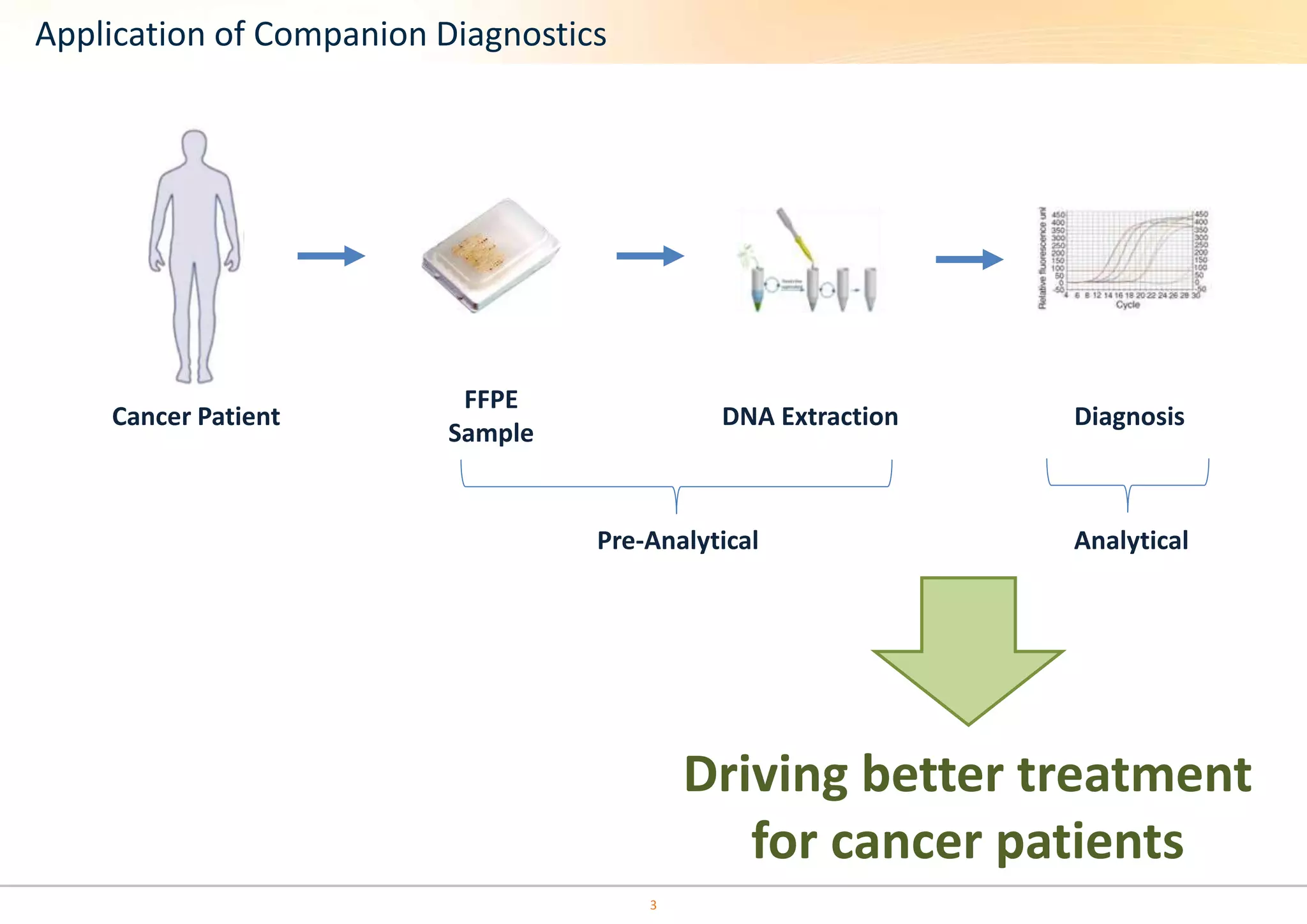
3 
FFPE 
Sample 
Cancer Patient DNA Extraction Diagnosis 
Driving better treatment 
for cancer patients 
Application of Companion Diagnostics 
Pre-Analytical Analytical
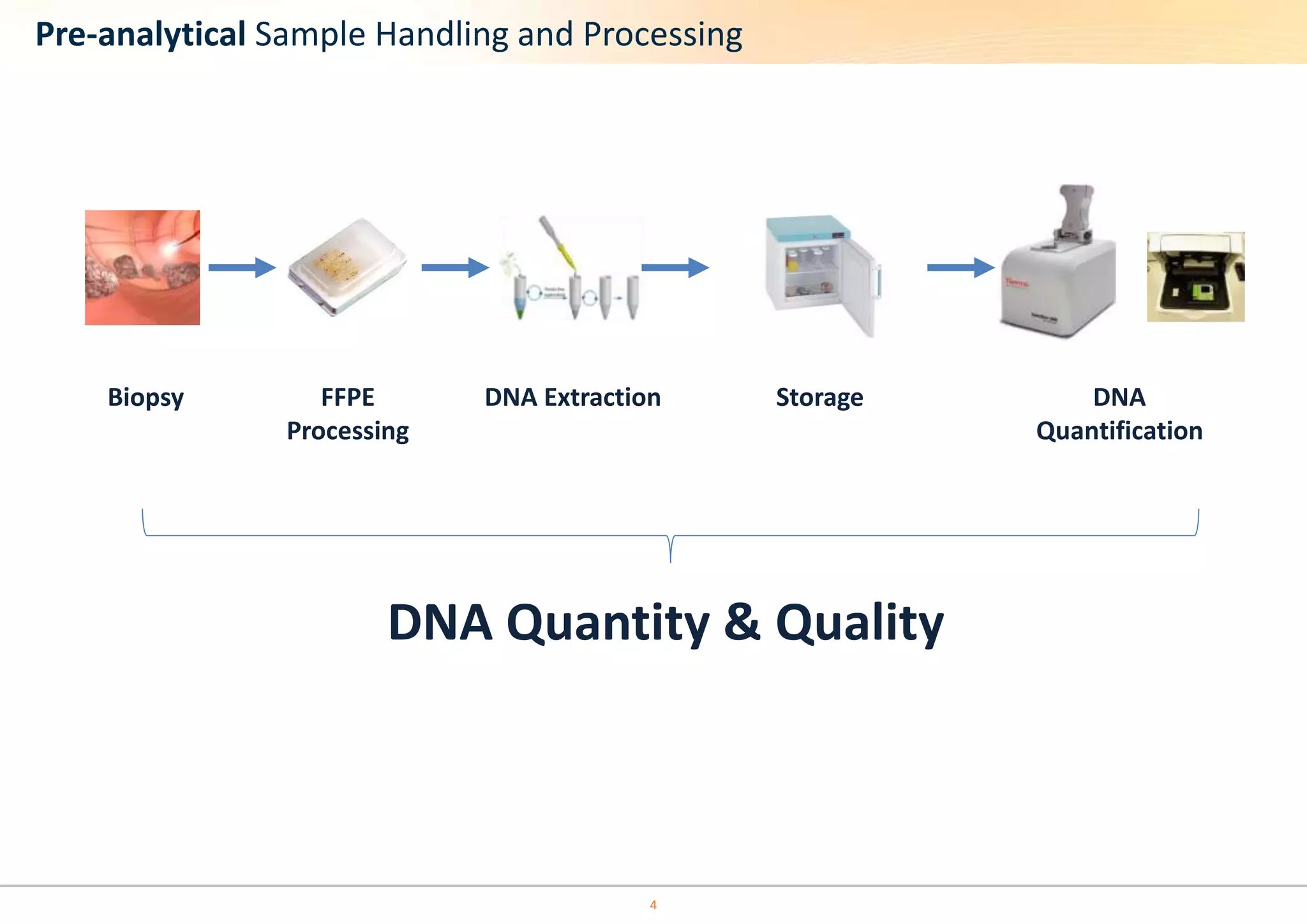
Pre-analytical Sample Handling and Processing 
Biopsy DNA 
4 
Quantification 
DNA Extraction Storage 
DNA Quantity & Quality 
FFPE 
Processing
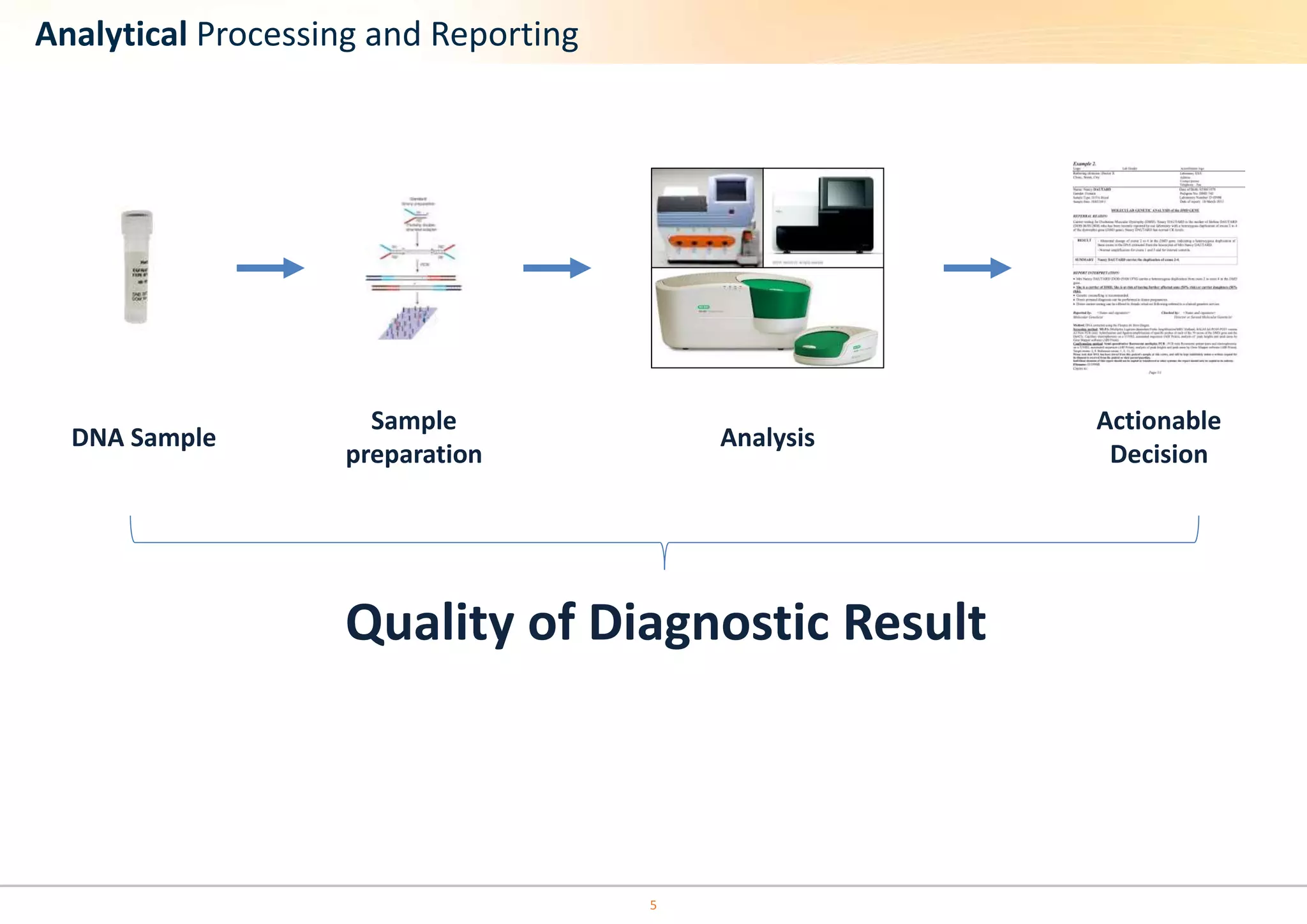
Analytical Processing and Reporting 
Sample 
preparation 
DNA Sample Analysis 
5 
Actionable 
Decision 
Quality of Diagnostic Result
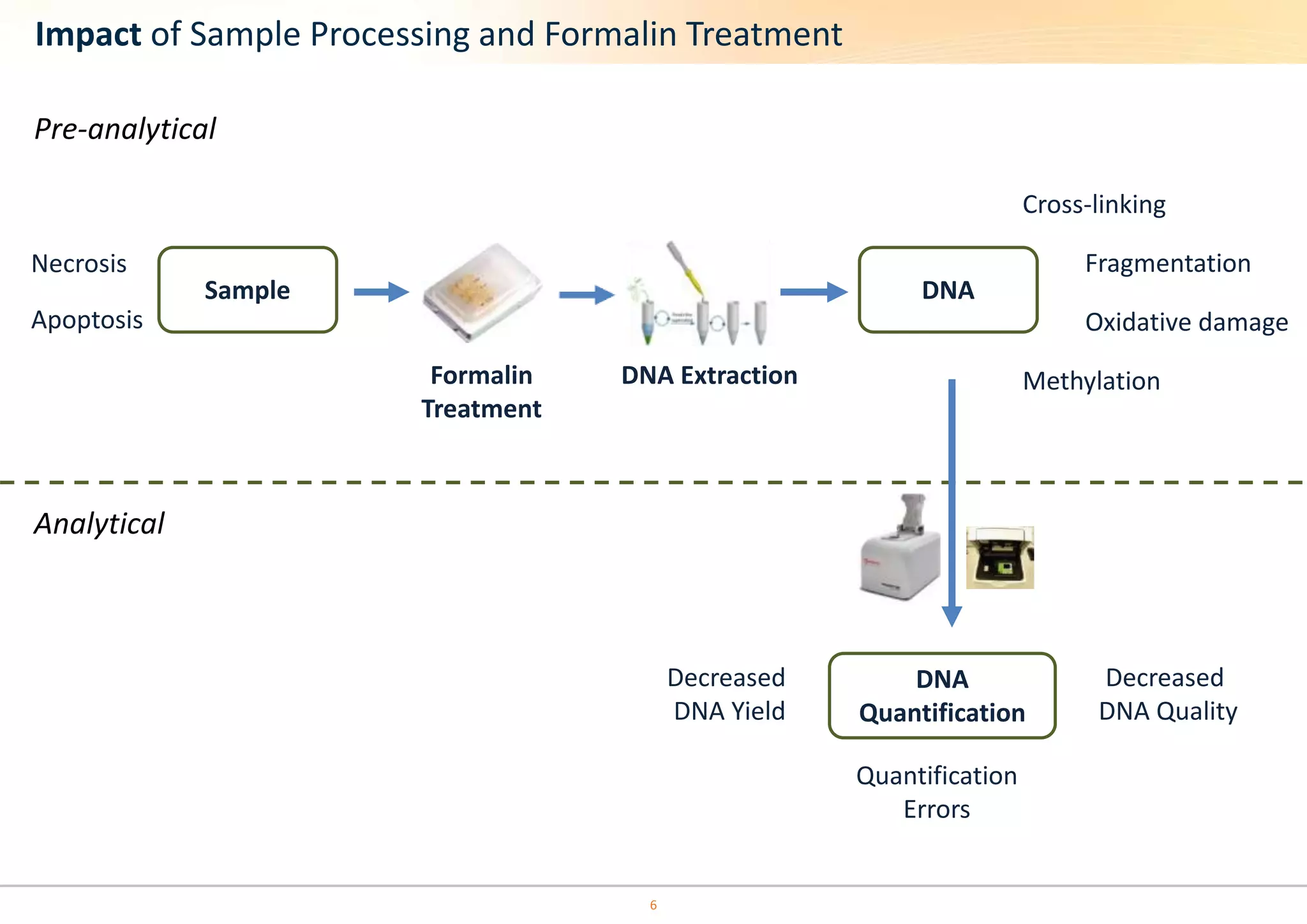
Impact of Sample Processing and Formalin Treatment 
Necrosis Fragmentation 
6 
Pre-analytical 
Analytical 
DNA 
DNA 
Quantification 
Decreased 
DNA Yield 
Decreased 
DNA Quality 
Quantification 
Errors 
Cross-linking 
Oxidative damage 
Methylation 
Sample 
Apoptosis 
Formalin DNA Extraction 
Treatment
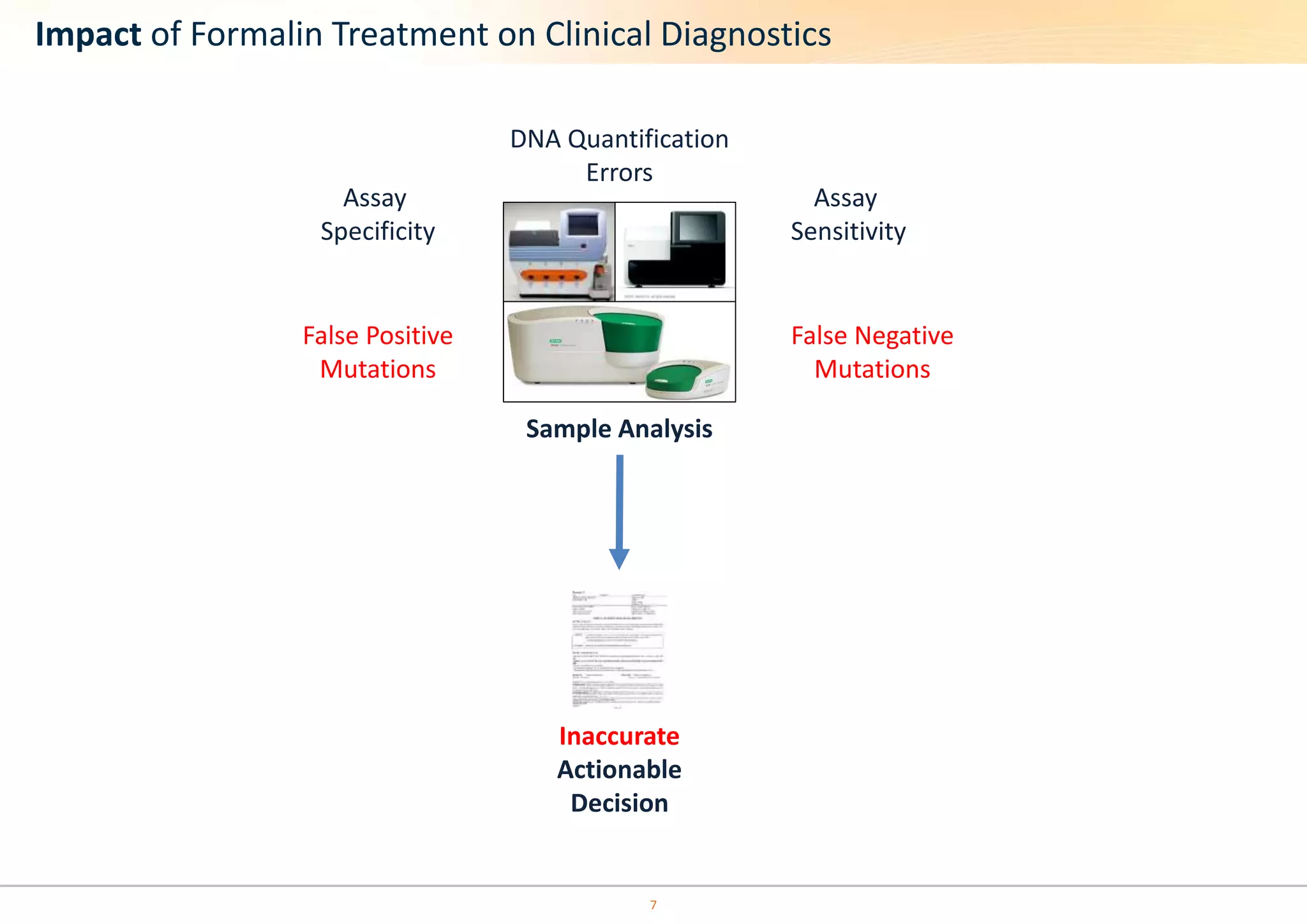
Impact of Formalin Treatment on Clinical Diagnostics 
DNA Quantification 
Errors 
Sample Analysis 
7 
False Positive 
Mutations 
Assay 
Sensitivity 
False Negative 
Mutations 
Assay 
Specificity 
Inaccurate 
Actionable 
Decision
Dr. Hadas Amit 
Senior Scientist, Diagnostics 
Hadas is a senior scientist with a strong interest in the future of personalised 
medicine with focus on advances in cell free tumor DNA (cfDNA). Hadas is leading 
the research and development of Formalin-Compromised Reference Standards at 
Horizon Diagnostics. 
8 
Presenters
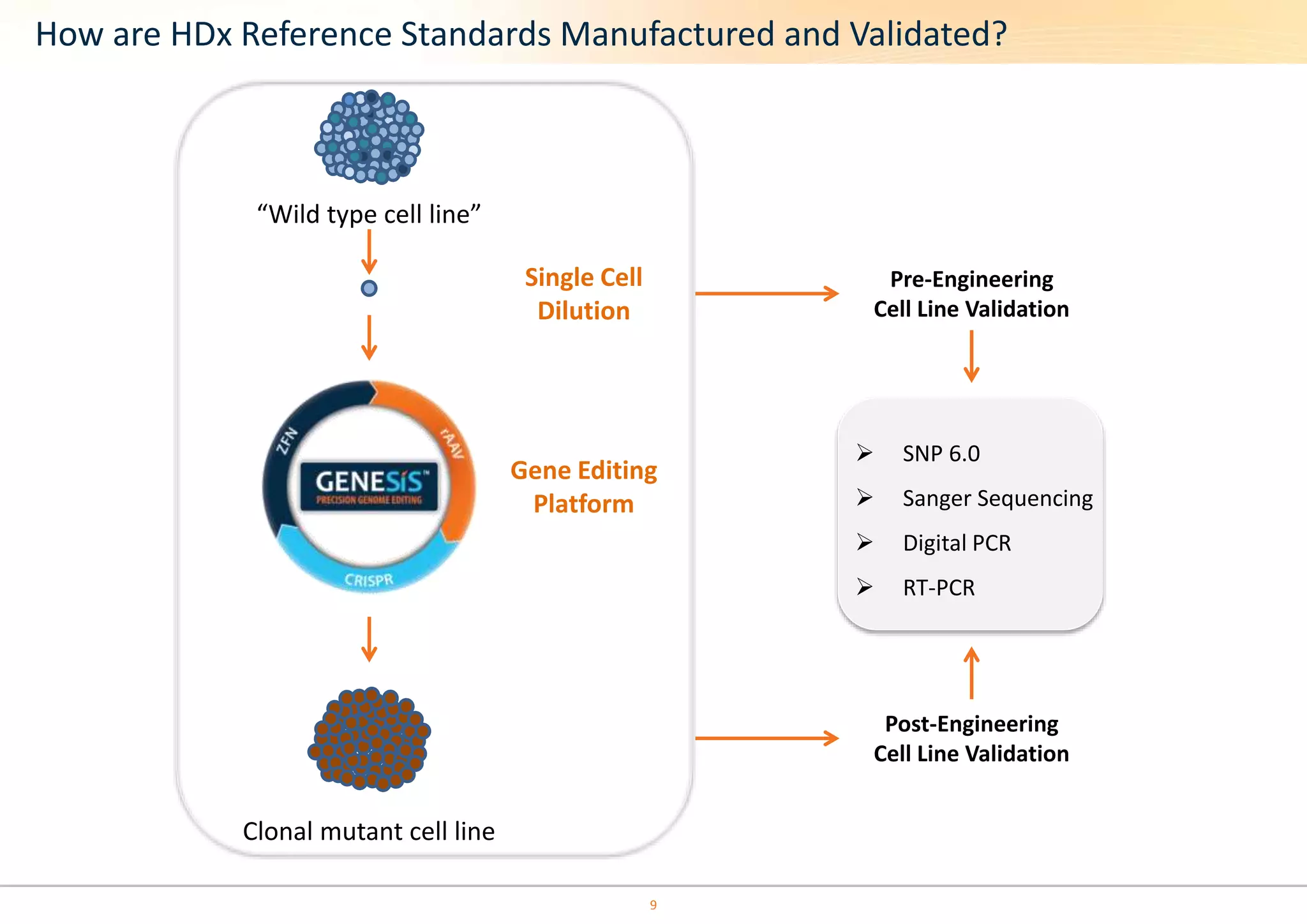
How are HDx Reference Standards Manufactured and Validated? 
“Wild type cell line” 
Single Cell 
Dilution 
Clonal mutant cell line 
Pre-Engineering 
Cell Line Validation 
 SNP 6.0 
 Sanger Sequencing 
 Digital PCR 
 RT-PCR 
Post-Engineering 
Cell Line Validation 
Gene Editing 
Platform 
9
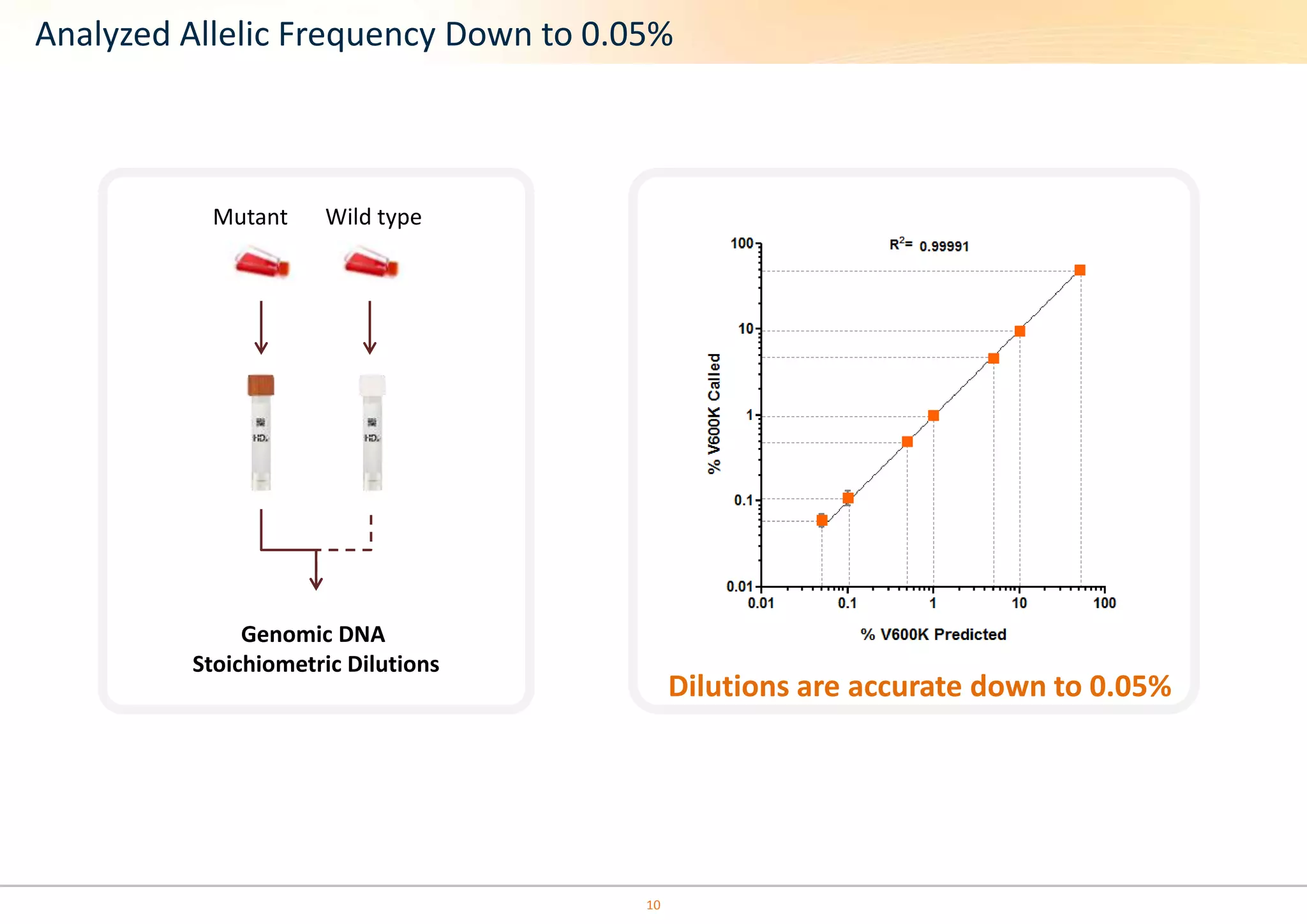
Analyzed Allelic Frequency Down to 0.05% 
Mutant Wild type 
Genomic DNA 
Stoichiometric Dilutions 
Dilutions are accurate down to 0.05% 
10
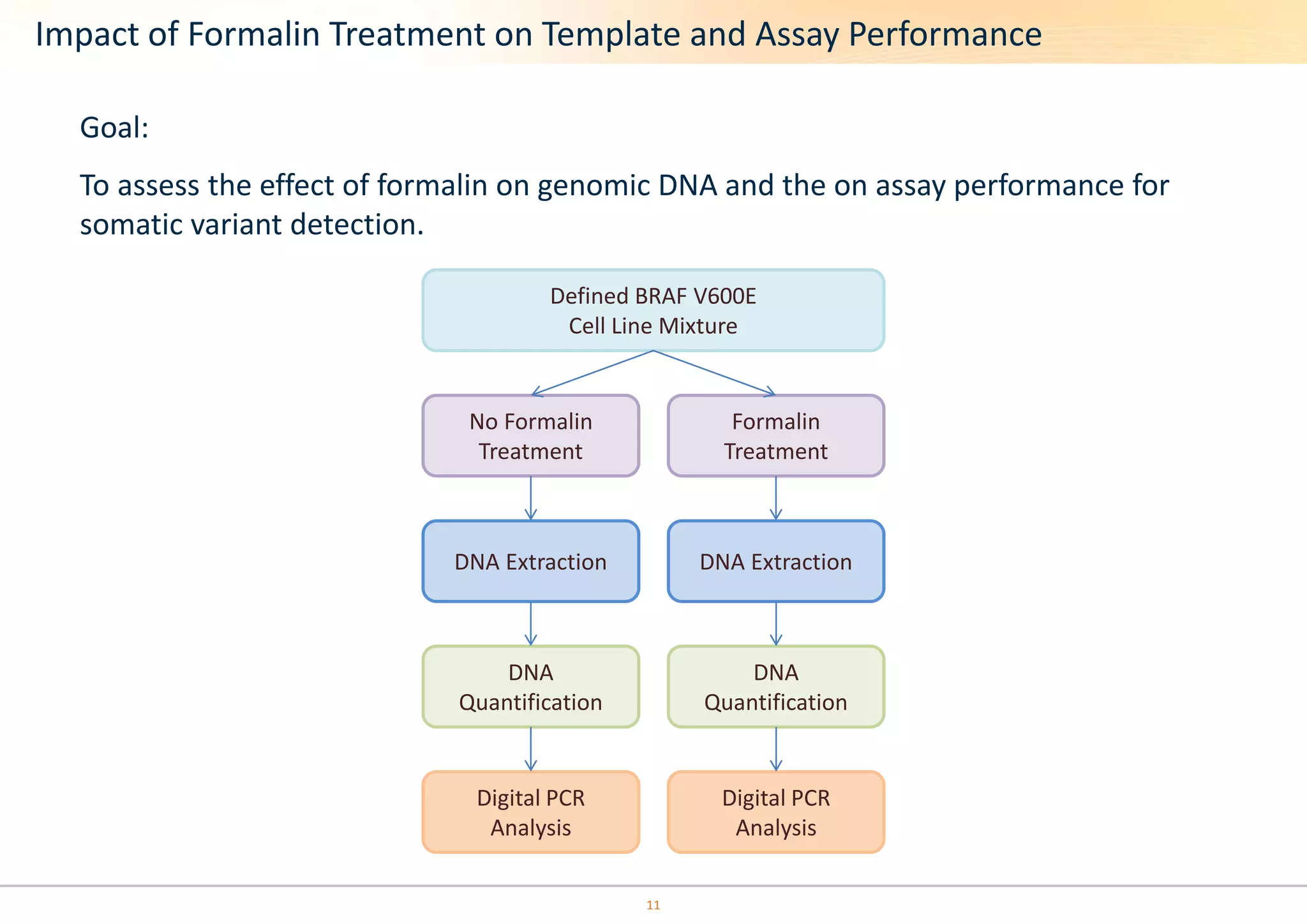
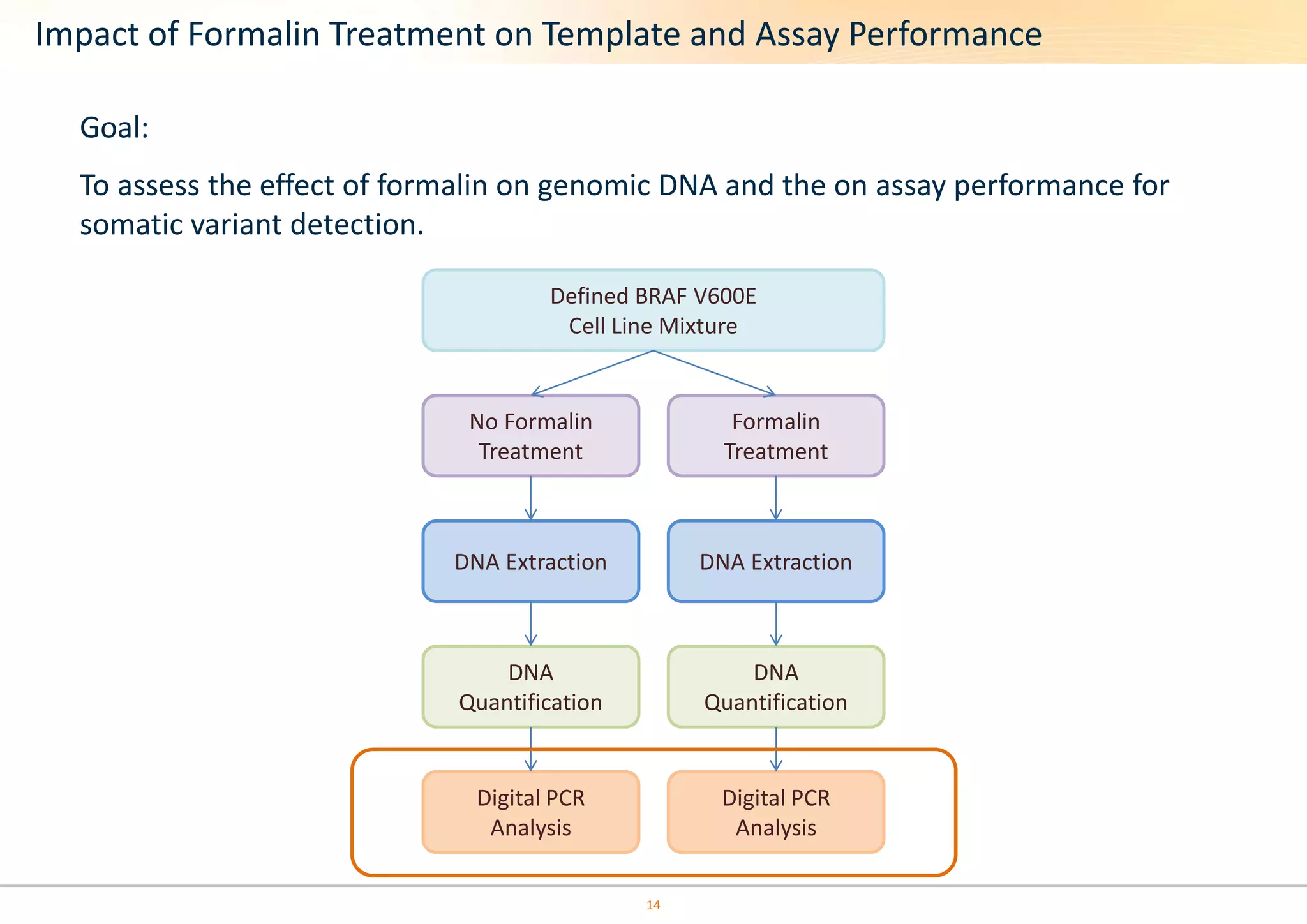
Impact of Formalin Treatment on Template and Assay Performance 
Goal: 
To assess the effect of formalin on genomic DNA and the on assay performance for 
somatic variant detection. 
Defined BRAF V600E 
Cell Line Mixture 
No Formalin 
Treatment 
Formalin 
Treatment 
DNA Extraction DNA Extraction 
DNA 
Quantification 
DNA 
Quantification 
Digital PCR 
Analysis 
Digital PCR 
Analysis 
11
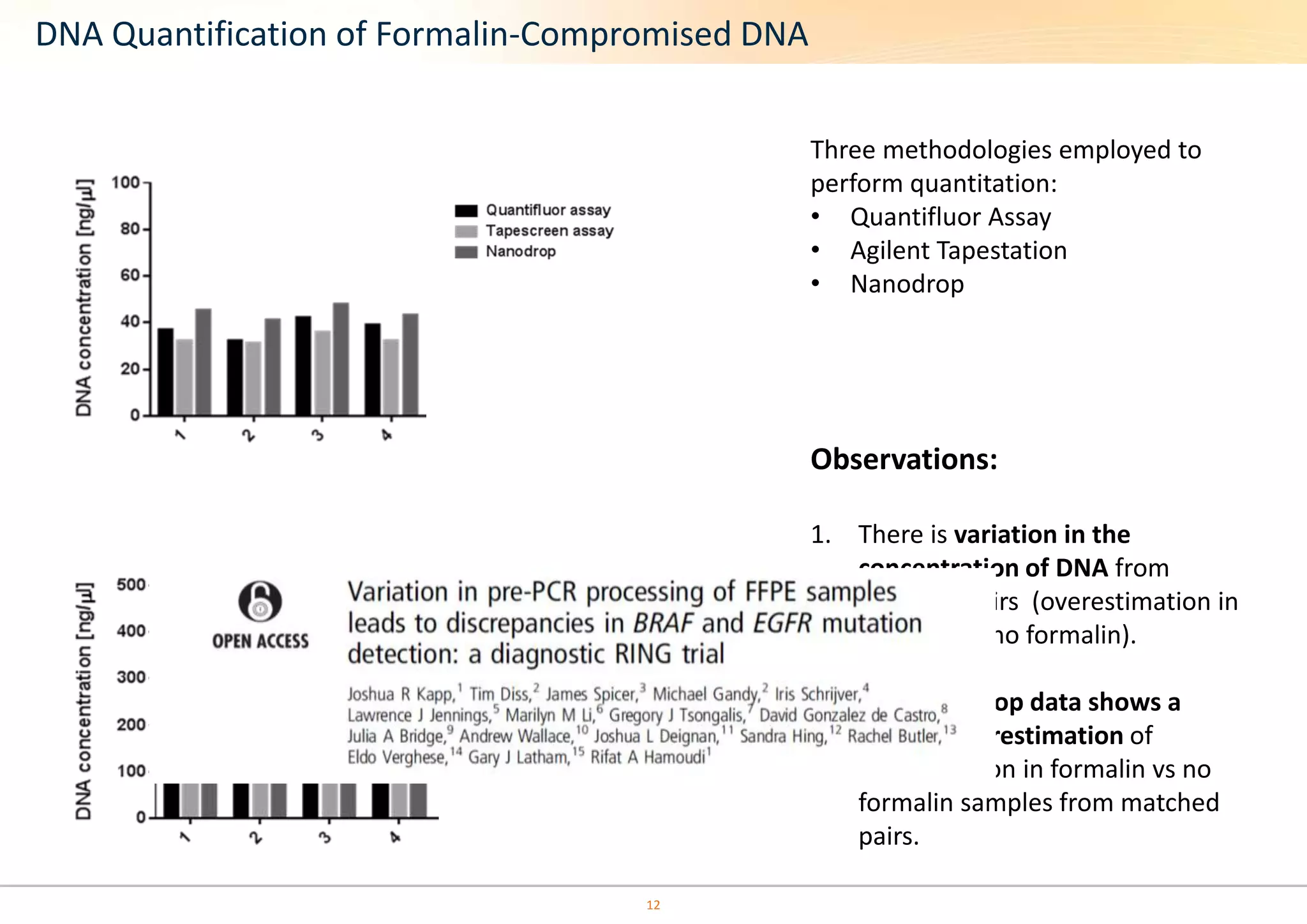
Three methodologies employed to 
perform quantitation: 
• Quantifluor Assay 
• Agilent Tapestation 
• Nanodrop 
Observations: 
1. There is variation in the 
concentration of DNA from 
matched pairs (overestimation in 
formalin vs no formalin). 
2. The Nanodrop data shows a 
greater overestimation of 
concentration in formalin vs no 
formalin samples from matched 
pairs. 
DNA Quantification of Formalin-Compromised DNA 
12
Impact of Formalin Treatment on Template and Assay Performance 
Goal: 
To assess the effect of formalin on genomic DNA and the on assay performance for 
somatic variant detection. 
Defined BRAF V600E 
Cell Line Mixture 
No Formalin 
Treatment 
Formalin 
Treatment 
DNA Extraction DNA Extraction 
DNA 
Quantification 
DNA 
Quantification 
Digital PCR 
Analysis 
Digital PCR 
Analysis 
14
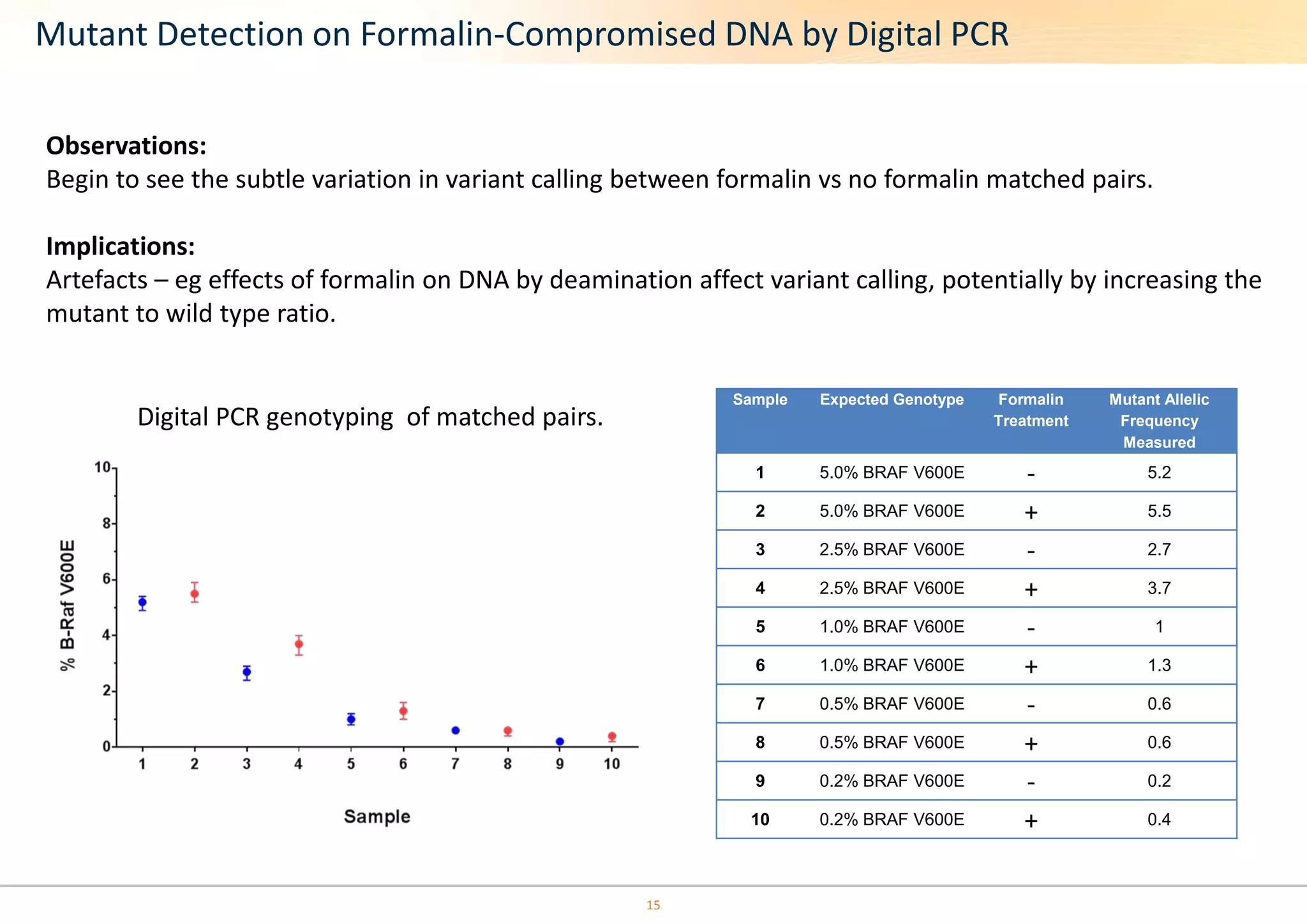
Mutant Detection on Formalin-Compromised DNA by Digital PCR 
Observations: 
Begin to see the subtle variation in variant calling between formalin vs no formalin matched pairs. 
Sample Expected Genotype Formalin 
Treatment 
Mutant Allelic 
Frequency 
Measured 
1 5.0% B-Raf V600E - 5.2 
2 5.0% B-Raf V600E + 5.5 
3 2.5% B-Raf V600E - 2.7 
4 2.5% B-Raf V600E + 3.7 
5 1.0% B-Raf V600E - 1.0 
6 1.0% B-Raf V600E + 1.3 
7 0.5% B-Raf V600E - 0.6 
8 0.5% B-Raf V600E + 0.6 
9 0.2% B-Raf V600E - 0.2 
10 0.2% B-Raf V600E + 0.4 
Digital PCR genotyping of matched pairs. 
Expected and measured allelic frequencies 
Implications: 
Artefacts – eg effects of formalin on DNA by deamination affect variant calling, potentially by increasing the 
mutant to wild type ratio. 
Sample Expected Genotype Formalin 
Treatment 
Mutant Allelic 
Frequency 
Measured 
1 5.0% BRAF V600E - 5.2 
2 5.0% BRAF V600E + 5.5 
3 2.5% BRAF V600E - 2.7 
4 2.5% BRAF V600E + 3.7 
5 1.0% BRAF V600E - 1 
6 1.0% BRAF V600E + 1.3 
7 0.5% BRAF V600E - 0.6 
8 0.5% BRAF V600E + 0.6 
9 0.2% BRAF V600E - 0.2 
10 0.2% BRAF V600E + 0.4 
15
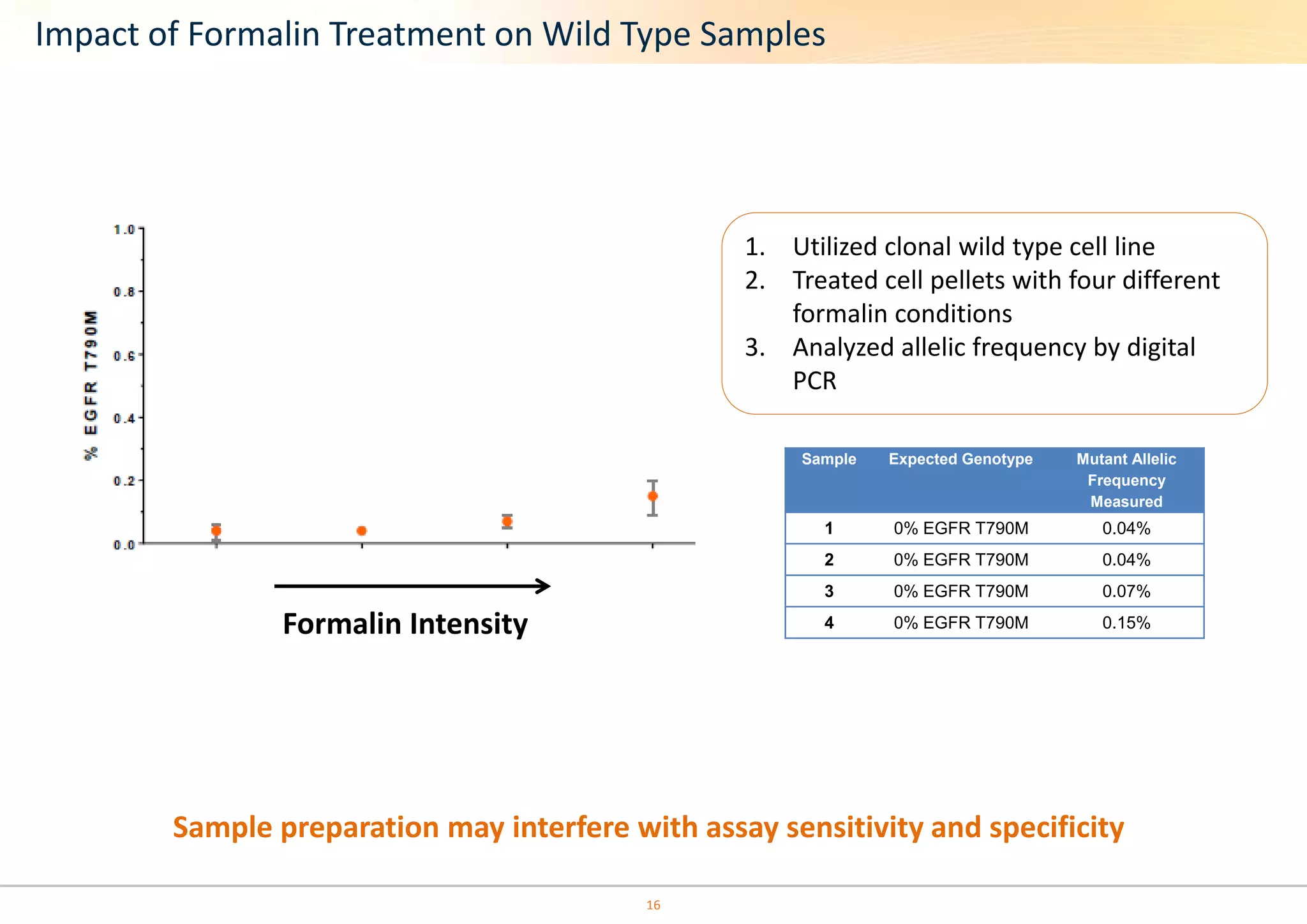
Impact of Formalin Treatment on Wild Type Samples 
Formalin Intensity 
1. Utilized clonal wild type cell line 
2. Treated cell pellets with four different 
formalin conditions 
3. Analyzed allelic frequency by digital 
PCR 
Sample Expected Genotype Mutant Allelic 
Frequency 
Measured 
1 0% EGFR T790M 0.04% 
2 0% EGFR T790M 0.04% 
3 0% EGFR T790M 0.07% 
4 0% EGFR T790M 0.15% 
Sample preparation may interfere with assay sensitivity and specificity 
16
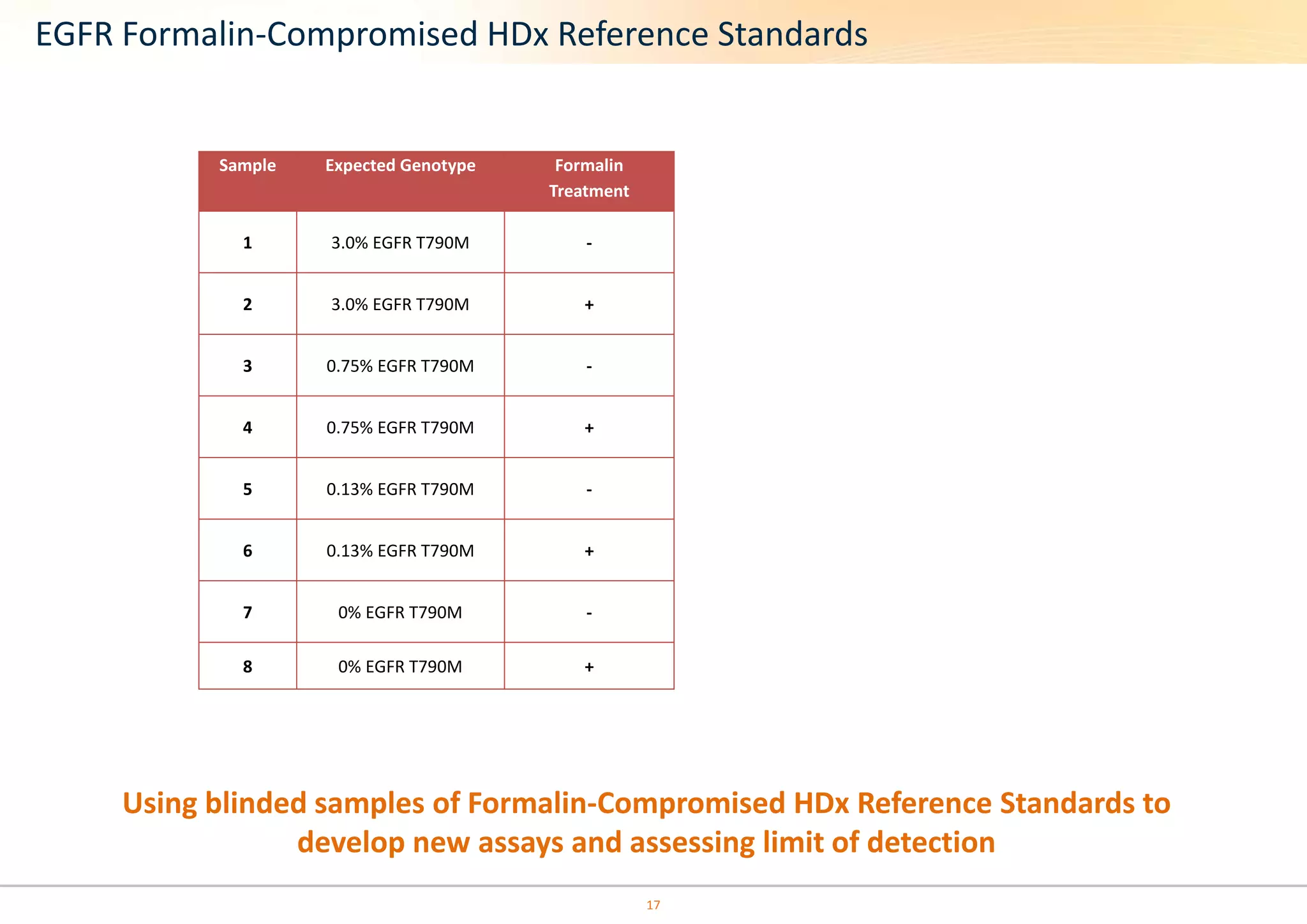
EGFR Formalin-Compromised HDx Reference Standards 
17 
Sample Expected Genotype Formalin 
Treatment 
1 3.0% EGFR T790M - 
2 3.0% EGFR T790M + 
3 0.75% EGFR T790M - 
4 0.75% EGFR T790M + 
5 0.13% EGFR T790M - 
6 0.13% EGFR T790M + 
7 0% EGFR T790M - 
8 0% EGFR T790M + 
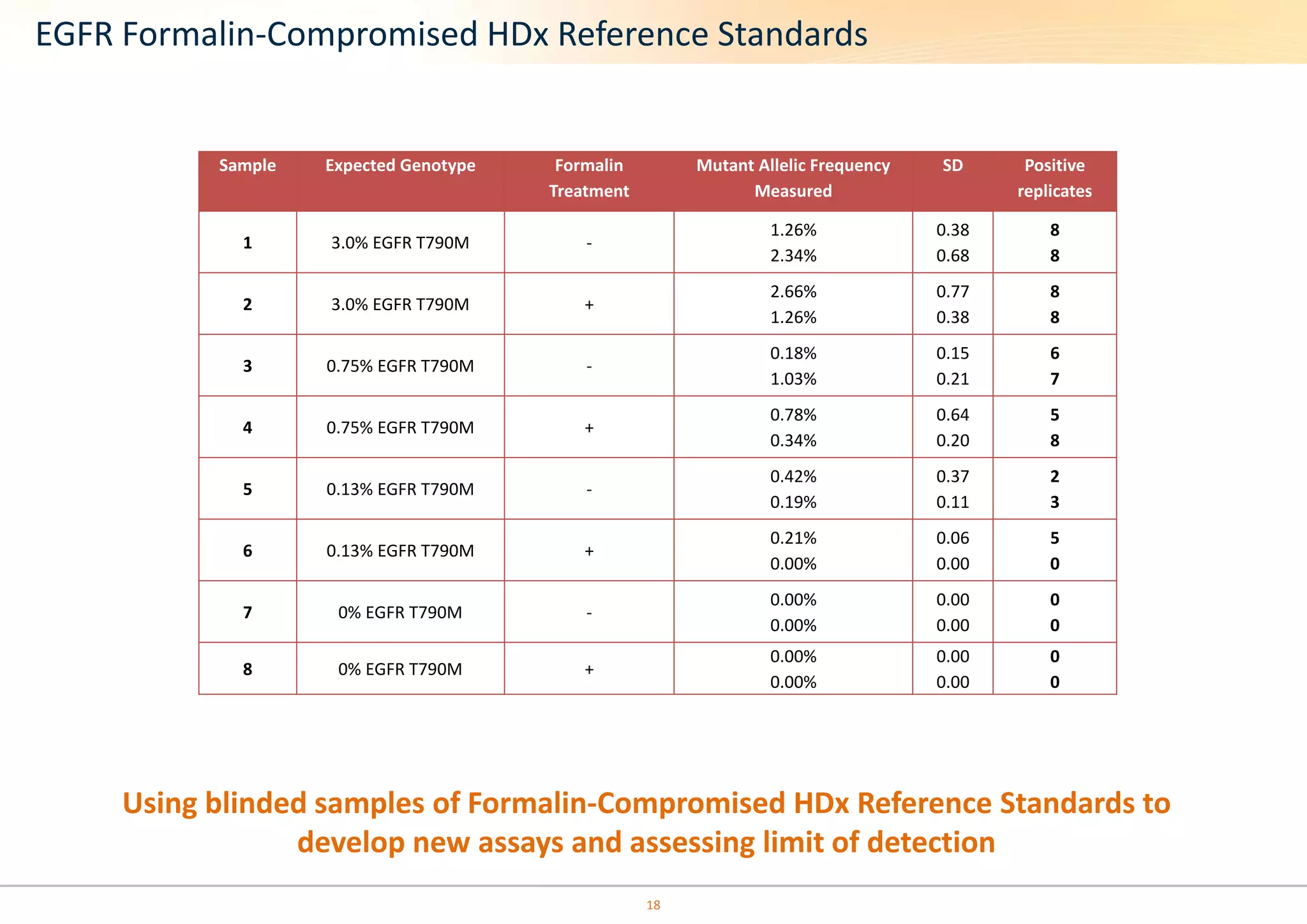
Using blinded samples of Formalin-Compromised HDx Reference Standards to 
develop new assays and assessing limit of detection
EGFR Formalin-Compromised HDx Reference Standards 
Using blinded samples of Formalin-Compromised HDx Reference Standards to 
develop new assays and assessing limit of detection 
18 
Sample Expected Genotype Formalin 
Treatment 
Mutant Allelic Frequency 
Measured 
SD Positive 
replicates 
1 3.0% EGFR T790M - 
1.26% 
2.34% 
0.38 
0.68 
8 
8 
2 3.0% EGFR T790M + 
2.66% 
1.26% 
0.77 
0.38 
8 
8 
3 0.75% EGFR T790M - 
0.18% 
1.03% 
0.15 
0.21 
6 
7 
4 0.75% EGFR T790M + 
0.78% 
0.34% 
0.64 
0.20 
5 
8 
5 0.13% EGFR T790M - 
0.42% 
0.19% 
0.37 
0.11 
2 
3 
6 0.13% EGFR T790M + 
0.21% 
0.00% 
0.06 
0.00 
5 
0 
7 0% EGFR T790M - 
0.00% 
0.00% 
0.00 
0.00 
0 
0 
8 0% EGFR T790M + 
0.00% 
0.00% 
0.00 
0.00 
0 
0
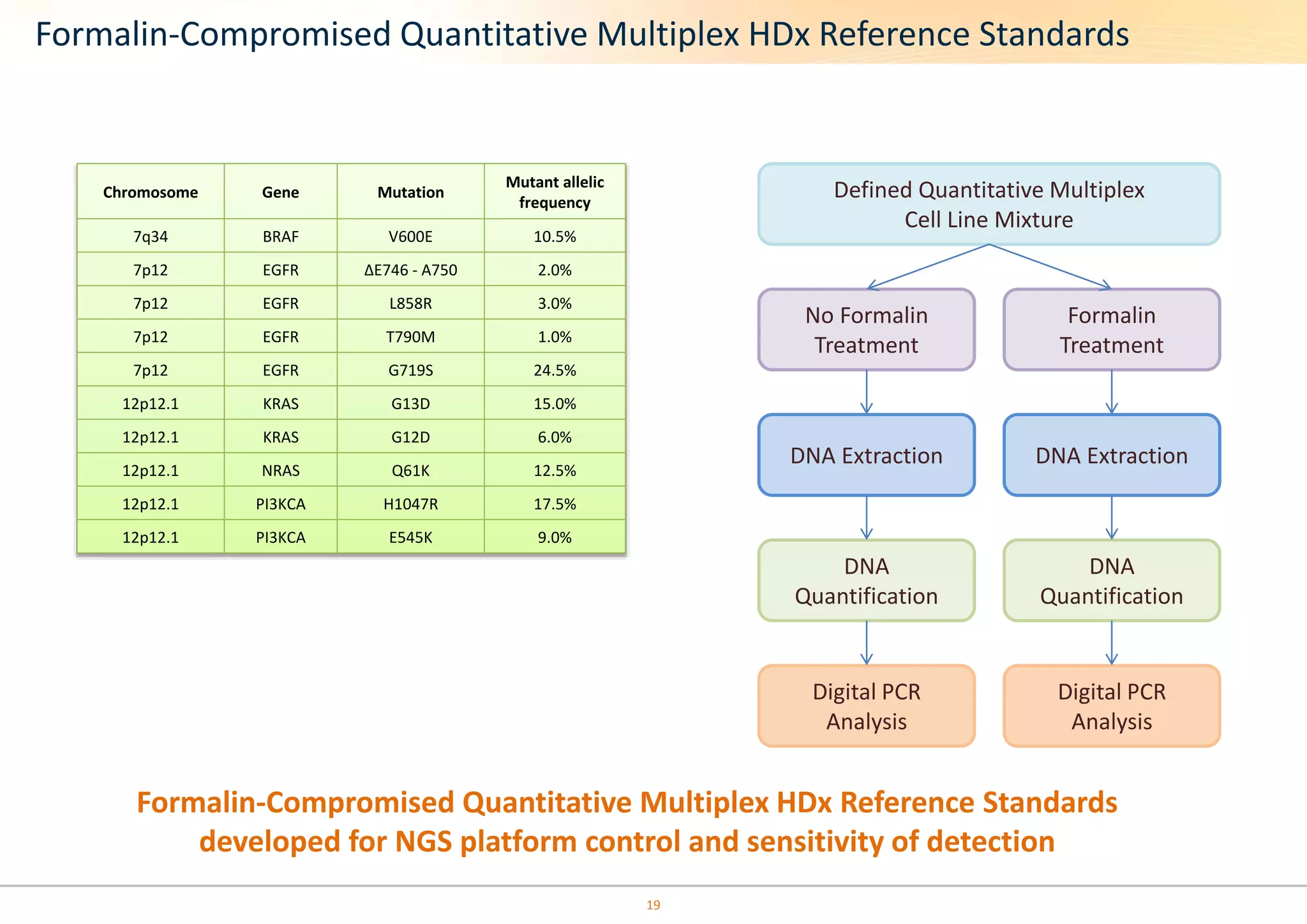
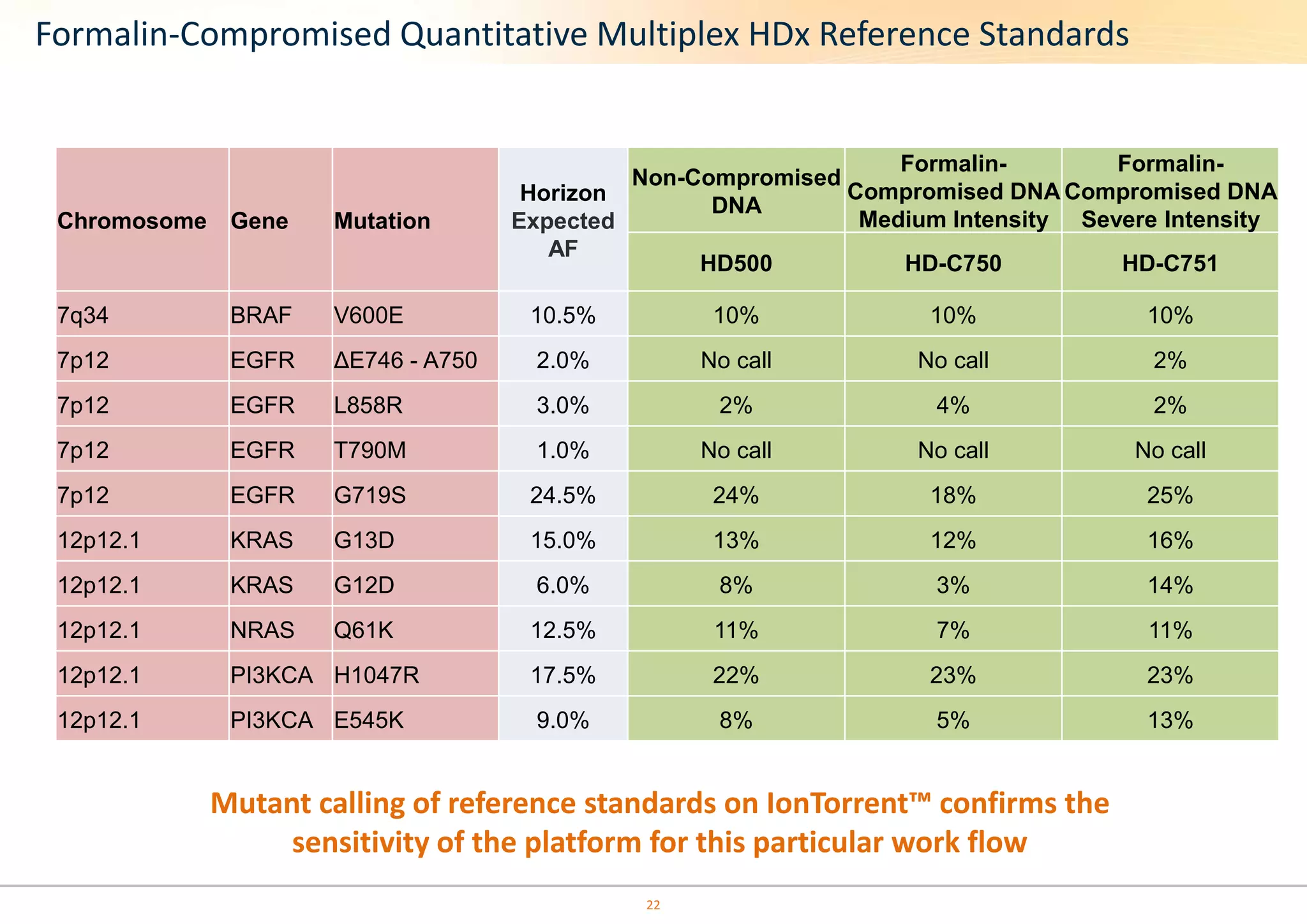
Formalin-Compromised Quantitative Multiplex HDx Reference Standards 
developed for NGS platform control and sensitivity of detection 
19 
Chromosome Gene Mutation 
Mutant allelic 
frequency 
7q34 BRAF V600E 10.5% 
7p12 EGFR ΔE746 - A750 2.0% 
7p12 EGFR L858R 3.0% 
7p12 EGFR T790M 1.0% 
7p12 EGFR G719S 24.5% 
12p12.1 KRAS G13D 15.0% 
12p12.1 KRAS G12D 6.0% 
12p12.1 NRAS Q61K 12.5% 
12p12.1 PI3KCA H1047R 17.5% 
12p12.1 PI3KCA E545K 9.0% 
Defined Quantitative Multiplex 
Cell Line Mixture 
No Formalin 
Treatment 
Formalin 
Treatment 
DNA Extraction DNA Extraction 
DNA 
Quantification 
DNA 
Quantification 
Digital PCR 
Analysis 
Digital PCR 
Analysis
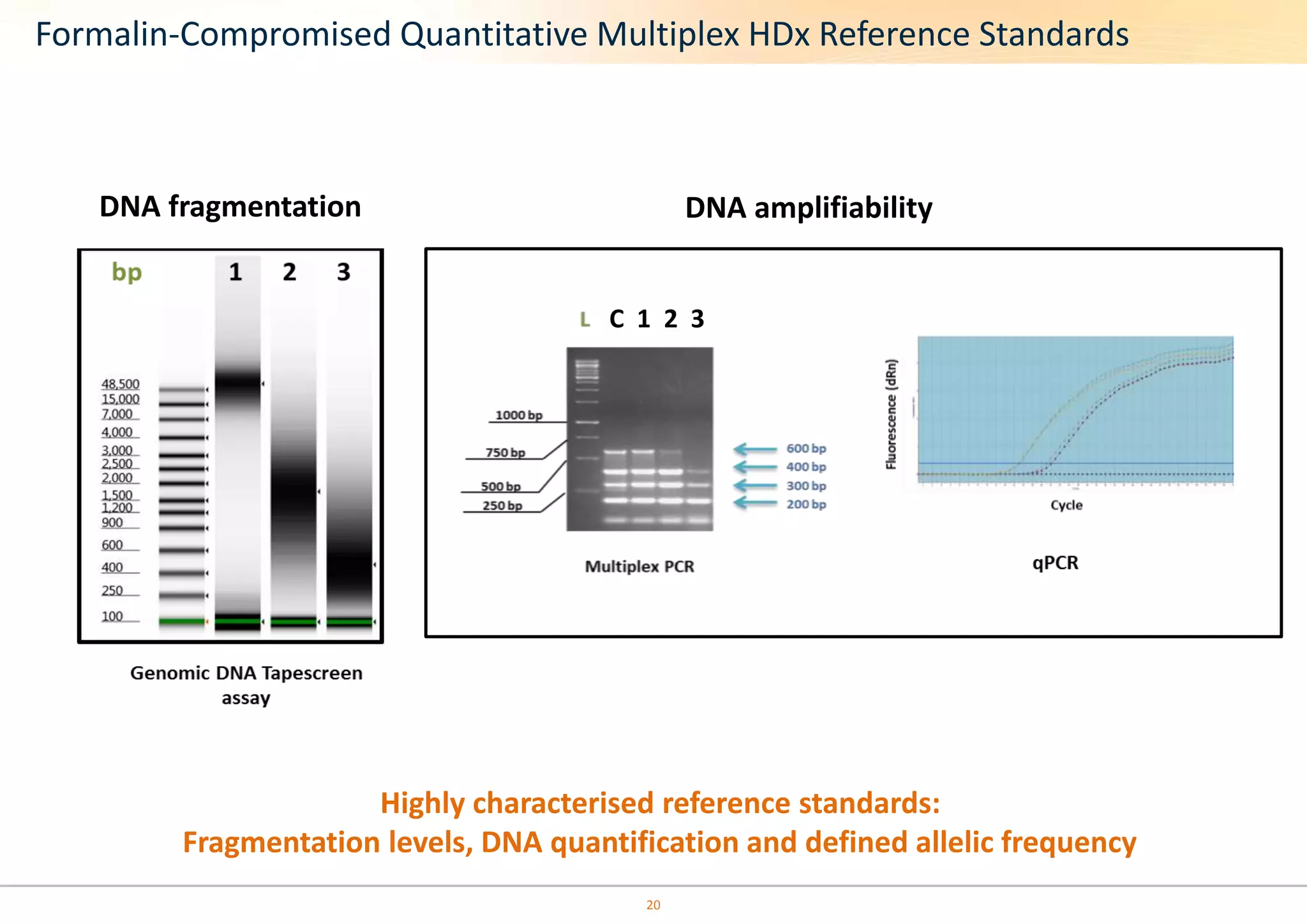
Formalin-Compromised Quantitative Multiplex HDx Reference Standards 
DNA fragmentation DNA amplifiability 
C 1 2 3 
Highly characterised reference standards: 
Fragmentation levels, DNA quantification and defined allelic frequency 
20
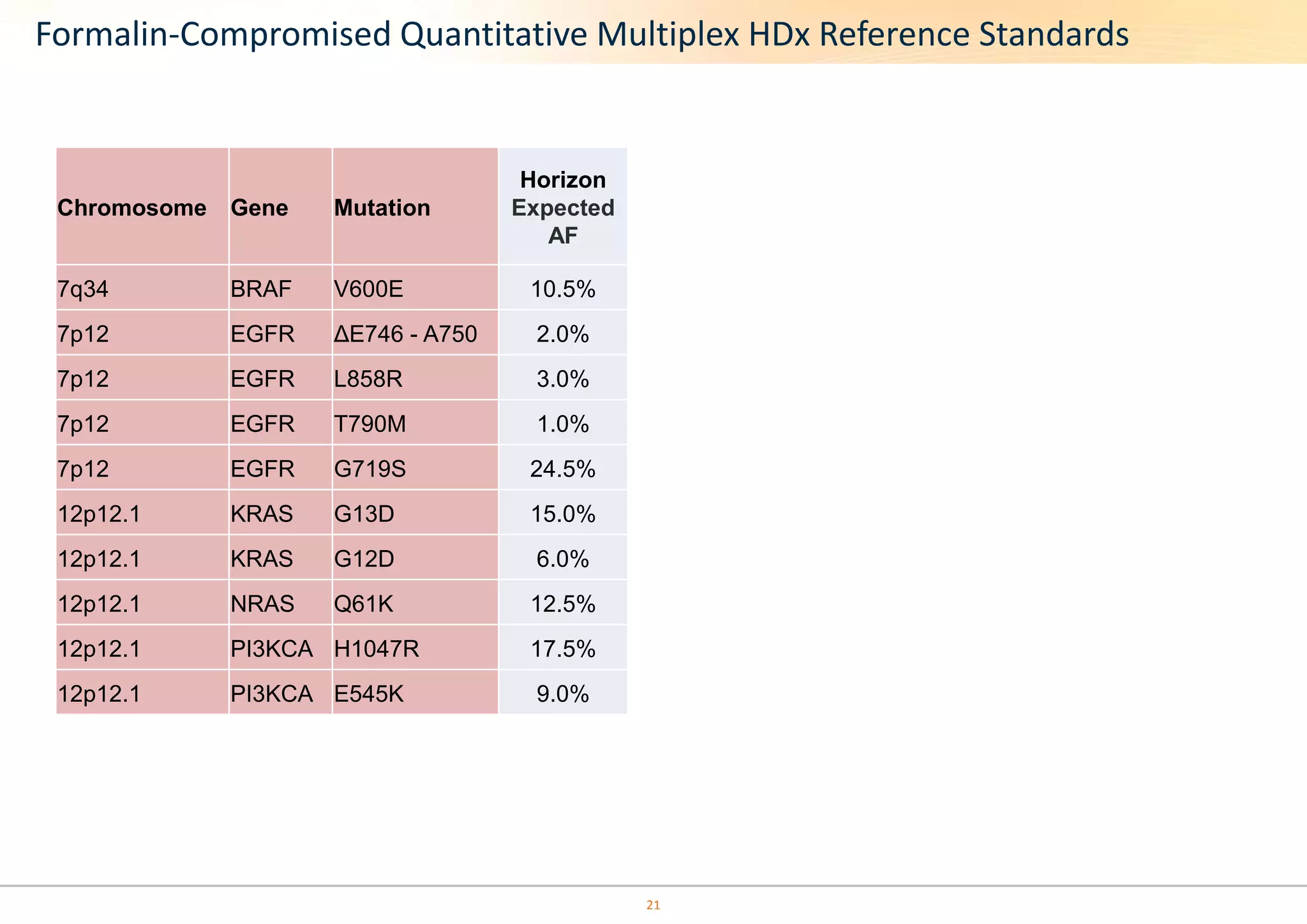
Formalin-Compromised Quantitative Multiplex HDx Reference Standards 
21 
Chromosome Gene Mutation 
Horizon 
Expected 
AF 
7q34 BRAF V600E 10.5% 
7p12 EGFR ΔE746 - A750 2.0% 
7p12 EGFR L858R 3.0% 
7p12 EGFR T790M 1.0% 
7p12 EGFR G719S 24.5% 
12p12.1 KRAS G13D 15.0% 
12p12.1 KRAS G12D 6.0% 
12p12.1 NRAS Q61K 12.5% 
12p12.1 PI3KCA H1047R 17.5% 
12p12.1 PI3KCA E545K 9.0%
Formalin-Compromised Quantitative Multiplex HDx Reference Standards 
Mutant calling of reference standards on IonTorrent™ confirms the 
sensitivity of the platform for this particular work flow 
22 
Chromosome Gene Mutation 
Horizon 
Expected 
AF 
Non-Compromised 
DNA 
Formalin- 
Compromised DNA 
Medium Intensity 
Formalin- 
Compromised DNA 
Severe Intensity 
HD500 HD-C750 HD-C751 
7q34 BRAF V600E 10.5% 10% 10% 10% 
7p12 EGFR ΔE746 - A750 2.0% No call No call 2% 
7p12 EGFR L858R 3.0% 2% 4% 2% 
7p12 EGFR T790M 1.0% No call No call No call 
7p12 EGFR G719S 24.5% 24% 18% 25% 
12p12.1 KRAS G13D 15.0% 13% 12% 16% 
12p12.1 KRAS G12D 6.0% 8% 3% 14% 
12p12.1 NRAS Q61K 12.5% 11% 7% 11% 
12p12.1 PI3KCA H1047R 17.5% 22% 23% 23% 
12p12.1 PI3KCA E545K 9.0% 8% 5% 13%
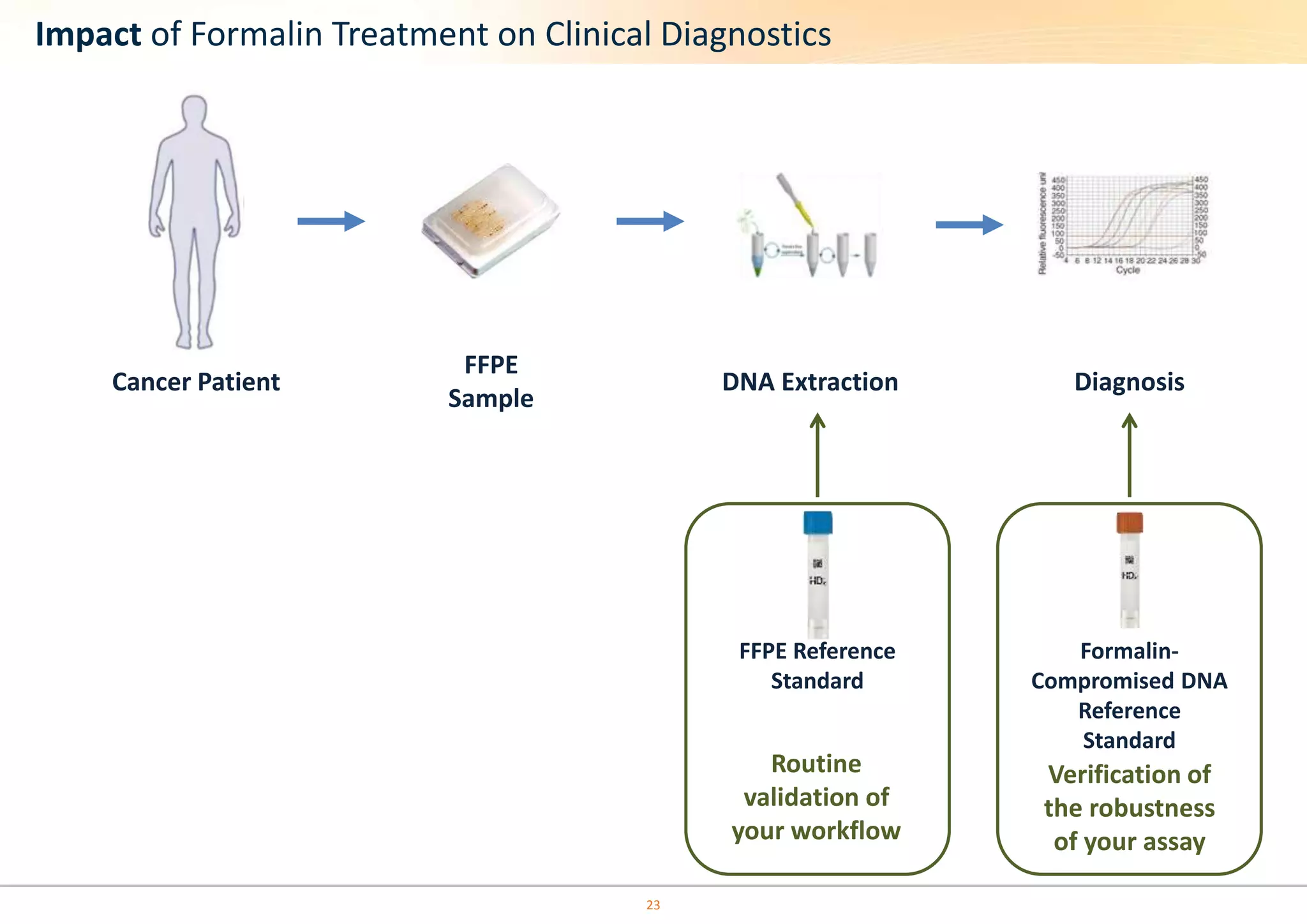
Impact of Formalin Treatment on Clinical Diagnostics 
23 
FFPE 
Sample 
Cancer Patient DNA Extraction Diagnosis 
FFPE Reference 
Standard 
Formalin- 
Compromised DNA 
Reference 
Standard 
Routine 
validation of 
your workflow 
Verification of 
the robustness 
of your assay
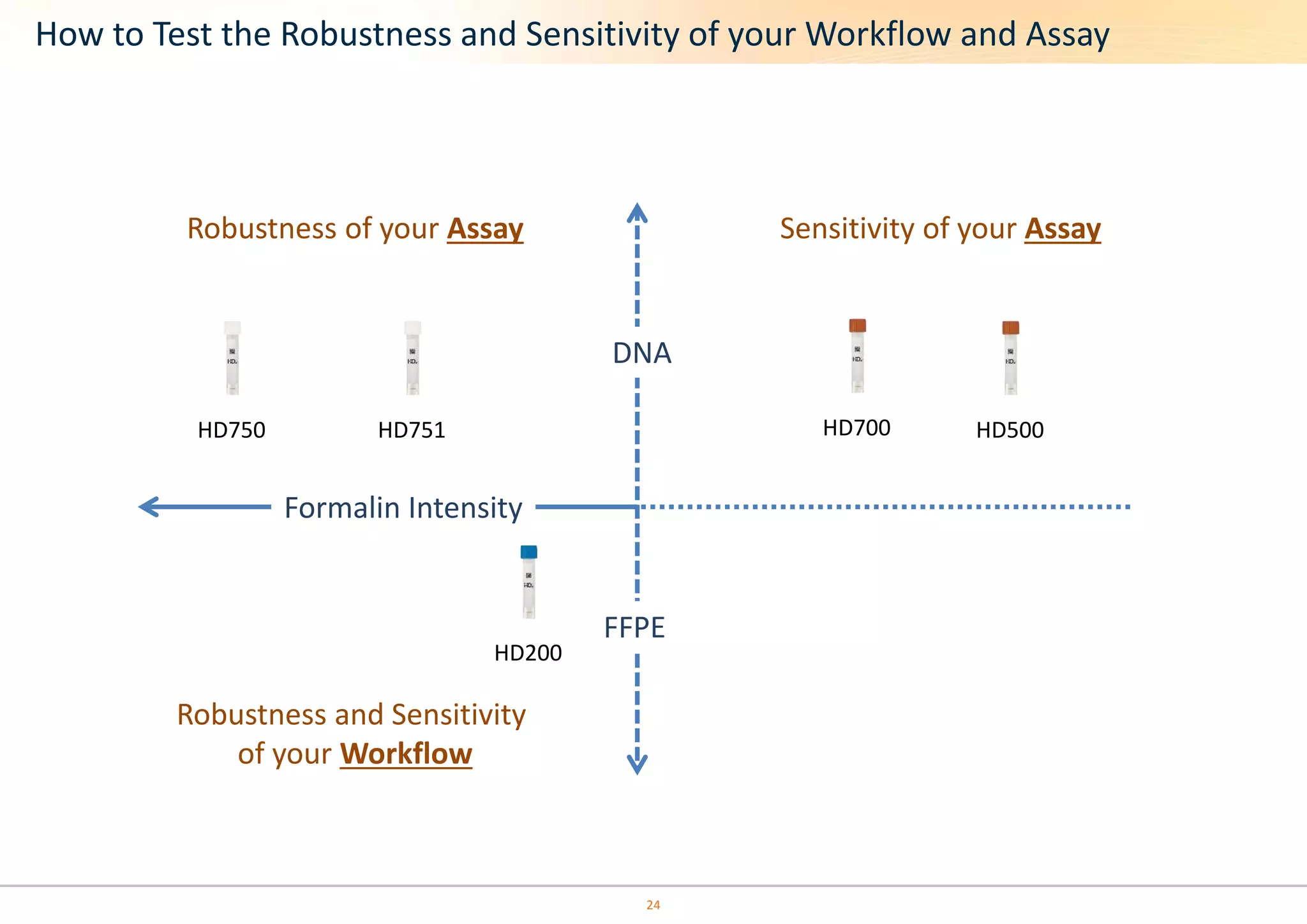
How to Test the Robustness and Sensitivity of your Workflow and Assay 
DNA 
24 
Sensitivity of your Assay 
HD700 HD500 
HD750 HD751 
Formalin Intensity 
HD200 
Robustness and Sensitivity 
of your Workflow 
FFPE 
Robustness of your Assay
Your Horizon Contact: 
Jonathan Frampton 
j.frampton@horizondiscovery.com 
Horizon Discovery Group plc, 7100 Cambridge Research Park, Waterbeach, Cambridge, CB25 9TL, United Kingdom 
Tel: +44 (0) 1223 655 580 (Reception / Front desk) Fax: +44 (0) 1223 655 581 Email: info@horizondx.com Web: www.horizondx.com

To assess the effect of formalin on genomic DNA and assay performance for somatic variant detection

  • 1.
    The Effects ofFormalin on Clinical Diagnostics Dr Jonathan Frampton Product Manager, Diagnostics Dr Hadas Amit Product Development, Diagnostics Twitter: @HorizonDX_news
  • 2.
    Dr. Jonathan Frampton,PhD Product Manager, Diagnostics In his role, Jonathan works closely with a broad range of European, North American and EMEA oncology-focussed Quality Assurance Schemes with the goal of driving the standardization and normalization of molecular assays across the globe. Jonathan holds a PhD from University of Sussex in Genomic DNA Damage and Stability and has extensive product development experience through previous roles including Cambridge-based antibody company Abcam. 1 Presenters
  • 3.
    What is theimpact of assay failure in your laboratory and how do you monitor for it? 2
  • 4.
    3 FFPE Sample Cancer Patient DNA Extraction Diagnosis Driving better treatment for cancer patients Application of Companion Diagnostics Pre-Analytical Analytical
  • 5.
    Pre-analytical Sample Handlingand Processing Biopsy DNA 4 Quantification DNA Extraction Storage DNA Quantity & Quality FFPE Processing
  • 6.
    Analytical Processing andReporting Sample preparation DNA Sample Analysis 5 Actionable Decision Quality of Diagnostic Result
  • 7.
    Impact of SampleProcessing and Formalin Treatment Necrosis Fragmentation 6 Pre-analytical Analytical DNA DNA Quantification Decreased DNA Yield Decreased DNA Quality Quantification Errors Cross-linking Oxidative damage Methylation Sample Apoptosis Formalin DNA Extraction Treatment
  • 8.
    Impact of FormalinTreatment on Clinical Diagnostics DNA Quantification Errors Sample Analysis 7 False Positive Mutations Assay Sensitivity False Negative Mutations Assay Specificity Inaccurate Actionable Decision
  • 9.
    Dr. Hadas Amit Senior Scientist, Diagnostics Hadas is a senior scientist with a strong interest in the future of personalised medicine with focus on advances in cell free tumor DNA (cfDNA). Hadas is leading the research and development of Formalin-Compromised Reference Standards at Horizon Diagnostics. 8 Presenters
  • 10.
    How are HDxReference Standards Manufactured and Validated? “Wild type cell line” Single Cell Dilution Clonal mutant cell line Pre-Engineering Cell Line Validation  SNP 6.0  Sanger Sequencing  Digital PCR  RT-PCR Post-Engineering Cell Line Validation Gene Editing Platform 9
  • 11.
    Analyzed Allelic FrequencyDown to 0.05% Mutant Wild type Genomic DNA Stoichiometric Dilutions Dilutions are accurate down to 0.05% 10
  • 12.
    Impact of FormalinTreatment on Template and Assay Performance Goal: To assess the effect of formalin on genomic DNA and the on assay performance for somatic variant detection. Defined BRAF V600E Cell Line Mixture No Formalin Treatment Formalin Treatment DNA Extraction DNA Extraction DNA Quantification DNA Quantification Digital PCR Analysis Digital PCR Analysis 11
  • 13.
    Three methodologies employedto perform quantitation: • Quantifluor Assay • Agilent Tapestation • Nanodrop Observations: 1. There is variation in the concentration of DNA from matched pairs (overestimation in formalin vs no formalin). 2. The Nanodrop data shows a greater overestimation of concentration in formalin vs no formalin samples from matched pairs. DNA Quantification of Formalin-Compromised DNA 12
  • 14.
    Impact of FormalinTreatment on Template and Assay Performance Goal: To assess the effect of formalin on genomic DNA and the on assay performance for somatic variant detection. Defined BRAF V600E Cell Line Mixture No Formalin Treatment Formalin Treatment DNA Extraction DNA Extraction DNA Quantification DNA Quantification Digital PCR Analysis Digital PCR Analysis 14
  • 15.
    Mutant Detection onFormalin-Compromised DNA by Digital PCR Observations: Begin to see the subtle variation in variant calling between formalin vs no formalin matched pairs. Sample Expected Genotype Formalin Treatment Mutant Allelic Frequency Measured 1 5.0% B-Raf V600E - 5.2 2 5.0% B-Raf V600E + 5.5 3 2.5% B-Raf V600E - 2.7 4 2.5% B-Raf V600E + 3.7 5 1.0% B-Raf V600E - 1.0 6 1.0% B-Raf V600E + 1.3 7 0.5% B-Raf V600E - 0.6 8 0.5% B-Raf V600E + 0.6 9 0.2% B-Raf V600E - 0.2 10 0.2% B-Raf V600E + 0.4 Digital PCR genotyping of matched pairs. Expected and measured allelic frequencies Implications: Artefacts – eg effects of formalin on DNA by deamination affect variant calling, potentially by increasing the mutant to wild type ratio. Sample Expected Genotype Formalin Treatment Mutant Allelic Frequency Measured 1 5.0% BRAF V600E - 5.2 2 5.0% BRAF V600E + 5.5 3 2.5% BRAF V600E - 2.7 4 2.5% BRAF V600E + 3.7 5 1.0% BRAF V600E - 1 6 1.0% BRAF V600E + 1.3 7 0.5% BRAF V600E - 0.6 8 0.5% BRAF V600E + 0.6 9 0.2% BRAF V600E - 0.2 10 0.2% BRAF V600E + 0.4 15
  • 16.
    Impact of FormalinTreatment on Wild Type Samples Formalin Intensity 1. Utilized clonal wild type cell line 2. Treated cell pellets with four different formalin conditions 3. Analyzed allelic frequency by digital PCR Sample Expected Genotype Mutant Allelic Frequency Measured 1 0% EGFR T790M 0.04% 2 0% EGFR T790M 0.04% 3 0% EGFR T790M 0.07% 4 0% EGFR T790M 0.15% Sample preparation may interfere with assay sensitivity and specificity 16
  • 17.
    EGFR Formalin-Compromised HDxReference Standards 17 Sample Expected Genotype Formalin Treatment 1 3.0% EGFR T790M - 2 3.0% EGFR T790M + 3 0.75% EGFR T790M - 4 0.75% EGFR T790M + 5 0.13% EGFR T790M - 6 0.13% EGFR T790M + 7 0% EGFR T790M - 8 0% EGFR T790M + Using blinded samples of Formalin-Compromised HDx Reference Standards to develop new assays and assessing limit of detection
  • 18.
    EGFR Formalin-Compromised HDxReference Standards Using blinded samples of Formalin-Compromised HDx Reference Standards to develop new assays and assessing limit of detection 18 Sample Expected Genotype Formalin Treatment Mutant Allelic Frequency Measured SD Positive replicates 1 3.0% EGFR T790M - 1.26% 2.34% 0.38 0.68 8 8 2 3.0% EGFR T790M + 2.66% 1.26% 0.77 0.38 8 8 3 0.75% EGFR T790M - 0.18% 1.03% 0.15 0.21 6 7 4 0.75% EGFR T790M + 0.78% 0.34% 0.64 0.20 5 8 5 0.13% EGFR T790M - 0.42% 0.19% 0.37 0.11 2 3 6 0.13% EGFR T790M + 0.21% 0.00% 0.06 0.00 5 0 7 0% EGFR T790M - 0.00% 0.00% 0.00 0.00 0 0 8 0% EGFR T790M + 0.00% 0.00% 0.00 0.00 0 0
  • 19.
    Formalin-Compromised Quantitative MultiplexHDx Reference Standards Formalin-Compromised Quantitative Multiplex HDx Reference Standards developed for NGS platform control and sensitivity of detection 19 Chromosome Gene Mutation Mutant allelic frequency 7q34 BRAF V600E 10.5% 7p12 EGFR ΔE746 - A750 2.0% 7p12 EGFR L858R 3.0% 7p12 EGFR T790M 1.0% 7p12 EGFR G719S 24.5% 12p12.1 KRAS G13D 15.0% 12p12.1 KRAS G12D 6.0% 12p12.1 NRAS Q61K 12.5% 12p12.1 PI3KCA H1047R 17.5% 12p12.1 PI3KCA E545K 9.0% Defined Quantitative Multiplex Cell Line Mixture No Formalin Treatment Formalin Treatment DNA Extraction DNA Extraction DNA Quantification DNA Quantification Digital PCR Analysis Digital PCR Analysis
  • 20.
    Formalin-Compromised Quantitative MultiplexHDx Reference Standards DNA fragmentation DNA amplifiability C 1 2 3 Highly characterised reference standards: Fragmentation levels, DNA quantification and defined allelic frequency 20
  • 21.
    Formalin-Compromised Quantitative MultiplexHDx Reference Standards 21 Chromosome Gene Mutation Horizon Expected AF 7q34 BRAF V600E 10.5% 7p12 EGFR ΔE746 - A750 2.0% 7p12 EGFR L858R 3.0% 7p12 EGFR T790M 1.0% 7p12 EGFR G719S 24.5% 12p12.1 KRAS G13D 15.0% 12p12.1 KRAS G12D 6.0% 12p12.1 NRAS Q61K 12.5% 12p12.1 PI3KCA H1047R 17.5% 12p12.1 PI3KCA E545K 9.0%
  • 22.
    Formalin-Compromised Quantitative MultiplexHDx Reference Standards Mutant calling of reference standards on IonTorrent™ confirms the sensitivity of the platform for this particular work flow 22 Chromosome Gene Mutation Horizon Expected AF Non-Compromised DNA Formalin- Compromised DNA Medium Intensity Formalin- Compromised DNA Severe Intensity HD500 HD-C750 HD-C751 7q34 BRAF V600E 10.5% 10% 10% 10% 7p12 EGFR ΔE746 - A750 2.0% No call No call 2% 7p12 EGFR L858R 3.0% 2% 4% 2% 7p12 EGFR T790M 1.0% No call No call No call 7p12 EGFR G719S 24.5% 24% 18% 25% 12p12.1 KRAS G13D 15.0% 13% 12% 16% 12p12.1 KRAS G12D 6.0% 8% 3% 14% 12p12.1 NRAS Q61K 12.5% 11% 7% 11% 12p12.1 PI3KCA H1047R 17.5% 22% 23% 23% 12p12.1 PI3KCA E545K 9.0% 8% 5% 13%
  • 23.
    Impact of FormalinTreatment on Clinical Diagnostics 23 FFPE Sample Cancer Patient DNA Extraction Diagnosis FFPE Reference Standard Formalin- Compromised DNA Reference Standard Routine validation of your workflow Verification of the robustness of your assay
  • 24.
    How to Testthe Robustness and Sensitivity of your Workflow and Assay DNA 24 Sensitivity of your Assay HD700 HD500 HD750 HD751 Formalin Intensity HD200 Robustness and Sensitivity of your Workflow FFPE Robustness of your Assay
  • 25.
    Your Horizon Contact: Jonathan Frampton j.frampton@horizondiscovery.com Horizon Discovery Group plc, 7100 Cambridge Research Park, Waterbeach, Cambridge, CB25 9TL, United Kingdom Tel: +44 (0) 1223 655 580 (Reception / Front desk) Fax: +44 (0) 1223 655 581 Email: info@horizondx.com Web: www.horizondx.com

Editor's Notes

  • #2 Before I begin, I would like to ask you one question – what is the impact of assay failure in your laboratory and how do you monitor for it?
  • #11 How do we manufacture our reference standards? At Horizon, we have developed a library of over 550 genetically defined cells harbouring mutation found in cancer patients as well as their control cell lines from the same genetic background. As part of the cell line establishment process it is critical that we single-cell dilute the original “wild type” cell line to ensure clonality. These cells are extensively validated before undergoing cell line engineering to produce the mutant cell line of interest. For pre- and post-validation we run SNP 6.0 analysis to confirm cell line identity, sanger sequencing to confirm engineering as been accurately targeted to the endogenous gene, digital PCR to confirm copy number and allelic frequency and RT-PCR to analyse gene expression. Using our genetically defined cells lines we manufacture a range of reference standards – DNA, RNA, FFPE blocks and sections, and cells slides for IHC and FISH
  • #12 DNA Reference Standards These are ideal for the routine validation of your molecular assay workflow and can be used initially to determine the limit of detection of your platform. We can provide pre-diluted standards ready to go; for example a 5% EGFR T790M or alternatively the mutant and matched wild type separately and allow you to generate the specific dilution curve most useful for you. Dilution guidelines can be found on our website and we are always happy to discuss specific projects as needed. We typically provide our DNA standards at 100ng @ 5ng/ul. All of our DNA products undergo extensive validation and we use digital PCR to confirm the allelic frequency of any of our reference standards to an accuracy of 0.01%. If needed for custom work we can provide standards with allelic frequencies as low as 0.05%.