ALK: anaplastic lymphoma kinase; BRAF: v-Raf murine sarcoma viral oncogene homolog B; EGFR: epidermal growth factor receptor; FISH: fluorescence in situ hybridization; HER2: human epidermal growth
factor receptor 2; IHC: immunohistochemistry; NSCLC: non–small-cell lung cancer; TKI: tyrosine kinase inhibitor.
1. Lindeman NI et al. J Mol Diagn. 2018;20:129-159. 2. Kalemkerian GP et al. J Clin Oncol. 2018;36:911-919.
Molecular Testing in NSCLC
Understanding What
and How to Test1,2
PRACTICE AID
Access the activity,“MolecularTesting for EGFR Mutations in the Context of a ChangingTreatment Landscape, Evolving
Testing Options, and New Guidelines:What Pathologists Need to Know and Do,”at www.peerview.com/TPF40.
This Practice Aid has been provided as a quick reference to help learners apply the information to their daily practice.
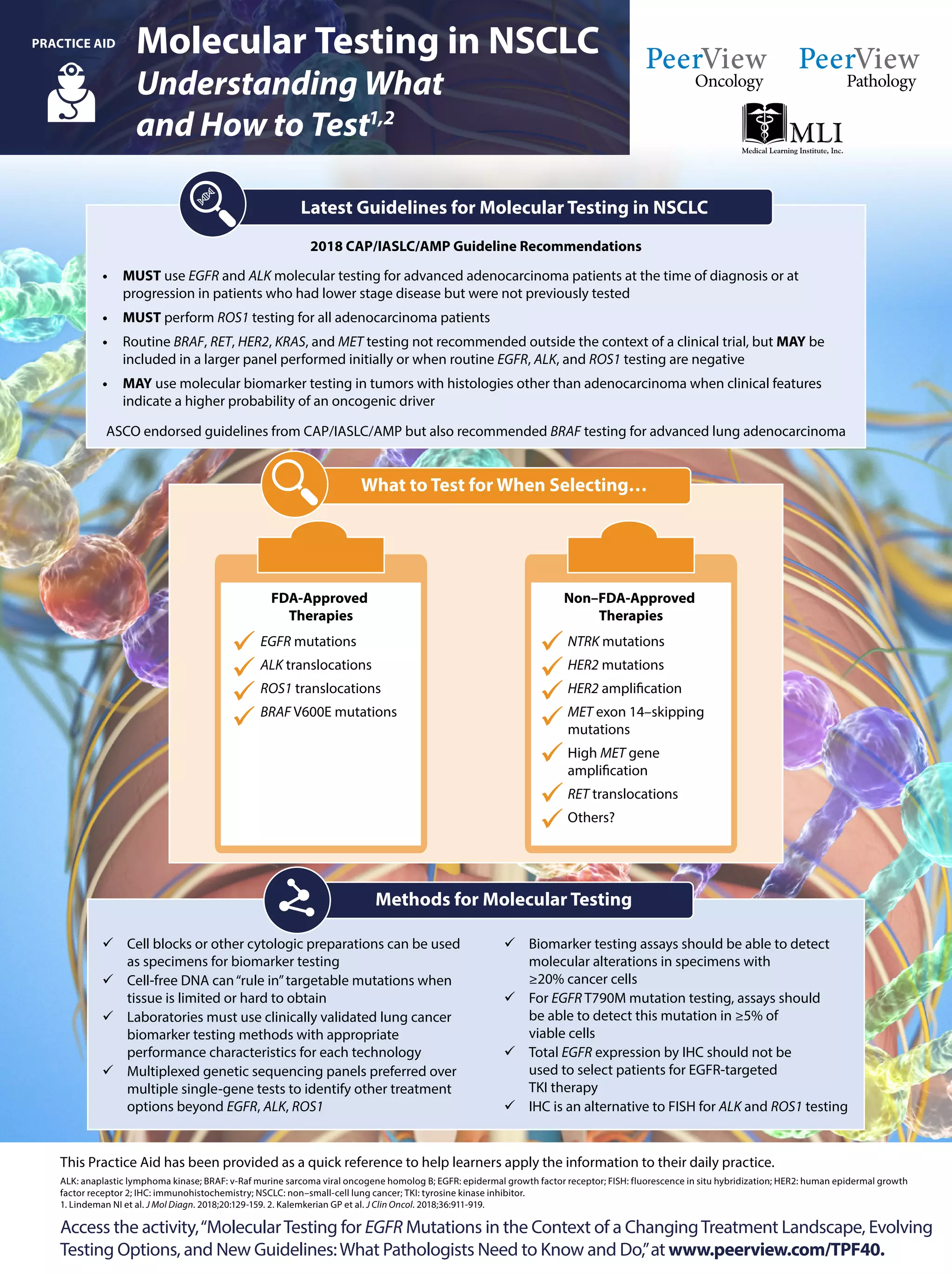
ü Cell blocks or other cytologic preparations can be used
as specimens for biomarker testing
ü Cell-free DNA can“rule in”targetable mutations when
tissue is limited or hard to obtain
ü Laboratories must use clinically validated lung cancer
biomarker testing methods with appropriate
performance characteristics for each technology
ü Multiplexed genetic sequencing panels preferred over
multiple single-gene tests to identify other treatment
options beyond EGFR, ALK, ROS1
ü Biomarker testing assays should be able to detect
molecular alterations in specimens with
≥20% cancer cells
ü For EGFR T790M mutation testing, assays should
be able to detect this mutation in ≥5% of
viable cells
ü Total EGFR expression by IHC should not be
used to select patients for EGFR-targeted
TKI therapy
ü IHC is an alternative to FISH for ALK and ROS1 testing
Methods for Molecular Testing
• MUST use EGFR and ALK molecular testing for advanced adenocarcinoma patients at the time of diagnosis or at
progression in patients who had lower stage disease but were not previously tested
• MUST perform ROS1 testing for all adenocarcinoma patients
• Routine BRAF, RET, HER2, KRAS, and MET testing not recommended outside the context of a clinical trial, but MAY be
included in a larger panel performed initially or when routine EGFR, ALK, and ROS1 testing are negative
• MAY use molecular biomarker testing in tumors with histologies other than adenocarcinoma when clinical features
indicate a higher probability of an oncogenic driver
ASCO endorsed guidelines from CAP/IASLC/AMP but also recommended BRAF testing for advanced lung adenocarcinoma
Latest Guidelines for Molecular Testing in NSCLC
2018 CAP/IASLC/AMP Guideline Recommendations
EGFR mutations
ALK translocations
ROS1 translocations
BRAF V600E mutations
NTRK mutations
HER2 mutations
HER2 amplification
MET exon 14–skipping
mutations
High MET gene
amplification
RET translocations
Others?
FDA-Approved
Therapies
Non–FDA-Approved
Therapies
What to Test for When Selecting…
EGFR TKI Landscape
First-Line Treatment Options for Patients
With Advanced EGFR-Positive NSCLC
EGFR: epidermal growth factor receptor; EGFRmut: mutant epidermal growth factor receptor; EGFRwt: epidermal growth factor receptor wild type; ERBB2: erb-b2 receptor tyrosine kinase 2; ERBB4: erb-b2 receptor tyrosine kinase 4; HER2: human epidermal growth factor receptor 2;
NSCLC: non–small-cell lung cancer; TKI: tyrosine kinase inhibitor.
1. Gefitinib (Iressa) Prescribing Information. https://www.azpicentral.com/iressa/iressa.pdf#page=1. Accessed October 9, 2018. 2. Mitsudomi T et al. Lancet Oncol. 2010;11:121-128. 3. Maemondo M et al. N Engl J Med. 2010;362:2380-2388. 4. Rosell R et al. Lancet Oncol. 2012;13:239-246.
5. Zhou C et al. J Clin Oncol. 2012;30:Abstract 7520. 6. Sequist LV et al. J Clin Oncol. 2013;31:3327-3334. 7. Wu YL et al. Lancet Oncol. 2014;15:213-222. 8. Soria JC et al. N Engl J Med. 2018;378:113-125.
Access the activity,“MolecularTesting for EGFR Mutations in the Context of a ChangingTreatment Landscape, EvolvingTesting Options, and New Guidelines:
What Pathologists Need to Know and Do,”at www.peerview.com/TPF40.
PRACTICE AID
This Practice Aid has been provided as a quick reference to help learners apply the information to their daily practice.
CharacteristicsAgent Efficacy1-8
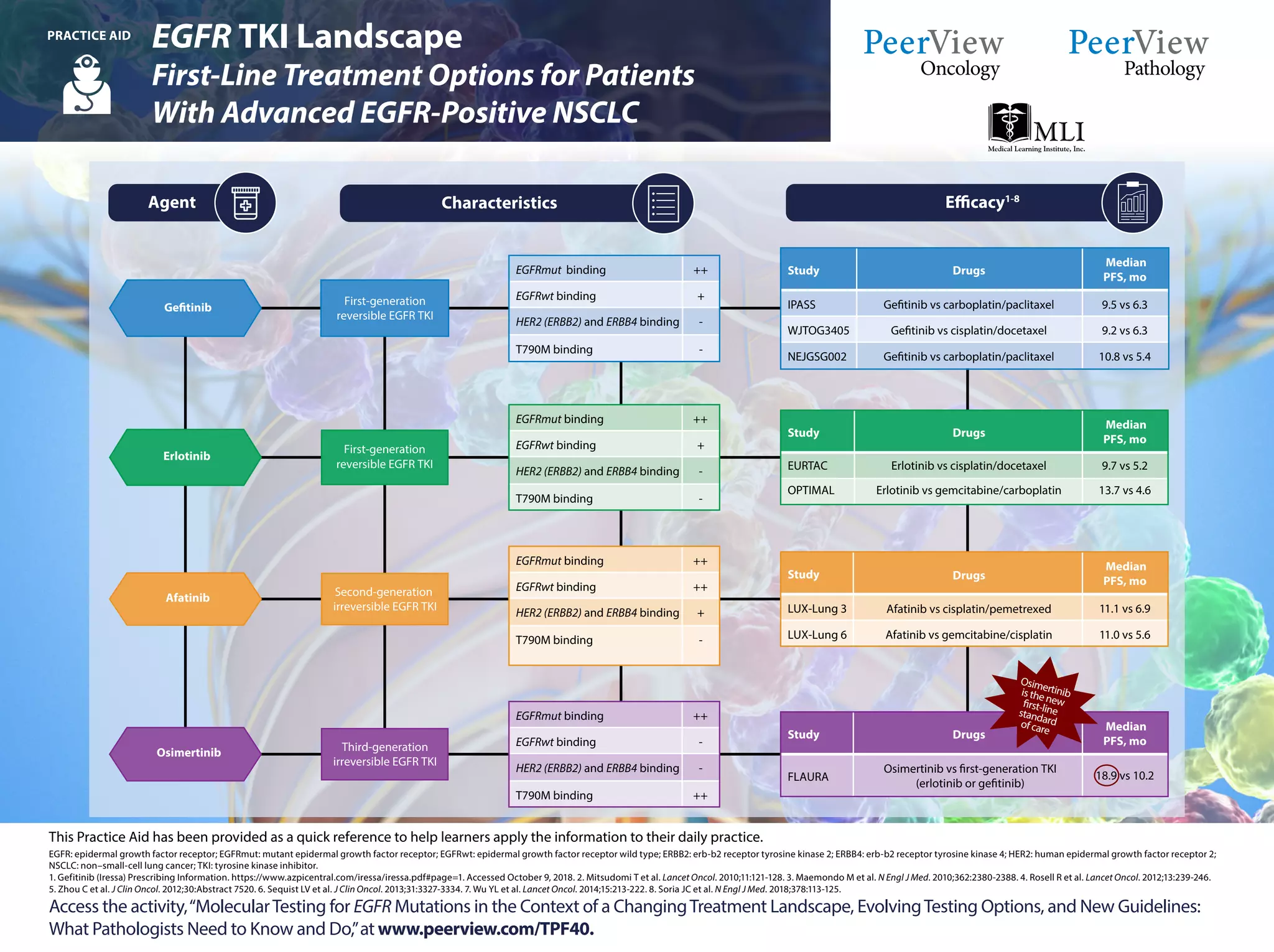
Osimertinib Third-generation
irreversible EGFR TKI
EGFRmut binding ++
EGFRwt binding -
HER2 (ERBB2) and ERBB4 binding -
T790M binding ++
Study Drugs
Median
PFS, mo
FLAURA
Osimertinib vs first-generation TKI
(erlotinib or gefitinib)
18.9 vs 10.2
Osimertinibis the newfirst-linestandardof care
Erlotinib
First-generation
reversible EGFR TKI
EGFRmut binding ++
EGFRwt binding +
HER2 (ERBB2) and ERBB4 binding -
T790M binding -
Study Drugs
Median
PFS, mo
EURTAC Erlotinib vs cisplatin/docetaxel 9.7 vs 5.2
OPTIMAL Erlotinib vs gemcitabine/carboplatin 13.7 vs 4.6
Afatinib Second-generation
irreversible EGFR TKI
EGFRmut binding ++
EGFRwt binding ++
HER2 (ERBB2) and ERBB4 binding +
T790M binding -
Study Drugs
Median
PFS, mo
LUX-Lung 3 Afatinib vs cisplatin/pemetrexed 11.1 vs 6.9
LUX-Lung 6 Afatinib vs gemcitabine/cisplatin 11.0 vs 5.6
Gefitinib
First-generation
reversible EGFR TKI
EGFRmut binding ++
EGFRwt binding +
HER2 (ERBB2) and ERBB4 binding -
T790M binding -
Study Drugs
Median
PFS, mo
IPASS Gefitinib vs carboplatin/paclitaxel 9.5 vs 6.3
WJTOG3405 Gefitinib vs cisplatin/docetaxel 9.2 vs 6.3
NEJGSG002 Gefitinib vs carboplatin/paclitaxel 10.8 vs 5.4

Molecular Testing for EGFR Mutations in the Context of a Changing Treatment Landscape, Evolving Testing Options, and New Guidelines: What Pathologists Need to Know and Do

  • 1.
    ALK: anaplastic lymphomakinase; BRAF: v-Raf murine sarcoma viral oncogene homolog B; EGFR: epidermal growth factor receptor; FISH: fluorescence in situ hybridization; HER2: human epidermal growth factor receptor 2; IHC: immunohistochemistry; NSCLC: non–small-cell lung cancer; TKI: tyrosine kinase inhibitor. 1. Lindeman NI et al. J Mol Diagn. 2018;20:129-159. 2. Kalemkerian GP et al. J Clin Oncol. 2018;36:911-919. Molecular Testing in NSCLC Understanding What and How to Test1,2 PRACTICE AID Access the activity,“MolecularTesting for EGFR Mutations in the Context of a ChangingTreatment Landscape, Evolving Testing Options, and New Guidelines:What Pathologists Need to Know and Do,”at www.peerview.com/TPF40. This Practice Aid has been provided as a quick reference to help learners apply the information to their daily practice. ü Cell blocks or other cytologic preparations can be used as specimens for biomarker testing ü Cell-free DNA can“rule in”targetable mutations when tissue is limited or hard to obtain ü Laboratories must use clinically validated lung cancer biomarker testing methods with appropriate performance characteristics for each technology ü Multiplexed genetic sequencing panels preferred over multiple single-gene tests to identify other treatment options beyond EGFR, ALK, ROS1 ü Biomarker testing assays should be able to detect molecular alterations in specimens with ≥20% cancer cells ü For EGFR T790M mutation testing, assays should be able to detect this mutation in ≥5% of viable cells ü Total EGFR expression by IHC should not be used to select patients for EGFR-targeted TKI therapy ü IHC is an alternative to FISH for ALK and ROS1 testing Methods for Molecular Testing • MUST use EGFR and ALK molecular testing for advanced adenocarcinoma patients at the time of diagnosis or at progression in patients who had lower stage disease but were not previously tested • MUST perform ROS1 testing for all adenocarcinoma patients • Routine BRAF, RET, HER2, KRAS, and MET testing not recommended outside the context of a clinical trial, but MAY be included in a larger panel performed initially or when routine EGFR, ALK, and ROS1 testing are negative • MAY use molecular biomarker testing in tumors with histologies other than adenocarcinoma when clinical features indicate a higher probability of an oncogenic driver ASCO endorsed guidelines from CAP/IASLC/AMP but also recommended BRAF testing for advanced lung adenocarcinoma Latest Guidelines for Molecular Testing in NSCLC 2018 CAP/IASLC/AMP Guideline Recommendations EGFR mutations ALK translocations ROS1 translocations BRAF V600E mutations NTRK mutations HER2 mutations HER2 amplification MET exon 14–skipping mutations High MET gene amplification RET translocations Others? FDA-Approved Therapies Non–FDA-Approved Therapies What to Test for When Selecting…
  • 2.
    EGFR TKI Landscape First-LineTreatment Options for Patients With Advanced EGFR-Positive NSCLC EGFR: epidermal growth factor receptor; EGFRmut: mutant epidermal growth factor receptor; EGFRwt: epidermal growth factor receptor wild type; ERBB2: erb-b2 receptor tyrosine kinase 2; ERBB4: erb-b2 receptor tyrosine kinase 4; HER2: human epidermal growth factor receptor 2; NSCLC: non–small-cell lung cancer; TKI: tyrosine kinase inhibitor. 1. Gefitinib (Iressa) Prescribing Information. https://www.azpicentral.com/iressa/iressa.pdf#page=1. Accessed October 9, 2018. 2. Mitsudomi T et al. Lancet Oncol. 2010;11:121-128. 3. Maemondo M et al. N Engl J Med. 2010;362:2380-2388. 4. Rosell R et al. Lancet Oncol. 2012;13:239-246. 5. Zhou C et al. J Clin Oncol. 2012;30:Abstract 7520. 6. Sequist LV et al. J Clin Oncol. 2013;31:3327-3334. 7. Wu YL et al. Lancet Oncol. 2014;15:213-222. 8. Soria JC et al. N Engl J Med. 2018;378:113-125. Access the activity,“MolecularTesting for EGFR Mutations in the Context of a ChangingTreatment Landscape, EvolvingTesting Options, and New Guidelines: What Pathologists Need to Know and Do,”at www.peerview.com/TPF40. PRACTICE AID This Practice Aid has been provided as a quick reference to help learners apply the information to their daily practice. CharacteristicsAgent Efficacy1-8 Osimertinib Third-generation irreversible EGFR TKI EGFRmut binding ++ EGFRwt binding - HER2 (ERBB2) and ERBB4 binding - T790M binding ++ Study Drugs Median PFS, mo FLAURA Osimertinib vs first-generation TKI (erlotinib or gefitinib) 18.9 vs 10.2 Osimertinibis the newfirst-linestandardof care Erlotinib First-generation reversible EGFR TKI EGFRmut binding ++ EGFRwt binding + HER2 (ERBB2) and ERBB4 binding - T790M binding - Study Drugs Median PFS, mo EURTAC Erlotinib vs cisplatin/docetaxel 9.7 vs 5.2 OPTIMAL Erlotinib vs gemcitabine/carboplatin 13.7 vs 4.6 Afatinib Second-generation irreversible EGFR TKI EGFRmut binding ++ EGFRwt binding ++ HER2 (ERBB2) and ERBB4 binding + T790M binding - Study Drugs Median PFS, mo LUX-Lung 3 Afatinib vs cisplatin/pemetrexed 11.1 vs 6.9 LUX-Lung 6 Afatinib vs gemcitabine/cisplatin 11.0 vs 5.6 Gefitinib First-generation reversible EGFR TKI EGFRmut binding ++ EGFRwt binding + HER2 (ERBB2) and ERBB4 binding - T790M binding - Study Drugs Median PFS, mo IPASS Gefitinib vs carboplatin/paclitaxel 9.5 vs 6.3 WJTOG3405 Gefitinib vs cisplatin/docetaxel 9.2 vs 6.3 NEJGSG002 Gefitinib vs carboplatin/paclitaxel 10.8 vs 5.4